20.380 workshop:
Drug Carriers: Polymers, Vesicles, Nanoparticles and systemic delivery
1
vesicles
Polymer-drug conjugates
micelles nanoparticles
microparticles
Packed chromosomes organelles
Actin fibers proteins
Protein complexes
biological structures carriers
liposomes
polymerosomes
Thickness of
lipid bilayer viruses
1 nm 10 nm 100 nm 1000 nm
Images of various biological molecules removed due to copyright restrictions.
2
Objectives of molecular and particulate drug carriers:
• (I) Alter pharmacokinetics
• (II) Alter biodistribution
• (III) Provide drug reservoirs
Table from Science removed due to copyright restrictions. See Table 1 from Allen, Theresa M. and Pieter R. Cullis. "Drug Delivery Systems: Entering the Mainstream." Science 303, no. 5665 (2004).
3
4
Delivery via systemic and oral routes
Size limits for penetration of tissue from circulation:
Kidneys Reticuloendothelial system
5
Objectives of nano- and micro-carriers:
protection of cargos from premature degradation
Objectives of nano- and micro-carriers:
(1) protection of cargos from premature degradation
i.v. proteins and polymers are rapidly cleared from the blood:
Poly(N-2-hydroxypropylmethacrylamide)
Blood levels (%/g)
(Seymour Duncan Eur. J. Cancer 5 766-770 (1995)) 6
Courtesy of Elsevier, Inc., http://www.sciencedirect.com. Used with permission.
20.380 drug targeting workshop S09
Fate of injected particles in vivo
(Mebius and Kraal Nature Reviews Immunology 5, 606-616 (August 2005))
Reprinted by permission from Macmillan Publishers Ltd: Nature Reviews Immunology. Source: Mebius,
Reina E., and Georg Kraal. "Structure and Function of the Spleen."Nature Reviews Immunology 5 (2005). © 2005.
Fate of injected particles in vivo
(Braet and Wisse, Comp. Hepatology 1, 1 (2002))
Source: Braet, Filip and Eddie Wisse. "Structural and Functional Aspects of Liver Sinusoidal Endothelial Cell Fenestrae: A Review." Comparative Hematology 1 (2002).
(Adams and Ecksteen, Nat. rev. Immunol 6 244-251 (2006))
Reprinted by permission from Macmillan Publishers Ltd: Nature Reviews Immunology. Source:Adams,
20.380 drug targeting
David H. and Bertus Eksteen. "Aberrant Homing of Mucosal T Cells and Extra-Intestinal Manifestations
workshop S09
of Inflammatory Bowel Disease." Nature Reviews Immunology 6 (2006). © 2006.
Fate of injected particles in vivo
(Bartlett, Davis et al. PNAS 2007)
Source: Bartlett, Derek W., et al. "Impact of Tumor-Specific Targeting on the Biodistribution and
Efficacy of SiRNA Nanoparticles Measured by Multimodality in Vivo Iimaging."Proceedings of the
20.380 drug targeting
National Academy of Science 104, no. 39 (2007). © 2007 National Academy of Sciences, USA.
workshop S09
Carriers must avoid immune-mediated clearance to stay in circulation/traffic to target tissues
10 (Reddy, Swartz, Hubbell, et al. Nat. Biotech. (2007))
Reprinted by permission from Macmillan Publishers Ltd: Nature Biotechnology.
Source: Reddy, Sai T., et al. "Exploiting lymphatic Transport and Complement Activation in Nanoparticle Vaccines."Nature Biotechnology 25 (2007). © 2007.
Image by MIT OpenCourseWare. Adapted from Michigan State University College of Natural Science, Biomedical Laboratory Diagnostics.
F.F. Davis (1977): showed showed that poly (ethylene glycol) conjugated to a protein is non- immunogenic and greatly increased protein half-lives in vivo
Diagram of ethylene glycol conjugated to a Micrograph of bacterial cell showing peptidoglycan
protein removed due to copyright restrictions.
cell wall removed due to copyright restrictions.
T. Paustian, http://www.microbiologytext.com/index.php?
module=Book&func=displayarticle&art_id=60
(Annu Rev. Microbiol 32, 19 (1978)) (J. Biol. Chem. 252, 3578 (1977))
Lecture 18 Spring 2008 12
PEGylated molecules:
protein
PEG chain
(Harris, 2003)
Reprinted by permission from Macmillan Publishers Ltd: Nature Reviews Drug Discovery.
Source: Harris, J. Milton and Robert B. Chess. "Effect of Pegylation on Pharmaceuticals."
Nature Reviews Drug Discovery 2 (2003). © 2003.
Synthesis of ‘stealth’ particles
(Stolnik et al. 1995) Adsorbed PEG block copolymers
PEG block copolymer micelles/nanoparticles
Covalently grafted PEG
Block copolymer adsorbed
Block copolymer entangled
Carrier surface
e.g. Pluronics:
PEO PPO
Lecture 18 Spring 2008 13
Courtesy of Elsevier, Inc., http://www.sciencedirect.com. Used with permission. Source: Stolnik, S., L. Illum, and S. S. Davis. "Long Circulating Microparticulate Drug Carriers." Advanced Drug Discovery 16 (1995).
Clearance of particles from the blood
Figure showing change in dose over time from Science magazine removed due to copyright restrictions. For article, see Gref, R., et al. "Biodegradable Long-Circulating Polymeric Nanospheres."Science 263, no. 5153 (1994).
(Davis et al. Nat. Rev. Drug Disc. 7 771-782 2008)
20.380 drug targeting workshop S09
Reprinted by permission from Macmillan Publishers Ltd:
Nature Reviews Drug Discovery. Source: Davis, Mark E., Zhuo (Georgia) Chen, and Dong M. Shin. "Nanoparticle
Therapeutics: An Emerging Treatment Modality for Cancer."
Nature Reviews Drug Discovery 7 (2008). © 2008.
TEM of nanoparticles Release properties of diblock particles
(Li et al., 2001) Increased t
1/2in blood:
Altered biodistribution:
Lecture 18 Spring 2008 15
Courtesy of Elsevier, Inc., http://www.sciencedirect.com. Used with permission. Source: Li, Ya-Ping, et al. "PEGylated PLGA
Nanoparticles as Protein Carriers: Synthesis, Preparation and Biodistribution in rats." Journal of Controlled Release 71, no. 2 (2001).
PASSIVE TARGETING OF TUMORS:
Enhanced permeation and retention (EPR) effect in tumors:
20.380 drug targeting
workshop S09
Enhanced permeation and retention (EPR) effect in tumors:
(Lammers et al. Neoplasia 8 788-795 (2006)) 20.380 drug targeting workshop S09
Figure removed due to copyright restrictions. See Figure 2a,b from Lammers, Twan, et al. "Effect of Intratumoral Injection on the Biodistribution and the Therapeutic Potential of HPMA Copolymer–Based Drug Delivery Systems." Neoplasia 8, no. 10 (2006).
Applications of polymer-drug conjugates and particles as drug carriers and cellular markers
Blood-brain barrier
(Pardridge Nat. Rev. Drug Disc. 1 131 (2002))
18
Reprinted by permission from Macmillan Publishers Ltd: Nature Reviews Drug Discovery. Source: Pardridge, William M.
"Drug and Gene Targeting to the Brain with Molecular Trojan Horses." Nature Reviews Drug Discovery 1 (2002). © 2002.
Applications of polymer-drug conjugates and particles as drug carriers and cellular markers
(2) INTRACELLULAR BARRIERS: Intracellular drug delivery
A
B C
19
OVERVIEW OF MOLECULAR/PARTICULATE DRUG CARRIERS:
STRUCTURE, SYNTHESIS, PROPERTIES
vesicles
Polymer-drug conjugates
micelles nanoparticles
microparticles
carriers
liposomes
polymerosomes
2-10 nm 5-50 nm 50-2,000 nm 50-10,000 nm
1 nm 10 nm 100 nm 1000 nm
Lecture 18 Spring 2008 20
Images of various biological molecules removed due to copyright restrictions.
Polymer pro-drugs and markers
21
22
Polymer pro-drugs and markers
Pro-Ile-Cys(Et)-Phe-Phe-Arg-Leu
cathepsin D substrate
Reprinted by permission from Macmillan Publishers Ltd: Nature Biotechnology.
Source: Weissleder, Ralph, et al. "In Vivo Imaging of Tumors with Proteaseactivated Near-Infrared Fluorescent Probes." Nature Biotechnology 17 (1999). © 1999.
Figure removed due to copyright restrictions.
See Figure 1 from Tung, Ching-Hsuan, et al.
"Preparation of a Cathepsin D Sensitive Near-Infrared Fluorescence Probe for Imaging." Bioconjugate Chemistry 10, no. 5 (1999).
Micelle carriers
Courtesy of Elsevier, Inc., http://www.sciencedirect.com. Used with permission.
Source: Kakizawa, Yoshinori and Kazunori Kataoka. "Block Copolymer Micelles
for Delivery of Gene and Related Compounds." Advanced Drug Delivery Reviews 54, no. 2 (2002).
23
Figure removed due to copyright restrictions.
See Figure 3 from Kataoka, Kazunori, et al.
"Spontaneous Formation of Polyion Complex Micelles with Narrow Distribution from Antisense Oligonucleotide and Cationic Block Copolymer in Physiological Saline." Macromolecules 29, no. 26 (1996).
Cargo-loaded micelles via polyion association:
Vesicle carriers
Liposomes – lipid bilayer vesicles formed typically using phospholipids mimicking the plasma membrane of cells
Virosomes – hybrids formed by fusion of liposomes with viral particles
Polymerosomes – synthetic vesicles formed using block copolymers as analogs of small-molecule amphiphiles
24
Liposome carriers
Diagram of liposome with drug entrapped in liposome interior removed due to copyright restrictions.
Courtesy of Elsevier, Inc., http://www.sciencedirect.com.
Used with permission. Source: Meers, Paul. "Enzyme-Activated Targeting of Liposomes."Advanced Drug Delivery Reviews 53 (2001).
25
Figure removed due to copyright restrictions.
See Figure 6b from Bergstrand, Nill and Katarina Edwards.
"Aggregate Structure in Dilute Aqueous Dispersions of Phospholipids, Fatty Acids, and Lysophospholipids."
Langmuir 17 (2001).
Courtesy of Elsevier, Inc., http://www.sciencedirect.com. Used with permission. Source: Meers, Paul.
"Enzyme-Activated Targeting of Liposomes." Advanced Drug Delivery Reviews 53 (2001).
26
Pros and cons of vesicular delivery
Advantages:
Disadvantages:
27
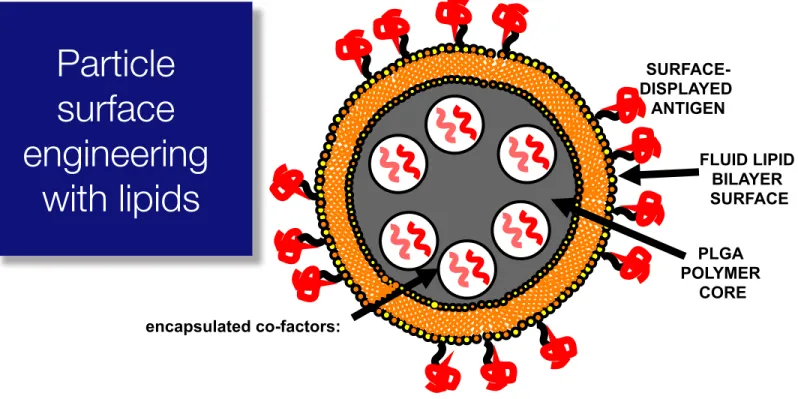
Particle
SURFACE-surface
DISPLAYED ANTIGENengineering with lipids
FLUID LIPID BILAYER SURFACE
PLGA POLYMER
CORE encapsulated co-factors:
Figure removed due to copyright restrictions.
See Figures 1 and 3 from Bershteyn, Anna, et al.
"Polymer-Supported Lipid Shells, Onions, and Flowers."
Soft Matter 4, no. 9 (2008).
lipid segregation/self-assembly at the surface of nanoparticles
25:1 wt:wt polymer:lipid
50 nm
Figure removed due to copyright restrictions.
See Figures 1 and 3 from Bershteyn, Anna, et al.
"Polymer-Supported Lipid Shells, Onions, and Flowers."
Soft Matter 4, no. 9 (2008).
Lecture 18 Spring 2008 30
+
Plasmid DNA
Polycation backbone*
Hydrophilic side chains**
** side chain components
* Backbone components
PEI -(CH 2 -CH 2 -O) n - PEO
PLL
dextran
POLYPLEXES
Nanoparticle DNA packaging
Figures removed due to copyright restrictions.
See Figures 2, 5, and 6 from Park, Susan and Kevin E. Healy. "Nanoparticulate DNA Packaging
Using Terpolymers of Poly(lysine-g-(lactide-b-ethylene glycol))."
Bioconjugate Chemistry 14, no. 2 (2003).
Nanoparticle DNA packaging
0.5X HBS (Hank’s buffered saline) = 75 mM NaCl, 20 mM HEPES,2.5% glucose 0.5X HBG (HEPES-buffered glucose) = 20 mM HEPES, 5% glucose
Copyright © 2001 John Wiley and Sons, Ltd. Reprinted with permission of John Wiley & Sons., Inc.
Source: Wightman, Lionel et al. "Different Behavior of Branched and Linear Polyethylenimine for Gene Delivery In Vitro and In Vivo."The Journal of Gene Medicine 3, no. 4 (2001).
(Wightman et al., J. Gene Med. 3, 362-372 (2001))
Lecture 18 Spring 2008 32
Objectives of nano- and micro-carriers:
targeted delivery to select tissues or cells
(Wickham Nat. Med. 9 135 (2003)) 33
Reprinted by permission from Macmillan Publishers Ltd: Nature Medicine.
Source: Wickham, Thomas J. "Ligand-Directed Targeting of Genes to the Site of Disease." Nature Medicine 9 (2003). © 2003.
MIT OpenCourseWare http://ocw.mit.edu
20.380J / 5.22J Biological Engineering Design
Spring 2010
For information about citing these materials or our Terms of Use, visit: http://ocw.mit.edu/terms.