P
www.permanyer.com
Rev Inves Clin. 2016;68:201-9 ORIGINAL ARTICLE
Chronic Hepatitis C Treatment
with Direct-Acting Antiviral Agents
in a Real-Life Setting
Ruby Ann Chirino-Sprung
1*, Margarita Dehesa
2, Enrique Wolpert
3, Clara Corona-Lau
4,
Ignacio García-Juarez
5, Juan Francisco Sánchez-Ávila
5, Carlos Moctezuma-Velázquez
5and David Kershenobich
51Hospital Ángeles Pedregal; 2Fundación Mexicana para la Salud Hepática; 3Clínica Lomas Altas; 4Laboratorio Biomédica
de Referencia; 5Instituto Nacional de Ciencias Médicas y Nutrición Salvador Zubirán. Mexico City, Mexico
Corresponding author: *Ruby Ann Chirino-Sprung Hospital Ángeles Pedregal
Camino Sta. Teresa #1077, Consultorio 635 Torre A Col. Héroes de Padierna, Magdalena Contreras C.P. 01700, Ciudad de México, México
E-mail: [email protected] Received for publication: 12-05-2016 Accepted for publication: 18-07-2016
ABSTRACT
Background: In clinical trials, new oral direct-acting antiviral agent therapies have demonstrated a high sustained virological response rate in patients with hepatitis C virus infection. We aimed to analyze the efficacy and safety data from direct-acting antiviral agent interferon-free therapy in hepatitis C virus infection in a study performed in five different clinical settings in Mexico City; four private practice sites and one academic medical center in a real-world scenario. Methods: Eighty-one patients were treated with seven different direct-acting antiviral agent regimens, in which the end of treatment, sustained virological response at 12 weeks post-treatment, and adverse effects were evaluated. At their discretion, attending physicians selected the treatment regimens and durations. Results: In total, 70.4% of the patients were female and the mean age was 60.7 years; 74.1% had blood transfusion as a risk factor. The most common genotype was 1b (70.4%). The fibrosis stage was F3 or F4 in 55.5% of patients; liver cirrhosis was present in 44%. The overall end of treatment response was 98.8%, and the rate of sus-tained virological response was 96%, independent of the regimen. Three patients did not achieve sussus-tained virological response; they had cirrhosis and were treatment-experienced, and two had hepatocarcinoma. Non-significant adverse effects during treatment were documented. Conclusions: In this real-life setting in Mexico, a rate of 96% of sustained virological response to direct-acting antiviral agents was achieved in an older population of patients with advanced fibrosis. This study provides data that may be useful in guiding health professionals and authorities in the development of health policies. (REV INVES CLIN. 2016;68:201-9)
Key words: Chronic hepatitis C. DAA. Direct-acting antiviral agent. Epidemiology. Hepatitis in Latin America. SVR. Sustained virological response.
No part of this publication may be reproduced or photocopying without the prior written permission
of the publisher
.
There is a need to provide guidance to health profes-sionals and patients through the dissemination of infor-mation. Consistent with this approach, the purpose of the present work was to analyze the real-life experi-ence gained from the use of DAAs outside of controlled clinical trials in Mexico; this study focused on patients who have had access to DAAs either through their own resources or by being insured privately. We believe that by analyzing the data related to effectiveness, compli-ance, and side effects we can assist health profession-als, health authorities, and the pharmaceutical indus-try with advancing the development of a public health policy regarding DAA use in hepatitis C patients.
The primary objective of this study was to evaluate the efficacy and safety data of the DAA interferon-free therapy in HCV infection in four private medical sites and one academic medical center, all in Mexico City, in a real-world scenario.
MATERIALS AND METHODS
Study design and patients
This multicenter, case series, retrospective study re-viewed prospectively collected data concerning the efficacy and safety of DAAs, with or without RBV, in patients with chronic HCV infection. The study was conducted in five different clinical settings in Mexico City; four were private practice settings, and one was an academic, tertiary care referral center. The ethics and research committees of each institution approved this observational study. Patient demographics (age, gender, and risk factors), virological, and clinical data, including medication dosage, were collected through individual health record reviews. The clinical severity of liver disease was established at baseline. The fibro-sis stage was determined by non-invasive tests, such as the FibroTest or elastography (MRI/FibroScan®), and/or liver biopsy.
The patients included in this study had HCV infec-tion, and the study sample was composed of treatment-naive patients and patients who had been previously exposed to PegIFN and RBV. Patients were classified as relapsers, partial responders, non-re-sponders, protease inhibitor failures (PegIFN/RBV/ boceprevir or telaprevir), and liver transplant recipi-ents. Relapsers were defined as patients who had an
INTRODUCTION
In the first decade of the 21st century, the treatment of chronic hepatitis C primarily relied on the administration of pegylated interferon plus ribavirin (PegIFN/RBV)1-3.
Strategies were implemented around this treatment to increase the prediction of patient response to therapy, thereby increasing its effectiveness4,5;
no-tably, the determination of interleukin 286 and the
concept of rapid response at week 4 and early re-sponse at week 127 helped predict patient
respons-es. Sustained virological response (SVR) was re-ported in approximately 50% of the patients with hepatitis C virus (HCV) genotype 1 and 70% of those with genotype 2. These data were obtained from clinical trials primarily performed in the USA, Europe, and Asia and included a significant number of patients8,9.
The treatment in these studies was difficult, requir-ing weekly injections of PegIFN for 24-48 weeks, with frequent clinical and biochemical adverse ef-fects that were primarily associated with anemia, leukopenia, and thrombocytopenia and required the use of hematopoietic growth factors. These results often indicated an important deterioration in patient quality of life10.
With the advent of new oral direct-acting antiviral agents (DAA) as part of the therapeutic armamen-tarium for hepatitis C, a significant change has oc-curred in the past five years. There have been recent reports of SVR rates greater than 90% after 12 weeks of treatment for the most frequent genotypes11, in
addition to therapeutic drugs administered orally, free of interferon, that do not convey significant side ef-fects12. However, the new DAAs are expensive, and
this cost has become one of the most important con-straints limiting the number of patients who have access to treatment.
Well-designed, individual and national epidemiological studies and cost-benefit analyses have been per-formed throughout Latin America, allowing compari-sons with first-world countries13-15. However, these
studies have not resulted in treatment opportunities. The region is remarkably similar in its strengths and vulnerabilities. Uncertainties in drug registration and economic and health policies are the main factors af-fecting access to new treatments.
No part of this publication may be reproduced or photocopying without the prior written permission
of the publisher
.
undetectable viral load at the end of treatment (EOT), but who did not achieve SVR. Partial responders were defined as patients who achieved a 2 log10 drop in HCV RNA by week 12, but did not achieve an EOT response. Non-responders were patients who did not achieve a 1 log10 reduction in HCV RNA by week 4 or a 2 log10 drop in HCV RNA by week 12. They were included independently of their fibrosis stage and liver disease grade.
Laboratory procedures
All of the patients had serum anti-HCV antibodies, determined by using a commercial kit (Vitros® 5600; Ortho Clinical Diagnostics, Raritan, NJ, USA), with 100% sensitivity and 99.75% specificity. When the test was positive, serum HCV RNA levels were quanti-fied using a commercial real-time RT-PCR (Abbott RealTime HCV, Abbott m2000rt; Abbott Molecular Inc., Des Plaines IL, USA), with a lower limit of quanti-fication of 12 IU/ml. The HCV genotype and subtype were determined using a commercial kit (Abbott Re-alTime HCV Genotype II, Abbott m2000rt; Abbott Molecular Inc., Des Plaines IL, USA).
Laboratory tests, including liver function tests, red blood cell counts, white blood cell counts, and platelet counts, were monitored at baseline; at weeks 4, 12, and 24, as needed; and 12 weeks after the comple-tion of treatment.
Study endpoints and treatment
The study endpoints were as follows: (i) the number of patients who achieved undetectable HCV RNA at the EOT, at 12 or 24 weeks; and (ii) the number of patients who achieved SVR 12 weeks after complet-ing treatment (SVR12).
Treatment
The DAA treatment regimens and their durations (i.e. 12 or 24 weeks) were selected at the discretion of the treating physicians. Treatment regimens included combinations of sofosbuvir (SOF), ribavirin (RBV), simeprevir (SMV), ledipasvir (LDV), ombitasvir (OBV), paritaprevir (PTV), ritonavir (r), and dasabuvir (DSV). Seventy-three patients received 12 weeks of treat-ment; one patient with genotype GT2 received 16 weeks of SOF/RBV. Seven patients were treated with
24-week regimens: two patients with SOF/SMV, one with SOF/RBV, two with SOF/LDV, one with SOF/ LDV/RBV, and one patient with OBV/PTV/r/DSV (Table 1).
Data on adverse side effects were collected for all patients during the entire treatment and follow-up periods. These data were reviewed to identify the causal relationship with the treatment regimens.
Statistical analysis
Continuous data are expressed by the mean values and standard deviation (SD); categorical variables are expressed as absolute and relative numbers and per-centages. Categorical data were analyzed with the X2 test, and an EPI value of ≤ 0.05 was considered sta-tistically significant.
RESULTS
Baseline characteristics
This study included 81 patients, 57 women (70.4%) and 24 men (29.6%). The age range was 41-81 years (mean age, 60.7 years). The most common risk factor was blood transfusion, reported in 60 patients (74.1%); three patients had a history of surgery without blood transfusion (3.7%); two were healthcare workers (2.5%), and one had a family member with hepatitis C (1.2%). In 15 patients (18.5%) we were unable to determine a risk factor. Co-morbidity was present in 32 patients (39.5%); diabetes mellitus and arterial hyperten-sion were the most frequent (seven patients with each co-morbidity), followed by a history of cancer in five patients. Digestive, thyroid, and ocular diseas-es were prdiseas-esent in three patients each, and dyslipid-emia was present in two patients. Cardiovascular, rheumatologic, and cerebrovascular diseases were present in one patient each.
The most common HCV genotype was type 1, identi-fied in 73 patients (90.1%); 16 patients (19.8%) had subtype 1a (GT1a), and 57 (70.4%) had subtype 1b (GT1b). Genotype 2 (GT2) was identified in seven patients (8.6%), and one patient (1.2%) had geno-type 3 (GT3). In 71 patients (87.7%), the HCV RNA viral load was ≤ 6,000,000 IU/ml, and in 10 patients (12.3%) the viral load was > 6,000,000 IU/ml.
No part of this publication may be reproduced or photocopying without the prior written permission
of the publisher
.
Eleven patients (13.6%) underwent liver biopsy; five of them also had a non-invasive test done, and in all cases there was a correlation between both tests. In 86.4% of patients, fibrosis stage was determined by a non-invasive test: FibroScan in 12 patients; FibroTest in 13; magnetic resonance imaging in 16; abdominal ultrasound and clinical and laboratory findings in 42 pa-tients. Regarding the fibrosis stage, the distribution in the study sample was as follows: F0 = 11 (13.6%), F1 = 17 (21%), F2 = 8 (9.9%), F3 = 9 (11.1%), and F4 = 36 (44.4%). Patients in stage F4 were further classified as Child A (88.8%), Child B (5.6%), or Child C (5.6%) (Table 2).
Of the 81 patients, 40 (49.4%) were treatment-naive, and 41 (50.6%) had been previously treated with
PegIFN/RBV; five of these patients had also been treat-ed with PegIFN/RBV/boceprevir; one patient had been treated with PegIFN/RBV/telaprevir, and one patient had received PegIFN/RBV/SMV. Of the previously treat-ed patients, 18 (43.9%) were non-responders, 18 (43.9%) were relapsers, one (2.44%) had a partial response, and four patients (9.75%) had a history of discontinuing previous treatments because of adverse effects. Four patients (4.9%) had hepatocellular car-cinoma (HCC), three had undergone liver transplanta-tion (3.7%), and one patient (1.2%) had HIV.
Efficacy
An EOT response occurred in 80 of the 81 patients (98.8%), independent of the treatment regimen. So far, 75 patients have completed the time framework to evaluate response to treatment at 12 weeks after completing treatment (SVR12). The SVR12 rate was 96% (72/75 patients).
Table 2. Baseline characteristics of patients with chronic hepatitis C
Patient
characteristics Number of patients (%)(n = 81)
Age (years)
Mean age 60.77
Range 41-81
Gender
Female 57 (70.4)
Male 24 (29.6)
HCV genotype
1 2 (2.5)
1a 14 (17.3)
1b 57 (70.4)
2 7 (8.6)
3 1 (1.2)
Fibrosis stage
F0 11 (13.6)
F1 17 (21.0)
F2 8 (9.9)
F3 9 (11.1)
F4 36 (44.4)
Child-Pugh class
A 32 (88.8)
B 2 (5.6)
C 2 (5.6)
Treatment-naive 40 (49.4)
Treatment-experienced 41 (50.6)
HCV: hepatitis C virus. Table 1. Direct-acting antiviral regimens selected by the
phy-sicians to treat patients with chronic hepatitis C
DAA treatment regimens Number
of patients (n = 81) SOF 400 mg QD/SMV 150 mg QD
12 weeks
SOF 400 mg QD/SMV 150 mg QD 24 weeks
11
2
SOF 400 mg QD/SMV 150 mg QD/RBV*
12 weeks 1
SOF 400 mg QD/RBV* 12 weeks
SOF 400 mg QD/RBV* 16 weeks
SOF 400 mg QD/RBV* 24 weeks
4
1
1
SOF 400 mg QD/LDV 90 mg QD 12 weeks
SOF 400 mg QD/LDV 90 mg QD 24 weeks
22
2
SOF 400 mg QD/LDV 90 mg QD/RBV* 12 weeks
SOF 400 mg QD/LDV 90 mg QD/RBV* 24 weeks
6
1
OBV/PTV/r (25/150/100 mg QD)/DSV (250 mg BID)
12 weeks
OBV/PTV/r (25/150/100 mg QD)/DSV (250 mg BID)
24 weeks
OBV/PTV/r (25/150/100 mg QD)/DSV (250 mg BID)/RBV*
12 weeks
13
1
16
*The ribavirin dose ranged between 800 and 1,200 mg.
BID: twice daily; DAA: direct-acting antiviral agent; DSV: dasabuvir; LDV: ledipasvir; OBV: ombitasvir; PTV: paritaprevir; QD: once daily; r: ritonavir; RBV: ribavirin; SMV: simeprevir; SOF: sofosbuvir.
No part of this publication may be reproduced or photocopying without the prior written permission
of the publisher
.
According to genotype, the EOT response was 93.8% for GT1a, 100% for GT1b, 100% for GT2, and 100% for GT3. Considering the fibrosis stage, the EOT response was 100% in the F0, F1, F2, and F3 patients and 97.2% in the F4 patients.
The SVR12 rate was achieved in 87.5, 100, 85.7, and 100% of the patients with GT1a, GT1b, GT2, and GT3, respectively. The SVR12 rate was 100% in the patients with fibrosis stages F0, F1, F2, and F3. Patients in stage F4 achieved a lower SVR12 rate of 91.4%.
An EOT response was achieved in 97.5% of the patients previously exposed to PegIFN/RBV-based treatments. The response rate in the previous non-responders was 94.4%. In the relapsers, partial responders, and Pe-gIFN/RBV intolerant patients the EOT responses were 100%. An SVR12 was achieved in 92.1% of the treat-ment-experienced patients. In the previous non-re-sponders, the SVR12 rate was 94.4%; the rates were 86.6% in the previous relapsers and 100% in the par-tial responders and PegIFN/RBV intolerant patients (Table 3). The EOT response and SVR12 in naive pa-tients were 100%.
According to the duration of therapies, the two patients that relapsed received 12-week regimens with SOF/
SMV/RBV and SOF/RBV, and one non-responder pa-tient was treated with OBV/PTV/r/DSV for 24 weeks.
Three patients (4%) did not achieve SVR12: one pa-tient was a non-responder, and two papa-tients relapsed (Table 4). The patient who failed to achieve an EOT response was a 70-year-old woman with cirrhosis, clas-sified as Child A, who was a previous non-responder to PegIFN/RBV. The patient had GT1a and was treated with OBV/PTV/r/DSV, without RBV, for 24 weeks.
The two relapsers had cirrhosis, classified as Child A, and had relapsed from previous treatment, one from PegIFN/RBV and one from PegIFN/RBV/SMV; both pa-tients had been diagnosed with liver cancer and were treated before receiving the DAA treatment. One pa-tient was a 75-year-old woman with GT1a, with HCC classified as early stage (A) according to the Barcelona Clinic Liver Cancer (BCLC) staging system; she received radiofrequency ablation with no evidence of tumor during surveillance. She was treated with SOF/SMV/ RBV for 12 weeks. The other patient was a 58-year-old man with GT2, who had HCC classified as BCLC inter-mediate stage (B), who had received transarterial che-moembolization and had no evidence of tumor when he was treated with SOF/RBV for 12 weeks. A total of four patients had a history of HCC: the two patients Table 3. Rates of sustained virological response at 12 weeks according to genotype, fibrosis stage, and prior treatment history
EOT No. (%) (n = 81)
SVR12 No. (%) (n = 75)
80/81 (98.8) 72/75 (96.0)
HCV genotype
1a 15/16 (93.8) 14/16 (87.5)
1b 57/57 (100) 51/51 (100)
2 7/7 (100) 6/7 (85.7)
3 1/1 (100) 1/1 (100)
Fibrosis stage
F0 11/11 (100) 11/11 (100)
F1 17/17 (100) 14/14 (100)
F2 8/8 (100) 7/7 (100)
F3 9/9 (100) 8/8 (100)
F4 35/36 (97.2) 32/35 (91.4)
Previous treatment EOT 40/41 (97.5) SVR12 35/38 (92.1)
Non-responders 17/18 (94.4) 17/18 (94.4)
Relapsers 18/18 (100) 13/15 (86.6)
Partial responders 1/1 (100) 1/1 (100)
IFN intolerant 4/4 (100) 4/4 (100)
EOT: end of treatment; IFN: interferon; SVR12: sustained virological response at week 12 of treatment.
No part of this publication may be reproduced or photocopying without the prior written permission
of the publisher
.
referred to previously who did not achieve SVR12, and a 61-year-old woman, GT1b, naive to previous treat-ment, with F4 fibrosis stage and an HCC in early stage (A) who underwent surgical resection, with no evidence of tumor; she received SOF/SMV for 12 weeks and achieved SVR12. The other patient was a 62-year-old man, GT1b, naive to previous treatment, fibrosis stage F4, with HCC in early stage (A), who underwent radiofrequency ablation, with no evidence of tumor while being treated with SOF/SMV for 12 weeks, and who also achieved SVR12.
Three patients received treatment post-liver trans-plantation, all of whom achieved SVR12. Two of these patients (GT1b) received SOF/SMV for 12 weeks and SOF/LDV/RBV for 12 weeks, and one patient (GT2) was treated with SOF/RBV for 24 weeks.
Safety
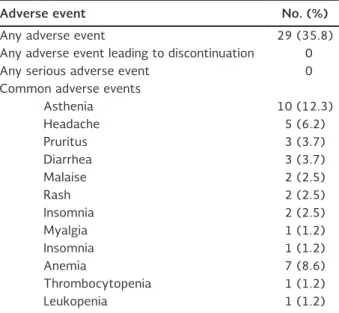
Of the 81 patients, 35.8% experienced an adverse event. The events were minor in all of the patients, and none of them discontinued their treatment. The most common adverse events were asthenia in 12.3% of the patients, and headache in 6.2%, followed by pruritus, diarrhea, and malaise, which were each pres-ent in 3.7% of the patipres-ents. Less frequpres-ently occurring adverse events were rash, myalgia, and insomnia.
Anemia occurred in six patients (8.6%), and it was the most common adverse event in patients receiving RBV. In two patients the RBV dose was modified but not suspended. No patient discontinued the treat-ment because of anemia or received erythropoietin or transfusion. According to the regimen received, the adverse effects occurred more frequently in patients treated with OBV/PTV/r/DSV or OBV/PTV/r/DSV/ RBV at rates of 8.6 and 11.1%, respectively, followed by SOF/LDV or SOF/LDV/RBV, both at 3.7%. A total of 4.9% of the patients treated with SOF/SMV ex-perienced adverse events; the adverse event rate was 2.4% for SOF/RBV, and no adverse events were reported in patients treated with SOF/SMV/RBV (Table 5).
Based on these results, we are proposing a decision-making algorithm for evaluation and treatment with DAA agents that can be applied independently of the selected treatment scheme (Fig. 1).
DISCUSSION
The effectiveness of DAAs as therapeutic agents for hepatitis C has been clearly demonstrated world-wide16,17. The present study aimed to evaluate the
overall effect of DAAs on chronic hepatitis C and was Table 4. Rates of end of treatment and sustained virological response at week 12 of treatment according to direct-acting an-tiviral treatment regimens
EOT (n = 81)
No. (%)
SVR12 (n = 72) No. (%)
Non-responder (n = 1) No. (%)
Relapse (n = 2) No. (%) SOF/SMV
n = 13 13 (100) 13 (100)
0 0
SOF/SMV/RBV
n = 1 1 (100) 0 (0) 1 (100)
SOF/RBV
n = 6 6 (100) 5 (83.3) 0 1 (16.7)
SOF/LDV
n = 24 24 (100) 22 (100) 0 0
SOF/LDV/RBV
n = 7 7 (100) 7 (100) 0 0
OBV/PTV/r/DSV
n = 14 13 (92.9) 11 (91.6) 1 (8.4) 0
OBV/PTV/r/DSV/RBV
n = 16 16 (100) 14 (100) 0 0
Total
n = 81 80 (98.8) 72 (96) 1 (1.4) 2 (2.6)0
DAA: direct-acting antiviral; DSV: dasabuvir; EOT: end of treatment; LDV: ledipasvir; OBV: ombitasvir; PTV: paritaprevir; r: ritonavir; RBV; ribavirin; SMV: simeprevir; SOF: sofosbuvir; SVR: sustained virological response at week 12 of treatment.
No part of this publication may be reproduced or photocopying without the prior written permission
of the publisher
.
not designed as a comparative study of different treatment regimens.
As the registration of DAAs in Mexico has become a reality18, the only patients who have thus far
benefit-ed from these new forms of therapy are those with private insurance or the economic means to obtain the medication.
Herein, we analyzed the data obtained in this group of individuals with the purpose of contributing to the process of making these drugs available to the gen-eral public, who represent the vast majority of chron-ic HCV patients in the country, where only 0.44% of the population has private insurance19. Overall, this
analysis may be helpful in determining soon who should be treated and when, in a scenario where pri-oritization is necessary.
This study represents real-life experiences and is not a large-scale HCV therapy controlled trial, which allows the identification of relevant issues that are specific to the region and that represent hurdles in accessing treatment.
Patients with genotypes 1, 2, or 3 were included, with GT1b being the most frequent. These results are sim-ilar to the findings previously reported in Mexico20,21
and in other regions in Latin America22,23. Most novel
DAAs are now recognized to induce a good response
in patients infected with GT1a and GT1b HCV, includ-ing those with compensated cirrhosis.
The mean age of the study population was 60.7 years. Among those patients who had received a transfusion, the length of exposure to the virus was 43.6 years. Not surprisingly, 55.5% of the patients had an F3 or F4 fibrosis stage, 36/81 (44.4%) had liver cirrhosis, three had undergone liver transplantation, and four had HCC. These data align with results from a previ-ous report by our group using the FibroTest to iden-tify the stage of liver fibrosis in 261 HCV-infected patients. In that study, stages F3 and F4 represent-ed 55% of the sample24.
In 1989, cirrhosis associated with hepatitis C account-ed for only 5% of all cases in western countries; that rate increased to 10% in 1998 and 20% in 2006 as the age and duration of illness of those infected be-gan to increase. The proportion of patients with cir-rhosis was projected to reach 24.8% by 2010, 37.2% by 2020, and 44.9% by 203025. Data from the
pres-ent study indicate that the patipres-ents in our country are Table 5. Adverse events associated with direct acting
anti-viral treatment in patients with chronic hepatitis C
Adverse event No. (%)
Any adverse event 29 (35.8)
Any adverse event leading to discontinuation 0
Any serious adverse event 0
Common adverse events
Asthenia 10 (12.3)
Headache 5 (6.2)
Pruritus 3 (3.7)
Diarrhea 3 (3.7)
Malaise 2 (2.5)
Rash 2 (2.5)
Insomnia 2 (2.5)
Myalgia 1 (1.2)
Insomnia 1 (1.2)
Anemia 7 (8.6)
Thrombocytopenia 1 (1.2)
Leukopenia 1 (1.2)
Hepatitis C
Diagnosis (Anti-HCV, quantitative
HCV RNA, and genotyping)
Staging Liver fibrosis (Non-invasive biochemical markers, imaging, elastography)
Selection of direct-acting antiviral agent
regimen
HCV RNA at the end of treatment and 12 weeks
after treatment
Figure 1. Decision-making algorithm for hepatitis C evalua-tion and treatment with direct-acting antiviral agents.
No part of this publication may be reproduced or photocopying without the prior written permission
of the publisher
.
late to receive the new DAA therapy. In addition, these patients are older, which validates the fact that fibrosis progression is in general inversely related to age, and explains why cirrhosis and its complications occur most commonly after 60 years of age.
Fibrosis staging has become a relevant issue in deter-mining how to optimize hepatitis C treatment; clearly, the best strategy involves treating all patients (F0-F4), independently of the degree of fibrosis. Providing treatment at earlier stages will reduce the number of patients that develop more severe liver disease and will reduce the cost of care of the complications of advanced fibrosis and cirrhosis. However, giving treatment at stages F3-F4 implies treating those patients at a greater risk of developing complica-tions in the near future, such as esophageal variceal bleeding, encephalopathy, and HCC. Furthermore, in F3-F4 patients achieving SVR, a significant decrease in morbidity and mortality related to liver disease has been demonstrated26,27.
At present, no single policy regarding treatment for hepatitis C can be applied worldwide, and each re-gion and country will need to adjust to their own situations. In particular in Latin America, funding and medical resources do not presently allow for a strat-egy in which all patients with hepatitis C can access DAA treatment. Interestingly, a recent report on how to optimize HCV treatment in resource-con-strained countries (including Egypt, Thailand, and Ivory Coast) demonstrated that prioritizing treat-ment in patients in stages F3 and F4 is the most effective strategy in terms of life-years saved (i.e. 13.1-22.0% in the next 5-10 years)28. Any strategy
is better than the alternative of continuing with the current treatment levels in which cases of advanced liver disease and liver-related deaths will continue to increase through 203029.
Treatment-experienced patients represented the most prevalent group (50.6%) in our study, including previ-ous null responders, relapsers, partial responders, and patients who had interrupted previous IFN-based treat-ment because of significant side effects; the remaining 49.4% of participants were treatment-naive. The over-all EOT response was 98.8%, and the SVR12 was 96%. Ten patients had a viral load > 6,000,000 UI/ml, all of whom responded to treatment independently of the regimen. This population represents 12% of our sample,
which is greater than values previously reported in the literature30 and may be related to the higher
percent-age of cirrhotic patients in our sample. Adverse events occurred in 35.8% of the patients; all the events were mild and did not affect their treatment compliance. These events occurred in 11.1% of patients receiving the OBV/PTV/r/DSV+RBV regimen and in 3.7% of patients receiving the SOF/LDV+RBV regimen.
The three patients who failed to achieve SVR had advanced fibrosis; two were older than 75 years, two had GT1a and one had GT2, and two had HCC. They were all experienced patients, including two relapsers and one non-responder.
The American Association for the Study of Liver Dis-eases (AASLD) 2015 guidelines recommend treat-ment in patients with HCC, regardless of whether they are candidates for liver transplantation. Our results show a low SVR12 in this group of patients because only 2/4 (50%) patients achieved SVR12, and none of those patients presented with decom-pensated liver function.
Based on these results, one can speculate that if the viremic population in Mexico is approximately 0.7%, there are about 355,000 patients in stages F3-F4 who would be candidates to receive DAAs in the public sector. This finding imposes an important health bur-den in terms of morbidity and mortality31.
Contrary to the design of clinical trials, our real-life sample shows that 39.5% of the patients had an as-sociated comorbidity, which may imply the need for additional medications independent of their health hazard risk. This finding becomes a relevant issue because one of the main factors that determine the percentage of SVR is the concomitant use of medica-tions. These patients should be monitored at more frequent intervals than HCV patients without health conditions that promote liver injury32. If DAAs are to be
approved for generalized use in the public and private sectors, the implementation of a solid system is nec-essary to identify and guide practitioners in the knowl-edge of drug-drug interactions to prevent adverse events and treatment failure33.
Because most of the patients in Mexico and Latin America are as yet unaware of their disease15 it is
nec-essary to increase the level of education and awareness
No part of this publication may be reproduced or photocopying without the prior written permission
of the publisher
.
among individuals at risk and in the medical commu-nity. There is a need to increase the diagnostic and service delivery capacities for HCV infection. Simulta-neously, a new screening policy in addition to screening blood bank products must be implemented to allow earlier detection of patients and to identify the highest priority groups for prevention and treatment towards eradication. With such high SVR percentages, devel-oped countries can voice concerns about eradication; however, eradication is not yet the case in the Latin American region where detection is still an important problem and testing policies are urgently needed. A significant caveat is that screening should be at-tached to access to treatment. Even in more advanced countries, no action has been taken in 30% of patients who tested positive for HCV34, and only
approximate-ly 15% of the patients diagnosed with chronic HCV infection have actually received treatment35.
Latin American countries must develop courageous, successful, and long-term planning policies that should lead to significant medical advances in the region, align-ing them with the global preventive and therapeutic strategies being developed in other regions of the world. Real-world data can help guide health professionals and policy makers36,37. Undoubtedly, a national action plan
accompanied by federal guidelines for the screening and treatment of hepatitis C should be advocated.
REFERENCES
1. McHutchison JG. Hepatitis C advances in antiviral therapy: what is accepted treatment now? J Gastroenterol Hepatol. 2002;17:431-41. 2. Craxi A, Licata A. Clinical trial results of peginterferons in
com-bination with ribavirin. Semin Liver Dis. 2003;23:35-46. 3. Hadziyannis SJ, Papatheodoridis GV. Peginterferon-alpha2a
(40 kDa) for chronic hepatitis C. Expert Opin Pharmacother. 2003;4:541-51.
4. Poynard T, Marcellin P, Lee SS, et al. Randomised trial of inter-feron alpha2b plus ribavirin for 48 weeks or for 24 weeks versus interferon alpha2b plus placebo for 48 weeks for treatment of chronic infection with hepatitis C virus. International Hepatitis Interventional Therapy Group (IHIT). Lancet. 1998;352:1426-32. 5. Ramadori G, Meier V. Hepatitis C virus infection: 10 years after the discovery of the virus. Eur J Gastroenterol Hepatol. 2001;13:465-71. 6. Ge D, Fellay J, Thompson AJ, et al. Genetic variation in IL28B
predicts hepatitis C treatment-induced viral clearance. Nature. 2009;461:399-401.
7. Ferenci P. Predictors of response to therapy for chronic hepatitis C. Semin Liver Dis. 2004;24:25-31.
8. Alter HJ. HCV natural history: the retrospective and prospective in perspective. J Hepatol. 2005;43:550-2.
9. Manns MP, Wedemeyer H, Cornberg M. Treating viral hepatitis C: efficacy, side effects, and complications. Gut. 2006;55:1350-9. 10. Simin M, Brok J, Stimac D, Gluud C, Gluud LL. Cochrane systematic
review: pegylated interferon plus ribavirin vs. interferon plus ribavirin for chronic hepatitis C. Aliment Pharmacol Ther. 2007;25:1153-62. 11. Asselah T, Boyer N, Saadoun D, Martinot-Peignoux M, Marcellin P.
Direct-acting antivirals for the treatment of hepatitis C virus infection: optimizing current IFN-free treatment and future per-spectives. Liver Int. 2016;36:47-57.
12. Banerjee D, Reddy KR. Review article: Safety and tolerability of direct-acting anti-viral agents in the new era of hepatitis C therapy. Aliment Pharmacol Ther. 2016;43:674-96.
13. Alonso M, Gutzman A, Mazin R, Pinzon CE, Reveiz L, Ghidinelli M. Hepatitis C in key populations in Latin America and the Carib-bean: systematic review and meta-analysis. Int J Public Health. 2015;60:789-98.
14. Gaite LA, Marciano S, Galdame OA, Gadano AC. Hepatitis C in Ar-gentina: epidemiology and treatment. Hepat Med. 2014;6:35-43. 15. Kershenobich D, Razavi HA, Sanchez-Avila JF, et al. Trends and
projections of hepatitis C virus epidemiology in Latin America. Liver Int. 2011;31:18-29.
16. McConachie SM, Wilhelm SM, Kale-Pradhan PB. New direct-acting antivirals in hepatitis C therapy: a review of sofosbuvir, ledipasvir, daclatasvir, simeprevir, paritaprevir, ombitasvir and dasabuvir. Expert Rev Clin Pharmacol. 2016;9:287-302. 17. AIHG Panel. Hepatitis C guidance: AASLD-IDSA
recommenda-tions for testing, managing, and treating adults infected with hepatitis C virus. Hepatology. 2015;62:932-54.
18. Cofepris. Mexico: Comisión Federal para la Protección contra Riesgos Sanitarios (updated 2016). Available at: www.cofepris. gob.mx/.
19. Encuesta Nacional de Salud y Nutrición. Instituto Nacional de Salud Pública. Available at: http://ensanut.insp.mx/informes/ ENSANUT2012ResultadosNacionales.pdf.
20. Dehesa-Violante M, Bosques-Padilla F, Kershenobich-Stalnikow-itz D. Prevalence of hepatitis C virus genotypes in Mexican pa-tients. Rev Gastroenterol Mex. 2007;72:344-8.
21. Jimenez-Mendez R, Uribe-Salas F, Lopez-Guillen P, Cisneros-Garza L, Castaneda-Hernandez G. Distribution of HCV geno-types and HCV RNA viral load in different regions of Mexico. Ann Hematol. 2010;9:33-9.
22. Mendez-Sanchez N, Gutierrez-Grobe Y, Kobashi-Margain RA. Epidemiology of HCV infection in Latin America. Ann Hematol. 2010;9:27-9.
23. Gower E, Estes C, Blach S, Razavi-Shearer K, Razavi H. Global epidemiology and genotype distribution of the hepatitis C virus infection. J Hepatol. 2014;61:S45-57.
24. Lau-Corona D, Pineda LA, Aviles HH, et al. Effective use of fi-brotest to generate decision trees in hepatitis C. World J Gas-troenterol. 2009;15:2617-22.
25. Davis GL, Alter MJ, El-Serag H, Poynard T, Jennings LW. Aging of hepatitis C virus (HCV)-infected persons in the United States: a multiple cohort model of HCV prevalence and disease progres-sion. Gastroenterology. 2010;138:513-21.
26. Singal AG, Volk ML, Jensen D, Di Bisceglie AM, Schoenfeld PS. A sustained viral response is associated with reduced liver-re-lated morbidity and mortality in patients with hepatitis C virus. Clin Gastroenterol Hepatol. 2010;8:280-8.
27. Morgan TR, Ghany MG, Kim HY, et al. Outcome of sustained virological responders with histologically advanced chronic hep-atitis C. Hepatology. 2010;52:833-44.
28. Obach D, Yazdanpanah Y, Esmat G, et al. How to optimize hep-atitis C virus treatment impact on life years saved in resource-constrained countries. Hepatology. 2015;62:31-9.
29. Hatzakis A, Chulanov V, Gadano AC, et al. The present and fu-ture disease burden of hepatitis C virus (HCV) infections with today’s treatment paradigm - volume 2. J Viral Hepat. 2015;22: 21-41.
30. Benvegnu L, Gios M, Boccato S, Alberti A. Natural history of compensated viral cirrhosis: a prospective study on the incidence and hierarchy of major complications. Gut. 2004;53:744-9. 31. Gane E, Kershenobich D, Seguin-Devaux C, et al. Strategies to
manage hepatitis C virus (HCV) infection disease burden - vol-ume 2. J Viral Hepat. 2015;22:46-73.
32. Shiffman ML. Universal screening for chronic hepatitis C virus. Liver Int. 2016;36:62-6.
33. Höner Zu Siederdissen C, Maasoumy B, Marra F, et al. Drug-drug interactions with novel all oral interferon-free antiviral agents in a large real-world cohort. Clin Infect Dis. 2016;62:561-7. 34. Liu Y, Lawrence RH, Falck-Ytter Y, Watts B, Hirsch AA. Evaluating
a hepatitis C quality gap: missed opportunities for HCV-related cares. Am J Manag Care. 2014;20:e257-64.
35. Holmberg SD, Spradling PR, Moorman AC, Denniston MM. Hep-atitis C in the United States. N Engl J Med. 2013;368:1859-61. 36. Zoulim F, Liang TJ, Gerbes AL, et al. Hepatitis C virus treatment
in the real world: optimising treatment and access to therapies. Gut. 2015;64:1824-33.
37. Younossi Z, Park H, Gordon S, et al. Real-world outcomes of Ledipasvir/Sofosbuvir in treatment-naive patients with hepatitis C. Am J Manag Care. 2016;22:SP205-11.
No part of this publication may be reproduced or photocopying without the prior written permission
of the publisher
.