
Synthesis and characterization of new alkoxide and aryloxide derivatives of titanium and zirconium X ray molecular structure of [ZrCp2(OC6F5)2]
8
0
0
Texto completo
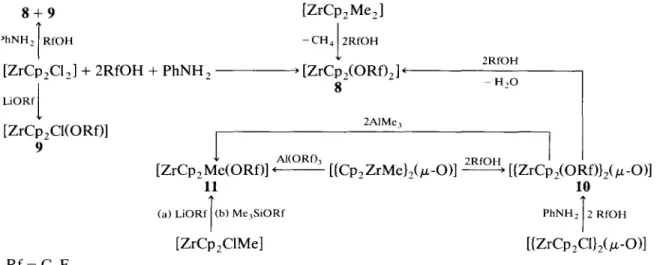
(2) 154. J.l. Amor et al. /Journal of Organometallic Chemist~ 485 (1995) 153-160. 2. Results and discussion. final product, and it was obtained as an orange crystalline solid by cooling its toluene solution.. Solid lithium or sodium alkoxides, M O R ( R = CH2CH=CMe2; M = Li 1; Na 2; R = C 6 F 5 ; M = Li 3) were p r e p a r e d by reaction of the alcohols with n-butyl lithium or sodium metal in hexane. Reaction of a hexane suspension of 3 with SiC1Me 3 afforded SiMe3(OC6F 5) 4, as an oily yellow liquid, whereas the reaction of 3 equivalents of C6FsOH with A1Me 3 in hexane led to AI(OC6Fs) 3 5, as a powdery colourless solid. All these compounds were used as reagents to transfer the alkoxo group to different organo metal complexes of G r o u p 4.. [TiCp*C12Me ] + C6FsOH(excess ). ROH. (i) Na. ,. MOR. R=CH2CH=C~CH3) 2 (ii)LiBun M=Li(I),Na(2) TiCp* MeC12. [ (TiCp* Cl)(/..t_O) ]3 , O2/H20. ~. 3 AIEtC12 [TiCp*CI~]. Ti. Me/[ ~OCH2CH=C(CH 3)2 CI. 6 1/3 AIMe3 RfOH LiBu" LiORf+ BuSH 3 CH 4 + AI(ORf)3 ' hexane Rf C6F5 hexane 3 5 SiCIMe hexane. SiMe3ORf+ LiC1 4. 2.1. Titanium complexes. Reaction of 1 or 2 with one equivalent of [TiCp*C12Me] (Cp* = C s M e s) in toluene gave [TiCp*C1Me(OCH2CH-CMe2)] 6 as a yellow liquid after filtration of the alkalin metal chloride and evaporation of the solvent. C o m p o u n d 6 was treated with AiEtCI z in an attempt to insert the terminal olefin into the t i t a n i u m - m e t h y l bond to give the oxotitanacycle. However, this led to a different product, which results from a metathetical reaction, the methyl and alkoxo being preferentially transferred to aluminium to give [TiCp*CI 3] together with an alkylalkoxoaluminium derivative. The reaction was almost quantitative when 3 equivalents of A1EtC12 were used. Simultaneous hydrolysis takes place when the reaction is carried out in the presence of water, to give the previously reported [4] trimer [{(TiCp*C1)(/x-O)}3]. Unresolvable mixtures of chloro-alkoxo compounds were obtained when [TiCp*CI2Me] was treated with different molar ratios of C6FsOH , as confirmed by IH and 19F N M R spectroscopy. Only when an excess of the alcohol was used, was [TiCp*(OC6Fs)3] 7, the sole. , [TiCp* (OC6F5)3]. (1). 7 The ~H N M R spectrum of complex 6 shows one singlet at 6 0.79 due to the methyl group bound to titanium, along with a singlet at 6 1.80 corresponding to the methyl protons of the cyclopentadienyl ring. The alkoxo ligand gives rise to a doublet at 8 4.74 for both protons of the methylene group, a triplet at 6 5.40 for the internal olefinic carbon-bonded proton and two singlets at 6 1.46 and 8 1.52 for methyl protons of both inequivalent methyl groups bound to the terminal olefinic carbon. A similar behaviour is also observed in the 13C N M R spectrum, which shows one singlet (6 134.9) and one doublet (6 123.9; J ( C - H ) = 157.7 Hz) for the two olefinic carbons, one triplet at 6 72.9 ( J ( C - H ) = 142.5 Hz) for the oxygen-bonded methylene carbon and two quadruplets at 6 17.9 ( J ( C - H ) = 125.9 Hz) and 8 25.6 ( J ( C - H ) = 125.4 Hz) owing to the inequivalent methyl carbons. The mass spectrum shows the presence of the parent ion at 318 (M+). The 1H and 19F N M R spectra of complex 7 show the expected singlet for the methyl protons of the cyclopentadienyl ring and the three signals for the pentafluorophenyl group (see Experimental section). 2.2. Zirconium complexes. [ZrCp2C12] reacted with two equivalents of pentaflurophenol in the presence of aniline to give the dialkoxide [ZrCP2(OC6F5)2] 8. When the same reaction was carried out in a 1 : 1 molar ratio, a mixture of 8 and the chloroalkoxide [ZrCP2CI(OC6Fs)] 9 was obtained. The separation of 8 and 9 is difficult as they possess similar solubility in most solvents. Therefore this method is not ideal for obtaining pure 9, which can be easily isolated in high yield by the reaction of the dichloride with one equivalent of the lithium salt, 3. Alternative methods can also be followed to synthesize 8. The most convenient method consists of the reaction of the dimethylzirconium complex with toluene solutions of the alcohol, with the resultant evolution of methane. An equally clean reaction takes place when the /z-oxo dimer [(ZrCP2Me)2(t~-O)] is treated with two equivalents of pentafluorophenol, leading to the alkoxo dimer [{ZrCp2(OC6Fs)}2(/~-O)] 10. Further alcoholysis of 10 by an excess of alcohol is an alternative way to obtain 8 in high yield. The best method to obtain the methylalkoxo derivative [ZrCp2Me(OC6Fs)] 11 is based on the reaction of [ZrCp2CIMe] with one equivalent of 3. Complex 11 can also be obtained in lower yields: (a) by reaction of 10 with AlMe3; (b) by.
(3) 155. J.L Amor et al. / Journal of Organometallic Chemistry 485 (1995) 153-160. [ZrCP2Me 2]. 8+9 4~. "hNH2[ RfOH. - CH4[2RfOH. /. [ZrCP2Cl 2] + 2RfOH + P h N H 2. 2RfOH. , [ZrCP2(ORf)2], 8. LiORf[. H~O. 2AIMe3. [ZrCpzCl(ORf)] 9. I. [ZrCP2Me(ORf)] 11 (a). <Al(ORf)~. " [{CP2ZrMe}z(/z-O)]. 2RfOH. 1. [{ZrCP2(ORf)}2(/z-O)] 10. LiORfl(b)Me3SiORf. PhNH212RfOH. [ZrCP2CIMe]. [{ZrCP2CI}2(/x-O)]. Rf = C6F 5. reaction of the /.t-oxo methyl dimer with 5; and (c) by reaction of [ZrCP2CIMe] with 4. All the new complexes were characterized by analysis, IR and tH and 19F NMR spectroscopy and the molecular structure of complex 8 was studied by X-ray diffraction methods. All the compounds show one singlet in the 1H spectra and three signals are observed in the 19F NMR spectra (see experimental section).. hydrogen atoms are displayed in Table 1. Selected bond distances and bond angles are given in Table 2. Only a half of the molecule exists in the asymmetrical unit of the unit cell, the other half is generated by a C 2 crystallographic axis passing through the Zr atom. The molecular structure consists of a typical bentsandwich geometry, with two ligands in the equatorial plane. Coordination around the Zr atom is pseudo-tetrahedral if the centroids of the Cp rings are assumed to occupy single coordination sites. The angles of this pseudotetrahedron, ranging from 130° in C p - Z r - C p ' to 96 ° in O ( 1 ) - Z r - O ( 1 ) ' , are normal for this type of structures [5]. The most interesting feature of this structure is the. 2.3. Crystal structure of [ZrCp2(OC6Fs)2] (8) The molecular structure of 8 is shown in Fig. 1 with the atomic labelling scheme. Final atomic coordinates and equivalent isotropic thermal parameters for non-. F4 F5. C5. C4. F3. )_ C3 Zrl ~ .. Ll Y. C1. 01. F2 C2. 01' C10. C9. C8. t~/. Fig. 1. ORTEP view of molecular structure of compound 8 with the atomic labelling scheme..
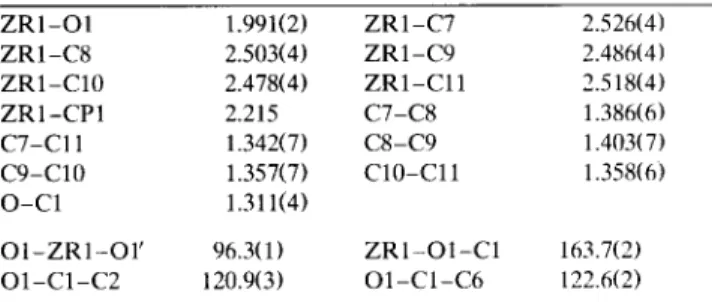
(4) 156. J.L Amor et al. /Journal of Organometallic Chemistry 485 (1995) 153-160. Table 1 Table of positional parameters and their estimated standard deviations for compound 8 Atom x y z B (A2) ZR1 F1 F2 F3 F4 F5 O1 C1 C2 C3 C4 C5 C6 C7 C8 C9 C10 Cll. 0.000 -0.0479(2) -0.1215(2) -0.1824(2) -0.1640(2) -0.0895(2) -0.0274(2) - 0.0671(2) -0.0772(2) -0.1156(2) -0.1459(2) -0.1362(2) - 0.0975(2) -0.1811(3) - 0.1289(3) - 0.1063(3) -0.1436(3) -0.1896(3). 0.14110(4) 0.5897(3) 0.7396(3) 0.5915(3) 0.2935(4) 0.1407(2) 0.2889(3) 0.3606(3) 0.5136(3) 0.5911(4) 0.5159(5) 0.3662(4) 0.2896(4) 0.1483(4) 0.0399(6) -0.0747(4) -0.0313(5) 0.1037(5). 0.250 3.639(6) 0.3233(1) 7.40(5) 0.4375(2) 9.24(7) 0.5594(1) 10.11(6) 0.5660(1) 9.69(7) 0.4523(2) 8.56(7) 0.3288(1) 6.66(5) 0.3841(2) 4.59(5) 0.3827(2) 4.81(6) 0.4407(2) 5.81(7) 0.5023(2) 6.25(8) 0.5057(2) 6.01(8) 0.4473(2) 5.47(7) 0.1967(3) 6.95(9) 0.1583(2) 8.7(1) 0.2088(3) 8.6(1) 0.2745(3) 9.2(1) 0.2668(3) 8.0(1). Anisotropically refined atoms are given in the form of the isotropic equivalent displacement parameter defined as: (4/3)*[a2*B(l,l)+ b2*B(2,2) + c2"B(3,3) + ab(cos gamma)*B(1,2) + ac(cos beta)* B(1,3) + bc(cos alpha)*B(2,3)]. Table 2 Selected bond distances (A) and ZRI-OI 1.991(2) ZR1-C8 2.503(4) ZR1-C10 2.478(4) ZR1-CP1 2.215 C7-C11 1.342(7) C9-C10 1.357(7) O-C1 1.311(4) O1-ZR1-OI' O1-C1-C2. 96.3(1) 120.9(3). bond angles (°) for compound 8 ZR1-C7 2.526(4) ZR1-C9 2.486(4) ZR1-Cll 2.518(4) C7-C8 1.386(6) C8-C9 1.403(7) C10-Cll 1.358(6) ZR1-O1-C1 O1-C1-C6. 163.7(2) 122.6(2). Numbers in parentheses are estimated standard deviations in the least significant digits. CP1 is the centroid of C7, C8, C9, C10, C11. disposition of the ( C 6 ~ ) ring planes, which are located practically on the reflection plane defined by O(1), Zr(1) and O(1)', making an angle of 9.7(3) ° with this plane. D u e to steric reasons, this probably forces the angle Z r ( 1 ) - O ( 1 ) - C ( 1 ) to be bent away from the centre of the system with a value of 163.7 °, but this is nevertheless smaller than that found in other phenoxoderivatives. For the same reason the O ( 1 ) - Z r ( 1 ) - O ( 1 ) ' angle is larger (96 °) that in o t h e r similar systems. T h e Z r ( l ) - O ( 1 ) distance is very short (1.991(2) A) when c o m p a r e d with the single Z r - O b o n d distance (2.2 A), showing significant multiple-bond character by prr-dTr interaction with the vacant d orbitals of the metal. Large Z r - O - C angles and short Z r - O distances are consistent either with 7r d o n a t i o n from the alkoxide oxygen lone pairs to the metal or with highly ionic alkoxide oxygen character [10]. Nevertheless, the Z r - O - C angle found for complex 8 is smaller and the o. Z r - O distance is longer than those found in comp o u n d s where strong pTr-drr donation has been claimed: [ Z r C p 2 ( O - t B u ) R u ( C O ) z C p ] ( Z r - O - C 169.6 (4) °, d ( Z r - O ) 1.910 (4) A) [6], [Zr{HB-3,5-Me3Pz}2(OtBu)(r/2-CMeNCMe3)] ( Z r - O - C 174.4 (6) °, d ( Z r - O ) 1.924 (6) A) [7], [ Z r C p z ( O S i P h 0 o ( D M E ) ] ( Z r - O - S i 171 (1) °, d ( Z r - O ) 1.910 (1) A) [8]~, [ Z r 2 ( O i p r ) 8 ( H o - i p r ) 2 ( d ( Z r - O ) 1.943 A average) [9], and Z r ( O C C H 3 ( C F 3 ) 2 ) a ] ( Z r - O - C 163.9 ° average, d ( Z r - O ) 1.916 .~ average) [10]. T h e angle f o u n d for the fluoroalkoxide [Zr(OCCH3(CF3)2) 4] is very similar to that found in c o m p o u n d 8. T h e Z r - C (Cp ring) distances are fairly uniform, ranging from 2.526 (3) to 2.478 (4) ,~. The Cp (centroid) is at 2.215 A from the Zr atom. T h e C - C distances and angles in the Cp and phenyl systems are normal, and the C - F distances have a m e a n value of 1.338 A.. 3. Experimental section All manipulations were p e r f o r m e d u n d e r an inert a t m o s p h e r e (dinitrogen or argon) using Schlenk and vacuum-line techniques or a glove box model HE-63-P. Solvents were purified by distillation from an appropriate d r y i n g / d e o x y g e n a t e d agent ( s o d i u m / b e n z o p h e n one for T H F and diethyl ether, sodium for toluene and s o d i u m / p o t a s s i u m alloy for hexane). [TiCp*C12Me], [1] [ Z r C P 2 ( C H 3 ) 2 ] , [12] [ Z r C p 2 C I ( C H 3 ) ] , [13] [{ZrCp2CI}2(/z-O)] [14] and [{ZrCp2(CH3)2(/~-O)] [15] were p r e p a r e d according to literature procedures. [ZrCp2CI 2] (Aldrich), ( C H 3 ) 2 C = C H C H 2 O H (Fluka), C 6 F s O H (Aldrich), LiBu n (Ventron), A l M e 3 (Aldrich), A1EtC12 (Aldrich), SiC1Me 3 (Ventron), pyridine (Aldrich), aniline (Aldrich) and sodium metal (Aldrich) were obtained commercially. N M R spectra were r e c o r d e d on Varian FT-80 and Varian Unity FT-300 instruments (1H shifts were referenced to SiMe 4 and CC13F was used as an internal reference for 19F chemical shifts). Mass spectra were obtained with a HewlettPackard 5890 spectrometer. Elemental analyses for C and H were carried out on a Perkin-Elmer 240B microanalyzer. 3.1. Preparation o f S i M e 3 0 ( C o F s ) (4) SiCIMe 3 (2.81 g, 3.27 ml, 25.90 mmol) was added at - 4 0 ° C to a suspension of L i O C 6 F s (5 g, 25.90 mmol) in hexane (200 ml). The reaction mixture was w a r m e d to room t e m p e r a t u r e and then stirred for 24 h. A f t e r filtration the solution was evaporated to yield a yellow liquid which was characterized as 4. I H N M R (C6D 6, 25°C, 300 MHz.): ~ 0.06 (s). 19F N M R (C6D 6, 25°C, 282 MHz.): ~ - 160.7 (d, o-C6F5), - 166.22 (t, m-C6Fs), - 168.4 (t, p-C6Fs)..
(5) J.L Amor et aL /Journal of Organometallic Chemist~. 485 (1995) 153-160. 3.2. Preparation of [TiCp*CIMe(OCH2CH=CMe2)] (6) Method 1 45 ml of a 1.6 M solution of n BuLi (4.46 g, 69.7 mmol) in hexane were added to a solution of dry (CH3)zC---CHCH2OH (7 ml, 6 g, 69.7 mmol) in hexane (50 ml). A white precipitate was formed immediately. The suspension was allowed to warm to room temperature. After 2 h, the solution was filtered and the solid washed with cold hexane (2 × 20 ml) an dried under vacuum to give 6.22 g (97% yield) of compound 1. [TiCp*CI2Me] (1.76 g, 6.54 mmol) and LiOCH 2CH=CMe 2 (0.60 g, 6.54 mmol) were transferred to a 100 ml Schlenk flask. Cold toluene (30 ml) was added slowly to the flask which was cooled in an acetone bath at - 7 8 ° C . After stirring for 24 h the orange of the solution had changed to pale yellow. The solution was filtered and the toluene removed in vacuo to afford a yellow oil and a small quantity of white precipitate. Hexane (5 ml) was added and the oil frozen at - 78°C. The solvent was decanted. The orange solid was washed once at - 7 8 ° C with cold pentane, to yield the chiral titanium complex 6 as a viscous oil.. Method 2 Dry (CH3)zC=CHCH2OH (7 ml, 6 g, 69.7 mmol) was solved in hexane (100 ml) and sodium metal (1.6 g, 69.7 mmol) was added. The mixture was then heated under reflux for 1 week. The fine white solid formed was separated from any unreacted sodium metal with a wide bore, teflon transfer tube. The volatiles were then removed in vacuo and the white solid washed with hexane to give 6.25 g (83% yield) of compound 2. [TiCp*CI2Me] (1.76 g, 6.54 mmol) and NaOCHzCH=CMe 2 (0.71 g, 6.54 m m o l ) w e r e transferred to a 100 ml Schlenk flask. Cold toluene (30 ml) was added slowly to the Schlenk flask cooled in an acetone bath at -78°C. Compound 6 was obtained as described above. Anal. Found: C, 60.33; H, 8.27. Calc. for CI6H27C1OTi: C, 60.29; H, 8.54% lH N M R (C6D6, 25°C, 300 MHz.) 6 0.79 (s, 3H, Ti-CH3), 1.46 (s, 3H, CH3-C=), 1.52 (s, 3H, CH3-C=), 1.80 (s, 15H, CsMes), 4.74 (d, 2H, CH2), 5.40 (t, 1H, CH). 13C N M R (C6D6, 25°C, 75 MHz.): 6 11.8 [q, J ( C H ) = 126.9 Hz., C5(CH3)5], 17.9 [q, J ( C H ) = 125.9 Hz., =C(CH3)2], 25.6 [q, J ( C H ) = 125.4 Hz., =C(CH3)2], 55.6 (q, J(CH) = 124.9 Hz., T i CH3), 72.9 (t, J ( C H ) = 142.5 Hz, CH2), 123.9 (d, J(CH) = 157.7 Hz., -CH=), 124.5 [s, C5(CH3)5], 134.9 [S, =C(CH3)2]. m / z = 318 {[M] +} 3.3. Reaction of [TiCp*CIMe(OCIt2CH=CMe2)] and AlEtCl 2. [TiCp*CIMe(OCH2CH=CMe2)] (1.86 g, m m o l ) w a s dissolved in toluene (30 ml) at - 7 8 ° C . A 3-fold excess of a 1.8 M solution of A1EtC12 (2.23 g, 9.74 ml) in. 157. toluene was slowly added to the orange solution. The solution changed immediately to a bright red. The reaction mixture was stirred for 2 h at low temperature and then quenched with an excess of pyridine. After warming to room temperature, the volatiles were removed in vacuo to leave a bright red gum. After washing with hexane the gum was mixed with toluene to give a red solution and yellow insoluble residue. Both hexane and toluene solutions yielded [TiCp* C13].. 3.4. Preparation of [TiCp*(OCoF~) 3] (7) A solution of freshly distilled C6FsOH (1.86 ml, 3.5 g, 19.0 mmol) in hexane (10 ml) was added dropwise at room temperature to a stirred solution of [TiCp*ClzMe] (1.35 g, 5.02 mmol) in toluene (50 ml). The orange solution darkened and after 15 min it became dark orange and a gas was evolved. The solution was filtered, and the volume reduced in vacuo to 15-20 ml. On addition of hexane and subsequent cooling to - 3 0 ° C a dark orange microcrystalline solid was obtained, which was identified as 7. Anal. Found: C, 46.24; H, 2.07. Calc. for C28H15F1503Ti: C, 45.92; H, 2.06% IH NMR (C6D6, 25°C, 300 MHz.) 6 1.78 (s, 15H, CsMes). 19F NMR (C6D6, 25°C, 282 MHz.) 6 - 162.2 (d, o-C6Fs), - 1 6 6 . 6 (t, m-C6Fs), - 1 6 9 . 3 (t, P-C6Fs).. 3.5. Preparation o f [ZrCP2(OC6F5) 2] (8) Method 1 A suspension of [ZrCP2C12] (0.5 g, 1.7 mmol) in diethyl ether (40 ml) was treated with a solution of freshly distilled C6FsOH (0.33 ml, 0.62 g, 3.4 mmol) in diethyl ether (25 ml) in the presence of aniline (3.4 mmol). After 30 rain the precipitation of (PhNH3)CI was observed. This solid was filtered off and the filtrate was evaporated to dryness under vacuum to give a white solid, which was washed with hexane (3 × 20 ml), recrystallized from t o l u e n e / h e x a n e , and characterized as 8 (0.94 g, 95% yield).. Method 2 A solution of freshly sublimed [ZrCp2(CH3) 2] (0.5 g, 1.9 mmol) in toluene (50 ml) was treated with a solution of freshly distilled C6FsOH (0.37 ml, 0.72 g, 3.9 mmol) in diethyl ether (25 ml). The reaction mixture was stirred for 2 h until the evolution of methane was ceased. The resulting solution was evaporated to dryness and the solid obtained washed with hexane (2 x 20 ml). Recrystallization from t o l u e n e / h e x a n e gave a white product characterized as 8 (1.11 g, 100% yield).. Method 3 A solution of [{ZrCP2(CH3)}z(/z-O)] (0.5 g, 1.02 mmol) in toluene (50 ml) was treated with a solution of.
(6) 158. J.L Amor et aL /Journal of Organometallic Chemistry 485 (1995) 153-160. freshly distilled C 6 F s O H (0.38 ml, 0.75 g, 4.1 mmol) in diethyl ether (30 ml). The reaction mixture was stirred for 4 h until the evolution of m e t h a n e ceased. The resulting solution was evaporated to dryness and the solid obtained washed with hexane (2 × 20 ml) to give a white solid which, after recrystallization from t o l u e n e / hexane, was characterized as 8 (0.60 g, 100% yield) Anal. Found: C, 44.81; H, 1.69. Calc. for C22H10F1002Zr: C, 44.86, H, 1.69% I H N M R ( C , D , , 25°C, 300 MHz.): ~ 5.82 (s, C5H5). 19F N M R (C~D6, 25°C, 282 MHz.): 6 - 165.42 (d, o-C6F5), - 1 6 7 . 4 0 (t, mC6F5), - 173.52 (td, P-C6Fs).. presence of aniline (3.77 mmol). The reaction mixture was stirred for 3 h. ( P h N H 3)C1 was observed as a white precipitate. After filtration, the resulting solution was evaporated to dryness and the solid obtained washed with hexane (3 × 20 ml) to give a white solid, which was recrystallized from t o l u e n e / h e x a n e and characterized as 10 (1.53 g, 95% yield). Anal. Found: C, 46.34; H, 2.39. Calc. for C32H20Fl003Zr2: C, 46.59; H, 2.44% 1H N M R (C6D6, 25°C, 300 MHz.): ~ 5.98 (s, C5H5). 19F N M R (C6D6, 25°C, 282 MHz.): 6 - 165.28 (d, o-C6F5), - 167.6 (t, m-C6Fs) , - 174.84 (td, P-C6Fs).. 3.6. Preparation of [ZrCp2CI(OC6Fs)] (9). 3.8. Preparation of [ZrCPe(Ctt3)(OC6Fs)] (11). 10 ml of a 1.6 M solution of nBuLi (1.0 g, 15.49 mmol) in hexane were added dropwise (1 h) to a solution of freshly distilled C 6 F s O H (0.9 ml, 1.72 g, 9.29 mmol) in hexane (50 ml) at - 2 0 ° C . The mixture was slowly warmed at room t e m p e r a t u r e and then stirred for 2 h. A white solid was formed as the t e m p e r a t u r e was raised. After filtration, the solid was washed with hexane (3 x 20 ml) to give compound 3 (1.41 g, 80% yield). A solution containing L i O C 6 F s (0.83 g, 43 mmol) in T H F (50 ml) was added dropwise to a solution of [ZrCp2C12] (1.27 g, m 4.3 mmol) in toluene (20 ml). The reaction mixture was stirred at room temperature for 2 h, to give a clear solution. The solution was evaporated to dryness. The white solid obtained was recrystallized from t o l u e n e / h e x a n e to give compound 9 as a white microcrystalline solid (1,3 g, 70% yield). Anal. Found: C, 43.81; H, 2.36. Calc. for C16HI~ICIFsOZr: C, 43.71; H, 2.29% 1H N M R (C6D 6, 25°C, 300 MHz.): 6 5.85 (s, C5H5). 19F N M R (C6D 6, 25°C, 282 MHz.): ~ - 1 6 4 . 7 3 (d, o-C6F5), - 1 6 7 . 3 8 (t, mC6F5), - 173.50 (td, P-C6F5).. Method 1. 3. 7. Preparation of [{ZrCPe(OC6Fs)}e-(tx-O)] (10). Method 3. Method 1 A solution of [{ZrCP2(CH3)}2(/x-O)] (0.66 g, 1.34 mmol) in toluene (50 ml) was treated with a solution of freshly distilled C6F5OH (0.26 ml, 0.49 g, 2.68 mmol) in diethyl ether (30 ml) at 0°C. The reaction mixture was warmed to room t e m p e r a t u r e and then stirred for 2 h, until the evolution of m e t h a n e ceased. The resulting solution was evaporated to dryness and the solid obtained washed with hexane (3 x 20 ml) to give a white solid, which was recrystallized from t o l u e n e / h e x a n e and characterized as 10 (1.07 g, 98% yield).. Method 2 A solution of [(ZrCP2CI}2(/.t-O)] (1 g, 1.88 mmol) in toluene (50 ml) was treated with a solution of freshly distilled C6FsOH (0.36 ml, 0.69 g, 3.77 mmol) in the. A 2 M solution of A1Me 3 (0.9 ml, 0.13 g, 1.81 mmol) in hexane was solved in toluene (20 ml) and this was added to a toluene solution (50 ml) containing [{ZrCpe(OC6Fs)}z(/J~-O)] (0.75 g, 0.9 mmol). The reaction mixture was heated at 65-70°C for 2 h. After cooling to room temperature, the solution was evaporated to dryness and the solid obtained was washed with hexane (3 × 20 ml) to give a white solid which was recrystallized from t o l u e n e / h e x a n e and characterized as 11 (0.45 g, 60% yield).. Method 2 A solution of LiOC6F 5 (0.24 g, 1.28 mmol) in T H F (25 ml) was added dropwise at - 4 0 ° C , to a solution of [ZrCp2CI(CH3)] (0.35 g, 1.28 mmol) in toluene (50 ml). The reaction mixture was warmed to room temperature and then stirred for 2 h. The solution was filtered and evaporated to dryness to give a white solid which was washed with hexane (3 × 20 ml) and recrystallized from t o l u e n e / h e x a n e to give a white solid characterized as 11 (0.32 g, 60% yield).. A solution containing freshly distilled C6FsOH (2 ml, 3.83 g, 20.7 mmol) in hexane (10 ml) was added dropwise at - 3 0 ° C , to a solution of A1Me 3 (2.9 ml, 0.49 g, 6.9 mmol) in hexane (50 ml). The reaction mixture was slowly warmed to room temperature. After stirring for 2 h a yellow powder was observed. The solution was evaporated to dryness and the solid obtained was washed with hexane (3 × 50 ml) to yield a fine colourless solid, which was characterized as 5 (3.98 g, 100%, yield). 19F N M R (C6D6, 25°C, 282 MHz.): 6 - 165.25 (d, o-C6F5), - 1 6 6 . 2 8 (t, m-C6Fs) , -170.8 (td, p-f6F5). A solution of AI(OC6F5) 3 (0.58, 1.02 mmol) in toluene (30 ml) was added at - 4 0 ° C , to a solution of [{ZrCp,(CH3)}2(~-O)] (0.5 g, 1.02 mmol) in toluene (50 ml). The reaction mixture was warmed to room temperature. After 3 h of stirring the solution was filtered.
(7) J.I. Amor et al. /Journal of Organometallic Chemist~ 485 (1995) 153-160. Table 3 Crystal data, experimental data and structure refinement procedures for compound 8 Formula Crystal habit Color Crystal size (mm3) Symmetry Unit cell determination Unit cell dimensions:. C22HloO2FloZr1. a, b, c (A) (o). 13.023(5), 8.986(2), 18.158(6) 91.54(2) 2124(2) 4. v (~,) z. Prismatic Colorless 0.30x0.15 X0.15 Monoclinic C 2 / c Least squares fit from 25 reflns. Deal., g cm 3. 1.61. Mw. 798.9 1026 7.90 ~o/20 scans; Omax = 27°. F(000) iz cm 1 scan mode n° reflections: Measured Independent observed Range of hkl Standard reflections R Rw Goodness of fit indicator Largest parameter shift/error Max. peak in final diff. map, e-3A. 6725 2276 1> 2o-(/) criterium h-18 to 18; k 0 to 12:1 0 to 25 2 reflections every 120 minutes, no variation 0.040 0.048 1.465. 159. F i n a l values of R = 0.040 a n d R w = 0.048 with Rw and w=4Fo/[O'lFol] 2 were o b t a i n e d . A n o m a l o u s dispersion corrections a n d atomic scattering factors were t a k e n from I n t e r n a t i o n a l T a b l e s [16]. C a l c u l a t i o n s were p e r f o r m e d with the SDP package [17], a n d M u l t a n [18] a n d D i r d i f [19] p r o g r a m s o n a Microvax II c o m p u t e r .. =[ZwllFol-[Fcll2wlFo[ 2]. Acknowledgments F i n a n c i a l s u p p o r t for this research by C I C Y T (Project 92-0178-C) is gratefully acknowledged. J.I.A. acknowledges Repsol Petr61eo S.A. for a Fellowship.. Supplementary material available from the Cambridge Crystallographic Data Centre T a b l e s of anisotropic t e m p e r a t u r e factors, positional p a r a m e t e r s for h y d r o g e n atoms, b o n d lengths a n d b o n d angles for c o m p o u n d 8. T a b l e s of calculated a n d observed s t r u c t u r e factors are available from the authors.. 0.08 0.45. a n d e v a p o r a t e d to dryness to give a pale yellow solid which was washed with hexane (2 × 20 ml). Recrystallization from t o l u e n e / h e x a n e gave a pale-yellow comp o u n d , c h a r a c t e r i z e d as 11 (0.25 g, 65% yield). A n a l . F o u n d : C, 48.58; H, 3.14. Calc. for C17H13 F s O Z r : C, 46.68; H, 3.12% l H N M R (C6D6, 25°C, 300MHz.): ~ 0.52 (s, 3H, M e - Z r ) , 5.70 (s, 10H, C5H5). 19F N M R (C6D6, 25°C, 282 MHz.): 3 - 165.80 (d, o-C6F5), - 167.98 (t, m-C6Fs), - 174.35 (td, p-C6Fs).. 3.9. S t r u c t u r a l d a t a f o r Z r C P 2 ( O C o F 5 ) 2 (8). Crystallographic a n d e x p e r i m e n t a l details of X-ray crystal s t r u c t u r e d e t e r m i n a t i o n are given in T a b l e 3. D a t a were collected at r o o m t e m p e r a t u r e . I n t e n s i t i e s were corrected for L o r e n z a n d p o l a r i s a t i o n effects in the usual m a n n e r . N o a b s o r p t i o n or extinction corrections were m a d e . T h e s t r u c t u r e was solved by a combin a t i o n of direct m e t h o d s a n d F o u r i e r synthesis a n d r e f i n e d (on F) by full-matrix least-squares calculations. All the n o n - h y d r o g e n atoms were r e f i n e d anisotropically. T h e h y d r o g e n a t o m s were f o u n d in the difference synthesis map, r e f i n e d o n e cycle isotropically a n d t h e n fixed.. References [1] (a)L. Clawson, J. Soto, S.L. Buchwald, M.L. Steigerwald and R.H. Grubbs, J. Am. Chem. Soc., 107 (1985) 3377: (b) J.R. Young and J.R. Stille, Organometallics, 9 (1990) 3022; (c) J.R. Young and J.R. Stille, J. Am. Chem. Soc. 114 (1992) 4936. [2] A.D. Horton and A.G. Orpen, Organometallics, 11 (1992) 8. [3] Bayer Ger. Often. Patent 2706118, 1977. Chem. Abstr., 89 (1978) 198894y. [4] F. Palacios, P. Royo, R. Serrano, J.L. Balcfizar, I. Fonseca and F. Florencio, J. Organomet. Chem., 375 (1989) 51. [5] D.J. Cardin, M.F. Lappert and C.L. Raston, Chemistry of Organo-Zirconium and Hafnium Compounds, Wiley. New York, 1986. [6] C.P. Casey, R.F. Jordan and A.L. Rheingold, J. Am. Chem. Soc., 105 (1983) 665. [7] D.L. Reger, M.E. Tarquini and L. Lebioda, Organometallics 2, (1983) 1763. [8] E.A. Babaian, D.C. Hrncir, S.G. Bott and J.L Atwood, lnorg. Chem. 25 (1986) 4818. [9] B.A. Vaartstra, J.C. Huffman, P.S. Gradeff, L.G. HubertPfalzgraf, J.C. Daran, S. Parraud, K. Yunlu and K.G. Caulton, Inorg. Chem. 29 (1990) 3126. [10] J.A. Samuels, E.B. Lobkovsky, W.E. Streib, K. Folting, J.C. Huffman, J.W. Zwanziger and K.G. Caulton, J. Am. Chem. Soc. 115 (1993) 5093. [11] A. Martin, M. Mena, M.A. Pellinghelli, P. Royo, R. Serrano and A. Tiripicchio, J. Chem. Soc., Dalton Trans. (1993)2117. [12] E. Samuel and M.D. Rausch, J. Am. Chem. Soc., 95 (1973) 6263. [13] J.R. Surtees, J. Chem. Soc., Chem. Commun. (1965) 567. [14] (a)A.F. Reid, J.S. Shannon, J.W. Swan and P.C. Wailes, Aust. J. Chem., 18 (1965) 173; (b) J.G. Dillar and R.W. Kiser, J. Organomet. Chem., 16 (1969) 265. [15] P.C. Wailes, H. Weigold and P. Bell, J. Organomet. Chem., 34 (1972) 155..
(8) 160. J.L Amor et aL /Journal of Organometallic Chemistry 485 (1995) 153-160. [16] International Tables for X-Ray Crystallography, Vol. IV, Kynoch, Birmingham, 1974. [17] B.A. Frenz and Associates, Inc. SDP; Texas A&M and Enraf Nonius: College Station TX 77840, and Delft, 1985. [18] P. Main; Fiske S.E.; Hull, S.L.; Lessinger, L.; Germain, C.; Declerq, J.P.; Woolfson, M.M. Multan. Universities of York and Louvain, 1980 program for resolution of X-ray structures.. [19] P.T. Beurkens, W.P. Bossman, H.M. Doesburg, R.O. Could, T.E.M. van der Hark, P.A.J. Prick, J.H. Noordik, G. Beurkens, and V. Parthasarathu, D1m~IF Manual 82. Technical Report 1981-82, Crystallographic Laboratory, Toernooiveld, 1981..
(9)
Figure
Documento similar
i-Pr, whereas no reaction was observed when CNtoBu was used, All the new iminoacyl complexes were characterized by DH and ;'~C NMR Sl~CtrOscopyand the Xoray molecular stmclm~e
Reduction of a pentane solution of complex 1 with I equiv, of 10% sodium amalgam stirred for 12h in the absence of ligands led to a solution which after filtration and evaporation
The molecular structure of trans-8 determined by X-ray diffraction analysis shows a linear disposition of the nitrosyl groups although the observed vNO is 1566 cm -1, lower than the
After the addition was completed, the reaction mixture was kept at 60°C overnight, then cooled to room temperature and a yellow precipitate mixtures of compounds 7, vide infra
A similar alkylation of the zirconium complex 3 with the lithium derivative of the bulkier neophyl group led to the trineophyl complex 8, isolated in 90% yield as a yellow oil at
After filtration, the resulting solution was concentrated and cooled to −30°C to give a white solid which was washed with hexane, recrystallised from toluene–hexane and characterised
![Dicyclopentadienyl titanium and zirconium complexes with the double bridged bis(dimethylsilanodiyl) dicyclopentadienyl [(Me2Si)2(η5 C5 H3)2]2 ligand: X ray molecular structure of [Ti{(SiMe2)2(η5 C5H3)2}Me2]](data:image/gif;base64,R0lGODlhAQABAIAAAP///wAAACH5BAEAAAAALAAAAAABAAEAAAICRAEAOw==)