Secretaría Administrativa. Escuela de Doctorado. Casa del Estudiante. C/ Real de Burgos s/n. 47011-Valladolid. ESPAÑA Tfno.: + 34 983 184343; + 34 983 423908; + 34 983 186471 - Fax 983 186397 - E-mail: [email protected]
PROGRAMA DE DOCTORADO EN INGENIERÍA INDUSTRIAL
TESIS DOCTORAL:
CONTROL SYSTEMS OF OFFSHORE HYDROGEN
PRODUCTION BY RENEWABLE ENERGIES
Presentada por Álvaro Serna Cantero para optar al grado de
Doctor por la Universidad de Valladolid
Dirigida por:
Álvaro Serna Cantero
CONTROL SYSTEMS OF OFFSHORE HYDROGEN PRODUCTION BY RENEWABLE ENERGIES
Tese de doutorado submetida ao Programa de Pós-Graduação em Engenharia de Automação e Sistemas para a obtenção do Grau de doutor em Engenharia de Automação e Sistemas pela Universidade Federal de Santa Catarina (UFSC) e em Engenharia Industrial pela Universidad de Valladolid (UVA) em regime de cotutela.
Orientadores:
Prof. Fernando Juan Tadeo Rico (UVA).
Prof. Julio Elías Normey-Rico (UFSC)
Serna, Álvaro
Control systems of offshore hydrogen production by renewable energies / Álvaro Serna ; orientador, Fernando Juan Tadeo Rico, coorientador, Julio Elías Normey-Rico, 2018.
212 p.
Tese (doutorado) - Universidade Federal de Santa Catarina, Centro Tecnológico, Programa de Pós Graduação em Engenharia de Automação e Sistemas, Florianópolis, 2018.
Inclui referências.
1. Engenharia de Automação e Sistemas. 2. Controle Preditivo. 3. Gestão de Energia. 4. Hidrogênio. 5. Eletrólise. I. Tadeo Rico, Fernando Juan. II. Normey-Rico, Julio Elías. III.
Álvaro Serna Cantero
CONTROL SYSTEMS OF OFFSHORE HYDROGEN PRODUCTION BY RENEWABLE ENERGIES
Esta Tese foi julgada adequada para obtenção do Título de “Doutor em Engenharia de Automação e Sistemas”, e aprovada em sua forma final pelo Programa de Pós-Graduação em Engenharia de Automação e Sistemas da Universidade Federal de Santa Catarina e pelo Programa de Ingeniería Industrial da Universidad de Valladolid (Espanha).
Florianópolis, 26 de Fevereiro de 2018.
________________________ Prof. Daniel Coutinho Coordenador do Curso
Universidade Federal de Santa Catarina
Banca Examinadora
___________________ Prof. Daniel Coutinho Universidade Federal de
Santa Catarina
___________________ Prof. Carlos Bordons Alba
Universidad de Sevilla
______________ Prof. Jorge O. Trierweiler Universidade Federal do Río
AGRADECIMIENTOS
In these lines I want to remember and thank all the people that have contributed to this thesis in some way.
This thesis would not have been possible without the help of my advisors, Fernando Tadeo and Julio E. Normey Rico. I want to thank them for their tremendous dedication, their motivational skills and their effort spent in helping me with valuable comments and advice, and for guiding me during these four years. I also want to thank my partners of the ‘Departamento de Ingeniería de Sistemas y Automática’ of the ‘Universidad de Valladolid’, and especially my colleagues José Luis, Carlos, Tania, Cristian, Pedro, María, Jacobo, Imene and Johanna for the good times in meetings and conferences. I wish them all the best.
I address my special thanks to the staff of the ‘Departamento de Automação e Sistemas’ of the ‘Universidade Federal de Santa Catarina’, particularly Vítor Mateus and André Tahim for always being nice and helpful.
I also want to remember and give thanks to José Gabriel García Clúa from the National University of La Plata, for the advices about hydrogen he suggested me.
I would also like to express my deepest gratitude to Félix García-Torres, for his advice and valuable contributions during my research stay in the CNH2, and also for his hospitality during my stay in Puertollano.
I also gratefully acknowledge the research grants program from the ‘Universidad de Valladolid’ and the ‘Junta de Castilla y León’ and the European Commission (7th Framework Programme, grant agreement 288145, Ocean of Tomorrow Joint Call 2011).
Y gracias a mi familia: a mi madre, a mi padre y a mi hermana por vuestro gran apoyo y ayuda incondicional.
Thank you,
“The Stone Age did not end for lack of stone, and the Oil Age will end long before the world runs out of oil”.
RESUMO ESTENDIDO
Esta tese trata do projeto de um Sistema de Gestão de Energia (SGE), utilizando Controle Preditivo (Model Predictive Control – MPC) que busca equilibrar o consumo de energía renovável de um conjunto de unidades de eletrólise. A energia gerada na plataforma é equilibrada regulando o ponto de operação de cada unidade de eletrólise e suas conexões ou desconexões, usando um MPC baseado em um algoritmo de Programação Múltipla Inteira-Quadrática. Este algoritmo de Controle Preditivo permite levar em conta previsões de potência e consumo de energia disponível, melhorar o equilíbrio e reduzir o número de ligações e desconexões dos dispositivos. Diferentes estudos de caso são realizados em instalações compostas por unidades de geração de energia elétrica a partir da energía das ondas e do vento. Osmose reversa é considerada como um passo intermediário para a produção de agua que alimenta um conjunto de eletrolizadores. A validação utilizando dados medidos no local de destino das plataformas mostra o funcionamento adequado do SGE proposto. Além disso, a tese também apresenta o projeto de um sistema de controle a curto prazo (segundos) acoplado ao SGE em uma microgrid baseada no hidrogênio. Finalmente, é desenvolvido um estudo econômico dos componentes desta microgrid.
RESUMEN
Esta tesis trata sobre un proyecto de diseño de un Sistema de Gestión de Energía (SGE), utilizando Control Predictivo (Model Predictive Control – MPC) que busca equilibrar el consumo de energía renovable con un conjunto de unidades de electrólisis productoras de hidrógeno. La energía generada en la plataforma es equilibrada regulando el punto de operación de cada unidad de electrólisis y sus conexiones o desconexiones, usando un MPC basado en un algoritmo de Programación Mixta-Entera Cuadrática. Este algoritmo de Control Predictivo permite tomar en cuenta previsiones de potencia y consumo de energía disponible, mejorar el equilibrio y reducir el número de encendidos y apagados de los equipos. Diferentes casos de estudio son realizados en instalaciones compuestas por unidades de generación de energía eléctrica a partir de la energía de las olas y del viento. Se considera la técnica de ósmosis inversa como paso intermedio para la producción de agua que alimenta el conjunto de electrolizadores. La validación se realiza utilizando datos meteorológicos medidos en el lugar propuesto para el sistema, mostrando el funcionamiento adecuado del SGE propuesto. Además, la tesis también presenta el estudio de un sistema de control a corto plazo (segundos) acoplado al SGE en una micro red basada en hidrógeno. Finalmente, se desarrolla un estudio económico de los componentes de la micro red propuesta.
ABSTRACT
This thesis deals with the design of an Energy Management Systems (EMS), based on Model Predictive Control (MPC) to balance the consumption of renewable energy by a set of electrolysis units. The energy generated at the installation is balanced by regulating the operating point of each electrolysis unit and its connections or disconnections, using an MPC based on a Mixed-Integer-Quadratic-Programming algorithm. This Predictive Control algorithm makes it possible to take into account predictions of available power and power consumption, to improve the balance and reduce the number of connections and disconnections of the devices. For this, different case studies are carried out on installations composed of wave and wind energies. Reverse osmosis is considered as an intermediate step for water production which feeds a set of electrolyzers. Validation using measured data at the target location of the installations shows the adequate operation of the proposed EMS. In addition, the thesis also presents the design of a short term system control system (seconds) coupled to the EMS for the hydrogen-based microgrid. Finally an economic study of the components of this microgrid is developed.
LIST OF FIGURES
Figure 1.1 – H2OCEAN platform [http://www.h2ocean-project.eu/] ...29
Figure 1.2 – Participants in H2OCEAN project ...30
Figure 2.1 – Share of US primary energy demand, 1780-2100 ...36
Figure 2.2 – World map of wave energy flux in kW per meter wave front ...37
Figure 2.3 – Wave period in January in North Atlantic Ocean ...37
Figure 2.4 – Wave height in January in North Atlantic Ocean ...37
Figure 2.5 – Example of a WEC coupled with a VAWT (H2OCEAN) ...38
Figure 2.6 – Scheme of the WEC proposed in H2OCEAN...39
Figure 2.7 – Energy profile given by a 1.6 MW WEC using data of Fig. 2.3 and 2.4. ...39
Figure 2.8 – Example of a WEC Power Matrix in 3D ...40
Figure 2.9 – Example of a 30-100kW Vertical Axes Wind Turbine in UK ...42
Figure 2.10 – Wind speed in January in North Atlantic Ocean ...42
Figure 2.11 – Energy profile given by a 5 MW VAWT using the data of Figure 2.10 ...43
Figure 2.12 – Energy profile given by the VAWT developed in the H2OCEAN project. ...43
Figure 2.13 – Industrial Reverse Osmosis system ...44
Figure 2.14 – Transport of water through an RO membrane ...45
Figure 2.15 – Hydrogen-based car (Toyota Mirai). ...47
Figure 2.16 – Steam reforming of natural gas ...48
Figure 2.17 – Partial oxidation process scheme ...49
Figure 2.18 – Coal gasification process scheme ...50
Figure 2.19 – Scheme of the electrolysis reaction ...52
Figure 2.20 – Alkaline electrolyzer stack ...53
Figure 2.21 – PEM electrolyzer module ...55
Figure 2.22 – PEM stack module ...55
Figure 2.23 – Model Predictive Control (MPC) scheme ...57
Figure 2.24 – Receding horizon scheme ...58
Figure 3.1 – Structure of the proposed desalination installation ...68
Figure 3.2 – Structure of the first case study ...69
Figure 3.3 – Proposed EMSW for the first case study ...71
Figure 3.4 – Sequential Function Chart of the Control Logic of the RO ...72
Figure 3.5 – Detail of the Sequential Function Chart (Stage A) ...73
Figure 3.6 – Scheme of the sizing for the first case study ...75
Figure 3.9 – Power produced by renewable energies (Pw) ... 78
Figure 3.10 – Fresh water produced (QF) in each RO section ... 79
Figure 3.11 – Total fresh water produced (QF) ... 79
Figure 3.12 – Total power consumed (PT) ... 79
Figure 3.13 – Stored seawater ... 79
Figure 3.14 – % Battery charge 100%(1-DOD). ... 80
Figure 3.15 – Structure of the second case study ... 81
Figure 3.16 – Scheme of the proposed EMSW for the second case study .... 82
Figure 3.17 – Power available (PW) and consumed (PT) by the desalination unit ... 85
Figure 3.18 –Evaluation of the seawater tank level (VS) ... 85
Figure 3.19 – Evaluation of the fresh water tank level (BT1) ... 86
Figure 3.20 – Evaluation of the DEMI water tank level (BT2) ... 86
Figure 3.21 – Operation of the seawater pump (SWP) ... 86
Figure 3.22 – Operation of the first stage of the desalination unit (RO1A+RO1B). ... 86
Figure 3.23 – Operation of the second stage of the desalination unit (RO2A+RO2B) ... 87
Figure 3.24 – Process diagram of the hydrogen plant ... 88
Figure 3.25 – Converted power along time ... 95
Figure 3.26 – Power consumed by the different sections in the installation ... 96
Figure 3.27 – Power balance (converted – consumed) ... 96
Figure 3.28 – % Batteries charge: 100% (1 – DOD) ... 96
Figure 3.29 – Hydrogen production in the installation ... 96
Figure 3.30 – DEMI water tank level... 97
Figure 4.1 – Block structure of the renewable hydrogen plant ... 103
Figure 4.2 – Scheme of the controlled and manipulated variables ... 104
Figure 4.3 – Ratio H2 produced/Power consumed at different α ... 105
Figure 4.4 – Proposed EMSH based on MPC ideas ... 106
Figure 4.5 – Structure of the EMSH control algorithm... 119
Figure 4.6 – A co-located hybrid VAWT-WEC device ... 120
Figure 4.7 – Meteorological predictions of wave period ... 121
Figure 4.8 – Meteorological predictions of wave height ... 121
Figure 4.9 – Meteorological predictions of wind speed ... 122
Figure 4.10 – Power available and consumed for the first case study ... 123
Figure 4.11 – Operation of electrolyzer i = 1 for the first case study. ... 123
Figure 4.12 – Operation of electrolyzer i = 2 for the first case study ... 124
Figure 4.14 – Hydrogen production for the first case study ...125
Figure 4.15 – Power available and consumed for the second case study ...127
Figure 4.16 – Operation of electrolyzer i = 1 for the second case study ...127
Figure 4.17 – Operation of electrolyzer i = 2 for the second case study ...127
Figure 4.18 – Operation of electrolyzer i = 3 for the second case study ...128
Figure 4.19 – Operation of electrolyzer i = 4 for the second case study ...128
Figure 4.20 – Operation of electrolyzer i = 5 for the second case study ...128
Figure 4.21 – Operation of electrolyzer i = 6 for the second case study ...129
Figure 4.22 – Hydrogen production for the second case study ...129
Figure 5.1 – Coupling of the Long Term System with the Short Term System for the hydrogen-based microgrid ...135
Figure 5.2 – Components of the hydrogen-based microgrid ...138
Figure 5.3 – Activation time (φ) between the on/off state (δ) and the logical order signal to start-up (Λ) ...144
Figure 5.4 – Block diagram coupling the LTS and the STS...146
Figure 5.5 – Hydrogen-based microgrid proposed in this case study ...150
Figure 5.6 – Nitidor electrolyzer in the CNH2 ...151
Figure 5.7 – Battery and ultracapacitor in the CNH2 ...151
Figure 5.8 – Available renewable power profile ...152
Figure 5.9 – Operation of the electrolyzers (Elz 1 = 4kWp, Elz 2 = 4kWp, Elz 3 = 1kWp) ...153
Figure 5.10 – Power exchange of the battery and ultracapacitor ...153
Figure 5.11 – Battery and ultracapacitor SOC ...154
Figure A.1 – Example of a hydrogen-based microgrid ...190
Figure A.2 – Smart house powered by renewable energies and a hydrogen-based microgrid in the CNH2, Spain ...191
Figure A.3 – Example of a Siemens PLC controller ...191
Figure A.4 – Possible customers of HyRenCon ...192
Figure A.5 – Scheme of a hydrogen-based microgrid for the case of the Phi Suea House in Thailand ...198
Figure A.6 – Benefits in the environment of a hydrogen-based microgrid for the case of the Phi Suea House in Thailand ...199
Figure A.7 – Scheme of the components of the hydrogen-based microgrid ...200
Figure A.8 – Investment for the HyRenCon company for the first five years ...201
Figure A.9 – Financing for the HyRenCon company for the first five years ...202
LIST OF TABLES
AEMET – Agencia Estatal de Meteorología AeH2 – Asociación Española de Hidrógeno BMC – Business Model Canvas
CNH2 – Centro Nacional del Hidrógeno DC – Direct Current
DEMI – Demineralized DOD – Depth of Discharge
ELMS – Electrolyzer Management System EMS – Energy Management System EUR- Euros
F-HBA – Floating Heave-buoy Array FCEV- Fuel Cell Electric Vehicle FWP – Fresh water pump
ICT – Information Technology and Communication LTS – Long Term System
MIQP – Mixed Integer Quadratic Programming MLD – Mixed Logical Dynamical System
NLMIQP – Non Linear Mixed Integer Quadratic Programming PEM – Proton Exchange Membrane
PID – Proportional-Integral-Derivative controller PLC – Programmable Logic Controller
PNMPC – Practical Non-Linear Model Predictive Control PTO – Power Take Off
RO – Reverse Osmosis
SETA – Sociedad Española de Tratamiento de Agua SME – Small and Medium-sized Enterprise
SMR – Steam Methane Reforming SOC – State Of Charge
SOEC – Solid Oxide Electrolyzer Cell STS – Short Term System
SWP – Seawater Pump
LIST OF SYMBOLS
HS – Significant wave height (m)
TP – Mean wave period (s)
WS– Mean wind speed (m/s)
u – Control action of the sequence QF – Fresh water flow (m
3
/h) QS – Seawater flow (m
3
/h) VS – Seawater tank (m
3
) BT1 – Fresh water tank (m3)
LT – Tank level of the seawater tank (m)
LTmax – Maximum tank level of the seawater tank (m)
LTmin – Minimum tank level of the seawater tank (m)
I – Amperage of the battery (A) V – Voltage of the battery (V)
PW – Power supplied by the renewable energies (kW)
PT – Total power consumed (kW)
CR – Rated capacity at that discharge rate (A∙h)
CP – Peukert´s capacity of the battery (A∙h)
t – Time
kP – Peukert´s coefficient 𝛙 – Efficiency of the battery Wa – Hours of autonomy (h)
QDE – Demineralized water flow (m 3
/h) BT2 – Demineralized water tank (m3) i – Subscript of each device
Ui– Prioritized units in the reverse osmosis
Ei– List of predicted energy demands
Oi– List of operating units
Di– List of disconnected units
n – Number of devices P
̅EL– Rated power consumption of the electrolyzers (kW) POS– Power consumed by the reverse osmosis (kW)
PCO – Power consumed by the compression (kW)
Urev – reversible voltage or open circuit voltage at the cell (V) η – Over potential (V)
ΔGi – Gibbs free energy (J) F – Faraday constant (C/mol) V0 – Initial specific volume (m
3
T – Temperature (K)
Epro – Activation energy for proton transport in the membrane (J/mol)
Eexc – Activation energy for the electrode reaction (J/mol)
π – Conductivity of the membrane (S/m) RE – Resistive loss (Ω)
tm – Thickness of the membrane (m)
ac – Activity coefficient
i0 – Exchange current density (A/m2)
λ – Charge transfer coefficients N – Prediction horizon
Nu – Control horizon
i – Subscript of each device
δi (k) – Binary variable: ON/OFF electrolysis unit i at instant k
δ̂i (k) – Prediction of the binary variable of unit i at instant k
αi (k) – Capacity factor of electrolysis unit i at instant k
α
̂i (k) – Prediction of the capacity factor of unit i at instant k
zi (k) – Auxiliary variable of electrolysis unit i at instant k
Δzi (k) – Increase of the auxiliary variable of unit i at instant k
Δẑi (k) – Prediction of the increase of the auxiliary variable
Hi (k) – Hydrogen production of electrolysis unit i at instant k (Nm 3
/h) Ĥi (k) – Prediction of the hydrogen production of unit i at instant k
H̅i – Maximum H2 production (Nm 3
/h) of electrolysis unit i ai – Slope of power model of electrolysis unit i (kWh/ Nm3)
bi – Offset of power model of electrolysis unit i (kWh/ Nm3)
αi α̅i – Minimum and maximum capacity factor of unit i
Pi (k) – Power consumption of electrolysis unit i at instant k (kW)
P
̂available (k) – Prediction of power available at instant k (kW) wH – Weighting factor of the error
wδ – Weighting factor of the control variable
J – Quadratic cost function (Nm3/h) T– Triangular matrix
gi (k) – Optimization model of electrolysis unit i at instant k
k – Time index Ts – Sample time
Pidis – Discharge power of the device i (kW)
Pich – Charge power of the device i (kW)
Cimax – Maximum capacity of the device I (A∙h)
ψidis – Discharge efficiency of the device i ψich – Charge efficiency of the device i
zeleLTS – Power formulated as MLD variable for the Long Term System
zeleSTS – Power formulated as MLD variable for the Short Term System φi – Activation time to start up the electrolyzer i
Λi – Logical order signal to start up the electrolyzer i
m – Lower bound of the system M – Upper bound of the system
ε – Smaller tolerance of the device σion – Start-up state of the electrolyzer
σioff – Shut-down state of the electrolyzer
ϑi – MLD power variation in degradation state
SUMMARY
1 INTRODUCTION ... 29 1.1 MOTIVATION ... 29 1.2 OBJECTIVES ... 31
2 STATE OF THE ART ... 35 2.1 RENEWABLE ENERGIES ... 35
2.1.1 Wave Energy ... 36 2.1.2 Wind Energy ... 41
2.2 REVERSE OSMOSIS ... 44 2.3 HYDROGEN ... 46
2.3.1 Hydrogen production... 47
2.3.1.1 Black Hydrogen ... 48 2.3.1.2 Green Hydrogen ... 51 2.3.1.3 Blue Hydrogen ... 51 2.4 MODEL PREDICTIVE CONTROL ... 56
2.4.1 MPC strategy... 56 2.4.2 Receding horizon ... 58 2.4.3 Constraints ... 59
2.5 CONTRIBUTIONS ... 60
2.5.1 Journal papers... 60 2.5.2 Conference papers ... 60 2.5.3 Other contributions ... 61 2.5.4 Patent and intellectual property registration ... 62
2.6 ORGANIZATION OF THE THESIS ... 63 2.7 SUMMARY AND CONCLUSIONS ... 64
3 CONTROL OF THE H2OCEAN PLATFORM ... 67 3.1 FRESH H2O PRODUCTION IN THE H2OCEAN PLATFORM 67
3.1.1 Desalination plant operation ... 68 3.1.2 First case study ... 68
3.1.2.1 Energy Management System based on heuristic control ... 70 3.1.2.2 Sizing of the first case study ... 74 3.1.2.3 Results and discussion ... 75
3.1.3 Second case study ... 80
3.1.3.1 Energy Management System ... 80 3.1.3.2 Results and discussion ... 84 3.2 H2 PRODUCTION IN THE H2OCEAN PLATFORM ... 87
3.2.1 Hydrogen plant operation for hydrogen production ... 88 3.2.2 Energy Management System... 89 3.2.3 Sizing and modelling ... 89
4 ENERGY MANAGEMENT SYSTEM FOR HYDROGEN PRODUCTION BASED ON MPC ... 101 4.1 MATERIALS AND METHOD ... 102
4.1.1 Process description ... 102 4.1.2 Manipulated variables ... 103 4.1.3 Model and controlled variables ... 104 4.1.4 Model Predictive Control for hydrogen production ... 105
4.2 PROPOSED ENERGY MANAGEMENT SYSTEM ... 107
4.2.1 Control objectives ... 107 4.2.2 Cost function and optimization problem ... 107 4.2.3 Approximation to an MIQP ... 109 4.2.4 Constraints ... 113 4.2.5 Optimization ... 114 4.2.6 MPC strategy ... 118
4.3 CASE STUDIES... 120
4.3.1 First case study... 121 4.3.2 Second case study ... 125
4.4 SUMMARY AND CONCLUSIONS ... 130
5 COUPLING OF A LOW LEVEL SYSTEM WITH A HIGH LEVEL SYSTEM IN A H2 MICROGRID ... 135
5.1 HYDROGEN-BASED MICROGRIDS ... 136
5.1.1 Components of the hydrogen-based microgrid ... 137 5.1.2 Electrolyzers ... 138 5.1.3 Batteries and ultracapacitor ... 139
5.2 LONG TERM SYSTEM ... 140
5.2.1 Long term MPC design ... 141 5.1.2 Control objectives of the LTS ... 141
5.3 SHORT TERM SYSTEM ... 143
5.3.1 Short term MPC design ... 145 5.3.2 Control objectives of the STS ... 147
5.3.2.1 Ultracapacitor cost function ... 148 5.3.2.2 Battery cost function ... 148 5.3.2.3 Electrolyzer cost function ... 149 5.4 CASE STUDY ... 149
5.4.1 Controller implementation... 152 5.4.2 Results and discussion ... 152
5.5 SUMMARY AND CONCLUSIONS ... 154
6.2 FUTURE WORK ... 161
ACKNOWLEDGEMENTS ... 163
REFERENCES... 164
CHAPTER 1
1 INTRODUCTION
1.1 MOTIVATION
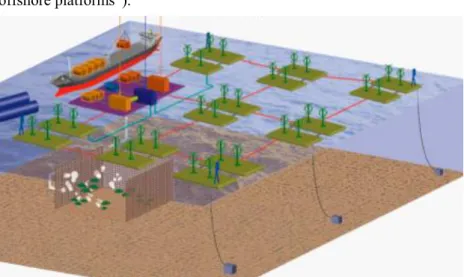
This thesis is derived from the European Project H2OCEAN (http://www.h2ocean-project.eu/), whose aim was the development of a wind-wave power offshore platform equipped for hydrogen generation by electrolyzers (see Figure 1.1). The platform comprises a Reverse Osmosis section as an intermediate step in the production of hydrogen.
H2OCEAN started its activities on January 1st, 2012 and ended on December 31st, 2014. The European Union granted a financial contribution of 4.5 million EUR (FP7-OCEAN.2011-1 “Multi-use offshore platforms”).
Figure 1.1- H2OCEAN platform (http://www.h2ocean-project.eu/).
The H2OCEAN Consortium was composed of 17 partners from 5 European countries (Spain, the United Kingdom, Denmark, Germany and Italy): 10 SMEs, 1 Large Enterprise, 4 Universities (among them the University of Valladolid) and 2 Research Institutes.
Figure 1.2- Participants in H2OCEAN Project.
The University of Valladolid was the leader of Work Package 5. The goals of this WP5 were the development and dimensioning of a hydrogen installation for offshore platforms. The work done included:
1. Evaluation of existing electrolyzing technologies for marine environments (AGERSTED, 2014).
2. Design of offshore desalination units for hydrogen generation (TORRIJOS, 2012).
3. Development of an Energy Management System (EMS) for the offshore hydrogen installation to minimize energy consumption and balance production and consumption of energy (SERNA et al. 2017).
investment share for offshore energy generation infrastructures, increasing the price of energy (BAUER; LYSGAARD, 2015).
Offshore power links are known to be significantly expensive (RUDDY et al. 2016), so the system is here assumed to be fully isolated from the grid. Thus, the EMS balances power consumption with production by connecting or disconnecting sections of the electrolyzation plant (following a Smart Grid approach for the microgrid in the plant), and using temporary storage of electricity for short-term balances and increased autonomy (which is a relevant issue in offshore installations). The importance of designing a control system to balance the energy provided from renewable sources and the energy consumed by the components of the installation (reverse osmosis, hydrogen production, storage, etc.) was considered a key factor for its correct operation. Therefore, the operation of the devices using an advanced control strategy based on model predictive control ideas is very relevant for these systems (MELO; CHANG CHIEN, 2014), so it is the focus of the current thesis.
1.2 OBJECTIVES OF THE THESIS
The main objective of this thesis named, “Control system of offshore hydrogen production by renewable energies”, is to develop an Energy Management System (EMS) based on Model Predictive Control (MPC) ideas that balances energy consumption with the renewable energy supplied in stand-alone installations, in particular for offshore installations.
For this, the modelling of the renewable energy sources (wave and wind energy), plus the design of a control proposal for water generation by reverse osmosis, and hydrogen production by electrolysis focusing on the H2OCEAN platform is first carried out (Chapter 3).
Then, an advanced control system of the electrolysis section, numerically optimizing the state-of-health of the devices, is developed in Chapter 4.
Chapter 5 evaluates the coupling of low and high level controllers of the hydrogen-based microgrids made up of electrolyzers, batteries and ultracapacitor.
CHAPTER 2
2 STATE OF THE ART
2.1 RENEWABLE ENERGIES
Worldwide primary energy demand, which mainly relies on fossil fuels, has doubled since 1971 (QUADRELLI; PETERSON, 2007). This demand is increasing following economic development and population growth (CHUNG et al. 2012). Therefore, mankind is facing unprecedented challenges for energy supplies because of the decrease in the availability of inexpensive fossil fuels (KRUYT et al. 2009) and the harmful effects of the emissions of greenhouse gases, such as carbon, sulphur and nitrogen dioxides (LEWIS et al. 2011). These emissions generate climate change and the reduction of the ozone layer (BARNES et al. 2016). These reasons should provide sufficient motivation for a decrease in the consumption of fossil fuels: providing affordable, clean, secure and adequate energy sources remains one of the world’s biggest challenges (TOUATI, 2015). The need for renewable energy sources to meet world energy demand and progressively divert pollutant fossil energy sources is clear (ELLABBAN et al. 2014), so new energy resources are required (YAHYAOUI, 2015). Thus, many research efforts are concentrating on developing efficient alternative energy sources (POST et al. 2007): Renewable energies, such as photovoltaic, solar thermal, wind, hydro, waves and biomass are the best placed to fill this gap.
Figure 2.1 shows the evolution of different energy sources during the last centuries and an estimate for the next years. Nonetheless, the uneven availability of energy sources, complex logistics, or high installation costs are still preventing them from being widely used. Renewable energy has many advantages, but a central problem is to balance energy consumption with energy production in remote areas (DE MATOS et al. 2015).
Figure 2.1- Share of US primary energy demand, 1780-2100. (ROSER, 2016)
2.1.1 Wave energy
Figure 2.2- World map of wave energy flux in kW per meter wave front. (http://www.newslettereuropean.eu/new-way-wave-tidal-energy/).
The energy produced by waves depends on the wave period (TP)
and height (HS). Figures 2.3 and 2.4 show these parameters in a certain
location in the North Atlantic Ocean over 1 month in winter. It is these parameters that are used in this thesis (Chapter 3). As can be seen, they vary because of meteorological conditions:
Figure 2.3- Mean wave period in January in North Atlantic Ocean (ROC, 2014)
Figure 2.4- Significant wave height in January in North Atlantic Ocean (ROC, 2014)
0 5 10 15 20 25 30
0 2 4 6 8
Time (days)
W
av
e
he
igh
t
(m
)
0 5 10 15 20 25 30
4 6 8 10 12 14
Time (days)
W
av
e
pe
riod
(s
Wave energy converters
The number of companies that design a device capable of exploiting wave energy is increasing (FOLLEY, 2016). The output energy of a mechanism is basically determined by the system characteristics and the wave weather in the area (BABARIT et al. 2012). The most common devices are the multibody floating Wave Energy Converters, WEC (SIRNIVAS et al. 2016). Figure 2.5 shows an example of a WEC coupled with a vertical axes wind turbine (VAWT), developed in the H2OCEAN project. For offshore installations, the energy is extracted by the relative motion of different parts of the structure. The main advantage of these devices is that, in deep water (> 40m), there is a greater energy potential because the waves have not yet experienced losses. The device used in this thesis is a floating heave-buoy array (F-HBA), represented in Figure 2.6. It is a multibody floating WEC composed of many heaving buoys connected to a common reference structure. This structure is composed of an arrangement of a single support structure and a series of ballast baskets, connected through tension wires. The total buoyancy force from the buoys is balanced by net gravity forces of the bridge and the ballast baskets.
Ballast Tension wires
Support structure Heaving buoys
Figure 2.6- Scheme of the WEC proposed in H2OCEAN
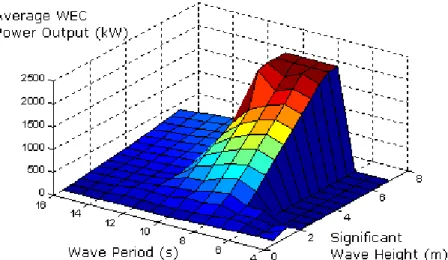
Figure 2.7 depicts the average power output that can be absorbed by the specific wave energy converter (WEC) shown in Figure 2.5, taking into account meteorological parameters described previously of mean wave period and significant wave height.
Figure 2.7- Average power output provided by a 2.2 MW WEC using data of Figs.2.3-2.4.
The buoys are connected to the submerged structure via a hydraulic Power Take-Off (PTO) system, which converts the mechanical energy of the device into electricity. In the case of wave activated body WECs, they can be based on hydraulic components (hydraulic rams and motors) combined with an electrical generator (HENDERSON, 2006), or they can be fully electrical (ERIKSSON, 2007 and RUELLAN et al. 2010), which was assumed in this thesis due to the special conditions of offshore platforms.
One of the key points in the structural design and energy extraction capacity of the device is the response to different periods and wave
0 5 10 15 20 25 30
0 0.5 1 1.5 2 2.5
Time (days)
W
av
e
Po
w
er
(M
W
heights (see Figure 2.8).To evaluate the energy produced by the WEC, water waves are considered to travel along the surface of the sea with an approximate sinusoidal profile, characterized in terms of the time between successive crests and the size of these crests (THORPE, 1999). Wave height and period are represented by statistical measurements, the most common being the significant wave height (around four times the root-mean square of the surface elevation during a given window), and the wave period.
The devices have a maximum range of operation. The power output that can be used by a device is limited to a maximum significant wave height and a minimum wave period. Multiplying the WEC power matrix (Figure 2.8) by the buoy-measured data of the sea location, the average absorbed power output during a specific time period of the device can be derived.
Figure 2.8- Example of a WEC Power Matrix in 3D (SERNA, TADEO 2014)
2.1.2 Wind energy
Wind energy is a renewable energy source which is obtained from air masses in movement (BURTON et al. 2001). Electric power is generated by a turbine that converts a portion of the kinetic energy from the wind into mechanical energy (BIANCHI et al. 2007). This technology has matured to a level of development where it is generally accepted (GONZÁLEZ; LACAL-ARÁNTEGUI, 2016). Wind power is already playing an important role in electricity generation, especially in countries such as Germany, Denmark, Korea or Spain (PÉREZ-COLLADO et al. 2015), (HOU et al. 2017), (KIM; KIM, 2017). World wind energy resources are substantial, and in many areas, such as the US and Northern Europe, could in theory supply all of the electricity demand (JACOBSON; DELUCCHI, 2011). However, the intermittent character of the wind resources and the necessity of long distances for energy transmission are considered the main drawbacks of wind energy.
Nowadays offshore farms are a promising technology (ESTEBAN et al. 2011) and there is considerable hope that offshore wind farms may be the solution (NG; RAN, 2016). Vast offshore areas are characterized by higher and more reliable wind resources in comparison with continental areas. However, offshore wind energy production is in a quite preliminary phase (BALOG et al. 2016). There have been many successes with offshore wind farms in Europe since installations began in 1991 (SUBRAMANI; JACANGELO, 2014).
Vertical Axes Wind Turbine
Figure 2.9- Example of a 30-100kW Vertical Axes Wind Turbine in UK (https://bobbischof.com/about/vertical-axis-wind-turbines-for-micro-generation/).
The energy produced by the wind depends mainly on its speed. Figure 2.10 shows mean wind speed (WS) in the same location and for
the same period of time as in 2.1.1. There can be more variability than in the case of waves, due to differences in inertial masses of water versus air.
Figure 2.10- Mean wind speed in January in North Atlantic Ocean. (ROC, 2014)
Figure 2.11 depicts the average power output that can be absorbed by the specific hybrid VAWT shown in Figure 2.5, taking into account the mean wind speed shown in Figure 2.10. As can be seen, this power
0 5 10 15 20 25 30
0 5 10 15 20
Time (days)
W
ind
s
pe
ed
(m
/s
is even more variable than wave power and depends strongly on meteorological conditions.
Figure 2.11- Average power output provided by a 5 MW VAWT using data of Figs.2.10
Wind turbines have a maximum range of operation. The average power output that can be used by a device is limited to a certain range of mean wind speeds. Figure 2.12 shows the relationship between power output and mean wind speed in this specific VAWT:
Figure 2.12- Power profile of the VAWT developed in the H2Ocean project.
Unlike in the case of wave energy, in which energy depends on two variables (wave period and height), wind energy only depends on one variable (wind speed). Moreover, each VAWT has its own power profile that depends on the wind speed and the VAWT characteristics.
0 5 10 15 20 25 30
0 2 4 6 Time (days) W ind Po w er (M W )
0 5 10 15 20 25 30
0 1 2 3 4 5 6
Wind speed (m/s)
2.2 REVERSE OSMOSIS
Reverse Osmosis (RO) is an intermediate step which desalinates seawater to produce demineralized water, because electrolysis only operates with low conductivity water (less than a few µS). In the last few decades, different techniques for fresh water production have been developed. RO has become the most popular desalination technology (especially for large-scale seawater desalination plants) (GUDE, 2016). The required plant capacity, the product cost, the technology maturity and the coupling of the renewable energy and the desalination systems (GARCÍA-RODRÍGUEZ, 2003) determine RO as the best option for the case proposed in this thesis. Figure 2.13 depicts a typical industrial RO system.
Figure 2.13- Industrial Reverse Osmosis system (http://www.pureaqua.com/what-is-reverse-osmosis-ro/).
The pressure required depends mainly on the salt concentration of the feed flow. Typical values are over 40 bars for brackish water and over 80 bars for seawater (WONG et al. 2012). This pressure is supplied by high-pressure pumps of positive-displacement or (more commonly) centrifugal type (see Fig 2.13). Flow and other characteristics of the desalted water (named “permeate”) depend on many factors, such as salt concentration, operating pressure, temperature, membrane permeability, etc., (LI; WANG, 2010).
Fresh water
Brine Pressurized
seawater
Figure 2.14- Transport of water through an RO membrane
To produce a high desalted water flow, the membranes are packed in different configurations. There are several types of RO membranes such as for seawater, brackish water, high rejection, high recovery, or low flux (GOMEZ PALACIN, 2014). An RO desalination plant has different stages or sections: the pre-treatment of the feed flow, the pumping system with the high-pressure pumps, the RO pressure vessel racks, the post-treatment of the desalted flow before being removed and, finally, the energy recovery of the reject flow before being removed (GOMEZ PALACIN, 2014).
renewable energy and the desalination systems determine the selection (GARCÍA-RODRÍGUEZ, 2003).
Offshore desalination plants powered by renewable energies are being proposed as an alternative for a coastal desalination facility, for those locations where the lack of suitable land makes a land-based desalination plant inadequate (DAVIES, 2005). This is an offshore plant, which makes the implementation of distillation processes difficult. Thus, RO was selected as the desalination technique.
2.3 HYDROGEN
Hydrogen has been considered as an energy source since the nineteenth century (HAMACHER, 2016). Because of global climate change, carbon emissions into the atmosphere should be gradually restricted (OPPENHEIMER; ANTTILA-HUGHES, 2016). Therefore, current energy sources which feed homes, industries and transport should be gradually replaced by alternative sources (GARCÍA-CLÚA, 2013). Hydrogen is a clean energy carrier independent of energy sources (SUBRAMANI et al. 2016) and, when it is produced from renewable energies, offers significant advantages (PANWAR et al. 2011). It is still not a primary energy source such as oil or coal, although it can be considered as an excellent energy vector. One advantage of hydrogen in comparison with other energy sources is that it is everywhere. For example, in water it is bound with oxygen, which is one of the most abundant components on Earth, but it also can be linked with carbon in compounds such as natural gas, coal or biomass.
Figure 2.15- Hydrogen-based car Toyota Mirai (http://www.popsci.com/how-hydrogen-vehicles-work).
2.3.1 Hydrogen production
Nowadays, worldwide hydrogen production was estimated at around 50 million tons in 2013 and most of the production is obtained from natural gas reforming (KROPOSKI et. al. 2006). This production method currently prevails due to its profitability, but the sources from which hydrogen can be obtained are varied. The state of the art of the technologies associated to hydrogen production is very different; while some technologies are still in a research stage, others are already well known on a laboratory scale.
2.3.1.1 Black H2
Steam reforming
Steam Methane Reforming, SMR, is the least expensive method and therefore the most used to produce hydrogen nowadays (GARCÍA-CLÚA, 2013). It is the most common technology for H2 production on a
large scale in the chemical industry and refineries. SMR is the endothermic chemical reaction in which methane, the main component of natural gas, reacts with steam to deliver a mixture of H2 gas and
carbon monoxide called syngas (TSUBOI et al. 2017). The heat required for the reaction is normally obtained by combustion of the methane feed gas. Reaction 2 is called WGSR (Water-Gas Shift Reaction). Figure 2.16 shows the SMR process:
CH4 + H2O + heat CO + 3H2 (1)
CO + H2O CO2 + H2 + heat (2)
Figure 2.16- Steam reforming of natural gas process
(https://wiki.uiowa.edu/display/greenergy/Steam+Reforming+of+Natural+Gas).
Partial oxidation
Partial oxidation is a reforming process where the fuel is partially burned. The exothermic reaction (3) provides the heat required by the other reforming reactions, resulting in CO and H2. The CO produced is
then converted into H2 according to the WGSR reaction (2).
CH4 + ½ O2 CO +2H2 + heat (3)
This technique is often applied in refineries for the conversion of waste into H2, CO, CO2 and H2O. Fuel oils, gasoline and methanol can
also be raw materials. Some shortcomings are its low efficiency, the requirement of pure O2 and its high level of pollution, more than SMR
(GARCÍA-CLÚA, 2013).
Figure 2.17- Partial oxidation process scheme
(http://www.gasification-syngas.org/technology/syngas-production/).
Pyrolysis
Pyrolysis is the thermochemical decomposition of organic material at elevated temperatures in the absence of O2. It involves the
decomposition is performed without O2 at a temperature of 1600° C in a
plasma reactor (DONG et al. 2015). The full reaction is given by equation (4).
CH4 C +2H2 (4)
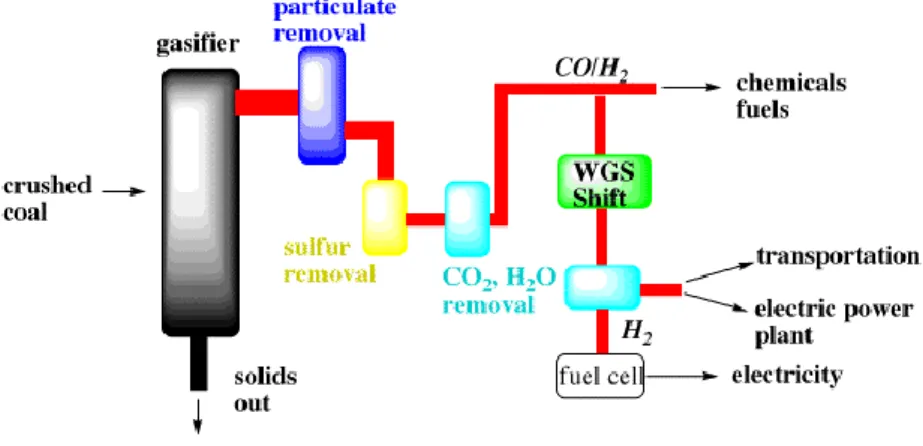
Gasification
Coal gasification is a process that converts solid coal into synthesis gas mainly composed of H2, CO, CO2 and CH4. The reaction is
C +H2O + heat CO + H2 (5)
Coal can be gasified by controlling the mix of coal, oxygen and steam into the gasifier (SHOKO et. al. 2006). Due to the fact that the reaction is endothermic, additional heat is required as in the SMR. CO produced is then converted to H2 and CO2 through the WGSR reaction
(see reaction 2). In most applications, H2 needs to be purified before
future applications. Despite this procedure being already commercially available, nowadays, it can only compete with SMR in countries where the cost of natural gas is very high (GARCÍA-CLÚA, 2013).
Figure 2.18- Coal gasification process scheme
2.3.1.2 Green H2
The use of biomass as a renewable energy resource is nowadays becoming a reality. The production of H2 from biomass can be divided
into three main categories (NI et al. 2006):
1. Direct production (e.g. pyrolysis/gasification, which are similar to the “black H2” discussed in section 2.3.1.1).
2. Indirect means of production via reforming biofuels (e.g. biogas, biodiesel).
3. Metabolic processes that disintegrate water via photosynthesis to produce a WGSR reaction through photo-biological organisms.
Producing H2 by extraction from biomass can be considered better
than in the case of fossil fuels, as the raw material consumes CO2 from
the atmosphere during its growth, so it is considered renewable and carbon-free (GARCÍA-CLÚA, 2013).
2.3.1.3 Blue H2
Electrolyzation is a mature, market-available technique (see Figures 2.19-2.22) that can operate intermittently, producing large volumes of hydrogen without greenhouse gas emissions, as long as the electricity is provided by renewable sources (DOS SANTOS et al. 2017). Figure 2.18 depicts the simplest scheme of electrolysis reaction. The full electrolysis reaction is given by Equation (6):
H2O + electricity H2 ↑ + ½ O2 ↑ (6)
Figure 2.19- Scheme of the electrolysis reaction
(http://www.diracdelta.co.uk/science/source/w/a/water%20electrolysis/source.html#. WJHVNH_iSyI).
There are two main types of low temperature electrolyzers: alkaline (GANLEY, 2009) and proton exchange membrane, PEM (BARBIR, 2005), which are the most frequent in the market. Furthermore, there exist high temperature electrolyzers (SOEC), but they are still only a promising technology (SCHILLER et al. 2009).
Alkaline electrolysis
Alkaline electrolyzers generate H2 with a purity better than
99.97%, which is the quality used in the automotive industry (PETERSEN, 2012). They are already available at the power levels (about MW) that make the technology cost-efficient (see Refs (VALVERDE et al. 2016), (RASHID et al. 2015), (MORGAN et al. 2013) and (XIANG et al. 2016) for details). An aqueous solution of 20 to 30% potassium hydroxide (KOH) is used as the ionically conductive medium. The electrodes immersed in this electrolyte are polarized by electrochemical reactions (7) and (8), resulting in the overall reaction (6) presented before:
Cathode 2H2O + 2e
- H2 ↑ + 2OH
-(7) Anode 2OH- ½ O2 ↑ + H2O + 2e
Each cathode-anode pair forms a basic electrolysis cell that operates at 1.9-2.5V DC. There are two types of cell design: unipolar and bipolar. Unipolar cells are interconnected in parallel by single polarity electrodes. In this way, high currents and low voltages are obtained. Unipolar cells are simpler to repair than bipolar. Bipolar cells are interconnected in series leading to higher battery voltages, thus, electrodes assume both polarities. Each of the electrodes acts as an anode on one face and as a cathode on the other, except those located at the ends. The stack is connected via alternating layers of electrodes with separation membranes and compressing the assembly with clamps. As cells are relatively thin, the entire stack can be considerably smaller than in the unipolar design. One disadvantage is that a cell cannot be repaired without removing the entire stack. The main challenges for the future of alkaline electrolysis are reducing costs and increasing energy efficiency (GARCÍA-CLÚA, 2013). Figure 2.20 presents a bipolar design of an alkaline electrolyzer stack.
PEM Electrolysis
A second electrolyzer technology that is commercially available is the solid Polymer Electrolyte Membrane, or PEM. In a PEM electrolyzer, the electrolyte is in a thin, solid, ion-conducting membrane instead of the aqueous solution of alkaline electrolyzers. This allows protons to transfer from the anode to the cathode and, in this way, H2
can be separated from O2 (GARCÍA-CLÚA, 2013). PEM electrolyzers
have advantages in terms of safety when compared with alternative technologies (see (MANSILLA et al. 2013) and references therein); moreover, they have already been successfully tested in marine environments (DI BLASI et al 2013). Hydrogen is produced at the cathode side and oxygen on the anode side, following reactions (9) and (10). In the case of an acidic PEM cell, it is assumed that liquid water splitting occurs according to the following half-cell reactions:
Cathode 2H+ + 2e- H2 ↑ (9)
Anode H2O ½ O2 ↑ + 2H +
+ 2e- (10)
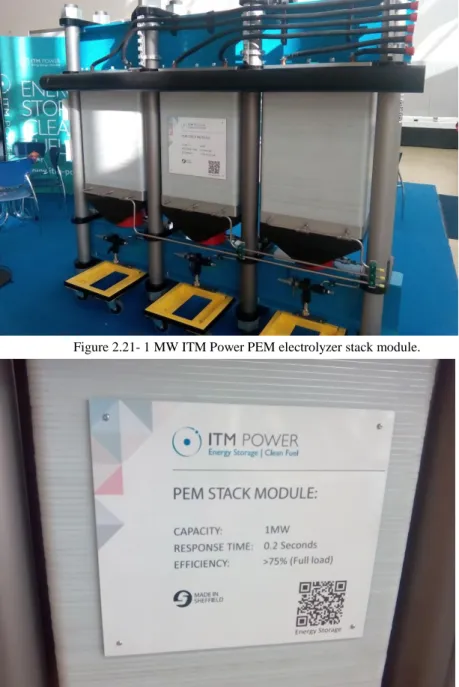
Solvated protons formed at the oxygen-evolving anode of the PEM cell migrate through the membrane to the cathode, where they are reduced to molecular hydrogen. PEM technology is one of the most promising water electrolysis technologies for direct coupling with renewable electrical sources (ROZAIN et al: 2016, MENDES et al. 2016). Figures 2.21 and 2.22, respectively, show a PEM module and stack.
High temperature electrolysis
Figure 2.21- 1 MW ITM Power PEM electrolyzer stack module.
These studies focus on the development of the inherent manufacturing processes, and the integration in efficient and durable electrolyzers. Also interesting is the fact that SOECs could be used for the electrolysis of CO2 to CO, and also for the co-electrolysis of
H2O/CO2 to H2/CO (syngas) (CARMO et al. 2013). The SOEC
technology is still a promising technology, but has a huge potential for the future mass production of H2, if the issues related to operation and
durability of the ceramic materials at high temperature are solved (REITER, 2016).
2.4 MODEL PREDICTIVE CONTROL
The term Model Predictive Control (MPC) does not designate a specific control strategy, but a very ample range of control methods which make explicit use of a model of the process to obtain the control signal by minimizing an objective function. Three decades have passed since milestone publications by several industrialists spawned a flurry of research and industrial/commercial activities on MPC (LEE, 2011). This control system has been popular in industry since the 1980s and there is steadily increasing attention from control practitioners and theoreticians (CAMACHO; BORDONS, 2013). Throughout the three decades of the development, theory and practice supported each other quite effectively, a primary reason for the fast and steady rise of the technology (LEE, 2011). MPC was originally studied and applied in the process industry, where it has been in use for decades (MORARI; LEE, 1999). Now, predictive control is being considered in other areas, such as power electronics and drives (RODRIGUEZ et al. 2013). The reason for the growing interest in the use of MPC in this field is the existence of very good mathematical models to predict the behaviour of the variables under control in electrical and mechanical systems (VAZQUEZ et al. 2014). Comparing with other methods of process control, MPC can be used to solve the most common problems in today's industrial processes, which need to be operated under tight performance specifications where many constraints need to be satisfied (CHRISTOFIDES et al. 2013).
2.4.1 MPC strategy
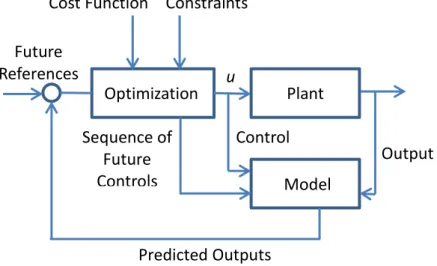
outputs, based on past and current values and on the proposed optimal future control actions. These actions are calculated by the optimizer, taking into account the cost function as well as the constraints (CAMACHO; BORDONS, 2013). All MPC controllers follow this strategy:
1-The predicted outputs for a determined horizon N, called the prediction horizon, are predicted at each instant k using the process model. These predicted outputs depend on the sequence of future control signals u, which are those to be sent to the system to be calculated.
2-The sequence of future control signals is calculated by optimizing a determined criterion in order to keep the process as close as possible to the future references. This criterion usually takes the form of a cost function. Constraints are also included in the optimization block.
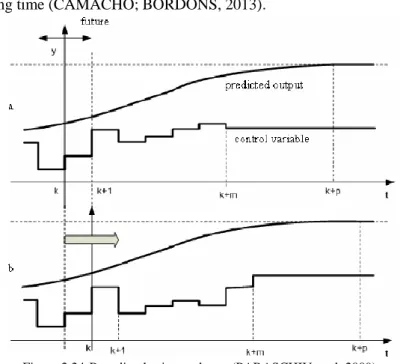
3-MPC uses a receding horizon strategy; thus, although a set of future control moves are computed in the optimization block, only the first control action of the sequence (u) is applied and the procedure is repeated at the next sampling time (LEE, 2011).
Figure 2.23-Model Predictive Control (MPC) scheme.
A model is used to predict the future plant outputs, based on past and current values and on the proposed optimal future control actions. These actions are calculated by the optimizer, taking into account the
Output
Optimization
Plant
Model
Future
References
Constraints
Cost Function
u
Sequence of
Future
Controls
cost function (where the future tracking error is considered) as well as the constraints. The process model consequently plays a decisive role in the controller. The chosen model must be capable of capturing the process dynamics so as to precisely predict the future outputs, as well as being simple to implement and to understand. The optimizer is another fundamental part of the strategy as it provides the control actions (CAMACHO; BORDONS, 2013).
2.4.2 Receding horizon
It is important to remark that one of the most important characteristics of the MPC is the use of the receding horizon. At each instant, the horizon is displaced towards the future, which involves the application of the sequence calculated at each step k. In this type of strategy, only the first control actions are taken at each instant and the procedure is again repeated for the next control decisions in a receding horizon fashion (unlike other classical control schemes such as PIDs, in which the control actions are taken based on past errors). In the receding-horizon strategy, only the first elements of the control variable are used, rejecting the rest and repeating the calculations at the next sampling time (CAMACHO; BORDONS, 2013).
2.4.3 Constraints
To solve MPC constraints in this thesis, the Mixed Logical Dynamical System (MLD) will be used. The MLD was developed for the first time by (BEMPORAD; MORARI, 1999) to associate the performance of the system with discrete variables δ and continuous variables α. MLD conversions make it possible to include binary and auxiliary variables, introduced in a discrete-time dynamic system to describe, in a unified model, the evolution of the continuous and logic signals of the system.
The MLD MPC results in an optimization problem with a set of linear constraints and integer (in this case Boolean) decision variables. With the introduction of a series of basic conversions, given in Table 1.1, the non-linearity of the system, introduced by the combination of logical and dynamic variables, is transformed into constraints of the control algorithm (GARCÍA-TORRES, 2015). In Table 1.1, m and M represent the lower and upper bounds of the system and ε > 0 is the smaller tolerance of the device (BEMPORAD; MORARI, 1999).
Relation Logic MLD Inequalities
P1 AND (˄) S1 ˄ S2 δ1 = 1, δ2 = 1
P2
S3 ↔ (S1 ˄ S2)
-δ1 + δ3 ≤ 0
-δ2 + δ3 ≤ 0
δ1 + δ2 – δ3 ≤ 1
P3 OR (˅) S1 ˅ S2 δ1 + δ2 ≥ 1
P4 NOT (~) ~ S1 δ1 = 0
P5 IMPLY (→) S1 → S2 -δ1 - δ2 ≤ 0
P6 IF (↔) S1 ↔ S2 -δ1 - δ2 = 0
P7 [aTx ≤ 0] → [δ = 1] aTx ≥ ε + (m - ε)
P8 [δ = 1] → [aTx ≤ 0] aT ≤ M - Mδ
P9
[aTx ≤ 0] ↔ [δ = 1] aT ≤ M – Mδ
aT ≥ ε + (m - ε) δ
P10
Mixed
Product z = δ∙aTx
z ≤ Mδ z ≥ mδ z ≤ aTx – m(1- δ)
2.5 CONTRIBUTIONS OF THE THESIS
2.5.1 Journal papers
SERNA, A.; YAHYAOUI, I.; NORMEY-RICO, J. E.; de PRADA, C.; TADEO, F. Predictive control for hydrogen production by electrolysis in an offshore platform using renewable energies. International Journal of Hydrogen Energy, 42(17) 12865-12876, 2017. IF (2016): 3.6.
SERNA, A.; TADEO, F.; NORMEY-RICO, J. E. Ruled-based control of off-grid desalination powered by renewable energies. Renewable energy and sustainable development, pp 205-213, 1, No1, 2015. SERNA, A.; TADEO, F. Offshore hydrogen production from wave energy. International Journal of Hydrogen Energy, 39(3), 1549-1557, 2014. IF (2014): 3.3.
SERNA, A.; TADEO, F. Offshore desalination using wave energy. Advances in Mechanical Engineering, 5, 539857, 2013. IF (2013): 0.5.
2.5.2 Conference papers
SERNA, A.; TADEO, F.; YAHYAOUI, I.; NORMEY-RICO, J. E. Business background analysis for a controlled hydrogen-based microgrid. In Proceedings of the 14th International Workshop on Advanced Control and Diagnosis (ACD), November 2017, Bucharest, Romania.
SERNA, A.; TADEO, F.; NORMEY-RICO, J.E. Advanced control based on MPC ideas for offshore hydrogen production. In Proceedings of the 38th Jornadas de Automática 2017, September, Gijón, Spain.
SERNA, A.; TADEO, F.; NORMEY-RICO, J. E.; AGERSTED, K. Ruled-based control of off-grid electrolysis. In Proceedings of the 21st World Hydrogen Energy Congress (WHEC), June 2016, Zaragoza, Spain.
SERNA, A.; TADEO, F.; NORMEY-RICO, J. E. Mixed-Integer-Quadratic-Programming based Predictive Control for hydrogen production using renewable energy. In Proceedings of the 7th International Renewable Energy Congress (IREC), March 2016, Hammamet, Tunisia. (pp. 1-6). IEEE.
SERNA, A.; TADEO, F.; NORMEY-RICO, J. E. Control avanzado basado en ideas de control predictivo para la producción de hidrógeno mediante electrólisis. In Proceedings of the 14th Simposio de Ingeniería de Control CEA 2016, March 2016, Logroño, Spain.
SERNA, A.; TADEO, F.; NORMEY-RICO, J.E. Producción de hidrógeno por energías renovables en una plataforma híbrida en alta mar. In Proceedings of the 36th Jornadas de Automática 2015, September, Bilbao, Spain.
SERNA, A.; NORMEY-RICO, J. E.; TADEO, F. Model predictive control of hydrogen production by renewable energy. In Proceedings of the 6th International Renewable Energy Congress (IREC), March 2015, Sousse, Tunisia. (pp. 1-6). IEEE.
SERNA, A.; TADEO, F.; TORRIJOS, D. Heuristic control of multi-stage desalination plants under variable available power. In Proceedings of the 15th International Conference of Sciences and Techniques of Automatic Control and Computer Engineering (STA), December 2014, Hammamet, Tunisia. (pp. 853-858). IEEE.
SERNA, A.; TORRIJOS, D.; TADEO, F., TOUATI, K. Evaluation of wave energy for a near-the-coast offshore desalination plant. In Proceedings of the International Desalination Association (IDA) World Congress, October 2013, Tianjin, China.
2.5.3 Other contributions
ISBN: 9780128129593 and one chapter in the book titled: “Advances in Renewable Energies and Power Technologies: Volume 2: Geothermal and Biomass Energies, Fuel Cells and Smart Grids” ISBN: 9780128131855. Edited by Dr. Imene Yahyaoui. Elsevier, 1st January 2018.
YAHYAOUI, I.; ATIEH, A.; SERNA, A.; TADEO, F. Sensitivity analysis for photovoltaic water pumping systems: Energetic and economic studies. Energy Conversion and Management, 135, 402-415, 2017. IF (2016): 5.6.
SERNA, A.; TADEO, F.; NORMEY-RICO, J. E. Control de la producción de H2 por energías renovables en una plataforma híbrida en
alta mar. In the 3rd Jornadas del Programa de Doctorandos de la Universidad de Valladolid, September 2016, Valladolid, Spain. Poster presentation.
SERNA, A.; TADEO, F.; NORMEY-RICO, J.E. (2015, March). Sistema de control en la producción de hidrógeno en alta mar mediante energías renovables. In the 8th Reunión de Jóvenes Investigadores Iberoamericanos, March 2015, Tordesillas, Spain. Poster presentation.
SERNA, A.; TADEO, F. Modelling of an offshore hydrogen production from wave energy. In Proceedings of the 4th International Renewable Energy Congress (IREC), December 2012, Sousse, Tunisia. Oral presentation.
SERNA, A.; TADEO, F.; de PRADA, C. The H2OCEAN Project: A wind + wave power open-sea platform equipped for hydrogen generation. In Offshore Wind Turbines Workshop, University of Hull, September 2012, Hull, UK. Poster presentation.
2.5.4 Patent and intellectual property registration
Title: Offshore hydrogen production using wave energy Author: ÁLVARO SERNA CANTERO
Reference number: VA-299-2013 Year: 2013
Winner of the University of Valladolid “Prometeo” award 2013 whose aim is the stimulation of the application of knowledge, as well as collaboration between knowledge-generating agents and specialists in the transfer of knowledge and the promotion of a culture of innovation and creativity. For this, this award provides incentives for the development of market-oriented prototypes, achieving a set of products that can be offered to meet the needs of the market.
2.6 ORGANIZATION OF THE THESIS
This thesis is organized as follows:
Chapter 1: This chapter introduces the thesis content. Section 1.1 gives the motivation, while section 1.2 give details of the objectives proposed for this thesis.
Chapter 2: This chapter deals with the state of the art of the technologies developed in the thesis. Section 2.1 is dedicated to renewable energies. Section 2.2 gives a review of reverse osmosis. Section 2.3 presents information about hydrogen economy and production, followed by a summary of Model Predictive Control theory (Section 2.4). Finally, the contributions of the thesis are detailed.
Chapter 3: This chapter focuses on the design of control strategies for the production of water by Reverse Osmosis and hydrogen by electrolysis within the H2OCEAN offshore platform. Section 3.1 is dedicated to the fresh water production, whilst Section 3.2 deals with hydrogen production. Finally, this chapter ends with some conclusions.
Chapter 4: This chapter develops an Energy Management System of hydrogen production (EMSH) based on Model Predictive Control
ideas optimizing the connections and disconnections of the electrolyzers. This numerical optimization solves a Mixed-Integer Quadratic Programming algorithm with constraints.
Chapter 5: This chapter comprises the coupling of a short-term control system with the long-term EMSH proposed in Chapter 4 for a
Chapter 6: This chapter includes some conclusions and future work.
Annex: This annex presents an economic study and a business plan for the hydrogen-based microgrid proposed in Chapter 5.
2.7 SUMMARY AND CONCLUSIONS
In this chapter, an overall introduction of the technologies developed in the thesis has been detailed:
Wind and wave energy are the energy sources chosen to produce energy, as they can be easily obtained in the H2OCEAN platform.
Reverse Osmosis is the most adequate technology to transform seawater into fresh water. It is very well known and commercially available.
Electrolysis has been chosen to obtain hydrogen from water due to its technological maturity and easy implementation.
Model Predictive Control is an advanced control strategy that can be used to solve the most common problems in today's industrial processes, which need to be operated under tight performance specifications. Thus, it was chosen to design the Energy Management System for hydrogen production that is fully developed in Chapter 4.