
Impact of implementing industry 4 0 in Colombia’s supply chains
11
0
0
Texto completo
(2) 2. 2. Methodology. For the elaboration of this article, different bibliographic databases were consulted such as IEEE Explore, Science Direct, Cengage, Engineering Village and Scopus; The keywords used in all databases were Supply Chain, Internet of Things, Industry 4.0, Optimization and Automation. Additionally, relevant articles were consulted, current news, publications in academic magazines such as the magazine of the Mining Faculty in the Universidad Nacional de Colombia, SpringerLink, European Research of Company Management and Economy. Furthermore, different search engines were used such as Google Scholar, Mendeley, Google Books, among others. Within the sources of interest, the most relevant topics were established by searching the main characteristics of the topic.. 3. Introduction to Industry 4.0. In this field, there has been some research and one of the researchers named Bauer states that competitiveness has its base in flexibility since this is reflected on shorter deadlines, diversity in the demand and customization of the product which gives birth to the term Industry 4.0. To reach this state, industrial processes were involved in the so-called industrial revolutions. The first one occurred between the 18th and 19th centuries which introduced mechanical aspects into the production process by using steam and hydraulic energy. The second industrial revolution took place at the end of the 19th century as electric energy and production began to strengthen the industry giving way to scheduling and task organization leading to efficiency. The third revolution came in the 1970s with the appearance of electronics and information technologies. These technological advances allowed the automation of production processes. Finally, the fourth revolution is currently underway which has consolidated the production through technological, informatics and communication processes with reduction in the expenses and greater efficiency. In 2015, Blanchet stated that the fourth revolution has allowed some sectors to change more rapidly than others. Given the previously mentioned communicative processes, it is important to highlight that higher efficiency is related to production elements linked to the internet. This is how the concept of Industry 4.0 emerges. “The fourth industrial revolution is not defined by a set of emerging technologies per se, but instead by a transition to new systems that are built over the infrastructure of the (previous) digital revolution” quoted from Schwab, executive director of the World Economic Forum (WEF) and one of the main enthusiasts of the revolution. It can be evidenced that Industry 4.0 was derived from two important aspects. In 2014, Lasi considers that there are aspects which are extremely related to the society.
(3) 3. and the economy. This can be explained by the fact that shortening production and transportation times is a competitive advantage which is essential to companies. Flexibility is another important factor since it enables the customization of the client‟s needs in terms of the product. By offering this service, the interest of the client on the company is increased but to work on this aspect it is crucial that the machinery of the production process can effectively adapt to changes and modifications [3].. 4. Introduction to the supply chain. The supply chain is a set of interrelated processes that can be grouped in to two large areas: evolution and planning [4]. It is a set of functional activities that are repeated many times over the productive flow channel in order to convert raw materials into finished products. Value is thereby added to the product for end user [5]. The management of the supply chain uses advanced technology, information management, operational research and organizational planning with the purpose of correctly programming and controlling factors to better produce and deliver the products and services to satisfy the customer [6].. 5. Scope. Currently, the term Industry 4.0 is gaining momentum in all the practices and tools that it encompasses. Technology is the driving force of the supply chain and many technological mechanisms are available [7]. Technological tools allow the companies to automate functions in order to eliminate redundancies and costs, generate information that support management plans as well as the tasks of execution, evaluation and connection of people‟s skills and experience. The Internet of Things (IoT) offers the possibility to learn and interact with machines through different tools and devices such as sensors, actuators, screens, software and other systems connected to the internet [8]. The implementation of IoT systems can perfectly integrate the cybernetic world with the physical world and has led to crucial changes that have powered human interaction with the digital world [9]. It is no secret that current business, production and other types of models tend to disappear since it is not always clear what must be reinvented or what needs to be modified or updated in the working model that has been used for a long time. Models that manage to survive will have infinite benefits in the future in terms of costs, speed, performance and other vital factors throughout the supply chain. The supply chain has included the fourth industrial revolution which allows useful tools to evolve, develop and be potentiated such as the visibility of the inventory in real time, the input of purchases, the state of the exits from the inventory, the operational movements, the sudden flaws which will lead to a faster response to both the client‟s needs and the operation. The standardization and improvement of some processes can be achieved as well as the creation or organization of new links [10]..
(4) 4. This strategy seeks to align the operation and generate more control that is accurate and opportune with the purpose of predicting flaws and long-term improvements [11]. The intellectual capacity and technology have improved the supply chain through different tools that let companies capture the voice of the client. Communication throughout all the stages of the supply chain enables the reaction to the needs with a flexible production, automated storage and process optimization and automation [12] [13]. Some of the most used tools and media (TICs, GPRS technology, RFID, low-power networks to sense in palettes) are labeled as smart and can be considered alternative modern processes that emerge from the need to handle a large amount of products and information flows [11]. The inclusion of new technologies such as robotics, the Internet of Things, nanotechnology, artificial intelligence and 3D printing are generating an important shift worldwide [14]. The automation and optimization of many processes through new technologies will progressively reduce the functions performed by mankind with machines that are faster and more productive. This is more attractive in terms of investment and offers economic benefits. Currently, this means that we are building the future. The convergence of a large number of new materials, developments, robust software, faster connection networks, efficient processes and Internet-based services is changing the industry [1]. The industry 4.0 also called the fourth industrial revolution is known for implementing robots and integrating them to cyber-physical systems with the purpose of achieving a radical transformation. These advances and changes over different methodologies have led to the creation of smart factories [15]. The fourth industrial revolution poses a new challenge for organizations that need to adapt and continue to be supported on a digital transformation. If this challenge is not adequately faced, the company could be left out of the market as it was seen in previous technological revolutions [16].. 6. Consequences and impact. Companies should profit from market analysis to improve their supply chains and attend the user demand since customization of products requires a strong connection between the sales department and production capacity. The planning systems that include technology from Industry 4.0 should break down the demand to improve the visualization of the supply chain throughout the different links with the purpose of detecting the possible incidences caused. The impact is hard to dimension since these technologies are having an impact on a global scale in the social, economic, political and work aspects. The real consequences will arise as time passes on [10]. The fourth industrial revolution has had real consequences nowadays due to the implementation of new technologies and systems that have allowed the development of new industrial.
(5) 5. and commercial applications which entails direct and indirect consequences that fall on the employee. A relevant aspect is the human factor and which is the most important asset in a company and no change would be possible without it. Although there is a strong focus on technology, highly-qualified professionals are still necessary to plan, control and develop all the processes. It is important that the companies allocate a part of the investment into the integral formation of the employee so that the teams working inside a company are prepared to face the needs of a market that changes every day [1]. According to the International Labor Organization (ILO), the unemployment rate measures the percentage of the population in working age that does not have a job, but is “available and looking for” employment [17].. Fig 1. The unemployment according to the International Labor Organization (ILO). Taken from: https://datos.bancomundial.org/indicador/SL.UEM.TOTL.ZS?end=2017&start=1991 &view=map The organization estimates that the number of people unemployed worldwide will surpass 201 million with an additional increase foreseen of 2,7 million in 2018 [18]. This situation is notably related to the companies seeking to reduce operation and process times as well as other variables that replace manpower. Hence, this implementation can be detrimental since robots could do the same tasks that people currently do; the robot can even replace one or more persons because he does the job while being faster and cheaper. The WEF discussed this matter last year when a report was presented in Davos that argued that the digitalization of the industry will suppose the disappearance of 7,1 million jobs and the creation of another 2,1 million for 2020 [19]. To combat this.
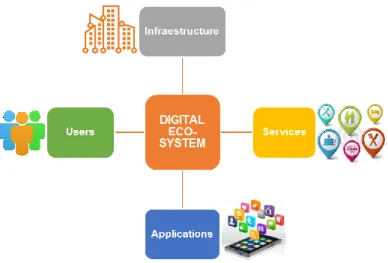
(6) 6. effect, it is necessary that employees are better trained in target areas of the industry 4.0 which means that some skills need to be added and potentiated. There are learning factories that contribute to guide the path to new production trends as the industry 4.0 [20].. 7. Implementation in Colombia. In Colombia, the last few years have seen an increase in the interest for the connectivity of the country with the rest of the world. In 2009, the Communications Ministry of the Republic of Colombia became the Ministry of Information Technologies and Communications (ITC) according to Law 1341 or TIC Law which is the entity in charge of designing, adopting and promoting policies, plans, programs and projects in the sector of Information Technology and Communications. Its functions include to increase and facilitate access to all inhabitants of the national territory to the ITC and their benefits [21]. Next, the scheme represents the relation between the general relation of the digital ecosystems with different focuses that are evidenced in the country. The users, infrastructure, services and applications are considered.. Fig 2. Ecosistema digital Adapted from: http://www.mintic.gov.co/portal/vivedigital/612/w3-propertyvalue19438.html One of the plans of the Ministry of ITC is the “Live digital” (“Vive digital” in Spanish) strategy which, seeks that the country takes a great technological leap through the massification of the internet and the development of national digital ecosystem. In spite of this plan and other policies that have been implemented in the country, the efforts haven‟t been sufficient. The increase in the ITCs in the country has been slow and globalization forces Colombian companies to compete with the rest of the world, so the process must be accelerated. To achieve this, the public, private.
(7) 7. and academic sectors must emphasize their efforts in moving on to Industry 4.0 in Colombia [21]. In the country, the strategy has just begun to interact with the industry. In some cities such as Bogotá and Medellin, the technological and industrial breakthrough is more noticeable. In 2013, Medellin participated in the “City of the year” contest and won recognition to being the most innovative city in the world which establishes a precedent in Colombia [22]. The transportation, communication and services sectors are the most advanced in the implementation of the Industry 4.0 technology which has generated new strategies to give answer to the clients. In the country, some companies can be recognized for implementing industry 4.0 such as Uber, Emermedica and financial entities. Most of the companies have implemented web platforms which allow users to carry out more processes through the network. A large amount of applications has been developed which allow the interaction between people and information that is found online such as Waze and Google Maps. It is important to highlight that the country has not profited from new technologies. Innovation is clearly scary and there is always a resistance to change. This is a common problem in the country and companies do not want to revolutionize or branch out into new digital tools [19]. In Colombia there are already a number of companies that have focused their efforts on the implementation of Industry 4.0, sectors such as mining, oil, water treatment plants and manufacturing, have discovered the benefits of the correct implementation of the Industry 4.0, this is the case of Kaeser Compressors which is in the ranking of the 20 most innovative companies in the world in Industry 4.0 according to the Internet of Things Institute. Industry 4.0 is growing in the country but due to limited technological conditions, the companies that wish to implement it must face great challenges. However, there are companies that have implemented different technologies throughout the supply chain and have better positioned themselves in the market. They can serve as a guide to new companies although logistic advances are expected in the following years that allow the implementation of the strategy in Colombia. Finally, the logistic improvement efforts need different focuses. Not only must there be concern on the country‟s logistic infrastructure but there must also be an emphasis on the communication processes and interactions with the client as well as the decision making based in their requirements and demands so that commercial relations are not lost.. 8. Proposed implementation. In Colombia, industry 4.0 has had very little application due to most companies being small or medium-sized. There are diverse factors that support this behavior in the.
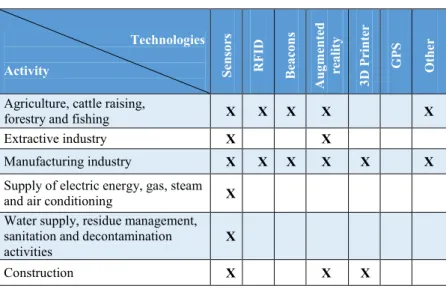
(8) 8. country. One of them is the lack of information, knowledge and tools that directly affect technological and industrial development. It is detrimental that industry 4.0 has not been implemented in Colombia because its application and implementation could contribute to solving many inconvenients and problems of the national companies. Hence, the following methodology is proposed to diagnose the needs of the small and medium-sized companies and propose solutions based on industry 4.0 that would solve them. 1. Determine the issues to solve in the company as well as the critical processes that need improvement, work flow, etc. 2. Determine the main objective to reach with industry 4.0. Some examples are: - Regulate and optimize the flow of materials - Improve the security of the processes - Improve the level of availability of the materials 3. Determine the technologies to implement according to the activities of the company and the desired goals. To achieve this, the studies carried out on the matter can be considered. The following table suggests some technologies for each productive sector. The selection of the technologies should be based in terms of the costs of acquisition, installation and maintenance to adjust the implementation budget. 4. Determine the informatics system that will register the data and process the information obtained with the implementation of industry 4.0. - The information should be stored in the cloud - Determine the staff in charge of the interpretation of the information 5. Determine the sectors and departments of the company that would be affected by the changes that will be implemented since the collaborators of these areas must be educated on industry 4.0 and the technologies that will be implemented as well as its benefits.. Manufacturing industry Supply of electric energy, gas, steam and air conditioning Water supply, residue management, sanitation and decontamination activities Construction. X. X. X. X. X X. X. X X. X. X. X. X X X. Other. X. GPS. X. 3D Printer. Augmented reality. Agriculture, cattle raising, forestry and fishing Extractive industry. Beacons. Activity. RFID. Technologies. Sensors. Table 1. Suggested Industry 4.0 technologies for each activity sector. X.
(9) 9 Retail and wholesale commerce, engine-based cars repair. X. X. X. Transport and storage. X. X. X. HostelHH Hostelry Finance and insurance Professional, scientific and technical activities Management and assistance Public administration and defense, social and mandatory security Education. X. X. X. X. X. X. X. X. X. X. X. X. X. X. X X. X X. Social services and sanitary activities. X. Art, recreation and entertainment. X. Other services. X. Home activities. X. X X X X. X. X. X. X. X. X. X. X. X. X. Adapted from: MARTÍ, D. L. P. (2016), Análisis de Casos de Estudio sobre Industria 4.0 y Clasificación según Sectores de Actividad y Departamentos Empresariales.. 9. Conclusions. The fourth industrial revolution is not an easy challenge but it can become the opportunity for organizations to immerse themselves in the digital era. Industry 4.0 should focus on the distribution, storage and implementation of technologies that facilitate the flow of information throughout the supply chain to satisfy the customer needs. It is important to consider the climatic and geographical conditions of the country offer a relevant scenario for the correct development of the labors of the supply chain. All of this suffers from modifications as institutions and government entities solve the failures in the infrastructure derived from the inefficient use of resources to improve access routes, ports, etc. Industry 4.0 in Colombia is a field that has not been widely developed so its study and application must be motivated by the companies and the academia. One of the fields of study is the logistics and the immersion in the supply chain and other productive processes. As a final aspect, it is noteworthy that the implementation of Industry 4.0 allows companies to have faster responses, more standardized distribution channels and clients more satisfied with the products and services that they offer. This will potentiate the country‟s productive sector in a considerable manner..
(10) 10. References 1. “La cuarta revolución industrial | Opinión | EL PAÍS.”, https://elpais.com/elpais/2013/05/22/opinion/1369216935_294419.html, last accessed 2017/11/06. 2. G. Schuh, T. Potente, R. Varandani, C. Hausberg, and B. Fränken, “ScienceDirect Collaboration Moves Productivity To The Next Level,” Procedia CIRP, vol. 17, pp. 3–8, (2014) 3. D. L. P. MARTÍ, “Análisis de Casos de Estudio sobre Industria 4.0 y Clasificación según Sectores de Actividad y Departamentos Empresariales.,”(2016) 4. F. Sabriá, A. T. De an, and A. Fernández, La Cadena de suministro. Marge Design Editors, (2004) 5. R. H. Ballou, Log stica administración de la cadena de suministro. Pearson Educación, (2004) 6. Jorge H. Chavez, Supply Chain Management (Gestión de la cadena de suministro), Segunda. (2012) 7. D. &kulvwrsk+huupdqq and D. 6hedvwldq7klhgh, “Industry 4.0 Impacts on Lean Production Systems,” Procedia CIRP, vol. 63, pp. 125–131, (2017) 8. G. Peralta, M. Iglesias-urkia, M. Barcelo, R. Gomez, A. Moran, and J. Bilbao, “Fog Computing Based Efficient IoT Scheme for the Industry 4 . 0.” 9. A. H. H. Ngu, M. Gutierrez, V. Metsis, S. Nepal, and M. . Sheng, “IoT Middleware A Survey on Issues and Enabling technologies,” IEEE Internet Things J., vol. 4, no. 1, pp. 1– 1, (2016) 10. H.-C. Pfohl, B. Yahsi, and T. Kuznaz, “The impact of Industry 4.0 on the Supply Chain,” Proc. Hambg. Int. Conf. Logist. (HICL)-20, no. August, pp. 32–58, (2015) 11. “¿Por qué digitalizar ahora su cadena de suministro? - Prakxon.”, http://www.prakxon.com/digitalizar-ahora-cadena-suministro/, last accessed 2018/01/03. 12. Robert Handfield, “What is Supply Chain Management? - SCM | Supply Chain Resource Cooperative (SCRC) | North Carolina State University,” What is Supply Chain Management?, (2011) 13. M. Fisher, “What is the Right Supply Chain for Your Product?,” Harv. Bus. Rev., vol. 75, no. 2, pp. 105–116, 1997. 14. N. P. Betancur, “EL SENA A LA VANGUARDIA DE LA CUARTA REVOLUCIÓN INDUSTRIAL,” in III simposio nacional de formación con calidad y pertiencia, (2016) 15. M. Postráneck and M. Sv tek, “Smart City Near to 4 . 0 – an Adoption of Industry 4 . 0 Conceptual Model,” pp. 15–19, (2017) 16. “La Gestión de la Cadena de Suministro en la Era de la Industria 4.0.” 17. “Los 10 pa ses con mayor índice de desempleo (y por qué China no es uno de ellos) BBC Mundo.” , http://www.bbc.com/mundo/noticias/2016/03/160302_desempleo_china_gch_am.,last accessed 2018/01/08 18. “La OIT estima que el desempleo mundial aumentará en 3,4 millones en 2017.”, https://datos.bancomundial.org/indicador/SL.UEM.TOTL.ZS?end=2017&start=1991&vie w=map, last accessed 2018/01/03 19. “Cuarta revolución el mundo está cambiando, ¿para mejor o para peor? | Tendencias | EL PAÍS Retina.” , https://retina.elpais.com/retina/2017/03/31/tendencias/1490988352_520971.html. last accessed 2017/11/06.
(11) 11 20. F. Baena, A. Guarin, J. Mora, J. Sauza, and S. Retat, “Learning Factory The Path to Industry 4.0,” Procedia Manuf., vol. 9, pp. 73–80, (2017) 21. Ecosistema digital, http://www.mintic.gov.co/portal/vivedigital/612/w3-propertyvalue19438.html, last accessed 2017/11/06 22. “Medell n gana el „Premio Nobel de las ciudades‟ | ELESPECTADOR.COM.”, https://www.elespectador.com/noticias/nacional/antioquia/medellin-gana-el-premio-nobelde-ciudades-articulo-622551. last accessed 2017/11/06.
(12)
Figure

Documento similar
In this paper, we offer an in-depth analysis of the current status of the social issues related to the supply chain in the apparel industry and offer solutions to how the
Description NAME OF THE ISLAND NAME OF THE COMPANY FINANCIAL ID NUMBER INDUSTRY ID NUMBER AFTER 2009 INDUSTRY ID NUMBER BEFORE 2009 HEADQUARTER CITY Date of Establishment Total
THE FACES OF THE OIL PALM HISTORY AGRO-INDUSTRY CULTURE wealth A PROMISING FUTURE WELLBEING AND PROGRESS AN ALTERNATIVE FOR DEVELOPMENT ENVIRONMENTAL SUSTAINABILITY COMMITMENT...
Is within this context that we used Data Envelopment Analysis (DEA) to analyze the financial data from 75 companies of the Colombian Shoe Industry Sector, in order to find which
The interviewed dairy processors were concerned about the following problems: ▪ Frequent power outages that reduce the volume of production as not all of them can afford buying
Figure 4: Estimated additional jobs in China that could be created by AI and related technologies in each sector over the next 20 years Source: PwC analysis 0% Additional jobs, as a
Presentaci?n de PowerPoint Valorization of byproducts of the food industry in a biorefinery concept using High Pressure Fluid Technologies Dr ?scar Benito Rom?n S Varona, M T Sanz,
Applications of Wine Pomace in the Food Industry Approaches and Functions CRF3 crf312238 Dispatch September 28, 2016 CE AFL Journal MSP No No of pages 20 PE Tom O?Brien 1 2 3 4 5 6 7 8 9
