Poor response to hepatitis C treatment in elderly patients
Ivonete Silva, Roberto Carvalho Filho,Ana Cristina Feldner, Iandra Zaros, Antonio Eduardo Silva, Maria Lucia Ferraz
Department of Gastroenterology, Hepatology Unit, Federal University of São Paulo, São Paulo, Brazil.
ABSTRACT
Introduction. Treatment of genotype 1 chronic hepatitis C in elderly patients has been associated with low rates of a sustained virological response (SVR), but the reasons are unclear. Objective. To determine the SVR rate in patients ≥ 60 years with genotype 1 chronic hepatitis C treated with Peg-IFN and ribavirin, and to identify risk factors related to treatment response in this specific group of patients. Material and me-thods. Patients were divided into < 60 years (non-elderly) and ≥60 years (elderly) and were compared re-garding clinical, laboratory and histological characteristics and response to treatment. Results. A total of 231 patients were included in the study. The elderly group (n=89) presented a predominance of women, more advanced hepatic disease, higher glucose, cholesterol and LDL levels, lower hemoglobin levels, and a larger proportion of overweight subjects. The SVR rate was lower (25 vs. 46%) and anemia, ribavirin dose reduction and use of filgrastim and erythropoietin were more frequent in elderly patients. Negative predic-tive factors of SVR in the whole group (n = 231) were glucose ≥ 100 mg/dL and age ≥ 60 years. In the elderly group, only pretreatment variables (lower serum glucose and higher hemoglobin levels) were asso-ciated with SVR. Conclusion. The SVR rate was low in elderly patients. However, this poor response was not due to poor tolerance, but mainly to pretreatment conditions. Among elderly patients, the best candi-dates for hepatitis C treatment are those with elevated pretreatment hemoglobin levels and adequate glyce-mic control.
Key words. Aged patients. Pegylated interferon plus ribavirin therapy. Sustained virological response.
Correspondence and reprint request: Ivonete S S Silva, MD. Department of Gastroenterology. Federal University of São Paulo. Av. Dr. Altino Arantes, 742/41, zip code: 04042-003, São Paulo, Brazil. Tel. 55-11-55764050. Fax: 55-11-55898258
E-mail: [email protected].
Manuscript received: July 18, 2012. Manuscript accepted: December 10, 2012.
INTRODUCTION
Chronic infection with hepatitis C virus (HCV) is highly prevalent in many regions of the world. Pa-tients infected with HCV are at an increased risk of developing cirrhosis and hepatocarcinoma, conditions that are responsible for the high rates of morbidity and mortality seen in these patients. The increased life expectancy of the population has led to a signifi-cant increase in the prevalence of HCV infection among older adults, reflecting high rates of infec-tion acquired in the past.1 Older age is associated
with the progression of liver disease and is an im-portant risk factor for the development of
hepato-carcinoma, particularly among patients treated with interferon who do not achieve a sustained virologi-cal response (SVR).2
Treatment of elderly patients with pegylated in-terferon (Peg-IFN) and ribavirin (RBV) is a major challenge since some studies have associated this combination therapy with higher rates of treatment discontinuation due to adverse events,3-4 Peg-IFN
and/or RBV dose reductions,5 and lower SVR rates6
when these individuals were compared to younger patients.
Questions remain regarding the treatment of he-patitis C in the elderly population. The SVR rates reported in the literature vary because the series studied are heterogeneous in terms of the therapeu-tic regimen used (doses and treatment duration) and age classifications.3-7 In addition, few studies have
specifically evaluated factors associated with poor treatment response in the elderly population.
risk factors related to treatment response in this specific group.
MATERIAL AND METHODS
The study was conducted at the Hepatitis Outpa-tient Clinic of Federal University of São Paulo. Pa-tients with chronic hepatitis C (positive for anti-HCV and HCV RNA) infected with geno-type 1 and treated with Peg-IFN and RBV bet-ween 2005 and 2010 were studied retrospectively. Criteria for inclusion in the study were age older than 18 years, a positive HCV RNA test (quantitati-ve detection by Taq-Man real-time PCR, with a de-tection limit of 50 IU/mL), histological grade of disease activity ≥ A2 and histological stage of fibro-sis ≥ F2 according to the Metavir score, and admi-nistration of at least one dose of Peg-IFN and RBV. Patients co-infected with HIV or HBV, patients with alcoholic liver disease, chronic kidney disease and decompensated cirrhosis, and organ transplant reci-pients were excluded.
The patients were divided into two groups accor-ding to age: < 60 years (non-elderly) and ≥ 60 years (elderly). The groups were compared regarding clinical, laboratory and histological characteristics and response to treatment by intention-to-treat analysis.
Pretreatment clinical and laboratory assessment
The following variables were analyzed: age, gen-der, risk factors of transmission, serum levels of ALT, hemoglobin, cholesterol, HDL, LDL, triglyce-rides, glucose and ferritin, body mass index, HCV load, and stage of fibrosis and grade of necroinflam-matory activity on liver biopsy.
Therapeutic regimen
Peg-IFN was administered subcutaneously at a dose of 180 µg/week (Peg-IFN2a) or 1.5 µg/kg/week (Peg-IFN2b) for 48 weeks. Weight-based RBV was administered orally for 48 weeks at a dose of 1,250 mg/day for patients weighing ≥ 75 kg or of 1,000 mg/ day for patients weighing < 75 kg.
Erythropoietin was introduced when hemoglo-bin < 10 g/dL or in patients who showed symptoms of anemia. A dose of 10,000 to 40,000 IU per week was administered subcutaneously based on clinical criteria. When granulocytes were < 500/mm3, 300 µg filgrastim was
adminis-tered subcutaneously 1 or 2 times per week. The Peg-IFN and/or RBV dose was either reduced or discontinued if the changes persisted. Treatment was also discontinued in cases of patients with platelets < 25,000/mm3 and/or clinical
intoleran-ce. The SVR to treatment was evaluated 24 weeks after completion of treatment by assessment of HCV RNA.
Clinical and laboratory assessment
during treatment
The following events during treatment were eva-luated: treatment discontinuation, Peg-IFN and/or RBV dose reduction, development of anemia (hemog-lobin ≤ 10 g/dL), and use of at least one dose of erythropoietin and/or filgrastim.
Statistical analysis
The results are expressed as the mean or median. The χ2 test or Fisher’s exact test was used to
com-pare proportions between groups. Continuous variables were compared using the t-test or Mann-Whitney test. A logistic regression model was constructed to identify factors associated with SVR. A P value < 0.05 was considered to be statistically significant.
RESULTS
Comparison of baseline and treatment variables in the population
studied according to SVR
Among patients infected with HCV-1 and treated with Peg-IFN and RBV (n = 231), those who achieved SVR (n = 88) were younger (P = 0.001), presented a lower degree of fibrosis (P = 0.04), a h i g h e r f r e q u e n c y o f n o r m a l g l u c o s e l e v e l s (P = 0.004), and a longer treatment duration (P = 0.002) (Table 2).
Stepwise forward logistic regression was perfor-med to identify variables that were independently as-sociated with SVR (n = 231). The model included only variables that were significant upon univariate analysis. In the final model, negative predictive fac-tors of SVR were glucose ≥ 100 mg/dL and age ≥ 60 years. Longer treatment duration was a positive pre-dictive factor of SVR (Table 3).
Since older age was independently associated with lower SVR, an analysis including only elderly pa-tients was performed in order to identify the
varia-bles associated with SVR in this specific group of pa-tients.
Comparison of baseline and treatment variables in elderly patients according to the
presence or absence of SVR
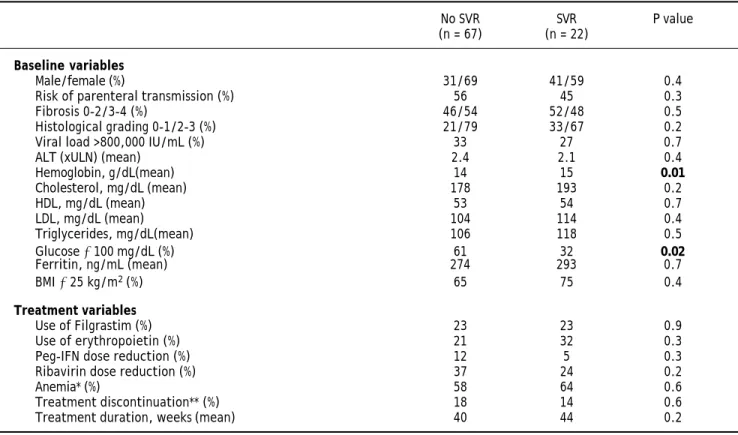
Lower serum glucose and higher hemoglobin levels were the baseline variables associated with SVR upon univariate analysis in the group of elderly patients. No difference in any of the treatment variables was observed between patients who achieved SVR and those who did not (Table 4).
Side effects of treatment in elderly patients (n = 89)
Treatment was discontinued due to side effects by 16.8% of the patients (n = 15). The main side effects were fatigue (8%), anemia (4%), hepatic decompen-sation (2%), allergy (1%), and vasculitis (1%). Table 1. Comparison of baseline and treatment characteristics between elderly and non-elderly patients with chronic hepatitis C (genotype 1).
Population studied <60 years ≥ 60 years P value (n = 231) (n = 142) (n = 89)
Baseline variables
Age (mean) 52 44 64 <0.001
Male/female (%) 46/54 54/46 34/66 0.002
Parenteral transmission (%) 53 53 53 0.9
Fibrosis 3-4 (%) 38 30 53 <0.001
Grading 2-3 (%) 65 60 76 0.01
Viral load >800,000 IU/mL (%) 30 29 32 0.6
ALT, U/L (xULN) (mean) 2.4 2.5 2.3 0.5
Hemoglobin, g/dL (mean) 14.5 14.7 14 0.005
Cholesterol, mg/dL (mean) 172 163 182 0.01
HDL, mg/dL (mean) 52 52 53 0.7
LDL, mg/dL (mean) 98 90 106 0.01
Triglycerides, mg/dL (mean) 111 112 110 0.8
Glucose ≥ 100 mg/dL (%) 34,5 24 53 < 0.001
Ferritin, ng/mL(mean) 314 334 278 0.2
BMI ≥ 25 kg/m2 (%) 56 48 67 0.02
Treatment variables
SVR (%) 38 46 25 0.001
Use of Filgrastim (%) 15.5 10 23 0.01
Use of erythropoietin (%) 16 10 24 0.005
Peg-IFN dose reduction (%) 7 4 10 0.08
Ribavirin dose reduction (%) 21 11 34 <0.001
Anemia* (%) 42 31 59 <0.001
Treatment discontinuation** (%) 12 9 17 0.07
Treatment duration, weeks (mean) 43 44 41 0.07
Table 2. Comparison of baseline and treatment variables in the population studied (n = 231) according to the presence or absence of a sustained virological response (SVR).
No SVR SVR P value
(n = 143) (n = 88)
Baseline variables
Age ≥ 60 years (%) 47 25 0.001
Male/female (%) 47/53 46/54 0.8
Parenteral transmission (%) 57 48 0.1
Fibrosis 3-4 (%) 44 30 0.04
Grading 2-3 (%) 70 58 0.06
Viral load >800,000 IU/mL(%) 29 31 0.7
ALT, U/L (xULN) (mean) 2.3 2.6 0.3
Hemoglobin, g/dL (mean) 14.3 14.7 0.1
Cholesterol, mg/dL (mean) 169 176 0.3
HDL, mg/dL (mean) 52 52 0.8
LDL, mg/dL (mean) 94 107 0.07
Triglycerides, mg/dL (mean) 109 113 0.7
Glucose ≥ 100 g/dL (%) 42 22 0.004
Ferritin, ng/mL (mean) 325 294 0.5
BMI ≥ 25 kg/m2 (%) 55 59 0.5
Treatment variables
Use of Filgrastim (%) 18 11 0.2
Use of erythropoietin (%) 15 17 0.5
Peg-IFN dose reduction (%) 10 3 0.07
Ribavirin dose reduction (%) 25 14 0.05
Anemia*(%) 40 44 0.6
Treatment discontinuation** (%) 15 8 0.1
Treatment duration, weeks (mean) 41 46 0.002
*Percentage of patients with hemoglobin <10 g/dL during treatment. **Percentage of patients who discontinued treatment due to side effects. BMI: body mass index.
Table 3. Predictive factors of a sustained virological response in 231 patients infected with HCV-1 and treated with pegylated interferon and ribavirin.
P value OR 95% CI
Age ≥ 60 years 0.02 0.4 0.219 0.910
Glucose ≥ 100 mg/dL 0.01 0.4 0.200 0.862
Treatment duration 0.01 1 1.01 1.106
OR: odds ratio; 95% CI: 95% confidence interval.
DISCUSSION
Chronic hepatitis C is a severe disease that can cause cirrhosis and is associated with high mortality. The cohort of patients who acquired the infection in the past is older today, a fact that renders them more susceptible to advanced liver disease. In addition, these patients are at high risk of developing hepato-cellular carcinoma.8-9 Antiviral treatment reduces
the risk of these complications and increases the survival of patients with chronic hepatitis C, but is associated with important side effects and low
response rates, representing a challenge particularly in this population of older patients.10
The current standard treatment for chronic hepatitis C is Peg-INF and RBV combination therapy, which results in SVR in 40-55% of cases.11-12 However, these
showed that age ≥ 60 years was predictive of poor treatment response. Controversy exists whether older age unfavorably affects the response to HCV treatment12. A wide variation in SVR rates among older patients has been reported in the literature (22 to 52%). These discrepant results can be attributed to study heterogeneity, different age limits, and small sample size, among others. Surprisingly, Huang, et al.3 reported an SVR rate of 51.9% in 27 patients
ol-der than 65 years with chronic hepatitis C caused by genotype 1 who were treated with Peg-IFN and RBV. In contrast, in the study of Kainuma et al6 the SVR rate was 22.9% in 253 patients aged 65 years or older with chronic hepatitis C treated with Peg-IFN and RBV, a rate similar to that observed in the present study.
The reasons for the poor treatment response among elderly patients are still unclear. Some inves-tigators suggest that treatment with Peg-IFN and RBV is associated with a larger number of clinical and laboratory side effects that are less tolerated by this population, compromising therapeutic efficacy as a result of drug dose reductions and/or early dis-continuation of treatment.5-7 The frequency of
treat-ment discontinuation was 16.8% in the elderly pa-tients studied here. Fatigue and anemia were the most frequent adverse events that led to drug discontinuation. In addition, older adults more frequently required RBV dose reductions and received more erythropoietin.
RBV-induced anemia is a major problem in the treatment of hepatitis C. In the present study, one patient who developed anemia during treatment had ischemic coronary disease and blood transfusion was necessary in two other patients. Several studies have addressed the dilemma of anemia in the treat-ment of this population. In fact, renal function de-clines with age.13 As a consequence, the clearance of
RBV may be compromised, increasing the toxic effects of this drug and consequently the risk of ane-mia.14 Therefore, caution is needed when treating
el-derly patients despite the availability of recombinant erythropoietin, which has recently contributed to a better management of treatment-induced anemia, promoting an increase in serum hemoglobin levels and treatment compliance and consequently increa-sing the chance of SVR15-17.
Table 4. Comparison of baseline and treatment variables according to the presence or absence of SVR in elderly patients (≥ 60 years) infected with HCV-1 and treated with pegylated interferon and ribavirin (n = 89)
No SVR SVR P value
(n = 67) (n = 22)
Baseline variables
Male/female (%) 31/69 41/59 0.4
Risk of parenteral transmission (%) 56 45 0.3
Fibrosis 0-2/3-4 (%) 46/54 52/48 0.5
Histological grading 0-1/2-3 (%) 21/79 33/67 0.2
Viral load >800,000 IU/mL (%) 33 27 0.7
ALT (xULN) (mean) 2.4 2.1 0.4
Hemoglobin, g/dL(mean) 14 15 0.01
Cholesterol, mg/dL (mean) 178 193 0.2
HDL, mg/dL (mean) 53 54 0.7
LDL, mg/dL (mean) 104 114 0.4
Triglycerides, mg/dL(mean) 106 118 0.5
Glucose ≥ 100 mg/dL (%) 61 32 0.02
Ferritin, ng/mL (mean) 274 293 0.7
BMI ≥ 25 kg/m2 (%) 65 75 0.4
Treatment variables
Use of Filgrastim (%) 23 23 0.9
Use of erythropoietin (%) 21 32 0.3
Peg-IFN dose reduction (%) 12 5 0.3
Ribavirin dose reduction (%) 37 24 0.2
Anemia* (%) 58 64 0.6
Treatment discontinuation** (%) 18 14 0.6
Treatment duration, weeks(mean) 40 44 0.2
Despite the high rates of adverse effects among ol-der patients seen in the present study, the rate of treatment discontinuation due to adverse events was not significantly higher when compared to the non-elderly group. In a recent study, Nishikawa, et al.,18
also found no significant difference in the frequency of treatment discontinuation due to side effects bet-ween elderly and non-elderly patients with chronic hepatitis C treated with Peg-IFN and RBV.
In the present study, no significant differences in the use of erythropoietin, Peg-IFN and RBV dose re-ductions, frequency of treatment discontinuation due to adverse effects, or treatment duration were observed between elderly patients who achieved SVR and those who did not. Gianninni, et al.,19 also
found no association between Peg-IFN or RBV dose reduction and SVR in patients with chronic hepati-tis C older than 65 years.
The present results showed that only low pretreatment levels of hemoglobin and elevated glycemia had a negative impact on SVR in elderly patients, suggesting that baseline conditions are fundamental for the tolerance to and success of treatment. In older adults, the prevalence of changes in glucose metabolism is high20 and evidence indicates
that low glucose tolerance and diabetes interfere negatively with the hepatitis C treatment response.21-24
Thus, these abnormalities should be corrected before treatment in order to achieve an SVR in this specific group of patients.
CONCLUSION
The present study showed that older age was a negative predictive factor of SVR in patients with ge-notype 1 chronic hepatitis C treated with Peg-IFN and RBV. In addition, the SVR rate was lower in the elderly group compared to non-elderly patients. However, the low SVR rate could not be explained by a higher frequency of side effects, RVB dose re-duction, or treatment discontinuation. On the other hand, baseline conditions of elderly patients were more important than treatment variables. Among el-derly patients, the best candidates for hepatitis C treatment are those with elevated pretreatment he-moglobin levels and adequate glycemic control.
REFERENCES
1. Mindikoglu AL, Miller RR. Hepatitis C in the elderly: epide-miology, natural history, and treatment. Clin Gastroenterol Hepatol 2009; 7: 128-34.
2. Imai Y, Tamura S, Tanaka H, Hiramatsu N, Kiso S, Doi Y, Inada M, et al. Reduced risk of hepatocellular carcinoma after
interferon therapy in aged patients with chronic hepatitis C is limited to sustained virological responders. J Viral He-pat 2010; 17: 185-91.
3. Huang CF, Yang JF, Dai CY, Huang JF, Hou NJ, Hsieh MY, Lin ZY, et al. Efficacy and safety of pegylated interferon combined with ribavirin for the treatment of older pa-tients with chronic hepatitis C. J Infect Dis 2010; 201: 751-9.
4. Oze T, Hiramatsu N, Yakushijin T, Mochizuki K, Oshita M, Hagiwara H, Mita E, et al. Indications and limitations for aged patients with chronic hepatitis C in pegylated inter-feron alfa-2b plus ribavirin combination therapy. J Hepa-tol 2011; 54: 604-11.
5. Nudo CG, Wong P, Hilzenrat N, Deschenes M. Elderly pa-tients are at greater risk of cytopenia during antiviral the-rapy for hepatitis C. Can J Gastroenterol 2006; 20: 589-92. 6. Kainuma M, Furusyo N, Kajiwara E, Takahashi K, Nomura H, Tanabe Y, Sat T, et al. Pegylated interferon alpha-2b plus ribavirin for older patients with chronic hepatitis C. World J Gastroenterol 2010; 16: 4400-9.
7. Honda T, Katano Y, Shimizu J, Ishizu Y, Doizaki M, Hayashi K, Ishigami M, et al. Efficacy of peginterferon-alpha-2b plus ribavirin in patients aged 65 years and older with chronic hepatitis C. Liver Int 2010; 30: 527-37.
8. Huang CF, Chuang WL, Yu ML. Chronic hepatitis C infec-tion in the elderly. Kaohsiung J Med Sci 2011; 27: 533-7. 9. Miki D, Aikata H, Uka K, Saneto H, Kawaoka T, Azakami T,
Takaki S, et al. Clinicopathological features of elderly pa-tients with hepatitis C virus-related hepatocellular carci-noma. J Gastroenterol 2008; 43: 550-7.
10. Floreani A. Hepatitis C: Should antiviral therapy be offe-red to elderly patients? Nat Rev Gastroenterol Hepatol 2009; 6: 503-4.
11. Manns MP, McHutchison JG, Gordon SC, Rustgi VK, Shiff-man M, Reindollar R, et al. Peginterferon alfa-2b plus riba-virin compared with interferon alfa-2b plus ribariba-virin for initial treatment of chronic hepatitis C: a randomised trial. Lancet 2001; 358: 958-65.
12. Fried MW, Shiffman ML, Reddy KR, Smith C, Marinos G, Goncales FL Jr., et al. Peginterferon alfa-2a plus ribavirin for chronic hepatitis C virus infection. N Engl J Med 2002; 347: 975-82.
13. Lindeman RD. Overview: renal physiology and pathophy-siology of aging. Am J Kidney Dis 1990; 16: 275-82. 14. Marcus EL, Tur-Kaspa R. Chronic hepatitis C virus
infec-tion in older adults. Clin Infect Dis 2005; 41: 1606-12. 15. Pockros PJ, Shiffman ML, Schiff ER, Sulkowski MS, Younossi
Z, Dieterich DT, et al. Epoetin alfa improves quality of life in anemic HCV-infected patients receiving combination therapy. Hepatology 2004; 40: 1450-8.
16. Tseng KC, Chen LH, Chen CY, Chang TT, Chou AL, Wu IC, et al. Low dose erythropoietin-beta improves anemia and maintains ribavirin dose in chronic hepatitis C patients receiving combination therapy with ribavirin plus pegyla-ted interferon Alfa-2b. Hepatol Res 2009; 39: 539-45. 17. Alavian SM, Tabatabaei SV, Behnava B. Impact of
erythro-poietin on sustained virological response to peginterferon and ribavirin therapy for HCV infection: a systematic re-view and meta-analysis. J Viral Hepat 2012; 19: 88-93. 18. Nishikawa H, Iguchi E, Koshikawa Y, Ako S, Inuzuka T,
Takeda H, et al. The effect of pegylated interferon-alpha2b and ribavirin combination therapy for chronic he-patitis C infection in elderly patients. BMC Res Notes 2012; 5: 135.
treatment of chronic HCV infection in patients aged 65 years and more. Dig Dis Sci 2010; 55: 3193-9.
20. Morley JE. An overview of diabetes mellitus in older per-sons. Clin Geriatr Med 1999; 15: 211-24.
21. Romero-Gomez M, Del Mar Viloria M, Andrade RJ, Salmeron J, Diago M, Fernandez-Rodriguez CM, et al. Insulin resis-tance impairs sustained response rate to peginterferon plus ribavirin in chronic hepatitis C patients. Gastroente-rology 2005; 128: 636-41.
22. Dai CY, Huang JF, Hsieh MY, Hou NJ, Lin ZY, Chen SC, et al. Insulin resistance predicts response to
peginterferon-alpha/ribavirin combination therapy in chronic hepatitis C patients. J Hepatol 2009; 50: 712-8.
23. Deltenre P, Louvet A, Lemoine M, Mourad A, Fartoux L, Moreno C, et al. Impact of insulin resistance on sustained response in HCV patients treated with pegylated interfe-ron and ribavirin: a meta-analysis. J Hepatol 2011; 55: 1187-94.