JF Sánchez Ávila. Cost efficacy and cost–benefit of treatment of hepatitis C S69
edigraphic.com
Annals of Hepatology 2006; 5(Suppl. 1): S69-S73Annals of
Hepatology
Cost efficacy and cost–benefit
of treatment of hepatitis C
Juan Francisco Sánchez Ávila1
The combination of the high costs of new drugs and limited resources necessitates economic evaluation of all new therapeutic options. Socioeconomic evaluations seek to optimize the use of available resources by identi-fying, evaluating, measuring, and comparing various al-ternatives to interventions, diagnoses, or therapies. Thus, new interventions do not have to cost less if resources are used in a more efficient way.1 The benefits of
interven-tions are defined in terms of clinical, psychosocial or eco-nomic outcomes.
There are several types of economic evaluations. Those accepted as type 1 evidence include full economi-cal evaluations in which multiple sensitivity analyses are conducted. Systematic reviews are considered to be type 1a evidence.2 Full economical evaluations may be
classi-fied according to outcomes as cost reduction, profit–cost, cost-usefulness, cost-effectiveness and cost-benefit stud-ies. In cost-reduction evaluations, alternatives that have similar outcomes are compared to identify the one with the lowest cost. In the other types of evaluations, inter-ventions with different outcomes are compared in terms of morbidity and mortality (cost effectiveness), useful-ness or quality of life (cost usefuluseful-ness) or monetary units (cost–benefit).3
Impact of infection by hepatitis C virus
Assessment of the impact of a disease should be based on the effects of several factors such as:
1. longevity (mortality and years lost because of prema-ture death),
2. morbidity (diminution of health and quality of life and increased need for medical assistance),
3. direct and indirect expenses of medical assistance, and 4. monetary losses related to income forfeited because of
work disability or premature death.4,5
All parameters used to assess the impact of a disease should be expressed in terms of regional statistics on its
prevalence and incidence, and the mortality and morbid-ity associated with it. Unfortunately, reliable statistics on hepatitis C do not exist for most countries. In 1990, the World Bank and the World Health Organization carried out a study of the impact of diseases worldwide in order to establish health policies.6 Even though this study only
evaluated the impact of hepatic disease in general, some estimates of the impact of chronic viral hepatitis were made. Of the 8.3 million people worldwide with liver cir-rhosis in 1990, the condition was caused by chronic viral hepatitis C in 1.4 million cases; 10% of those with cir-rhosis died that year. Of the 858,000 cases of hepatocar-cinoma, 170,000 cases are estimated to be secondary to hepatitis C virus (HCV) infection; 100,000 died from hepatocarcinoma that year.6,7 The corresponding years
adjusted for disability (DALYs) could be as high as 4.2 million of DALYs.7
The United States of America has reliable statistics on HCV infection. In the National Health Survey8 carried
out between 1988 and 1994 with a sample population of 21,000 persons, 1.8% of people had anti-HCV antibod-ies, 74% of whom were positive for HCV RNA, i.e., they had active infections.4 Extrapolation of these statistics to
the population of the USA indicates that 3.1–4.8 million people have been in contact with the HCV, and about 2.7 million have active infections (95% CI = 2.4–3.0 mil-lion). The prevalence of HCV infection is greatest is among 30–49 year olds, which suggests that they con-tracted the infections 10 to 30 years ago. The major limi-tation of the survey is that it did not include groups of people such as the homeless, prisoners, orphans, and peo-ple in hospices, among whom the prevalence of HCV in-fection is as high as 40%–54%. Therefore, this study may underestimate the impact of the disease. Estimates of the incidence of HCV infection that are based on the data of the National System of Notifiable Diseases may also un-derestimate the incidence of hepatitis C, because acute and chronic hepatitis C is asymptomatic in a large per-centage of subjects, many high-risk individuals do not have access to health systems, and health workers may under-record cases of hepatitis C.
The Centers for Disease Control in the USA used a catalytic model to predict that the incidence of hepatitis C would diminish progressively until an incidence of 1% was attained in 2003.9 Even though the incidence of
1Departamento de Gastroenterología, Instituto Nacional de
Nutrición y Ciencias Médicas “Salvador Zubirán”, México, D.F.
Address for correspondence: E-mail: [email protected]
Artemisa
edigraphic.com
SUSTRAÍDODE-M.E.D.I.G.R.A.P.H.I.C
:ROP ODAROBALE FDP
VC ED AS, CIDEMIHPARG
ARAP
ACIDÉMOIB ARUTARETIL :CIHPARGIDEM
new cases of hepatitis C may diminish, the number of pa-tients with cirrhosis and end-stage liver disease is ex-pected to increase because chronic hepatitis C may take more than a decade to progress to an advanced stage. The Centers for Disease Control estimate that a fourfold in-crease in the number of subjects with advanced liver dis-ease will occur between 1990 and 2015. Davis et al. used a previously validated natural history model to estimate that by 2040, liver cirrhosis related to HCV will have in-creased by 38%, decompensated liver cirrhosis will have increased by 124%, and hepatocarcinoma will have in-creased by more than 100%.10
Estimates of the mortality rates of hepatitis C pa-tients are reliable because data on mortalities from 1990 to 1998 included deaths from end-stage liver disease, viral hepatitis, or sequels related to liver disease.10 The
most recent report ranked chronic liver disease as the tenth most frequent cause of death in the United States from 1990 to 1998 and revealed that mortality related to HCV increased by 220% between 1993 and 1998. The number and proportion of patients awaiting liver trans-plants increased progressively over the past 10 years. In addition, the number of hospitalizations of patients with an 1CV-positive condition has increased; in 1998, 2% (140,000) of all hospital releases were HCV posi-tive. Hospital expenses associated with treatment of hepatitis C patients in the United States exceed 1,000 million dollars.4,5 A study by the American
Gastroenter-ology Association estimated that 317,000 consultations costing 24 million dollars were related to the treatment of hepatitis C during 1998, and that 530 million dollars
was spent on antiviral treatment of HCV.11 Other
au-thors showed that hospitalization, medical visits, and the use of other health resources by HCV-infected pa-tients increased by 25%–30% per year between 1994 and 2001.12
The trend in the United States is similar to that in other countries. Deuffic et al. estimated that mortality caused by HCV-induced hepatocarcinoma will increase
by 150% in men and by 200% in women by 2020.13 In
another model prepared for the Australian population, Law estimated that the number of cases of HCV-related liver cirrhosis will increase by 102% by 2010 and that of HCV-related hepatocarcinoma will increase by 150%.14 Recently, Buti et al.15 estimated that despite an
anticipated reduction in the number of new cases of HCV infection, the proportion of hepatitis C patients with cirrhosis will increase to 14% and morbidity will increase to 10% by 2030. There are few publications about the costs of HCV infection in Latin America. A multicenter study carried out at third-level service hos-pitals in Mexico established that chronic HCV infec-tion is the second most frequent cause of liver cirrho-sis.16 Another study suggested that the prevalence of
pa-tients with HCV-induced liver cirrhosis would increase by more than 70%.17
Cost effectiveness of combined antiviral treat-ment with pegylated interferon and ribavirin
The objectives of treatment of chronic hepatitis C are to eliminate the virus and halt the progress of liver dam-age. A sustained viral response (SVR) is associated with improved hepatic function, liver histology, quality of life, and survival. The latter effect, as well as the possible modulator role of antiviral treatment on liver fibrogene-sis is found in a prospective evaluation.
Treatment of chronic HCV infection is based on a combination of interferon and ribavirin. Large multi-center studies18,19 have shown that approximately 40% of
patients who are treated with this combination of drugs for 48 weeks will attain an SVR, defined as undetectable viral RNA 6 months after termination of treatment.
Recently, pegylated interferon was approved for use in patients with chronic HCV liver disease. The binding of polyethylene glycol to interferon improves its pharmacok-inetics, allowing it to be administered once weekly. The combination of pegylated interferon and ribavirin results in an SVR of 50%, which is especially important for pa-tients with HCV genotype 1.20-22 Other studies showed that
patients with HCV genotypes 2 and 3 may be treated with lower doses of ribavirin for shorter periods.23
Based on available information, the consensus of the National Institutes of Health of the United States24
recom-mended that antiviral therapy for hepatitis C should be appropriate to the HCV genotype. Pegylated interferon alfa and 1000–1200 mg/day ribavirin for 48 weeks are recommended for genotype 1 and pegylated interferon alfa and 800 mg/d ribavirin for 24 weeks are
recommend-ed for genotypes 2 and 3.24 This new combination of
drugs has increased the cost of therapy.
The combination of interferon alfa and ribavirin is cost effective compared with other routine medical inter-ventions.25,28 Because combined antiviral therapy with
pegylated interferon plus ribavirin is the treatment of choice for patients with chronic HCV, many evaluations have been conducted in various parts of the world, in-cluding England, Spain, Germany, and the USA. These studies, all of which constitute type 1 evidence, used models adapted to their respective countries to show that the combination of pegylated interferon and ribavirin is cost effective.29–32
nonpe-edigraphic.com
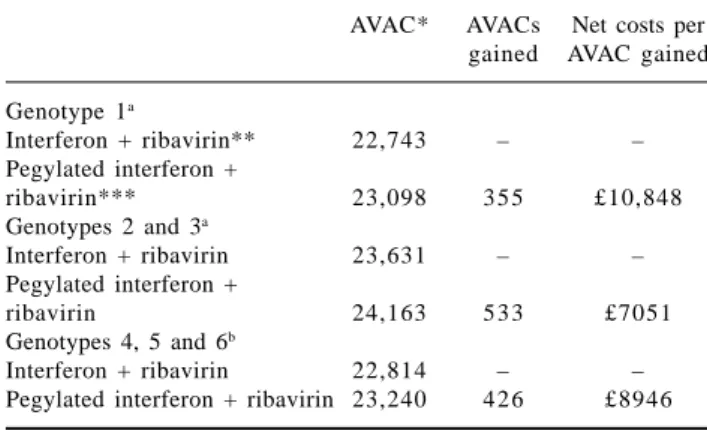
gylated interferon monotherapy were analyzed. Thepri-mary outcome of all studies was an SVR. A model of cost effectiveness was applied to a hypothetical cohort of 1,000 chronic hepatitis C patients over a period of 30 years. The relative risk of remaining infected after pegy-lated interferon plus ribavirin treatment was 17% lower than after unpegylated interferon plus ribavirin treat-ment. Patients with HCV genotypes 2 and 3 had the highest SVR and those infected with HCV genotype 1 had the lowest SVR. The relative risk of remaining infect-ed after monotherapy with pegylatinfect-ed interferon was 20% less than after monotherapy with unpegylated interferon. Responses to monotherapy varied according to genotype and viral load. There were no significant differences be-tween therapeutic regimens in the frequency or intensity of adverse effects. When compared to the cost of no treat-ment, the increasing cost per year of life adjusted for quality (AVAC) of treatment with pegylated interferon plus ribavirin for 48 weeks was £6045. Compared with the combination of nonpegylated interferon plus ribavi-rin, the increasing cost per AVAC of pegylated interferon plus ribavirin was £12,123. The increasing costs per
AVAC were more favorable in patients with HCV geno-types 2 and 3 with low viral loads than those who re-ceived no treatment. Sensitivity analysis proved that the model was robust. All estimates were less than £30,000 per AVAC, which is the limit for cost effectiveness in the United Kingdom (Table I). This study concluded that pe-gylated interferon in monotherapy and in combination with ribavirin achieves a higher SVR than nonpegylated interferon and is cost effective.33
The other study was performed by Siebert and Sroc-zynsky as part of the German team for hepatitis C mod-el (GEHMO), as commissioner of Federal Germany Health and Social Security Ministery. This systematic review of published evidence was undertaken to deter-mine the efficacy and cost-effectiveness of antiviral treatment with interferon or pegylated interferon com-bined with ribavirin in treatment-naïve patients chron-ically infected with HCV. A series of meta-analyses was made, and evidence tables were constructed. The Markov model of hepatitis C was applied to determine the long-term clinical efficacy, costs, and cost effec-tiveness of the therapeutic strategies. The model pa-rameters were derived from German databases consist-ing of nine controlled randomized studies, two health technology evaluations, a Cochrane review, two analyses, and seven economic evaluations. The meta-analysis showed that the proportion of nonresponders was reduced by 17% by the combination of pegylated interferon and ribavirin, which had an adjusted in-creasing cost of •9,800 per AVAC. This suggests that in treatment-naïve, chronic hepatitis C virus carriers, the combination of pegylated interferon and ribavirin is the most efficient and cost-effective treatment (Ta-ble II) and that it increases survival and improves quality of life.34
Analysis of data from studies of various types of pe-gylated interferon21,22 revealed that it is possible to
identify subjects who do not respond to therapy from their viral response at twelve weeks of combined antivi-ral treatment with a negative predictive value of 98%– 100%. This finding enabled formulation of a treatment discontinuation rule for HCV genotype 1 patients who do not achieve early viral response, which is defined as
Table II. Increasing relationship cost effectiveness and relation incremental cost with an annual discount rate of 3% for various management
strategies in patients with chronic hepatitis C.
Interferon vs Interferon + ribavirin Pegylated interferon + No treatment no treatment vs interferon ribavirin vs interferon
Life expectancy (years) 17.97 18.45 19.19 19.90
Increasing life expectancy (years) – 0.48 0.73 1.45
Relation increasing cost effectiveness (£/year) – 5,800 12,300 10,300
Years of life adjusted for quality (AVACs) 16.07 16.60 17.38 18.13
Incremental AVACs – 0.53 0.78 1.53
Relation increasing cost usefulness (£/AVAC) – 5300 11,600 9800
Adapted from: Siebert et al., Int J Technol Assess Health Care. 2005;21(1):55–65.
Table I. Subanalysis by genotype of increasing cost-usefulness
discounted for the cost per year of life adjusted for quality (AVAC) for combined antiviral treatments in a model of 1,000 patients.
AVAC* AVACs Net costs per gained AVAC gained
Genotype 1a
Interferon + ribavirin** 22,743 – –
Pegylated interferon +
ribavirin*** 23,098 355 £10,848
Genotypes 2 and 3a
Interferon + ribavirin 23,631 – –
Pegylated interferon +
ribavirin 24,163 533 £7051
Genotypes 4, 5 and 6b
Interferon + ribavirin 22,814 – –
Pegylated interferon + ribavirin 23,240 426 £8946
*AVAC: year of life adjusted for quality
edigraphic.com
SUSTRAÍDODE-M.E.D.I.G.R.A.P.H.I.C
:ROP ODAROBALE FDP
VC ED AS, CIDEMIHPARG
ARAP
ACIDÉMOIB ARUTARETIL :CIHPARGIDEM
a reduction to a viral load equal to or greater than 2 logarithms with respect to the baseline load at week 12. This rule does not apply to patients with HCV geno-types 2 and 3 because 90%–99% of them will achieve an SVR, rendering this criterion not cost effective. Mod-eling to estimate cost reductions and resource optimiza-tion shows that this strategy is highly cost-effective (40%–44% reduction of in lasting and 15.7%–45% re-duction in treatment costs).33,35–36 Because of the low
probability of achieving SVR (0%–2%) to keep therapy on those patients not achieving early viral response, conditioning a non-cost-effective ratio in the different models studied.33,35,36
The availability of a safe, efficient and cost-effective antiviral therapy invokes the question of what would happen if all subjects that are infected with HCV at present were offered treatment. Models indicate that treatment of 10% or 50% of the HCV-infected popula-tion with pegylated interferon plus ribavirin would re-duce morbidity by 6% and 26% and mortality by 4% and 20%, respectively.10,15
The following require further investigation: compari-son between both types of pegylated interferon, retreat-ment of patients who have not responded to therapy pre-viously, long-term maintenance treatment, treatment effi-cacy and evolution in long-term patients who present with comorbidities, prospective validation, adjustment of rules for establishing treatment regimens, determination of short-term regimen efficacy in patients who are easy to treat (genotype 2, low viral load), and determination of long-term regimens in subjects with less favorable pre-dictive factors. However, as the progression of the dis-ease differs between patients, detailed evaluation of the eligibility of patients and antiviral management must be done on an individual basis.
Recommendations of the consensus panel:
From a theoretical point of view, is it advisable to treat all patients with HCV infection?
Consensus was not reached. However, the majority of panel members (56%) recommended treating all pa-tients with chronic HCV infection. Models indicate that treatment of 10% or 50% of the HCV-infected population with pegylated interferon plus ribavirin would reduce morbidity by 6% and 26% and mortality by 4% and 20%, respectively, with evidence quality type 1 (l-m).
Evidence quality: 1
Is there a cost-benefit to discontinuation of treatment according to viral responses at week 12?
The panel of the consensus recommends application of the discontinuation rule for viral loads greater than or equal to two logarithms from baseline at week 12.
Evidence quality: 1
At present, is it justifiable to offer treatment to pa-tients with compensated liver cirrhosis?
The panel considers treatment of subjects with compen-sated liver cirrhosis justifiable in terms of cost benefit.
Evidence quality: 1
Do you consider the use of conventional interferon alfa and ribavirin for patients with HCV genotypes 2 and 3a to be a resource-saving strategy?
Most of the panel (55%) considered the use of regular interferon in combination with ribavirin for patients with HCV genotypes 2 and 3 unacceptable as a resource-sav-ing strategy.
Evidence quality: 1
References
1 . Conceptos básicos en Evaluación económica. En Drummond MF, O’Brien BJ Sttodart GL, Torrance GW. Métodos para la evaluación económica de los programas de asistencia sanitaria. Segunda Edición. Ediciones Díaz Santos 2001.
2. Drummond MF, Richardson WS, O’Brien BJ, Levine M, Heyland D. Users’ guides to the medical literature: XIII. How to use an article on economic analysis of clinical practice: A. Are the results of the study valid? JAMA 1997; 277: 1552-7.
3. O’Brien BJ, Heyland D, Richardson WS, Levine M, Drummond MF. Users’ guides to the medical literature: XIII. How to use an article on economic analysis of clinical practice: B. What are the results and will they help me in caring for my patients? JAMA 1997; 277: 1802-6.
4 . Kim WR. The burden of hepatitis C in the United States. Hepatology 2002; 36: S30-S34.
5. Kim WR, Brown RS, Terrault NA, El-Serag H. Burden of liver disease in the United States: summary of a workshop. Hepatology 2002: 36: 227-42.
6. Murray CJ, López AD. Mortality by cause for eight regions of the world: global burden of disease study. Lancet 1997; 349: 1269-76. 7 . Kim WR. Global epidemiology and burden of hepatitis C.
Mi-crobes Infect 2002; 4: 1219-25.
8 . Alter MJ, Kruszon-Moran D, Nainan OV, et al. Prevalence of hepatitis C virus infection in the United States. N Eng J Med 1999; 341: 556-62.
9 . Armstrong GL, Alter MJ, McQuillan GM, Margollis HS. The past incidence of hepatitis C infection: implications for the future burden of chronic liver diseases in the United States. Hepatology 2000; 31: 777-82.
10. Davis GL, Albright JE, Cook SF, Rosenberg DM. Projecting fu-ture complications of chronic hepatitis C in the United States. Liver Transpl 2003; 9: 331-8.
11. Sandler RS, Everhart JE, Donowitz M, Adams E, Cronin K, Goodman C, Gemmen E, Shah S, Avdic A, Rubin R. The burden of selected digestive diseases in the United States. Gastroenterol-ogy 2002; 122(5): 1500-11.
12. Grant WC, Jhaveri RR, McHutchison JG, Schulman KA, Kauf TL. Trends in health care resource use for hepatitis C virus infec-tion in the United States. Hepatology 2005; 42: 1406-13. 13. Deuffic S, Buffat L, Poynard T, et al. Modeling the hepatitis C
virus epidemic in France. Hepatology 1999; 29: 1569-601. 14. Law MG. Modeling the hepatitis C virus epidemic in Australia.
edigraphic.com
15. Buti M, San Miguel R, Brosa M, Cabases JM, Medina M, AngelCasado M, Fosbrook L, Esteban R. Estimating the impact of hepatitis C virus therapy on future liver-related morbidity, mor-tality and costs related to chronic hepatitis C. J Hepatol 2005; 42: 639-45.
16. Mendez-Sánchez N, Aguilar-Ramírez JR, Reyes A, Dehesa M, Juárez A, Castaneda B, Sánchez-Avila F, Poo JL, Guevara González L, Lizardi J, Valdovinos MA, Uribe M, Contreras AM, Tirado P, Aguirre J, Rivera-Benítez C, Santiago-Santiago R, Bosques-Padilla F, Muñoz L, Guerrero A, Ramos M, Rodríguez-Hernández H, Jacobo-Karam J; Grupo de Estudio, Asociación Mexicana de Hepatología. Etiology of liver cirrhosis in Mexico. Ann Hepatol 2004; 3(1): 30-3.
17. Mendez-Sanchez N, Villa AR, Chavez-Tapia NC, Ponciano-Rodriguez G, Almeda-Valdes P, Gonzalez D, Uribe M. Trends in liver disease prevalence in Mexico from 2005 to 2050 through mortality data. Ann Hepatol 2005; 4(1): 52-5.
18. McHutchison JG, Gordon SC, Schiff ER, Shiffman ML, Lee WM, Rustgi VK, Goodman ZD, Ling MH, Cort S, Albrecht JK. Interferon alfa-2b alone or in combination with ribavirin as ini-tial treatment for chronic hepatitis C. Hepatitis Interventional Therapy Group. N Engl J Med 1998; 339(21): 1485-92. 19. Poynard T, Marcellin P, Lee SS, Niederau C, Minuk GS, Ideo G,
Bain V, Heathcote J, Zeuzem S, Trepo C, Albrecht J. Randomized trial of interferon alpha2b plus ribavirin for 48 weeks or for 24 weeks versus interferon alpha2b plus placebo for 48 weeks for treatment of chronic infection with hepatitis C virus. Interna-tional Hepatitis IntervenInterna-tional Therapy Group (IHIT) Lancet 1998; 352(9138): 1426-32.
20. Lindsay KL, Trepo C, Heintges T, Shiffman ML, Gordon SC, Hoefs JC, Schiff ER, Goodman ZD, Laughlin M, Yao R, Albrecht JK; Hepatitis Interventional Therapy Group. A randomized, double-blind trial comparing pegylated interferon alfa-2b to in-terferon alfa-2b as initial treatment for chronic hepatitis C. Hepatology 2001; 34(2): 395-403.
21. Manns MP, McHutchison JG, Gordon SC, Rustgi VK, Shiffman M, Reindollar R, Goodman ZD, Koury K, Ling M, Albrecht JK. Peginterferon alfa-2b plus ribavirin compared with interferon alfa-2b plus ribavirin for initial treatment of chronic hepatitis C: a randomized trial. Lancet 2001; 358(9286): 958-65.
22. Fried MW, Shiffman ML, Reddy KR, Smith C, Marinos G, Goncales FL Jr, Haussinger D, Diago M, Carosi G, Dhumeaux D, Craxi A, Lin A, Hoffman J, Yu J. Peginterferon alfa-2a plus ribavirin for chronic hepatitis C virus infection. N Engl J Med 2002; 347(13): 975-82.
23. Hadziyannis SJ, Sette H Jr, Morgan TR, Balan V, Diago M, Marcellin P, Ramadori G, Bodenheimer H Jr, Bernstein D, Rizzetto M, Zeuzem S, Pockros PJ, Lin A, Ackrill AM; PEGASYS Interna-tional Study Group. Peginterferon-alpha2a and ribavirin combi-nation therapy in chronic hepatitis C: a randomized study of treatment duration and ribavirin dose. Ann Intern Med 2004; 140(5): 346-55.
24. National Institutes of Health. Consensus Development Confer-ence Statement: Management of hepatitis C. June 2002. http:// www.consensus.nih.gov
25. Younossi ZM, Singer ME, McHutchison JG, Shermock KM. Cost effectiveness of interferon alpha2b combined with ribavirin for the treatment of chronic hepatitis C. Hepatology 1999; 30(5): 1318-24.
26. Wong JB, Poynard T, Ling MH, Albrecht JK, Pauker SG. Cost-effectiveness of 24 or 48 weeks of interferon alpha-2b alone or with ribavirin as initial treatment of chronic hepatitis C. Interna-tional Hepatitis IntervenInterna-tional Therapy Group. Am J Gastroenterol 2000; 95(6): 1524-30.
27. Buti M, Casado MA, Fosbrook L, Esteban R. Cost effectiveness of the treatment of chronic hepatitis C with interferon-alpha. Gastroenterol Hepatol 1998; 21(4): 161-8.
28. Buti M, Casado MA, Fosbrook L, Wong JB, Esteban R. Cost-effectiveness of combination therapy for naive patients with chronic hepatitis C. J Hepatol 2000; 33(4): 651-8.
29. Buti M, Medina M, Casado MA, Wong JB, Fosbrook L, Esteban R. A cost-effectiveness analysis of peginterferon alfa-2b plus ribavirin for the treatment of naive patients with chronic hepatitis C. Aliment Pharmacol Ther 2003; 17(5): 687-94.
30. Siebert U, Sroczynski G, Rossol S, Wasem J, Ravens-Sieberer U, Kurth BM, Manns MP, McHutchison JG, Wong JB; German Hepa-titis C Model (GEHMO) Group; International HepaHepa-titis Interventional Therapy (IHIT) Group. Cost effectiveness of peginterferon alpha-2b plus ribavirin versus interferon alpha-2b plus ribavirin for initial treatment of chronic hepatitis C. Gut 2003; 52(3): 425-32.
31. Wong JB, Nevens F. Cost-effectiveness of peginterferon alfa-2b plus ribavirin compared to interferon alfa-2b plus ribavirin as initial treatment of chronic hepatitis C in Belgium. Acta Gastroenterol Belg 2002; 65(2): 110-11.
32. Salomon JA, Weinstein MC, Hammitt JK, Goldie SJ. Cost-effec-tiveness of treatment for chronic hepatitis C infection in an evolv-ing patient population. JAMA 2003; 290(2): 228-37.
33. Shepherd J, Brodin H, Cave C, Waugh N, Price A, Gabbay J. Pegylated interferon alpha-2a and -2b in combination with ribavirin in the treatment of chronic hepatitis C: a systematic review and economic evaluation. Health Technol Assess 2004; 8(39): iii-iv,1-125.
34. Siebert U, Sroczynski G; German Hepatitis C Model GEHMO Group; HTA Expert Panel. Effectiveness and cost-effectiveness of initial combination therapy with interferon/peginterferon plus ribavirin in patients with chronic hepatitis C in Germany: a health technology assessment commissioned by the German Federal Ministry of Health and Social Security. Int J Technol Assess Health Care 2005; 21(1): 55-65.
35. Davis GL, Wong JB, McHutchison JG, Manns MP, Harvey J, Albrecht J. Early virologic response to treatment with peginterferon alfa-2b plus ribavirin in patients with chronic hepa-titis C. Hepatology 2003; 38(3): 645-52.