Otras secciones de este sitio:
☞ ☞ ☞ ☞
☞ Índice de este número
☞ ☞ ☞ ☞
☞ Más revistas
☞ ☞ ☞ ☞
☞ Búsqueda
Others sections in this web site:
☞ ☞ ☞ ☞
☞ Contents of this number
☞ ☞ ☞ ☞
☞ More journals
☞ ☞ ☞ ☞ ☞ Search
Artículo:
Side effects of medical therapy for chronic hepatitis C
Copyright © 2004: Mexican Association of Hepatology
ANNALS OF HEPATOLOGY
Number 1 January-March 2004
Volume 3
ML Shiffman. Side effects of HCV treatment MG 5
edigraphic.com
Annals of Hepatology 2004; 3(1): January-March: 5-10Annals of Hepatology
Concise Review
Side effects of medical therapy for
chronic hepatitis C
Mitchell L Shiffman, MD1
Abstract
The treatment of chronic hepatitis C virus (HCV) has improved greatly over the past decade. Over half of all patients treated with the combination of peginterferon and ribavirin have the opportunity to achieve sustained virologic response. The major factors which interfere with this goal are the side effects of therapy which quire that the doses of peginterferon or ribavirin be re-duced or that these medications be discontinued. While some of these side effects can be overcome and treatment continued, some side effects are severe and potentially life threatening. Appropriate recognition and manage-ment of these side effects will both improve response to therapy and avoid unnecessary morbidity and mortality.
Key words: Hepatitis C virus, peginterferon ribavirin side effects.
The treatment of chronic hepatitis C virus (HCV) in-fection has evolved significantly over the past several years. The most effective therapy currently available is the combination of peginterferon and ribavirin. Large clinical trials have demonstrated that 42-51% of patients can achieve a sustained virologic response (SVR) follow-ing 48 weeks of combination therapy,1,2 In patients with
HCV genotypes 2 or 3 SVR approaches 80% and a recent study has suggested that this can be achieved with just 24 weeks of peginterferon and a lower dose of ribavirin.3
One of the major limitations of HCV therapy is that both peginterferon and ribavirin cause numerous side ef-fects.4 The most common of these side effects include
flu-like symptoms, hematologic, neuropsychiatric and der-matologic toxicities and the development of autoimmune
1Hepatology Section, Virginia Commonwealth University Medical
Center, Richmond, Virginia, USA
Address for correspondence: Hepatology Section
Virginia Commonwealth University Health System Box 980341 Richmond, VA 23298
USA Phone: 804-828-4060 FAX: 804-828-4945
E-mail: [email protected]
disorders. Most patients are able to tolerate the adverse events of treatment and complete a full course of therapy. Once treatment is discontinued these side effects typical-ly resolve. However, about 25-33% of patients will expe-rience severe side effects and in rare instances some ad-verse events may be life threatening. The standard ap-proach to managing adverse events which are clinically significant is to reduce the dose of peginterferon and/or ribavirin. When side effects do not resolve with dose re-duction or the adverse event is particularly debilitating discontinuation of therapy may be necessary. Unfortu-nately, an accumulating body of evidence now strongly suggests that dose reduction and particularly early dis-continuation of HCV treatment is associated with a marked decline in SVR.5 This is most pronounced in
pa-tients with HCV genotype 1 who appear to require full dose therapy to achieve the optimal virologic response. Recognizing and managing the side effects of peginter-feron and ribavirin is therefore important. Proper side ef-fect management may enable many patients to remain on therapy and this could increase the likelihood that they will achieve an SVR following treatment with peginter-feron and ribavirin.
This review will summarize the major side effects as-sociated with peginterferon and ribavirin experienced by patients with chronic HCV. Ways in which the physician and patient can both recognize and successfully manage these adverse effects will be discussed.
Flu-like and other generalized systemic side effects
Flu-like symptoms occur in nearly half of patients re-ceiving treatment with peginterferon and ribavirin.1,2,4
particu-Annals of Hepatology 3(1) 2004: 5-10
6
edigraphic.com
larly prior to the first several interferon injections, is also very effective in limiting the severity of these symptoms and should be encouraged. Over several weeks the regu-lar use of acetaminophen and NSAIDs can be reduced as these symptoms subside. Flu-like symptoms appear to be less severe in those patients who remain well hydrated by consuming large amounts of water, sport drinks and/or fruit juices.
Severe persistent headaches which do not respond to acetaminophen or NSAIDs occur in less than 10% of pa-tients.1,2,4 Use of narcotic pain medications may be
neces-sary for these patients. In some cases interferon induced headaches have migraine features and are associated with nausea, vomiting and visual changes. Evaluation by neu-rology may be necessary in some cases, particularly if these symptoms do not respond to standard anti-migraine therapy.
Approximately 20% of patients will develop signifi-cant diarrhea. This typically occurs within 1-3 days fol-lowing the weekly injection and is most severe for only the first several weeks. In up to 5% of patients diarrhea may persist throughout the entire week and/or throughout the entire course of therapy. Interferon induced diarrhea is typically responsive to variable doses of imodium or loperamide.
Hematologic toxicity
Anemia, neutropenia and thrombocytopenia are com-mon during treatment with peginterferon and ribavirin. Neutropenia and thrombocytopenia are a direct result of interferon induced bone marrow suppression.6-8 In most
studies, the total neutrophil and platelet counts decline by approximately 20% from the pre-treatment baseline.1,2,4,7
This typically occurs within the first 4-8 weeks of treat-ment after which time the neutrophil and platelet counts remain stable throughout the remainder of therapy. De-spite this decline, the neutrophil and platelet counts re-main within the limits of normal in the majority of pa-tients receiving peginterferon.
Patients with cirrhosis frequently have a neutrophil count that is at or below the lower limits of normal and this declines further during treatment with peginterferon. In addition, many individuals of African descent have es-sential neutropenia and are also at risk for developing sig-nificant neutropenia during treatment with peginterferon.9
Although it is recommended by the pharmaceutical man-ufacturer to reduce the dose of peginterferon if the abso-lute neutrophil count declines below 1,500 cells/mm3
many physicians with significant experience utilizing this agent will tolerate an absolute neutrophil count as low as 750-500 cells/mm3 before dose reducing or discontinuing
treatment. Preliminary studies have failed to demonstrate a link between bacterial infections and interferon induced neutropenia even in patients with advanced fibrosis or stable Child class A cirrhosis.10,11 Thus, although the use
of a neutrophil stimulating factors such as granulocyte colony stimulating factor (GCSF) appears to raise the neutrophil count in patients receiving interferon therapy it is unlikely that these agents will be clinically useful even in patients with cirrhosis.12,13 The exception is in patients
with decompensated cirrhosis who appear to be at in-creased risk for bacterial infection in the setting of inter-feron induced neutropenia.14
Thrombocytopenia to levels associated with spontane-ous bleeding rarely occur in response to peginterferon even in patients with cirrhosis.4,7 Although it is
recom-mended by the pharmaceutical manufacturer to dose re-duce peginterferon if the platelet count falls below 75,000/mm3 many physicians with significant experience
will allow the platelet count to decline to; a value of 25,000-30,000 before they either reduce the dose or stop treatment. The only exception to this is interferon induced immune thrombocytopenia (ITP). This is characterized by a precipitous decline in the platelet count, usually to values less than 30,000/mm3, which typically occur
with-in 4-8 weeks after with-initiatwith-ing with-interferon therapy. Anti-platelet antibodies are not detectable in all patients with interferon induced ITP.15 If suspected, interferon must be
discontinued immediately and the platelet monitored closely. In some patients, the platelet count will not in-crease after interferon is discontinued and corticosteroids may be need to be instituted. The development of inter-feron induced ITP is a contraindication to future interfer-on therapy, even if the initial episode resolves and the platelet count returns to the pretreatment baseline.
A decline in the hemoglobin by 2 grams or greater is observed in nearly 75% of patients treated with peginter-feron and ribavirin.1,2,4,7 This is secondary to ribavirin
in-duced hemolysis and interferon inin-duced marrow suppres-sion which prevents a compensatory reticulocytosis.16,17
Since ribavirin is excreted unmetabolized by the kidney, serum levels of ribavirin rise precipitously in patients with even mild degrees of renal insufficiency and this leads to severe hemolysis.18 As a result, ribavirin should
not be utilized in patients with significant renal dysfunc-tion.
Anemia develops in approximately 40% of patients treated with peginterferon and ribavirin and is either symptomatic or sufficient to require that the dose of rib-avirin be reduced in about 20-25%.1,2,4,7 Although it is
rec-ommended by the pharmaceutical manufacturer to dose reduce ribavirin when the hemoglobin falls below 10 gm/ dL many patients become symptomatic when the hemo-globin falls below 12 gm/dL. Both interferon and ribavi-rin should be discontinued if the hemoglobin falls below 8.5 gm/dL.
Neuropsychiatric toxicity
MG 7
edigraphic.com
sustraídode-m.e.d.i.g.r.a.p.h.i.c cihpargidemedodabor
:rop odarobale FDP
VC ed AS, cidemihparG
arap
acidémoiB arutaretiL :cihpargideM
in 30-40% of patients receiving peginterferon and ribavi-rin.1,2,4,19,20 It is therefore important to both screen patients
for the presence of a psychiatric disease prior to initiating treatment for chronic HCV and to monitor for the appear-ance of symptoms during therapy. The presence of medi-cally treated psychiatric disease is not a contraindication to initiating interferon therapy. However, the psychiatric disorder should be well controlled and the patient should be monitored by a psychiatrist on a weekly basis during the first month of treatment and at regular intervals throughout the course of therapy.
The most common psychiatric side effects of interfer-on therapy include insomnia, irritability and depressiinterfer-on. It is believed that these symptoms result from interferon induced cytokine production and inhibition in serotonin synthesis.21 In a randomized, placebo controlled trial, the
prophylactic use of the serotoin agonist paroxetine was shown to significantly reduce the incidence of major de-pression in patients receiving daily, high dose interferon for treatment of melanoma.22 Since only 20-25% of
pa-tients with chronic HCV receiving peginterferon and rib-avirin develop depression sufficient to warrant pharmaco-logic intervention, the prophylactic use of antidepressants in this population is not advocated. Treatment should be considered when irritability or depression being to inter-fere with work and family related activities. In many pa-tients receiving interferon therapy depression is the result of severe insomnia. The use of anti-depressants with se-dation side effects is very effective in such patients. Ef-fective treatment of irritability and depression may allevi-ate the need to dose reduce peginterferon. However, if symptoms are persist the dose of peginterferon should be reduced until there is objective improvement. Patients who develop severe depression and either suicidal or ho-micidal thoughts should be hospitalized and discontinue treatment immediately.
Neuropathy and seizures have also been reported to be an adverse event of interferon therapy.23,24 However, the
incidence of such findings is uncommon. This is believed to be secondary to the effects of interferon on nerve con-duction. Both a sensory and motor neuropathy have been reported. The appearance of such symptoms may be long lasting. Treatment should be discontinued in patients who develop neuropathy or seizures while receiving interferon therapy.
Dermatologic toxicity
Several dermatologic disorders may emerge during treatment with interferon and ribavirin. The majority of these dematologic findings are the result of immune me-diated manifestations of interferon and include vitiligo, li-chen planus, psoriasis and leukoclastic vasculitis.25
Refer-al to a dermatologist may be helpful both in identifying the specific disorder and in instituting therapy. In many cases the dermatologic lesion can be controlled and
inter-feron can be continued without the need for dose reduc-tion. The only exception is leukoclastic vasculitis which in some cases may be associated with a systemic vasculi-tis.26 Injection site reactions are common dermatologic
findings in patients receiving interferon therapy. Such re-actions typically resolve within several weeks.
Ribavirin may cause an erythematous, pruritic, papular rash which most commonly appears on chest and upper arms following significant sun exposure.1,2,4,27 Although
very pruritic, the appearance of this rash does not require that ribavirin be discontinued or dose reduced. Symptom-atic treatment of pruritus with either topical or system agents is frequently successful. If the pruritus is particu-larly severe and therapy not helpful then reducing the dose of ribavirin is usually effective.
Autoimmune and other disorders associated with interferon treatment
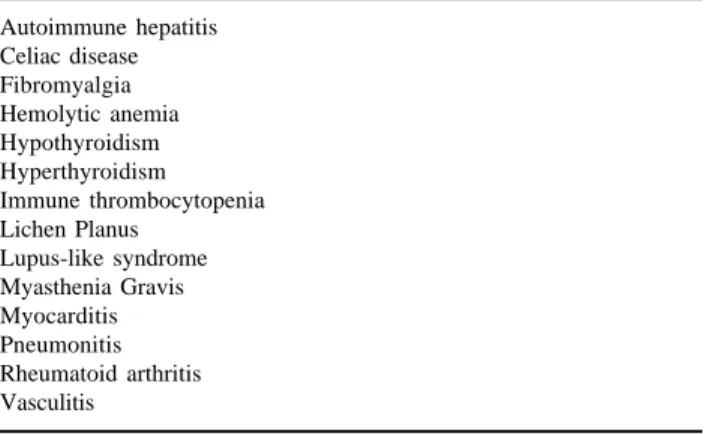
Several autoimmune disorders have been reported to appear in response to interferon therapy (Table I). In some cases these autoimmune disorders may be severe and life threatening. One of the most devastating of these compli-cations is interferon induced pneumonitis which may progress rapidly to the adult respiratory distress syndrome and pulmonary failure.28 The development of a lupus-like
syndrome, rheumatoid arthritis and system vasculitis have also been observed.26 Other uncommon findings associated
with use of interferon and possibly of autoimmune etiology have included sudden hearing loss,29 cardiac toxicity30 and
sarcoidosis.31 Interferon should be discontinued as soon as
it is recognized that treatment has precipitated a significant autoimmune disorder.
Disorders of the thyroid, both hypo- and hyperthyroid-ism, develop in 10-15% of patients during interferon ther-apy.32 As a result, it is recommended that thyroid function
studies be performed at baseline, prior to initiating inter-feron therapy, and a periodic intervals during therapy. Pa-tients who develop biochemical evidence of hypothyroid-ism may require thyroid replacement prior to becoming overtly symptomatic but do not require that the dose of interferon be modified. It remains unclear if interferon in-duced hypothyroidism resolves after treatment has been completed and thyroid replacement therapy can be dis-continued. Interferon induced hyperthyroidism is fre-quently more difficult to manage. Patients who develop symptomatic hyperthyroidism may require beta-block-ade, pharmacolgic therapy or radio-iodine ablation to re-duce thyroid function. However, if the symptoms of hy-perthyroidism cannot be rapidly alleviated interferon should be discontinued.
Retinopathy has been reported to occur in less than 5% of patients receiving interferon therapy.33 The etiology for
Annals of Hepatology 3(1) 2004: 5-10
8
edigraphic.com
and papilledema. Patients who develop significant visual changes while undergoing interferon therapy should un-dergo ophthamologic examination and treatment discon-tinued if significant abnormalities thought secondary to interferon are identified. Patients with a history of hyper-tension and diabetes mellitus are thought to be at in-creased risk for interferon induced retinal pathology. The manufacturers have recommended that persons with a history of hypertension and diabetes mellitus undergo ophthamologic examination prior to initiating interferon therapy. How this will affect the management of such pa-tients remains undefined.
Effect of dose reduction on SVR
Reducing the dose of interferon and/or ribavirin is re-quired in approximately 25-33% of patients who receive treatment for chronic HCV. The most common reasons for dose reduction in interferon include flu-like side effects, depression and autoimmune manefestations, neutropenia thrombocytopenia. The most common reasons for dose re-ducing ribavirin include anemia and rash (Table II). Unfor-tunately, reducing the dose of peginterferon and ribavirin or discontinuing therapy before the planned course of ther-apy is complete has been associated with a reduction in SVR.5,34,35 The first study in which this was demonstrated
combined interferon and ribavirin dose reductions and dis-continuations and did not separately evaluate the relative importance of each medication independently or of dose reduction versus discontinuation.5 Patients who completed
all therapy without dose reduction had a SVR of 61%. This declined to 50% in patients who dose reduced after week 12 and to 34% in patients who dose reduced prior to week 12 (Table III). More recently, two studies have demonstrat-ed that dose rdemonstrat-eduction of ribavirin within the first 12-20 weeks of therapy significantly reduced both early virologic response (EVR) and SVR.34,35 In contrast, reducing the
dose of peginterferon did not appear to significantly impact either EVR or SVR. More importantly, reducing the dose of peginterferon or ribavirin after patients had already be-come HCV RNA undetectable did not adversely affect the ability to achieve SVR.
In the original trials, where the impact of dose reduc-tion upon SVR was first assessed, protocol mandated dose reductions for neutropenia, thrombocytopenia and amenia were the major indications for dose reduction.1,2
In these studies the dose of peginterferon was reduced by 50% and ribavirin was reduced from either 1,000 or 12,000 mg/day to 600 mg/day. The reason for such dras-tic reductions was primarily related to safety in these reg-istration trials. However, in practice many experienced physicians dose reduce by lesser amounts; peginterferon alfa-2a from 180 mcg/week to 135 mcg/week; peginter-feron alfa-2b from 1.5 mcg/kg/week to 1.0 mcg/kg/week and ribavirin from either 1,200 to 1,000 mg/day or from 1000 to 800 mg/day. Since anemia is a function of both ribavirin induced hemolysis and interferon induced bone marrow suppression reducing the dose of peginterferon may instead of ribavirin may improve anemia and allevi-ate the need to dose reduce ribavirin. Reducing the amount by which the doses of these medications are low-ered, particularly during the first 12-20 weeks of therapy, may lead to improved rates of SVR.
Role of hematologic growth factors
Anemia is the primary indication for reducing the dose of ribavirin.1,2 As noted above, this has been associated Table I. Autoimmune disorders stimulated by interferon.
Autoimmune hepatitis Celiac disease Fibromyalgia Hemolytic anemia Hypothyroidism Hyperthyroidism Immune thrombocytopenia Lichen Planus
Lupus-like syndrome Myasthenia Gravis Myocarditis Pneumonitis Rheumatoid arthritis Vasculitis
Table III. Effect of dose reduction of interferon and ribavirin on early and sustained virologic response.
Early virologic Sustained
response virologic response
Dose reduction prior to week 12:
None 80% 62%
Peginterferon 70%
Ribavirin 60%
Peginterferon and ribavirin 33% 34%
Dose reduction after week 12:
Peginterferon, ribavirin or both 51%
Data from references: 5 and 34.
Table II. Frequency and reasons for dose reduction of interferon and ribavirin during treatment of chronic HCV.
Interferon Ribavirin
Adverse side effects including: 11-15% ~20%
Depression Flu-like side effects Fatigue
Other
Thrombocytopenia 4% < 1%
Neutropenia 18-20% 1%
Anemia 1% 9-22%
MG 9
edigraphic.com
with a reduction in SVR, particualrly when ribavirin is re-duced within the first 12-20 weeks after initiating thera-py.5,34,35 Two randomized controlled trials have now
dem-onstrated that ribavirin induced anemia can be corrected by erythropoetin alfa.36,37 On average the hemoglobin
in-creased by 2 grams within 6-8 weeks after initiating erythropoetin and this alleviated the need to dose reduce ribavirin or allowed the dose of ribavirin to be increased. Quality of life and energy were both significantly im-proved in patients who received erythropoetin for treat-ment of ribavirin induced anemia. However, neither study demonstrated was designed to evaluate the effect of erythropoetin and correction of anemia on SVR. In addi-tion, the mean time to initiate erythropoetin in the ran-domized, placebo controlled trial was not until after pa-tients had received 12 weeks of HCV therapy; and that time more than half of all patients were already become HCV RNA undetectable.37 Nevertheless, these studies do
suggest that erythropoetin alfa, if instituted early, is like-ly to prevent a significant fall in hemoglobin during peginterferon and ribavirin therapy and could therefore prevent the need to dose reduce ribavirin and improve SVR. However, the use of erythropoetin is unlikely to be benefit in patients who do not achieve EVR despite re-ceiving optimal doses of peginterferon and ribavirin.
Emerging data strongly suggests that dose reducing peginterferon, particularly by small amounts (ie. from 180 to 135 mcg/week for peginterferon alfa-2a and from 1.5 to 1.0 mcg/kg/week) does not impair either EVR or SVR.38,39 In addition, the incidence of bacterial infections
in patients being treated with peginterferon and ribavirin does not appear to be associated with neutropenia, partic-ularly in patients without decompensated cirrhosis (x). As a result, the use of GCSF to prevent neutropenia does not appear to be either necessary or beneficial in the great majority of patients with chronic HCV.
References
1. Manns MP, McHutchison JG, Gordon SC, Rustgi VK, Shiffman M,
Reindollar R, Goodman ZD, Koury K, Ling M, Albrecht JK. Peginterferon 2b plus ribavirin compared with interferon alfa-2b plus ribavirin for initial treatment of chronic hepatitis C: a ran-domized trial. Lancet 2001; 358: 958-965.
2. Fried MW, Shiffman ML, Reddy KR, Smith C, Marinos G, Goncales FL Jr, Haussinger D, Diago M, Carosi G, Dhumeaux D, Craxi A, Lin A, Hoffman J, Yu J. Peginterferon alfa-2a plus ribavirin for chronic hepatitis C virus infection. N Engl J Med 2002; 347: 975-982. 3. Hadziyannis SJ, Sette Jr H, Morgan TR, Balan V, Diago M, Marcellin
P, Ramadorl G, Bodenheimer Jr H, Bernstein D, Rizzetto M, Zeuzem S, Pockros P, Lin A, Ackrill AM. Peginterferon alfa-2a and ribavirin combination therapy in chronic hepatitis C. A randomized study of treatment duration and ribavirin dose. Ann Int Med 2004; 140: 346-355.
4. Fried MW. Side effects of therapy of hepatitis C and their manage-ment. Hepatology 2002; 36: S237-S244.
5. McHutchison JG, Manns M, Patel K, Poynard T, Lindsay KL, Trepo C, Dienstag J, et al. Adherence to combination therapy enhances sustained response in genotype-1-infected patients with chronic hepa-titis C. Gastroenterology 2002; 123: 1061-1069.
6. Soza A, Everhart JE, Ghany MG, Doo E, Heller T, Promrat K, Park Y, et al. Neutropenia during combination therapy of interferon and ribavirin for chronic hepatitis C. Hepatology 2002; 36: 1273-1279. 7. Maddrey WC. Safety of combination interferon alfa-2b/ribavirin therapy in chronic hepatitis C-relapsed and treatment-naive patients.
Semin Liver Dis 1999; 19(Suppl 1): 67-75.
8. Shiffman ML, Hofmann CM, Sterling RK, Luketic VA, Contos MJ,
Sanyal AJ. A randomized, controlled trial to determine whether con-tinued ribavirin monotherapy in hepatitis C virus-infected patients who responded to interferon-ribavirin combination therapy will en-hance sustained virologic response. J Infect Dis 2001; 184: 405-409.
9. Reed WW, Diehl LF. Leukopenia, neutropenia and reduced
hemo-globin levels in healthy American blacks. Ann Intern Med 1991; 151: 501-505.
10. Jacobsen. Neutropenia and infections abstract.
11. Heathcote EJ, Shiffman ML, Cookesly WG, Dusheiko GM, Lee SS, Balart L, Reindollar R, et al. Peginterferon alfa-2a in patients with chronic hepatitis C and cirrhosis. N Engl J Med 2000; 343: 1673-1680.
12. Fukuda A, Kobayashi H, Teramura K, Yoshimoto S, Ohsawa N. Ef-fects of interferon alfa on peripheral neutrophil counts and serum granulocyte colony stimulating factor levels in chronic hepatitis C patients. Cytokines Cell Mol Ther 2000; 6: 149-154.
13. Carreno V, Martin J, Pardo M, Brotons A, Anchia P, Navas S, Fernandez M, et al. Randomized controlled trial of recombinant hu-man granulocyte macrophage stimulating factor for the treatment of chronic hepatitis C. Cytokine 2000; 12: 165-170.
14. Crippin JS, McCashland T, Terrault N, Sheiner P, Charlton MR. A pilot study of the tolerability and efficacy of antiviral therapy in hepa-titis C virus-infected patients awaiting liver transplantation. Liver
Transpl 2002; 8: 350-5.
15. Fujii H, Kitada T, Yamada T, Sakaguchi H, Seki S, Hino M. Life-threatening severe immune thrombocytopenia during alpha-interferon therapy for chronic hepatitis C.
Hepatogastroenterology 2003; 50: 841-842.
16. Peck-Radosavljevic M, Wichlas M, Homoncik-Kraml M, Kreil A, Hofer H, Jessner W, Gangl A, et al. Rapid suppression of hemato-poiesis by standard or pegylated interferon-alpha. Gastroenterology 2002; 123: 141-151.
17. De Franceschi L, Fattovich G, Turrini F, Ayi K, Brugnara C, Manzato F, Noventa F, et al. Hemolytic anemia induced by ribavirin therapy in patients with chronic hepatitis C virus infection: role of mem-brane oxidative damage. Hepatology 2000; 31: 997-1004. 18. Van Vlierbergh H, Delanghe JR, De Vos M, Leroux-Roel G, et al.
Factors influencing ribavirin-induced hemolysis. J Hepatol 2001; 34: 911-916.
19. Fontana RJ. Neuropsychiatric toxicity of antiviral treatment in chronic hepatitis C. Dig Dis 2000; 18: 107-116.
20. Hilsabeck RC, Perry W, Hassanein TI. Neuropsychological impair-ment in patients with chronic hepatitis C. Hepatology 2002; 35: 440-446.
21. Menkes DB, MacDonald JA. Interferons, serotonin and neurotoxic-ity. Psychol Med 2000; 30: 259-268.
22. Musselman DL, Lawson DH, Gumnick JF, Manatunga AK, Penna S, Goodkin RS, Greiner K, et al. Paroxetine for the prevention of de-pression induced by high-dose interferon alfa. N Engl J Med 2001; 344: 961-966.
23. Meyers CA, Scheibel RS, Forman AD. Persistent neurotoxicity of sys-temically administered interferon-alpha. Neurology 1991; 41: 672-676. 24. Valentini P, Mariotti P, Ngalikpima CJ, Angelone DF, Ranno O. Sei-zures in an interferon-treated child. Dig Liver Dis 2001; 33: 363-365. 25. Dalekos GN, Hatzis J, Tsianos EV. Dermatologic disease during interferon-alpha therapy for chronic viral hepatitis. Ann Intern Med 1998; 128: 409-410.
Annals of Hepatology 3(1) 2004: 5-10
10
edigraphic.com
28. Kumar KS, Russo MW, Borczuk AC, Brown M, Esposito SP, Lobritto SJ, Jacobson IM, et al. Significant pulmonary toxicity associated with interferon and ribavirin therapy for hepatitis C. Am J
Gastroenterol 2002; 97: 2432-2440.
29. Cadoni G, Marinelli L, De Santis A, Romito A, Manna R, Ottaviani F. Sudden hearing loss in a patient hepatitis C virus positive on therapy with interferon alfa: a possible autoimmune-microvascular patho-genesis. J Laryngol Otol 1998; 112: 962-963.
30. Teragawa H, Hondo T, Amano H, Hino F, Ohbayashi M. Adverse effects of interferon on the cardiovascular system in patients with chronic hepatitis C. Jpn Heart J 1996; 37: 905-915.
31. Li SD, Yong S, Srinivas D, Van T. Reactivation of sarcoidosis during interferon therapy. J Gastroenterol 2002; 37: 50-54.
32. Prummel MF, Laurberg P. Interferon-alpha and autoimmune thyroid disease. Thyroid 2003; 13: 547-551.
33. Saito H, Ebinuma H, Nagata H, Inagaki Y, Saito Y, Wakabayashi K, Takagi T, et al. Interferon-associated retinopathy in a uniform regi-men of natural interferon-alpha therapy for chronic hepatitis C. Liver 2001; 21: 192-197.
34. Davis GL, Wong JB, McHutchison JG, Manns MP, Harvey J, Albrecht J. Early virologic response to treatment with peginterferon alfa-2b plus ribavirin in patients with chronic hepatitis C. Hepatology 2003; 38: 645-652.
35. Shiffman ML, Di Bisceglie AM, Lindsay KL, Morishima C, Wright EC, Everson GT, Lok AS, Morgan TR, Bonkovsky HL,
Lee WM, Dienstag JL, Ghany MG, Goodman ZD, Everhart JE. Peginterferon alfa-2a and ribavirin in patients with chronic hepa-titis C who have failed prior treatment. Gastroenterology 2004; (in press).
36. Dieterich DT, Wasserman R, Brau N, Hassanein TI, Bini EJ, Bowers PJ, Sulkowski MS. Once-weekly epoetin alfa improves anemia and facilitates maintenance of ribavirin dosing in hepatitis C virus-infected patients receiving ribavirin plus interferon alfa. Am J Gastroenterol 2003; 98: 2491-2499.
37. Afdhal NH, Dieterich DT, Pockros PJ, Schiff ER, Shiffman ML, Sulkowski MS, Wright T, Younossi Z, Goon BL, Tang KL, Bowers BJ. Epoetin alfa maintains ribavirin dose in HCV-infected patients: a prospective, double-blind, randomized controlled study.
Gastro-enterology 2004; (in press).
38. Lindsay KL, Trepo C, Heintges T, Shiffman ML, Gordon SC, Hoefs JC, Schiff ER, Godman Z, Laughlin M, Yao R, Albrecht JK. A ran-domized, double-blind trial comparing peginterferon alfa-2b to in-terferon alfa-2b as initial treatment for chronic hepatitis C. Hepatology 2001; 34: 395-403.