Is pre-treatment liver biopsy
necessary for all hepatitis C genotypes?
Kevork M. Peltekian,* Vincent G. Bain,† Samuel S. Lee,‡ Morris Sherman,§ Curtis L. Cooper,|| Eric M. Yoshida,¶ Paul J. Marotta,** Mel Krajden,†† Robert Balshaw,‡‡ Marc Deschênes.§§(a)
* Division of Gastroenterology. Dalhousie University, Halifax, Nova Scotia, Canada. † Division of Gastroenterology. University of Alberta, Edmonton, Alberta, Canada. ‡ Division of Gastroenterology. University of Calgary, Calgary, Alberta, Canada. § Division of Gastroenterology. University Health Network, Toronto, Ontario, Canada.
|| Division of Gastroenterology. Division of Infectious Diseases of the University of Ottawa, Ottawa, Ontario, Canada. ¶ Division of Gastroenterology. University of British Columbia, Vancouver, British Columbia, Canada.
** BC Centre for Disease Control. Toronto, Ontario, Canada. †† British Columbia Centre for Disease Control, Vancouver, British Columbia, Canada. ‡‡ Syreon Corporation, Vancouver, BC, Canada. §§ Division of Gastroenterology. Royal Victoria Hospital, Montreal, Quebec, Canada.
(a) On behalf of the Canadian PEGASYS Study Group.
ABSTRACT
Background. Current practice guidelines recommend liver biopsy prior to treatment of hepatitis C genoty-pe-1 but not for genotype-2/3; this is based on expert opinion, not on published evidence. Methods. In retrospective analysis of a large trial database prior to the publication of recent guidelines, we compared outcomes in 985 treatment-naïve patients with hepatitis C who did or did not undergo liver biopsy before starting peginterferon alfa-2a plus ribavirin. Results. Physicians elected to treat 141/654 (21.6%) genotype-1 patients and 126/331 (38.1%) genotype-2/3 patients without liver biopsy. There were no differences in ba-seline characteristics among those with or without pre-treatment liver biopsy, except for female prepon-derance in genotype-1 patients with liver biopsy. The sustained viral response (SVR) rate was no different amongst genotype-2/3 patients who had a biopsy before treatment with 66.3% SVR vs. 69.8% of those trea-ted without biopsy (p = 0.546), but significantly higher among genotype-1 patients with pre-treatment liver biopsy at 54.6 vs. 44.0% for those treated without a liver biopsy (p = 0.029). In genotype-1 patients with li-ver biopsy, more patients with cirrhosis had dose adjustments (p = 0.0057) rather than drug discontinua-tion. There was tendency for earlier discontinuation among patients without pre-treatment liver biopsy.
Conclusions. Pre-treatment liver biopsy was associated with better SVR amongst genotype-1 patients. This improvement may reflect ongoing commitment to completing the treatment course by both patient and physician. In genotype-2/3 patients, pre-treatment liver biopsy may not be essential to maximize SVR rates. This study validates the recommendations of the most recent treatment guidelines for hepatitis C.
Key words. Chronic hepatitis C. Liver biopsy. Outcomes research. Practice guidelines. Antiviral therapy. Adherence. Adverse events.
Correspondence and reprint request: Dr. Kevork M. Peltekian Hepatology Services. Division of Gastroenterology
Queen Elizabeth II Health Sciences Centre 1276 South Park Street, VG Site Room 6-208 Halifax, NS, Canada B3H 2Y9
Ph.: (902) 473-2898, Fax: (902) 473-2783 E-mail: [email protected]
Manuscript received: February 05. 2011. Manuscript accepted: March 21, 2011. INTRODUCTION
Liver biopsy has been the cornerstone for the diagnosis and management of liver disease. Over the past two decades, however, new tests and proce-dures have increased our diagnostic ability. In particular for liver disease due to chronic viral infections,
viro-logical and biochemical assays, and ultrasonogra-phic examination of the abdomen have reduced the uncertainty of clinical diagnosis, with progressively greater efficiency and lower risk.1-4 Since the level of certainty needed in decision making is a function of the characteristics of available therapies, one may tolerate substantial diagnostic uncertainty if the treatment cures the disease.5-7
guide-lines have recommended the routine performance of liver biopsy before initiation of antiviral therapy for chronic HCV.12-14
More recent guidelines have shifted the emphasis suggesting that liver biopsy may not be necessary for genotype-2/3 but still recommending it in pa-tients infected with HCV genotype-1 if treatment is being considered. These recommendations have been based on expert-opinion rather than published evidence.
Patients are not always eager to have a liver biopsy, and frequently have anticipatory anxiety, which would be expected of a procedure that is asso-ciated with complications and death.10
Guidelines are commonly issued by scientific com-mittees and often do not incorporate patients’ prefe-rence into medical decision making. Moreover, liver biopsy may not always be representative for stage or grade of the liver disease, as sample bias, and interor intra-observer variability affect the diagnos-tic yield.15-18
A cost-effectiveness analysis suggested that the best strategy in the management of patients with HCV in-fection is to offer therapy to all patients and not to biopsy,19,20 and that the histopathological diagnosis is of little additional value for the recommendation of treatment16 empirical treatment based on HCV-RNA quantification, or HCV genotyping but without liver biopsy, has acceptable cost-effectiveness.19
These conclusions, derived from mathematical si-mulation based on Markov computer modeling, re-quire direct clinical verification before becoming widely accepted. At minimum, patients would like to see some evidence that a liver biopsy would make a difference in outcomes before accepting the expert advice. Physicians who treat HCV also would like to see that in genotype-2/3 the decision for initiating therapy in patients without a pre-treatment liver biopsy would not impact the outcomes.
In this study, we compared sustained viral res-ponse (SVR) rates after combination treatment with peginterferon alfa-2a and ribavirin in treatment-naïve patients with HCV infection who underwent or did not undergo liver biopsy prior to initiation of therapy.
MATERIAL AND METHODS
Patients
Patients included in this retrospective analysis of prospectively collected data were enrolled in the open-label Canadian Pegasys Expanded Access
Pro-gram (EAP). Eligibility criteria for the proPro-gram were broad and previously described.21 Individuals were required to have a clinical diagnosis of chronic HCV and quantifiable HCV RNA in serum. Patients with clinically advanced liver disease could be enro-lled only if they had compensated liver disease (Child-Pugh class A), neutrophil count > 1.5 x 10⁹/ L, and platelet count > 90 x 109/L. Only treatment-naïve patients were included in this analysis. Also all patients with multiple genotypes or genotype-4/5/ 6 were excluded.
Liver biopsy
In the second phase of EAP, there was no requi-rement for a liver biopsy to enroll patients. The de-cision was left to the usual clinical practice of the participating physician. Any biopsies performed on patients enrolled in the EAP were read by the presi-ding local pathologist at each study site. For those who underwent liver biopsy, grading of inflamma-tion and staging of fibrosis were analyzed accor-ding to the METAVIR scoring system. Only the most recent biopsy result was recorded on the case report form. For patients who were treated without a liver biopsy, the reason for not perfor-ming a liver biopsy was not collected on the case report forms.
Treatment
Patients received peginterferon alfa-2a 180 µg/week plus either a low fixed dose of ribavirin (800 mg/day) or a weight-based dose of ribavi-rin (1,000 mg/day for patients with a body weight < 75 kg; 1,200 mg/day for patients with a body weight ≥ 75 kg) for 24 or 48 weeks (Pegasys RBV®, Roche, Mississauga, Canada).
The EAP was not a randomized trial; the dura-tion of treatment and ribavirin dose were selected at the investigator’s discretion. The impact of diffe-rences in dosage has also been reported previous-ly.22 In this analysis, only genotype-1 patients who were assigned to a ribavirin dose of 1,000/1,200 mg/ day and planned treatment duration of 48 weeks were included. Among genotype-2/3 patients, only those assigned to a ribavirin dose of 800 mg/day and planned treatment duration of 24 weeks were included.
Outcomes
The primary efficacy outcome was SVR, defined as undetectable HCV RNA (< 50 IU/mL by qualita-tive PCR assay, Cobas Amplicor HCV Test, v2.0, Ro-che Diagnostics, Indianapolis, IN, USA) 24 weeks following completion of therapy. Early virological response (EVR) was defined as 2-log10 or more drop in serum HCV RNA, or undetectable HCV RNA by quantitative PCR assay (Cobas Amplicor HCV Moni-tor, v2.0, Roche Diagnostics, Indianapolis, IN, USA; limit of quantification 600 IU/mL) at week 12. In ge-notype-1 patients those who had undetectable HCV RNA by qualitative PCR at week 24 continued treat-ment for total of 48 weeks.
End of treatment virological response (EOTVR) was defined as undetectable HCV RNA by qualitative PCR at the end of planned treatment (i.e., week 24 for genotypes-2/3 and 48 for genotype-1). Relapse rate was defined as percentage of patients with detectable HCV-RNA at 24 weeks post-treatment from those with undetectable HCV-RNA at the end of the treatment period.
Adverse events,
dose adjustments and drug discontinuation
Safety assessments (physical examination and la-boratory evaluations) and monitoring for adverse events were conducted at regular intervals throug-hout EAP, entered into case report forms, and cap-tured in the database.
In the event of clinically significant laboratory abnormalities or adverse events, the adjustment or discontinuation of dosage of peginterferon alpha-2a or ribavirin was left to the individual participating physicians who were all aware of the recommended guidelines. All these dose adjustments and drug dis-continuations were also captured by the EAP case report forms.
Statistical analysis
The analysis for the current study was reported on the intention-to-treat approach. All patients re-gistered in the second phase of EAP who received at least one dose of peginterferon alfa-2a and ribavirin were included. They were grouped either having li-ver biopsy or not having lili-ver biopsy prior to treat-ment. Differences between groups were evaluated by Fisher’s exact test or Kruskal-Wallis test.
For the dose adjustment and drug discontinua-tion analysis, those with pre-treatment liver biopsy
were further stratified by the presence or absence of cirrhosis (METAVIR score 4).
Time to dose adjustment or drug discontinuation for peginterferon alfa-2a and ribavirin was evalua-ted by cumulative failure plot similar to a Kaplan Meier survival analysis with comparison between groups by log rank test.
Baseline factors predictive of SVR were identified by multiple logistic regression analysis using a bac-kward elimination process. Factors considered in the initial model included biopsy status (yes vs. no), age (per 10 year increment), sex (male vs. female), race (Caucasian vs. non-Caucasian), BMI (per unit increase), HCV RNA level (per log10 increment) and platelet count (< 150 vs. ≥ 150 x 109/L). All these factors were identified a priori since they are known to impact SVR.21
The α-level of significance for a two-tailed test was considered to be at p of 0.05. All statistical analyses were performed using SAS v. 9.1 (SAS Ins-titute, Cary, NC, USA).
RESULTS
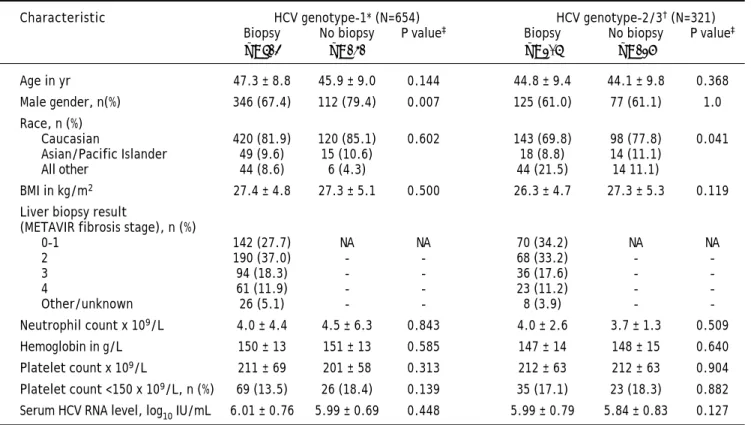
A total of 2,702 patients were originally enrolled into EAP at 72 centers in Canada. The first patient was enrolled in October 2001. A total of 1,620 pa-tients were enrolled in the second phase of the trial when a liver biopsy was not a prerequisite. There were 985 treatment-naïve patients available for this analysis including 654 genotype-1 patients assigned to a ribavirin dose of 1,000/1,200 mg/day and treat-ment duration of 48 weeks, and 331 genotype-2/3 patients assigned to a ribavirin dose of 800 mg/day and treatment duration of 24 weeks. The baseline characteristics of these patients are presented in table 1.
Participating physicians elected to initiate thera-py for HCV without a pre-treatment liver biopsy in 141 (21.6%) genotype-1 infected patients and 126 (38.1%) genotype-2/3 patients. Amongst the 513 ge-notype-1 infected patients and 205 genotype-2/3, the staging of fibrosis according to METAVIR score were comparable with 11.9% of genotype-1 patients and 11.2% genotype-2/3 patients having cirrhosis (METAVIR score 4).
fur-ther analysis. The ethnic distribution amongst geno-type-2/3 patients between the two groups were diffe-rent (p = 0.041) with less Asians or Pacific Islanders (8.8 vs. 11.1%) having undergone pre-the-rapy liver biopsy. The overall number of African-Ca-nadians in this population was only 0.9%.
Specifically, for genotype-1, when considering the baseline variables that usually predicted lower SVR such as higher viral load, older age, higher BMI or lower platelet counts (reflecting more advanced liver disease and portal hypertension), no significant differences could be identified between the group who had pre-treatment liver biopsy versus the group who did not undergo liver biopsy prior to initiation of therapy.
Virological response
EVR rate at week 12, EOTVR rate and SVR rate at 24 weeks following the completion of treatment are shown in figure 1. There was no significant di-fference in the proportion of genotype-2/3 patients treated without a biopsy who achieved an SVR
(66.3%) when compared with patients treated without a biopsy (69.8%, p = 0.546).
In contrast to the findings in genotype-2/3, 54.6% of those with a pre-therapy biopsy achieved an SVR, compared with 44.0% of those treated without a biopsy (p = 0.029); this unexpected 10.6% absolute improvement in SVR reflected 24.1% increase in SVR in those patients whose fibrosis stage was known before starting therapy. Further analysis re-vealed that after the first 12 weeks of treatment, there were no difference in EVR rates between the two groups among genotype-1 patients (p = 0.28), nor was there any difference in relapse rates with 20.4% in those with a pre-treatment biopsy vs. 22.4% in those treated without a biopsy (p = 0.687). The major difference and contributing factor to lo-wer SVR was the EOTVR rate differences between the two groups (p = 0.019).
Safety and tolerability
To further elucidate the reasons for differences in EOTVR, we examined the number of dose
adjust-Table 1. Baseline characteristics of treatment-naïve patients included in the analysis by genotype and biopsy status.
Characteristic HCV genotype-1* (N=654) HCV genotype-2/3† (N=321)
Biopsy No biopsy P value‡ Biopsy No biopsy P value‡
(n = 513) (n = 141) (n = 205) (n = 126)
Age in yr 47.3 ± 8.8 45.9 ± 9.0 0.144 44.8 ± 9.4 44.1 ± 9.8 0.368
Male gender, n(%) 346 (67.4) 112 (79.4) 0.007 125 (61.0) 77 (61.1) 1.0
Race, n (%)
Caucasian 420 (81.9) 120 (85.1) 0.602 143 (69.8) 98 (77.8) 0.041
Asian/Pacific Islander 49 (9.6) 15 (10.6) 18 (8.8) 14 (11.1)
All other 44 (8.6) 6 (4.3) 44 (21.5) 14 11.1)
BMI in kg/m2 27.4 ± 4.8 27.3 ± 5.1 0.500 26.3 ± 4.7 27.3 ± 5.3 0.119
Liver biopsy result
(METAVIR fibrosis stage), n (%)
0-1 142 (27.7) NA NA 70 (34.2) NA NA
2 190 (37.0) - - 68 (33.2) -
-3 94 (18.3) - - 36 (17.6) -
-4 61 (11.9) - - 23 (11.2) -
-Other/unknown 26 (5.1) - - 8 (3.9) -
-Neutrophil count x 109/L 4.0 ± 4.4 4.5 ± 6.3 0.843 4.0 ± 2.6 3.7 ± 1.3 0.509
Hemoglobin in g/L 150 ± 13 151 ± 13 0.585 147 ± 14 148 ± 15 0.640
Platelet count x 109/L 211 ± 69 201 ± 58 0.313 212 ± 63 212 ± 63 0.904
Platelet count <150 x 109/L, n (%) 69 (13.5) 26 (18.4) 0.139 35 (17.1) 23 (18.3) 0.882 Serum HCV RNA level, log10 IU/mL 6.01 ± 0.76 5.99 ± 0.69 0.448 5.99 ± 0.79 5.84 ± 0.83 0.127
Table 2. Dose adjustments and reported adverse events in treatment-naïve patients by genotype and biopsy status.
Characteristic HCV genotype-1 (n = 654) HCV genotype-2/3 (n = 321)
Biopsy No biopsy P value Biopsy No biopsy P value
(n = 513) (n = 141) (n =205) (n = 126)
Dose adjustments, n (%)
Peginterferon alfa-2a 217(42.3) 63(44.7) 0.0632 69(33.7) 49(38.9) 0.347
Ribavirin 249(48.5) 70(49.6) 0.849 59(28.8) 47(37.3) 0.116
Patients with adverse events, n (%) 207(40.4) 51(36.2) 0.383 66(32.2) 31(24.6) 0.171
ments and early discontinuation among the groups. There were no statistically significant differences in the frequency of ribavirin or peginterferon alfa-2a dose adjustment in patients infected with genotype-1 or genotypes-2/3 who were treated with and without a pre-treatment liver biopsy (Table 2) though there was tendency for more peginterferon alfa-2a discon-tinuation in the group that did not have pre-therapy biopsy; this did not achieve 2-tailed significance (p = 0.0632). Overall the incidence of non-serious ad-verse events was similar in genotype-1 patients and genotype-2/3 patients who were treated with a biop-sy vs. those patients without a biopbiop-sy (Table 2).
Among genotype-1 patients, there were no signifi-cant differences between the two groups in the mean overall length of therapy with either peginterferon alfa-2a (286 vs. 270 days in patients with and without a biopsy) or ribavirin (291 vs. 275 days, respectively). Similarly, there were no significant differences between the two groups in the mean over-all length of therapy with either peginterferon
alfa-2a (159 vs. 152 days, respectively) or ribavirin (165 vs. 158 days, respectively) among genotype-2/3 infec-ted patients.
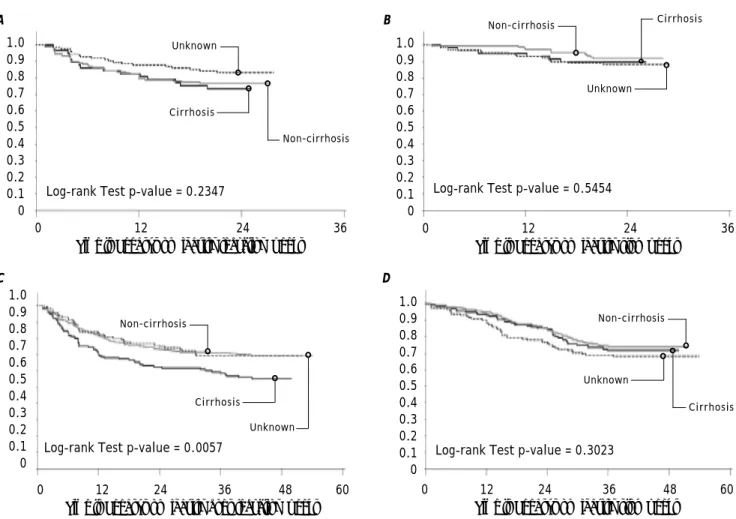
When the cumulative failure plots for dose ad-justment and drug discontinuation were reviewed (Figure 2) for peginterferon alfa-2a or ribavirin in genotype-1 and genotype-2/3 patients, amongst those who underwent liver biopsy, more patients with cirrhosis had significantly more dose adjust-ments (p = 0.0057) especially during the first 12 weeks of therapy. The drug discontinuation was comparable (p = 0.3023) to those without cirrho-sis or patients who did not undergo liver biopsy with discontinuations occurring around week-12 due to lack of early viral response or at week-24 because of ongoing HCV viremia by qualitative PCR testing. Also in genotype-1 patients who did not undergo liver biopsy prior to treatment, there was tendency for earlier drug discontinuation compared to patients who had undergone liver biopsy with or without cirrhosis.
Figure 1. Virological response rates at week 12 (EVR) the end of treatment (EOTVR) and after 24 weeks of following comple-tion of treatment (SVR). When comparing with patients who were treated without a biopsy, those who had pre-treatment liver biopsy achieved 21.0% higher EOTVR and 24.1% higher SVR.
Pretreatment biopsy done Treated without a biopsy
100
80
60
40
20
0
Patients (%)
p = 0.180 p = 0.019 p = 0.029 p = 0.012 p = 0.596 p = 0.546
EVR EOTVR SVR EVR EOTVR SVR
Genotype 1 Genotype 2 or 3
82.5 77.3
68.6
56.7 54.6
44.0
93.7
84.9 89.3 85.7
Independent factors impacting SVR
We proceeded by exploring the significant diffe-rence in SVR in genotype-1 patients. To avoid and correct for the inherent bias in the patient popula-tion, we conducted multiple logistic regression analysis to see if the availability of pre-treatment li-ver biopsy was independently associated with SVR. When baseline factors were entered into the stepwise analysis, the following were significantly associated with SVR in genotype-1 infected patients:
• Pre-therapy biopsy (OR 1.513 vs. no biopsy, 95% CI 1.024-2.234; p = 0.0376).
• Age (OR 0.827 per 10-year increment, 95% CI 0.685-0.998; p = 0.0473).
• Caucasian race (OR 0.435 vs. non-Caucasian race, 95% CI 0.279-0.678; p = 0.0002).
• HCV RNA level (OR 0.663 per 1-log increase, 95%CI 0.529-0.830; p = 0.0003).
• Platelet count level (OR 0.352 for < 150 vs. ≥ 150 x109/L, 95% CI 0.215-0.570; p < 0.0001).
Only age was significantly associated with SVR in the multiple logistic regression analysis of data from genotype-2/3 infected patients (OR 0.739 per 10-year increment in age, 95% CI 0.576-0.948; p = 0.0173).
DISCUSSION
All patients with chronic HCV are potential can-didates for specific antiviral therapy. Originally, gi-ven the modest response to interferon monotherapy, treatment was recommended only in patients in whom the impact of treatment could be greatest, in terms of halting disease progression and preven-Figure 2. In genotype-2/3 there were no differences in number of patients with dose adjustments in peginterferon alfa-2a or ribavirin (A) or drug discontinuation (B). In genotype-1 patients, there were significantly more dose adjustment (C) with p-value = 0.0057 rather than discontinuation peginterferon alfa-2a or ribavirin (D).
1.0 0.9 0.8 0.7 0.6 0.5 0.4 0.3 0.2 0.1 0
0 12 24 36 48 60
Time to Pegasys or Ribavirin stop (weeks) 1.0
0.9 0.8 0.7 0.6 0.5 0.4 0.3 0.2 0.1 0
0 12 24 36
Time to Pegasys or Ribavirin reduction (weeks)
1.0 0.9 0.8 0.7 0.6 0.5 0.4 0.3 0.2 0.1 0
0 12 24 36
Time to Pegasys or Ribavirin stop (weeks)
1.0 0.9 0.8 0.7 0.6 0.5 0.4 0.3 0.2 0.1 0
0 12 24 36 48 60
Time to Pegasys or Ribavirin does reduction (weeks)
Log-rank Test p-value = 0.2347 Log-rank Test p-value = 0.5454
Log-rank Test p-value = 0.0057 Log-rank Test p-value = 0.3023
Non-cirrhosis
Cirrhosis Unknown
Non-cirrhosis
Unknown
Non-cirrhosis
Unknown Cirrhosis
Non-cirrhosis Cirrhosis
Unknown
Cirrhosis
A B
ting complications. On this premise early treatment guidelines recommended that decisions about treatment should be made only after performing a liver biopsy.12-14
However, in recent years we have witnessed a re-markable improvement in the clinical effectiveness of treatment of chronic HCV, with SVR rates of up to 50% in genotype1- patients and up to 80% in pa-tients infected with genotype-2/3.8,9,22 Revision of guidelines would be expected to follow this therapeu-tic gain: as the probability of achieving an SVR in-creases, the need for absolute certainty in staging and grading chronic viral hepatitis decreases.
One would expect that a selective rather than routine liver biopsy policy would be used to assist in decision-making regarding therapy; possible algo-rithm may include restricting the invasive procedure to patients with a high probability of no response or considering performing liver biopsy in non-respon-ders after first course of treatment.
Pretreatment liver biopsy was recommended at the time the Canadian EAP was initiated.12-14 The current AASLD and Canadian guidelines continue to recommend liver biopsy prior to initiating treat-ment but both make the distinction that in genoty-pe-2/3 treatment may be initiated without a pre-therapy liver biopsy.23,24
This current analysis substantiates the expert opinion that in genotype-2/3 patients, the pre-thera-py liver biopsy does not make a difference in outco-mes. A liver biopsy may be unnecessary in patients with genotypes 2/3 HCV infection, since more than 80% of them achieve SVR with the standard-of-care treatment.
In this analysis, genotype-1 patients achieved lo-wer SVR rates with an absolute difference of 10.6% when pre-treatment liver biopsy was not performed. If we analyzed the number-needed-to-treat, there would be one additional subject achieving SVR for every 10 HCV patients starting therapy in the group with a pre-treatment liver biopsy. When we exami-ned this more closely, with similar EVR and relapse rates, the difference in SVR rate was due to differen-ces in EOTVR rate in genotype-1.
Of course there might have been some bias in the decision to biopsy or not biopsy prior to initiating treatment. Using the more rigorous multiple logistic regression analysis identified pre-treatment liver biopsy as independent association with SVR only in HCV-infected patients with genotype-1 but not with genotype-2/3.
We had hypothesized that if a treating physi-cian suspected the patient was cirrhotic on the
ba-sis of clinical or radiological evidence, they may avoid a biopsy. However, in this analysis, surro-gate markers of advanced liver disease or more re-sistance to treatment such as lower platelet counts, older age, higher BMI, and higher viral load were comparable between the groups that did or did not undergo liver biopsy before therapy. In fact, amongst those who underwent liver biopsy, 29.8% had advanced METAVIR fibrosis stages 3 or 4. This was no different from our own EAP phase-1 study, when liver biopsy was an inclusion crite-rion, where 34.2% had METAVIR fibrosis stages 3 or 4.21
This analysis excluded patients who had clear indi-cations for advanced liver disease with portal hyper-tension (Child-Pugh class B or C, neutrophil count ≤
1.5 x 10⁹/L, and platelet count ≤ 90 x 109/L). It is likely that in those patients with stigmata of advan-ced liver disease or imaging compatible with cirrhosis or portal hypertension, treating physicians avoided pre-treatment liver biopsy. This would imply an over representation of cirrhotic patients in the group trea-ted without a liver biopsy, and therefore, lower SVR that was seen in genotype-1 patients.
The interesting finding in the current analysis is that similar bias should have been expected to occur in the genotype-2/3 patients but yet similar SVR was achieved in the group undergoing pre-treatment li-ver biopsy vs. the group without pre-treatment lili-ver biopsy.
Adherence is an important contributor to succes-sful treatment of HCV. Both patient motivation and physician treatment experience may be important for a better adherence to combination treatment for HCV.25 Adherence of 85% or more to peginterferon and ribavirin treatment was associated with increa-sed HCV suppression.26
In this analysis, close examination of adherence to treatment, revealed more dose adjustments in the group of patients who had cirrhosis on the pre-treat-ment liver biopsy but similar rates of dose disconti-nuation as the patients who had shown no cirrhosis on the liver biopsy.
Of course there is also the possibility that pa-tients who did not undergo pre-treatment liver biop-sy may have been less committed to starting therapy and to completion of longer course of therapy nee-ded for genotype-1 patients but not impacting geno-type-2/3 patients significantly.
The finding that SVR rates were higher in genoty-pe-1 patients treated after a biopsy does not resolve the ongoing debate about whether a biopsy is warranted for persons infected with HCV, genotype-1, whose response to such treatment approximates 50% among Caucasians and 30% among African Americans. A key question is whether a decision to treat with antiviral therapy is or is not altered by the information provided by histology.
In the past, advocates for routine biopsy prior to treatment argued that treatment should be provided to patients in whom the impact of treatment could be greatest, for example those with advanced fibro-sis, rather than those patients who are less likely to benefit, such as those with minimal or no portal fi-brosis. The main argument supporting this claim was the slowly progressive natural history of chro-nic hepatitis, with a median time from infection to cirrhosis of roughly 30 years.27
Today the rationale is to treat all patients to re-duce the burden of liver disease. Often, physicians use the liver biopsy to support the decision to pos-tpone therapy in a patient. With the newer HCV the-rapies in the pipeline, the requirement of liver biopsy prior to starting of treatment will have to be re-examined.
Opponents of routine liver biopsy question the view that liver-related deaths are the only serious consequences of HCV infection. Other benefits of vi-ral elimination, such as a patient’s perceived lack of cleanliness, elimination of the risk of household and sexual transmission, and barriers to fertility, are usually ignored by academic committees, but are gi-ven a high priority by patients.28
Furthermore, treatment is less effective once fi-brosis has progressed to a more severe stage,29 whilst even relatively mild disease can progress to a fibrotic event over years.30,31 Patients with mild he-patitis may not be at greatest risk for liver-related deaths, but might opt for treatment if available the-rapy offers a high probability of ridding them of their infection.
Since there has been significant advancements made in assessing liver fibrosis using elastography or serum fibrosis markers, either alone or in combi-nation,32 some of these issues may be revisited with another cost-benefit analysis in genotype-1
treat-ment-naïve patients incorporating baseline informa-tion from a combinainforma-tion of non-invasive methods for analysis of liver histology vs. liver biopsy or consi-dering liver biopsy only in non-responders to antivi-ral therapy
There are other reasons for considering liver biopsy in HCV patients such as identification of pa-tients at high risk for development of hepatocellular carcinoma and large esophageal varices; these were not dealt with in this study though recent longitudi-nal data reveal that techniques such as transient elastography may be even more useful in identifying those with cirrhosis.33
CONCLUSION
The results of the present study show that geno-type-1 patients who underwent liver biopsy had hig-her SVR rates than those who did not undergo biopsy. This might be related to better adherence over a longer duration to the combination therapy in more advanced liver disease.
This will require a controlled trial where genoty-pe-1 patients would be randomized to antiviral the-rapy with or without pre-treatment staging of fibrosis (by liver biopsy or non-invasive markers).
In contrast liver biopsy had no impact on SVR ra-tes in those infected with HCV genotype-2/3 challen-ging the assumed need for a biopsy in these individuals. These findings provide hard evidence for the recommendations published by recent con-sensus guidelines23,24,34-36 based only on expert-opi-nions.
ACKNOWLEDGEMENT
Nadia Lesnikova and Jennifer Lee of Syreon Cor-poration, Vancouver, Canada assisted Dr. Balshaw with the initial data analyses. Mr. Chris Usaty, from Roche, Mississauga, Canada, was instrumental in coordinate all phases of development of this ma-nuscript.
DISCLOSURE STATEMENT
the Introduction, Discussion and the abstract. Mr. Jarvis did this work under contract to Roche Cana-da. Drs Peltekian, Bain, Lee, Sherman, Cooper, Yos-hida, Marotta, Krajden, and Deschênes were involved in the planning and conduct of the study, collection and interpretation of data and revising the manuscript. Dr. Balshaw was involved in the de-sign and conduct of the statistical analyses and draf-ting of the manuscript. All authors read and approved the final draft submitted to the journal. This study was funded by Roche, Mississauga, Ca-nada.
ABBREVIATIONS
• AASLD:AASLD:AASLD:AASLD:AASLD: American Association for the Study of Liver Disease.
• BMI: BMI: BMI: BMI: BMI: Body mass index.
• EAP:EAP:EAP:EAP:EAP: Expanded Access Program. • EOTVR: EOTVR: EOTVR: EOTVR: EOTVR: End of therapy viral response. • EVR:EVR:EVR:EVR:EVR: Early viral response.
• HCV:HCV:HCV:HCV:HCV: Hepatitis C virus.
• PCR:PCR:PCR:PCR:PCR: Polymerase chain reaction. • RNARNARNARNARNA: Ribonucleic acid.
• SVR:SVR:SVR:SVR:SVR: Sustained viral response.
APPENDIX
The Canadian Pegasys Study Group also inclu-des: Frank Anderson MD, The Liver & Intestinal Research Centre, Vancouver, BC; Robert Bailey MD, Royal Alexandra Hospital, Edmonton, AB; Victor Feinman MD, Mount Sinai Hospital, Toronto ON; Susan Greenbloom MD, Toronto Digestive Disease Associates Inc., Toronto ON; Nir Hilzenrat MD, Montreal Jewish General Hospital, Montreal QC; Kelly Kaita MD, John Buhler Research Centre, Win-nipeg MB; Linda Scully MD, The Ottawa Civic Hos-pital, Ottawa ON; Bernard Willems MD, CHUM Saint Luc Hospital, Montreal QC; Helga Witt-Sulli-van MD, Hamilton Health Sciences Corp-General Site, Hamilton ON; Lawrence Worobetz MD, Royal University Hospital, Saskatoon, SK.
REFERENCES
1. Sorbi D, McGill DB, Thistle JL, Therneau TM, Henry J, Lin-dor KD. An assessment of the role of liver biopsies in asymptomatic patients with chronic liver test abnormali-ties. Am J Gastroenterol 2000; 95: 3206-10.
2. Andriulli A, Festa V, Leandro G, Rizzetto M. Usefulness of a liver biopsy in the evaluation of patients with elevated ALT values and serological markers of hepatitis viral infec-tion: an AIGO study. Dig Dis Sci 2001; 46: 1409-15. 3. Andriulli A, Mangia A, Niro G, Caturelli E. To biopsy or not
to biopsy. Hepatol 2001; 34: 438-39.
4. Saadeh S, Cammell G, Carey WD, Younossi Z, Barnes D, Easley K. The role of liver biopsy in chronic hepatitis C.
Hepatol 2001; 33: 196-200.
5. Pauker SG, Kassirer JP. The threshold approach to clinical decision making. N Engl J Med 1980; 302: 1109-17. 6. Eisenberg JM, Hershey JC. Derived thresholds.
Determi-ning the diagnostic probabilities at which clinicians initia-te initia-testing and treatment. Med Decis Making 1983; 3: 155-68.
7. Kassirer JP. Our stubborn quest for diagnostic certainty. A cause of excessive testing. N Engl J Med 1989; 320: 1489-91. 8. Manns MP, McHutchison JG, Gordon SC, Rustgi VK,
Shiff-man M, Reindollar R, et al. Peginterferon alfa-2b plus riba-virin compared with interferon alfa-2b plus ribariba-virin for initial treatment of chronic hepatitis C: a randomized trial. Lancet 2001; 358: 958-65.
9. Fried MW, Shiffman ML, Reddy KR, Smith C, Marinos G, Goncales FL Jr., et al. Peginterferon alfa-2a plus ribavirin for chronic hepatitis C virus infection. N Engl J Med
2002; 347: 975-82.
10. Piccinino F, Sagnelli E, Pasquale G, Giusti G. Complicatio-ns following percutaneous liver biopsy. A multicentre re-trospective study on 68,276 biopsies. J Hepatol 1986; 2: 165-73.
11. Myers RP, Fong A, Shaheen AA. Utilization rates, complica-tions and costs of percutaneous liver biopsy: a popula-tion-based study including 4275 biopsies. Liver Int 2008; 28: 705-12.
12. National Institutes of Health Consensus Development Con-ference Panel statement: management of hepatitis C. He-patology 1997; 26: 2S-10S.
13 EASL International Consensus Conference on Hepatitis C. Paris, 26-28, February 1999, Consensus Statement. Euro-pean Association for the Study of the Liver. J Hepatol
1999; 30: 956-61.
14. Grant A, Neuberger J. Guidelines on the use of liver biopsy in clinical practice. British Society of Gastroenterology.
Gut 1999; 45(Suppl. 4): IV1-IV11.
15. Soloway RD, Baggenstoss AH, Schoenfield LJ, Summerskill WH. Observer error and sampling variability tested in eva-luation of hepatitis and cirrhosis by liver biopsy. Am J Dig Dis 1971; 16: 1082-86.
16. Pagliaro L, Rinaldi F, Craxi A, Di PS, Filippazzo G, Gatto G, et al. Percutaneous blind biopsy versus laparoscopy with guided biopsy in diagnosis of cirrhosis. A prospective, randomized trial. Dig Dis Sci 1983; 28: 39-43.
17. Maharaj B, Maharaj RJ, Leary WP, Cooppan RM, Naran AD, Pirie D, et al. Sampling variability and its influence on the diagnostic yield of percutaneous needle biopsy of the li-ver. Lancet 1986; 1: 523-25.
18. Intraobserver and interobserver variations in liver biopsy interpretation in patients with chronic hepatitis C. The French METAVIR Cooperative Study Group. Hepatology
1994; 20: 15-20.
19. Wong JB, Koff RS. Watchful waiting with periodic liver biopsy versus immediate empirical therapy for histologica-lly mild chronic hepatitis C. A cost-effectiveness analysis.
Ann Intern Med 2000; 133: 665-75.
20. Wong JB, Bennett WG, Koff RS, Pauker SG. Pretreatment evaluation of chronic hepatitis C: risks, benefits, and costs. JAMA 1998; 280: 2088-93.
22. Hadziyannis SJ, Sette H Jr., Morgan TR, Balan V, Diago M, Marcellin P, et al. Peginterferon-alpha2a and ribavirin combination therapy in chronic hepatitis C: a randomized study of treatment duration and ribavirin dose. Ann In-tern Med 2004; 140: 346-55.
23. Ghany MG, Strader DB, Thomas DL, Seeff LB. Diagnosis, management, and treatment of hepatitis C: an update.
Hepatology 2009; 49: 1335-74.
24. Sherman M, Shafran S, Burak K, Doucette K, Wong W, Gir-grah N, et al. Management of chronic hepatitis C: consen-sus guidelines. Can J Gastroenterol 2007; 21(Suppl. C): 25C-34C.
25. Tanioka D, Iwasaki Y, Araki Y, Osawa T, Ikeda H, Ando M, et al. Factors associated with adherence to combination therapy of interferon and ribavirin for patients with chronic hepatitis C: importance of patient’s motivation and physician’s treatment experience. Liver Int 2009; 29: 721-9.
26. Lo RV III, Amorosa VK, Localio AR, O’Flynn R, Teal V, Do-rey-Stein Z, et al. Adherence to hepatitis C virus therapy and early virologic outcomes. Clin Infect Dis 2009; 48: 186-93.
27 Poynard T, Bedossa P, Opolon P. Natural history of liver fi-brosis progression in patients with chronic hepatitis C. The OBSVIRC, METAVIR, CLINIVIR, and DOSVIRC groups.
Lancet 1997; 349: 825-32.
28 Rosenberg WM. Success in treating mild chronic hepatitis C: different outcomes new guidelines? Eur J Gastroenterol Hepatol 2002; 14: 595-97.
29. Heathcote EJ, Shiffman ML, Cooksley WG, Dusheiko GM, Lee SS, Balart L, et al. Peginterferon alfa-2a in patients with chronic hepatitis C and cirrhosis. N Engl J Med 2000; 343: 1673-80.
30. Takahashi M, Yamada G, Miyamoto R, Doi T, Endo H, Tsuji T. Natural course of chronic hepatitis C. Am J Gastroen-terol 1993; 88: 240-3.
31. Yano M, Yatsuhashi H, Inoue O, Inokuchi K, Koga M. Epide-miology and long term prognosis of hepatitis C virus infec-tion in Japan. Gut 1993; 34: S13-S16.
32. Boursier J, Vergniol J, Sawadogo A, Dakka T, Michalak S, Gallois Y, et al. The combination of a blood test and Fi-broscan improves the non-invasive diagnosis of liver fibro-sis. Liver Int 2009; 29: 1507-15.
33. Tuma P, Medrano J, Resino S, Vispo E, Madejón A, Sán-chez-Piedra C, et al. Incidence of liver cirrhosis in HIV-in-fected patients with chronic hepatitis B or C in the era of highly active antiretroviral therapy. Antivir Ther 2010; 15: 881-6.
34. Garcia JA. Usefulness of liver biopsies in chronic infec-tion with hepatitis C virus (Latin American Consensus Conference on hepatitis C). Ann Hepatol 2006; Suppl. 1: S11-74.
35. Asian Pacific Association for the Study of the Liver (APASL) Hepatitis C Working Party; McCaughan GW, Oma-ta M, Amarapurkar D, Bowden S, Chow WC, ChuOma-taputti A, et al. Asian Pacific Association for the Study of the Liver consensus statements on the diagnosis, management and treatment of hepatitis C virus infection. J Gastroenterol Hepatol 2007; 22: 615-33.