
Learning from errors: effects of teachers training on students’ attitudes towards and their individual use of errors
10
0
0
Texto completo
(2) 22. S. Rach, S. Ufer, and A. Heinze. “Mistakes are often the best teachers”, “Aus Fehlern wird man klug”, “Erreur n'est pas crime”, “De los errors se aprende”. In many languages all over the world, we find proverbs about errors. Interestingly, many of these proverbs attribute a positive function to errors. This indicates the existence of a cumulative human experience in which errors can have positive effects. However, many people associate negative feelings with errors, which probably arise from the fact that errors are one of the most important criteria to assess the performance of individual actions. Traditionally, mathematics education research has analyzed patterns underlying students’ errors related to different mathematical concepts (e.g., Radatz, 1979; Tatsuoka, 1984). We want to stress that our perspective on errors differs from these specific diagnostic research perspective. Our goal is not to analyze why a learner makes an error and which individual misconceptions or problems are responsible for this. Instead, we focus on the error-handling activities that teachers and students perform in mathematics lessons. The main questions are how students experience the activities of their teachers in error situations, how students individually use their own errors as learning opportunities and which aspects of mathematics instruction are beneficial for motivating and supporting students’ learning processes when dealing with individual errors in mathematics.. THEORETICAL BACKGROUND The concept of error can be defined as a process or fact that does not match a given norm (Oser & Spychiger, 2005). As expressed by the proverbs quoted above, it seems to be a consensus in educational science that learning from errors is principally possible. One explanation for this assumption follows from the theory of negative knowledge because an understanding of errors is considered to be necessary for distinguishing between correct processes or facts and the incorrect surroundings. Theory of Negative Knowledge and the Role of Errors The theory of negative knowledge postulates that individuals accumulate two complementary types of knowledge: positive knowledge about correct facts and procedures and negative knowledge about incorrect facts and procedures (e.g., Minsky, 1994). Negative knowledge is necessary to identify the boundaries of correct facts and processes and therefore, to distinguish between correct and incorrect facts and processes. Since individuals are not usually been taught about incorrect facts or processes, individual experiences in error situations are considered necessary to acquire this knowledge (Oser & Spychiger, 2005). Nevertheless, it is questionable whether all error situations are fruitful learning opportunities and how the acquisition of negative knowledge for future error prevention takes place.. PNA 8(1).
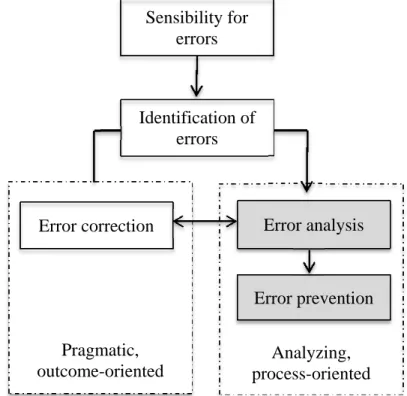
(3) Learning from Errors: Effects of Teachers’…. 23. Based on prior research (Garuti, Boero, & Chiappini, 1999; Heinze & Reiss, 2007; Oser & Spychiger, 2005), we propose a process model describing two different ways of dealing with errors (Figure 1). We distinguish a pragmatic, outcome-oriented, and an analytic, process-oriented path of action. While the former proceeds directly from error detection to error correction, the latter path includes a closer analysis of the error and the generation of error prevention strategies. With respect to generation of negative knowledge, the latter approach can be expected to be more beneficial. Sensibility for errors. Identification of errors. Error correction. Error analysis. Error prevention Pragmatic, outcome-oriented. Analyzing, process-oriented. Figure 1. Process model for learning in error situations There is strong empirical evidence for this assumption from research on error management trainings in different domains of working life (Keith & Frese, 2008). Nevertheless, the choice of a productive, analyzing approach towards error situations does also rely on affective characteristics of the learner. Errors are often experienced as adverse events, and thus fear can impede their potentially positive effects. On the other hand, dealing with errors in learning showed to be more effective than avoiding them, if there is clear feedback and an error-tolerant culture (Keith & Frese, 2008; Nordstrom, Wendland, & Williams, 1998). Error-Handling Activities in the Mathematics Class Findings from video-based investigations from Switzerland, the USA, Italy and Germany (for a short survey, see Heinze & Reiss, 2007) show similar tendencies on how teachers deal with errors in mathematics class. First, the number of errors in the public teacher-students interaction is comparatively low (about 3-5 errors per lesson). Second, about 90% of the public handling of errors in mathematics PNA 8(1).
(4) 24. S. Rach, S. Ufer, and A. Heinze. lessons is clearly teacher-directed. Oser and Spychiger (2005) explain the low number of errors per mathematics lesson with error avoidance behavior of teachers and students. In particular, teachers try to avoid interruptions in the ongoing instruction process and do not want to expose students who make errors. Accordingly, they pose their questions in such a way that students rarely give erroneous answers. From the students’ perspective on handling errors in mathematics class, there are hardly any empirical studies with a clear focus on this topic. Results from the Swiss group of Oser and colleagues based on questionnaire data from 295 students (Grade 4-9) indicate that students have a rather positive attitude towards dealing with errors during mathematics class as well as to the role teachers play (Spychiger, Kuster, & Oser, 2006). Students perceive their teachers’ errorhandling as friendly and supportive and they rarely experience anxiety due to errors. However, they report only a moderate level for their individual use of errors as learning opportunities. Heinze, Ufer, Rach, and Reiss (2011) analyzed questionnaire data from 1674 students (Grade 6-9). They showed that perceived affective support of teachers correlates with lower anxiety and that perceived cognitive support of teachers correlates with a more intensive use of errors as learning opportunities. Heinze and Reiss (2007) investigated the effects of in-service teacher training in 29 classes. Here, teachers of the experimental group received a combined training in error-handling and in teaching reasoning and proof, whereas teachers of the control group only participated in training on reasoning and proof teaching. Students were asked to evaluate how teachers handled their errors. It turned out that only teachers of the experimental group classrooms improved their error-handling behavior significantly. Moreover, students’ achievement in geometry proof increased significantly stronger in the experimental group than in the control group. Borasi (1996) reports about several teaching experiments she conducted in a series of case studies. She developed a strategy of capitalizing on errors as springboards for inquiry in mathematics classrooms. This strategy is integrated in a specific teaching approach. In Borasi (1996) she summarizes that her case studies provide “anecdotal evidence” that learners can benefit from a specific teaching approach focusing the use of errors. Summarizing these empirical studies, errors can be considered as an important factor of learning processes. However, students do not use them often as learning opportunities and it is unclear which aspects of mathematics instruction are relevant to change this. In particular, it is open if an error-tolerant classroom culture is sufficient to support students (affective support), or if, in addition, specific meta-cognitive strategies for a beneficial error-handling should be taught (cognitive support). Moreover, it is open if there are different groups of learners with specific perceptions of error situations so that differential effects of classroom interventions can be expected.. PNA 8(1).
(5) Learning from Errors: Effects of Teachers’…. 25. RESEARCH QUESTIONS The aim of our research was to evaluate the effects of an error-tolerant classroom culture as well as specific interventions addressing strategies to use errors as learning opportunities. Moreover, we explored profiles of students’ perceptions of error situations and the differential effects of the interventions on students with different profiles. Our study was guided by the following research questions. 1. What are the effects of an error-tolerant classroom culture and interventions addressing strategies for learning from errors on students’ attitudes towards error-handling? 2. Is it possible to identify different types of students showing characteristic profiles with respect to their attitudes towards error-handling? 3. If characteristic types of students can be identified, do the interventions affect students of different types in different ways?. DESIGN OF THE STUDY We conducted a quasi-experimental intervention study with 6-9th grade students (12-15 years old) from 32 classrooms in different school types in Germany (comprehensive schools and schools from the academic focused school track Gymnasium). We applied a pre-post questionnaire design with two experimental groups and a small control group. After cleaning the data from outliers, we obtained a sample of N = 698 students for the pre-questionnaire. Because of dropout, only N = 571 complete data sets were available for the pre- and postquestionnaire (see Table 1). Teachers of the error-tolerant culture group took part in a professional training program lead by the researchers. In this training, teachers were informed about the potential use of errors for learning and some of the empirical results described above. They were encouraged to consider errors as learning opportunities instead of useless interruptions in classroom. In particular, aspects of an error-tolerant and error-positive culture for mathematics classroom were discussed. Teachers of the error-tolerant culture and strategies group classrooms participated in the same training program and, in addition, they got materials dealing with strategies to learn from errors. These materials encourage learners to reflect on their errors made in homework or exercises and are based on the process model for learning from errors (right part in Figure 1). In contrast to the first experimental group, these teachers got concrete ideas (and material) on how they can support their students on a cognitive level. For an intervention check, teachers were asked to fill in a questionnaire on how they used these materials. Teachers of the control group classrooms delivered their regular lesson without any train-. PNA 8(1).
(6) 26. S. Rach, S. Ufer, and A. Heinze. ing and without using any additional material. Overall, the intervention lasted five months. Teachers in the second experimental group were asked to implement the material in their mathematics lessons regularly. Table 1 Structure of the Sample Intervention group. Classrooms. npre. npre & post. Control group. 4. 87. 73. Error-tolerant culture. 13. 267. 218. Error-tolerant culture and strategy instruction. 15. 344. 280. A slightly adapted version of the Swiss questionnaire on error handling in the mathematics classroom with 22 items (Spychiger et al., 2006) was used to assess students’ attitudes towards error-handling before and after the intervention. As described in Heinze et al. (2011), four scales could be extracted (Table 2). Table 2 Student Questionnaire: Item Examples and Reliabilities (pre/post) Item example Cronbach’s Sometimes our math teacher looks .88/.91 distressed when a student makes an error. 7 items [reversed item] Cognitive teacher support If I make an error in maths lessons my .77/.83 in error situations (TScog) teacher handles the situation in a way that I 4 items can benefit from. No fear of making errors I become scared when I make an error in .69/.73 in mathematics lessons mathematics. [reversed item] 3 items (NF) Individual use of errors In mathematics I explore my errors and try .78/.81 for the learning process to understand them. 8 items (IU) Factor Affective teacher support in error situations (TSaff). Note. Likert scale: 0 = strongly disagree, 1 = disagree, 2 = agree, 3 = strongly agree. RESULTS OF THE STUDY To evaluate the effects of the interventions, we conducted ANCOVAs for each of the four scales with the pre-questionnaire results as covariate and the group as a factor. There was a general regression towards disagreeing ratings from pre- to post-test, that had to be taken into account when interpreting the questionnaire data. There was no effect of the intervention on individual use of errors (IU, F (2.567 ) 1.338 , p 0.5 ) and on cognitive teacher support (TScog, F ( 2.567 ) 0.495 , p .05 ). The intervention had significant positive effects on affective teacher PNA 8(1).
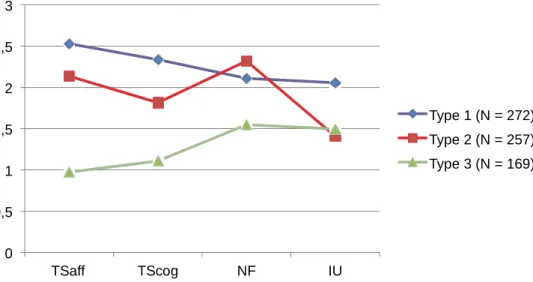
(7) Learning from Errors: Effects of Teachers’…. 27. support (TSaff, F (2.567 ) 9.476 , p .001 , 2 .032 ) and reduced the fear of making errors (NF, F ( 2.567 ) 3.765 , p .05 , 2 .013 ). There were no significant differences between the two experimental groups in these variables, but students from the experimental groups reported less fear and more affective support than the control group students (Table 3). Table 3 Development of Students’ Perceptions of Error Situation Control group M (SD) TSaff TScog NF IU. Pre 1.71 (0.84) 1.91 (0.62) 1.98 (0.77) 1.78 (0.45). Post 1.47 (0.96) 1.74 (0.73) 1.93 (0.87) 1.57 (0.56). Error-tolerant culture Pre 2.03 (0.77) 1.84 (0.77) 2.01 (0.73) 1.71 (0.49). Post 2.02 (0.83) 1.79 (0.83) 2.18 (0.71) 1.64 (0.48). Error-tolerant culture and strategy instruction Pre 2.12 (0.69) 1.91 (0.68) 2.12 (0.74) 1.68 (0.55). Post 2.12 (0.77) 1.81 (0.78) 2.21 (0.75) 1.60 (0.57). Note. Likert scale: 0 = strongly disagree; 1 = disagree, 2 = agree, 3 = strongly agree.. To describe students’ profiles, we carried out a cluster analysis using the four scales of the pre-questionnaire (Ward method). We could identify three types of learners with respect to their attitudes towards error-handling (Figure 2), two types showing relatively high response low ratings on all scales and one type reporting some teacher support, little fear of errors, but also little use of errors as learning opportunities. 3 2,5 2 Type 1 (N = 272) 1,5. Type 2 (N = 257) Type 3 (N = 169). 1 0,5 0 TSaff. TScog. NF. IU. Figure 2. Profiles of the student types identified in the pre-questionnaire PNA 8(1).
(8) 28. S. Rach, S. Ufer, and A. Heinze. A MANCOVA with the four scales of the post-questionnaire as dependent variables, the corresponding scales in the pre-questionnaire as covariates, the intervention group and the student types as factors shows a significant effect of the intervention group ( F (8.1112 ) 5.059, p .001, 2 .035 ) but no effect of student type ( F (8.1112 ) 0.674, p .05 ) and no interaction effect between the two ( F (16.2232 ) 1.220, p .05 ).. DISCUSSION For teaching and learning in school and, in particular, in the mathematics classroom, errors are often considered an important part of the learning process. In the study presented in this paper, teachers of the experimental group classes took part in training about the role of errors and the importance of an error-tolerant classroom culture. In addition, some of these teachers implemented learning material in their lessons that encourage students to analyze their errors so that they can develop error prevention strategies (right part of Figure 1). So, in both intervention groups, students got an affective support and, in the second intervention group, an additional cognitive support was provided. Concerning research question 1, our findings show that—in comparison to a control group—there is a positive effect of both interventions with respect to students’ fear of making mistakes and students’ perception of affective teacher support. This indicates that teachers of the experimental groups were able to implement an error-tolerant classroom culture and that this change had positive effects on their students in an affective level. However, a comparison of the two intervention groups does not give evidence for the influence of the additional systematic cognitive support. In particular, students’ perception of teachers’ cognitive support and students’ reports on their individual use of errors did not change. We observe the same result when comparing the intervention groups with the control group. It seems that an affective support based on an error-tolerant classroom culture is not sufficient for inducing a change of students’ perception of and handling in error situations with respect to the cognitive level. The surprising result is that students of the second intervention group got a cognitive support they did not notice. One reason might be the unfamiliar demands for students when working with the implemented material on analyzing errors. In Germany, students are not familiar with reflections about their own learning processes and, in particular, with reflections about their own errors. A possible second reason can be the quality of the intervention. Since we only have questionnaire-based self reports of teachers, we do not know if they used learning materials in an adequate way. Concerning research questions 2 and 3, we were able to identify three types of learners which report different perceptions of error situations and its handling during mathematics learning. However, results of the MANCOVA did not reveal PNA 8(1).
(9) Learning from Errors: Effects of Teachers’…. 29. differential effects of the intervention on these three types of learners. Accordingly, for all three types we observed similar positive effects on the affective level and no effects on the cognitive level. Based on these findings, we assume there is no need for a student type-specific affective support by an error-tolerant classroom culture. Concerning the cognitive support in error situations, the investigation of student type-specific instruction strategies might be a promising idea for further research.. ACKNOWLEDGEMENTS This research was supported by the Federal State Hamburg (Research program “komdif-Kompetenzmodelle ALS Basis für eine diagnosegestützte individuelle Förderung”).. REFERENCES Borasi, R. (1996). Reconceiving mathematics instruction: a focus on errors. Norwood, NJ: Ablex Publishing Corporation. Garuti, R., Boero, P., & Chiappini, G. (1999). Bringing the voice of Plato in the classroom to detect and overcome conceptual mistakes. In O. Zaslavsky (Ed.), Proceedings 23rd Conference of the International Group for the Psychology of Mathematics Education (Vol. 3, pp. 9-16). Haifa, Israel: PME. Heinze, A., & Reiss, K. (2007). Mistake-handling activities in the mathematics classroom: effects of an in-service teacher training on students’ performance in geometry. In J.-H. Woo, H.-C. Lew, K.-S. Park, & D.-Y. Seo (Eds.), Proceedings of the 31st Conference of the International Group for the Psychology of Mathematics Education (Vol. 3, pp. 9-16). Seoul, Korea: PME. Heinze, A., Ufer, S., Rach, S., & Reiss, K. (2011). The student perspective on dealing with errors in mathematics class. In E. Wuttke & J. Seifried (Eds.), Learning from errors (pp. 65-79). Opladen, Germany: Barbara Budrich. Keith, N., & Frese, M. (2008). Effectiveness of error management training: a meta-analysis. Journal of Applied Psychology, 93(1), 59-69. Minsky, M. (1994). Negative expertise. International Journal of Expert Systems, 7(1), 13-19. Nordstrom, C. R., Wendland, D., & Williams, K. B. (1998). “To err is human”: an examination of the effectiveness of error management training. Journal of Business and Psychology, 12(3), 269-282. Oser, F., & Spychiger, M. (2005). Lernen ist schmerzhaft. Zur theorie des negativen wissens und zur praxis der fehlerkultur. Weinheim, Germany: Beltz. Radatz, H. (1979). Error analysis in mathematics education. Journal of Research in Mathematics Education, 10(3), 163-172.. PNA 8(1).
(10) 30. S. Rach, S. Ufer, and A. Heinze. Spychiger, M., Kuster, R., & Oser, F. (2006). Dimensionen von fehlerkultur in der schule und deren messung. Der schülerfragebogen zur fehlerkultur im unterricht für schülerinnen und schüler der mittel-und oberstufe. Schweizerische Zeitschrift für Bildungswissenschaften, 28(1), 87-110. Tatsuoka, K. (1984). Analysis of errors in fraction addition and subtraction problems. Research Report. Champaign, IL: University of Illinois at Urbana.. This document was originally published as Rach, S., Ufer, S., & Heinze, A. (2012). Learning from errors: effects of teachers training on students’ attitudes towards and their individual use of errors. In Y. T. Tso (Ed.), Proceedings of the 36th Conference of the International Group for the Psychology of Mathematics Education (Vol. 3, pp. 329-336). Taipei, Taiwan: PME.. Stefanie Rach Leibniz Institute for Science and Mathematics Education, Kiel, Germany [email protected]. Stefan Ufer Ludwig-Maximilians-University of Munich, Germany [email protected] Aiso Heinze Leibniz Institute for Science and Mathematics Education, Kiel, Germany [email protected]. Received: September 2012. Accepted: January 2013.. PNA 8(1).
(11)
Figure
Documento similar
This is because in relation to the AR questions, it was necessary to know students opinion regarding group work and individual learning process.. There were 5 surveys that were
The use of functional communication activities is significantly related to English language learning in basic level students at the language center of Cesar Vallejo
It is important teachers know about how to realize the dramatization technique, for supporting the teaching and learning activities in English language, it means students will able
Activities Teacher realize in the class for motivate the Students Teacher changes the strategy when the Students feel bored Teacher solve questions Teacher attitude
The objectives of this research were to assess how students recognize explicit information in a text to answer questions with the appropriate response through the use of
