Facultad de Odontología Vol. 21, No. 1 January-March 2017
pp 12-20
Revista Odontológica Mexicana
ORIGINAL RESEARCH
www.medigraphic.org.mx
* DDS, Dental Research Laboratory Almaraz/UBIMED. § Biology Degree, Immunobiology Laboratory. II DDS.
¶ DDS, Dental Education and Research Laboratory.
Iztacala Graduate School, National Autonomous University of Mexico (UNAM).
ABSTRACT
Periodontal ligament is a fibrous connective tissue of ectomesenchymal origin which contains a multipotent postnatal stem cells population with clonogenic capacity and high proliferation index. Multipotent postnatal stem cells population culture has been achieved through several extraction methods, nevertheless some technical problems have been encountered. For this reason, in the present study, 6 different methods were compared so as to improve isolation of primary periodontal ligament cells. Multipotent postnatal stem cells population were isolated from 36 healthy premolars, which were then cultured in complete Dulbecco m odified Eagle medium (BioWest) (added with L-glutamine, 10% fetal bovine serum and 1% antibiotic), in standard culture conditions. Assays for cell proliferation were conducted with 3-(4,5 dimethylthiazol-2-yl)-2,5 diphenyltetrazolium technique as well as cell migration through crop injury test, after which osteogenic differentiation was assessed. Cultures were performed in triplicate with each of the published techniques; thus we were able to obtain a minimum population of cells susceptible to contamination. The «simplifi ed method» was conducted through explant enzymatic digestion and culture: with obtained multipotent postnatal stem cells population, a 14 day proliferation was observed in standard conditions of ascendant culture; in migration tests, multipotent postnatal stem cells population totally covered injured surfaces after 72 hours. CD90 positive expression was observed in over 80% of all cells; CD73 positive expression was found in 70% of cells, CD105 in 60% and vimentin in 90% of the population, as well as negative marking to CD11b and CD45. Positive osteogenic differentiation was observed after 14 days, through positive expression to RUNX2 in at least 15% of cells, and to osteocalcin in 90% as well as positive test to alizarin red. Based on obtained results we were able to affi rm that the simplifi ed method allows to isolate a population of mesenchymal cells, which might be obtained from extracted healthy premolars.
Key words: Periodontal ligament, osteogenic differentiation, stem cells.
Palabras clave: Ligamento periodontal, diferenciación osteogénica, células troncales. RESUMEN
El ligamento periodontal es un tejido conectivo fi broso, de origen ec-tomesenquimal que contiene una población de células troncales post-natales multipotenciales, con capacidad clonogénica y alto índice de proliferación. Se ha conseguido cultivar células troncales postnatales multipotenciales a través de diferentes métodos de extracción, con algunos problemas técnicos. Por esta razón, se compararon seis di-ferentes métodos a fi n de mejorar el aislamiento de células primarias del ligamento periodontal. Se aislaron células troncales postnatales multipotenciales a partir de 36 premolares sanos, que se cultivaron en medio de Eagle modifi cado por Dulbecco (BioWest) completo (adicio-nado con L-glutamina, 10% de Suero fetal bovino y 1% de antibiótico) y en condiciones estándares de cultivo. Se realizaron los ensayos para proliferación celular mediante la técnica de 3-(4,5-dimetiltiazol-2-il)-2,5-difeniltetrazolio, migración celular a través de la prueba de lesión del cultivo, y se evaluó su diferenciación osteogénica. Los cultivos realiza-dos por triplicado con cada una de las técnicas publicadas, nos condu-jo a obtener una población mínima de células que fueron susceptibles a contaminarse. Se realizó con el «método simplifi cado»: por digestión enzimática y cultivo de explantos, con las células troncales postnata-les multipotenciapostnata-les obtenidas se observó una proliferación durante 14 días en condiciones estándares de cultivo ascendente, en las pruebas de migración las células troncales postnatales multipotenciales cubrie-ron totalmente la superfi cie lesionada a las 72 horas, se observó ex-presión positiva de CD90 en más del 80% de las células; exex-presión positiva a CD73 en un 70%, CD105 en un 60% y vimentina en un 90% de la población, así como un marcaje negativo a CD11b y CD45. Se observó una diferenciación osteogénica positiva a los 14 días median-te la expresión positiva a RUNX2 en al menos el 15% de las células y a osteocalcina en un 90%, así como las pruebas positivas a rojo de ali-zarina. Con los resultados obtenidos, podemos afi rmar que el método simplifi cado permite aislar una población de células mesenquimales, que se pueden obtener a partir de premolares sanos extraídos.
Isolation of periodontal ligament stem cells from extracted
premolars. Simplifi ed method
Aislamiento de células mesenquimales del ligamento periodontal
de premolares extraídos. Método simplifi cado
Cynthia Georgina Trejo Iriarte,* Omar Ramírez Ramírez,* Alejandro Muñoz García,§
Silvia Leticia Verdín Terán,II José Francisco Gómez Clavel¶
Acronyms: ALP = Alcaline phosphatase, DMEM = Dulbecco m odifi ed Eagle medium, FBS = Fetal bovine serum, MSC = Mesenchymal
stem cells, MTT = 3-(4,5 dimethylthiazol-2-il)-2,5 diphenyltetrazolium, PBS = Phosphate buffered saline solution, PDL = Periodontal ligament, PDLSC = Periodontal ligament stem cells, PLCSC = Peripheral limbar cornea stromal cells.
© 2016 Universidad Nacional Autónoma de México, [Facultad de Odontología]. This is an open access article under the CC BY-NC-ND license (http://creativecommons.org/licenses/by-nc-nd/4.0/). Received: January 2016. Accepted: July 2016.
This article can be read in its full version in the following page: http://www.medigraphic.com/facultadodontologiaunam
www.medigraphic.org.mx
INTRODUCTIONPeriodontal ligament is a fi brous connective tissue composed of fi bers, cell and collagen-rich intercellular substance, protein content and polysaccharides, it is of ecto-mesenchymal origin. It encompasses the following functions: 1) suspend the tooth in its bone socket, 2) provide nutrients to both socket and cement, 3) protect the teeth, and 4) preserve homeostasis of teeth within the socket by means of continuous regeneration.1 This regeneration of the Periodontal
Ligament (PDL) as a continuous physiological mechanism, gave rise to the theory that this tissue could contain a subpopulation of stem cells.2 In 2004,
Seo et al3 published that it was possible for human
PDL to contain a population of multipotential, postnatal stem cells, which would possess clonogetic capacity, high proliferation index and the ability to regenerate periodontal tissue.4-6
It has been shown that mesenchymal periodontal ligament stem cells (PDLSCs) are similar to other mesenchymal stem cells in the expression of the following markers: STRO-1, CD146, CD90, CD29, CD44, CD13, CD105 and CD166, as well as their self-regenerating capacity and their multi-potentiality.3,7,8
Several authors, after isolating PDLSCs showed their ability to differentiate to mesodermal type lineages, differentiating in cementoblast-like cells, osteoblasts, chondrocytes, adipocytes, myofibroblasts, and collagen-forming fi bers.9,10 Potential of PDLSCs has
even been researched to give rise to nervous system-like cells and cementoblasts.11
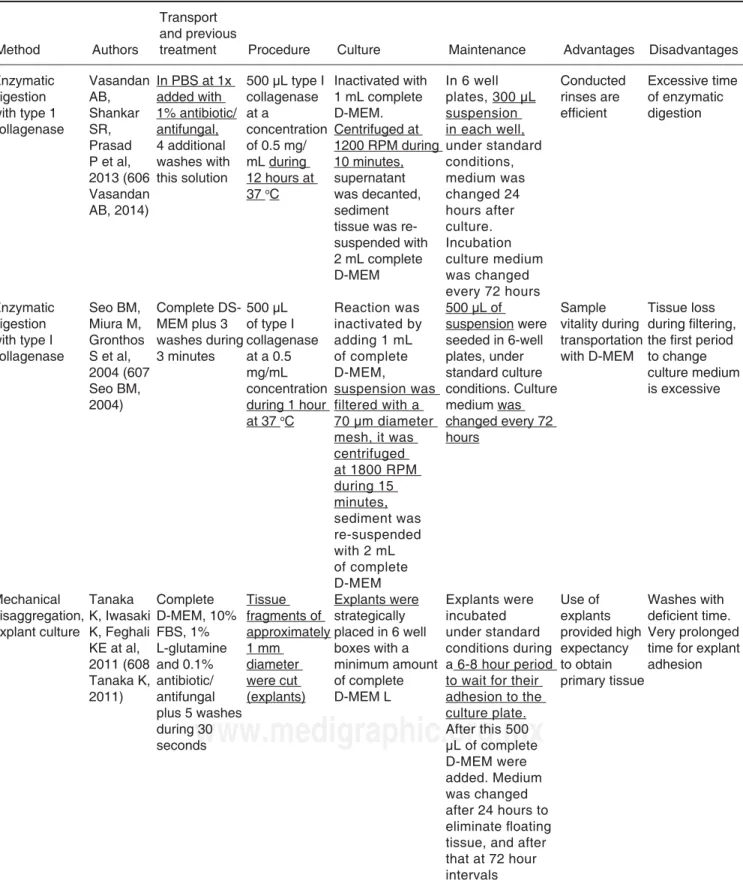
Presently, PDLSCs haven been successfully cultured through different extraction methods, showing that PDL is a suitable source of stem cells, with the consequent potential use in regenerative medicine. Nevertheless, methods described to this date encounter some technical problems. For this reason, six methods were compared (Table I) in an effort to improve isolation methods of PDL primary cells, since none of the reported methods was precise. The aim of the present research paper was to present a highly replicable, simplifi ed method for harvesting the aforementioned cells.
MATERIAL AND METHODS Sample harvesting and transportation
Thirty six healthy premolars were obtained; they were donated by patients of the Naucalpan Orthodontic Specialty Clinic, who had previously signed informed consent forms according to the Bioethics Committee
of the Iztacala Graduate School, attached to the National Autonomous University of Mexico (UNAM). The following inclusion criteria were used for tooth selection: only patients without systemic alterations, suitable periodontal health, fi rst and second premolar teeth from right and left upper and lower jaws. Exclusion criteria were: patients affl icted with systemic diseases, patients with gingivitis and/or periodontal disease, premolars with presence of dental plaque and/or presence of caries and/or periapical reaction.
Samples were transferred in 3 mm of D-MEM medium (BioWest) supplemented with 1% antibiotic (penicillin-streptomycin Gibco® No Cl. 15140-122) at
4 oC.
Employed techniques are meticulously described in table I. In all seeding techniques complete D-MEM (BioWest) was used (added with L-glutamine, 10% of FBS and 1% of antibiotic, in standard culture conditions at 37 oC with presence of 5% CO
2.
Subcultures were performed with 60/80% confl uence, after having been washed for 30 seconds with Hank solution (Sigma Aldrich); 500 μL of tripsin/ EDTA at 0.25%/0.1% (BioWest) during 1-3 minutes at a 37 oC temperature. Cell subcultures were conducted
in a 1/3 proportion.
Cell proliferation assay
Five hundred cells were seeded in 24-well boxes, one cell to a well. Assessment of cell proliferation was conducted at 1, 3, 5, 7, and 14 days after seeding, this was accomplished with addition of 50 μL of MTT (Sigma Aldrich) incubated for four hours at 37 oC in
a 5% CO2 atmosphere. At a later point, 100 μL of dimethyl sulfoxide (DMSO, Sigma Aldrich) were added in order to achieve optic density reading in a spectrometer at al 540 nm wave length.
Cell migration assessment
With cells in confluence, a lesion was performed along the culture, causing continuity loss, the culture was monitored with photographs taken at 24, 48 and 72 hours.
Immunocytofl uorescence
Cells were fixated in a 4% paraformaldehyde phosphate tampon for 20 minutes. Blocking was conducted in PBS with 3% bovine serum albumin and 0.01% Triton-X 100. Cells were stained with the following: anti-human rabbit antibodies conjugated with Fluor® 647: PE, TRIT, FITC, and DAP
www.medigraphic.org.mx
Table I. Comparative and explanatory table of techniques used for cell extraction (harvesting better?).
Differences among them are underlined.
Method Authors
Transport and previous
treatment Procedure Culture Maintenance Advantages Disadvantages Enzymatic digestion with type 1 collagenase Vasandan AB, Shankar SR, Prasad P et al, 2013 (606 Vasandan AB, 2014) In PBS at 1x added with 1% antibiotic/ antifungal, 4 additional washes with this solution 500 μL type I collagenase at a concentration of 0.5 mg/ mL during 12 hours at 37 oC Inactivated with 1 mL complete D-MEM. Centrifuged at 1200 RPM during 10 minutes, supernatant was decanted, sediment tissue was re-suspended with 2 mL complete D-MEM In 6 well plates, 300 μL suspension in each well, under standard conditions, medium was changed 24 hours after culture. Incubation culture medium was changed every 72 hours Conducted rinses are effi cient Excessive time of enzymatic digestion Enzymatic digestion with type I collagenase Seo BM, Miura M, Gronthos S et al, 2004 (607 Seo BM, 2004) Complete DS-MEM plus 3 washes during 3 minutes 500 μL of type I collagenase at a 0.5 mg/mL concentration during 1 hour at 37 oC Reaction was inactivated by adding 1 mL of complete D-MEM, suspension was filtered with a 70 μm diameter mesh, it was centrifuged at 1800 RPM during 15 minutes, sediment was re-suspended with 2 mL of complete D-MEM 500 μL of suspension were seeded in 6-well plates, under standard culture conditions. Culture medium was changed every 72 hours Sample vitality during transportation with D-MEM Tissue loss during fi ltering, the fi rst period to change culture medium is excessive Mechanical disaggregation, explant culture Tanaka K, Iwasaki K, Feghali KE at al, 2011 (608 Tanaka K, 2011) Complete D-MEM, 10% FBS, 1% L-glutamine and 0.1% antibiotic/ antifungal plus 5 washes during 30 seconds Tissue fragments of approximately 1 mm diameter were cut (explants) Explants were strategically placed in 6 well boxes with a minimum amount of complete D-MEM L Explants were incubated under standard conditions during a 6-8 hour period to wait for their adhesion to the culture plate. After this 500 μL of complete D-MEM were added. Medium was changed after 24 hours to eliminate fl oating tissue, and after that at 72 hour intervals Use of explants provided high expectancy to obtain primary tissue Washes with defi cient time. Very prolonged time for explant adhesion
www.medigraphic.org.mx
Este documento es elaborado por Medigraphic
Continua Table I. Comparative and explanatory table of techniques used for cell extraction (harvesting better?).
Differences among them are underlined.
Method Authors
Transport and previous
treatment Procedure Culture Maintenance Advantages Disadvantages Enzymatic digestion with trypsin/EDTA 0.25%/0.1% Tanaka K, Iwasaki K, Feghali KE at al, 2011 (608 Tanaka K, 2011) Complete D-MEM, 10% FBS, 1% L-glutamine and 0.1% of antibiotic/ antifungal plus two washes during 2 minutes Tissue was digested during 60 minutes at 37 oC in 500 μL of 0.25% trypsin with 0.1% EDTA. At 10 minute intervals the sample was shaken during 30 seconds 500 μL complete D-MEM were added to arrest enzymatic digestion. Suspension was fi ltered with a 70 μm diameter mesh. Suspension was centrifuge at 1800 RPM during 15 minutes. Supernatant was discarded and sediment was re-suspended with 2 mL complete D-MEM In six well plates, 500 μL of suspension were placed in each well. Medium was changed every 72 hours With use of trypsin/EDTA enzymatic digestion was enhanced with constant shaking Defi ciencies in the washes. Prolonged time for enzymatic digestion, sample fi ltering Enzymatic digestion with type I collagenase and sample transport in Hanks solution Gholamre-zanezhad Ali, 2011 (609, Gholamre-zanezhad Ali, 2011) Hanks solution at a 4 oC temperature, three 1 minute washes Tissue was centrifuged with Hanks solution at 1500 RPM for 10 minutes. Supernatant was discarded and tissue was re-suspended with 500 μL type I collagenase at 0.5 mg/mL concentration for one hour at 37 oC Reaction inactivation was achieved with one milliliter of complete D-MEM. Suspension was centrifuged at 1500 RPM during 10 minutes. Supernatant was discarded and sediment was re-suspended with 2 mL of complete D-MEM 200 μL of suspension were culture in 6 well plates during 4 hours at 37 oC. After this, 500 μL of complete D-MEM were added. Medium was substituted for the fi rst time at 5 days, and after that every 72 hours Adequate incubation time to wait for explant adhesion Transport in Hanks solution. Defi cient washes Standardized technique enzymatic digestion and explant culture Ramírez RO, Trejo ICG, 2015 Complete D-MEM at a temperature of 4 oC. Three 5 minute washes were performed with 3 mL D-MEM supplemented with 5% antibiotic Enzymatic digestion with 500 μL of trypsin/EDTA 0.25%/0.1% during 20 minutes at 37 oC. At fi ve minute intervals, tissue was shaken with a Vortex at 1000 RPM during 30 seconds Reaction inactivation was achieved with 500 μL of complete D-MEM. Centrifugation at 1800 RPM during 10 minutes, supernatant was discarded and tissue was re-suspended with 1 mL complete D-MEM 150-200 μL suspension were seeded in 6 wells, incubation was allowed for 2-4 hours waiting for adhesion of tissue to the culture plate. After this, complete D-MEM was added and medium was changed 4 days after seeding, after this, medium was changed every 72 h Advantages of previous techniques were enjoyed
www.medigraphic.org.mx
(Fluoroshield®), RUNX2, osteocalcin, CD73, CD90,
CD105 and vimentin (1:250 Santa Cruz) during 45 minutes. Samples were examined in a Zeiss Axio LAB1 fl uorescence microscope.
Osteogenic differentiation
In this process, 105 were seeded in passage 3;
medium StemPro Osteogenesis Differentiation Kit (Gibco®) was added; it was replaced every 72 hours
for 14 days.
Staining with alizarin red
Once the cells were differentiated after 7 and 14 days’ culture, they were fi xated and stained with alizarin red. They were then subjected to three five minute rinses with PBS; 500 μL 0.1% alizarin red were added (HYCEL®) and were left to rest for 15 minutes at
room temperature.
RESULTS
Cell population harvesting
Poor technical specificity of found articles influenced in obtaining cell population harvesting, cultures conducted in triplicate with each of the studied techniques lead us to obtain a minimum cell concentration which did not achieve confluence. In some cases, after a culture time of seven days, no cells were obtained; and in other cases, the scarce amount of obtained cells was susceptible to contamination, probably caused by the transport medium of the tooth and the washes.
Optimum cell population for the study was achieved using the «standardized technique of enzymatic digestion and explant culture». Once the periodontal tissue was dissected and seeded, cells appeared in the fi rst 72 hours, which after an additional period of
46 hours showed fi broblastoid aspect in the cultured explants periphery, fi lling thus the culture dish in 65 to 70%. After this, explants were eliminated with the washes. After seven days, the culture dish was found to exhibit cells in confl uence (Figure 1).
Viability and/or cell proliferation
Cell population self-renovation capacity was assessed by means of methylthiazole tetrazolium assay (MTT) 3-(4,5-dimethylthiazole 2-il)-2,5-diphenyltetrazolium bromide; spectometry-measured absorbance was proportionate to cell proliferation viability.
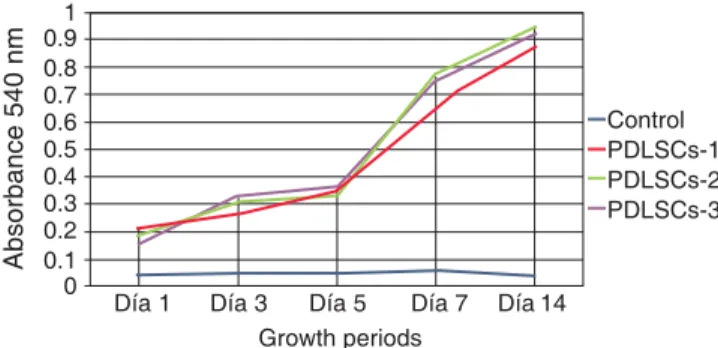
Five hundred cells were seeded in 24-well plates; they were evaluated at 1, 3, 5, 7 and 14 days. Absorbance was measured at a 540 nm wave length. Obtained measurements were incorporated in a graph. An ascending graph was obtained, which corresponded to a concentration of cells per measuring unit, thus demonstrating that cells preserved their proliferation during 14 days in standard culture circumstances (Figure 2).
Cell migration capacity
Cell migration towards the injured area was observed after 12 hours of lesion onset; cells coated between 10-20% of the critical area. After 24 hours, cell numbers increased, covering then from 40-60% of the surface of the culture jar. After 48 hours, cells were observed to be in semi-confluence; after 72 hours, cells totally covered the area, this can be observed in images of fi gure 3.
Immunofl uorescence
Immunofluorescence assays were performed in the third subculture of our cell population. After counting, positive expression to CD90 was observed
Figure 1.
Image A) after 72 hours culture, cell growth can be observed around the explant. Image B) taken after 8 days of confl uence culture.
40x 100x100x
www.medigraphic.org.mx
in over 80% of all cells, positive expression to CD73 was observed in 70%, positive expression to CD105 in 60% and vimentin in 90% of the population
(Figure 4).
Osteogenic differentiation
Once bone differentiation was induced, cells lost their fi broblastoid morphology in seven days, and acquired a less elongated, cuboid-like prismatic morphology. There was also a greater amount of extracellular matrix as well as presence of calcification nodules, which were observed by means of staining with alizarin red the cultured area, revealing thus a size of 9.6 cm2 (Figure 5).
RUNX2 is a transcription factor indispensable for bone maturation, it was expressed in our cell population in osteogenic differentiation at 14 days, in at least 15% of all cells.
Osteocalcin is a protein secreted at late stages of bone differentiation, it is able to bond to calcium for its stabilization. The presence of this molecule in 90% of cells after 14 days indicates mineralization regulation
(Figure 6).
Figure 2. Average results obtained from reading at 540 nm
wavelength. Control PDLSCs-1 PDLSCs-2 PDLSCs-3 1 0.9 0.8 0.7 0.6 0.5 0.4 0.3 0.2 0.1 0 Absorbance 540 nm
Día 1 Día 3 Día 5 Día 7 Día 14 Growth periods
Figure 3.
A) Photograph taken immediately
after establishing lesion in the culture. B) 12 hours after the lesion, migration of a group of cells re-colonizing 10 to 20% of the lesion can be observed.
C) 24 hours later migration of a
cell group was observed which re-colonized damaged area in 40/60%. D) and E) After 48 hours, it can be observed that cells have covered 80-90%. F) 72 hours after the lesion, cells reach confl uence once again.
40x A 40x B 40x C 40x D 40x E 40x F
www.medigraphic.org.mx
DISCUSSIONPeriodontal ligament can be considered an accessible source, since teeth, once extracted, are considered waste tissue, and in cases under orthodontic treatment, extraction is the best treatment alternative.12
It has already been shown that cell populations obtained from the Periodontal Ligament possess the ability to regenerate several tissues,13-16 recently,
information has been published on the use of periodontal ligament as a source of stem cells. Nevertheless, a consensus should be reached on used protocols, since these protocols can be very inconsistent and prevent clear comparison of obtained cell populations.17 Therefore, the fact of being
familiarized in depth with the mechanism of used techniques, allowed us to suggest this «standardized method», which stressed the importance of preserving the sample’s integrity as well as avoiding its contamination.18-20 This culture method requires less
experience in periodontal tissue handling, therefore it is easy to achieve and might thus avoid possible culture contamination.
The capacity of our cells derived from PDL to form groups of adhering clonogenic cells with characteristics similar to fi broblasts has been demonstrated with the formation of 1 x 10⁶ cells generated from 1 x 10³,
cultured at low density in a seven day culture time. This population of cell forming colonies, which we have named PDLSCs, exhibited high rate of proliferation by MTT, similar to the rate observed by other authors.3,8
We thus showed that the new method had improved, or at least was effective in extracting a population of cells similar to periodontal ligament mesenchymal
A B C
D E F
G H I
40x 40x 40x
Figure 4.
Images taken with fluorescence microscope at 40x amplifi cation.
A) CD90 expression (green), B) Nuclear DAPI (blue), and C)
Fusion, D) CD73 (red), E) Nuclear DAPI (blue) and F) Fusion, G) Vimentin (green), H) CD105 (red) and I) Fusion of both with nuclear DAPI (blue).
Figure 5. Staining with alizarin red A) macroscopic
photograph with contrast with hematoxylin of control cells and cells induced to differentiation after 14 days. Staining with alizarin red of differentiated cells B) 10x, C) 40x.
A
B C
Color image available at: www.medigraphic.com/facultadodontologiaunam
www.medigraphic.org.mx
cells which showed positive antigenic profile to mesenchymal cell markers CD105, CD90, CD73 and vimentin, this would confi rm their mesodermal origin and mesenchymal phase, and allows us to report their mesenchymal stem cell status.13-15,21 PDLSCs showed
that osteogenic line can be differentiated in eight days or less; this might be due to ectomesenchymal origin and concurs with reports of Cha et al22 which
report a cell population which differentiates expressing osteogenic markers such as RUNX2, OCN and the formation of mineralization nodules.15
CONCLUSIONS
Based on obtained results, we can propose that the simplifi ed method allows isolation of a population of mesenchymal cells derived from periodontal ligament of healthy extracted premolars.
REFERENCES
1. Xiao L, Nasu M. From regenerative dentistry to regenerative medicine: progress, challenges, and potential applications of oral stem cells. Stem Cells Cloning. 2014; 7: 89-99.
2. Ivanovski S, Gronthos S, Shi S, Bartold PM. Stem cells in the periodontal ligament. Oral Dis. 2006; 12 (4): 358-363.
3. Seo BM, Miura M, Gronthos S, Bartold PM, Batouli S, Brahim J et al. Investigation of multipotent postnatal stem cells from human periodontal ligament. Lancet. 2004; 364 (9429): 149-155. 4. Seymour GJ, Cullinan MP, Heng NC. Oral biology. Molecular
techniques and applications. New York: Springer; 2010. 5. Zhu W, Liang M. Periodontal ligament stem cells: current status,
concerns, and future prospects. Stem Cells Int. 2015; 2015: 972313.
6. Navabazam AR, Sadeghian-Nodoshan F, Sheikhha MH, Miresmaeili SM, Soleimani M, Fesahat F. Characterization of mesenchymal stem cells from human dental pulp, preapical follicle and periodontal ligament. Iran J Reprod Med. 2013; 11 (3): 235-242.
7. Trubiani O, Di Primio R, Traini T, Pizzicannella J, Scarano A, Piattelli A et al. Morphological and cytofl uorimetric analysis of
adult mesenchymal stem cells expanded ex vivo from periodontal ligament. Int J Immunopathol Pharmacol. 2005; 18 (2): 213-221. 8. Nagatomo K, Komaki M, Sekiya I, Sakaguchi Y, Noguchi K, Oda
S et al. Stem cell properties of human periodontal ligament cells. J Periodontal Res. 2006; 41 (4): 303-310.
9. Saito MT, Silverio KG, Casati MZ, Sallum EA, Nociti FH Jr. Tooth-derived stem cells: update and perspectives. World J Stem Cells. 2015; 7 (2): 399-407.
10. Seo BM, Miura M, Sonoyama W, Coppe C, Stanyon R, Shi S. Recovery of stem cells from cryopreserved periodontal ligament. J Dent Res. 2005; 84 (10): 907-912.
11. Guo S, Guo W, Ding Y, Gong J, Zou Q, Xie D et al. Comparative study of human dental follicle cell sheets and periodontal ligament cell sheets for periodontal tissue regeneration. Cell Transplant. 2013; 22 (6): 1061-1073.
12. Ding G, Liu Y, Wang W, Wei F, Liu D, Fan Z et al. Allogeneic periodontal ligament stem cell therapy for periodontitis in swine. Stem Cells. 2010; 28 (10): 1829-1838.
13. Su F, Liu SS, Ma JL, Wang DS, E LL, Liu HC. Enhancement of periodontal tissue regeneration by transplantation of osteoprotegerin-engineered periodontal ligament stem cells. Stem Cell Res Ther. 2015; 6: 22.
14. Yang H, Gao LN, An Y, Hu CH, Jin F, Zhou J et al. Comparison of mesenchymal stem cells derived from gingival tissue and periodontal ligament in different incubation conditions. Biomaterials. 2013; 34 (29): 7033-7047.
15. Xu Q, Li B, Yuan L, Dong Z, Zhang H, Wang H et al. Combination of platelet-rich plasma within periodontal ligament stem cell sheets enhances cell differentiation and matrix production. J Tissue Eng Regen Med. 2014. doi: 10.1002/term.1953.
16. Akizuki T, Oda S, Komaki M, Tsuchioka H, Kawakatsu N, Kikuchi A et al. Application of periodontal ligament cell sheet for periodontal regeneration: a pilot study in beagle dogs. J Periodont Res. 2005; 40 (3): 245-251.
17. Tran-Hle B, Doan VN, Le HT, Ngo LT. Various methods for isolation of multipotent human periodontal ligament cells for regenerative medicine. In vitro Cell Dev Biol Anim. 2014; 50 (7): 597-602.
18. Paladino FV, Peixoto-Cruz JS, Santacruz-Perez C, Goldberg AC. Comparison between isolation protocols highlights intrinsic variability of human umbilical cord mesenchymal cells. Cell Tissue Bank. 2016; 17 (1): 123-136.
19. Karamzadeh R, Eslaminejad MB, Aflatoonian R. Isolation, characterization and comparative differentiation of human dental pulp stem cells derived from permanent teeth by using
A B C
D E F
Figure 6.
Images taken with fl uorescence microscope. A) Expression of RUNX2, 40x (green), B) Nuclear DAPI (blue) 40x and C) Fusion 40x, D) Osteocalcin (green), E) Nuclear DAPI (blue) 63x and F) Fusion 63x.
www.medigraphic.org.mx
two different methods. J Vis Exp. 2012; (69). pii: 4372. doi:10.3791/4372.
20. Domenis R, Lazzaro L, Calabrese S, Mangoni D, Gallelli A, Bourkoula E et al. Adipose tissue derived stem cells: in vitro and in vivo analysis of a standard and three commercially available cell-assisted lipotransfer techniques. Stem Cell Res Ther. 2015; 6: 2. 21. Iwasaki K, Komaki M, Yokoyama N, Tanaka Y, Taki A, Honda I
et al. Periodontal regeneration using periodontal ligament stem cell-transferred amnion. Tissue Eng Part A. 2014; 20 (3-4): 693-704.
22. Cha Y, Jeon M, Lee HS, Kim S, Kim SO, Lee JH et al. Effects of in vitro osteogenic induction on in vivo tissue regeneration by dental pulp and periodontal ligament stem cells. J Endod. 2015; 41 (9): 1462-1468.
Mailing address:
Cynthia Georgina Trejo Iriarte