arXiv:1110.0480v1 [astro-ph.CO] 3 Oct 2011
Astronomy & Astrophysicsmanuscript no. ms˙corr c ESO 2011
October 5, 2011
A study of the color diversity around maximum light in Type
Ia supernovae
R´egis Cartier1
,2, Francisco F¨orster1, Paolo Coppi2, Mario Hamuy1, Keiichi Maeda3, Giuliano Pignata4, and
Gaston Folatelli3
1
Departamento de Astronom´ıa, Universidad de Chile, Casilla 36-D, Santiago, Chile
2
Department of Astronomy, Yale University, New Haven, CT 06520, USA
3
Institute for the Physics and Mathematics of the Universe (IPMU), University of Tokyo, 5-1-5 Kashiwanoha, Kashiwa, Chiba 277-8583, Japan
4
Departamento Ciencias F´ısicas, Universidad Andres Bello, Av. Rep´ublica 252, Santiago, Chile Preprint online version: October 5, 2011
ABSTRACT
From a sample of 12 well-observed Type Ia supernovae, we find clear evidence of correlations between early phase (U −B), (V −R), and (V −I) colors and the velocity shifts of the [Fe II] λ7155 and [Ni II] λ7378 nebular lines
measured from late-phase spectra. As these lines are thought to trace the ashes of the initial deflagration process, our findings provide additional support to the new paradigm of off-center explosions in Type Ia supernovae, and we interpret these correlations as viewing angle effects in the observed colors. We also show that the nebular velocity shifts are related to the strength and width of the Ca IIH&Kand IR-triplet lines near-maximum light. The evidence presented here implies that the viewing angle must be taken into account when deriving extinction values and distances in future cosmological studies based on Type Ia supernovae.
Key words.supernovae: general — distance scale
1. INTRODUCTION
Type Ia Supernovae (SNe) play an important role in mod-ern astrophysics thanks to their great power in extragalactic distance determinations, which permitted the discovery of the cosmic acceleration (Riess et al. 1998, Perlmutter et al. 1999). Line-of-sight extinction has to be taken into account to correct the distance estimate of the SN host galaxy. Several empirical methods that make use of SN colors have been developed for this purpose and very different extinc-tion laws from the Galactic law need to be invoked to re-duce the dispersion in the calibration of SNe Ia in cos-mological studies (Hicken et al. 2009, Folatelli et al. 2010, Wang et al. 2009b).
Theoretical and observational studies have shown ev-idence of an off-center deflagration as the initial burning process in SNe Ia (Kasen et al. 2009, Maeda et al. 2010c,a, 2011). Maeda et al. (2010a) show a relation between the velocity gradient of the Si II lines observed near maximum light and the nebular velocity shifts measured from the [Fe II] λ7155 and [Ni II] λ7378 lines, which are thought to trace the region where the initial deflagration occurs. The off-center explosion model of Maeda et al. (2010a) ex-plains the large diversity in velocity gradients near maxi-mum light described in Benetti et al. (2005), who classifies as either high velocity gradient (HVG) or low velocity gra-dient (LVG) SNe depending on the velocity gragra-dient of the Si II λ6355 line.
Kasen et al. (2009), Maeda et al. (2011), and Foley & Kasen (2011) demonstrate both theoretically and observationally that the (B−V) colors and luminosity
depend on the asymmetry of the explosion and the viewing angle. Here we present additional evidence that favors this new paradigm of asymmetric explosions in the form of strong correlations of (V −I), (V −R), and (U−B) colors at very early phases with the nebular velocity shifts at late epochs. These correlations could be useful in improving SN color calibrations in future cosmological studies.
2. SAMPLE AND METHODOLOGY
Our sample consists of 12 nearby SNe with a well-sampled light curve, photometry from at least six days before maxi-mum light and late-time spectroscopic observations, i.e. at least 150 days after maximum, to measure nebular velocity shifts. In Table 1, we summarize the decline rate (∆mB
15) and line-of-sight reddening values of our Type Ia SNe sam-ple.
We estimated the epoch of maximum light for each fil-ter, ∆mB
15, and the SN colors at different epochs using fifth order polynomial interpolated light curves. We used K-corrected photometry for SN 2004eo and S-K-corrected pho-tometry whenever available in the literature. Given that we are interested in assessing the relations between op-tical colors and nebular velocity shifts around maximum light, we estimated host galaxy reddening using the Lira relation (Phillips et al. 1999), which is a method indepen-dent of SN colors at maximum. To estimate Galactic ex-tinction, we used the maps of Schlegel et al. (1998) and the extinction law (RV = 3.1) of Cardelli et al. (1989),
Table 1: Sample of Type Ia Supernovae.
SN ∆mB15 E(B-V)Gal E(B-V)host Ref.
1990N 1.04±0.14 0.026 0.163±0.066 L98
1994D 1.40±0.15 0.022 −0.028±0.046 P96
1998aq 1.06±0.12 0.014 0.060±0.025 R05
1998bu 1.04±0.19 0.025 0.401±0.017 J99
2001el 1.16±0.11 0.014 0.318±0.020 K03
2002bo 1.02±0.23 0.025 0.437±0.051 B04
2002dj 1.14±0.17 0.096 0.149±0.050 P08
2002er 1.25±0.15 0.157 0.189±0.057 P04
2003du 1.00±0.11 0.010 0.032±0.020 S07
2004eo 1.31±0.16 0.109 0.048±0.024 P07
2005cf 1.00±0.13 0.097 0.138±0.012 W09
2006dd 1.12±0.18 0.021 0.054±0.019 S10
References. B04. Benetti et al. (2004); J99. Jha et al. (1999); K03. Krisciunas et al. (2003); L98. Lira et al. (1998); P96. Patat et al. (1996); P04. Pignata et al. (2004); P07. Pastorello et al. (2007); P08. Pignata et al. (2008); R05. Riess et al. (2005); S07. Stanishev et al. (2007); S10. Stritzinger et al. (2010); W09. Wang et al. (2009a)
-15 -10 -5 0 5 10 -15 -10 -5 0 5 10
Fig. 1: Reddening-corrected colors of our sample of Type Ia supernovae.
reddening-corrected light curves are shown in Figure 1. We adopted the nebular velocity shifts (Vneb) from Maeda et al. (2011) and studied their relation with SN colors at different epochs.
Finally, we investigate the effect of Ca II lines, which are the dominant features in the U and I bands, in the colors of SNe Ia. To quantify the effects of Ca II in the SN colors, we model the available spectra acquired four days priot to maximum using the code syn++ described in Thomas et al. (2011), and then we computed synthetic photometry for our models with and without Ca II lines.
3. OPTICAL COLORS AND THE NEBULAR
VELOCITY SHIFTS
We now study the relation between optical colors and viewing angle in the context of off–center ignition mod-els (Kasen et al. 2009, Maeda et al. 2010c,b,a). We assume that the viewing angle is traced by the nebular velocity
Fig. 2: (top) (U−B)0 vsVnebat two different epochs.r is the linear correlation coeficient. (bottom) same as above but for (V −I)0.
shift of the [Fe II]λ7155 and [Ni II]λ7378 lines, which are suggested to originate from the ashes of the deflagration process (Maeda et al. 2010c,a, 2011).
We first note that in Figure 1 the (U −B) and (V − I) colors show a large diversity before and near maximum light. The (B−V) and (V −R) color curves, on the other hand, are more homogeneous at all epochs. We show that some of this diversity in colors could be due to the viewing angle.
We now introduce zero subscripts for the reddening-corrected colors. To quantify possible correlations between unreddened colors andVneb, we use the linear model:
(color)0=α+β×(Vneb /1000 km s− 1
). (1) In Figure 2, we present the evolution of the (U−B)0and (V−I)0colors as a function ofVneb, at -4 and 0 days since maximum light, as well as the best–fitting linear model from eq. (1). From the top and bottom panels, it is clear that there is a linear correlation between (U−B)0andVneband a linear anticorrelation between (V−I)0andVneb. Although not shown here, these correlations are clearly present from -8 to +8 days since maximum light, going generally from steeper to shallower slopes with time, in agreement with the scatter seen in Figure 1. A weaker, but significant an-ticorrelation was found between (V −R)0 and Vneb, and no significant correlation was found between (B−V)0 and Vneb. Best–fitting parameters for eq. (1) at selected colors and epochs are shown in Table 2. All the correlations found are significant, with a very low probability of the data being drawn from an uncorrelated population in all cases.
4. EFFECT OF VIEWING ANGLE IN Ca II LINES
Table 2: Correlations between unreddened colors and Vneb
References. Fitting parameters for the model described with eq. (1) for selected colors and epochs. The last column contains the Pearson correlation coefficient, whose values imply low prob-abilities of the data being drawn from an uncorrelated popula-tion: 0.029, 0.04, 0.032, 0.004, 0.001, 0.007, and 0.003 for each row, respectively.
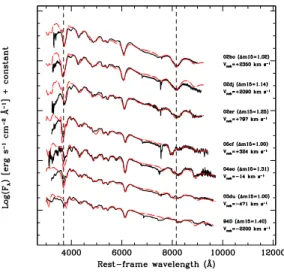
Fig. 3: Spectral evolution at -4 days since maximum as a function of nebular velocity shift (Vneb). The ob-served spectra in black and syn++ models in red (dot-dashed lines). The spectra are redshift and ex-tinction corrected (RV = 3.1). The dashed lines
cor-respond to the expected rest-frame wavelength of H&K and IR-triplet Ca II lines and the spectra in the figure correspond to SN 1994D (Patat et al. 1996), SN 2002bo (Benetti et al. 2004), SN 2002dj (Pignata et al. 2008), SN 2002er (Kotak et al. 2005), SN 2003du (Sollerman et al. 2004), SN 2004eo (Pastorello et al. 2007), SN 2005cf (Bufano et al. 2009).
purpose, we use the [Fe II] λ7155 and [Ni II] λ7378 line velocity shifts as a proxy for viewing angle.
Figure 3 shows the optical spectra of our sample of Type Ia SNe sbout four days before maximum, organized as a function ofVneb. The spectra in Figure 3 are corrected for extinction using the Cardelli et al. (1989) Galactic extinc-tion law (RV = 3.1) and the reddening estimates given in
Table 1, shifted toz= 0.
A clear trend in the width and strength of the Ca II H&Kand IR-triplet lines with nebular velocity shift is ev-ident in Figure 3. For negative values of the nebular ve-locity shift, (i.e. seen from the side closer to the deflagra-tion center in the Maeda et al. 2010a model), the Ca II
lines are weaker, whereas these features become stronger with increasing values for the nebular velocity shift, (i.e. seen from the opposite side of the initial deflagration in the Maeda et al. 2010a model).
At first glance, it seems that the strength of the Ca II H&K and IR-triplet could explain, at least in part, the color variations with Vneb. For example, as Vneb increases and the Ca IIH&Kline gets stronger, theU-band flux gets relatively weaker, making the SN look redder in (U−B)0, in qualitative agreement with the trend seen in the top-left panel of Figure 2. Likewise, as Vneb increases and the Ca II triplet gets stronger, the I-band flux gets relatively weaker, making the SN look bluer in (V−I)0, in qualitative agreement with the trend seen in the bottom-left panel of Figure 2.
To assess quantitatively the effect of Ca II lines in the colors of SNe Ia, we model the spectra from Figure 3 using syn++ (Thomas et al. 2011). In syn++, one computes a spectrum by specifying the location and optical depth for a given set of ions. The input parameters for syn++ are the photospheric velocity, the optical depth, the e-folding length of the opacity profile, the maximum and minimum cut-off velocity for each ion, and the Boltzmann excitation temperature for parameterizing line strengths. The spectral models are very good over all wavelengths except blueward of 3800 ˚A, where the spectrum is dominated by a superpo-sition of many metal lines.
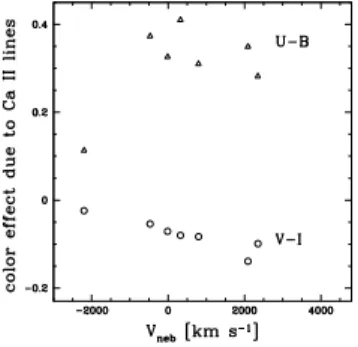
From the resulting model spectra, we compute synthetic colors using the U BV RI filter functions given by Bessell (1990). We then repeat the calculation after removing the Ca lines from the model spectra. Figure 4 shows the total effect of the Ca II lines in the (U−B)0and (V−I)0colors, as a function of Vneb. We note that this is the maximum possible effect because we then suppress all of the lines in the spectra. In (U−B)0, the synthetic colors vary by∼0.3 mag, which could account for part of the observed variation of∼0.4 mag shown in Figure 2. We do not see the regular trend withVneb expected if Ca lines alone were responsible
for the correlations found in this work (eq. 1). However given the difficulties in modeling the spectra shortward of 3800 ˚A it is difficult to separate the contribution of Ca II lines in the colors. In (V −I)0, we recover the trend seen in Figure 2, although the overall variation in the synthetic colors is a factor of four smaller than the observed variation of ∼0.4 mag. We conclude that the strength of the Ca II lines is only partially responsible for the observed variations in colors withVneb, and part of the color diversity is likely due to differences in the slope of the continuum.
As expected, our synthetic (B−V)0and (V−R)0colors are weakly affected by the Ca II lines, which fall at the edge of the B and R bands. In (B−V)0, the color becomes slightly (∼0.05) bluer asVnebincreases from -2000 to 2000 km s−1, which is caused by the emission component of the
Ca IIH&KP-Cygni profile. In (V−R)0, the effect amounts to only 0.01 mag over the entire range ofVneb.
Fig. 4: (U−B)0 and (V −I)0 color differences from mod-els of the spectra shown in Figure 3, and the same spectra after removing theH&K and IR-triplet Ca II lines.
HVG SNe individual lines overlap and can be modeled with a single broad Ca II component.
5. DISCUSSION AND CONCLUSIONS
The theoretical work of Kasen et al. (2009) has put for-ward the notion of intrinsically asymmetric ignition and subsequent detonation in Type Ia SNe, to explain the “peak luminosity-decline rate relation” and color diversi-ties for a given decline rate. Strong support for this idea was provided by Maeda et al. (2010a) by successfully relat-ing the early Type Ia velocity gradient diversity described in Benetti et al. (2005) with the late-time nebular velocity shifts of the [Fe II]λ7155 and [Ni II]λ7378 lines, interpret-ing the nebular velocity shifts as an indication of viewinterpret-ing angle for an initially off-center deflagration.
We have presented clear evidence of correlations be-tween the late-time nebular velocity shifts, or viewing angle, and the (U−B)0, (V−R)0and (V−I)0reddening–corrected colors from -8 to +8 days since B-band maximum, provid-ing additional support to the new paradigm of off-center explosions. In (B −V)0, on the other hand, we find no significant correlation with the nebular velocity shifts. The strengths of these color dependences on Vneb imply that the ejecta are asymmetric and that they are as important as the relations between color and ∆mB
15.
We also note that the (Bmax−Vmax) color dependence
on velocity gradient found in Foley & Kasen (2011) from a sample of 121 SNe Ia (Wang et al. 2009b) could not be investigated in our sample because of the small number of SNe. On the other hand, the correlation between extinc-tion and ∆mB
15 corrected (B−V) colors and Vneb found in Maeda et al. (2011) using the relations by Folatelli et al. (2010) are recovered in our sample. Our estimate of the host galaxy extinction is systematically higher by 0.08 mag than the values given in Maeda et al. (2011). These differences are possibly caused by our use of the Lira relation, which is based on the late-time (B−V) colors, while they employ the (Bmax−Vmax) pseudo color at maximum (Folatelli et al.
2010). We do not find any relation between the residuals of our (Bmax−Vmax) colors or extinction estimates and the
Maeda et al. (2011) estimates with ∆mB
15or Vneb.
The reader may wonder whether our results are an arti-fact of our method for inferring extinction corrections. This concern can be ruled out given that the (U −B)0 vsVneb
and (V−I)0vsVnebcorrelations go in opposite directions, so that it is impossible to wash out both relations simulta-neously by changing the reddening technique.
We also show that there is a relation betweenVneb and the shape and strength of the Ca II H&K and IR triplet lines, which are the strongest features in theU andIbands, independently of ∆mB
15. This agrees with Tanaka et al. (2008), who noted that HVG SNe tend to have stronger Ca II features. As shown in the previous section, the effect of the Ca II lines in (U−B)0and (V−I)0is significant, but their strength is only partially responsible for the observed color variations and their dependence on Vneb is difficult to assess. A reasonable conclusion is that the continuum emission is also affected by viewing angle effects.
Finally, the evidence presented here implies that both Vneb and ∆m
B
15 must be taken into account when deriv-ing extinction values based on maximum-light colors, which is a critical parameter in deriving distances from SNe Ia. Furthermore, as shown by Foley & Kasen (2011), ignoring this effect could introduce significant biases in the determi-nation of extinction laws (RV). A larger sample of nearby
SNe Ia is urgently required to improve our calibration of these correlations and understand the influence of viewing angle on SN colors.
Acknowledgements. We would like to thank the anonymous ref-eree for constructive comments on the text. R.C. acknowledges support by CONICYT through Programa Nacional de Becas de Postgrado grant D-2108082 and by the Yale-Chile fellowship in as-trophysics. R.C., M.H., F.F., and G.P. acknowledges support pro-vided by the Millennium Center for Supernova Science through grant P10-064-F (funded by “Programa Bicentenario de Ciencia y Tecnolog´ıa de CONICYT” and “Programa Iniciativa Cient´ıfica Milenio de MIDEPLAN”). M.H. acknowledges support provided by FONDECYT through grant 1060808. MH. and G.P. acknowledges support provided by Centro de Astrof´ısica FONDAP 15010003, and Center of Excellence in Astrophysics and Associated Technologies (PFB 06). F.F. acknowledges support provided by FONDECYT through grant 3110042. The work by K.M. is supported by World Premier International Research Center Initiative (WPI Initiative), MEXT, Japan, and by JSPS grant in aid for Scientific Reasearh (23740141). G.P. acknowledges support by the Proyecto FONDECYT 11090421 and from Comit´e Mixto ESO-Gobierno de Chile.
References
Benetti, S., Cappellaro, E., Mazzali, P. A., et al. 2005, ApJ, 623, 1011 Benetti, S., Meikle, P., Stehle, M., et al. 2004, MNRAS, 348, 261 Bessell, M. S. 1990, PASP, 102, 1181
Bufano, F., Immler, S., Turatto, M., et al. 2009, ApJ, 700, 1456 Cardelli, J. A., Clayton, G. C., & Mathis, J. S. 1989, ApJ, 345, 245 Folatelli, G., Phillips, M. M., Burns, C. R., et al. 2010, AJ, 139, 120 Foley, R. J. & Kasen, D. 2011, ApJ, 729, 55
Hicken, M., Challis, P., Jha, S., et al. 2009, ApJ, 700, 331
Jha, S., Garnavich, P. M., Kirshner, R. P., et al. 1999, ApJS, 125, 73 Kasen, D., R¨opke, F. K., & Woosley, S. E. 2009, Nature, 460, 869 Kotak, R., Meikle, W. P. S., Pignata, G., et al. 2005, A&A, 436, 1021 Krisciunas, K., Suntzeff, N. B., Candia, P., et al. 2003, AJ, 125, 166 Lira, P., Suntzeff, N. B., Phillips, M. M., et al. 1998, AJ, 115, 234 Maeda, K., Benetti, S., Stritzinger, M., et al. 2010a, Nature, 466, 82 Maeda, K., Leloudas, G., Taubenberger, S., et al. 2011, MNRAS, 413,
3075
Maeda, K., R¨opke, F. K., Fink, M., et al. 2010b, ApJ, 712, 624 Maeda, K., Taubenberger, S., Sollerman, J., et al. 2010c, ApJ, 708,
1703
Pastorello, A., Mazzali, P. A., Pignata, G., et al. 2007, MNRAS, 377, 1531
Patat, F., Benetti, S., Cappellaro, E., et al. 1996, MNRAS, 278, 111 Perlmutter, S., Aldering, G., Goldhaber, G., et al. 1999, ApJ, 517,
565
Pignata, G., Patat, F., Benetti, S., et al. 2004, MNRAS, 355, 178 Riess, A. G., Filippenko, A. V., Challis, P., et al. 1998, AJ, 116, 1009 Riess, A. G., Li, W., Stetson, P. B., et al. 2005, ApJ, 627, 579 Schlegel, D. J., Finkbeiner, D. P., & Davis, M. 1998, ApJ, 500, 525 Sollerman, J., Lindahl, J., Kozma, C., et al. 2004, A&A, 428, 555 Stanishev, V., Goobar, A., Benetti, S., et al. 2007, A&A, 469, 645 Stritzinger, M., Burns, C. R., Phillips, M. M., et al. 2010, AJ, 140,
2036
Tanaka, M., Mazzali, P. A., Benetti, S., et al. 2008, ApJ, 677, 448 Thomas, R. C., Nugent, P. E., & Meza, J. C. 2011, PASP, 123, 237 Wang, X., Filippenko, A. V., Ganeshalingam, M., et al. 2009a, ApJ,
699, L139