
Antiguo Oriente: Cuadernos del Centro de Estudios de Historia del Antiguo Oriente, 2004, n° 2 (número completo)
141
0
0
Texto completo
(2) Facultad de Filosofía y Letras. Departamento de Historia Centro de Estudios de Historia del Antiguo Oriente Av. Alicia Moreau de Justo 1500 Edificio San Alberto Magno (C1107AFD) Buenos Aires Argentina www.uca.edu.ar Dirección electrónica: [email protected] Teléfono: (54-11) 4349-0200 ext. 1189. Hecho el depósito que marca la Ley 11.723 Impreso en la Argentina © 2004 UCA ISSN 1667-9202.
(3) AUTORIDADES. DE LA. UNIVERSIDAD. Rector Monseñor Dr. Alfredo Horacio Zecca Vicerrector Lic. Ernesto José Parselis AUTORIDADES DE LA FACULTAD Decano Dr. Héctor José Delbosco Director del Departamento de Historia Dr. Miguel Ángel De Marco Secretario Académico Lic. Santiago Bellomo AUTORIDADES DEL. CENTRO DE ESTUDIOS DE HISTORIA DEL ANTIGUO ORIENTE Directora Lic. Roxana Flammini Secretario Prof. Javier M. Paysás Colaboradores Virginia Laporta, Romina Della Casa, Catalina Cabana.
(4) COMITÉ EDITORIAL. Jorge Bedoya, Universidad de Buenos Aires, Argentina. Marcelo Campagno, Universidad de Buenos Aires, CONICET, Argentina. Josep Cervelló Autuori, Universidad Autónoma de Barcelona, España. Alicia Daneri Rodrigo, Universidad Nacional de La Plata, CONICET, Argentina. Amir Gorzalczany, Israel Antiquities Authority, Israel. Santiago Rostom Maderna, Universidad Católica Argentina, Argentina. Troy Sagrillo, Katholieke Universiteit Leuven, Bélgica.. Revisión Técnica de los resúmenes en inglés: Dra. Graciela Souto, Departamento de Lenguas, Facultad de Filosofía y Letras, Universidad Católica Argentina..
(5) SUMARIO. COLABORACIONES Carrier netting from the Ptolemaic Roman harbour town of Berenike (Egyptian Red Sea Coast) ANDRÉ J. VELDMEIJER & SIGRID VAN ROODE ................................................... 9 Cerámicas “Edomita”, “Madianita” y “Negevita”: ¿Indicadoras de grupos tribales en el Negev? JUAN MANUEL TEBES .................................................................................... 27 De patrones y clientes: sobre la continuidad de las prácticas sociopolíticas en la antigua Palestina EMANUEL O. PFOH ........................................................................................ 51 La hipótesis sotíaca de Eduard Meyer. Una revisión a 100 años de su publicación MARCELO ZULIAN ......................................................................................... 75 Algunos aportes iconográficos, simbólicos y litúrgicos iranios al Imperio Romano y al Cristianismo JAVIER M. PAYSÁS ........................................................................................ 85 A lead amulet of Nefertem found at Tel Michal on the Coastal Plain of Israel AMIR GORZALCZANY & GRACIELA GESTOSO SINGER ..................................... 113 RESEÑAS BIBLIOGRÁFICAS ............................................................................ 119 POLÍTICA EDITORIAL E INSTRUCCIONES PARA LOS COLABORADORES ................. 129 DIRECCIONES PARA ENVÍOS DE ARTÍCULOS Y RESEÑAS BIBLIOGRÁFICAS ............. 132.
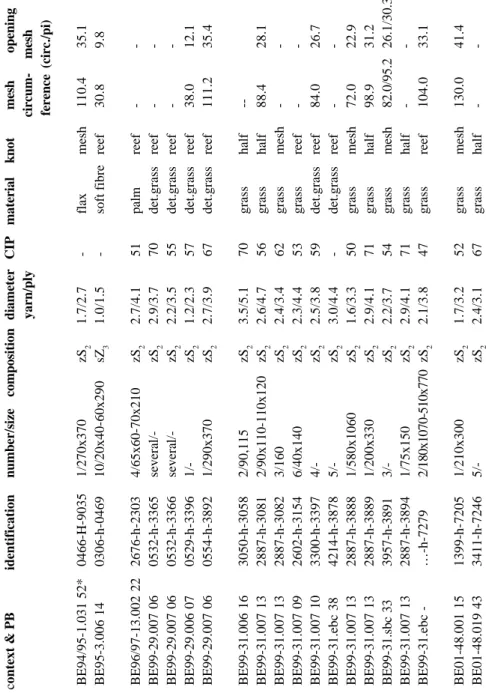
(6) CARRIER NETTING FROM THE PTOLEMAIC ROMAN HARBOUR TOWN OF BERENIKE (EGYPTIAN RED SEA COAST)1 ANDRÉ J. VELDMEIJER & SIGRID M. VAN ROODE*. Abstract: The excavations at Berenike (Egyptian Red Sea Coast) yielded various examples of carrier netting, mainly from first century AD contexts. This paper presents the artefacts, describes and illustrates them. Preliminary conclusions are offered on the basis of comparison with material from other sites, especially Qasr Ibrim. The objects’ representation in art and their occurrence in the archaeological record are discussed. Keywords: cordage-netting-knots-Berenike Palabras Clave: cordaje-redes-nudos-Berenice. INTRODUCTION Among the cordage excavated at the Ptolemaic Roman harbour town of Berenike (Egyptian Red Sea Coast) are 142 pieces of netting. The netting originates from eight different trenches (figure 1), distributed over 32 different loci, including six baulk and trench cleaning loci and 41 pb2-numbers. The focus of the present work is on the netting not related to fishing, referred to as carrier netting (table 1). All 533 fragments originate from early Roman contexts (first century AD) with the exception of one complete net from trench BE94/95-1; this is dated to the fifth century AD or later. The knotless netting from trench BE96/…-10 will be dealt with separately; this fragment 1. The excavations at Berenike were conducted by the University of Delaware (co-director S.E. Sidebotham) and the Leiden University (co-director W.Z. Wendrich) during 1994-2001. * PalArch Foundation, Amsterdam, Netherlands. 2 A ‘p(ottery) b(ucket)’ is the smallest unit within each locus (see Wendrich 1996: 127). The field method is a modified Gezer excavation and recording system (Sidebotham et al. 1989: 134-136). Dating has been done on the basis of pottery; see http://www.archbase.com/, the database website of the excavations, for the complete dating of all loci, but also Veldmeijer, in review, a. BE99-31.ebc ….-h-7279. The pieces of cordage were registered on 18 December 2000. The trench however, was excavated during the 1999 season. Therefore no site identification number was given. The area where these trenches are situated are all dated to the first century AD. We decided to take the netting into the cordage database because of the preserved ring. 3 Two entries are numbered ‘several’ and consist of isolated reef knots..
(7) 10. ANDRÉ J. VELDMEUER & SIGRID M. VAN ROODE. is also dated to late Roman times. The carrier netting originates from eight trenches (13 loci4 and 15-pb numbers)5. Carrier netting is recognized by various characteristics. Netting made of grass or palm can be regarded as carrier-netting, because these materials are far less suitable for use in water. When soaked, they are more susceptible to deterioration6, worsened by the generally low Cord Indices of Ply (CIP)7 of grass cordage of this composition8. Furthermore, the soaked netting would be too heavy to work with easily and mending the netting would result in very weak spots because the newly inserted strings9 cannot be tied properly to the wet netting. Although these repairs are weak spots in flax netting as well, flax can be tied more strongly. Fish-netting is made exclusively with mesh knots, even nowadays, whereas these knots are mostly not used in carrier netting. THE MATERIAL10 The netting from Berenike is fragmented and deteriorated and complete carrier netting has not been recovered, except for one example from the fifth century AD (see below). The character of the handles of the Berenike netting, if there were any, remains obscure11. Handles in pottery carriers, for instance, were used to put a strong pole through to carry the heavy load, as is shown in scenes in art (see below). Moreover, Wendrich12 published a reconstruction of a pottery carrier with handles recovered from Amarna and finds from Qasr Ibrim also show handles13. However, netting made with overhand knots, like the one excavated at Amarna, are not encountered in Berenike. This might indicate a different way of constructing netting in Pharaonic and Roman times. Other carrier netting with handles, though not pottery carriers, has 4. But see the remarks on the loci of trench BE96/97-13 in Veldmeijer, in review, a. See note 2. 6 Wendrich & Veldmeijer 1996: 289. 7 The Cord Index of Ply (CIP) expresses the tightness of a piece of plied cordage. 8 Veldmeijer, in review, a. 9 Cordage with a diameter of less than 10 mm. 10 Terminology is presented in detail in Wendrich 1991; Wendrich & Veldmeijer 1996. A discussion and evaluation of terminology in Veldmeijer, in review, b. For knots in general see Ashley 1993 and Veldmeijer, accepted. 11 (Pieces of) handles are recovered but it is not possible to be certain on the origin of them. They might originate from netting as well as from baskets. 12 Wendrich 1989; 1999. 13 Veldmeijer & van Roode, forthcoming. 5.
(8) CARRIER NETTING FROM THE PTOLEMAIC ROMAN.... 11. been reported from Roman Tebtunis14. The size of the netting depends on the size of the jar, which does not mean that netting was specifically made for one type of pottery; netting can be slightly adjusted to fit the size of the pottery. The small meshed carrier netting, recovered from trench BE94/95-115 has already been discussed by Wendrich16. It is the only almost complete netting object: all other pieces of netting, fishing, carrier or hair netting alike, are small to large fragments. All but one site artefact registration number, containing ten pieces of netting, are made with zS217 cordage (table 1). The diameters vary from 1.0 up to 3.5 mm for the yarn and 1.5 up to 5.1 mm for the ply18. The CIP varies from 50 to 71, which is a remarkable small variation compared to that with the fish-netting (33 up to 8619). Mesh size varied from small (9.8 mm) to large (41.4 mm). Eleven pieces of netting (table 1) have been made with half knots20. All but the five pieces from BE01-48 originate from one trench, namely trench BE99-31, but both trenches have been dug in the same trash dump (figure 1) and are dated to the first century AD. The description presented here is based on the fragment shown in figure 221. This netting is made with zS2 grass cordage with a CIP of 71 and measures 200x330 mm. It contains 35 S22 half knots which are 24.5 mm spaced. The mesh created has an opening of 31.2 mm. There is no indication of a top or bottom (which is also the case with the other ten pieces made with half knots). The lack of top or bottom makes the reconstruction of the knotting technique difficult but a possible way of knotting is shown in figure 2D. A string is laid in a curve next to the neighbouring string (2D, top left). The extremity marked ‘I’ is moved under 14. Domning 1977. BE94/95-1.031 0466-H-9035. 16 Wendrich 1995. 17 zS2 and comparable formulae: The twist is the orientation of yarns, plies and cables, made visible by ‘z’ or ‘s’ (yarns), ‘Z’ or ‘S’ (plies), ‘[Z]’ or ‘[S]’ (cable), ‘{Z}’ or ‘{S}’ (double cable). The central stroke of the letter marks the orientation. Thus zS2[Z3] means that two zspun yarns (2) are twisted in S-direction. There upon three (3) of these plies are cabled in [Z]direction. Note that there are various ways of visualising the twist of cordage. 18 Two or more twisted yarns. A ply is the second level of a string and rope. 19 Veldmeijer & van Roode, in review. 20 Note that netting with half knots, as presented here, differs from that presented by Wendrich (1991: Figure 24 (=30)). The different definition (cf. ibidem) is the reason for this. 21 BE99-31.007 2887-h-3889. 22 The description of the orientation of knots is comparable to the description of twist and composition, following the middle stroke of the ‘S’ and ‘Z’, see note 17. 15.
(9) 12. ANDRÉ J. VELDMEUER & SIGRID M. VAN ROODE. the neighbouring string (‘II’) and into the curve just made (2D, top right). Pulling the extremity closes the half knot. In the next row, extremity ‘I’ is used as the tied string, (2D middle and bottom respectively). The strings change from active (‘I’; the string that ties) to passive (‘II’; the string that is tied), which results in a ‘staircase-like’ pattern (figure 2C). Over 33 pieces of netting, made with reef knots23, have been registered (table 1). Fourteen of these are made with SZ reef knots. It has not proved possible to identify the orientation of the reef knots in the other fragments. Making netting with reef knots is done in two ways, according to Ashley24. Figure 3A shows a reconstruction drawing in which the (thinner) strings are attached to a thicker string25. The way in which the strings are attached to the thicker top string or rope26 is taken from BE99-31.ebc …-h-7279 (see figure 4). Obviously there are many ways of connecting the netting to a border string/rope. Both extremities of the two strings, marked ‘I’ and ‘II’ in figure 3A, participate in the knotting. Extremity ‘II’ of string ‘a’ is knotted into a reef knot together with extremity ‘I’ of string ‘b.’ Extremity ‘I’ of string ‘a’ is knotted into a reef knot with ‘II’ of another string, marked ‘c.’ The knotting is done downwards (i.e. in the figure; when using the work might be turned 45 degrees), taking the thicker border line as top, which results in horizontal reef knots. In this reconstruction each string participates with two other strings in the knotting of the reef knots. The reconstruction shows equally orientated reef knots, but an alternation of ZS and SZ rows is possible as well. It is not possible to differentiate between ZS and SZ reef knots unless both knots are used in the same object27. Another way of knotting netting with reef knots, mentioned by Ashley (ibidem), requires a netting needle. Figure 3B shows a reconstruction drawing in which two strings, attached to a border line as explained above, are knotted into a hitch. Then, the hitches are turned over by pulling the strings, 23. See also Veldmeijer (1999: 267-269) for netting made with reef knots (BE96/97-13.002 2676-h-2302). Reef knots are also known as square knots. 24 Ashley 1993: 65. 25 If the production of netting with reef knots is compared to the production of netting with mesh knots, the thicker string is not necessarily the beginning of the netting. Often a thicker string is knotted at the end of the production process of netting made with mesh knots (Wendrich 1999: 293-295). 26 Cordage with a diameter of 10 mm or more. 27 For a detailed discussion on problems with reef knots see Veldmeijer, accepted..
(10) CARRIER NETTING FROM THE PTOLEMAIC ROMAN.... 13. marked ‘II’ in the figure, into the direction of the arrows. However, Ashley does not mention the fact that the hitch only changes into a reef knot if the part of the string, which is marked ‘I’ in the figure, is moved in the opposite direction28. This knotting, either done from left to right or from right to left, results in vertical reef knots. The pieces of netting shown in figure 4 originate from a first century AD context29 and are made of grass zS2 cordage with a CIP of 47. The pieces, of which the circumference is shown in figure 4A, measure 510x770 mm and 180x1070 mm and contain >150 and >90 ZS reef knots respectively. The bottom ring30 is used as starting point for the establishment of reef knots31. Half of the bottom ring is preserved and the reconstructed diameter is 45 mm. Though small, pottery vessels with bases that fitted such rings are reported32. The bottom ring of the netting is made of three or four zS2 strings but the exact number cannot be determined due to the fragmented state. The same is true for the diameter of these strings, but the minimal diameter is 2.5 mm for the yarn and 5.2 mm for the ply. The string that is used to knot the netting is folded over the ring (figure 4B). Due to the bad preservation it remains uncertain in which way these loops are locked; either half hitched around two of the extremities as shown in figure 4B left, or around one of the extremities as seen in figure 4B right. The first row of reef knots is either made with the same string as the loops or a new string is inserted. Insertion of new string, either fastened by means of knots or twisted into the previous string, is inevitable during the following, continuous knotting of the netting (see the general description above). The average diameter of the mesh openings is 33.1 mm. The netting has three irregularities (figure 4C). One (figure 4C top left), is made by a piece of string running through several meshes. The string has a standard overhand knot but is not fastened to the netting, nor did it tie it. If not broken, it is hard to believe that it is some sort of repair. The exact meaning of this piece of string is unclear. The irregularities shown in figure 4C top 28. On the relation between reef knots and hitches see also Veldmeijer (1999). But see note 2. 30 It is called ‘bottom ring’ because the toe (bottom) of the amphora is put in the ring; the ring in contrast is the starting point of knotting the netting. 31 Although the small piece of netting has no bottom ring and thus no starting point, the orientation of the reef knot is the same as of the larger piece because the two pieces originate from the same carrier netting. 32 For instance Tomber 1999; pers.com. Pearce 1999. 29.
(11) 14. ANDRÉ J. VELDMEUER & SIGRID M. VAN ROODE. right and bottom on the other hand, have been made to repair the netting. The repair top right shows the repair of a hole by means of a string of which one extremity is knotted to the netting at one side of the hole by means of half knots. The netting on the other side of the hole is pulled by the other extremity after which it crosses the gap and is folded around the same netting as it has knotted. Figure 4C bottom shows a repair by means of one string. The string has been fastened to one side of the netting by means of a half knot. It ties another string in the middle of the hole, also by means of a half knot, after which it forms a reef knot with a side mesh, thus connecting two sides of the damaged part. The third side is connected, too, because the string has been knotted to this part of the netting by means of a half knot. The other extremity has been tied in. Another piece of carrier netting from the same period, though from another trench, is shown in figure 533. The netting consists of one large piece and several isolated knots and originates from a first century AD context. It is most likely made of grass, but a certain identification could not be obtained due to the deteriorated condition. The cordage has a zS2 composition with a CIP of 67. The piece measures 290x370 mm and contains SZ reef knots. The bottom ring, used as the starting point, has an inside diameter of 27.0x37.3 mm and is slightly malformed. The width of the ring, measured from the inside to the outside, is 16.1 mm, which results in a total outside diameter of 60 mm. The ring is 16.5 mm thick. It is not possible to determine the nature of the core of the ring (unspun material, plied or cabled34 cordage etc.) due to the loops of the netting. These loops (‘I’ in the figure 5B) connect the netting to the core and are very tightly pushed together. The loops are tied at the inside and outside of the ring by means of a twined string (see inset figure 5B for the pattern). Most likely this construction is comparable to the technique shown in figure 4. Certainty on this however cannot be obtained without damaging the ring which we were anxious not to do. The loops at the ring have been used to connect the first row of knots. The first row of reef knots is connected in the same plane as the loops (see ‘I’ in the figure). In other words, when looking at the netting from a side, the first row of knots faces in side view. The next row of knots, marked ‘II’ in the figure, connects two knots of the first row in such a way that the orientation of the knots changes from a side view to a view en face, which continues throughout 33. BE99-29.007 0554-h-3892. A strand, which is formed by two or more twisted plies. A cable is the third level of string and rope.. 34.
(12) CARRIER NETTING FROM THE PTOLEMAIC ROMAN.... 15. the rest of the netting. The new view is obtained due to the 90-degree angle with the first row of knots. The meshes created this way have an average opening of 35.4 mm (the first row of meshes are not taken into account in calculating the average mesh size, because these meshes have a different shape and are much smaller). Carrier netting made with mesh knots is an exception, because almost all carrier netting is made with other knots. Fish-netting on the other hand, is made exclusively with mesh knots, even nowadays. The production of mesh knot carrier netting is assumed to be comparable to the knotting of fishnetting (except, of course, the adding of floats and weights and the like)35. The netting shown in figure 636 is made with grass zS2 string with a CIP of 50. The piece originates from a first century AD context and measures 1060x580 mm. It contains 15 rows of S orientated mesh knots37. The meshes have an average opening of 22.9 mm. The edge of the netting consists of a zS3 string, which has a slightly larger diameter. The CIP however is slightly less (48). A zS2 string runs through the openings created by the zS3 string, which is still partly in place. Most of these meshes, 16 up to the concreted part, are pointed, which is an indication of the force that was exerted on them by pulling the zS2 string in the opposite direction. This side of the netting however, is not the side at which the knotting was started38. Three repairs are observed of which one is shown in figure 6D left. Three zS2 strings are folded over the string between two mesh knots. Thereafter, these three strings are cabled into an [S6] cable. This cabling is done very tightly because the cable tends to curl. The diameter of this piece of cordage is 7.4 mm and contrasts sharply with the diameter of the cordage from which the netting is made because this cordage has an average diameter of 3.3 mm. A CIP/CIC cannot be determined due to the irregular plying/cabling. It is unclear how the other end of the string is tied to the netting. Another damaged part is repaired by mesh knotting a thick piece of zS2 string with a diameter of 6.1 mm into a damaged part (not illustrated). The third damaged part is repaired by hitching a piece of rope, with a diameter of 10.4 mm and a CIP of 64, at 35 On the knotting of fishing netting see Wendrich (1999: 293-295) and Veldmeijer & van Roode, in review. 36 BE99-31.007 2887-h-3888. 37 The exact number of knots cannot be determined due to the concreted and curled part. This part is not retrieved in order to protect the non-concreted part from salt encrustment. It was therefore detached from the non-concreted part. 38 Wendrich 1999: 293-295..
(13) 16. ANDRÉ J. VELDMEUER & SIGRID M. VAN ROODE. both sides of the mesh knot, as seen in figure 6D right. The zS2 string is cabled [S2] after the hitch. Another example of carrier netting made with mesh knots consists of three pieces39 and originates from a context that is dated to the first century AD. The netting is made of grass zS2 string with a CIP of 54. The average size of the opening of the meshes is 26.1 for the smaller pieces and 30.3 for the larger piece. The piece, shown in figure 7, consists of a bottom ring with a piece of netting40. The ring is comparable to the bottom ring shown in figure 5 and has an inside diameter of 27.5 mm. The thickness of the ring is 19.4 mm and the width, top view, is 15.5 mm. The attachment of the netting to the ring differs from the previously discussed rings. The exact attachment cannot be determined without damaging the ring and the netting, which has therefore not been done. It is certain however, that one knot is inserted at the top of the ring, marked ‘I’ in figure 7B, whereas the next one is inserted at the bottom of the ring, marked ‘II’ in the figure. This results in a first row of knots that face outwards, as are the following rows. This contrasts with the netting previous discussed in which the first row of knots makes a 90 degree angle relative to the bottom ring. The knots at the top are connected with the neighbouring knot at the bottom, by means of a knot of the following row, marked ‘III’ in the figure. The knots in the first row are close together leaving small, nearly closed meshes. The meshes of the netting further away from the ring are larger (inset figure 7B). The netting shows loops, which are made of zS3 string (cf. the netting shown in figure 6). The CIP of this zS3 string is 62. The largest piece has a repair that is made with a thicker string (diameter of 5.8 mm); it is knotted with a mesh knot. Another knot is made in the opposite direction; possibly this is a repair as well. Twining is used to secure the attachment of the netting to the ring (cf. figure 5). USE OF CARRIER NETTING Despite the fact that pottery is probably the most extensively studied artefact category, surprisingly little attention has been given to the transport of these items and even less to the individual moving of (large) pottery vessels. Although a detailed study is in progress, we present a few examples of pictorial evidence of the transport of pottery by means of carrier netting. 39 40. BE99-31.sbc 3957-h-3891. BE99-31.sbc 3957-h-3891..
(14) CARRIER NETTING FROM THE PTOLEMAIC ROMAN.... 17. Pottery and especially large vessels and amphorae were, according to tomb scenes, often transported by means of carrier netting41. Many scenes in tombs of Pharaonic periods depict this means of transport and provide insights into the use of such carrier netting. However, scenes also depict people carrying amphorae on their necks42. Transport over relatively short distances or transfer from one ship to another and comparable activities were probably done without netting. Often these jars have handles but netting was still used to carry handled amphorae, probably for transport over larger distances. The New Kingdom tomb of Wah (Thebes nr. 22) shows an amphora with handles, carried in a carrier (figure 8). Here, the spike is put in the ring. The netting recovered in Amarna, was also reconstructed with the idea that the spike was put into the ring43. But the bottom of a pot does not necessarily protrude through the ring in order to retain its position in the netting. A complete pot with carrier netting in situ from Qasr Ibrim shows that the bottom rests upon the ring in pretty much the same way as on a pot stand44. Some depictions show the bottom ring on the outside of the jar or show carriers without a bottom ring. The use of the ring depended on the shape of the pottery as well (different forms of pottery, more specifically amphorae, are encountered in Berenike); evidence from Qasr Ibrim suggests that carriers without a bottom ring were used as well. Strong poles might have been put through the handles of the nets to carry the heavy load, as is shown in scenes in the New Kingdom tomb of Rekhmira45. Though not found at Berenike, we should like to mention some netting from elsewhere, as for instance that found at Qurneh46. Some of these pieces are elaborate knot-works and used to carry small pots. Probably, these were made for a special purpose, for instance to carry pots used in a ritual or for being interred (the instances have been found in an intact burial of the 18th dynasty). 41 Literature refers to the nets as sling (Wendrich 1989); we prefer to use the term ‘pottery carrier’ because this term immediately makes clear what is meant. Terms including reference to ‘amphorae’ are to be avoided as not all pottery carried with netting was amphorae. 42 Casson 1994: 103 (figure 76), 132 (figure 96). 43 Wendrich 1989: 183-186; 1999: 204-205. 44 Veldmeijer & van Roode, forthcoming. 45 For instance Davies 1943: plate L; another instance is shown in figure 8. 46 Petrie 1909..
(15) 18. ANDRÉ J. VELDMEUER & SIGRID M. VAN ROODE. Another example of elaborate knotting can be seen in the Cairo Museum. It is hard to believe that this netting was made with the idea of transporting pots and a more decorative function seems to be more plausible. These items are included in future studies47, but it can be easily assumed that these nets were made for long term use. The netting from Qasr Ibrim, mentioned above, is thought to have a far shorter lifespan and might have been made for single use only, based on the simple construction and the string used (only spun and not twisted). Netting was not used just for carrying amphorae or other pottery. Stalks of grain were transported in netting sacks, either carried by a man, as depicted in the tomb of Menena48 or by an animal. This latter method of transport was still prevalent in Egypt at the beginning of last century49 and can be seen even today. A complete net from the Roman town of Tebtunis50 had also large meshes (much larger even than the meshes encountered in Berenike). According to the author51: “In view of the small overall size but very large mesh of this netting, it would hardly have been useful for fishing or fowling. It clearly seems to have been intended as a general utility netting for holding or transporting bulky objects, or securing a load on the back of a pack animal…”. The latter seems less probable, because in such a case the netting could be tied at the top, or as mentioned above, netting sacks could be used, and this theory gives no explanation for the handles. In general, the meshes of these netting sacks and carrier nets are large. As table 1 shows, the mesh size of the Berenike netting is relatively small. Consequently, it is tempting to conclude that remains of netting sacks are not among the netting material recovered there. However, the nature of the excavated netting does not exclude a use for transporting items other than pottery, despite the relatively small mesh size. Furthermore, the nature of cordage is such that one always has to reckon with multiple applications, for netting as well as for other cordage. DISCUSSION As has been stated above, the research into carrier netting is still in its infancy. This article is the first in a series of articles presenting detailed 47. Veldmeijer & van Roode, forthcoming. Gutgesell 1997. 49 Blackman 2000: 173, 177 fig. 104. 50 Domning 1977. 51 Domning 1977: 57. 48.
(16) CARRIER NETTING FROM THE PTOLEMAIC ROMAN.... 19. research on cordage. The project, based on archaeological evidence, will include pictorial evidence as well. The surviving carrier netting is generally of solid construction. The nets have been carefully made; the bottom rings are sturdy. Although three kinds of knots (reef knots, half knots and mesh knots) have been used to make the netting, the reef knot is the most common knot as is to be expected in carrier netting. The repairs are not as carefully executed; sometimes even half-knots have been used, which loosen easily. Comparison of the netting from Berenike with material from other sites leads to the preliminary observation that three types of netting can be distinguished: the well-made netting discussed in this paper, which was used until beyond repair, the coarse netting made of yarns and knotted with halfknots or the knotless netting which appears to have been made for one-time use only, and the netting made by means of decorative elaborate knotting. Possibly, this last-mentioned netting was used to hang pots from the ceiling to keep them away from crawling insects, rodents and the like. This can still be observed in present-day Nubia. They might even have been used in ritual contexts (including burials) as well. As far as the preservation is concerned, in general only the lower parts of the netting have been preserved. This part is the most sturdy element of the construction, with a larger density of the netting around the bottom ring. Another reason for the poor preservation is the nature of the material used. The perishable character of objects made of organic material such as netting results in the survival of relatively few finds. The perishable character of this type of netting is even further increased due to the relatively low CIP of the cordage used. As a result, it is even more susceptible to deterioration and hence has not survived. Another reason for the relatively low amount of cordage finds is that cordage is a multi-purpose, multi-functional and above all re-usable item and organic material was often used, when discarded, as fuel for ovens and kilns. The carrier netting has been recovered mainly from the early Roman contexts; only one piece of netting can be dated to a fifth century AD context. The lack of material from the centuries in between these two periods can be explained by the fact that no trash dumps from this era have been excavated. The explanation for the lack of netting from the fifth century AD trash dump is more difficult. One possible reason is that the nature of the deposit was not related to the activities for which these nets would have been used. The fifth-.
(17) 20. ANDRÉ J. VELDMEUER & SIGRID M. VAN ROODE. century excavated trash dump in the middle of the town is a domestic waste heap whereas the early Roman dump contained much more industrial material. Other explanations need to be considered as well, however. The absence of carrier netting in the fifth century AD might also reflect a different way of handling and transporting the large quantities of pottery still transiting through Berenike in this late period. Pictorial evidence from the Pharaonic era indicates that netting was used to carry pottery with handles (amphorae) as well as pottery without handles. Judging from the absence of carrier netting in later contexts, changes apparently occurred in the traditional way of transporting goods; in this period the pottery might have been transported by hand. Roman representations of ships unloading cargo show pottery being carried on the shoulder or by hand; no carrier nettings are depicted. Transporting by hand, in turn, might be explained by the fact that in general the pots were smaller and easier to carry by hand and/or by means of ropes through the handles. In short, the absence of netting from later periods may be attributed to both the nature of the excavated dumps and/or a possible change in methods of transporting cargo. ACKNOWLEDGMENTS W.Z. Wendrich and R. van Walsem are acknowledged for reading earlier drafts of the manuscript; J.P. Wild and F. Wild are acknowledged for reading the manuscript and checking English. S.E. Sidebotham and R. Tomber are thanked for the remarks on the transportation theory. P.J. Rose and the EES are acknowledged for allowing us to use the Qasr Ibrim material for comparison and J. Spencer is thanked for his assistance in the study of Qasr Ibrim material in the British Museum, London. We thank E. Endenburg for the production of various figures and his assistance in field work and A.M. Hense is thanked for reworking the photographs..
(18) CARRIER NETTING FROM THE PTOLEMAIC ROMAN.... 21. REFERENCES ASHLEY, C. W. 1993. The Ashley book of knots, New York/London/Toronto/ Sydney/Auckland, Doubleday. BLACKMAN, W.S. 2000. The fellahin of Upper Egypt, Cairo, The American University in Cairo Press (Classic Reissues). CASSON, L. 1994. Ships and seafaring in ancient times, London, British Museum Press. DAVIES, N. DE G. 1943. The tomb of Rekh-mi-Re at Thebes, New York, The Metropolitan Museum of Art. DOMNING, D. P. 1977. «Some examples of ancient Egyptian ropework». In: Chronique d’Égypte LIL, pp. 49-61. GUTGESELL, M. 1998. «Economie en handel». In: SCHULZ, R. & M. SEIDEL, (eds.), Egypte, het land van de farao’s, Köln, Könemann Verlagsgesellschaft, pp. 371-375. MACKAY, E. 1916. «Note on a new tomb (no. 260) at Drah Abu’l Naga, Thebes». In: Journal of Egyptian Archaeology 3, pp. 125-126, plates XIV, XV. PETRIE, W. M. F. 1909. Qurneh, London, Memoir(s) of the Egypt Exploration Fund (British School of Archaeology in Egypt 16). SIDEBOTHAM, S. E., RILEY, J. A., HAMROUSCH, H. A. & BARAKAT, H. 1989. «Fieldwork on the Red Sea Coast. The 1987 Season». In: Journal of the American Research Center in Egypt 26, pp. 127-166. TOMBER, R. S. 1999. «The pottery». In: SIDEBOTHAM, S.E. & W.Z. WENDRICH, (eds.). Berenike 1997. Report of the 1997 excavations at Berenike and the survey of the Egyptian Eastern Desert, including excavations at Shenshef. – Leiden, Centre of Non-Western Studies (CNWS Publications, special series no. 4), pp. 123-159. VELDMEIJER, A. J. 1999. «The cordage». In: SIDEBOTHAM, S.E. & W.Z. WENDRICH, (eds.), Berenike 1997. Report of the 1997 excavations at Berenike and the survey of the Egyptian Eastern Desert, including excavations at Shenshef. – Leiden, Centre of Non-Western Studies (CNWS Publications, special series no. 4), pp. 257-276. VELDMEIJER, A. J. In review, a. «A basic statistical description of archaeological cordage. A case study of the material from the Ptolemaic Roman harbour site Berenike (Egyptian Red Sea Coast)». In: PalArch, series archaeology of Egypt/Egyptology..
(19) 22. ANDRÉ J. VELDMEUER & SIGRID M. VAN ROODE. In review, b. «Archaeologically attested cordage. Terminology on the basis of the material from Ptolemaic Roman Berenike (Egyptian Red Sea coast)». In: Eras. Accepted. «Knots, archaeologically encountered: a case study of the material from the Ptolemaic Roman harbour Berenike (Egyptian Red Sea Coast). In: Studien zur Altägyptischen Kultur 34 (2005/06). VELDMEIJER, A. J. & S. M. VAN ROODE. In review. «Fishing netting from Berenike (Egyptian Red Sea Coast)». In: Antiquity. Forthcoming. «Carrier netting from Qasr Ibrim, Egypt». WENDRICH, W. Z. 1989. «Preliminary report on the Amarna basketry and cordage». In: KEMP, B.J., (ed.), Amarna reports V. – London, Egypt Exploration Society, pp. 169-201. WENDRICH, W.Z. 1991. Who is afraid of basketry; a guide to recording basketry and cordage for archaeologists and ethnographers. Leiden, Centre of Non-Western Studies (CNWS Publications). 1995. «Basketry and cordage». In: SIDEBOTHAM, S.E. & W.Z. WENDRICH, (eds.), Berenike ’94, preliminary report of the excavations at Berenike (Egyptian Red Sea Coast) and the survey of the Eastern Desert. Leiden, Centre of Non-Western Studies (CNWS Publications, special series no. 1), pp. 68-84. 1996. «The finds, introduction». In: SIDEBOTHAM , S.E. & W.Z. WENDRICH, (eds.), Berenike ’95, preliminary report of the excavations at Berenike (Egyptian Red Sea Coast) and the survey of the Eastern Desert. Leiden, Centre of Non-Western Studies (CNWS Publications, special series no. 2), pp. 127-145. 1999. The world according to basketry: interpretation of basketry production and basket makers in ancient and modern Egypt. Leiden, Centre of Non-Western Studies (CNWS Publications). WENDRICH, W. Z. & VELDMEIJER, A. 1996. «Cordage and basketry». In: SIDEBOTHAM, S.E. & W.Z. WENDRICH, (eds.), Berenike ’95, preliminary report of the excavations at Berenike (Egyptian Red Sea Coast) and the survey of the Eastern Desert. Leiden, Centre of Non-Western Studies (CNWS Publications, special series no. 2), pp. 269-296..
(20) CARRIER NETTING FROM THE PTOLEMAIC ROMAN.... 23. FIGURE TEXTS Table 1. Carrier netting, quantified per context. The table lists various aspects of the netting such as material, size and knots (‘-‘ = not taken). The entries marked with * (trench BE94/95-01) originate from a fifth-sixth century AD deposit. The others all originate from a first century AD deposit. Figure 1. The location of Berenike on the Red Sea Coast of Egypt. Inset: Map of the Ptolemaic Roman harbour site Berenike, with trenches that produced cordage indicated in grey. Maps by A.M. Hense. Figure 2. A: Piece of netting, knotted with half knots (BE99-31.007 2887-h3889). Scale bar photograph = 100 mm. Photograph by R. Bakker (Courtesy of the University of Delaware / LeidenUniversity / UCLA Berenike project). B: Shadow drawing (scale bar = 30 mm). C: Reconstruction drawing (not to scale). D: Possible sequence of knotting (not to scale, see text for explanation of Roman numerals). Drawings by A.J. Veldmeijer/E. Endenburg. Figure 3 A, B. Two ways of making netting with reef knots. The letters and Roman numerals are explained in the text. Not to scale. Drawings by A.J. Veldmeijer/E. Endenburg. Figure 4. A: Outline of the two pieces of netting (BE99-31.ebc …-h-7279). B: Two possible means of securing the string to the bottom ring. C: Repairs. Not to scale. Drawings by A.J. Veldmeijer/E. Endenburg. Figure 5. A: Large piece of carrier netting made with reef knots (BE9929.007 0554-h-3892). Scale bar = 100 mm. Photograph by R. Bakker (Courtesy of the University of Delaware / LeidenUniversity / UCLA Berenike project). B: Reconstruction drawing of the attachment of the piece of netting to the bottom ring. See figure 4 for alternative ways of attaching the netting to the ring. It is assumed that one large piece of string is wrapped several times because this is stronger than knotting different strings. Inset shows the pattern displayed by the security of the attachment of the netting to the bottom ring. Not to scale. Drawings by A.J. Veldmeijer/E. Endenburg. Figure 6. A. Carrier netting made with mesh knots (BE99-31.007 2887-h3888). Scale bar = 100 mm. Photograph by R. Bakker (Courtesy of.
(21) ENTRE PÁGS. 24 Y 25 VAN LAS PRIMERAS 8 P. DEL PLIEGO (1) 24. ANDRÉ J. VELDMEUER & SIGRID M. VAN ROODE. the University of Delaware / LeidenUniversity / UCLA Berenike project). B: Shadow drawing. Scale bar = 30 mm. C: Outline of the netting (not to scale). D: Reconstruction drawing of the piece of netting, hatched in C. E: Repairs (I, II, III from left to right, not to scale). Drawings by A.J. Veldmeijer/E. Endenburg. Figure 7. A: Carrier netting made with mesh knots (BE99-31.sbc 3957-h3891). Scale bar = 100 mm. Photograph by R. Bakker (Courtesy of the University of Delaware / LeidenUniversity / UCLA Berenike project). B: Reconstruction drawing of the attachment of the netting to the bottom ring of the carrier. Inset: Schematic drawing of the distribution of mesh size. Not to scale. Drawings by A.J. Veldmeijer/E. Endenburg. Figure 8. Offering bearers carry a large amphora by means of netting, hung on a pole. From the tomb of Wah, Thebes, New Kingdom (Drawing by E. Endenburg after MacKay, 1916: plate XIV)..
(22)
(23)
(24)
(25)
(26)
(27)
(28)
(29) 3050-h-3058 2887-h-3081 2887-h-3082 2602-h-3154 3300-h-3397 4214-h-3878 2887-h-3888 2887-h-3889 3957-h-3891 2887-h-3894 …-h-7279. 1399-h-7205 3411-h-7246. BE99-31.006 16 BE99-31.007 13 BE99-31.007 13 BE99-31.007 09 BE99-31.007 10 BE99-31.ebc 38 BE99-31.007 13 BE99-31.007 13 BE99-31.sbc 33 BE99-31.007 13 BE99-31.ebc -. BE01-48.001 15 BE01-48.019 43. zS2 zS2. zS2 zS2 zS2 zS2 zS2 zS2 zS2 zS2 zS2 zS2 zS2. zS2 zS2 zS2 zS2 zS2. 51 70 55 57 67 70 56 62 53 59 50 71 54 71 47 52 67. 1.7/2.7 1.0/1.5 2.7/4.1 2.9/3.7 2.2/3.5 1.2/2.3 2.7/3.9 3.5/5.1 2.6/4.7 2.4/3.4 2.3/4.4 2.5/3.8 3.0/4.4 1.6/3.3 2.9/4.1 2.2/3.7 2.9/4.1 2.1/3.8 1.7/3.2 2.4/3.1. grass grass. grass grass grass grass det.grass det.grass grass grass grass grass grass. palm det.grass det.grass det.grass det.grass. mesh half. half half mesh reef reef reef mesh half mesh half reef. reef reef reef reef reef. flax mesh soft fibre reef. knot. 130.0 -. -88.4 84.0 72.0 98.9 82.0/95.2 104.0. 38.0 111.2. 110.4 30.8. 41.4 -. 28.1 26.7 22.9 31.2 26.1/30.3 33.1. 12.1 35.4. 35.1 9.8. mesh opening circum- mesh ference (circ./pi). CARRIER NETTING FROM THE PTOLEMAIC ROMAN.... 1/210x300 5/-. 2/90,115 2/90x110-110x120 3/160 6/40x140 4/5/1/580x1060 1/200x330 3/1/75x150 2/180x1070-510x770. 4/65x60-70x210 several/several/1/1/290x370. 2676-h-2303 0532-h-3365 0532-h-3366 0529-h-3396 0554-h-3892. BE96/97-13.002 22 BE99-29.007 06 BE99-29.007 06 BE99-29.006 07 BE99-29.007 06. zS2 sZ3. TABLE 1 number/size composition diameter CIP material yarn/ply. 1/270x370 10/20x40-60x290. identification. BE94/95-1.031 52* 0466-H-9035 BE95-3.006 14 0306-h-0469. context & PB. ENTRE PÁGS. 24 Y 25 VAN LAS PRIMERAS 8 P. DEL PLIEGO (1) 25.
(30) CERÁMICAS “EDOMITA”, “MADIANITA” Y “NEGEVITA”: ¿INDICADORAS DE GRUPOS TRIBALES EN EL NEGEV? JUAN MANUEL TEBES*. Abstract: The Edomite, Midianite and Negbite wares are typical of the Negev area in the Late Iron Age II. Many scholars have identified the manufacturers of these wares with several peoples that, according to the Hebrew Bible, lived in this region in the Iron Age. However, the relationship between pottery and ethnicity is a complex issue. This paper argues that, rather than being indicators of ethnicity, these ceramic traditions reflect the geographical, socio-economic and cultural differences between the pastoralist and semi-pastoralist tribes that moved through the Negev and Southern Jordan in the Late Iron II. Keywords: Pottery-Ethnicity-Negev-Late Iron Age II Palabras clave: Cerámica-Etnicidad-Negev-Fines de la Edad del Hierro II. La Edad del Hierro (ca. 1200-586 a.C.) ha sido uno de los períodos más florecientes, en términos de desarrollo urbano y demográfico, de la historia del Negev. Se han excavado numerosos sitios de esta época, cuyos datos se remontan a la Edad del Hierro I (ca. 1200-1000 a.C.) (Fig. 1). Sin embargo, el desarrollo más acusado tuvo lugar durante el Hierro II (ca. 1000-586 a.C.), cuando a partir de los siglos X o IX a.C. el estado judaico comenzó a establecer centros administrativos y militares en el área. El cenit del asentamiento urbano ocurrió a partir de fines del siglo VIII a.C., y estuvo especialmente concentrado en el valle de Beersheba, en el Negev septentrional. Este desarrollo estuvo apuntalado por dos factores relacionados. Uno fue político: el comienzo de la hegemonía del Imperio Neo-Asirio en el sur del Levante. Otro fue económico: el Negev septentrional era una ruta de paso del comercio del incienso arábigo, que era transportado desde Arabia meridional hacia los mercados del Mediterráneo1. * 1. Universidad de Buenos Aires, Buenos Aires, Argentina. Finkelstein 1995: 139-153; Bienkowski y van der Steen 2001: 21-27; Herzog 2002: 94-102..
(31) 28. JUAN MANUEL TEBES. La arqueología del Negev ha alcanzado logros considerables con respecto a ciertas cuestiones centrales de la Edad del Hierro, en particular la excavación de la mayoría de los sitios locales y el descubrimiento de su rica cultura material. Sin embargo, estos logros no han tenido, usualmente, una contraparte de la misma medida en las interpretaciones de los investigadores. Esto es especialmente claro en los estudios de las cerámicas locales: a pesar del hallazgo de considerables cantidades de distintas cerámicas en contextos estratigráficos claros y los avances en los métodos científicos de análisis, todavía los arqueólogos continúan utilizando una terminología acuñada hace ya varias décadas y bajo la influencia obvia del texto bíblico. Sin embargo, el estudio de las cerámicas locales –conocidas como edomita, madianita y negevita– a la luz del contexto histórico de la época, y teniendo en cuenta lo que la antropología conoce actualmente sobre los pueblos pastoriles nómades, puede enriquecer de manera notable nuestra comprensión de la sociedad del Negev de fines del Hierro II. El objetivo de este estudio es centrar nuestra atención en la relación entre estas cerámicas y los pueblos que las manufacturaron. ¿Es posible atribuir estas cerámicas a determinados grupos étnicos? ¿O, más bien, sus estilos de manufactura reflejan otro tipo de factores, tales como diferencias geográficas o socioeconómicas? Son éstas y otras cuestiones las que estudiaremos en este trabajo. LAS CERÁMICAS LOCALES DEL NEGEV A FINES DEL HIERRO II Una de las características más importantes de fines de la Edad del Hierro II es la aparición de la cerámica conocida como “edomita”. Desde su descubrimiento a principios del siglo XX de nuestra era, la cerámica edomita ha sido objeto de numerosas discusiones. Cuestiones como su datación, su relación con ciertos grupos étnicos locales (los edomitas), su vínculo con la expansión militar del estado edomita y su relación con otras cerámicas, han estado en el centro del debate de la arqueología sirio-palestinense de la Edad del Hierro. La cerámica edomita –también conocida como “idumea”– está integrada por un conjunto de vasijas encontradas en Jordania meridional y el Negev, y datadas entre los siglos VIII-VI a.C. El corpus cerámico edomita posee una gran variedad tipológica: entre los tipos más característicos estan las finas vasijas pintadas –muchas imitando la cerámica asiria contemporánea–, vasijas cúlticas, y también toscos cuencos de cocina sin decorar. Los motivos decorativos más representativos son los geométricos, especialmente las bandas.
(32) CERÁMICAS “EDOMITA”, “MADIANITA” Y “NEGEVITA”.... 29. horizontales paralelas unidas por líneas verticales, cruces o un patrón enrejado en blanco y negro2. Desde que fue primero descripta por N. Glueck en los años 1930, esta cerámica ha sido tradicionalmente asociada con el reino de Edom, una entidad política que floreció en el sur de Jordania a fines del Hierro II. En esta cerámica se pueden detectar varias influencias externas. Se han propuesto influencias de la “cerámica palatina asiria” de fines de la Edad del Hierro II3, de la tradición decorativa fenicia4, e inclusive de la cerámica pintada de fines de la Edad del Bronce (la llamada “cerámica madianita”)5. Se ha encontrado cerámica con características edomitas en diversos sitios del Negev, en especial en el valle de Beersheba: Tel Malhata, Tel Arad, Beersheba (Tel Sheva), Tel ‘Ira, Tel Masos, Tel Aroer, Horvat Qitmit y Horvat Radum6. También aparece en asentamientos del Negev noroccidental, tales como Tel Sera‘, Tell Jemmeh y Tel Haror; así como en el Negev central –‘Ain el-Qudeirat– y en la vecindad del wadi Arabá –en ‘En Haseva, Givat Haseva y Tell el-Kheleifeh7. Otros hallazgos arqueológicos, muchos de naturaleza cúltica o religiosa, también apuntan a una presencia o influencia edomita en el Negev. En ‘En Haseva (estrato IV), un asentamiento fortificado frente al Arabá septentrional, se descubrió una favissa que contenía siete altares de piedra y sesenta y siete objetos de arcilla, que se supone fueron utilizados con propósitos cúlticos8. Se encontraron objetos similares en Horvat Qitmit, sitio localizado en el valle de Beersheba, con inscripciones grabadas con nombres edomitas9; debido a estas inusuales características, ambos sitios han sido considerados santuarios edomitas10. Sumado a esto, otros asentamientos locales han dado a luz ostraca,. 2. Oakeshott 1983; Mazar 1985. Pratico 1985: 25. 4 Mazar 1985: 261. 5 Zeitler 1992: 172; Oakeshott 1983: 62; Tebes 2003. 6 Beit-Arieh 1998: 30-39; Herzog 2002: 81; Singer-Avitz 2002: tabla 2, 184-192; 1999: 18, 33-39; Freud 1999: 226-227; Fritz y Kempinski 1983: 129; Biran y Cohen 1981: 265; Biran 1993: 91; Freud y Beit-Arieh 1995: 209-257; Beit-Arieh 1993: 1255. 7 Bartlett 1999: 104; Oren 1993c: 1333; 1993a: 584; Cohen 1981: 100; Cohen y Yisrael 1995: 224-228; Cohen 1994: 203-214; Pratico 1985: 22-25. 8 Cohen 1994; Cohen y Yisrael 1995. 9 Beit-Arieh 1995; Finkelstein 1992a. 10 Cohen y Yisrael 1995: 223-235. 3.
(33) 30. JUAN MANUEL TEBES. inscripciones grabadas y sellos referentes a Edom o edomitas (Tel Aroer, Tel ‘Ira, Tel Malhata, Tel Arad y Horvat ‘Uza)11. Se han propuesto varias teorías para explicar la aparición de cerámica edomita en el área del Negev. Algunos autores son de la opinión de que su distribución es una consecuencia de la hegemonía política del estado edomita en la región12. Los exponentes de esta hipótesis arguyen en su favor, principalmente, los pasajes bíblicos que sugieren cierto grado de control militar del Negev por parte de los edomitas (especialmente 2 Reyes 16: 6; 2 Crón. 28: 17). Otros, por el contrario, han sugerido que la aparición de vasijas edomitas en sitios al oeste del wadi Arabá es sólo un fenómeno cultural local, muy posiblemente relacionado con los patrones de intercambio de ese momento13. Esta parece ser la hipótesis más plausible. La aparición de rasgos materiales edomitas en el Negev no es, en verdad, similar en todos los sitios del área. Su distribución parece más reminiscente de fenómenos de expansión cultural o actividades comerciales más que de una ocupación militar. En algunos lugares, la cerámica edomita constituye una parte muy importante del material cerámico local (Tel Malhata, Horvat Qitmit, ‘Ain el-Qudeirat), mientras que en otros sitios actividades cúlticas, presumiblemente edomitas, son el rasgo cultural predominante (Horvat Qitmit, ‘En Haseva). Pero en el resto de los asentamientos del Negev sólo se han encontrado pocas vasijas o inscripciones edomitas. Mas aún, aunque en varias localidades del Negev pertenecientes a fines de la Edad del Hierro II aparecen niveles de destrucción –un rasgo arqueológico que, se asume, es frecuentemente resultado de actividades militares–, su relación con las campañas militares de los edomitas es, en el mejor de los casos, hipotética. Existen dudas respecto de la historicidad de los pasajes bíblicos que aluden a la presencia militar edomita en el Negev, especialmente el cuadro presentado por 2 Crón. 26: 17, que parece aludir a la situación del período post-exílico más que a la del reino de Judá. La única información aparentemente contemporánea de los hechos proviene de 2 Reyes 16: 6, que hace alusión a la toma de Elat (en el Arabá meridional) por parte de los edomitas, y no de todo el Negev. Mucho se ha discutido respecto a las referencias a la “amenaza edomita” en los ostraca 40 y 24 encontrados en Arad, aunque todas las interpretaciones están basadas en lo que dice el texto 11. Bartlett 1992; 1999: 102-106; MacDonald 2000: 187. Beit-Arieh y Cresson 1991: 134. 13 Mazar 1985: 269; Finkelstein 1995: 140-141; Singer-Avitz 1999: 53-54. 12.
(34) CERÁMICAS “EDOMITA”, “MADIANITA” Y “NEGEVITA”.... 31. bíblico. De hecho, no existe ningún patrón claro que permita relacionar la aparición de rasgos materiales considerados edomitas y los niveles de destrucción de los sitios del Negev. Estos últimos tienen que ver, más bien, con las invasiones asirias y babilonias que sacudieron la región entre fines del siglo VIII a.C. y principios del VI a.C. De hecho, la utilización del término “edomita” puede dar lugar a equívocos, ya que las vasijas edomitas halladas en el Negev fueron en su mayor parte manufacturadas con arcillas locales, en o en las cercanías del lugar en el que fueron halladas. En Horvat Qitmit, buena parte de los cuencos de cocina provienen de Edom propiamente dicho, pero las figuras, cerámica cúltica y ostraca provienen del Negev noroccidental, probablemente del mismo Qitmit14. Es por ello que es posible que las vasijas edomitas encontradas en el Negev, o al menos un porcentaje significativo de ellas, hayan sido hechas y utilizadas por los diversos pueblos que habitaron la región, y no sólo por un grupo étnico definido (los edomitas). Afortunadamente, la cerámica edomita no es nuestra única fuente de información arqueológica respecto de las sociedades del Negev de fines del Hierro II. La cerámica del Negev, o cerámica “negevita”, es un conjunto de vasijas toscas y manufacturadas a mano, de formas muy primitivas. Generalmente eran hechas con arcillas locales que contenían paja, estiércol y otros materiales orgánicos. Marcas de materia textil halladas en la base de algunas de estas vasijas son el resultado de su método de manufactura, ya que el secado de la cerámica se llevaba a cabo sobre telas, probablemente hechas de lana de cabra. Debido a estas características únicas, hace ya décadas el arqueólogo Y. Aharoni identificó la cerámica negevita como las vasijas manufacturadas y utilizadas por los pueblos pastoriles nómades del desierto del Negev15, siendo este juicio compartido por la mayoría de los estudios posteriores16. Esta cerámica ha sido atribuida a diversos pueblos mencionados en la Biblia: quenitas, recabitas, calebitas y jerajmeelitas (N. Glueck), quenitas (R. Cohen), amalecitas (B. Rothenberg), edomitas (D. Eitam), y tanto población hebrea como habitantes del desierto (M. Haiman)17.. 14. Gunneweg y Mommsen 1990; Gunneweg et. al. 1991. Aharoni et. al. 1960: 98-100. 16 Cohen 1980: 75-77; Haiman y Goren 1992. 17 Glueck 1965: 76; Rothenberg 1999: 170; Cohen 1980: 77; Eitam 1988: 333; Haiman 1989: 186. 15.
(35) 32. JUAN MANUEL TEBES. En verdad, la tradición negevita se perpetuó durante milenios en la población del Negev. Aunque en un principio se consideró que esta cerámica era única de la Edad del Hierro, estudios posteriores han demostrado su aparición en períodos anteriores (Bronce Antiguo e Intermedio) y posteriores (Bizantino-Islámico) al Hierro18. Dada la larga historia de la cerámica negevita, sumado a su homogeneidad tipológica, sus vasijas no son de utilidad para propósitos de datación cronológica. Se ha encontrado cerámica negevita en varios asentamientos del Negev de la Edad del Hierro: Tel Masos, Tel Arad, Beersheba, las “fortalezas” de la altiplanicie central, ‘Ain el-Qudeirat, sitios del Arabá meridional (área de Timna) y Yotvata19. También se ha hallado en sitios de Jordania meridional: Tell el-Kheleifeh, la zona de wadi Faynan (Barqa el-Hetiye, Khirbet enNahas), Buseirah, Tawilan y Ghrareh20. La cerámica “madianita”, también conocida como cerámica “Qurayya”, consiste de una serie de vasijas decoradas polícromas, las cuales, de acuerdo a análisis petrográficos, fueron manufacturadas en el área del noroeste de Arabia (probablemente en el sitio de Qurayya) con arcillas locales21. Esta cerámica es especialmente característica de los sitios mineros del Arabá meridional, especialmente Timna. La cerámica madianita encontrada en este último sitio puede dividirse en dos grupos: la encontrada en los campos de trabajo, y la encontrada en el templo de Hathor. En el primer lugar, se encontraron principalmente grandes vasijas domésticas, muchas sin decorar; mientras que en el templo de Hathor la cerámica característica consistía de pequeñas vasijas, decoradas con elaborados motivos geométricos, y posiblemente llevadas al lugar como ofrendas cúlticas. B. Rothenberg, director de las excavaciones de Timna, atribuyó la cerámica madianita a la población local que trabajaba allí bajo supervisión egipcia a fines del Bronce Reciente y el Hierro I, a los que identificó como los “madianitas” del texto bíblico22.. 18. Haiman y Goren 1992: 149. Fritz y Kempinski 1983: 91; Singer-Avitz 2002: 143-144; Beersheba: comunicación personal L. Singer-Avitz, Octubre 2003; Cohen 1980: 75-77; Eitam 1988: 323-324; Cohen 1981: 101103; Rothenberg 1999; Rothenberg y Glass 1983: 115; Meshel 1993: 1518. 20 Pratico 1985: 23-24, 27; Fritz 1994; 1996: 4-5; Levy et. al. 1999: 305; Bienkowski 1990: 100; 1992b: 101. 21 Rothenberg y Glass 1983: 111-113; Kalsbeek y London 1978; Parr 1992. 22 Rothenberg y Glass 1983. Eitam cree que el número de semejanzas entre las tres tradiciones cerámicas locales es tal, que éstas deberían atribuirse a un solo grupo étnico: los edomitas (Eitam 1988: 333). 19.
(36) CERÁMICAS “EDOMITA”, “MADIANITA” Y “NEGEVITA”.... 33. Existen bastantes semejanzas entre las cerámicas madianitas y edomitas como para suponer que existieron influencias cruzadas. Ambos conjuntos cerámicos poseen decoraciones polícromas con motivos muy similares, especialmente los de tipo geométrico. Las similitudes en los patrones decorativos motivó que en un principio los arqueólogos (Rothenberg, Aharoni) pensaran que ambas pertenecían a una misma tradición cerámica. Esto también dio lugar a equívocos concernientes a la datación23. Hasta la fecha, el único contexto arqueológico datable con fechas absolutas en el que se han hallado vasijas madianitas sigue siendo el de Timna (siglos XIII-XII a.C.). Sin embargo, el hallazgo cada vez más frecuente de cerámicas madianitas en contextos arqueológicos más tardíos ha hecho suficientemente claro que esta tradición tuvo un período de existencia mucho más largo, extendiéndose hasta fines del Hierro II y superponiéndose temporal y espacialmente, de este modo, con la cerámica edomita24. El área de distribución de las vasijas madianitas es amplia: se han encontrado en el valle de Beersheba (Tel Masos), el Negev noroccidental (Tel el-Far‘ah-sur), y más al norte (Gezer, Jedur, Laquish), e inclusive en el Sinaí (Bir el-‘Abd)25, y en sitios situados en el Arabá (Mesad Gozal, ‘En Haseva/Givat Haseva, Yotvata)26. También se las ha hallado en sitios de Jordania meridional: Tell el-Kheleifeh, área del wadi Faynan (Barqa elHetiye, Khirbet en-Nahas), Tawilan, Khirbet esh-Shedeiyid, Khirbet Duwar y Wadi Rumman27. Una comparación entre las cerámicas edomita, madianita y negevita demuestra similitudes y diferencias. Ciertamente, la distribución de las tres es similar, ya que aparecen en diversas cantidades en varios sitios del Negev septentrional, el Negev central, el Arabá y Jordania meridional. Sin embargo, las vasijas edomitas encontradas en el norte del Negev son mucho más numerosas que las madianitas y negevitas, representando una alta proporción del material cerámico en lugares tales como Tel Malhata, ‘En Haseva y Horvat Qitmit.. 23. Tebes 2004: 98-99. Bienkowski 2001: 262-263; Tebes 2003. 25 Rothenberg y Glass 1983: 81-83. 26 Rothenberg y Glass 1983: 73-74; Bienkowski y van der Steen 2001: 28; Meshel 1993: 1518. 27 Rothenberg y Glass 1983: 75-76, 83-84; Pratico 1985: 22; Fritz 1994; Bienkowski 2001: 259-63; Levy et. al. 1999: 305; Finkelstein 1992b: 161-163; 1995: 131. 24.
(37) 34. JUAN MANUEL TEBES. Los análisis tipológicos de las tres cerámicas han encontrado varias similitudes en determinadas formas y patrones decorativos28. No es de extrañar este tipo de semejanzas, dada la contigüidad temporal y espacial de estas vasijas. Es evidente que estas tradiciones cerámicas se influenciaron entre sí. La tipología de las cerámicas madianitas y negevitas presenta varias características que son comunes a las vasijas de sociedades pastoriles modernas 29 : ambas consisten, en su mayoría, de tipos domésticos, especialmente grandes cuencos y jarros. Sus formas son muy primitivas, las que atestiguan el uso de un torno muy lento –en el caso de las vasijas madianitas–, o directamente la ausencia de éste en el caso de las negevitas. Sin embargo, las diferencias son iguales de importantes. Ya hemos mencionado la manufactura tosca de las cerámicas madianitas y negevitas, así como su poca variabilidad tipológica. La cerámica edomita, por el contrario, constituye el principal horizonte cerámico en el área relativamente urbanizada de Jordania meridional, exhibiendo un amplio espectro de tipos y variantes. Con respecto a esto último, se ha notado una relación directa entre la tipología cerámica y la ubicación espacial de los asentamientos jordanos: en asentamientos de montaña predominan vasijas toscas y sin decorar, con pocas formas; por el contrario, sitios en lugares favorables muestran grandes cantidades de vasijas finas y pintadas, con un amplio rango tipológico30. En el Negev, las cerámicas edomitas aparecen en la forma de diferentes tipos: toscas vasijas domésticas, cerámicas finas con influencia asiria, e inclusive cerámicas votivas. Estas variaciones deben ser atribuidas, muy probablemente, a la ubicación y el ambiente socioeconómico en el que los alfareros de las vasijas edomitas vivieron. Por ejemplo, los toscos cuencos de cocina, reminiscentes de las formas básicas madianitas y negevitas, fueron posiblemente manufacturados por alfareros pastoriles nómades. En consecuencia, es posible suponer que las tres cerámicas fueron producto del trabajo de la heterogénea sociedad de Jordania meridional y el Negev de fines del Hierro II. Como en otros períodos de la historia del Negev, esta sociedad estaba compuesta por grupos que poseían una economía mixta, en la que coexistían la agricultura sedentaria y el pastoreo nómade. Entre los grupos pastoriles posiblemente debamos incluir a las diversas tribus nómades que aparecen en las fuentes neoasirias y bíblicas. 28. Rothenberg y Glass 1983: 100; Eitam 1988: 325-327; Edens y Bawden 1989: 54-58; Singer-Avitz 2002: 143-144. 29 Cribb 1991: 76. 30 Zeitler 1992: 172-176..
(38) CERÁMICAS “EDOMITA”, “MADIANITA” Y “NEGEVITA”.... 35. LAS SOCIEDADES PASTORILES LOCALES EN LA FUENTES ESCRITAS ¿En qué medida se pueden relacionar las cerámicas que hemos discutido con los grupos étnicos que habitaron el Negev a fines del Hierro II? El estudio de los fenómenos de etnicidad es uno de los campos más antiguos de la moderna disciplina arqueológica, aunque también uno de los más polémicos. Ya hemos visto en el anterior apartado la utilización que se ha hecho –muchas veces de manera completamente acrítica– del texto bíblico para adjudicar rasgos étnicos a determinadas cerámicas. La Biblia hebrea nos presenta un panorama en el que el área del Negev estuvo habitada por una variedad de pueblos, muy relacionados entre sí y frecuentemente difíciles de distinguir31. En primer lugar, se encontraban las tribus judaicas, subdivididas a su vez en clanes y familias. Los clanes judaicos más importantes en la zona eran los calebitas y jerajmeelitas. Geográficamente, los calebitas estaban relacionados con el área comprendida entre la altiplanicie de Judá y el Negev septentrional32. Los jerajmeelitas habitaban en un distrito llamado el “Negeb de los jerajmeelitas” (1 Sam. 27: 10; 30: 29), al norte del Negev moderno. Entre los clanes judaicos del Negev estaba situada la tribu de Simeón, que aparentemente no poseía un territorio específico (Jos. 19: 1-9; cf. 1 Crón. 4: 28-32; Jos. 15: 20-30). Del análisis de estos versículos es evidente que los simeonitas estaban asentados en el Negev noroccidental y la parte sur de la Sefelá33, aunque también se encontraban en la montaña de Seir (1 Crón. 4: 42). El texto bíblico también nos provee de información respecto a otros grupos que, desde la perspectiva de los autores bíblicos, no estaban integrados dentro del pueblo de Israel: edomitas, quineceos, quenitas, madianitas, amalecitas y árabes. La montaña de Seir (el nombre por el cual los hebreos conocían parte o la totalidad del Negev y Jordania meridional) es el lugar donde Esaú, el patriarca epónimo de los edomitas, se estableció y tuvo varios hijos (Gén. 36: 8-13). En el ínterin, los edomitas expulsaron a los habitantes originales de Seir, los jorreos, descendientes del epónimo Seir (Gén. 36: 20-30; Deut. 2: 12, 22). Muchos de los nombres de los descendientes de Esaú y Seir. 31. Para este tema, ver el completo estudio de Axelsson 1987, especialmente páginas 66-83. Hebrón (Jos. 14: 6-15; 15: 13-14; 21: 12; cf. Jue. 1: 10), Debir (Jos. 15: 15-19; Jue. 1: 1115), “Negeb de Caleb” (1 Sam. 30: 14). 33 Na’aman 1980: 143-147. 32.
(39) 36. JUAN MANUEL TEBES. reaparecen en las listas de las familias y clanes judaicos, como los calebitas y jerajmeelitas, ubicados en la zona del Negev (1 Crón. 2, 4)34. Otros grupos con lazos menos cercanos con la genealogía de Judá son los quineceos y los quenitas. El texto bíblico relaciona genealógicamente a los quineceos con el clan de los calebitas, así como con los edomitas35. Los quenitas parecen haberse asentado en el norte del Negev36. No hay precisión sobre el lugar de origen de los madianitas: se los ha localizado en Jordania meridional y el noroeste de Arabia, aunque también en el sur de Palestina37. Otro grupo relacionado con el área del Negev son los amalecitas; en Gén. 36 Amalec aparece relacionado con los descendientes de Esaú. La Biblia presenta a los amalecitas con un modo de vida nómade, moviéndose a través de vastos territorios: se encuentran amalecitas en el Sinaí (Núm. 17: 8; cf. Deut. 25: 17), y en varias localidades del Negev38. Los árabes son mencionados en relación con los conflictos militares de los reyes de Judá, principalmente en el contexto geográfico del área al sur del país de los filisteos (2 Crón. 21: 16). Se conocen algunos nombres de estas tribus o los lugares donde vivían, como los meonitas y los habitantes de Guur Baal (2 Crón. 26: 7). Las inscripciones asirias son una fuente adicional de información sobre la región del Negev y sus habitantes. El Negev noroccidental era, a fines de la Edad del Hierro II, uno de los puntos terminales del comercio del incienso árabe. De hecho, es evidente que uno de los principales objetivos de las campañas militares asirias a Palestina meridional desde fines del siglo VIII a.C. era económico, esto es, asegurarse los puertos mediterráneos del comercio árabe39. Con el fin de mantener una presencia apropiada en el área, los reyes asirios hicieron tratados con los líderes de las tribus árabes locales. En su. 34. Bartlett 1969: 2-4; 1992: 288; Knoopers 2001: 27-28; Levin 2003: 241-242. Kuntz 1992. 36 Arad (Jue. 1: 16); “Negeb de los quenitas” (1 Sam. 27: 10; cf. 30: 29 TM; Jue. 4: 11); Cades (Jue. 4: 11); cf. Halpern 1992. 37 Mendenhall 1992; Payne 1983. 38 El Negev en general (Núm. 13: 29; 1 Sam. 15: 7; 27: 8; cf. 1 Crón. 4: 42-43), Cades (Gén. 14: 7); el Nahal Besor (1 Sam. 30: 10), Jorma (Núm. 14: 43-45; cf. Deut. 1: 44), Arad (Jue. 1: 16), la región de Gaza (Jue. 6: 4), la “ciudad de Amalec” (1 Sam. 15: 5), y Siceleg (1 Sam. 30: 1). También se mencionan amalecitas en el valle del Jordán (Jue. 3: 13; 6: 33) y en Efraím (Jue. 12: 15); cf. Mattingly 1992. 39 Tadmor 1966; Elat 1978: 26-30; Otzen 1979; Finkelstein 1995: 146-147. 35.
(40) CERÁMICAS “EDOMITA”, “MADIANITA” Y “NEGEVITA”.... 37. campaña palestinense de 734-732 a.C., Tiglatpileser III luchó con Siruattu el me‘unita, “cuyo territorio está debajo de Egipto”. Luego de su segunda campaña a Palestina, el mismo rey asirio designó a un miembro de la tribu de Ibda’il como “guardián en la frontera de Egipto”. En años posteriores (ca. 720 a.C.), Sargón II puso la región bajo la supervisión del sheik de la ciudad de Laban. Ambos gobernantes asirios establecieron “karu” –un tipo de puerto o estación de comercio– en la costa meridional palestinense; mas aún, el objetivo explícito de Sargón era que los nuevos habitantes comerciaran con Egipto. En 669 a.C., con el fin de cruzar el Sinaí durante su segunda campaña a Egipto, Asarhadon utilizó camellos para la provisión de agua de su ejército, los cuales fueron provistos por los “reyes de Arabia”40. CERÁMICAS LOCALES: ¿INDICADORAS. DE. GRUPOS TRIBALES?. La heterogeneidad étnica de la población del Negev en la Edad del Hierro, tal como es expresada por las fuentes bíblicas y asirias, ayuda a esclarecer varias cuestiones respecto de las cerámicas locales. Primero, es obvio que la diversidad étnica de la zona habla en contra de atribuir un rasgo material directamente a un grupo en particular. Uno de los estudios más importantes sobre etnicidad en el antiguo Oriente es el ya clásico trabajo de K.A. Kamp y N. Yoffee. Según estos autores, “sociólogos y antropólogos culturales definen un grupo étnico como un número de individuos que se ven a sí mismos ‘como siendo semejantes por virtud de un ancestro común, real o ficticio, y que son considerados así por otros’”. La referencia a un origen y una herencia cultural común provee un conjunto de ideas y símbolos en base a los cuales se desarrollan relaciones de. 40. Elat 1978: 26-30; ver también Ahlström 1994: 633-637, 674-676, 744-745; Finkelstein 1995: 28; Galil 2000: 518-519. Se ha tratado de identificar el “karu” de las fuentes asirias. E.D. Oren ha sugerido el sitio de Tell er-Ruqeish, al sudoeste de Gaza, fundado en el siglo VIII a.C. (Oren 1993b). R. Reich ha propuesto, basándose principalmente en características arquitectónicas, Tell Abu Salima, un sitio cercano a Sheikh Zuweid, en el Sinaí septentrional (Reich 1993). Se cree generalmente que estas ciudades fueron fundadas por Asiria con el fin de controlar o supervisar el comercio interregional entre el Mar Mediterráneo, Egipto y Arabia. La cerámica no-local encontrada en estos asentamientos, en su mayoría egea y chiprotafenicia, confirma que estos sitios eran centros para el comercio marítimo del Mediterráneo. Sin embargo, no se ha encontrado cerámica edomita, madianita ni negevita en estos lugares. Este es un punto realmente interesante, tomando en cuenta que las inscripciones asirias pintan un panorama de relación cercana entre los asirios y las tribus árabes locales. Evidentemente, estos grupos pastoriles no dejaron restos arqueológicos de sus actividades..
Figure
Documento similar
The notified body that issued the AIMDD or MDD certificate may confirm in writing (after having reviewed manufacturer’s description of the (proposed) change) that the
Boletín trimestral del departamento de medicamentos veterinarios de la AEMPS, octubre-diciembre 2022
En el apartado 4.6 de la Ficha Técnica y 6 del Prospecto se añade la frase “En muy raras ocasiones se han notificado reacciones de hipersensibiliad, incluyendo anafilaxia (en
En estos últimos años, he tenido el privilegio, durante varias prolongadas visitas al extranjero, de hacer investigaciones sobre el teatro, y muchas veces he tenido la ocasión
que hasta que llegue el tiempo en que su regia planta ; | pise el hispano suelo... que hasta que el
Para ello, trabajaremos con una colección de cartas redactadas desde allí, impresa en Évora en 1598 y otros documentos jesuitas: el Sumario de las cosas de Japón (1583),
E Clamades andaua sienpre sobre el caua- 11o de madera, y en poco tienpo fue tan lexos, que el no sabia en donde estaña; pero el tomo muy gran esfuergo en si, y pensó yendo assi
[r]
SVP, EXECUTIVE CREATIVE DIRECTOR JACK MORTON
