Barcelona
Data Sheet
2013
Publisher:
4
Privileged location
4 Population, surface area and climate
5 Foreign population
6
Accessible and
well-connected
6 Airport7 Port of Barcelona
8
Engine of a large and
diversified economic area
8 Economic activity9 Productive specialisation
10 Fostering knowledge and creativity
12 Innovation
12 Creative industries
13
Entrepreneurial and
business friendly city
13 Companies14 Business Creation
15 Real estate market
16
Magnet for talent
16 Jobs in Barcelona
17 Activity, employment and unemployment
17 Salaries
19
Internationalised
economy
19 Exports20 Foreign investment in Catalonia
21 Catalan investment abroad
22
Strategic sectors
22 Strategic sectors in the Barcelona economy
23 Tourism
26 Retail
27
Ambitious city projects
27 ICT
28 Mobile ecosystem
29 Smart City
30
Best quality of life
in Europe
31 Energy and Environment32 Sustainable mobility
32 Culture and Education
33
City brand
that adds value
34 International positioning of BarcelonaBarcelona, centre of a megaregion with 25
million inhabitants
Barcelona, the capital of Catalonia, has more than 1,600,000 inhabitants, and is at the heart of a metropolitan area extending 2,500km2 with close to
5,000,000 inhabitants, representing 63.4% and 10.2% of the Catalan and Spanish population respectively.
The current development of metropolitan areas extends beyond their geographical boundaries and creates the megaregion, or polycentric groups of cities, which are a natural unit of economic influence in a geographical area.
In southern Europe the most significant one is the Barcelona-Lyon corridor, which encompasses 25 million inhabitants and a production of around €1.000 billion, putting it in 16th and 11th position in the world for
population and wealth respectively.
The diverse, intercultural and cosmopolitan spirit of Barcelona is shown by the fact that more than 17% of the city’s residents are foreigners.
Population, surface area
and climate
population and area
PoPulation January 2013 (inhabitants)
Percentage of sPanish total
surface area (km2)
PoPulation density (Per km2)
Barcelona
1,611,822
3.4%
102
15,771
Metropolitan
region*
4,788,422
10.2%
2,464
1,943
Catalonia
7,553,650
16.0%
32,108
235
Spain
47,129,783
100.0%
505,986
93
*Districts of Barcelonès, Baix Llobregat, Maresme, Vallès Oriental and Vallès Occidental SOURCE: Barcelona City Council Statistics Department, Statistical Institute of Catalonia, National Statistics Institute
Barcelona demographic indicators, 2012
age structure
0-14 years
12.3%
15-64 years
66.8%
65 and over
20.9%
life expectancy (2011)
83.3
Men
80.0
Women
86.2
Birth rate (2012)
8.5‰
Death rate (2012)
9.6‰
Fertility rate (2011)
Births per 1,000 women between 15 and 49 years
38.4‰
SOURCE: Department of Statistics of Barcelona City Council, and Statistical Institute of Catalonia
Barcelona weather statistics, 2012
Privileged
location
population in 20 metropolitan agglomerations worldwide, 2013*
metroPolitan area PoPulation
Tokyo
37,239,000
Shanghai
21,766,000
New York
20,673,000
Mexico City
20,032,000
Los Angeles
15,067,000
Buenos Aires
13,776,000
Paris
10,869,000
London
9,576,000
Hong Kong
7,162,000
Toronto
6,184,000
Madrid
6,087,000
San Francisco
6,020,000
Milan
5,248,000
Barcelona
4,788,422
Boston
4,514,000
Berlin
3,956,000
Sydney
3,956,000
Montreal
3,450,000
Seattle
3,180,000
Stockholm
1,435,000
*2013 estimates, and – for Barcelona – official figure for January 2013
SOURCE: Demographia World Urban Areas: 9th Annual Edition (2013,03) and National Statistics Institute
A metropolis of:
4
.
8
million inhabitants
2,500
km
2Foreign population
Foreigners as a percentage oF total population
20% 18% 16% 14% 12% 10% 8% 6% 4% 2% 0%
2000 2005 2007 2009 2011 2013
Note: Data as of January 1st each year
SOURCE: Barcelona City Council Statistics Department
Foreigners in Barcelona, By continent oF origin, January 2013
America
Africa
Europe
Asia
Oceania
SOURCE: Barcelona City Council Statistics Department
37.7%
7.1%
33.0%
22.0%
0.1%
1.9%
14.2%
15.6%
18.1%
17.3%
17.4%
17.4
%
foreignAccessible
and
well-connected
In terms of access infrastructure to the city, 2012 reached record numbers of passenger traffic through the El Prat airport, so that Barcelona holds ninth position among the main European airports in the Airports Council International rankings. Likewise, there was a notable increase in the number of passengers on international flights compared to 2011.
Port activity registers 1.8 million TEU and 41.5 million tonnes transported in 2012, of which it’s worth highlighting the year on year percentage increase of tonnes loaded, up 13.1%, in line with the evolution of exports. Additionally, in 2012 the port of Barcelona was placed in 16th position among the European ports in the
ranking of container transport.
In 2012, Barcelona, with 2.4 million cruise passengers, is the top home port for cruise ships in Europe and the Mediterranean for the 12th consecutive year, and the
fourth in the the world.
The inclusion of the Mediterranean rail corridor in the basic transeuropean transport network will enable a direct connection from Mediterranean ports towards Europe and represents a strategic opportunity to increase the market share of the port of Barcelona in the traffic of goods coming from Asia.
Airport
Barcelona airport
2012 2013*
Passengers
35,145,176
35,210,735
Goods (in tonnes)
96,522
100,297
*Provisional data
SOURCE: Spanish Airports and Air Navigation (AENA)
main european airports By passenger Volume
city (airPort) Passengers 2012
London Heathrow (LHR)
70,038,804
Paris Roissy (CDG)
61,611,934
Frankfurt (FRA)
57,520,001
Amsterdam (AMS)
51,035,590
Madrid (MAD)
45,175,501
Istanbul (IST)
44,992,420
Munich (MUC)
38,360,604
Rome Fiumicino (FCO)
36,980,161
Barcelona (Bcn)
35,145,176
London Gatwick (LGW)
34,222,405
SOURCE: AENA and Airports Council International, Airport Traffic Report, 2012
Barcelona airport, international Flights By geographic region, 2012
geograPhic
region destination airPort weekly flightsnumber of direct Passengerstotal number of
North America
3
22
877,694
Africa
9
53
561,808
9
th
35
+
million passengers
European
airport
Port of Barcelona
port oF Barcelona indicators traffic (in millions)
2011 2012
Goods (tons)
43.1
41.5
Containers (TEU*)
2.0
1.8
Passengers
3.8
3.4
infrastructure
Land area (ha)
1,081
Docks and berths (km)
22
*TEU: Measure of maritime transport capacity equivalent to a container of 20 feet (6.1m) SOURCE: Barcelona Port Authority
cruise indicators
2012
passenger cruises
2,408,634
Embarkations
721,929
Disembarkations
716,454
In transit
970,251
Cruise Liner stopovers
770
SOURCE: Barcelona Port Authority
2.4
million cruise passengers
european port ranking By container transport, 2012
ranking 2012 city Port teu* 2012
1 Rotterdam
11.865.916
2 Hamburg
8.863.896
3 Antwerp
8.635.169
4 Bremen
6.115.211
5 Valencia
4.469.754
6 Algecires
4.114.231
7 Felixtowe
3.700.000
8 Ambarli (Istanbul)
3.097.464
9 Piraeus
2.745.012
10 Gioia Tauro
2.721.104
11 Duisburg
2.600.000
12 Marsaxlokk
2.540.000
13 St Petersburg
2.524.680
14 Le Havre
2.306.000
15 Genoa
2.064.806
16 Zeebrugge
1.953.000
17 Barcelona
1.756.429
18 Southampton
1.475.510
19 Mersin
1.263.495
20 Las Palmas
1.253.205
*TEU: Measure of maritime transport capacity equivalent to a container of 20 feet (6.1m) SOURCE: Cargo Systems, Top 100 Containerports
1st
home port in Europe and the Mediterranean for the 12th consecutive year500
Engine of a large
and diversified
economic area
Barcelona is a dynamic economic powerhouse
with a diversified structure and international
recognition
International positioning of the city and the strength of the Barcelona brand are assets which in the current economic context are highly relevant in improving its ability to attract companies, jobs, talent, and foreign investment.
The gross domestic product (GDP) of the city of Barcelona in 2010 reached €61.9 billion, with a GDP of €38,500 per inhabitant. The distribution of gross added value by sectors stresses the importance of collective services (23.1%) and business services and real estate agents – which represent a fifth of the total (19.9%) -- followed by transport and warehousing, information and communications (12.2%), retail and repairs (11.5%), and hotels (8.4%).
Barcelona has a significant industrial sector which employs 8.5% of workers, and its metropolitan area, with 15.4% of industrial workers, accounts for more than half (61.4%) of this work in Catalonia, most notably in the clusters of vehicle production – one of the main European manufacturers –, pharmaceutical and chemical, food products, electrical material and equipment, paper and graphic arts, and waste treatment.
In 2012 Catalonia generated a GDP of €207,762 million, which represents 19.8% of the Spanish total. The per capita GDP of Catalonia is 17% above that of the European Union.
Economic activity
Barcelona and metropolitan area oF Barcelona. gross domestic product at market price (gdp)1 2010
gdP mP
(€m) inhabitant/€000sgdP mP Per
indeX catalonia
= 100
Barcelona
61,915.2
38.5
139.2
Metropolitan area of
Barcelona*
137,755.2
29.2
105.4
*Districts of Barcelonès, Baix Llobregat, Maresme, Vallès Oriental and Vallès Occidental 1 GDP 2010. Base year 2008. Valued at market price
SOURCE: Statistical Institute of Catalonia
gdp at current market prices (€m)
catalonia sPain (%) cat./sP.
2009
204,226
1,048,060
19.5
2010
205,315
1,048,883
19.6
2011
208,948
1,063,355
19.6
2012
207,762
1,051,204
19.8
SOURCE: Statistical Institute of Catalonia and National Statistics Institute
gdp per capita, 2012
Base line ue = 100 (purchasing power parity*)
150 130 110 90 70 50
117
98
108
500
19
.
8
%
Productive specialisation
production structure, % employees By economic sectors, 2012*
barcelona bmr catalonia sPain
Agriculture
0.0
0.1
0.3
0.4
Industry
8.5
15.4
17.6
14.9
Construction
3.0
4.0
4.7
5.4
Services
88.5
80.5
77.4
79.3
TOTAL
100.0
100.0
100.0
100.0
*Fourth quarter data
SOURCE: Barcelona City Council Statistics Department and National Social Security Institute
importance oF companies By economic sector in Barcelona, 2012
Business services
25%
Trade and repairs
20%
Education, health and social
services
10%
Construction
10%
Real estate activity
7%
Hotels
6%
Transport and warehousing
5%
Other services
4%
Industry
4%
Information and communication
3%
Artistic, cultural and leisure
activities
3%
Finance and insurance
activities
2%
Energy and water
0%
*Business services include professional, scientific, technical, and administrative activi-ties, along with auxiliary services
SOURCE: Central Business Directory, National Statistics Institute
Barcelona, gross Value added (gVa)1 For 11 Fields oF
actiVity, 2010
% of total
Agriculture, livestock, forestry
and fishing
0,0
Energy, chemicals, rubber and
metallurgy
1.5
Food, textile, wood, paper, and
publishing
5.5
Machinery, electrical material,
and transport
3.6
Construction
7.5
Trade and repairs
11.5
Hotels
8.4
Transport, warehousing and
communications
12.2
Finance
6.8
Business services and real
estate activities
19.9
Education, health,
administra-tion and other services
23.1
TOTAL sectors
100.0
1 GVA 2010, base year 2008, value at basic prices
Fostering knowledge and
creativity
maJor world cities in terms oF scientiFic production, 2012
city rankingworld euroPean ranking
Beijing
1
—
London
2
1
Tokyo
3
—
Seoul
4
—
Boston
5
—
Paris
6
2
New York
7
—
Shanghai
8
—
Madrid
9
3
Barcelona
10
4
Moscow
11
5
Baltimore
12
—
Los Angeles
13
—
Sao Paulo
14
—
Toronto
15
—
Cambridge-MA
16
—
Philadelphia
17
—
Chicago
18
—
Houston
19
—
Rome
20
6
SOURCE: Polytechnic University of Catalonia – Centre for Land Policy and Valuation
Barcelona leads the advance of Spain towards
the knowledge economy
In 2012, the Barcelona area led the way in applications for utility models with 18.8% of the total for Spain, and the amount of patents listed for Barcelona is 14.5% of the Spanish total. Also, in 2011 Catalonia was home to the highest number of innovative companies in Spain (22.2%), and 23.1% of total state expenditure on innovative activities.
Barcelona is in fourth position in Europe and the 16th
worldwide in scientific production for 2012, according to the anual report from the Polytechnic University of Catalonia Additionally, in the world ranking of scientific excellence for physics and astronomy from the Max Planck Society there are three Catalan institutions – the Institute for Photonic Sciences in first place, the Catalan Institution for Research and Advanced Studies in third position and the Institute of High Energy Physics in 18th place. The expenditure in R & D in
Catalonia stands at 1.55% of GDP in 2011, and the personnel dedicated to research and development in Catalonia is 44,456 workers.
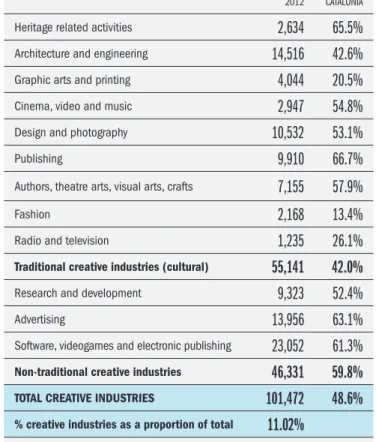
Creative activities account for more than 100,000 jobs and more than 7,300 companies in Barcelona in 2012, which represents 11% of the workers and 10.5% of the companies in the city. Barcelona is home to 46% of the creative companies and 51.5% of jobs in creative industries across Catalonia. It is worth mentioning that, according to the latest urban research, a higher percentage of workers in creative industries correlates strongly with greater productivity per inhabitant.
scientiFic excellence in the Fields oF physics and astronomy
1 institute of photonic sciences
2 Institute for Advanced Study
3 catalan institute for research and advanced studies
4 Rice University
5 Perimeter Institute for Theoretical Physics
6 University of Pennsylvania
7 Stanford University
8 Partners HealthCare System
9 Harvard University
10 University of California, Santa Barbara
11 Columbia University
12 Massachusetts Institute of Technology
13 Princeton University
14 Tufts University
15 University of Chicago
16 University of California, Santa Cruz
17 Carnegie Institution for Science
18 institute of high energy physics
SOURCE: Mapping Scientific Excellence. Max Planck Society
international Benchmark science and technology Facilities in Barcelona
Barcelona Supercomputing Centre - (BSC-CNS)
Mouse Clinic Platform
Proteomic Structural Biology Installation
International Center for Numerical Methods in Engineering (CIMNE)
Maritime Research and Experimentation Wave Flume (CIEM)
Catalan Supercomputer Centre (CESCA)
Barcelona Nuclear Magnetic Resonance Laboratory (LRB)
Clean room of the Barcelona Microelectronics Institute (IMB-CNM)
Synchrotron ALBA - Cells
SOURCE: Ministry of Economy and Competitiveness, Map of outstanding science and technology facilities
eVolution oF expenditure in r & d as a percentage oF gdp in catalonia and spain*
1.60 1.40 1.20 1.00 0.80 0.60
1996 1997 1998 1999 2000 2001 2002 2003 2004 2005 2006 2007 2008 2009* 2010* 2011* esPanya catalunya
*Spain figures for years 2009, 2010 and 2011, base year 2008 NOTE: GDP base year 2002
From 2001 includes continual and occasional R & D SOURCE: National Statistics Institute
0.90
1.06 1.031,06 0,92 1.19 1,04 1.33 1.27 1.35 1.42 1.48 1.62 1.70 1.65 1.55
0.83 0.82 0.89 0.88
0.91 0.950.99 1.05 1.06 1.12 1.20 1.27 1.35 1.39 1.39 1.33
3
Catalan institutions in the
world ranking for scientific
excellence
Physics and Astronomy category
1st place
Innovation
innoVation indicators
Patent aPPlications utility model aPPlications
2012 % of sPain total 2012 % of sPain total
Barcelona*
487
14.5
472
18,8
Catalonia
584
17.4
569
22,6
Spain
3,361
100.0
2,517
100.0
*Provincial data NOTE: Provisional data
SOURCE: Spanish Patent and Trademark Office
companies and innoVation
number of innovative
comPanies total eXPenditure on innovative activities
2011 % of sPain total (€000s) 2011 % of sPain total
catalonia
4,543
22.2
3,407,529
23.1
Spain
20,487
100.0
14,755,807
100.0
SOURCE: National Statistics Institute
Creative industries
JoBs in creatiVe industries* in Barcelona, 2012
2012 catalonia% of
Heritage related activities
2,634
65.5%
Architecture and engineering
14,516
42.6%
Graphic arts and printing
4,044
20.5%
Cinema, video and music
2,947
54.8%
Design and photography
10,532
53.1%
Publishing
9,910
66.7%
Authors, theatre arts, visual arts, crafts
7,155
57.9%
Fashion
2,168
13.4%
Radio and television
1,235
26.1%
traditional creative industries (cultural)
55,141
42.0%
Research and development
9,323
52.4%
Advertising
13,956
63.1%
Software, videogames and electronic publishing
23,052
61.3%
non-traditional creative industries
46,331
59.8%
total creatiVe industries
101,472
48.6%
% creative industries as a proportion of total
11.02%
*Including salaried workers and self-employed according to Social Security data SOURCE: Barcelona Institute of Regional and Metropolitan Studies (IERMB)
100,000
+
workers in creative industries
Companies
company headquarters, 2013
number of comPanies % of sPanish total
Barcelona
169,777
5.4
Province of Barcelona
438,385
13.9
Catalonia
580,804
18.5
Spain
3,146,570
100.0
SOURCE: National Statistics Institute, Central Business Register (DIRCE)
companies By numBer oF employees
barcelona Province of barcelona
Over 199 employees From 1 to 199 employees No employees
SOURCE: Central Business Register, National Statistics Institute
Entrepreneurial
and business
friendly city
Barcelona business activity is dynamic and
flexible
The Barcelona area is the headquarters for 438,385 companies, 14% of the Spanish total. The vast majority are SMEs, characterised by their great flexibility and ability to adapt to complex environments.
The rates of entrepreneurial activity (TEA) in the resident population (18 to 64 years) in the province of Barcelona, stands at 6.5% for 2012, which is above the rates for France (5.2%), Finland (6%) or Germany (5.3%), as well as the average for Spain (5.7%) and – along with Catalonia – that of the rest of the autonomous communities within the State.
In 2012 6,733 companies were set up in Barcelona, the highest number for four years and an increase of 4.9% over 2011. Across the province, Barcelona shows a ratio of 4.2 companies created per 1,000 inhabitants, and reaches a figure of 6.5 companies set up for every one that is closed down, thus leading the rankings in both indicators for large urban areas in the country.
The city aspires to generate an environment of trust that facilitates the development of economic and business activity through the Barcelona Growth project, promoted by Barcelona city council together with agents of the private sector. In this context can be highlighted the creation of an entrepreneurship area to promote the creation of companies in the sphere of the mobile ecosystem – for mobile
technologies – which receive financial help of €50,000 linked to the achievement of targets set out in the Barcelona mStartUp program.
0.2%
56.2%
43.6%
0.3%
41.0%
58.7%
15
%
of all businessesset up in Spain
438,385
Business Creation
entrepreneurial actiVity in european countries, 2012 (% of population 18 to 64 years)
Estonia
14.3
Lithuania
13.4
Netherlands
10.8
Slovakia
10.2
Poland
9.4
UK
9.2
catalonia
7.9
Portugal
7.7
eu average
7.6
Greece
6.5
Barcelona*
6.5
Sweden
6.4
Finland
6.0
Switzerland
5.9
spain
5.7
Denmark
5.4
Germany
5.3
Belgium
5.2
France
5.2
*Provincial data
SOURCE: Global Entrepreneurship Monitor (GEM), Catalonia Executive Report 2012
companies By knowledge intensity, 2012*
barcelona % of total catalonia % of total
High-technology
industrial sectors
156
0.2
666
0.3
Medium-high technology
industrial sectors
449
0.6
3,648
1.5
Knowledge intensive
services
19,398
27.7
51,125
21.4
total knowledge
intensiVe companies
20,003
28.6
55,439
23.2
Rest of companies
50,000
71.4
183,357
76.8
all companies in
the city
70,003
100.0
238,796
100.0
*Fourth quarter data
SOURCE: Ministry of Business and Labour of the Generalitat of Catalonia
commercial companies
2009 2010 2011 2012 % of sPanish total (2012)
created
City of Barcelona
6,223
6,094
6,416
6,733
7.7
Province of Barcelona
11,432 11,376 12,335 12,884
14.8
Catalonia
14,612 14,382 15,641 16,200
18.6
Spain
78,204 79,994 84,812 87,182
100.0
closed
Province of Barcelona
1,163
1,338
1,473
1,748
7.7
Catalonia
2,356
2,565
2,652
2,896
12.8
Spain
17,416 18,500 19,784 22,666
100.0
SOURCE: National Statistics Institute
The rate of
entrepreneurial
activity in Catalonia
(7.9%) is higher
than the European
Barcelona offers a competitive supply of
premises for economic activity
The joint Barcelona-Catalonia initiative from the Generalitat of Catalonia (Incasol), and Barcelona City Council promotes major zoning projects linked to strategic sectors of the knowledge economy that are growing in Barcelona and its surroundings, as well as the largest logistics offering along the Mediterranean corridor:
• Noteworthy in the city of Barcelona are the areas of the Smart City Campus - 22@, the Marina del Prat Vermell, and La Sagrera.
• Notable projects on the outskirts of Barcelona are Parc de l’Alba, Ripollet Park, Can Sant Joan, Mas Blau i Ca n’Alemany.
The cost of living in Barcelona has dropped in comparison with other cities of reference in Europe and worldwide, according to the survey carried out by Mercer Human Resource Consulting, which puts it in 85th position and – for
the third year running – outside of the 50 most expensive cities in the world, and the price of business premises is following the same trend.
Real estate market
oFFice premises, 2012
Total office stock
5,977,546 m
2Offices available
824,901 m
2Vacancy rate
13.80%
SOURCE: On point, Jones Lang LaSalle
oFFice prices, 2012
Outskirts (Sabadell, Sant Cugat, Esplugues, etc.)
New business areas
Business district (city centre)
Prime (Passeig de Gràcia-Diagonal)
6 8 10 12 14 16 18 20
SOURCE: On point, Jones Lang LaSalle
aVerage house prices in Barcelona, 2012
Rent (€/m2/month)
10.8
Second-hand housing sales (€/m2)
3,217
New housing sales (€/m2)
4,364
SOURCE: Barcelona City Council Statistics Department and idealista.com
€6.25/9m²/month
€8.75/15m²/month
€9.75/15.25m²/month
€13.75/18m²/month
The labour market in Barcelona has critical
mass and well-qualified workers
The city provides around 1 million jobs and the Barcelona area 2.2 million. The rates of activity (78%) and employment (64.2%) in Barcelona are higher than the Spanish average.
More than half of the jobs in the city of Barcelona (53.1%) are in knowledge intensive activities, and the city is at the centre of this segment of the Catalan economy, as 44.1% of knowledge intensive jobs are concentrated in Barcelona, which has 36.6% of all employees in Catalonia.
Barcelona today can count on a labour market with one of the highest critical masses in Europe in high added value sectors: Catalonia is the fifth region of Europe for the number of workers in medium and high technology manufacturing, the sixth for workers in science and technology, and ninth in the knowledge intensive service sectors, according to data from 2011.
Jobs in Barcelona
workers registered with the social security, 2012*
total % of sPain total
Barcelona
969,093
5.9
Province of Barcelona
2,182,623
13.4
Catalonia
2,875,276
17.6
Spain
16,332,488
100.0
*Fourth-quarter figures
SOURCE: Department of Business and Employment of the Generalitat of Catalunya and National Social Security Institute
% graduates*, 2011
women total
catalonia
42.7%
37.9%
Spain
43.4%
38.9%
European Union
34.7%
31.6%
*% of the employed population between 25 and 64 years with a university degree SOURCE: Eurostat
Magnet
for talent
2
.
9
million jobs in
Catalonia
Salaries
world city salary leVels, 2012
gross salary (new york = 100) city net salary (new york = 100)
131.1
Zürich132.4
123.6
Geneva119.2
123.1
Copenhaguen93.4
92.4
Tokyo90.4
83.3
Chicago80.6
91.5
Munich76.0
79.5
London75.2
78.1
Paris73.6
80.2
Vienna70.8
78.3
Amsterdam69.4
76.2
Montreal66.2
64.2
Lyon64.7
59.6
Barcelona58.7
42.8
Hong Kong49.8
55.1
Rome48.2
41.4
Athens40.0
SOURCE: UBS. Prices and Earnings around the Globe 2012
employees By knowledge intensity, 2012* (% of total)
Barcelona catalonia
High-technology industries Medium-high technology industries Knowledge intensive services Rest of employees
*Fourth-quarter figures
SOURCE: Department of Business and Employment of the Generalitat of Catalonia
Activity, employment and
unemployment
rates* oF actiVity, employment and unemployment, Fourth quarter 2013 (%)
activity
rate emPloyment rate unemPloyment rate
Barcelona
78.0
64.2
17.7
Catalonia
78.5
60.9
22.3
Spain
75.1
55.4
26.1
European Union**
72.2
64.5
10.6
*Specific rates (16-64 years) **EU data for the third quarter of 2013 SOURCE: Labour Force Survey and Eurostat
1%
3%
1%
5%
38%
56%
49%
47%
World renowned higher education
Catalonia has 12 universities with a total of 242.000 students, and the eight universities in Barcelona – both public and private – account for 90% of this enrolment. There are 445 official Masters courses with 17,474 students enrolled, and 13,269 students studying for doctorates, in the year 2011 - 2012.
In 2011 the percentage of Catalan workers with university degrees rose to 37.9% (total population) and 42.7% (women), a level far above the European Union average.
In the field of training, it’s worth pointing out that Barcelona is the only city with two teaching institutions among the top ten business schools in Europe, with ESADE and IESE sitting in eighth and third place in Europe and seventh and twenty-second in the world respectively, in the Global MBA 2013 ranking published by the Financial Times.
training and uniVersities, 2011-2012
Total university students in Catalonia*
241,835
Total university students in the Barcelona area*
219,058
Number of Masters offered by the universities in the
Barcelona area
445
Number of masters and doctoral students at
universities in the Barcelona area
30,743
Foreign students in Catalan public universities
15,756
Foreign masters and doctorate students at Catalan
public universities
9,061
*Includes Masters and doctorate students
SOURCE: Barcelona City Council Statistics Department
Best european Business schools, 2013
euroPean
ranking world ranking business school city
1 4 London Business School London
2 6 Insead Fontainebleau
3 7 iese Business school Barcelona
4 11 IE Business School Madrid
5 16 University of Cambridge: Judge Cambridge
6 19 IMD Lausanne
7 21 HEC Paris Paris
8 22 esade Business school Barcelona
9 24 University of Oxford: Saïd Oxford
10 28 Warwick Business School Coventry
11 29 Manchester Business School Manchester
12 33 Rotterdam School of Management, Erasmus University Rotterdam
13 38 Cranfield School of Management Cranfield
14 39 SDA Bocconi Milan
15 40 City University: Cass London
16 42 Imperial College Business School London
17 57 Hult International Business School UK/USA/UAE/China
18 61 The Lisbon MBA Lisbon
19 64 University College Dublin: Smurfit Dublin
20 64 Tilburg University, TiasNimbas Tilburg
SOURCE: Financial Times, Global MBA Ranking
Internationalised
economy
Barcelona has an open economy well
connected to the world.
Exports from the province of Barcelona reached a volume of €45.44 billion in 2012, representing the highest figure since records began, and an annual increase of 6.4%, almost double the average of Spain (3.4%). Exports have registered three consecutive years of growth and accumulated a nominal increase of 38.6% in the three years 2010-12.
In 2012 the Barcelona area consolidated its leadership of Spanish export rankings, generating a fifth (20.1%) of total exterior trade. Moreover 40,843 exporting companies are located in Barcelona, a figure which represents 30% of the Spanish total.
Its appeal to foreign investment is confirmed in various prestigious rankings: the Ernst & Young Attractiveness Survey Europe 2013 places urban Barcelona/Catalonia in third position for foreign investment projects brought to Europe in 2012, trailing only the areas of London and Paris and ahead of Madrid, Stuttgart, Dublin, and Lyon. Furthermore, according to the Global Cities Investment Monitor from KPMG, in 2012 Barcelona took the 12th
position among the main urban areas of the world in terms of the receipt of foreign investment projects, which is an advance of three positions over 2011 and the 10th position
worldwide in the period 2008 to 2012.
Catalonia is host to around 5,000 foreign companies, the main countries of origin being Germany (15.8%), France (14.4%) and the Netherlands (13.2%). Moreover, Catalonia has the largest concentration of Japanese companies (85.9%), Italian (67.1%), American (63%), French (61.9%), Austria (56.4%) and Swiss (50.1%) companies with operations in Spain.
Exports
exports (€m)
2011 2012* % of sPain total 2012
Barcelona*
42,321.8
45,444.3
20.1
Catalonia
54,954.9
58,853.2
26.0
Spain
215,230.4
222,114.6
100.0
*Provisional data
SOURCE: Ministry of Economy and Competitiveness
eVolution oF exports From the proVince oF Barcelona, 1995 - 2012 (€m)
50,000
45,000
40,000
35,000
30,000
25,000
20,000
15,000
10,000
1995 1996 1997 1998 1999 2000 2001 2002 2003 2004 2005 2006 2007 2008 2009 2010 2011 2012
SOURCE: Ministry of Economy and Competitiveness
45
,
400
million
Record exports
in the Barcelona area
exports From Barcelona By technology leVel, 2012
High-level technology
Medium-high level technology
Medium-low level technology
Low-level technology
Unclassified
SOURCE: Ministry of Economy and Competitiveness
exports From spain By technology leVel, 2012
High-level technology
Medium-high level technology
Medium-low level technology
Low-level technology
Unclassified
SOURCE: Ministry of Economy and Competitiveness
main destination countries For exports From Barcelona (proVince), 2012 (percentage of total)
France
15.8%
germany
11.3%
Italy
7.0%
Switzerland
6.2%
Portugal
5.6%
UK
5.0%
10.0%
48.5%
13.7%
16.0%
11.8%
7.7%
37.1%
17.4%
13.4%
24.4%
1
st
Urban area in Spanish export ranking
40,843
exporting
companies
30
%
of Spain total
Foreign investment in
Catalonia
Foreign inVestment (€m)
2010 2011 2012 esPanya% cat./
Catalonia
4,825.8
3,024.6
2,650.4
18.4
Spain
12,227.5
24,678.8
14,383.3
100.0
NOTE: Total gross investment excepting foreign securities holding companies SOURCE: Datainvex. Ministry of Economy and Competitiveness
Foreign inVestment in catalonia By country oF origin, 2012 (percentage of total)
luxembourg
29,0%
uk
18,7%
Ireland
11,9%
Netherlands
8,0%
Germany
6,1%
France
4,1%
Uruguay
2,6%
USA
2,5%
Switzerland
2,2%
India
1,6%
NOTE: Total gross investment excepting foreign securities holding companies SOURCE: Datainvex. Ministry of Economy and Competitiveness
exports of high and medium-high technology content
Catalan investment abroad
inVestment aBroad (€m)
2010 2011 2012 esPanya% cat/
Catalonia
2,070.5
2,706.0
1,338.6
11.6
Spain
29,170.1
29,791.4
11,545.3
100.0
NOTE: Total gross investment excepting Foreign Securities Holding Companies (ETVE) SOURCE: Datainvex. Ministry of Economy and Competitiveness
destination oF catalan inVestment aBroad, 2012 (percentage of total)
France
28.8%
Italy
14.3%
Germany
11.3%
Brazil
6.4%
Costa Rica
6.2%
Austria
5.0%
Netherlands
3.6%
China
3.3%
Luxembourg
2.8%
Colombia
2.5%
NOTE: Total gross investment excepting Foreign Securities Holding Companies (ETVE) SOURCE: Datainvex. Ministry of Economy and Competitiveness
Fdi in europe By urBan area, 2012
ranking urban area ProJects
2012 2012/2011change
1 Greater London (London)
313
-4.3%
2 Ile-de-France (Paris)
174
-14.7%
3 catalonia (Barcelona)
116
16.0%
4 Madrid (Madrid)
93
-1.1%
5 Düsseldorf (Düsseldorf)
84
0.0%
6 Stuttgart
81
52.8%
7 Dublin (Dublin)
72
20.0%
8 Freiburg
71
39.2%
9 Rhône-Alpes (Lyon)
70
6.1%
10 North Holland (Amsterdam)
68
38.8%
Other
2,655
-5.6%
total
3,797
-2.8%
SOURCE: Ernst & Young. European Investment Monitor 2013
Foreign direct inVestment in western europe By regions, first half 2013 (€m)
South East
3,372
catalonia
1,438
Ireland
941
South West
694
West Netherlands
664
West Midlands
644
Switzerland
523
C.A. Madrid
522
North West
441
SOURCE: Financial Times / Generalitat of Catalonia
3rd
European area in foreign
Strategic
sectors
The city actively promotes the development of sectors consider strategic for its economy such as the ICT, logistics and agri-food, the powerful retail and tourism sectors, along with new sectors such as the biomedical and electric vehicles in the field of mobility and
sustainable energy.
Logistics and transport are a key sector in Catalonia, as they represent 4% of economic activity, have the largest supply of logistics terrain available in Spain (24% of the total) and managed a total of 352 million tonnes of merchandise in 2012. Barcelona and Catalonia have significant competitive advantages in this area, such as their geostrategic position, the existence of an important production network -- with over 46,000 and 144,000 jobs, respectively -- or the availability of renewed infrastructure – such as port and airport of Barcelona -- and logistics areas. The Barcelona-Catalonia Logistics Centre (BCL), an initiative of the City Council, the Consortium of Barcelona and the Port of Barcelona, which currently has over one hundred members in the sector – is developing a strategy aimed at making the Barcelona metropolitan area the main logistics hub in southern Europe and the Mediterranean.
Barcelona and Catalonia boast one of the benchmark European agri-food clusters, and the largest one in Spain. This cluster is founded on the strength of the food industry - which with nearly 3,000 companies is the main branch of industry in Catalonia by turnover - and other major players such as Mercabarna, leader in the distribution of fresh produce in southern Europe, and a large number of facilities, universities and technology centres that support research and innovation. Other key activities in this field in Catalonia , are the biannual hosting of Alimentaria – the sector’s second most important fair in the world – and the valuable intangible heritage represented by the Mediterranean diet, which
Catalonia, with more than 1,100 companies 30,000 workers and €15.6 billion turnover in 2010 is the engine of medical technology research and “bio” in the country: Catalan biotechnology companies make up 20.5% of the Spanish total, generate 29.4% of turnover in the sector and is home to 23% of the new companies set up in this field during that year.
Strategic sectors in the
Barcelona economy
strategic sectors in the Barcelona
economy, fourth quarter 2012 (percentage of total)
ICT1
Logistics sector2
Agri-food3
Commerce4
Hotels
workers* comPanies**
*Registered with Social Security (general and self-employed) **Social Security centres 1 Manufacturers and services including wholesale ICT
2 Including all the group of transport and warehousing 3 Food industry and wholesale agri-food
4 Except wholesale agri-food and TIC
SOURCE: Barcelona City Council Statistics Department using data from the National Social Security Institute
3.1%
4.9%
1.5%
14.4%
7.5%
10.1%
21.7%
1.7%
2.6%
3.6%
Main sectors:
Barcelona is an international leader in the field
of tourism and the organisation of fairs and
congresses
Barcelona reached new historical highs of tourists (7.4 million) and overnight stays (15.93 million) in hotels and credit card expenditure (€2.38 billion) in 2012, thanks to the momentum of international demand. Compared to 2011, there was a notably sharp rise in credit card spending by foreign tourists in the shops (+25.4%), while there was a lower increase in overnight stays (+2.6%) and the number of tourists (+0.7%).
Various rankings highlight the attractiveness of Barcelona for foreign visitors: according to the MasterCard Index of Global Destination Cities 2013, Barcelona is the tenth placed city in the world and third in Europe – behind only London and Paris – with regard to the number of visitors and foreign tourism spending. Also, the European Cities Marketing Benchmarking Report 2012-2013 puts Barcelona in fourth place in Europe in terms of international overnight stays, while for trip advisor it is the world’s fifth most attractive city for tourists. Finally, according to the Euromonitor International Report for 2011, Barcelona is the twentieth most visited city by international tourists out of 100 cities of the world, and the fifth most visited of European cities.
As for business tourism, according to the International Congress and Convention Association (ICCA), Barcelona was the first city in the world in number of delegates and the third in the number of international meetings organized in the period 2008-2012. In 2012 Barcelona reached fifth position in the ranking for international congresses, after Vienna, Paris, Berlin and Madrid.
Tourism
Urban tourism destination
tourism and oVernight stays in Barcelona
2011 2012 2011-2012change
Tourists*
7,390,777
7,440,113
0.7%
Overnight stays
15,529,218
15,931,932
2.6%
Credit card spending (€)
1,901,562,192 2,384,477,371
25.4%
*Tourist staying in hotels SOURCE: Barcelona Tourism
hotel indicators
2011 2012 2011-2012change
Hotels
339
352
3.8%
Rooms
32,447
33,362
2.8%
Beds
63,528
65,100
2.5%
SOURCE: Barcelona Tourism
15
.
9
million overnight stays
4
th
European city in overnight stays by foreign
visitors
7
.
4
tourist numBers By purpose For Visit, 2012
Vacation
Business
Others
SOURCE: Barcelona Tourism
international credit card spending By country (€)
2012 % of total 2011-2012change
France
422,916,708
17.7
22.8
Italy
293,688,435
12.3
49.4
United States
195,651,403
8.2
14.8
United Kingdom
160,787,506
6.7
26.3
Russia
146,687,038
6.2
55.7
total
(all nationalities)
2,384,477,371
100.0
25.4
SOURCE: Barcelona Tourism
origin oF tourists, 2012
% tourists in hotels
Spain
21.8% 1,621,661
USA
8.5%
635,386
UK
8.0%
592,713
France
7.7%
572,259
Rest of America
7.4%
547,836
Italy
6.6%
491,103
Germany
5.6%
414,539
Scandinavia
4.8%
360,658
Eastern Europe*
3.5%
262,858
Netherlands
3.0%
224,295
Japan
2.2%
162,887
total Foreign tourists
78.2% 5,818,452
total tourists in hotels
7,440,113
*Eastern Europe: Czech Republic, Russia and Poland SOURCE: Barcelona Tourism
50.4%
41.0%
8.6%
2
,
384
million € of creditcard spending
78
%
of international tourismTO
City of Fairs and Conferences
conFerence indicators
2012
TOTAL meetings
2,176
TOTAL delegates
597,610
SOURCE: Barcelona Tourism and Barcelona City Council Statistics Department
numBer oF international meetings in world cities, 2008-2012
Paris
897
Vienna
875
Barcelona
822
Berlin
772
Singapore
721
SOURCE: ICCA, A Modern History of International Association Meetings 1963-2012
numBer oF delegates attending international meetings in world cities, 2008-2012*
Barcelona
519,159
Vienna
516,581
Berlin
470,076
Paris
448,881
Amsterdam
396,072
*Estimate based on the participants who figure in the registry of the ICCA SOURCE: ICCA, A Modern History of International Association Meetings 1963-2012
leading european exhiBitions held at Fira de Barcelona
fira de barcelona
GSMA WORLD CONGRESS
ALIMENTARIA
HISPACK + BTA Food Technology
EIBTM
CARBON EXPO
PISCINA BCN. International Swimming Pool Fair
HOSTELCO
CONSTRUMAT
3E / EXPOQUIMIA + EQUIPLAST + EUROSURFAS
BARCELONA BRIDAL WEEK - NOVIAESPAÑA
GRAPHISPAG
INTERNATIONAL CAR SHOW
BARCELONA INTERNATIONAL BOAT SHOW
SMART CITY EXPO WORLD CONGRESS
SOURCE: Fira de Barcelona
1
st
city of the world
in number of
international
meeting delegates
The city promotes a quality, diverse and local
retail model
With 16,022 companies and 142,629 workers, retail is one of the most important branches of the economic structure of Barcelona. Indeed, despite the impact of the crisis on their levels of activity and employment, the sector accounts for 22.9% of businesses and 14.2% of employees in the city at the end of 2012.
Local markets, with an area of over 200,000 m2 and €1
billion in economic impact, are at the forefront of Barcelona’s business model for their economic and social importance to the neighbourhoods and because they also represent the largest network of food markets in Europe.
International rankings of commercial appeal according to the preferences of international distribution companies (published in 2012 by Jones Lang Lasalle) and on the most valued destinations by international consumers (according to the Globe Shoppers Cities Index 2011 from The Economist Intelligence Unit) both place Barcelona in the top ten most attractive European cities from the retail point of view.
Retail
Barcelona retail
retail 2012*
number of companies
16,022
Jobs
142,629
local markets (december 2012)
Food
39
Specials
4
Number of establishments
2,709
Total surface
209,500 m
2Turnover1
27,853 €
*Fourth quarter data
1 Average sales per month per establishment
SOURCE: Barcelona City Council Statistics Department and Local Markets Institute
the 10 most attractiVe european destinations For inter-national retail companies, 2012
Position city
1 London
2 Paris
3 Moscow
4 Milan
5 Madrid
6 Rome
7 Munich
8 St Petersburg
9 Prague
10 Barcelona
2
nd
ICT
Barcelona ict companies By suBsectors (%)
Manufacturers ICT
Retail and wholesale of equipment for ICT
Computer program publishing
Telecommunications Information technology services
Data processing, hosting and related activities; Internet sites
Computer and communi- cation equipment repairs
*Social Security centres
SOURCE: IERMB based on Social Security data
ict in the home
(% of population between 16 and 74)
2010 2011 2012
Have a computer at home
75.7
79.0
78.7
Internet connection at home
72.4
75.7
75.0
Regular use of the Internet
78.3
82.1
82.8
SOURCE: Household survey of ICT equipment and usage. National Statistics Institute
Ambitious
city projects
Nurturing mobile technology and ICT
Barcelona aims to be a leader in the field of technology to enhance the quality of life, in a global environment in which mobile technology is emerging as a key vector of growth for the whole economy. In this context, the choice of Barcelona as Mobile World Capital – with the Mobile World Congress and the proposed industrial legacy (Legacy) – represents a strategic opportunity to position the city in this area.
Barcelona, with more than 28,500 workers and nearly 2,000 companies with employees, is the centre of ICT in Catalonia, as it accounts for 54.3% of workers and 43.5% of companies with employees in the sector in Catalonia. In 2010 the ICT sector, along with transport, generated 12.2% of GVA and kept its share of total activity compared to 2008 intact.
In 2011 the Catalonia mobile ecosystem has more than 2,300 companies, more than 39,400 employees and generates a turnover of €5.4 billion, the province of Barcelona being the core which absorbs 85%, 90% and 94%, respectively, of these totals.
During the period 2005-2011 almost three hundred European technology patents were applied for in Catalonia, of which 95% are located in the province of Barcelona.
3%
5.7%
5.4%
62.1%
2.1%
12.5%
Mobile ecosystem
key Figures oF the moBile eco-system in catalonia and Barcelona, 2011
number of
comPanies number of workers turnover (€m)
in absolute terms
Barcelona city
1,058
20,628
3,235.8
Barcelona province
1,997
35,438
5,077.0
Catalonia
2,342
39,408
5,399.1
% in relation to next biggest territory
Bcn city / Bcn province
53%
58%
64%
Bcn province / Catalonia
85%
90%
94%
NotE: NACE sectors included in table, according to the main activity informed to SABI: 6120 and the whole auxiliary ecosystem: 2611, 2612, 2630, 2651, 5821, 5829, 6201, 6202, 6190, 6311, 6312, 6399
SOURCE: Barcelona Chamber of Commerce section of Infrastructure and Economic Studies, “The mobile ecosystem in Barcelona and Catalonia”, BARCELONA OBSERVA-TORY, Report 2013
moBile ecosystem structure in catalonia, 2011
% of turnover in each subsector over the mobile ecosystem total
Production of measuring testing and navigation instruments and devices
Production of electronic components
Other telecommunication activities
Wireless telecommuni- cations
Computer programming activity
Information technology consulting
Data processing, hosting and related activities
Internet portals
Other information services Rest of related sectors
SOURCE: Barcelona Chamber of Commerce section of Infrastructure and Economic Studies, “The mobile ecosystem in Barcelona and Catalonia”, BARCELONA OBSERVA-TORY, Report 2013
12%
1%
4%
4%
8%
9%
14%
33%
11%
4%
Barcelona
Mobile
World Capital
Mobile World Congress
Mobile World Centre Mobile
World Events
Barcelona, fourth Smart city in Europe
Moreover, the clear commitment of Barcelona to become a smart city centres around applying ICT (Information and Communication Technologies) for urban innovation and ensuring sustainable development, an improved quality of life for citizens, greater efficiency of resources – both human and energy – and better citizen participation.
In addition, the city is leading the creation of a city protocol or world standard to measure the degree of sustainability and the capacity of urban areas to generate a good quality of life. The protocol involves a partnership between universities, cities and businesses to define the parameters of change in the city on the basis of environmental, cultural, social and economic values, guided by efficiency in consumption of resources and excellence in design.
According to a ranking conducted by Fast Company in 2013, Barcelona is Europe’s fourth-placed intelligent city, noted both for its initiatives such as its support for the global Smart Cities movement through the organization of the main international fair, as well as its leadership in setting up the City Protocol. Significant projects in the city include the promotion of electric vehicles, the public system of bicycle usage, the use of sensors to monitor noise levels, air quality, traffic congestion and waste management, as well as the success of 22@ and the fact that life expectancy in the city is among the highest in the world.
Furthermore, the Catalan capital occupies the seventh position in the Top 10 cities of the world where conditions for developing electric mobility initiatives are more favourable, and where this technology is being introduced and consolidated, according to the latest updated report of the International Energy Agency (EV City Casebook, 2012). This has been possible thanks to initiatives such as the public-private platform LIVE (Logistics for the Implementation of the Electric Vehicle) and the MOVELE plan. In addition, in 2013 the city hosted the electric mobility sector’s most important international symposium on technology: the World Electric Vehicle Symposium and Exhibition, EVS27.
Smart City
top 10 smart cities in europe, 2013
Position city
1 Copenhaguen
2 Amsterdam
3 Vienna
4 Barcelona
5 Paris
6 Stockholm
7 London
8 Hamburg
9 Berlin
10 Helsinki
SOURCE: Fast Company, Coexist. The Smartest Cities in Europe
Basic indicators For electric Vehicles, 2012
Fleets and testing facilities
Public fleets
294
Private
335
TOTAL
629
infrastructure
Public charging points
249
Reported incidents
310
Cards distributed
395
Number of charges (> 10 min)
5,083
Energy consumed
7,025
industrial transformation
Companies/Projects
124
SOURCE: Strategic Sectors dept, Area of Economy, Enterprise and Employment, Barce-lona City Council
4
th
smart city
in Europe
7
th
city in the world in electric
Catalan public health system and a range of internationally renowned private centres, which positions it as a world destination for medical tourism, as well as the hosting of medical conferences. To these appealing elements already in place, add the development of important projects in the field of research that have their main focus in the health sector.
quality-oF-liFe in world cities, 2012
Position city indeX*
1 Tokyo
0.931
2 Stockholm
0.925
2 Paris
0.925
4 Oslo
0.914
5 Barcelona
0.912
6 Toronto
0.907
7 Helsinki
0.905
8 Seoul
0.903
9 London
0.898
10 Milan
0.895
*The index takes values between 0 and 1
SOURCE: STATE oF WoRlD’S CITIES 2012-2013. UN-HABITAT
Best
quality of life
in Europe
Barcelona is internationally recognised as a
city with quality of life
The report State of World’s Cities 2012-2013, prepared by the United Nations Habitat agency, grants Barcelona fifth position in respect of quality of life among 69 cities of the world, and seventeenth place in the Global Prosperity Index 2012.1 Additionally, Barcelona is the ninth city in overall
attractiveness and the fifth in social and cultural character – with five other cities --, according to the world city comparison «Hot Spots», carried out in 2012 by the Economist Intelligence Unit. Moreover, according to European Cities Monitor 2011, Barcelona is the European city with the best quality of life for workers for the 14th consecutive year.
In the environmental field, Barcelona’s compact Mediterranean city model favours sustainable mobility – which represents 82% of internal trips – and stands out in prestige rankings – such as Scorecard on Prosperity 2013 from the Toronto Board of Trade – for its relatively short commuting times. Furthermore, Barcelona keeps the sixth position among the best European cities for internal transport, according to the European Cities Monitor.
It’s worth pointing out, as well, that Barcelona is currently setting standards at a European level with regards to water conservation. Per capita water consumption in 2012 was 108.2 L, 24.7 L less than in 1999, having achieved a reduction of around 19%. Additionally, Barcelona is the headquarters of the Secretariat of the Global Water Operators Partnerships Alliance (GWOPA) of UN-Habitat, hosting the permanent secretariat of this worldwide body for water policy management for the next five years.
A wide ranging and quality educational and cultural offer. The Barcelona area has 36 international schools, and the city a network of 38 public libraries.