Suggested citation: EFSA ANS Panel (EFSA Panel on Food Additives and Nutrient Sources added to Food), 2015. Scientific Opinion on the re-evaluation of tocopherol-rich extract (E 306), α-tocopherol (E 307), γ-tocopherol (E 308) and δ-tocopherol (E 309) as food additives. EFSA Journal 2015;13(9):4247, 118 pp. doi:10.2903/j.efsa.2015.4247
Available online: www.efsa.europa.eu/efsajournal
SCIENTIFIC OPINION
Scientific Opinion on the re-evaluation of tocopherol-rich extract (E 306), α-tocopherol (E 307), γ-tocopherol (E 308) and δ-tocopherol (E 309) as food
additives
1EFSA Panel on Food additives and Nutrient Sources added to Food (ANS)2,3
European Food Safety Authority (EFSA), Parma, Italy ABSTRACT
The Panel on Food Additives and Nutrient Sources added to Food provides a scientific opinion re-evaluating the safety of tocopherol-rich extract of natural origin (E 306), synthetic α-tocopherol (all-rac-α-tocopherol; dl-α- tocopherol; E 307), synthetic γ-tocopherol (dl-γ-tocopherol; E 308) and synthetic δ-tocopherol (E 309). The European Union’s Scientific Committee on Food did not set an Acceptable Daily Intake (ADI), but derived a Tolerable Upper Intake Level (UL) for vitamin E of 300 mg/day for adults. The Joint FAO/WHO Expert Committee on Food Additives (JECFA) derived an ADI of 0.15–2 mg/kg body weight (bw)/day for dl-α- tocopherol. The acute oral toxicity of tocopherols is low. In both a 13-week and a chronic (16-month) oral toxicity study, the No Observed Adverse Effect Level (NOAEL) was 125 mg/kg bw/day. The critical adverse effect is prolonged coagulation time. There is no concern that tocopherols are genotoxic or carcinogenic. There are insufficient data to address the reproduction and developmental toxicity. The Panel concluded that the available data are too limited to establish an ADI for the tocopherols. However, taking into account that vitamin E is widely consumed via human food, it is an essential nutrient and that the ULs are not exceeded in any population group, except in children in one survey from only one country, α-tocopherol, for the reported uses and use levels as a food additive, is not considered to be of safety concern. The Panel considered that the dataset on tocopherol-rich extract, and γ- and δ-tocopherol was too limited to be included in the safety assessment of tocopherols. Moreover, the Panel is aware that much lower concentration levels and fewer uses for γ- and δ- tocopherol are reported in food than for α-tocopherol. Therefore, the Panel concluded that tocopherols (E 306–
E 309) are not of safety concern at the levels used in food.
© European Food Safety Authority, 2015 KEY WORDS
1 On request from the European Commission, Question No EFSA-Q-2011-00475-00478, adopted on 9 September 2015.
2 Panel members: Fernando Aguilar, Riccardo Crebelli, Alessandro Di Domenico, Birgit Dusemund, Maria Jose Frutos, Pierre Galtier, David Gott, Ursula Gundert-Remy, Claude Lambré, Jean-Charles Leblanc, Oliver Lindtner, Peter Moldeus, Alicja Mortensen, Pasquale Mosesso, Agneta Oskarsson, Dominique Parent-Massin, Ivan Stankovic, Ine Waalkens- Berendsen, Rudolf Antonius Woutersen, Matthew Wright and Younes Maged. Correspondence: [email protected]
3 Acknowledgement: The Panel wishes to thank the members of the former Working Group ‘B’ Food Additives and Nutrient Sources (2011–2014) and the members of the Standing Working Group on the re-evaluation of food colours: Fernando Aguilar, Riccardo Crebelli, Alessandro Di Domenico, Maria Jose Frutos, Pierre Galtier, David Gott, Claude Lambré, Jean- Charles Leblanc, Agneta Oskarsson, Jeanne Stadler, Paul Tobback, Ine Waalkens-Berendsen and Rudolf Antonius Woutersen, for the preparatory work on this scientific opinion and EFSA staff members Petra Gergelova, Ana Maria Rincon and Stavroula Tasiopoulou for the support provided to this scientific opinion. The ANS Panel wishes to acknowledge all European competent institutions, Member State bodies and other organisations that provided data for this scientific output.
tocopherol-rich extract (E 306), α-tocopherol (E 307), γ-tocopherol (E 308), δ-tocopherol (E 309), food antioxidant, vitamin E
SUMMARY 1
Following a request from the European Commission to the European Food Safety Authority (EFSA), 2
the Scientific Panel on Food Additives and Nutrient Sources added to Food (ANS Panel) was asked to 3
provide a scientific opinion re-evaluating the safety of tocopherol-rich extract of natural origin 4
(E 306), synthetic α-tocopherol (all-rac-α-tocopherol; dl-α-tocopherol; E 307), synthetic γ-tocopherol 5
(dl-γ-tocopherol; E 308) and synthetic δ-tocopherol (E 309), which are used as antioxidants in foods to 6
inhibit the peroxidation of fats and lipids. 7
The Panel was not provided with a newly submitted dossier and based its evaluation on previous 8
evaluations, additional literature that has become available since then and data provided following a 9
public call for data. The Panel noted that not all of the original studies on which the previous 10
evaluations were based were available for re-evaluation by the Panel. 11
Tocopherols belong to the group of substances named vitamin E. Vitamin E is the collective term for a 12
family of structurally related substances, namely tocopherol- and tocotrienol-derivatives, that exhibit, 13
qualitatively, the biological activity of the naturally occurring d-α-tocopherol. Vitamin E is an 14
essential vitamin and is naturally present in plant-derived foods, particularly fruit and vegetables. 15
All tocopherols evaluated in this opinion are used as antioxidants in food, either individually or in 16
combination, and are authorised under Annex II of Regulation (EC) No 1333/2008 on food additives. 17
The Scientific Committee on Food (SCF) has not set an Acceptable Daily Intake (ADI) for 18
tocopherols, but considered the use of tocopherols as antioxidants in food acceptable. The SCF, in its 19
evaluation of vitamins and minerals, established a Tolerable Upper Intake Level (UL) of 300 mg/day 20
for vitamin E (SCF, 2003). Effects on blood clotting were used as the basis for deriving this UL of 21
300 mg/day for vitamin E. This UL also applies to pregnant and lactating women. The UL was scaled 22
for children in the age ranges 1–3, 4–6, 7–10, 11–14 and 15–17 years to give ULs of 100, 120, 160, 23
220 and 260 mg/day, respectively. 24
The current ADI for α-tocopherol, established by the Joint FAO/WHO Expert Committee on Food 25
Additives (JECFA), is 0.15–2 mg/kg body weight (bw)/day. The JECFA ADI is based on clinical 26
experience in humans and takes into account the fact that α-tocopherol is an essential nutrient. 27
Specifications for tocopherol-rich extract of natural origin (E 306) and synthetic α-tocopherol (E 307) 28
have been defined in Commission Regulation (EU) No 231/2012 and by JECFA. Specifications for 29
synthetic γ-tocopherol (E 308) and synthetic δ-tocopherol (E 309) have been defined in only 30
Commission Regulation (EU) No 231/2012. 31
Tocopherols are relatively stable in foods, but oxidation may occur when exposed to air, heat, acids, 32
alkalis or metal ions. During storage, when peroxyl radicals are formed in oils or in the presence of 33
unsaturated fatty acids, α-tocopherol reacts with these radicals, leading to the formation of 34
tocopheroxyl radicals that further react with other peroxyl radicals to form non-radical products 35
(Burton and Traber, 1990). The non-radical oxidation products of vitamin E have been identified as α- 36
tocopheryl quinone, epoxy-alpha-tocopherylquinones and 8a-(lipid-dioxy)-alpha-tocopherones 37
(Yamauchi et al., 2002). A decrease in tocopherol content occurs during food processing as a result of 38
oxidation or thermal degradation depending on the processing procedures, storage time, conditions and 39
type of food. In sunflower oil heated to 180 °C, α-tocopherol reacts partly to produce oxidation and 40
degradation products, such as α-tocopheryl quinone and α-tocopheryl fatty acids (Kreps et al., 2015). 41
Based on toxicokinetics data for α-, γ- and δ-tocopherol and tocopherol-rich extract, α-tocopherol is 42
the most biologically active and is, therefore, the form that is most often used in toxicity testing. For 43
the purpose of this opinion, it is assumed that α-tocopherol is representative of the other tocopherols as 44
a worst case, based on the fact that this form of vitamin E is the only form that the liver can re-secrete 45
into the plasma, hence maintaining plasma concentrations and prolonging time in the plasma before 46
elimination. In testing α-tocopherol, it is likely that the most conservative No Observed Adverse 47
Effect Level (NOAEL) is determined. Therefore, results from toxicity studies on α-tocopherol are 48
assumed to also apply to γ-tocopherol, δ-tocopherol and tocopherol-rich extract. 49
Absorption of the tocopherols varies with dose, and the efficiency of absorption decreases with 50
increasing intake. Absorption across the gastrointestinal tract occurs along with dietary lipids and is 51
dependent on biliary secretion of bile acids and salts, which aid the emulsification process, to form 52
micelles with the hydrolysed fat. The micelles containing the vitamin E are then absorbed by passive 53
diffusion at the brush border enterocytes of the small intestine. Once absorbed, the tocopherols enter 54
the blood and lymphatics in chylomicrons, and are transported to the tissues. The liver appears to 55
select α-tocopherol using α-tocopherol transport protein, whereas most ingested γ- and δ-tocopherol 56
are eliminated by the liver into the bile and excreted in the faeces. 57
The acute oral toxicity of α-tocopherol is very low, with LD50 values for α-tocopherol reported to be 58
greater than 2 000 mg/kg bw/day for rats. 59
The critical effects on haematology (blood clotting) and clinical chemistry (total cholesterol, total 60
lipids and phospholipids) are not expected to vary qualitatively among the various forms of 61
tocopherols, i.e. prolonged coagulation times are common to all tocopherols and are thought to be due 62
to reduced absorption of vitamin K from the gastrointestinal tract, as supplementation with vitamin K 63
prevents the effects of the tocopherols on blood clotting. The NOAEL for this critical effect observed 64
in a 13-week oral (gavage) toxicity study in rats was 125 mg/kg bw/day. 65
Studies in humans give conflicting results with respect to the potential of vitamin E to affect the 66
incidence of cardiovascular disease and subsequent mortality. It appears that, as was observed in 67
animal studies, the principal adverse effect of the tocopherols is on prothrombin times and factors 68
related to blood clotting, via an interaction with vitamin K or vitamin K-dependent proteins. However, 69
it does appear that in humans this effect is only observed at high doses, which are not relevant to the 70
use of tocopherols as food additives. Susceptible subgroups appear to be individuals with already 71
compromised blood clotting capacity, and those with low vitamin K status. Although not all studies 72
are consistent, it appears that while cardiovascular disease is not affected by vitamin E in healthy 73
individuals, it has the potential to reduce primary cardiovascular outcomes, such as stroke, in patients 74
with existing cardiovascular disease. 75
There is no evidence to suggest that α-tocopherol is genotoxic. Well-conducted genotoxicity studies 76
(three Ames tests, an in vitro chromosomal aberration test and an in vivo mutagenicity study), 77
available through the public call for data, were all negative. There are no in vitro mammalian cell gene 78
mutation studies. However, there are in vitro and in vivo studies that support the antioxidant properties 79
of vitamin E being protective against genetic damage. 80
In a chronic toxicity study in rats (duration of up to 16 months), a NOAEL of 125 mg/kg bw/day was 81
determined, based on reduced body weight and increased heart and spleen weight. 82
One limited carcinogenicity study has been performed in rats. A NOAEL for general systemic toxicity 83
of α-tocopherol could not be established in this study due to the effects on blood clotting and the liver. 84
The NOAEL for carcinogenicity was > 2 000 mg/kg bw/day, the highest dose tested. The Panel 85
concluded that there is no concern that α-tocopherol is carcinogenic. 86
There are insufficient studies to address the reproduction and developmental endpoints, as there are no 87
multigeneration studies conducted in accordance with appropriate test guidelines. 88
Reported use levels from industry give information on the amount of the food additive added to food. 89
The use of these data results in an estimate of the exposure to α-tocopherol (E 307) at the moment the 90
food was produced. Considering that tocopherols are degraded during processing and storage, the loss 91
of tocopherols in food is very likely to have an impact on the overall exposure estimates calculated 92
using the reported use levels. Therefore, the Panel calculated additional exposure estimates for the 93
additive itself, including potential loss factors, intended to more closely reflect the exposure to α- 94
tocopherol (E 307) via foods as consumed. 95
The total exposure to α-tocopherol from all food sources (food additives, enzyme preparations, 96
nutrient as vitamin and from natural sources) would reach up to 6.3 mg/kg bw/day in toddlers at the 97
high level (with the exception of children in one survey from one country, achieving up to 98
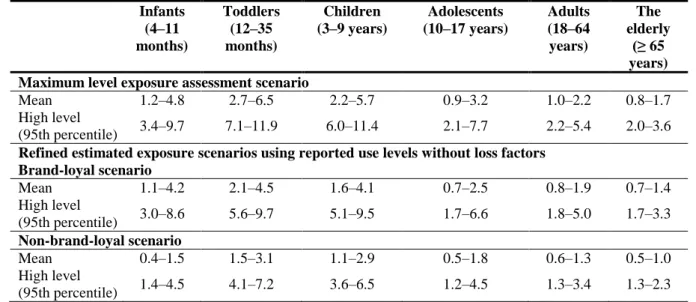
9.7 mg/kg bw/day). From the use of α-tocopherol (E 307) as a food additive itself, the exposure (non- 99
brand loyal scenario, considering loss factors) would range from 0.3 mg/kg bw/day in infants to 100
2.7 mg/kg bw/day in toddlers at the mean and from 0.9 mg/kg bw/day in adolescents to 5.9 mg/kg 101
bw/day in toddlers at the high level. 102
The Panel estimated that, when comparing all sources (i.e. from the additive itself, from natural 103
sources and from all food sources), the contribution of α-tocopherol (E 307) from its use as a food 104
additive may represent, on average, approximately 71 % (range 59–80 %) of the overall exposure to α- 105
tocopherol, and around a two- to five-fold higher intake than from natural sources, with the exception 106
of infants whose intake from the use of α-tocopherol (E 307) as a food additive is likely to be 0.9-fold 107
that of the intake from natural sources. 108
The Panel considered that the uncertainties identified would tend overestimate the actual exposure to 109
α-tocopherol (E 307) as a food additive, particularly for the maximum level scenario, and to 110
underestimate the actual exposure to α-tocopherol from all sources in European countries. 111
Taking into account that: 112
vitamin E is widely consumed via human food; 113
it is an essential nutrient; 114
there is no indication of genotoxic or carcinogenic potential; 115
animal and human studies available have not shown adverse effects, except effects on blood 116
clotting at high levels; 117
the exposure to α-tocopherol resulting from all food sources does not exceed the ULs for 118
vitamin E (SCF, 2003) in any population group, except in children in one survey from only 119
one country, 120
the Panel considered that α-tocopherol (E 307) at the reported uses and use levels as a food additive is 121
not of safety concern. 122
The Panel noted that the exceedance of the UL observed in children in one survey from one country 123
may be a result of different methodologies used among dietary surveys for reporting the amounts of 124
food supplements consumed. 125
The Panel considered that the database on γ- and δ-tocopherol was too limited to be included in the 126
safety assessment of tocopherols. However, the Panel is aware that much lower concentration levels 127
and fewer uses for γ- and δ-tocopherols are reported in food than for α-tocopherol. The Panel 128
considered that data on α-tocopherol can be read-across to the other tocopherols, based on the 129
similarities in the chemical structure, and the fact that α-tocopherol represents a worst case, as it is the 130
form which the body selectively retains. The Panel noted that it would be prudent to re-assess the 131
appropriateness of this read-across as new data on γ- and δ-tocopherols become available. Therefore, 132
the Panel considered that, overall, the use of tocopherols (E 306–E 309) as food additives would not 133
be of safety concern at the levels used in food. 134
The Panel noted that in Annex II of Regulation (EC) No 1333/2008, use levels of tocopherols (E 306– 135
E 309) in food for infants under the age of 12 weeks are included in categories 13.1.1, 13.1.5.1 and 136
13.1.5.2. The Panel considered that these uses would require a specific risk assessment in line with the 137
recommendations given by JECFA (1978) and the SCF (1998) and endorsed by the Panel. Therefore, 138
the current re-evaluation of tocopherols (E 306–E 309) as food additives is not considered to be 139
applicable to infants under the age of 12 weeks. The Panel concluded that the current re-evaluation of 140
tocopherols (E 306–E 309) as food additives is not applicable to infants under the age of 12 weeks. 141
The Panel recommended that the maximum limits for the impurities of toxic elements (arsenic, lead 142
and mercury) in the EC specifications for tocopherols should be revised in order to ensure that 143
tocopherols (E 306–E 309) as food additives will not be a significant source of exposure to these toxic 144
elements in food. 145
The Panel recommended re-assessing the appropriateness of the read-across from α-tocopherol to the 146
other tocopherols as new data on γ- and δ-tocopherols become available. 147
148
TABLE OF CONTENTS 149
Abstract ... 1 150
Background as provided by the European Commission ... 9 151
Terms of reference as provided by the European Commission ... 9 152
Interpretation of the Terms of Reference ... 9 153
Assessment ... 11 154
1. Introduction ... 11 155
2. Technical data ... 11 156
2.1. Identity of the substances ... 11 157
2.1.1. Tocopherol-rich extract (E 306) ... 13 158
2.1.2. α-Tocopherol (E 307) ... 13 159
2.1.3. γ-Tocopherol (E 308) ... 14 160
2.1.4. δ-Tocopherol (E 309) ... 14 161
2.2. Specifications ... 14 162
2.2.1. Tocopherol-rich extract (E 306), “Tocopherol concentrate, mixed (INS 307b)” and “d-α- 163
tocopherol, concentrate (INS 307a)” ... 14 164
2.2.2. α-Tocopherol (E 307) ... 16 165
2.2.3. γ-Tocopherol (E 308) ... 17 166
2.2.4. δ-Tocopherol (E 309) ... 18 167
2.3. Manufacturing process ... 19 168
2.4. Methods of analysis in food ... 19 169
2.5. Reaction and fate in food ... 20 170
2.6. Case of need and proposed uses ... 21 171
2.7. Reported use levels or data on analytical levels of tocopherols (E 306–E 309) ... 25 172
2.7.1. Summarised data on reported use levels in foods provided by industry... 25 173
2.7.2. Summarised data on concentration levels in foods submitted by Member States ... 26 174
2.8. Information on existing authorisations and evaluations... 27 175
2.9. Exposure assessment ... 29 176
2.9.1. Food consumption data used for exposure assessment ... 29 177
2.9.2. Exposure to α-tocopherol (E 307) ... 32 178
2.9.3. Exposure via other sources ... 35 179
2.9.4. Exposure to α-tocopherol from all food sources based on analytical data ... 36 180
2.9.5. Uncertainty analysis ... 38 181
3. Biological and toxicological data ... 39 182
3.1. Absorption, distribution, metabolism and excretion ... 39 183
3.1.1. Absorption ... 40 184
3.1.2. Distribution ... 40 185
3.1.3. Metabolism ... 43 186
3.1.4. Excretion ... 43 187
3.1.5. Summary of the absorption, distribution, metabolism and excretion data ... 44 188
3.2. Toxicological data ... 44 189
3.2.1. Acute toxicity ... 44 190
3.2.2. Short-term and subchronic toxicity ... 45 191
3.2.3. Genotoxicity ... 50 192
3.2.4. Chronic toxicity and carcinogenicity ... 52 193
3.2.5. Reproductive and developmental toxicity ... 53 194
3.2.6. Other studies ... 56 195
4. Discussion ... 60 196
Conclusions and recommendations ... 65 197
Documentation provided to EFSA ... 65 198
References ... 67 199
Appendices ... 76 200
Appendix A. Summary of reported use levels (mg/kg) of tocopherols (E 306–E 309) provided by 201
industry... 76 202
Appendix B. Summary of reported use levels (mg/kg) ofα-tocopherol (E 307) provided by industry, 203
expressed on a whole-weight basis, as considered for exposure assessment ... 88 204
Appendix C. Summary of analytical results (mg/kg) of tocopherols provided by Members States .. 93 205
Appendix D. Concentration levels of α-tocopherol (E 307) used in the maximum level and refined 206
exposure assessment scenarios (mg/kg bw/day) for exposure assessment of α- 207
tocopherol (E 307) used as a food additive. Scenario based on usage data reported by 208
industry. Data presented as used for exposure assessment ... 96 209
Appendix E. Concentration levels of α-tocopherol used in the refined exposure scenario (mg/kg 210
bw/day) for exposure assessment to α-tocopherol from all sources (food additive, 211
enzyme preparations, nutrient as vitamin and natural sources). Scenario based on 212
analytical data (or usage data when no analytical data were available). Data presented 213
as used for exposure assessment ... 101 214
Appendix F. Summary of total estimated exposure to α-tocopherol (E 307) from its use as a food 215
additive for refined exposure scenarios per population group and survey: mean and 216
high level (mg/kg bw/day) ... 105 217
Appendix G. Summary of total estimated exposure to α-tocopherol from all sources (food additive, 218
enzyme preparations, nutrient as vitamin and natural sources) per population group 219
and survey: mean and high level (mg/kg bw/day) ... 108 220
Appendix H. Main food categories contributing to exposure to α-tocopherol (E 307) based on 221
reported use levels ... 110 222
Appendix I. Main food categories contributing to exposure to α-tocopherol based on analytical 223
levels ... 115 224
Abbreviations ... 116 225
226
BACKGROUND AS PROVIDED BY THE EUROPEAN COMMISSION 227
Regulation (EC) No 1333/20084 of the European Parliament and of the Council on food additives 228
requires that food additives are subject to a safety evaluation by the European Food Safety Authority 229
(EFSA) before they are permitted for use in the European Union. In addition, it is foreseen that food 230
additives must be kept under continuous observation and must be re-evaluated by EFSA. 231
For this purpose, a programme for the re-evaluation of food additives that were already permitted in 232
the European Union before 20 January 2009 has been set up under the Regulation (EU) No 257/20105. 233
This Regulation also foresees that food additives are re-evaluated whenever necessary in light of 234
changing conditions of use and new scientific information. For efficiency and practical purposes, the 235
re-evaluation should, as far as possible, be conducted by group of food additives according to the main 236
functional class to which they belong. 237
The order of priorities for the re-evaluation of the currently approved food additives should be set on 238
the basis of the following criteria: the time since the last evaluation of a food additive by the Scientific 239
Committee on Food (SCF) or by EFSA, the availability of new scientific evidence, the extent of use of 240
a food additive in food and the human exposure to the food additive taking also into account the 241
outcome of the Report from the Commission on Dietary Food Additive Intake in the EU6 of 2001. The 242
report “Food additives in Europe 20007” submitted by the Nordic Council of Ministers to the 243
Commission, provides additional information for the prioritisation of additives for re-evaluation. As 244
colours were among the first additives to be evaluated, these food additives should be re-evaluated 245
with a highest priority. 246
In 2003, the Commission already requested EFSA to start a systematic re-evaluation of authorised 247
food additives. However, as a result of adoption of Regulation (EU) 257/2010, the 2003 Terms of 248
Reference are replaced by those below. 249
TERMS OF REFERENCE AS PROVIDED BY THE EUROPEAN COMMISSION 250
The Commission asks the European Food Safety Authority to re-evaluate the safety of food additives 251
already permitted in the Union before 2009 and to issue scientific opinions on these additives, taking 252
especially into account the priorities, procedures and deadlines that are enshrined in the Regulation 253
(EU) No 257/2010 of 25 March 2010 setting up a programme for the re-evaluation of approved food 254
additives in accordance with the Regulation (EC) No 1333/2008 of the European Parliament and of the 255
Council on food additives. 256
INTERPRETATION OF THE TERMS OF REFERENCE 257
The Panel on Food Additives and Nutrient Sources added to Food (ANS) described its risk assessment 258
paradigm in its Guidance for submission for food additive evaluations in 2012 (EFSA ANS Panel, 259
2012). This Guidance states, that in carrying out its risk assessments, the Panel sought to define a 260
health-based guidance value, e.g. an Acceptable Daily Intake (ADI) (IPCS, 2004) applicable to the 261
general population. According to the definition above, the ADI as established for the general 262
population does not apply to infants below 12 weeks of age (JECFA, 1978; SCF, 1998). In this 263
context, the re-evaluation of the use of food additives in food for infants below 12 weeks of age 264
represents a special case for which specific recommendations were given by the Joint FAO/WHO 265
4 Regulation (EC) No 1333/2008 of the European Parliament and of the Council of 16 December 2008 on food additives, OJ L 354, 31.12.2008, p. 16.
5 Commission Regulation (EU) No 257/2010 of 25 March 2010 setting up the programme for the re-evaluation of approved food additives in accordance with Regulation (EC) No 1333/2008 of the European Parliament and of the Council on food additives, OJ L 80, 26.03.2010, p. 19.
6 Report from the Commission on Dietary Food Additive Intake in the European Union, Brussels, 01.10.2001, COM (2001) 542 final.
7 Food Additives in Europe 2000, Status of safety assessments of food additives presently permitted in the EU, Nordic Council of Ministers. TemaNord 2002:560.
Expert Committee on Food Additives (JECFA) (JECFA, 1972, 1978) and by the SCF (SCF, 1996, 266
1998). The Panel endorsed these recommendations. 267
The Panel noted that in Annex II of Regulation (EC) No 1333/2008, use levels of tocopherols (E 306– 268
E 309) in food for infants under the age of 12 weeks are included in categories 13.1.1, 13.1.5.1 and 269
13.1.5.2. The Panel considered that these uses would require a specific risk assessment in line with the 270
recommendations given by JECFA (1978) and the SCF (1998), and endorsed by the Panel (EFSA 271
ANS Panel, 2012). Therefore, the current re-evaluation of tocopherols (E 306–E 309) as food 272
additives is not considered applicable for infants under the age of 12 weeks. 273
274
ASSESSMENT 275
1. Introduction 276
The present opinion deals with the re-evaluation of the safety of tocopherol-rich extract of natural 277
origin (E 306), synthetic α-tocopherol (all-rac-α-tocopherol; dl-α-tocopherol; E 307), synthetic γ- 278
tocopherol (dl-γ-tocopherol; E 308) and synthetic δ-tocopherol (E 309), which are used as antioxidants 279
in foods to inhibit the peroxidation of fats and lipids. These tocopherols are authorised as food 280
additives under Annex II of Regulation (EC) No 1333/20088 on food additives. 281
The food additives E 306, E 307, E 308 and E 309 belong to a family of structurally related chemical 282
substances bearing the collective term vitamin E, which comprises all tocopherol- and tocotrienol- 283
derivatives that exhibit, qualitatively, the biological activity of naturally occurring d-α-tocopherol. 284
The Joint FAO/WHO Expert Committee on Food Additives (JECFA) derived an Acceptable Daily 285
Intake (ADI) for dl-α-tocopherol of 0.15–2 mg/kg body weight (bw) based on clinical experience in 286
humans (JECFA, 1987). The Scientific Committee on Food (SCF) concluded that the use of α-, β-, γ- 287
and δ-tocopherols and α-tocopheryl acetate as antioxidants was acceptable, but considered that the 288
available data were not appropriate for establishing an ADI (SCF, 1989). Later, the SCF (2003) did 289
not set an ADI, but considered the available data and derived a Tolerable Upper Intake Level (UL) of 290
300 mg/day for vitamin E for adults, with scaling for children of various ages. 291
The Panel on Food Additives and Nutrient Sources added to Food (ANS) was not provided with a 292
newly submitted dossier and based its evaluation on previous evaluations, additional literature that has 293
become available since then and data provided following public calls for data9,10. The Panel noted that 294
not all of the original studies on which the previous evaluations were based were available for the 295
present re-evaluation. 296
2. Technical data 297
2.1. Identity of the substances 298
Tocopherols belong to the group of substances named vitamin E. All tocopherols evaluated in this 299
opinion are used as antioxidants in food, either individually or in combination. 300
According to the International Union of Pure and Applied Chemistry (IUPAC): “The term vitamin E 301
should be used as the generic descriptor for all tocol and tocotrienol derivatives exhibiting 302
qualitatively the biological activity of α-tocopherol. The term tocol is the trivial designation for 2- 303
methyl-2-(4,8,12-trimethyltridecyl)chroman-6-ol). The term tocopherol(s) should be used as a generic 304
descriptor for all mono, di, and trimethyltocols” (IUPAC–IUB, 1981). 305
Vitamin E occurs naturally as eight different substances: four tocopherols (d-α-, d-β-, d-γ- and d-δ- 306
tocopherol) and four tocotrienols (d-α-, d-β-, d-γ- and d-δ-tocotrienol). The molecular formulae of 307
these compounds have in common a polar chromanol ring. In the case of tocopherols, it is linked to a 308
phytyl chain, and in the case of tocotrienols it is linked to an isoprenoid chain. The structure of the 309
natural tocotrienols differs from that of the tocopherols by the presence of three trans double bonds in 310
the hydrocarbon chain. In addition, α, β, γ and δ species of both tocopherols and tocotrienols differ 311
with regard to the number and position of the methyl groups on the chromanol ring. 312
8 Regulation (EC) No 1333/2008 of the European Parliament and of the Council of 16 December 2008 on food additives.
OJ L 354, 31.12.2008, p. 16.
9 Call for scientific data on food additives permitted in the EU and belonging to the functional classes of preservatives and antioxidants. Published: 23 November 2009. http://www.efsa.europa.eu/en/dataclosed/call/ans091123a.pdf
10 Call for food additives usage level and/or concentration data in food and beverages intended for human consumption.
Published 27 March 2013. http://www.efsa.europa.eu/en/dataclosed/call/130327.htm
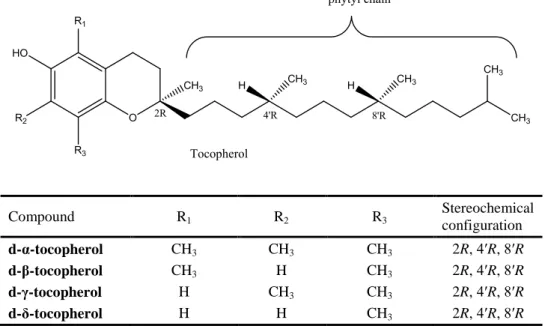
Tocopherols have three chiral centres at positions 2, 4′ and 8′. Thus, for each tocopherol, eight 313
stereoisomers exist. The natural tocopherols possess the stereochemical configuration 2R, 4′R, 8′R 314
(Figure 1). 315
316 317
Compound R1 R2 R3 Stereochemical
configuration
d-α-tocopherol CH3 CH3 CH3 2R, 4′R, 8′R
d-β-tocopherol CH3 H CH3 2R, 4′R, 8′R
d-γ-tocopherol H CH3 CH3 2R, 4′R, 8′R
d-δ-tocopherol H H CH3 2R, 4′R, 8′R
Figure 1: Structural formulae of the natural tocopherols 318
Information on the identity of the tocopherols authorised as food additives is presented in Table 1. 319
Table 1: General information on the tocopherols used as food additives (E 306–E 309) 320
Food additive Synonyms EINECS
number
CAS Registry Number (a)
Name according to CAS number (b) E 306 “Tocopherol-
rich extract” (c)
– – – –
E 307 “alpha- Tocopherol”
dl-α-Tocopherol; (all rac)-α- tocopherol (d)
233-466-0 10191-1-0 (±)-α-Tocopherol; dl-α- tocopherol; all-rac-α-
tocopherol E 308 “gamma-
Tocopherol”
dl-γ-tocopherol 231-523-4 7616-22-0 (±)-γ-Tocopherol; dl-γ- tocopherol; all-rac-γ-
tocopherol E 309 “delta-
Tocopherol”
– 204-299-0 119-13-1 d-δ-Tocopherol; (R,R,R)- δ-tocopherol
(a): Corresponding to the EINECS numbers (EC Inventory, online) indicated in Commission Regulation (EU) No 231/2012. 321
(b): From SciFinder. 322
(c): According to Commission Regulation (EU) No 231/2012, tocopherol-rich extract (E 306) contains tocopherols, such as 323
d-α-, d-β-, d-γ- and d-δ-tocopherols, and tocotrienols. 324
(d): The composition of E 307, as defined in Regulation 231/2012 “(all rac)-α-tocopherol” means a mixture, not necessarily 325
equimolecular, of all four possible racemates (i.e. of all the four pairs of enantiomers) (IUPAC-IUB, 1981). EINECS 326
(EC) number and CAS Registry Number correspond with this definition. 327
CAS, Chemical Abstract Service; EINECS, European Inventory of Existing Commercial chemical Substances. 328
2.1.1. Tocopherol-rich extract (E 306) 329
Tocopherol-rich extract (E 306) is defined in Commission Regulation (EU) No 231/201211 as a 330
“product obtained by the vacuum steam distillation of edible vegetable oil products, comprising 331
concentrated tocopherols and tocotrienols”. It contains tocopherols such as d-α, d-β-, d-γ- and d-δ- 332
tocopherols. 333
The Panel noted that JECFA (JECFA, 2006) uses a very similar definition for a tocopherol preparation 334
named “Tocopherol Concentrate, mixed (INS No 307b)”. This preparation is defined by JECFA as “a 335
form of Vitamin E obtained by the vacuum steam distillation of edible vegetable oil products, 336
comprising concentrated tocopherols. It may contain an edible vegetable oil added to adjust the 337
required amount of total tocopherols, and the tocopherol forms may be adjusted by suitable physical 338
and chemical means.” JECFA stated that no single Chemical Abstract Service (CAS) Registry 339
Number applies to this substance. 340
The Panel noted that, in 2007, JECFA (JECFA, 2007) used the following definition for both “d-alpha- 341
tocopherol, concentrate (E 307)” and “d-alpha-tocopherol, concentrate (INS No 307a)” (i.e. 5,7,8- 342
trimethyltocol): “a form of Vitamin E obtained by the vacuum steam distillation of edible vegetable oil 343
products, comprising a concentrated form of d-alpha-tocopherol. It may contain an edible vegetable 344
oil added to adjust the required amount of total tocopherols, and the content of d-alpha-tocopherol 345
may be adjusted by suitable physical and chemical means”. 346
However, the Panel noted that according to European Commission specifications (Commission 347
Regulation (EU) No 231/2012), E 306 must contain not less than 34 % w/w of total tocopherols. The 348
accompanying matrix can be assumed to contain tocotrienols, triglycerides, free fatty acids and other 349
low-volatile substances present in the original edible vegetable oil product. No clear information on 350
the composition of the accompanying matrix was provided to the Panel. 351
2.1.2. α-Tocopherol (E 307) 352
According to Commission Regulation (EU) No 231/2012, α-tocopherol (E 307) (synonym: dl-α- 353
tocopherol) is defined by the chemical names DL-5,7,8-trimethyltocol and DL-2,5,7,8-tetramethyl-2- 354
(4′,8′,12′-trimethyltridecyl)-6-chromanol. Its chemical formula is C29H50O2 and its molecular weight is 355
430.7 g/mol. The European Inventory of Existing Commercial Chemical Substances (EINECS) 356
number (EC number) is 233-466-0; this corresponds to the CAS Registry Number 10191-41-0. The 357
CAS database provides the following name: 2H-1-benzopyran-6-ol, 3,4-dihydro-2,5,7,8-tetramethyl-2- 358
(4,8,12-trimethyltridecyl)-. 359
According to general definitions in the literature, all-rac-α-tocopherol is a totally synthetic α- 360
tocopherol and is a mixture (not necessarily equimolar) of all the four possible pairs of enantiomers 361
(i.e. four racemates) (Hoffmann-Ostenhof, 1974). 362
Several synonyms are found in the literature, among others: all-rac-α-tocopherol, DL-α-tocopherol 363
and dl-α-tocopherol. 364
dl-α-Tocopherol is practically insoluble in water, freely soluble in acetone, anhydrous ethanol, 365
methylene chloride and fatty oils. dl-α-Tocopherol is described as a clear, odourless, or yellowish- 366
brown, viscous oily liquid (PhEur 8.4 (European Pharmacopoeia, 2015)). The calculated value for the 367
pKa (predicted) is 11.40 ± 0.40 (SciFinder). 368
11 Commission Regulation (EU) No 231/2012 of 9 March 2012 laying down specifications for food additives listed in Annexes II and III to Regulation (EC) No 1333/2008 of the European Parliament and of the Council. OJ L 83, 22.3.2012, p. 1–295.
2.1.3. γ-Tocopherol (E 308) 369
According to Commission Regulation (EU) No 231/2012, γ-tocopherol (E 308) (synonym: dl-γ- 370
tocopherol) is defined by the chemical name 2,7,8-trimethyl-2-(4′,8′,12′-trimethyltridecyl)-6- 371
chromanol. It has the molecular formula C28H48O2 and a molecular weight of 416.7 g/mol. The 372
EINECS number is 231-523-4, that corresponds to the CAS Registry Number 7616-22-0. The CAS 373
database provides the following name: 2H-1-benzopyran-6-ol, 3,4-dihydro-2,7,8-trimethyl-2-(4,8,12- 374
trimethyltridecyl)-. 375
Several synonyms are found in the literature, among others, all-rac-γ-tocopherol and dl-γ-tocopherol. 376
γ-Tocopherol is insoluble in water, freely soluble in ethanol and miscible with ether. It is described as 377
a clear, viscous, pale yellowish oil which oxidises and darkens on exposure to air or light 378
(Commission Regulation (EU) No 231/2012). 379
2.1.4. δ-Tocopherol (E 309) 380
According to Commission Regulation (EU) No 231/2012, δ-Tocopherol (E 309) is defined by the 381
chemical name 2,8-dimethyl-2-(4′,8′,12′-trimethyltridecyl)-6-chromanol. It has the molecular formula 382
C27H46O2 and a molecular weight of 402.7 g/mol. The EINECS number is 204-299-0, that corresponds 383
to the CAS Registry Number 119-13-1. The Panel noted that this CAS Registry Number corresponds 384
to (2R,4′R,8′R)-δ-tocopherol, which is the natural δ-tocopherol. The CAS database provides the 385
following name: 2H-1-benzopyran-6-ol, 3,4-dihydro-2,8-dimethyl-2-[(4R,8R)–4,8,12- 386
trimethyltridecyl]. 387
Synonyms used for δ-tocopherol (E 309) are (+)-δ-tocopherol, (R,R,R)-δ-tocopherol, D-δ-tocopherol 388
and d-δ-tocopherol. 389
δ-Tocopherol is insoluble in water, but is very soluble in ethanol, ether, acetone and chloroform. It is 390
described as a clear, viscous, pale yellowish or orange oil which oxidises and darkens on exposure to 391
air or light (Commission Regulation (EU) No 231/2012). 392
2.2. Specifications 393
Specifications for tocopherols have been defined in Commission Regulation (EU) No 231/2012 and by 394
JECFA (JECFA, 2006a,b, 2007). 395
2.2.1. Tocopherol-rich extract (E 306), “Tocopherol concentrate, mixed (INS 307b)” and “d- 396
α-tocopherol, concentrate (INS 307a)” 397
The specifications for tocopherol-rich extract (E 306), as defined in Commission Regulation (EU) 398
No 231/2012, and for “Tocopherol concentrate, mixed (INS No 307b)”, as defined by JECFA 399
(JECFA, 2006a), and “d-α-tocopherol, concentrate (INS 307a)”, as defined by JECFA (JECFA, 2007), 400
are presented in Table 2. 401
Table 2: Specifications for tocopherol-rich extract (E 306) according to Commission Regulation 402
(EU) No 231/2012, and for “Tocopherol concentrate, mixed (INS 307b)” and “d-α- 403
tocopherol, concentrate (INS No 307a)” according to JECFA 404
Commission Regulation (EU)
No 231/2012
JECFA (2006a) JECFA (2007)
Assay Content not less than 34 % of total tocopherols
Not less than 34 % of total tocopherols
Not less than 40 % of total tocopherols, of which not less than 95 % consists of d-α- tocopherol
Commission Regulation (EU)
No 231/2012
JECFA (2006a) JECFA (2007)
Description Brownish-red to red, clear, viscous oil having a mild, characteristic odour and taste. May show a slight separation of wax-like constituents in microcrystalline form
Brownish-red to red, clear, viscous oil having a mild, characteristic odour; may show a slight separation of wax-like constituents in microcrystalline form. It oxidises and darkens slowly in air and on exposure to light, particularly when in alkaline media
Brownish-red to light yellow, nearly odourless, clear viscous oil, which oxidises and darkens slowly in air and on exposure to light
Commission Regulation (EU)
No 231/2012
JECFA (2006a) JECFA (2007)
Identification By suitable gas liquid
chromatographic method
The retention time of the third major peak (i.e. the peak occurring just before that of the internal standard) in the chromatogram of the assay preparation is the same as that of the standard procedure, both relative to the internal standard, as obtained in the assay
The retention time of the major peak in the
chromatogram of the sample solution is the same as that of the standard solution, both relative to the internal standard, as obtained in the assay
Specific rotation [α]D20 not less than +20 °
[alpha] 25, D: not less than +20 °
alpha (25, D): not less than +24 °
Solubility tests Insoluble in water;
soluble in ethanol;
miscible in ether
Insoluble in water; soluble in ethanol; miscible in ether
Insoluble in water; soluble in ethanol; miscible with ether
Colour reaction Dissolve approximately
0.05 g of the sample in 10 mL of absolute ethanol.
Add, with swirling, 2 mL of nitric acid and heat at approximately 75 °C for 15 minutes. A bright red to orange colour develops
Dissolve about 0.05 g of the sample in 10 mL of absolute ethanol. Add, with swirling, 2 mL of nitric acid and heat at about 75 °C for 15 min. A bright red to orange colour develops
Purity
Sulphated ash Not more than 0.1 % Not more than 0.1 % Arsenic Not more than 3 mg/kg
Lead Not more than 2 mg/kg Not more than 2 mg/kg Not more than 2 mg/kg Mercury Not more than 1 mg/kg
Acidity Dissolve 1 g of the substance
in 25 mL of a mixture of equal volumes of ethanol and ether that has been
neutralised to
phenolphthalein TS with 0.1 N sodium hydroxide, add 0.5 mL of phenolphthalein TS, and titrate with 0.1 N sodium hydroxide until the solution remains faintly pink after shaking for 30 seconds.
Not more than 1.0 mL of 0.1 N sodium hydroxide is required
Dissolve 1 g of the sample in 25 mL of a mixture of equal volumes of ethanol and ether that has been neutralised to phenolphthalein TS with 0.1 N sodium hydroxide, add 0.5 mL of phenolphthalein TS, and titrate with 0.1 N sodium hydroxide until the solution remains faintly pink after shaking for 30 seconds. Not more than 1.0 mL of 0.1 N sodium hydroxide is required
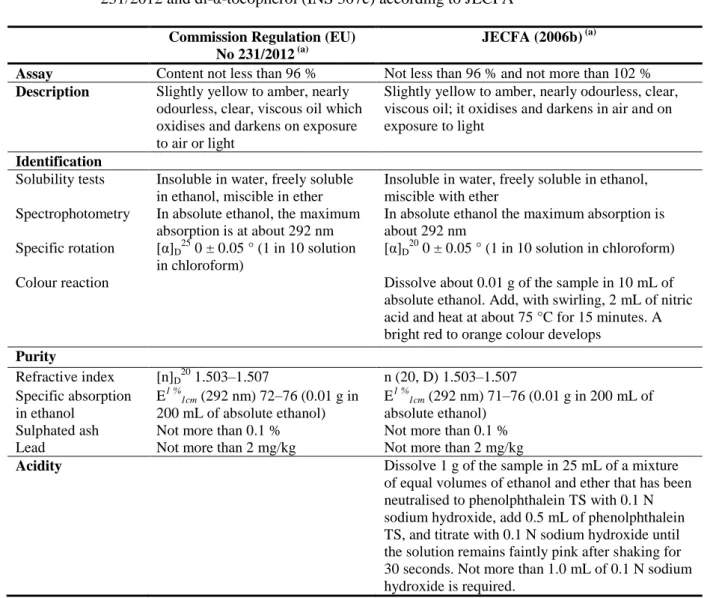
2.2.2. α-Tocopherol (E 307) 405
The specifications for α-tocopherol (E 307), according to Commission Regulation (EU) No 231/2012, 406
and dl-α-tocopherol, concentrate (INS (International Numbering System) 307c), according to JECFA 407
(JECFA, 2006b), are presented in Table 3. 408
409
Table 3: Specifications for α-tocopherol (E 307) according to Commission Regulation (EU) No 410
231/2012 and dl-α-tocopherol (INS 307c) according to JECFA 411
Commission Regulation (EU) No 231/2012 (a)
JECFA (2006b) (a)
Assay Content not less than 96 % Not less than 96 % and not more than 102 % Description Slightly yellow to amber, nearly
odourless, clear, viscous oil which oxidises and darkens on exposure to air or light
Slightly yellow to amber, nearly odourless, clear, viscous oil; it oxidises and darkens in air and on exposure to light
Identification
Solubility tests Insoluble in water, freely soluble in ethanol, miscible in ether
Insoluble in water, freely soluble in ethanol, miscible with ether
Spectrophotometry In absolute ethanol, the maximum absorption is at about 292 nm
In absolute ethanol the maximum absorption is about 292 nm
Specific rotation [α]D25 0 ± 0.05 ° (1 in 10 solution in chloroform)
[α]D20 0 ± 0.05 ° (1 in 10 solution in chloroform)
Colour reaction Dissolve about 0.01 g of the sample in 10 mL of
absolute ethanol. Add, with swirling, 2 mL of nitric acid and heat at about 75 °C for 15 minutes. A bright red to orange colour develops
Purity
Refractive index [n]D20
1.503–1.507 n (20, D) 1.503–1.507 Specific absorption
in ethanol
E1 %1cm (292 nm) 72–76 (0.01 g in 200 mL of absolute ethanol)
E1 %1cm (292 nm) 71–76 (0.01 g in 200 mL of absolute ethanol)
Sulphated ash Not more than 0.1 % Not more than 0.1 %
Lead Not more than 2 mg/kg Not more than 2 mg/kg
Acidity Dissolve 1 g of the sample in 25 mL of a mixture
of equal volumes of ethanol and ether that has been neutralised to phenolphthalein TS with 0.1 N sodium hydroxide, add 0.5 mL of phenolphthalein TS, and titrate with 0.1 N sodium hydroxide until the solution remains faintly pink after shaking for 30 seconds. Not more than 1.0 mL of 0.1 N sodium hydroxide is required.
(a): According to Commission Regulation (EU) No 231/2012 and JECFA, the specific absorption is measured by preparing 412
a sample of 0.01 g in 200 mL (which would be ≈ 0.05 %); however, in the specific absorption it is indicated as 1 % 413
(E1 % 1cm). 414
The Panel noted that in the monograph (PhEur 8.4) on all-rac-α-tocopherol in the European 415
Pharmacopoeia, limitations for further impurities, which may occur as by-products of the 416
manufacturing process, are indicated (Bracher et al., 2014; European Pharmacopoeia, 2015). The 417
maximum levels should not exceed 0.5 % for all-rac-trans-2,3,4,6,7-pentamethyl-2-(4,8,12- 418
trimethyltridecyl)-2,3-dihydrobenzofuran-5-ol, 1.5 % for all-rac-cis-2,3,4,6,7-pentamethyl-2-(4,8,12- 419
trimethyltridecyl)-2,3-dihydrobenzofuran-5-ol and 1.0 % for the sum of 4-methoxy-2,3,6-trimethyl-5- 420
[(all-RS,E)-3,7,11,15-tetramethylhexadec-2-enyl]phenol and (all-RS,all-E)-2,6,10,14,19,23,27,31- 421
octamethyldotriaconta-12,14,18-triene. 422
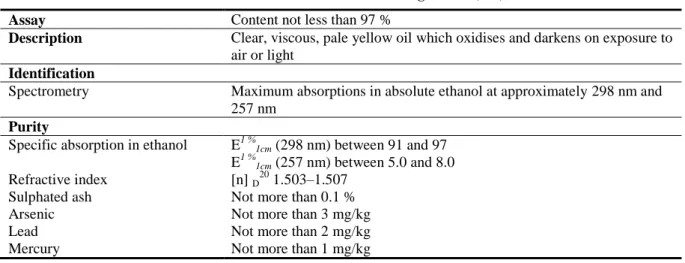
2.2.3. γ-Tocopherol (E 308) 423
The specifications for γ-tocopherol (E 308) according to Commission Regulation (EU) No 231/2012, 424
are presented in Table 4. 425
426
Table 4: Specifications for γ-tocopherol (E 308) according to Commission Regulation (EU) 427
No 231/2012 428
Commission Regulation (EU) No 231/2012
Assay Content not less than 97 %
Description Clear, viscous, pale yellow oil which oxidises and darkens on exposure to air or light
Identification
Spectrometry Maximum absorptions in absolute ethanol at approximately 298 nm and 257 nm
Purity
Specific absorption in ethanol E1 %1cm (298 nm) between 91 and 97 E1 %1cm (257 nm) between 5.0 and 8.0 Refractive index [n] D20 1.503–1.507
Sulphated ash Not more than 0.1 %
Arsenic Not more than 3 mg/kg
Lead Not more than 2 mg/kg
Mercury Not more than 1 mg/kg
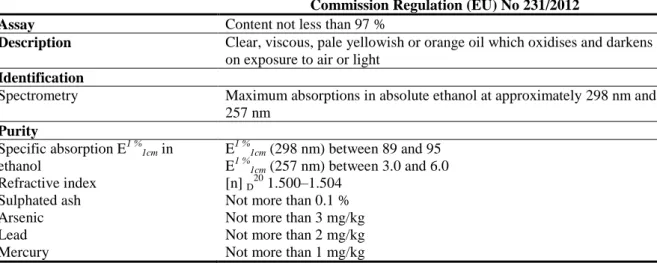
2.2.4. δ-Tocopherol (E 309) 429
The specifications for δ-tocopherol (E 309) according to Commission Regulation (EU) No 231/2012 430
are presented in Table 5. 431
Table 5: Specifications for δ-tocopherol (E 309) according to Commission Regulation (EU) No 432
231/2012 433
Commission Regulation (EU) No 231/2012
Assay Content not less than 97 %
Description Clear, viscous, pale yellowish or orange oil which oxidises and darkens on exposure to air or light
Identification
Spectrometry Maximum absorptions in absolute ethanol at approximately 298 nm and 257 nm
Purity
Specific absorption E1 %1cm in ethanol
E1 %1cm (298 nm) between 89 and 95 E1 %1cm (257 nm) between 3.0 and 6.0 Refractive index [n] D20 1.500–1.504
Sulphated ash Not more than 0.1 %
Arsenic Not more than 3 mg/kg
Lead Not more than 2 mg/kg
Mercury Not more than 1 mg/kg
The Panel noted that, according to the specifications, impurities of the toxic elements arsenic, lead and 434
mercury are accepted up to a concentration of 3, 2 and 1 mg/kg, respectively, for tocopherol-rich 435
extract (E 306), γ-tocopherol (E 308) and δ-tocopherol (E 309), while α-tocopherol (E 307) has a 436
specification for lead only, which is accepted if not more than 2 mg/kg. Contamination at these levels 437
could have a significant impact on the intake of these metals, for which the exposures are already close 438
to the health-based guidance values established by EFSA (EFSA Panel on Contaminants in the Food 439
Chain (CONTAM), 2009, 2010, 2012). The ANS Panel considered that the maximum limits for the 440
impurities of toxic elements (arsenic, lead and mercury) in the EC specifications should be revised in 441
order to ensure that tocopherols (E 306–E 309) as food additives will not be a significant source of 442
exposure to these toxic elements in food. 443
2.3. Manufacturing process 444
Tocopherol-rich extract is manufactured by the vacuum steam distillation of edible vegetable oil 445
products (JECFA, 2006a). 446
The most important commercial source of tocopherols comes from the processing of vegetable oils. 447
The deodorising step in the oil processing involves distillation to remove free fatty acids, and the 448
tocopherols are co-distilled with the fatty acids into the fatty acid distillate. A number of methods may 449
then be used to extract the tocopherols from the distillate. These include esterification, saponification, 450
distillation, chromatographic methods, liquid–liquid extraction, crystallisation, enzymatic methods and 451
supercritical fluid extraction. These are used in various combinations, as alone, no method is 452
sufficient. The first step is the removal of fatty components, which make up the major part of the 453
distillate. This is usually achieved using esterification and saponification, followed by distillation. 454
Non-saponifiable components can then be removed using chromatographic methods, crystallisation 455
and molecular distillation. Individual components such as α-, γ- and δ-tocopherols can be isolated 456
using chromatographic separation (Quek et al., 2007). 457
dl-α-Tocopherol (E 307) can be produced by the reaction of 2,3,5-trimethylhydroquinone and 458
isophytol in the presence of tridecylamine and zinc chloride catalyst. The separated dl-α-tocopherol- 459
containing phase is treated in an evaporator to remove traces of water under vacuum. The product is 460
further purified by distillation. 461
2.4. Methods of analysis in food 462
Standard methods are available for the determination of individual tocopherols in edible fats and oils. 463
The methods available have been reviewed by Cert et al. (2000). The most common methods utilise 464
high performance liquid chromatography (HPLC) analysis with either ultraviolet (UV) or fluorescence 465
detection and various standard methods are available, for example IUPAC method 2.432 (IUPAC, 466
1992), BVL (Bundesamt für Verbraucherschutz und Lebensmittelsicherheit) methods L 13.03/04-1 467
(BVL, 1987) and L 49.00-5 (BVL, 2006), and ISO (International Organization for Standardization) 468
9936:2006 (ISO, 2006). Analysis by HPLC, using normal-phase columns, allows good separation of 469
α-, β-, γ- and δ-tocopherols, but analysis time is relatively long. Hewavitharana et al. (2004) employed 470
a normal-phase silica column, with an initial pre-conditioning step to prevent irreversible binding. In 471
the analysis of tocopherols from chicken meat, the lowest detectable levels were 0.73 ng (α- 472
tocopherol) and 0.86 ng (γ-tocopherol). Reverse-phase columns have also been used and, although 473
they have the advantage of shorter analysis times, they are not able to resolve β- and γ-tocopherol 474
(Cert et al., 2000). Gliszczyńska-Swigło and Sikorska (2004) quoted detection limits for reverse-phase 475
HPLC in edible plant oils of 8 ng/mL for γ-tocopherol, and of 28 ng/mL for α-tocopherol. 476
Analysis of tocopherols in fats and oils by capillary gas chromatography (GC) is also possible, but this 477
normally involves warm saponification, thin layer chromatography (TLC) separation and derivitisation 478
prior to analysis (Cert et al., 2000). 479
Several authors have described the use of a mass spectrometer as the detector following liquid 480
chromatographic separation for the determination of tocopherols. Kalman et al. (2003) employed 481
atmospheric pressure chemical ionisation mass spectroscopy in the analysis of α-tocopherol in infant 482
foods, with a detection limit of 2.5 ng/mL. Lanina et al. (2007) used a similar approach in the analysis 483
of the four tocopherols in sunflower oil and milk; the detection limits were 9 ng/mL for α-, 8 ng/mL 484
for β- and 7.5 ng/mL for γ- and δ-tocopherols. 485
Supercritical fluid chromatography (SFC) is a more recently developed technique which has been used 486
to separate the tocopherols from complex matrices for analysis. Choo et al. (2005) applied this method 487
with a variable-wavelength UV detector to isolate minor components, including vitamin E forms, from 488
crude palm oil and from the residual oil from palm-pressed fibre. Fratianni et al. (2002) compared 489
supercritical fluid extraction using carbon dioxide with conventional extraction techniques for the 490
extraction of tocopherols from cereals, and found similar extraction yields and no significant 491
selectivity between the different tocopherols. 492
2.5. Reaction and fate in food 493
Tocopherols act as antioxidants to inhibit the peroxidation of fats and lipids in food (EFSA, 2008). 494
The tocopherols are relatively stable in foods; however, oxidation may occur when exposed to air, 495
heat, acids, alkalis or metal ions (EFSA, 2008). 496
A number of authors have investigated the stability of tocopherols in foodstuffs over time. Rastrelli et 497
al. (2002) investigated the degradation of α-tocopherol (and other components) in extra virgin olive oil 498
under various storage conditions. Oil was stored in either dark or colourless bottles, which were 499
completely filled or half-filled. The main changes found were in the half-filled bottles: α-tocopherol 500
degraded by 20 % after 2 months and by 92 % after 12 months. 501
During storage, when peroxyl radicals are formed in oils or in the presence of unsaturated fatty acids, 502
α-tocopherol reacts with these radicals, leading to the formation of tocopheroxyl radicals that further 503
react with other peroxyl radicals to form non-radical products (Burton and Traber, 1990). The non- 504
radical oxidation products of vitamin E have been identified as α-tocopheryl quinone, epoxy-alpha- 505
tocopherylquinones and 8a-(lipid-dioxy)-alpha-tocopherones (Yamauchi et al., 2002). 506
The influence of drying and storage on the tocopherol content of rapeseed was investigated by 507
Gawrysiak-Witulska et al. (2009). The levels of total tocopherol were determined after harvest and 508
after drying. Drying at near-ambient temperatures resulted in a loss of 6–11 %, while drying with hot 509
air led to a loss of 4–8 %. After storage for 12 months at 10 ± 2 °C, the concentration of tocopherols 510
had further decreased by 23–30 %. 511
Capitani et al. (2011) studied the effect of temperature and storage time on the concentration of 512
tocopherols in wheat germ oil. The level of total tocopherol decreased with time over 35 days, with no 513
significant difference between the results at 27 °C and 45 °C. Both α- and γ-tocopherols showed the 514
same pattern as total tocopherols, but for β-tocopherol the degradation rate increased with temperature. 515
Miquel et al. (2004) investigated the stability of tocopherols added to infant formula during storage. 516
The α-, γ- and δ-tocopherols all decreased in concentration over time, with a loss of ≈50 % by the end 517
of the 17-month storage period. 518
Steinhart and Rathjen (2003) investigated the effect of the method of preparation of hot meals on the 519
stability of tocopherols. The tocopherols were added to the food through the margarines used. 520
Although all preparation methods resulted in the loss of some tocopherols, in most cases this was less 521
than 20 %. The roasting of meat resulted in a loss of nearly 70 % as a result of direct oxidation. A 522
similar loss was seen with peas steamed in a metal container, but no losses were seen when this 523
method was repeated in a glass container. 524
The decrease in the tocopherol content of foods is caused by oxidation or thermal degradation, 525
depending on the processing procedures used, storage time, conditions and type of food. In sunflower 526
oil heated to 180 °C, α-tocopherol reacts partly to produce oxidation and degradation products, such as 527
α-tocopheryl quinone and α-tocopheryl fatty acids (Kreps et al., 2015). The changes in tocopherol 528
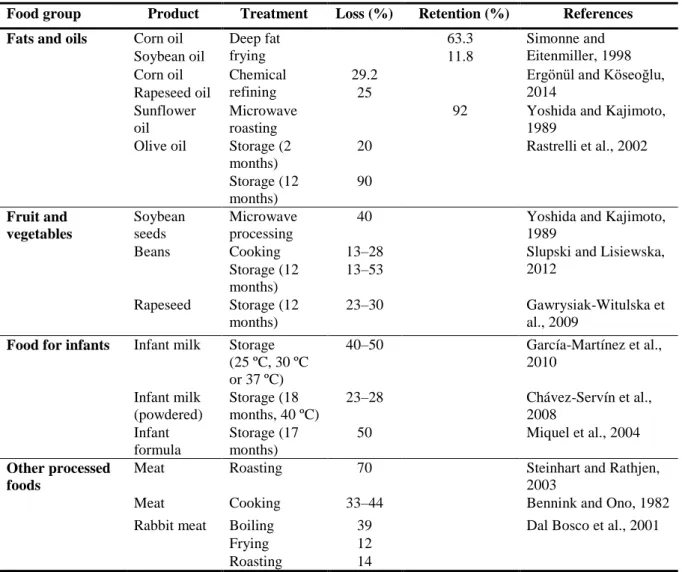
values are summarised in Table 6 and expressed as the percentage of loss or the percentage of 529
retention. 530
531