THE ROLE OF DESTINATION SPATIAL SPILLOVERS AND TECHNOLOGICAL INTENSITY IN THE LOCATION
OF MANUFACTURING AND SERVICES FIRMS
ANDRÉS ARTAL-TUR
JOSÉ MIGUEL NAVARRO-AZORÍN MARÍA LUISA ALAMÁ-SABATER
FUNDACIÓN DE LAS CAJAS DE AHORROS DOCUMENTO DE TRABAJO
Nº 652/2011
De conformidad con la base quinta de la convocatoria del Programa de Estímulo a la Investigación, este trabajo ha sido sometido a eva- luación externa anónima de especialistas cualificados a fin de con- trastar su nivel técnico.
ISSN: 1988-8767
La serie DOCUMENTOS DE TRABAJO incluye avances y resultados de investigaciones dentro de los pro- gramas de la Fundación de las Cajas de Ahorros.
Las opiniones son responsabilidad de los autores.
1
THE ROLE OF DESTINATION SPATIAL SPILLOVERS AND TECHNOLOGICAL INTENSITY IN THE LOCATION OF MANUFACTURING AND SERVICES FIRMS
Artal-Tur, Andrés* Navarro-Azorín, José Miguel*
Alamá-Sabater, María Luisa**
Abstract:
This paper focuses on the characteristics of destinations to identify the role of spatial spillovers in driving the location choices of manufacturing and services firms. With this objective in mind, a spatial conditional logit framework is defined, allowing for neighbourhood-related spatial effects.
A broad indicator of spatial spillovers generated by a given destination is also proposed. The model is then applied to empirically capture the behaviour of 1,092,864 new firms established in 316 municipalities in the Spanish Mediterranean Arc (SMA) between 1998 and 2008. Estimation results show that these spatial effects have a considerable impact on the location decisions of manufacturing companies compared to services companies. When the sample is split by technological intensity of activities, it can be observed that spatial spillovers are more likely to affect decisions by high-tech companies than those of low-tech ones, particularly for manufacturing activities.
Keywords: destination characteristics, spatial spillovers, location choice, technological intensity.
JEL classification: C31, C35, D22, R12.
* Technical University of Cartagena
**Corresponding author: Alamá-Sabater, María Luisa, Departamento de Economía, Jaume I University, Castellón, email: [email protected]
Acknowledges: A. Artal-Tur acknowledges financial support from the FEMISE Association (Project FEM 34-01), the Spanish Ministry of Science and Innovation (Project ECO 2008- 04059/ECON and Project ECO2011-27169) and Fundación Séneca – Región de Murcia (Project 11897/PHCS/09ECO). J.M. Navarro-Azorín acknowledge financial support from Fundación Séneca – Región de Murcia (Project 08736/PHCS/08). L. Alamá-Sabater acknowledges financial support from the Spanish Ministry of Public Works (Project MIFI 3239/2008 and Project P21/08).
2
1 INTRODUCTION
Studies on the forces driving geographical concentration of economic activity are one of the most active topics in current regional and international literature. As an example, contributions arising from the new economic geography highlight the explicit consideration of the role of distance, in the form of transport costs, together with increasing returns to scale, when studying the surge of economic centres (FINGLETON, 2007; KRUGMAN, 1992). Developments in the spatial econometrics literature provide another important example on this subject (ANSELIN, 2010). This interest in restoring the spatial dimension in economic studies has even made agglomeration economies one of the most scrutinized variables in regional and urban studies, with this variable occupying a salient position in the analysis of the factors underlying the location choices of agents, such as firms and people (GLAESER, 2010).
In this context, one important feature of studies dealing with agglomeration forces is that they are usually considered as being local in nature, i.e. the spatial scope of those effects is theoretically bounded by the spatial area that constitutes the unit of analysis, not allowing for real “spill-over” effects. Typically, researchers have measured the magnitude of these externalities within the area of study, such as a region or a municipality (ARAUZO et al., 2009).
Nonetheless, recent contributions attempt to escape this administrative constraint by highlighting the importance of inter-territorial externalities in location decisions by agents, in an effort to achieve more realistic modelling of people’s choices in space (ALAMÁ-SABATER et al., 2010; HOLMES and LEE, 2010; AUTANT-BERNARD and LESAGE, 2011). These developments are then concerned with a new focus when dealing with spatial spillovers, and now account for the fact that external economies arising in a given geographical destination do not only affect firms located in that destination, but could also be (and often are) affecting firms located in nearby destinations. Introducing those forces into theoretical models thus becomes necessary, given the relevance that these externalities show in driving location choices (AUTANT-BERNARD, 2006; MOHAMMADIAN and KANAROGLOU, 2003).
This paper continues studying the role that inter-territorial spatial spillovers play in influencing the location choices of firms. It focuses on improving the way we look at external economies and neighbourhood effects, in the spirit of spatial econometrics exercises. Several contributions are made to the literature. First, a spatially extended discrete choice framework is defined to model the location decisions of firms. Choices are now modelled as a function of individual destinations’ characteristics, including spatial effects arising from and affecting their surrounding areas. This modelling strategy helps in undertaking an explicit consideration of geography and externalities in location decisions. This framework will be proven useful in capturing the relative
3
importance of urbanization and specialization economies in this process, disentangling the role played by classic agglomeration economies from others arising from additional spatial externalities that are locally bounded or otherwise. Improving the measurement of the role played by those two agglomeration economies continues to be a matter of concern in this literature, given that they are the main agglomeration economies identified in mainstream location studies (GLAESER, 2010).
Second, the empirical model will also be accommodated to account for unobserved spatial effects that may affect the choices of firms, particularly those linked to the inherent spatial heterogeneity characterizing locations. Controlling for such unobservable effects is also important in the estimation procedure of the model, given the improvement in the measurement of agglomeration and spatial effects it affords. When considering this issue, we employ a random effects specification of the spatially extended framework, as suggested by GUIMARÃES et al. (2004).
The empirical exercise is carried out on a new assembled data set including observations of 1,092,864 new firms established in 316 municipalities in the Spanish Mediterranean Arc (SMA) in the period 1998-2008. The local dimension of the data set thereby clearly enriches that of previous European studies which were more focused on the regional or country dimension (AUTANT-BERNARD, 2006; COMBES and OVERMAN, 2004). This is an important issue when trying to capture spatial spillovers that rapidly dissipate with distance (ARAUZO, 2008).
Finally, given that technological intensity has become one of the leading indicators when characterizing industries and economic sectors in general, the paper will also explore how the technological intensity of firms influences their location decisions, and in particular, whether spatial effects are more likely to arise those firms with higher technology content in their processes. Estimation results show that neighbourhood characteristics have a considerable impact on firms’ location decisions. However, this effect seems to be more pronounced for manufacturing rather than services firms. Moreover, spatial spillovers are more likely to affect decisions by high-tech companies than those by low-tech ones, which is a common feature to both manufacturing and services.
After this introduction, the structure of the paper is as follows. Section 2 presents the analytical framework used in the study. Section 3 is devoted to a discussion of the choice of the explanatory variables set, estimating the empirical model and discussing the main findings of the investigation. Finally, Section 4 provides a conclusion.
4
2 MODEL SETTING
This section introduces a location model based on the standard that the firm will choose the municipality with the highest expected profit from several alternatives. From the point of view of a firm i which operates in industrys, each municipality in the set of possible locations offers an expected profit of ij such that
ij xj zsj W X j W Zsj j ij, (1)
where the variables inxjinclude the characteristics of the municipality affecting the location decisions of firms in all industries, whilezsjaccount only for those local characteristics affecting the location decisions of firms belonging to industry s; WXj and WZsj are spatially weighted averages of the characteristics of the municipality’s neighbours, which are either common to all industries or relative to a particular one, respectively; j is a municipality random effect capturing the unobservable locational advantages of those municipality,1 while ij is a random term capturing other unobservable factors that determine the expected profits from locating in municipality j for firm i.2
The basic idea underlying the theoretical framework is straightforward, with firms deciding to locate their plants in the most profitable municipality for them, as is usual in location theory.
Location j is therefore chosen by a firm i if the (expected) profit of choosing that location is
1It is assumed that the exp(j)’s are i.i.d. with a Gamma distribution with parameters ( , ) so that E(exp(j))1 and Var(exp(j))1.Note that modelling of unobservable effects by means of a random effects term relies on the assumption that these effects are uncorrelated with the explanatory variables. Notwithstanding, the –more plausible- fixed effects approach turned out impractical in the present study. As pointed out by GUIMARÃES et al. (2004), the fixed terms would absorb the effect of location specific variables included in xj and consequently, we will unable to identify their impact on firms’ location decisions. Moreover, the unavailability of data for different time periods prevented us from using time series variation to obtain estimates for these latter effects.
2This model spatially extends the original contribution to the location framework developed in GUIMARÃES et al.(2004).
5
higher than those (expected) due to locating in any alternative place. The probability of choosing location j is therefore:
Pr(ijik), for jk, and ,j k1, 2,,J , (2)
and it can be shown that if the error term ij is i.i.d. according to a type I extreme value distribution, the probability of a firm choosing municipality j conditional on the j‘s can be written as:
| ,
1
exp exp
j sj j sj j
j s J
k sk k sk
k k
x z WX WZ
x z WZ
P
WX
. (3)The following relationship for each industry s is the starting point in order to identify the spatial spillovers generated by a given municipality:
| |
1 j s k s
k j
P P
, (4)WherePm s| E P( m s| ,) for each location m. Then, from equation(4), and given a marginal change in characteristics (common to all industries) of the municipality j, the marginal direct and indirect (cross) effects verify:
| |
| |
0 j s k s
k
j s j k s
j j
j j k
P DE IE
x x
P
. (5)Moreover, in the conditional logit setting it follows that the indirect effect of a marginal change in the covariates of the municipality j can be written as:
| | | | | | |
j k s j s k s k s kj rj r
r j
s j k s j k s
P P P w w P S
IE
NSIE IE
. (6)The first term in equation (6), or the non-spatial indirect effectNSIEjk s| , captures the fact that in the conditional logit framework a change in one of the characteristics of the location j affects
6
its expected profit relative to those of the other municipalities and consequently leads to a change in the ranking of the alternatives which would ultimately modify the distribution of firms across locations. The second term in equation (6), the spatial indirect effectSIEjk s| , summarizes the effects of changes in the characteristics of municipality j over the probability of another municipality k to attract firms operating within the sector of activity s. Note that the intensity of this spatial spillover effect depends on two key factors. First, on the value of δ, meaning that the higher the value of this parameter, the more intense the spatial effects, given that the characteristics of the neighbourhood would receive a greater weight in determining the expected profit from locating in a given municipality. Second, the magnitude (and sign) of the spatial spillover also depends on the relevance of the municipality j as a neighbour of municipality k, given by the elements of the spatial weight matrix W. In this respect, closer neighbours to location k in geographical terms would be characterized by a higher value of the corresponding element of the k-th row of W and the term in parenthesis in equation (6) would also be consequently higher.3 Finally, it must be noted that the magnitude of the spatial spillovers from municipality j to municipality k is proportional to the probabilityPk s| , i.e. the location k would benefit more from spillovers from municipality j whenever it tends to concentrate a higher amount of firms operating in the industry s.
A synthetic or compact measure of the spatial spillovers generated by each municipality in the sample, denoted bySIEj s| , is now computed by integrating the terms SIEjk s| over every location k j:4
| | | |
k j
j s j k s j s kj k s
k j
SIE SIE
P w P
. (7)Furthermore, note that the total spatial spillovers generated by a municipality depends on its relative position as an attractor of firms (Pj s| ), showing a bias depending on the size of the
3 Note that the term wkj is inversely related to the geographical distance between locations k and j, while rj r s|
r j
w P
is a weighted average of elements in the terms in the k-th row of the W matrix. Thus, ifwkj is greater than the average, the spatial spillover would be positive, and negative otherwise.4 This summary measure of generated spatial spillovers resembles the Total Impact from an Observation Measure introduced in LESAGE and PACE (2009).
7
municipality. Accordingly, it seems appropriate to use a relative measure of spatial spillovers in order to rule out such a bias. A relative measure is then defined as the ratio of spatial indirect effects (SIEj s| ) to direct effects (DEj s| ), i.e. |
| j s j s
SIE
DE . Note that this measure does not depend on the value of the coefficients, thus completing the empirical specification of the model with a standardized (scale-free) measure of spatial spillovers associated with each municipality in the sample.
3 ESTIMATION RESULTS
3.1 DATA DESCRIPTION
The analysis in this paper draws on a data set for the population of firms established in the Spanish Mediterranean Arc (SMA) provided by the Spanish National Statistics Institute (INE).5 The SMA is defined here as the territory of the Spanish Mediterranean coastal area stretching from the French frontier to the Straits of Gibraltar, i.e. between the regions of Catalonia and Andalusia. Because of differences in levels of economic development, infrastructures, and competitiveness, Catalonia and Valencia present a more favourable position in a wide range of economic indicators in comparison with the other two regions comprising the SMA, Murcia and Andalusia.
The areas that make up the SMA constitute 40.9% (approximately 19 million inhabitants) of Spain’s population (3.8% of EU-27); 18.9% of the country’s surface area (2.2% of EU-27); and 40.6% of its GDP (3.7% of EU-27). The SMA as a geographical unit therefore accounts for more than 40% of Spanish population and economic activity in less than 20% of the country’s total area. In recent decades, the area has experienced significant demographic growth (boosted by migratory flows), resulting in high population densities, particularly on the seaboard. Other distinctive characteristics of the SMA include a heavy specialization in tourism and leisure- related activities which exploit environmental advantages (climate, landscape, etc.). Moreover,
5We are aware that in their location choices, firms do not concentrate uniquely on municipalities belonging to the SMA. At this point the present research is clearly constrained by the available database even though we are confident this data limitation only constitutes a minor source of biases in our empirical findings.
8
the manufacturing sector is based on SMEs that are mainly concentrated on traditional activities.
A detailed analysis of the spatial configuration of the SMA reveals the existence of two territorial imbalances which are in turn reinforced by an articulation of transport infrastructures with room for improvement. First, there is a suitable contrast between the active and densely populated seaboard and the sparsely inhabited inland areas. Second, there is some discontinuity in the urban network. From north to south, it contains the Barcelona urban agglomeration, the metropolitan area of Valencia, and a series of coastal cities from Benidorm (Alicante) to Cartagena (Murcia). At this point there is a marked decline urbanized areas in the SMA as far as Andalusia (except for the Málaga metropolitan area). Furthermore, in the entire area under study, two cities, Barcelona and Valencia are outstanding in terms of global connectivity, and are both becoming well consolidated urban structures connected to the rest of Europe. Finally, this latter last imbalance is consistent with the limited relative development of the southern regions making up the SMA mentioned above.
In this context, the data set comprises 1,092,864 new plants located in 316 municipalities between 1998 and 2008. Since services now occupy a large proportion of jobs in the SMA, they are worthy of attention and unlike other studies on activity location more traditionally focused on the manufacturing sector, both, services and manufacturing firms are included in the analysis.
The spatial distribution of the firms among the SMA municipalities is depicted in Figure 1, which clearly shows that a large proportion of firms are established in the Barcelona and Valencia urban metropolitan areas, together with the municipalities located in the coastal corridor (it should be added that administrative centres generally tend to be located in this area).
9
Figure 1. Geographical distribution of firms in the Spanish Mediterranean Arc (SMA).
A deeper descriptive look at the spatial distribution of firms in the SMA can be obtained by using the local Getis-Ord statistic,6 which is shown for each defined sub-sample of industries in Figure 2. It shows that the municipalities with the highest concentration of firms are located on the coast, and in the Barcelona metropolitan area in particular. This result holds true for both manufacturing and services and to some extent justifies a preliminary divide between a vibrant- agglomerated-environment centred in Barcelona and the remainder of the SMA. However, a closer look at the figure suggests that the Valencia metropolitan area is also a hot spot for every sector of activity, as well as municipalities in the South of Alicante for low-tech manufacturing and a number of locations on the coast of Malaga for low-tech services.
6The Getis-Ord statistics is intended to assess spatial dependence in a particular sub-region of the sample. It is based on a comparison of the average value within a given neighborhood set and the global value, and indicates the extent to which a location is surrounded by a cluster of high or low values of the variable.
10
Figure2. High/low clustering (local Getis-Ord Gi*statistic).
11
3.2 EXPLANATORY VARIABLES
Table 1 summarizes the list of explanatory variables considered as potential determinants of the location of firms in the SMA, along with their precise definition. The list of explanatory variables includes a set of dummies to account for potential differences in the institutional environment, which are mainly determined by the Autonomous Community to which the municipality belongs. Spanish Autonomous Communities (corresponding to the NUTS-2 regions of the European Union) are the first-level administrative divisions and are to a large extent responsible for a wide range of relevant aspects of industrial policy, such as innovation policy, subsidies, etc., which ultimately determine the costs of establishment for new companies, so it is important to include them as control variables.
Table 1: Independent variables: definition and data sources.
Variable Definition Source
RCAT, RMUR, RAND
Dummies for NUTS 2 regions (Catalonia, Region of Murcia, Andalusia). The reference category is the Valencian Region
Own elaboration
DISTHEAD Distance to administrative head in kilometres Own elaboration HC3 Ratio of labour force having attained a
higher education degree to total labour force
INE
POPULAT Number of inhabitants in the municipality Censo (INE) POPDEN Urban population per squared kilometre Censo (INE) and
own elaboration FIRMDEN Number of firms per squared kilometre DIRCE
DIVERS Index of diversification computed asH1, where
2 s s
H c and cs is the share of the number of firms in industry s over total firms for each municipality
Own elaboration from DIRCE data
FESPSECT Coefficient of specialization Own elaboration from DIRCE data
12
Distance to head, measured as the Euclidean distance to the administrative head of the related provincia,7 will act as a proxy for the accessibility (transport costs) of the municipality, as the design of the infrastructure network in Spain tends to favour these administrative centres. The distance to administrative heads can therefore be considered a measure of accessibility to the municipality or alternatively, as the transportation and distribution costs faced by firms located in each municipality.
The local level of population is included in the model as a measure of market size. In the absence of detailed local data on variables, such as personal income, that would better account for market attractiveness, the total population appears to be a reasonable proxy for potential consumer demand (KRUGMAN, 1992). However, the explanatory performance of this proxy may be low as the relevant market for a large proportion of the firms does not necessarily exactly match the municipality’s area.
Urban population density is used to proxy land price, since industrial and residential users compete for land. This is a cost variable and it is consequently expected to exert a negative influence on the probability of choosing a municipality. It may also could capture some congestion effects due to high levels of density in urban environments.
The availability of human capital stock is often cited as a source of observed differentials in productivity between firms and regions. Access to a more qualified workforce implies that firms can introduce advanced production techniques faster, that they can adopt new innovations easily and that new knowledge from both their own industry and other industries (knowledge spillovers) can be absorbed much more easily. Firms would therefore tend to locate in municipalities with a more highly educated workforce as this could boost their ability to benefit more from inter-industry knowledge spillovers and their productivity. Agglomeration economies arising from labour market pooling provide another benchmark for this type of positive effect arising from an educated local workforce (GLAESER, 2010). In this regard, the set of covariates includes the share of the workforce that has attained a University degree as a proxy for the stock of human capital. Human capital is expected to favour location choices in a targeted municipality.
7 Spanish provincias are intermediate administrative levels composed of several adjacent municipalities in the same region or autonomous community.
13
Apart from these factors, firms’ decisions on their location can also be driven by both intra- industry (localization economies) and inter-industry (urbanization economies) agglomeration effects or externalities. In this respect, a firm located in close proximity to other firms in the same industry can take advantage of a range of intra-industry benefits, including access to specialized know-how, sharing sector-specific skilled labour, integration in buyer-supplier networks, opportunities for efficient subcontracting, etc. As a result, the co-location of firms in the same industry generates cluster externalities that enhance the productivity of all firms in that industry, increasing local attractiveness for the localization of new firms operating in that industry. The location quotient for each industry in each municipality is used to capture the effects (if any) of localization economies. This measure identifies the degree to which any given municipality is specialized in any given economic activity, and it is expected to exert a positive effect on the probability of a generic firm locating in the municipality.
Firms can also benefit from being located in close proximity to firms in other industries. These inter-industry advantages include easier access to complementary services, the availability of a large labour pool with multiple specializations, and the availability of general infrastructure and a vibrant socio-economic atmosphere (JACOBS, 1969). Urbanization economies stem from the overall size and diversity of the urban agglomeration. However, size is usually correlated with diversity, as larger urban areas can support a wider range of economic activities. The defined explanatory variables set includes two related with size (measured by the concentration of firms per square kilometre in each municipality) and diversity (measured by the inverse of the Herfindahl-Hirschmann index of concentration), both of which measure some dimension of urbanization economies. Even though these variables are expected to exert a positive effect on location choices, it may be also the case that the agglomeration of firms in a given municipality generates negative externalities due to increased competition for limited infrastructures, specialized services, or the workforce, among other factors.
The spatial weight matrix W is defined in terms of the inverse Euclidean distances between municipalities, with a representative term:
1 1
1
if
0 otherwise
l jl jl
J
jl jl
d d d R
w
(8)wheredjl is the Euclidean distance between municipality j and municipality l, and Represents a critical distance determining the range of action of spatial effects, if present. Note that by
14
construction, wjlsatisfies wjl wlj, wjj 0, and
jw
jl 1
. In order to determine the most appropriate value for the parameter R, the approach proposed by FERSTL (2007)is adopted.This involves computing the Moran’s statistic for spatial correlation for different values of R and selecting a value Ropt such that:
arg min | ( *) |, 0
opt R
R zI y R , (9)
wherezI ( *)y is the standardized Moran’s statistic for the spatially filtered data.
3.3 ESTIMATES
This section estimates a spatial location model allowing for spatial spillovers affecting the location choices of new firms in the Spanish Mediterranean Arc (SMA) in the period 1998-2008.
It is assumed that the relevance of factors affecting location choices may vary according to the specific characteristics of the industry the firm belongs to. The entire whole sample is consequently divided into four sub-samples, with a model for manufacturing and services firms estimated separately, and the existence of high and low technological activities in these two major sectors of activity also taken into account. The industries included in each subsector are shown in Table 2.
15
Table 2: Classification of economic activities.
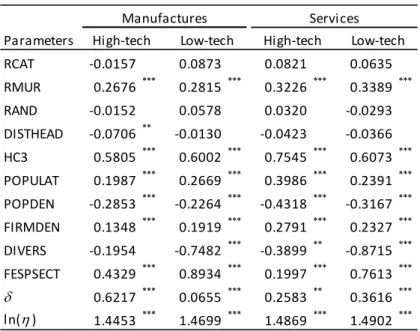
Table 3 presents the estimation results obtained for the various sectors of activity, from which some general conclusions can be drawn about the role played by each explanatory variable included in the preferred specification of the empirical model. In general, each parameter shows the expected sign and their magnitudes match those found in the comparable literature employing logit models in location choice analysis. All continuous variables are in logs, so the estimates obtained for coefficients reflect the elasticity (of the probability) of choosing a particular municipality with respect to the explanatory variable.8
8Without taking into account spatial effects, the relationship between the average probability elasticity and the coefficient estimate ߚ is
k JJ1
k where J represents the number of choices (see HEAD et al., 1995). Consequently, as J gets larger (as in this case), average probabilities approach the parameter estimates.Economic activities ISIC
High‐tech manufactures Manufacture of chemical industry 24
N.E.C. machinery and equipment 29
Office machinery, computing machinery 30 N.E.C. electrical machinery apparatus 31 Radio, TV and Communication equipment 32 Medical, precise, optical instruments 33 Manufacture of motor vehicles and trailers 34
Other transport equipment 35
Low‐tech manufactures Food products and beverages. Tobacco products 15,16
Textile products 17
Wearing apparel 18
Dressing of leather 19
Wood products (except furniture) 20
Manufacture of paper and paper product 21
Publishing and printing 22
Other manufactures 36
High‐tech services Post and telecommunications 64
Computer and related activities 72
Commercial R&D services 73
Low‐tech services Wholesale and retail trades. Hotels and restaurants 50,51,52,55 Land, water, air transport and supporting services 60,61,62,63
Finance & insurance 65,66,67
Real state activities. Business support activities 70,71,74
16
Table 3: Location choice of firms in the Spanish Mediterranean Arc (SMA): spatial conditional logit model.
Notes: The dependent variable is the location choice of new firms.
Significance of coefficients at *** 1%, ** 5% , * 10%.
Regarding the regional dummies, but for the Region of Murcia in particular, there seems to be no significant differences between the regions studied compared to the reference category (Valencian region). This result suggests that the SMA institutional framework is fairly uniform, with the exception of the Region of Murcia, which is the smallest region in the SMA, and exhibits a significant dynamism in firm birth rates in recent years, with important institutional incentives, which appear to be captured by the regional effects parameter.
The distance to administrative head has a negative influence on location choices, but the effect is only significant for firms operating in high-tech industrial activities. Although accessibility may be a highly relevant factor determining the location choices by firms, for municipalities in the SMA distances to administrative heads (associated with the largest urban centres) are therefore not so large as to impose an appreciable penalty for firms located in the more peripheral municipalities. Within this result, while good access to market centres (or location close to large urban centres) can encourage interaction and knowledge spillovers between firms, research institutions and governmental and regulatory authorities, these benefits can be offset by costs derived from enhanced competition between firms, such as increases in land rents, wages, or
Parameters
RCAT ‐0.0157 0.0873 0.0821 0.0635
RMUR 0.2676 *** 0.2815 *** 0.3226 *** 0.3389 ***
RAND ‐0.0152 0.0578 0.0320 ‐0.0293
DISTHEAD ‐0.0706 ** ‐0.0130 ‐0.0423 ‐0.0366 HC3 0.5805 *** 0.6002 *** 0.7545 *** 0.6073 ***
POPULAT 0.1987 *** 0.2669 *** 0.3986 *** 0.2391 ***
POPDEN ‐0.2853 *** ‐0.2264 *** ‐0.4318 *** ‐0.3167 ***
FIRMDEN 0.1348 *** 0.1919 *** 0.2791 *** 0.2327 ***
DIVERS ‐0.1954 ‐0.7482 *** ‐0.3899 ** ‐0.8715 ***
FESPSECT 0.4329 *** 0.8934 *** 0.1997 *** 0.7613 ***
0.6217 *** 0.0655 *** 0.2583 ** 0.3616 ***
ln() 1.4453 *** 1.4699 *** 1.4869 *** 1.4902 ***
Manufactures Services
High‐tech Low‐tech High‐tech Low‐tech
17
commuting times for workers. Accordingly, congestion costs associated with the location of firms close to administrative centres are likely to play a relevant role as a determinant of location choices. It may be also the case that accessibility to other nodes, such as maritime terminals and airports, are more relevant to firms than proximity to the administrative heads, and this being an issue for exploration in further work.
Location choice appears to be influenced positively by the local stock of human capital. This is also one of the most relevant determinants in the four subsamples, showing the higher capability in magnitude in influencing location choices after spatial spillovers. The estimated coefficient indicates that a municipality that experiences a 10% rise in the proxy for human capital would increase its probability of being chosen in the future from 5.8% to 7.5%, with the latter figure applying to firms belonging to the high-tech services sector.
The total municipality population exhibits the expected (positive) sign and appears statistically significant. As pointed out above, this independent variable is used to proxy the market size, and the results therefore suggest that location choices by firms seems to be guided by the benefits of locating production activities in areas which imply a higher potential demand for firm’s products, and the effect appears to be particularly relevant for high-tech services, as expected.
Urban population density is statistically significant, with a negative sign in all the sectors considered. These results confirm land costs as a relevant factor for location decisions, although it appears to be more influential for services than for manufacturing industries, and for high-tech activities in particular. In this regard, an increase of 10% in the urban population density of a municipality would reduce the probability of it being the preferred location from 2.2% in the case of low-tech manufacturing to 4.3% for high-tech service activities. This might reflect the greater propensity of service firms to locate closer to urban centres, and thus face more intense competition for land with residential users. Congestion costs are also not included in this result. This appears to be more of a problem for services, given that these activities usually choose locations closer to city centres by comparison with manufacturing.
The two dimensions (size and diversity) of urbanization economies are taken into account by the firm density per square kilometre and the diversification index of economic activity in each municipality. For the first variable, the results show the presence of positive agglomeration effects; the location of firms, regardless of the economic sector in which they work, has a consistently positive and significant impact on the attractiveness of potential host municipalities.
Nonetheless, contrary to prior expectations, the diversity index has a negative influence on the
18
location choice, but the effect for high-tech industries is not significant. The effect of diversity is also substantially higher for the location decisions of firms operating in high-tech activities, so that a 10% rise in the index of economic diversity in a municipality would lead to a reduction of 7.5% (low-tech industries) and of 8.7% (low-tech services) in its probability of being the destination for these types of firms in the future, which still reflects some degree of preference for specialized environments.
The estimated coefficients for the specialization quotients are positive and significant, indicating that firms tend to exploit the benefits of intra-industry clustering in their location choices.
However, these effects are more intense for firms in low-tech sectors, and especially in manufacturing, with an elasticity value close to 0.9. This result is consistent with the available empirical evidence on geographical distribution of industrial firms in the SMA. For example, (BOIX and GALLETTO, 2006) identifies a sizeable number of clusters of firms (local production systems) specializing in traditional manufacturing located in the SMA.
The econometric model includes a term to capture potential spatial effects affecting firms’
choices. These effects are summarized by the parameter; this parameter measures the relative importance of the local neighbourhood in determining firms’ choices. Spatial effects are significant despite exhibiting a rather wide range of values, ranging from 0.06 to 0.62 for industry and from 0.25 to 0.36 for services. Spatial effects are more pronounced for high-tech manufacturing firms, while for low-tech firms neighbourhood seems to be not so relevant (the estimated coefficient is 0.06), or perhaps external effects are basically locally bounded, with the inter-municipal spatial effects being less important. According to this result, firms involved in high-tech manufacturing exhibit a more pronounced tendency to look for sources of positive externalities (via knowledge sharing, labour market pooling, etc.), beyond the municipality where they are located as compared to other firms in the low-tech industries. This result is broadly consistent with the fact that access to knowledge should be particularly relevant as a search strategy for high-tech industries, and consequently there are obvious potential benefits from co-location in municipalities’ networks. This is also consistent with one of the empirical findings concerning the relevance of localization economies emerging from the municipality where the firm is located (a lower coefficient is estimated for the corresponding explanatory variable, the location quotients, in the case of high-tech manufacturing).
As for services, the local neighbourhood seems to exert a rather moderate effect in the location decisions of services firms, especially when compared with high-tech manufacturing firms, although it is always higher than those characterizing low-tech manufactures. There therefore seems to be a sort of home market effect for services activities, i.e. these companies could
19
potentially obtain enough local demand to exploit economies of scale, thus lessening the importance of the neighbourhood, as with low-tech industries (KRUGMAN, 1992). Moreover, this effect seems to be of a comparable magnitude in both high-tech and low-tech services, within a confidence interval for the parameter.
The conditional logit model also includes a random term (j), which is a factor defined to capture the effects of unobserved exogenous variables at the municipality level, such as cultural and geographical characteristics. As suggested by GUIMARÃES et al. (2004), if the independence from the irrelevant alternatives assumption is interpreted as an omitted explanatory variables problem, the random effect would contribute to mitigating this drawback in the conditional logit model.
3.4 MAPPING SPATIAL SPILLOVERS
The conditional logit model provides a useful framework for investigating the spillover effect generated by changes in the characteristics of each municipality by means of its impacts on the surrounding environment of other municipalities in the SMA. As noted above, these effects come from two sources: the first one is caused by the model specification (i.e. this effect would be also present in a non-spatially augmented conditional logit model), while the second is due to explicit recognition of the possibility of spatial effects in the firm’s location choice (this effect would only appear if the conditional logit model is augmented to include spatially weighted explanatory variables). In the first source, a marginal and positive change in one of the explanatory variables in the municipality j would improve the expected profits from choosing that location, thereby reducing the attractiveness of the other potential destinations for firms (direct effect). The indirect spatial effect arises because given the marginal change in a covariate characterizing the municipality j, it also would lead to an improvement in the profits expected from locating in other neighbouring municipalities, which in turn would increase their attractiveness for the location of firms.
Figure 3 depicts the distribution of the estimated spatial spillovers caused by marginal changes in the characteristics of each individual municipality in the sample.9In order to interpret these
9Note that from the model estimates it is possible to construct a measure of spatial spillovers from a municipality j for each sector of activity s (among those included in each sub-sample), i.e.
it is possible to compute SIEj s| and DEj s| . However, in order to simplify the discussion of the
20
results correctly, it must be stressed that the magnitude of the spatial spillovers linked to a given municipality remains a function of two basic factors. First, it depends on how much relevance firms assign to the neighbourhood’s area characteristics when computing the expected profits from locating in a particular destination, and this is controlled by the δ parameter. In this sense, the highest estimated value for the parameter δis obtained for high-tech manufacturing and, accordingly, overall spatial spillovers are more relevant for this type of economic activity compared to low-tech industries and services. Second, the magnitude of the spatial spillovers associated with a given location is determined by the average distance to other municipalities, as this contributes to shaping the characteristics of the surrounding area, thus increasing the expected profits from locating in that municipality. Municipalities integrated in dense urban networks should subsequently exhibit the greatest capability of generating spatial spillovers, with this effect particularly evident for the municipalities in the metropolitan areas of Barcelona and Valencia, where neighbouring municipalities reinforce each other’s spatial effects through indirect channels (see equation 6).
In the case of high-tech manufacturing, Figure 3 shows that the main focus of spatial spillovers is defined by Barcelona and the nearby municipalities. This result is explained by both the high concentration of firms operating in this sector of activity in these locations, and the geographical proximity between them. Furthermore, municipalities in the metropolitan area of Valencia also present considerable ability to generate spatial spillovers, as well as some locations in the South where firms manufacturing transport equipment concentrate. For low-tech manufacturing, apart from the Valencia and Barcelona metropolitan areas, a group of municipalities in the provincia of Alicante are relevant sources of spatial spillovers. These municipalities present a high level of specialization (and concentration) of light industry firms (mainly footwear and leather manufacturing).
As for the services sector, some interesting remarks arise from Figure 3. For high-tech services, the municipalities showing the highest capability of generating spillovers are generally administrative heads (which are rarely the largest municipalities in the SMA). This could be
results, Figure 3 presents aggregated measures of spatial effects from a municipality, computed as a weighted average of the form:
| s
j s j s
SIE n SIE
n ,wherens represent the number of firms in the sector s, and n is the total number of firms in the corresponding sub-sample.
21
explained by the fact that these administrative heads tend to be the centre of urban networks, in contrast to other municipalities in the SMA, which appear to be rather geographically isolated.
For low-tech services, and given the importance of tourism-related activities in the SMA, the municipalities with the greatest potential to generate spatial spillovers are clearly those located in the main tourism destinations in the SMA, including Barcelona and the coastal area of Alicante, Málaga and Cádiz, given the ongoing importance of sun and sand products in the Spanish and European tourism market.
Taken as a whole, these results are consistent with a centre-periphery model of agglomeration for the SMA space, given that the municipalities located on the coast reinforce their spatial effects on each other, while inland localities will gradually lose their attractiveness for new firms, given the behaviour underlying the model’s specification (PÓLESE and SHEARMUR, 2006).
For this reason, in this particular case Cohesion and Regional European funds appear to be of great importance in offsetting centrifugal forces, thus making a decisive contribution to balancing the location of economic agents such as firms and population in the territory. The same could be applied to the other EU regions, especially in Southern Europe, meaning that the results of this exercise are clearly relevant from the point of view of EU regional policy (PUGA, 2002).
22
Figure 3. Geographical distribution of spatial spillovers from each municipality
23
4 CONCLUSIONS
This paper studies the quantitative relevance of spatial spillovers for firms’ location choices at the municipality level within the Spanish Mediterranean Arc. With this objective, a spatial conditional logit is estimated to evaluate the relative weight of space in shaping firms’ location choices.
Additionally, the empirical model distinguishes between the corresponding spatial effects explained by or associated with the characteristics of the chosen municipality compared relative to the effects linked to the features of the surrounding area, which are described here as spatial spillovers. The relevance of spatial externalities in influencing firms´ choices and its relation to the technological content of the economic activity has been also analysed. This explicitly acknowledges that the net effects of agglomeration economies and spatial effects may vary considerably between sectors.
The empirical results support the hypothesis that inter-territorial spatial effects are clearly important in the location decisions of firms in manufacturing and service industries. In this regard, the surrounding area’s characteristics seems to be much more relevant in high-tech manufacturing industries compared to services activities, which seems to be more focused on the characteristics of the municipality itself, given the relevance of the effects associated with the size of the local market and locally bounded agglomeration effects.
The explicit inclusion of space in the model specification also led to the identification of new channels through which changes in the characteristics of one municipality could affect the attractiveness of other municipalities from the perspective of localization of establishments. These effects have been defined as spatial spillovers, and have acted as a way to measure to what extent changes in one municipality are relevant according to their relative impact on the other municipalities, which is a pivotal insight as yet undeveloped in location literature, but which plays a major role in explaining location choices as noted in the paper. Moreover, from the perspective of regional policy recommendations emerging from the results of the investigation, this paper has addressed the need to define differentiated policies for industry and services activities, which also depend on their technological content. Policies aimed at enhancing the attractiveness of municipalities as potential destinations for the establishment of new companies, must be aware of the specialization patterns that characterize the area studied, taking into account that the success of these policies may vary depending on the sector of activity characterizing the locality.
24
REFERENCES
ALAMÁ-SABATER, L., ARTAL-TUR, A., and NAVARRO-AZORÍN J.M. (2010) Industrial location, spatial discrete choice models and the need to account for neighbourhood effects, Annals of Regional Science, 47(2), 393-418.
ANSELIN, L. (2010) 30 years of Spatial Econometrics, Papers in Regional Science, 89(1), 3-25.
ARAUZO, J.M. (2008) Industrial location at a local level: Comments on the territorial level of analysis, Journal of Economic Social Geography, 99, 193-208.
ARAUZO, J.M., LIVIANO, D., and MANJÓN, M. (2009) Empirical studies in industrial location: An assessment of their methods and results, Journal of Regional Science, 50(3), 685-711.
AUTANT-BERNARD, C. (2006) Where do firms choose to locate their R&D?. A spatial conditional logit analysis on French data, European Planning Studies, 14(9), 1187-1208.
AUTANT-BERNARD, C., and LESAGE, J. (2011) Quantifying knowledge spillovers using Spatial Econometric models, Journal of Regional Science, 51(3), 471-496.
BOIX, R., and GALLETTO, V. (2006) Sistemas locales de empleo y distritos marshallianos en España, Economía Industrial, 359, 165-184.
COMBES P.P., and OVERMAN H.G. (2004) The Spatial Distribution of Economic Activities in the European Union. In: HENDERSON V. and THISE J.F. (Eds.) Handbook of Urban and Regional Economics, Volume 4, 88-134. North-Holland: Elsevier.
FERSTL, R. (2007) Spatial filtering with EViews and MATLAB, Austrian Journal of Statistics, 36, 17-26.
FINGLETON, B. (2007) New directions in Economic Geography. Cheltenham: Edward Elgar.
GLAESER, E.L. (2010) Agglomeration Economics. Chicago:NBER-Univesity of Chicago Press.
GUIMARÃES, P., FIGUEIREDO, O., and WOODWARD, D. (2004) Industrial location modeling:
Extending the random utility framework, Journal of Regional Science, 44, 1-20.
25
HEAD, K., RIES, J., and SWANSON, D. (1995) Agglomeration benefits and location choice:
Evidence from Japanese manufacturing investments in the United States, Journal of International Economics, 38, 223-247.
HOLMES, T.J., and LEE, S. (2010) Citied as Six-by-Six Mile Squares: Zipf´s Law?.In GLAESER E.
L., Agglomeration Economics, 105-131. Chicago: NBER-University of Chicago Press.
JACOBS J. (1969) The Economy of Cities, New York: Random House.
KRUGMAN, P.A. (1992) Geography and Trade, Cambridge (Mass): MIT Press.
LESAGE, J., and PACE, R.K. (2009) Introduction to Spatial Econometrics. Boca Raton (FL.):
Chapman and Hall.
MOHAMMADIAN A., and KANAROGLOU, P.S. (2003) Applications of Spatial Multinomial Logit Model to Transportation Planning, Communication presented at the 10th International Conference on Travel Behaviour Research, 10–15 Aug, Lucerne.
PÓLESE, M., and SHEARMUR, R. (2006) Why some regions will decline: A Canadian case study with thoughts on local development strategies, Papers in Regional Science, 85(1), 23-46.
PUGA, D. (2002) European regional policies in light of recent location theories, Journal of Economic Geography, 2(4), 373-406.
F
UNDACIÓN DE LASC
AJAS DEA
HORROS DOCUMENTOS DE TRABAJOÚltimos números publicados
159/2000 Participación privada en la construcción y explotación de carreteras de peaje Ginés de Rus, Manuel Romero y Lourdes Trujillo
160/2000 Errores y posibles soluciones en la aplicación del Value at Risk Mariano González Sánchez
161/2000 Tax neutrality on saving assets. The spahish case before and after the tax reform Cristina Ruza y de Paz-Curbera
162/2000 Private rates of return to human capital in Spain: new evidence F. Barceinas, J. Oliver-Alonso, J.L. Raymond y J.L. Roig-Sabaté 163/2000 El control interno del riesgo. Una propuesta de sistema de límites
riesgo neutral
Mariano González Sánchez
164/2001 La evolución de las políticas de gasto de las Administraciones Públicas en los años 90 Alfonso Utrilla de la Hoz y Carmen Pérez Esparrells
165/2001 Bank cost efficiency and output specification Emili Tortosa-Ausina
166/2001 Recent trends in Spanish income distribution: A robust picture of falling income inequality Josep Oliver-Alonso, Xavier Ramos y José Luis Raymond-Bara
167/2001 Efectos redistributivos y sobre el bienestar social del tratamiento de las cargas familiares en el nuevo IRPF
Nuria Badenes Plá, Julio López Laborda, Jorge Onrubia Fernández
168/2001 The Effects of Bank Debt on Financial Structure of Small and Medium Firms in some Euro- pean Countries
Mónica Melle-Hernández
169/2001 La política de cohesión de la UE ampliada: la perspectiva de España Ismael Sanz Labrador
170/2002 Riesgo de liquidez de Mercado Mariano González Sánchez
171/2002 Los costes de administración para el afiliado en los sistemas de pensiones basados en cuentas de capitalización individual: medida y comparación internacional.
José Enrique Devesa Carpio, Rosa Rodríguez Barrera, Carlos Vidal Meliá
172/2002 La encuesta continua de presupuestos familiares (1985-1996): descripción, representatividad y propuestas de metodología para la explotación de la información de los ingresos y el gasto.
Llorenc Pou, Joaquín Alegre
173/2002 Modelos paramétricos y no paramétricos en problemas de concesión de tarjetas de credito.
Rosa Puertas, María Bonilla, Ignacio Olmeda
174/2002 Mercado único, comercio intra-industrial y costes de ajuste en las manufacturas españolas.
José Vicente Blanes Cristóbal
175/2003 La Administración tributaria en España. Un análisis de la gestión a través de los ingresos y de los gastos.
Juan de Dios Jiménez Aguilera, Pedro Enrique Barrilao González 176/2003 The Falling Share of Cash Payments in Spain.
Santiago Carbó Valverde, Rafael López del Paso, David B. Humphrey Publicado en “Moneda y Crédito” nº 217, pags. 167-189.
177/2003 Effects of ATMs and Electronic Payments on Banking Costs: The Spanish Case.
Santiago Carbó Valverde, Rafael López del Paso, David B. Humphrey
178/2003 Factors explaining the interest margin in the banking sectors of the European Union.
Joaquín Maudos y Juan Fernández Guevara
179/2003 Los planes de stock options para directivos y consejeros y su valoración por el mercado de valores en España.
Mónica Melle Hernández
180/2003 Ownership and Performance in Europe and US Banking – A comparison of Commercial, Co- operative & Savings Banks.
Yener Altunbas, Santiago Carbó y Phil Molyneux
181/2003 The Euro effect on the integration of the European stock markets.
Mónica Melle Hernández
182/2004 In search of complementarity in the innovation strategy: international R&D and external knowledge acquisition.
Bruno Cassiman, Reinhilde Veugelers
183/2004 Fijación de precios en el sector público: una aplicación para el servicio municipal de sumi- nistro de agua.
Mª Ángeles García Valiñas
184/2004 Estimación de la economía sumergida es España: un modelo estructural de variables latentes.
Ángel Alañón Pardo, Miguel Gómez de Antonio
185/2004 Causas políticas y consecuencias sociales de la corrupción.
Joan Oriol Prats Cabrera
186/2004 Loan bankers’ decisions and sensitivity to the audit report using the belief revision model.
Andrés Guiral Contreras and José A. Gonzalo Angulo
187/2004 El modelo de Black, Derman y Toy en la práctica. Aplicación al mercado español.
Marta Tolentino García-Abadillo y Antonio Díaz Pérez 188/2004 Does market competition make banks perform well?.
Mónica Melle
189/2004 Efficiency differences among banks: external, technical, internal, and managerial Santiago Carbó Valverde, David B. Humphrey y Rafael López del Paso
190/2004 Una aproximación al análisis de los costes de la esquizofrenia en españa: los modelos jerár- quicos bayesianos
F. J. Vázquez-Polo, M. A. Negrín, J. M. Cavasés, E. Sánchez y grupo RIRAG 191/2004 Environmental proactivity and business performance: an empirical analysis
Javier González-Benito y Óscar González-Benito
192/2004 Economic risk to beneficiaries in notional defined contribution accounts (NDCs) Carlos Vidal-Meliá, Inmaculada Domínguez-Fabian y José Enrique Devesa-Carpio
193/2004 Sources of efficiency gains in port reform: non parametric malmquist decomposition tfp in- dex for Mexico
Antonio Estache, Beatriz Tovar de la Fé y Lourdes Trujillo 194/2004 Persistencia de resultados en los fondos de inversión españoles
Alfredo Ciriaco Fernández y Rafael Santamaría Aquilué
195/2005 El modelo de revisión de creencias como aproximación psicológica a la formación del juicio del auditor sobre la gestión continuada
Andrés Guiral Contreras y Francisco Esteso Sánchez
196/2005 La nueva financiación sanitaria en España: descentralización y prospectiva David Cantarero Prieto
197/2005 A cointegration analysis of the Long-Run supply response of Spanish agriculture to the common agricultural policy
José A. Mendez, Ricardo Mora y Carlos San Juan
198/2005 ¿Refleja la estructura temporal de los tipos de interés del mercado español preferencia por la li- quidez?
Magdalena Massot Perelló y Juan M. Nave
199/2005 Análisis de impacto de los Fondos Estructurales Europeos recibidos por una economía regional:
Un enfoque a través de Matrices de Contabilidad Social M. Carmen Lima y M. Alejandro Cardenete
200/2005 Does the development of non-cash payments affect monetary policy transmission?
Santiago Carbó Valverde y Rafael López del Paso
201/2005 Firm and time varying technical and allocative efficiency: an application for port cargo han- dling firms
Ana Rodríguez-Álvarez, Beatriz Tovar de la Fe y Lourdes Trujillo 202/2005 Contractual complexity in strategic alliances
Jeffrey J. Reuer y Africa Ariño
203/2005 Factores determinantes de la evolución del empleo en las empresas adquiridas por opa Nuria Alcalde Fradejas y Inés Pérez-Soba Aguilar
204/2005 Nonlinear Forecasting in Economics: a comparison between Comprehension Approach versus Learning Approach. An Application to Spanish Time Series
Elena Olmedo, Juan M. Valderas, Ricardo Gimeno and Lorenzo Escot
205/2005 Precio de la tierra con presión urbana: un modelo para España Esther Decimavilla, Carlos San Juan y Stefan Sperlich
206/2005 Interregional migration in Spain: a semiparametric analysis Adolfo Maza y José Villaverde
207/2005 Productivity growth in European banking
Carmen Murillo-Melchor, José Manuel Pastor y Emili Tortosa-Ausina
208/2005 Explaining Bank Cost Efficiency in Europe: Environmental and Productivity Influences.
Santiago Carbó Valverde, David B. Humphrey y Rafael López del Paso
209/2005 La elasticidad de sustitución intertemporal con preferencias no separables intratemporalmente: los casos de Alemania, España y Francia.
Elena Márquez de la Cruz, Ana R. Martínez Cañete y Inés Pérez-Soba Aguilar
210/2005 Contribución de los efectos tamaño, book-to-market y momentum a la valoración de activos: el caso español.
Begoña Font-Belaire y Alfredo Juan Grau-Grau
211/2005 Permanent income, convergence and inequality among countries José M. Pastor and Lorenzo Serrano
212/2005 The Latin Model of Welfare: Do ‘Insertion Contracts’ Reduce Long-Term Dependence?
Luis Ayala and Magdalena Rodríguez
213/2005 The effect of geographic expansion on the productivity of Spanish savings banks Manuel Illueca, José M. Pastor and Emili Tortosa-Ausina
214/2005 Dynamic network interconnection under consumer switching costs Ángel Luis López Rodríguez
215/2005 La influencia del entorno socioeconómico en la realización de estudios universitarios: una apro- ximación al caso español en la década de los noventa
Marta Rahona López
216/2005 The valuation of spanish ipos: efficiency analysis Susana Álvarez Otero
217/2005 On the generation of a regular multi-input multi-output technology using parametric output dis- tance functions
Sergio Perelman and Daniel Santin
218/2005 La gobernanza de los procesos parlamentarios: la organización industrial del congreso de los diputados en España
Gonzalo Caballero Miguez
219/2005 Determinants of bank market structure: Efficiency and political economy variables Francisco González
220/2005 Agresividad de las órdenes introducidas en el mercado español: estrategias, determinantes y me- didas de performance
David Abad Díaz