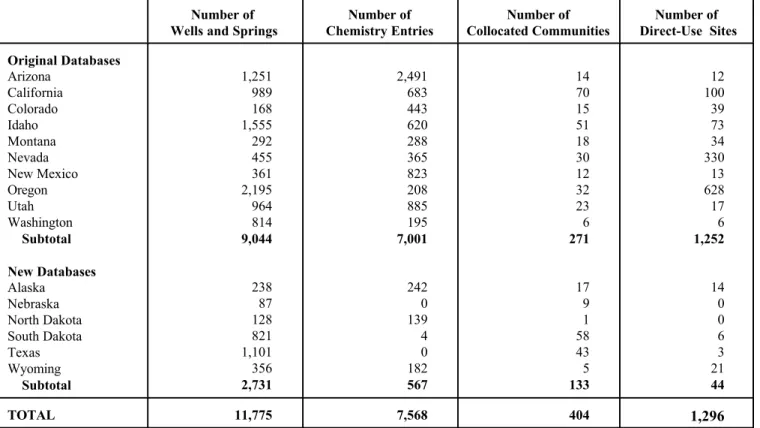
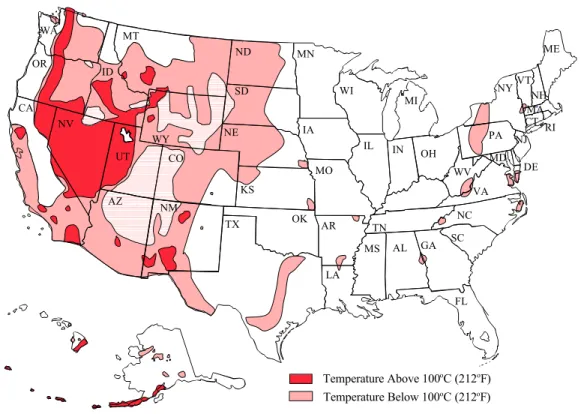
Reports from the original state teams and new information from the six additional states document a total of 11,775 wells and springs in the databases with the new states producing an additional 2,731 entries. This information was either not consistently reported in all state databases or was newly discovered in the development of newer state databases. Charlie's earliest achievement was the first use of a downhole heat exchanger (DHE) in Klamath Falls for a geothermal heating system about 70 years ago.
A major problem with early wells in the area was failure of the coil or heat exchanger in the well itself, particularly at the air/water interface. Oil was usually used to prevent pipe corrosion, but it was harmful to the environment. Among these four thermal waters Bad Gastein is an exception, due to the content of radon in the waters.
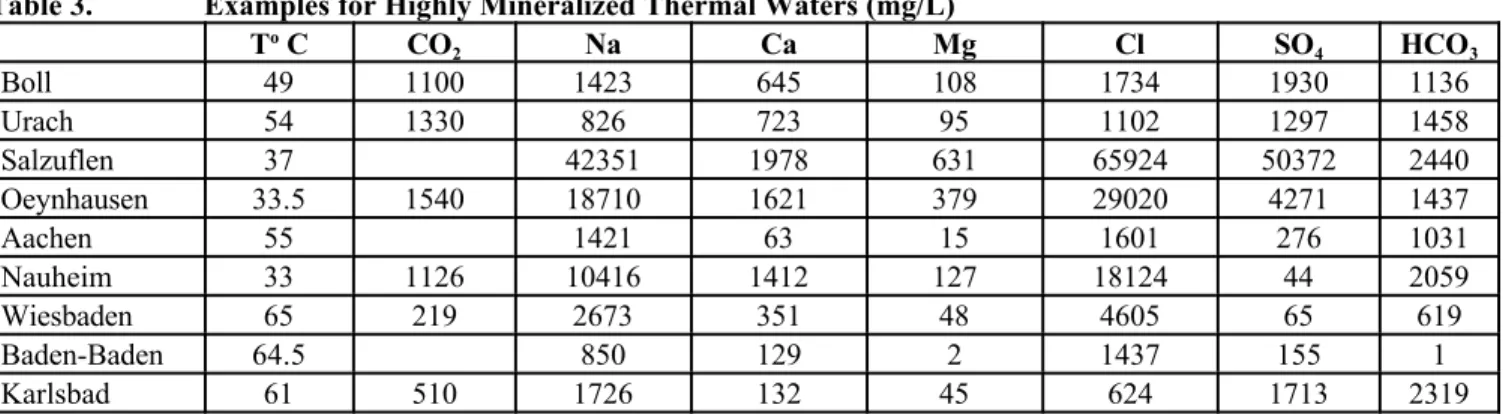
Throughout Central Europe, many highly mineralized thermal waters can be found, as halite, gypsum and carbonate rocks are widespread (e.g. Tertiary Upper Rhine graben, Middle Triassic Muschelkalk and Röt, and Permian Zechstein in northern and central Germany). The thermal waters of the northern rim of the Rheinische Schiefergebirge, Carlsbad, southern rim of the Taunus get their salt content from the Permian Zechstein. I think this overview gave an idea of the frequency and diversity of thermal waters in Germany and Central Europe, some of which have been used for a very long time.
The great diversity of the thermal waters and their classification in different regional provinces is shown in the final figure 2.
THERMAL SPRINGS AND SPAS IN POLAND
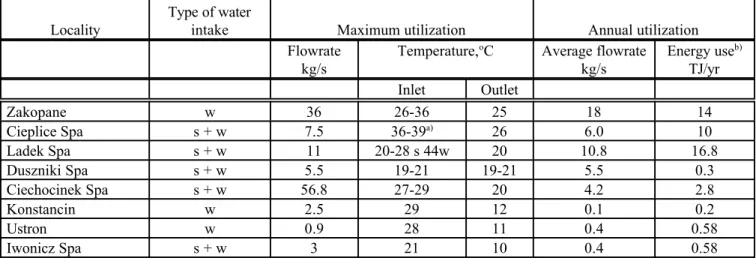
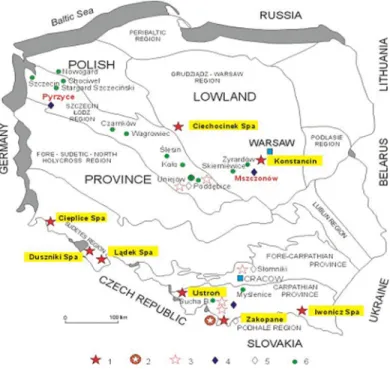
Having the warmest healing waters in Poland, Cieplice (Figure 1) is one of the most famous and most visited spas in Poland. Two of the hot springs in Cieplice were named after King Sobieski and his wife. The first bathhouse was built at the end of the 15th century; since then, it developed slowly but flourished in the 19th century.
Ladek is a good example of the appropriate joint use of geothermal water in healing, recreation and tourism. Ciechocinek is located in Central Poland, on the left bank of the Vistula River valley (Figure 1). After Ciechocinek was granted city rights (1919), the therapeutic station was a starting point for the rapid development of the city.
The first wells, m deep, which support the existing springs, were drilled at the end of the 19th century. In addition, it is currently one of the most famous and most visited Polish resorts. In general, centers will be one element of integrated or cascaded geothermal systems.
Zakopane is located in southern Poland (figures 1 and 2) on the slopes of the Tatra Mountains. the highest part of the Carpathians). The hot spring in Jaszczurowka was used by the local highlanders long before the mid-19th century. There are two completed projects, one of which has just been developed in Zakopane (30,000 inhabitants), the main city of the region.
The plans also include the construction of a conference center as an integral part of the complex. The investment will be financed from Polish sources, with the municipal council being one of the shareholders. Poddebice and the surrounding areas (as well as nearby Uniejow, which also has geothermal prospects) are home to Cretaceous sedimentary formations, one of the most promising geothermal aquifers in the country.
One of the limitations of a broad and adequate development is still insufficient promotion and funding. New results of the isotopic and hydrochemical investigations of the therapeutic waters of Ciechocinek Spa.” Proz.
THERMAL WATERS AND BALNEOLOGY IN BULGARIA
Bojadgieva 1 , S.Dipchikova 2 , A.Benderev 3 and J.Koseva 2
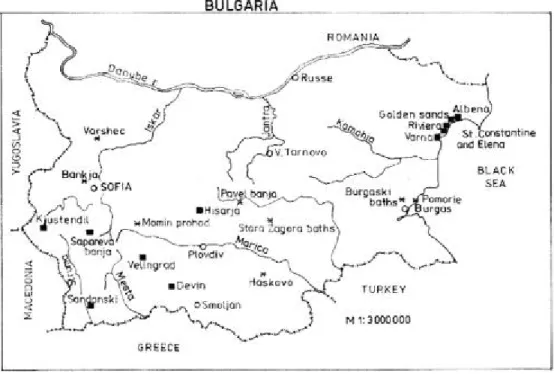
In the area of the capital alone, there are six springs of mineral water provided by fountains. In our largest spas, there is information about the use of thermal water for both treatment and heating in Roman baths from the 1st-4th centuries AD. Until 1990, all spas were included in the health care system and received regular state subsidies.
They have been selected for several reasons: well-developed treatment base, large tourist centers and good prospects for further development under the new free market policy in the country. It thrived in the first century under Roman rule, when impressive balneotherapy "temples" were built, which were the second largest in the Balkan Peninsula. The balneological complex is located in the center of the city and has been in operation since 1966.
Most thermal waters in the region are slightly mineralized and have a wide temperature range. Near the spa there is a large deposit of healing peat, rich in biologically active substances and moist acids. The combination of various natural factors in the same area creates exclusive opportunities for versatile, comprehensive and wide use of all.
The presence of hydrogen sulfide, hydrosulfide and sulfide in the mineral water in Kjustendil and Sapareva Banja makes them very useful in the treatment of bone joints, peripheral nervous system, curing gynecological disorders, curing chronic lead-based intoxications, etc. The gynecological disorders are of special priority on the balneotherapeutic list of this region. Since 1999, mineral water from the Chepino suburb has been bottled for sale at home and abroad.
In the North Black Sea region there is a unique combination of seaside resorts and spa centers for healing and prevention. These mineral waters can be used in the treatment of: diseases of the respiratory system and functional disorders of the cardiovascular system and nervous system; diseases of the circulatory system, second-rate allergies; disorders of the musculoskeletal system, gynecological diseases, etc. After 1980, modern geothermal stations were built in the northern part of the Black Sea and operated all year round.
Parallel to that, there are conditions that favor small local centers in the spirit of today's trends in the so-called "rural tourism" and traditional healing as well as to widely use the renewable energy sources in our daily life. Complex utilization of geothermal waters in the town of Sapareva Banja (SW Bulgaria), high priority national project,” World Solar Program Bulgaria.
LOW-ENTHALPY POWER GENERATION WITH ORC-TURBOGENERATOR
THE ALTHEIM PROJECT, UPPER AUSTRIA
Injection Well
Both wellheads of the two boreholes require 50 m² each, and the power house requires around 230 m3. The general planning of the integration of the turbogenerator system into the district heating network was carried out by Geotec Consult of Markt Schwaben in Bavaria. The staff of Geotec Consult were also responsible for the design and supervision of the borehole.
This contract and tariff concept makes it possible to economically exploit the geothermal station for heat and power in the municipality of Altheim. This article is adapted from the Proceedings of the International Summer School Conference: International Geothermal Days “Germany 2001”, Kiril Popovski and Burkhard Sanner, editors, published in Skopje, Macedonia - Used with permission.
THE SWISS DEEP HEAT MINING PROJECT - THE BASEL EXPLORATION DRILLING -
After selecting a first adequate site in the city of Basel and drilling the necessary boreholes, the goal was to create a deep fractured reservoir and build a pilot plant that produces electricity and heat. The modular concept of a Deep Heat Mining pilot plant consists of one injection well and two production wells. For a number of practical, economic, political and geothermal reasons, the first Enhanced Geothermal System pilot plant in Switzerland will be located in the Basel area of NW Switzerland at the border with France and Germany.
The city of Basel is a highly developed urban area with many heat consumers, existing heat distribution networks and a strong policy towards renewable energy sources. The sedimentary sequence filling the rift is relatively well known, but no wells have penetrated the crystalline bed predicted at a depth of 2.2 ± 0.2 km. The first exploratory well (DHM-1) was sighted in Otterbach and drilling began in June.
In January 2001, a temperature log from surface to 537 m revealed a geothermal gradient of 4.2EC/100 m, which is slightly higher than predicted. A new drilling program was set up, including a more powerful rig as well as larger borehole and casing diameters. Later, this borehole will be completed as the first of three seismic monitoring wells located around and above the future deeply fractured reservoir.
This article is taken from the Proceedings of the International Summer School Conference: International Geothermal Days “Germany 2001”, Kiril Popovski and Burkhard Sanner, editors, published in Skopje, Macedonia.
GEOTHERMAL PIPELINE