Otras secciones de este sitio:
☞ ☞ ☞ ☞
☞ Índice de este número
☞ ☞ ☞ ☞
☞ Más revistas
☞ ☞ ☞ ☞
☞ Búsqueda
Others sections in this web site:
☞ ☞ ☞ ☞
☞ Contents of this number ☞
☞ ☞ ☞
☞ More journals ☞
☞ ☞ ☞ ☞ Search
Artículo:
Incidence and prevalence of hepatitis C virus infection in Chile
Copyright © 2005: Mexican Association of Hepatology
ANNALS OF HEPATOLOGY
Number 2 April-June 2 0 0 5
Volume 4
R González et al. Hepatitis C incidence and prevalence in Chile 127
edigraphic.com
Annals of Hepatology 2005; 4(2): April-June: 127-130
Annals of Hepatology
1 Departments of Gastroenterology. 2 Public Health.
School of Medicine. Pontificia Universidad Católica de Chile.
Address for correspondence: Robinson González, M.D. Department of Gastroenterology School of Medicine
Pontificia Universidad Católica de Chile Marcoleta 367
833-0024 Santiago Chile
Phone number : 56-2-3543280 Fax number: 56-2-639778 E-mail: [email protected]
Manuscript received 25 February and accepted 12 April, 2005.
Original Article
Incidence and prevalence of hepatitis C
virus infection in Chile
Robinson González;1 Alejandro Soza;1 Verónica Hernández;1 Rosa M. Pérez;1 Manuel Álvarez;1 Arturo Morales;1 Marco Arellano;1 Arnoldo Riquelme;1 Paola Viviani;2 Carmen Covarrubias;1
Marco Arrese;1 Juan Francisco Miquel;1 Flavio Nervi1
Abstract
Chronic hepatitis C is a major cause of liver-related mor-bidity and mortality. Epidemiological data regarding this infection in developing countries is scanty. Methods: Prevalence of hepatitis C (HCV) infection was investigat-ed in a random sample of Chilean general adult popula-tion older than 20 years of age. Addipopula-tionally, frequency of HCV infection was assessed in group of native Chilean Amerindians (Mapuche Indians) living in an isolated lo-cality of the Southern Chile. Incidence of HCV infection was estimated using serum samples separated by 7 years (1993-2000). Results: Among 959 subjects, prevalence of anti-HCV antibodies was 1.15% (95% CI 0.48-1.82%) and 0.83% when only RIBA-confirmed cases were con-sidered. Among these subjects, 62.5% had detectable HCV RNA in serum and 40% of them had a history of blood transfusion. Age distribution of cases showed a steadily increasing prevalence with age. Estimated inci-dence of new HCV infections was 15 per 100,000 subjects per year in the period 1993-2000. No cases were detected among the 145 Mapuche subjects studied. Conclusions: HCV infection is a prevalent disease in the Hispanic popu-lation of Chile with a low incidence in the last decade, whereas it was not detected in an isolated Mapuche Indian community. Age distribution of prevalence suggests that the peak of infection in Chile occurred 30 to 50 years ago.
Key words: Incidence, prevalence, hepatitis C virus, liver disease, HCV, epidemiology, Mapuche Indians.
Ever since its discovery and characterization in 1989, the hepatitis C virus (HCV) has become a worldwide health is-sue.1 The World Health Organization (WHO) has estimated
that 170 million persons are chronically infected globally with HCV, and 3 to 4 million persons are newly infected each year.2 In Europe, prevalence vary from 0.01% up to
5%. In Africa, rates up to 51% have been reported.1,3 HCV is
the first cause of post-transfusion hepatitis, and its progres-sion to liver cirrhosis and hepatocellular carcinoma is well documented.4-6 HCV infection is mostly asymptomatic, and
is detected occasionally due to elevation of aminotransferas-es levels or routine screening of donated blood. However, the disease is also frequently detected in advanced stages due to appearance of its chronic complications.6-8 Nowadays,
HCV is the most frequent indication for liver transplantation in many countries,9 this being also the case in Chile.10
The epidemiology of HCV infection in Latin American countries has not been completely characterized. Available data from Chile indicate that prevalence of HCV infection among blood donors is between 0.2 to 0.5%.11-13 Infection
rates have also been studied in specific demographic groups, such as patients undergoing hemodialysis,14 pregnant
wom-en,15 patients with porphyria cutanea tarda16 and
hepatocellu-lar carcinoma.13 However, there is no available data
report-ing the prevalence of HCV infection in our general popula-tion. Thus, the aim of this study was to determine the incidence and prevalence of HCV infection in the Chilean population assessing HCV serology in two ethnically and geographically dissimilar groups: urban Hispanic population and rural Mapuche Indians.
Methods
Study design and demographics: This study was
his-Annals of Hepatology 4(2) 2005: 127-130
128
edigraphic.com
sustraídode-m.e.d.i.g.r.a.p.h.i.c cihpargidemedodabor
:rop odarobale FDP
VC ed AS, cidemihparG arap
acidémoiB arutaretiL :cihpargideM
sustraídode-m.e.d.i.g.r.a.p.h.i.c tory of gallstone disease in Chile.17 Two ethnically different
populations were studied in two separate regions of the country. Firstly, a sample of Chilean Hispanics was enrolled from households located in La Florida district in Santiago. This was carried out using a software that randomly selected blocks with a proportional representation of the different neighborhoods of the area, according to previously de-scribed methods.17 Secondly, a group of Mapuche Indians
was recruited from Huapi Island in the Southern part of Chile. Both groups were studied in 1993 and 2000. All sub-jects were interviewed by the authors and anthropometric characteristics, data from physical examination and a set of laboratory tests were performed. Additionally, an abdominal ultrasound was carried out in all subjects.
Ethnic characterization of subjects: The subjects were
classified as Hispanics or Mapuches based on a statement of race in a questionnaire that included the presence of specific ethnic surnames and skin color. An estimation of the aborig-ine genetic pool present in the Hispanic and Mapuche popu-lations was obtained by calculating the Amerindian Admix-ture Index (AAI) from the ABO blood group distribution, assuming a hybrid population of biparental origin.18,19 The
Amerindian maternal origin was defined by the determina-tion of the mitochondrial DNA polymorphisms in all Mapu-che Indians and in a selected sample of 350 unrelated His-panic individuals. For this purpose, genomic DNA was
iso-lated from each subject.20 The four Amerindian founder
haplotypes and sequencing analysis of the hypervariable D-loop region were performed in DNA samples of the two populations, as described previously.20-22
Serology: Anti-HCV antibodies were detected using a
third-generation ELISA assay (Abbot Labs. Chicago, IL) in samples obtained during the year 2000. Positive samples were confirmed using a third-generation recombinant immu-noblot assay (RIBA, Chiron Corporation, Emeryville, CA). Patients testing positive for both methods were considered true positives and HCV RNA presence was determined in their plasma samples. In addition, serological testing was performed on stored samples from 1993 for those patients testing positive in 2000.
HCV-RNA determination: HCV RNA was detected
by polymerase chain reaction (PCR), using two groups of starters for the non encoding 5’ region (Amplicor Test Version 2.0, Roche, Geneva, Switzerland).
Statistical methods: Demographic characteristics
were described with proportions and means with standard deviations (SD). Differences among subjects positive and negative for HCV infection were calculated using Fisher´s exact test and Student´s t test as appropriate. Prevalence ranges were calculated with a 95% confidence interval. Crude incidence and prevalence were calculated.
Results
During 1993, 1581 subjects from La Florida and 182 from Huapi Island were enrolled in a study on prevalence,
natural history and risk factors for cholelitiasis.17 In the year
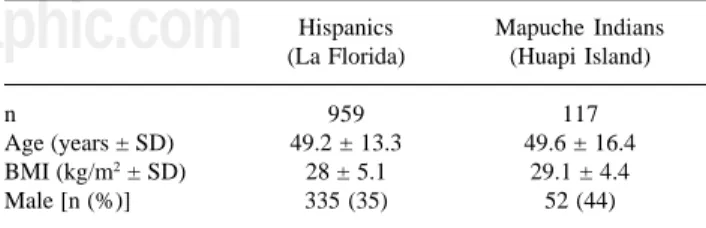
2000 the same population was reassessed, gathering infor-mation on 71% (1,117) of all patients from La Florida and 61% (145) of all patients from Huapi Island. Of all 1,117 pa-tients studied in La Florida in 2000, 964 were evaluated since 153 patients died during the period 1993-2000. From those 964 subjects, 959 individuals were studied, since 5 had a Mapuche family background. From a group of 145 indi-viduals living in Huapi Island, 117 were enrolled during March 2001, since 28 subjects died in the previous seven years. Data concerning demographics features of both popu-lation included in this study is shown in table I.
Analysis of serum samples obtained from subjects living in La Florida County, showed that 11 individuals tested pos-itive for anti-HCV antibodies by third-generation ELISA in-dicating a seroprevalence of HCV infection of 1.15% (95% CI 0.48-1.82%) in Chilean Hispanic population. On the oth-er hand, no positive samples woth-ere detected in Huapi Island. Table II shows individual results of ELISA and RIBA as well as PCR status for HCV positive patients. When only cases confirmed by RIBA were considered, the estimated HCV infection prevalence was 0.83%. Circulating HCV RNA using PCR was detectable in 62.5% of subjects with positive anti-HCV antibodies (0.52% of the entire sample). Abnormal alanine aminotransferase levels were present in 4 out of 5 (80%) patients with positive HCV viremia, none of which showed clinical or ultrasonographic signs of cirrhosis. Analysis of age distribution in individuals who tested posi-tive for HCV (Figure 1) indicates that prevalence of infec-tion increases progressively with age. Individuals older that 50 years old exhibit a prevalence of 1.5%. No statistically significant differences in gender were found in the preva-lence of HCV infection, being 1.49% in men and 0.96% in women (p=NS).
From a total of 8 patients with positive anti-HCV con-firmed by RIBA, 4 (50%) had received blood transfusions, and 1 (13%) had a history of intravenous drug abuse. The 3 remaining patients did not have an established risk factor for HCV, although 2 of them had undergone surgery in the past. We were able to estimate the incidence of HCV infection during the interval period of the study, by analyzing the sam-ples stored during the period 1993-2000 which were ob-tained from the same patients. Table II shows that there was 1 documented case of appearance of anti-HCV antibodies (by ELISA and RIBA) during this period of time. This trans-lates to an annual incidence of 15 per 100,000 people.
Table I. Demographic characteristics among Hispanic and Mapuche Indian
population.
Hispanics Mapuche Indians (La Florida) (Huapi Island)
n 959 117
Age (years ± SD) 49.2 ± 13.3 49.6 ± 16.4
BMI (kg/m2 ± SD) 28 ± 5.1 29.1 ± 4.4
R González et al. Hepatitis C incidence and prevalence in Chile 129
edigraphic.com
DiscussionThe World Health Organization estimates that the
world-wide prevalence of HCV infection is approximately 3%,23
with significant geographical and ethnical variations, possi-bly due to the presence and frequency of risk factors associ-ated to the transmission of HCV inside a community.3
This is the first epidemiological study to determine the prevalence of HCV infection in the general population of Chile. ELISA tests are the most frequently used screening methods, due mainly to their availability and low cost.
Sen-sitivity in immunocompetent population is higher than 95% using a third generation test. ELISA testing was posi-tive in 11 of 959 individuals from La Florida (1.15%). No patients with positive serology were detected among the Mapuche population. Due to the existence of false positive results, particularly in populations with a low prevalence, or selected groups like blood donors, results must be con-firmed with a second method. In our group, 8 out of 11 pa-tients with positive ELISA (73%) had positive confirma-tion. Therefore, the prevalence of HCV infection in His-panic population from Santiago in 2000 was 0.83%. This is approximately 2 to 4 times the described prevalence in blood donors in our country, probably due to the fact that blood donors are a highly selected group that does not rep-resent the prevalence of infection in the general population. Similar situations have been reported in other countries. For example in the United States prevalence of HCV infec-tion in voluntary blood donors is 0.6%, one third of what is described in the general population.24
The absence of positive HCV serology in Huapi Island can be explained by a relatively small sample size and by the characteristics of the small isolated rural community with little access to medical attention and procedures, and lower prevalence of certain behavioral patterns like intra-venous drug abuse and sexual promiscuity. This supports also that HCV infection is not an endemic infection in Chilean Amerindians.
Our study, which was carried out in adult population (20 years or older), shows an increasing prevalence of in-fection with age. This distribution is similar to what is de-scribed in countries like Japan or Italy, where the estimated peak incidence of infection was 30 to 50 years ago. Age distribution of HCV infection may suggest possible means of transmission and patterns of complications for the fol-lowing years. Our study suggests that HCV infection was due mainly to health related procedures, namely transfu-sions and administration of intravenous treatments by un-trained personnel or under sub-optimal conditions, a fre-quent situation in our country a few decades ago. In the Table II. Description of subjects with positive anti-HCV antibodies.
Patient Year 1993 Year 2000 Demographic and clinical characteristics
ELISA RIBA ELISA RIBA PCR Age† Sex Drugs Surgery Blood transfusion
1 (-) (-) (+) (+) (+) 30 M (-) (+) (-)
2 (+) (+) (+) (+) (+) 46 M (+) (-) (-)
3 (+) (+) (+) (+) (+) 49 F (-) (+) (-)
4 (+) (+) (+) (+) (-) 53 F (-) (+) (+)
5 (-) (+) (+) (+) (-) 57 M (-) (-) (-)
6 (+) (+) (+) (+) (-) 60 F (-) (-) (+)
7 (+) * (+) (+) (+) 63 F (-) (+) (+)
8 (+) (+) (+) (+) (+) 71 F (-) (+) (+)
9 (+) (-) (+) (-) (-) 49 M (-) (-) (-)
10 (+) (±) (+) (±) (-) 61 F (-) (+) (-)
11 (+) (±) (+) * (-) 71 M (-) (+) (+)
†: Age in year 2000 (+): Positive (-): Negative (±): Undetermined *: Sample not available M: Male F: Female
Figure 2. Estimated incidence of HCV infection in the United States.26
Figure 1. Prevalence of HCV infection according to age in a
Annals of Hepatology 4(2) 2005: 127-130
130
edigraphic.com
United States the highest prevalence is seen in young adults and decreases after the age of 50, suggesting a more recent peak of incidence, possibly associated to the in-crease in intravenous drug abuse between the 60s and 80s. Regarding risk factors in the studied population, half of the infected individuals had a history of receiving blood transfusion and 13% had used intravenous drugs. The remaining 38% had no identified risk factors, except history of surgery in two thirds of them. This infection pattern is in accordance to the results of a clinical study of 147 Chilean patients with hepatitis C,25 and is similar to
the pattern found in Japan and Italy, where the main means of transmission are medical procedures.
One of the most interesting aspects of this study was the possibility of analyzing serum samples obtained 7 years earlier from the same subjects. This allowed us to estimate the cumulative incidence of HCV infection during this pe-riod, resulting in 15 cases per 100,000 persons annually. This matches the estimated incidence during the same peri-od of time in the United States (15.8 per 100,000).26 Figure 2
shows the incidence of new HCV infections in the United States from 1960 to 2001, with the highest incidence dur-ing the mid-80s. In our population, given the age distribu-tion of prevalence, we estimate this peak incidence to have happened between the 50s and 70s.
In summary, in a representative sample of the urban population of Santiago, the prevalence of HCV infection is 1.15%, with confirmed infection in 0.83%, among whom 62.5% had circulating HCV RNA. There were no cases of HCV infection in the studied Mapuche Indian population. The distribution of the infection according to age suggests that exposure to the virus occurred mainly in the setting of medical procedures (transfusion and thera-peutic injections with unsafe techniques), estimating the period of maximal incidence of HCV infection 30 to 50 years ago.
Aknowledgments:
Supported by a grant of the National Commission for Scientific and Technological Research (CONICYT), FONDECYT Nº 1030744 to F.N and FONDECYT Nº 1050782 to A.S. The authors thank Schering-Plough Chile for donating HCV ELISA assays.
References
1. Brown RS Jr, Gaglio PJ. Scope of worldwide hepatitis C problem.
Liver Transpl 2003; 9: S10-13.
2. Global surveillance and control of hepatitis C. Report of a WHO Consultation organized in collaboration with the Viral Hepatitis Pre-vention Board, Antwerp, Belgium. J Viral Hepat 1999; 6: 35-47. 3. Memon MI, Memon MA. Hepatitis C: an epidemiological review. J
Viral Hepat 2002; 9: 84-100.
4. Tong MJ, el-Farra NS, Reikes AR, Co RL. Clinical outcomes after trans-fusion-associated hepatitis C. N Engl J Med 1995; 332: 1463-1466.
5. Niederau C, Lange S, Heintges T, Erhardt A, Buschkamp M, Hurter D, Nawrocki M, et al. Prognosis of chronic hepatitis C: results of a large, prospective cohort study. Hepatology 1998; 28: 1687-1695. 6. Liang TJ, Rehermann B, Seeff LB, Hoofnagle JH. Pathogenesis,
natu-ral history, treatment, and prevention of hepatitis C. Ann Intern Med 2000; 132: 296-305.
7. Dienstag JL. The natural history of chronic hepatitis C and what we should do about it. Gastroenterology 1997; 112: 651-655. 8. Lauer GM, Walker BD. Hepatitis C virus infection. N Engl J Med
2001; 345: 41-52.
9. Rakela J, Vargas HE. Hepatitis C: magnitude of the problem. Liver
Transpl 2002; 8: S3-6.
10. Buckel E, Uribe M, Brahm J, Silva G, Ferrario M, Godoy J, Segovia R, et al. Outcomes of orthotopic liver transplantation in Chile.
Trans-plant Proc 2003; 35: 2509-2510.
11. Covarrubias C, Chianale J, Aldunce M. Detection of antibody to hepatitis C virus in Chilean blood donors, patient with chronic liver disease and high risk subjects. Gastroenterology 1998; 115: A577. 12. Wolff C, Jiron MI, Elgueta R, Vera M, Toriello L, Martinez L, Parraguez
A. Prevalence of antibody to hepatitis C virus in blood donors. Analy-sis of confirmed results. Rev Med Chil 1996; 124: 615-616. 13. Munoz G, Velasco M, Thiers V, Hurtado C, Brahm J, Larrondo-Lillo
M, Guglielmetti A, et al. Prevalence and genotypes of hepatitis C virus in blood donors and in patients with chronic liver disease and hepatocarcinoma in a Chilean population. Rev Med Chil 1998; 126: 1035-1042.
14. Gonzalez R, Vollrath V, Pereira J, Covarrubias C, Vacarezza A, Chianale J. Prevalence of hepatitis C virus RNA in hemodialysis patients: com-parison of four antibody assays. Nephron 1995; 69: 181-182. 15. Quero MS, Suarez M, Munoz G, Torres M, Pena M. Prevalence of
hepatitis C virus antibodies in pregnant women in Santiago. Rev Med
Chil 1995; 123: 907-908.
16. Wolff C, Armas R, Puig A, Krause P, Parraguez A. Hepatitis C virus infection in patients with porphyria. Rev Med Chil 1994; 122: 294-298. 17. Miquel JF, Covarrubias C, Villaroel L, Mingrone G, Greco AV, Puglielli L, Carvallo P, et al. Genetic epidemiology of cholesterol cholelithiasis among Chilean Hispanics, Amerindians, and Maoris.
Gastroenterology 1998; 115: 937-946.
18. Matson GA, Sutton HE, Etcheverry RB, Swanson J, Robinson A.
Distribution of hereditary blood groups among Indians in South America. 1970; 27: 157-194.
19. Chakaraborty R. Gene admixture in human populations, models and predictions. Yearbook Phys Anthropol 1986; 29: 1-43.
20. Lahiri DK, Nurnberger JI Jr. A rapid non-enzymatic method for the preparation of HMW DNA from blood for RFLP studies. Nucleic
Acids Res 1991; 19: 5444.
21. Horai S, Kondo R, Nakagawa-Hattori Y, Hayashi S, Sonoda S, Tajima K. Peopling of the Americas, founded by four major lineages of mi-tochondrial DNA. Mol Biol Evol 1993; 10: 23-47.
22. Ginther C, Corach D, Penacino GA, Rey JA, Carnese FR, Hutz MH, Anderson A, et al. Genetic variation among the Mapuche Indians from the Patagonian region of Argentina: mitochondrial DNA sequence varia-tion and allele frequencies of several nuclear genes. In: Pena SDJ, Chakraborty R, Epplen JT, Jeffreys AJ, eds. DNA fingerprinting: state of
the science. Basel: Birkhauser Verlag, 1993: 214-219.
23. Hepatitis C - Global prevalence (update). Wkly Epidemiol Rec 1999; 74: 425-427.
24. Murphy EL, Bryzman S, Williams AE, Co-Chien H, Schreiber GB, Ownby HE, Gilcher RO, et al. Demographic determinants of hepati-tis C virus seroprevalence among blood donors. Jama 1996; 275: 995-1000.
25. Soza A, Arrese M, Gonzalez R, Alvarez M, Perez RM, Cortes P, Patillo A, et al. Clinical and epidemiological features of 147 Chilean pa-tients with chronic hepatitis C. Ann Hepatol 2004; 3: 146-151. 26. Centers for Disease Control and Prevention. Estimated Incidence of Acute
HCV Infection United States, 1960-2001. http://www.cdc.gov/ncidod/