PENÍNSULA OF SANTA ELENA STATE UNIVERSITY FACULTY OF SCIENCES OF EDUCATION AND LANGUAGES
ENGLISH LANGUAGE TEACHING CAREER
TOPIC:
“FOAM CRAFTS TO IMPROVE ENGLISH VOCABULARY FOR
THE SEVENTH BASIC YEAR STUDENTS AT E.G.B.
PARTICULAR CATÓLICA “JESÚS EL SALVADOR”, SANTA ELENA, SANTA ELENA PROVINCE, 2015-2016”
RESEARCH PAPER
AS A PREREQUISITE TO OBTAIN A: BACHELOR’S DEGREE IN ENGLISH
AUTHOR:
JOSÉ ANTONIO CARVAJAL VILLÓN
ADVISOR:
ING. SANDRA CAAMAÑO LÓPEZ, MSc.
LA LIBERTAD – ECUADOR
UNIVERSIDAD ESTATAL PENÍNSULA DE SANTA ELENA FACULTAD DE CIENCIAS DE LA EDUCACIÓN E IDIOMAS
CARRERA DE LICENCIATURA EN INGLÉS
TEMA:
“FOAM CRAFTS TO IMPROVE ENGLISH VOCABULARY FOR
THE SEVENTH BASIC YEAR STUDENTS AT E.G.B.
PARTICULAR CATÓLICA “JESÚS EL SALVADOR”, SANTA ELENA, SANTA ELENA PROVINCE, 2015-2016”
TRABAJO DE TITULACIÓN
Como un pre-Requisito para obtener el título de: LICENCIADO EN INGLÉS
AUTOR:
JOSÉ ANTONIO CARVAJAL VILLÓN
TUTORA:
ING. SANDRA CAAMAÑO LÓPEZ, MSc.
LA LIBERTAD – ECUADOR
PENÍNSULA OF SANTA ELENA STATE UNIVERSITY FACULTY OF SCIENCES OF EDUCATION AND LANGUAGES
ENGLISH LANGUAGE TEACHING CAREER
TOPIC:
“FOAM CRAFTS TO IMPROVE ENGLISH VOCABULARY FOR
THE SEVENTH BASIC YEAR STUDENTS AT E.G.B.
PARTICULAR CATÓLICA “JESÚS EL SALVADOR”, SANTA ELENA, SANTA ELENA PROVINCE, 2015-2016”
RESEARCH PAPER
AS A PREREQUISITE TO OBTAIN A: BACHELOR’S DEGREE IN ENGLISH
AUTHOR:
JOSÉ ANTONIO CARVAJAL VILLÓN
ADVISOR:
ING. SANDRA CAAMAÑO LÓPEZ, MSc.
LA LIBERTAD – ECUADOR
iv La Libertad, March 10th 2016
ADVISOR’ S APPROVAL
In my role as advisor of the research paper under the title “FOAM CRAFTS TO IMPROVE ENGLISH VOCABULARY FOR THE SEVENTH BASIC YEAR STUDENTS AT E.G.B. PARTICULAR CATÓLICA “JESÚS EL SALVADOR”, SANTA ELENA, SANTA ELENA PROVINCE, 2015-2016” prepared by JOSÉ ANTONIO CARVAJAL VILLÓN undergraduate student of the English Teaching Career, Faculty of Education and Languages at Península of Santa Elena State University, I declare that after having guided, studied and reviewed the project, I approve it in its entirety, because it meets the requirements and is sufficient for its submission to the evaluation of the academic tribunal.
v STATEMENT OF AUTHORSHIP
I, JOSÉ ANTONIO CARVAJAL VILLÓN, with ID number 240001015-9, undergraduate student from the Península of Santa Elena State University, Faculty of Sciences of Education and Languages, as a prerequisite to obtain a Bachelor’s degree in English, in my role as author of the research paper “FOAM CRAFTS TO IMPROVE ENGLISH VOCABULARY FOR THE SEVENTH BASIC YEAR STUDENTS AT E.G.B. PARTICULAR CATÓLICA “JESÚS EL SALVADOR”, SANTA ELENA, SANTA ELENA PROVINCE, 2015-2016” certify that this research is of my authorship, except for the quotes and reflections used in this research paper.
Sincerely,
___________________________________ José Antonio Carvajal Villón
vi BOARD OF EXAMINERS
__________________ ____________________
Dra. Nelly Panchana Rodríguez, MSc. Lcda. Glenda Pinoargote Parra, M.A. Ed. FACULTY OF EDUCATION AND ENGLISH TEACHINGLANGUAGES DEAN CAREER DIRECTOR
__________________________ ___________________________
Ing. Sandra Caamaño López, MSc Lcdo. Byron Villacreses Santillán, MBA. ADVISOR SPECIALIST
______________________________ Abg. Joel Espinoza Ayala, MSc.
vii DEDICATION
This thesis work is dedicated with so much love and gratitude to my parents, Luis and Pascuala, who have been the biggest source of support and motivation to me during my entire personal and academic life. This work is also dedicated to other important relatives, such as, my grandparents, my sister, my nephew and niece.
Moreover, it is important to mention that this work is dedicated to all my classmates, with whom I have shared almost five years full of special moments, combined with good and bad experiences, but that made stronger our friendship.
viii ACKNOWLEDGMENT
I wish to express my eternal gratitude to many special people who have been part of the development of this work. First and foremost, I have to thank God for letting me be alive, guiding my steps and making my dreams turn in real experiences. I also have to express my gratitude to my dear parents because they have modeled the person with ethical and moral values that I am right now, without their support and encouragement I could have never achieved this academic goal.
I would like to sincerely thank my thesis advisor, Ing. Sandra Caamaño López MSc, for her support and motivation throughout the development of this project work and especially for her guidance and confidence.
Additionally, I have to thank Península of Santa Elena State University, to the Director of the English Language Teaching Career, MSc. Glenda Pinoargote, and to the professors from the Languages School; they are definitely responsible for forming the new English language teaching professionals. Thank you so much for sharing your worthwhile knowledge.
Finally, I wish to thank the principal and English teacher at Escuela de Educación Básica Particular Católica “Jesús el Salvador” for their unconditional support in the application of this proposal and to the seventh basic year students for their relevant participation in this project.
ix DECLARATION
The content of the following graduation work is my responsibility; the intellectual property belongs to Peninsula of Santa Elena State University.
_________________________________ José Antonio Carvajal Villón
x TABLE OF CONTENTS
ADVISOR’ S APPROVAL ... iv
STATEMENT OF AUTHORSHIP... v
BOARD OF EXAMINERS ... vi
DEDICATION ... vii
ACKNOWLEDGMENT ... viii
DECLARATION ... ix
TABLE OF CONTENTS ... x
ILLUSTRATIONS ... xvii
CHARTS ... xviii
GRAPHICS ... xix
APPENDIX ... xx
ABSTRACT ... xxi
INTRODUCTION... 1
CHAPTER I ... 3
STATEMENT OF THE PROBLEM ... 3
1.1 TITLE ... 3
1.2 STATEMENT OF THE PROBLEM ... 3
1.2.1 Context ... 3
1.2.2 Critical Analysis ... 5
1.2.3 Formulation of the Problem ... 9
1.2.4 Guideline Questions ... 9
1.2.5 Delimitation of Research Object ... 9
1.3 SIGNIFICANCE ... 10
1.4 OBJECTIVES OF THE RESEARCH ... 12
1.4.1 General Objective... 12
1.4.2 Specific Objectives... 12
CHAPTER II ... 13
THEORETICAL FRAMEWORK ... 13
xi
2.1.1 Vocabulary Development... 14
2.1.2 Engagement with vocabulary ... 16
2.1.3 The Importance of Vocabulary Learning ... 17
2.1.4 The Importance of Vocabulary for English skills ... 19
2.1.4.1 Speaking ... 19
2.1.4.2 Listening ... 19
2.1.4.3 Reading ... 20
2.1.4.4 Writing ... 21
2.1.5 Types of Vocabulary ... 21
2.1.6 How to teach Vocabulary ... 22
2.1.6.1 Traditional Approaches and Techniques ... 22
2.1.6.1.1 Visual techniques ... 22
2.1.6.1.2 Verbal techniques ... 23
2.1.6.1.3 Translation... 23
2.1.6.2 Student-centered Learning ... 23
2.1.7 Benefits of Using Strategies ... 23
2.1.8 Principles of Vocabulary Learning-Teaching ... 24
2.1.9 Other Significant Aspects of Language Learning Process ... 25
2.1.10 Methods for teaching vocabulary ... 26
2.1.11 Learning Styles... 26
2.1.12 Multiple Intelligences Theory ... 27
2.1.13 Vocabulary Learning Strategies ... 30
2.1.14 Didactic Materials ... 31
2.1.15 Significance of Didactic Resources ... 32
2.1.16 Classification of Didactic Materials ... 33
2.1.16.1 Permanent Material ... 33
2.1.16.2 Informative Material ... 33
2.1.16.3 Visual Illustrative Material ... 33
2.1.16.4 Audiovisual Material ... 34
2.1.17 Teachers’ Creativity for Designing Didactic Materials ... 34
xii
2.1.19 Ludic Activities for Teaching Vocabulary ... 35
2.1.20 Reasons to Apply Ludic/Playful Activities ... 35
2.1.21 Classification of Ludic Activities... 36
2.2 PHILOSOPHICAL BASIS ... 37
2.3 PEDAGOGICAL BASIS ... 41
2.4 PSYCHOLOGICAL BASIS ... 45
2.5 FUNDAMENTAL CATEGORIES ... 46
2.5.1 English language ... 46
2.5.2 English as a foreign language ... 47
2.5.3 English language learners ... 47
2.5.4 Vocabulary ... 47
2.5.5 Crafts ... 47
2.5.6 Foam ... 48
2.5.7 Strategies ... 48
2.5.8 Didactic Resources ... 48
2.5.9 Ludic Activities ... 49
2.6 LEGAL BASIS ... 49
2.7 HYPOTHESIS ... 50
2.7.1 VARIABLES OF THE STUDY ... 50
2.7.1.1 Dependent Variable ... 50
2.7.1.2 Independent Variable ... 50
CHAPTER III... 51
METHODOLOGY ... 51
3.1 RESEARCH APPROACH... 51
3.1.1 Scientific Method ... 51
3.1.2 Deductive Method ... 52
3.1.3 Inductive Method ... 52
3.1.4 Observation Method ... 53
3.1.5 Qualitative Method... 53
3.1.6 Quantitative Method... 54
xiii
3.2.1 Exploratory Research ... 54
3.2.2 Field Research ... 55
3.2.3 Bibliographic Research ... 55
3.2.4 Correlational Research ... 55
3.2.5 Applied Research ... 56
3.3 POPULATION AND SAMPLE ... 56
3.3.1 Population ... 56
3.3.2 Sample ... 57
3.4 VARIABLES OPERATIONALIZATION ... 58
3.4.1 Independent Variable ... 58
3.4.2 Dependent Variable. ... 59
3.5 TECHNIQUES AND INSTRUMENTS FOR DATA COLLECTION .... 60
3.5.1 Techniques ... 60
3.5.1.1 Observation ... 60
3.5.1.2 Survey ... 60
3.5.1.3 Interview ... 60
3.5.2 Instruments ... 61
3.5.2.1 Camera, video-camera... 61
3.5.2.2 Observation Guide ... 61
3.5.2.3 Questionnaire ... 61
3.6 DATA COLLECTION PLAN ... 62
3.7 DATA PROCESSING PLANNING ... 63
3.8 ANALYSIS AND INTERPRETATION OF RESULTS ... 64
3.8.1 Interview to the principal ... 64
3.8.2 Interview to the English teacher. ... 67
3.8.3 Interview to Specialist 1 ... 70
3.8.4 Interview to Specialist 2 ... 74
3.8.5 Interview to Specialist 3 ... 77
3.8.6 Interview to Specialist 4 ... 80
3.8.7 Survey to students of seventh basic year... 84
xiv
3.8.9 Analysis Results of Students’ Survey ... 96
3.8.10 Observation Class... 97
3.8.11 Analysis of the Observation Class ... 98
3.9 CONCLUSIONS AND RECOMMENDATIONS ... 99
3.9.1 Conclusions ... 99
3.9.2 Recommendations ... 100
CHAPTER IV ... 101
THE PROPOSAL... 101
4.1 INFORMATIVE DATA ... 101
4.1.1 Title of the Proposal ... 101
4.1.2 Executing Institution ... 101
4.1.3 Beneficiaries ... 101
4.1.4 Location... 102
4.1.5 Estimated time for Execution ... 102
4.1.6 Responsibles ... 102
4.1.7 Budget ... 102
4.2 PROPOSAL BACKGROUND ... 103
4.3 SIGNIFICANCE ... 104
4.4 OBJECTIVES ... 105
4.4.1 General Objective... 105
4.4.2 Specific Objectives... 105
4.5 DESIGN AND DEVELOPMENT OF THE PROPOSAL... 105
4.5.1 Didactic Materials ... 105
4.5.2 Foam Crafts ... 106
4.5.3 Characteristics of Foam Crafts ... 107
4.5.4 Benefits of Using Foam Crafts ... 108
4.6 Activities for Teaching Vocabulary Using Foam Crafts... 109
4.6.1 Vocabulary Content ... 110
4.6.2 FOAM CRAFTS FOR TEACHING VOCABULARY. ... 111
4.6.2.1 Foam Posters ... 112
xv
4.6.2.3 Foam Charts ... 114
4.6.2.4 Foam Board-Games ... 115
4.6.2.5 Foam Puppets ... 116
4.6.2.6 Foam Cards ... 117
4.6.3 Activities ... 118
Activity Nº 1: Matching Adjectives of Description ... 118
Activity Nº 2: Adjectives of Description ... 119
Activity Nº 3: Countries and Nationalities ... 120
Activity Nº 4: Matching Adjectives of Comparison ... 121
Activity Nº 5: Board Game with Adjectives of Comparison ... 122
Activity Nº 6: Matching Places in a City ... 123
Activity Nº 7: Posters of Places in a City ... 124
Activity Nº 8: Too + Adjectives ... 125
Activity Nº 9: Listening to and Matching Chores ... 126
Activity Nº 10: Reading Chores ... 127
Activity Nº 11: Description of Personal Chores ... 128
Activity Nº 12: Memory Game with Ingredients and Verbs ... 129
Activity Nº 13: Description of Recipes ... 130
Activity Nº 14: Memory Game with Activities for the Weekend ... 131
Activity Nº 15: Board Game with Future Tense ... 132
Activity Nº 16: Matching Holidays and Dates ... 133
Activity Nº 17: Description of Holiday Cards ... 134
4.6.4 Strategies of Improvement ... 135
4.6.5 Other Aspects of Improvement in Students ... 135
4.6.6 Results of Implementation ... 137
4.6.6.1 Results of Diagnostic Test ... 137
4.6.6.1.1 Analysis of Diagnostic Test Results of Students ... 138
4.6.6.2 Results of Final Test... 139
4.6.6.2.1 Analysis of Final Test Results... 140
4.6.6.3 Results of Students’ Improvement ... 141
xvi
4.7 Conclusions and Recommendations ... 143
4.7.1 Conclusions ... 143
4.7.2 Recommendations ... 144
CHAPTER V ... 145
ADMINISTRATIVE FRAMEWORK... 145
5.1 BUDGET... 145
5.2 TIMETABLE ... 147
5.3 BIBLIOGRAPHY ... 148
5.4 WEB REFERENCES ... 153
5.5 VIRTUAL UPSE BIBLIOGRAPHY ... 153
xvii ILLUSTRATIONS
Illustration Nº 1: Problem Tree ... 6
Illustration Nº 2: E.E.B. Particular Católica "Jesús el Salvador" ... 101
Illustration Nº 3: Location of E.E.B. Particular Católica "Jesús el Salvador" .... 102
Illustration Nº 4: Foam Crafts ... 106
Illustration Nº 5: Foam Posters ... 112
Illustration Nº 6: Foam Flashcards ... 113
Illustration Nº 7: Foam Charts ... 114
Illustration Nº 8: Foam Board Games ... 115
Illustration Nº 9: Foam Puppets ... 116
Illustration Nº 10: Foam Cards ... 117
Illustration Nº 11: Adjectives of Description Activity ... 118
Illustration Nº 12: Physical Description of People... 119
Illustration Nº 13: Countries and Nationalities Matching Activity ... 120
Illustration Nº 14: Comparative Adjectives Matching Activity ... 121
Illustration Nº 15: Comparative Adjectives Game ... 122
Illustration Nº 16: Labeling Places in a Foam City ... 123
Illustration Nº 17: Elaboration of a City Foam Poster ... 124
Illustration Nº 18: Foam Puppets Performance ... 125
Illustration Nº 19: Chores-Listening Activity ... 126
Illustration Nº 20: Chores-Reading Activity ... 127
Illustration Nº 21: Description of Personal Chores ... 128
Illustration Nº 22: Ingredients Memory Game ... 129
Illustration Nº 23: Recipe Description Activity ... 130
Illustration Nº 24: Activities for the Weekend-Game ... 131
Illustration Nº 25: Future Tense and Weekend Activities-Board Game ... 132
Illustration Nº 26: Holiday Activity ... 133
xviii CHARTS
Chart Nº 1: Population Chart ... 56
Chart Nº 2: Operationalization of the Independent Variable ... 58
Chart Nº 3: Operationalization of the Dependent Variable... 59
Chart Nº 4: Data Collection Plan ... 62
Chart Nº 5: Data Processing Plan ... 63
Chart Nº 6: Importance of English Vocabulary ... 84
Chart Nº 7: Students' Opinion about their English Vocabulary ... 85
Chart Nº 8: Appreciation of Students about English Vocabulary ... 86
Chart Nº 9: Usefulness of Didactic Resources ... 87
Chart Nº 10: Frequency of Didactic Resources Used by the Teacher ... 88
Chart Nº 11: Types of Vocabulary Resources used by the Teacher ... 89
Chart Nº 12: Use of Foam Crafts for Vocabulary Teaching ... 90
Chart Nº 13: Characteristics of Foam Crafts ... 91
Chart Nº 14: Opinions of Foam Crafts to Support English Vocabulary ... 92
Chart Nº 15: Willingness Criteria of Students to Use Foam Crafts ... 93
Chart Nº 16: Students' Survey Results ... 94
Chart Nº 17: Vocabulary Content from the Book "My New Puppet" ... 110
Chart Nº 18: Strategies of Improvement ... 135
Chart Nº 19: Cooperative Learning Matrix Adapted to the Proposal ... 136
Chart Nº 20: Results of Students' Diagnostic Test ... 137
Chart Nº 21: Final Test Results of Students ... 139
Chart Nº 22: Percentage of Students' Improvement after the Proposal ... 141
Chart Nº 23: Timetable ... 147
Chart Nº 24: Rubrics for the Diagnostic Vocabulary Test ... 168
Chart Nº 25: Rubrics for the Final Vocabulary Test ... 172
xix GRAPHICS
Graphic Nº 1: Importance of English Vocabulary ... 84
Graphic Nº 2: Students' Opinion about their English Vocabulary ... 85
Graphic Nº 3: Appreciation of Students about English Vocabulary ... 86
Graphic Nº 4: Usefulness of Didactic Resources ... 87
Graphic Nº 5: Frequency of Didactic Resources Used by the Teacher ... 88
Graphic Nº 6: Types of Vocabulary Resources used by the Teacher ... 89
Graphic Nº 7: Use of Foam Crafts for Teaching Vocabulary ... 90
Graphic Nº 8: Characteristics of Foam Crafts ... 91
Graphic Nº 9: Opinions of Foam Crafts to Support English Vocabulary ... 92
Graphic Nº 10: Willingness Criteria of Students to Use Foam Crafts ... 93
xx APPENDIX
Appendix Nº 1: Survey Applied to Students ... 155
Appendix Nº 2: Interview Applied to the English Teacher ... 158
Appendix Nº 3: Interview Applied to the Principal ... 160
Appendix Nº 4: Interview Applied to the Specialists ... 162
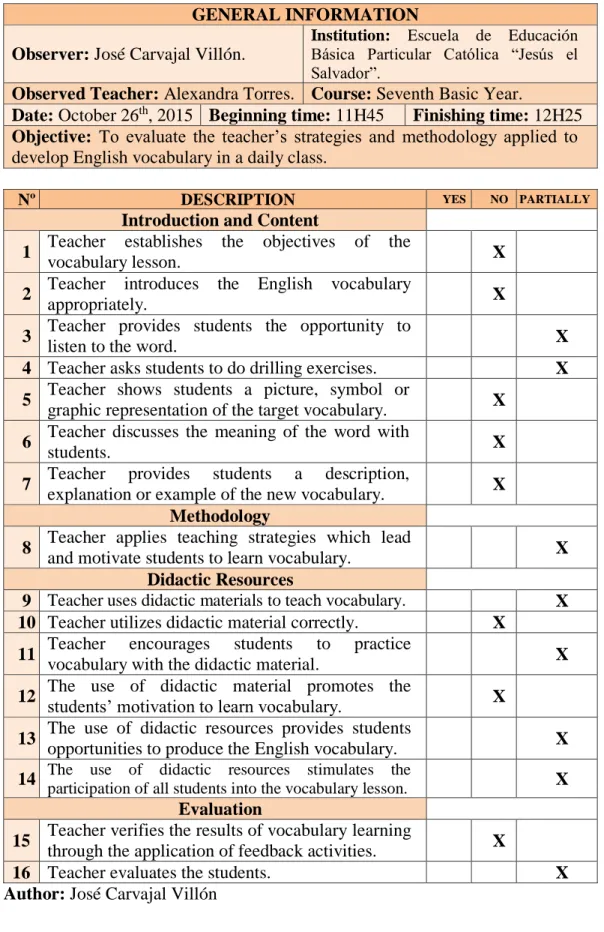
Appendix Nº 5: Observation Guide ... 164
Appendix Nº 6: Diagnostic Test Applied to Students ... 165
Appendix Nº 7: Rubrics for the Diagnostic Vocabulary Test ... 168
Appendix Nº 8: Final Test Applied to Students ... 169
Appendix Nº 9: Rubrics for the Final Vocabulary Test ... 172
Appendix Nº 10: Students’ Names from the Seventh Basic Year ... 173
Appendix Nº 11: Legal Articles ... 174
Appendix Nº 12: Interview with the Principal ... 176
Appendix Nº 13: Interview with the English Teacher ... 176
Appendix Nº 14: Observation Session ... 177
Appendix Nº 15: Students during the Survey ... 177
Appendix Nº 16: Students during the Diagnostic Test ... 178
Appendix Nº 17: Investigator during the Proposal Application ... 178
Appendix Nº 18: Investigator during the Proposal Application ... 179
Appendix Nº 19: Investigator during the Proposal Application ... 179
Appendix Nº 20: Students during the Final Test ... 180
Appendix Nº 21: Elaboration of Foam Crafts-Flashcards ... 180
Appendix Nº 22: Elaboration of Foam Crafts-City ... 181
Appendix Nº 23: Elaboration of Foam Crafts-Posters ... 181
Appendix Nº 24: Elaboration of Foam Crafts-Cards and Charts ... 182
Appendix Nº 25: Letter to the Educational Institution Principal ... 183
Appendix Nº 26: Permission to Apply the Proposal ... 184
Appendix Nº 27: Certification of the Proposal Application ... 185
Appendix Nº 28: Urkund Report ... 186
xxi PENÍNSULA OF SANTA ELENA STATE UNIVERSITY
FACULTY OF SCIENCES OF EDUCATION AND LANGUAGES ENGLISH LANGUAGE TEACHING CAREER
TOPIC:
“FOAM CRAFTS TO IMPROVE ENGLISH VOCABULARY FOR THE SEVENTH BASIC YEAR STUDENTS AT ESCUELA DE EDUCACIÓN BÁSICA PARTICULAR CATÓLICA “JESÚS EL SALVADOR”, SANTA ELENA, SANTA ELENA PROVINCE, 2015-2016”
Author: José Antonio Carvajal Villón Advisor: Ing. Sandra Caamaño López, MSc.
ABSTRACT
Vocabulary is considered as an essential part in the learning process of any language, and the English language is not the exception. Words are the basis for the production of the language; people need words to speak and write and they also require knowing vocabulary in order to understand what they read or listen. The basis of this investigation is to demonstrate that vocabulary teaching needs to be a dynamic and encouraging process for students. Teachers have to promote the motivation in students for learning vocabulary because it will be used in the activities for practicing and improving the English language learning. Therefore, the application of didactic resources is necessary to guarantee the appropriate vocabulary learning due to their immense educational value. The present work is centered on the significance of the application of foam crafts (didactic material made of foam) in the vocabulary teaching-learning process. Additionally, the purpose of this research is to show other teachers that foam crafts are a didactic option to optimize the vocabulary teaching as it was demonstrated in the seventh basic year students at Escuela de Educación Básica Particular Católica “Jesús el Salvador” during the 2015-2016 school year. It is fundamental to mention that some techniques and instruments, such as, surveys, interviews, observation, questionnaires, and observation guide, were applied in order to collect and present information in a mathematical and statistical way.
1 INTRODUCTION
Teaching vocabulary to students is not an easy task; teachers need to take into account different aspects that are important for the correct learning of new words. Vocabulary is a primary tool for any language learner. Learners need to know vocabulary because it contributes to the mastering of the four main English skills. Hence, vocabulary is essential to the English language teaching and learning because without vocabulary learners will not be able to speak, write, read nor listen in the target language.
Knowing that vocabulary is of great importance for learners in their English language development, it is relevant to mention that a factor that is closely related to a positive vocabulary learning is the way in which teachers teach new vocabulary. The application of didactic resources is necessary for providing students opportunities to practice, upgrade and increase their English vocabulary knowledge.
The purpose of the present investigative work is to establish the benefits of using foam crafts or didactic material made of foam during the English vocabulary lessons for students of seventh basic year at Escuela de Educación Básica Particular Católica “Jesús el Salvador”, 2015-2016. Furthermore, students benefit from the application of foam crafts because they promote positive experiences during the vocabulary lessons; being more specific, foam crafts activate the interest for learning, contribute to the cooperative learning, provide an illustration of the vocabulary words, and facilitates the comprehension.
2 Chapter I-The Problem: this chapter gives details about the statement of the
problem, the critical analysis, the significance of the problem, general and specific objectives of the investigation.
Chapter II-Theoretical Framework: this chapter describes all the theories of
important authors and previous researches that support the investigation topic. It also gives details about the philosophical, psychological and legal basis of this work, and the research hypothesis.
Chapter III-Methodology: it explains the methodological strategies applied during
the investigation in order to get a successful work. This chapter also includes the level of research, population, techniques and instruments used to gather relevant information about the investigated topic, data collection with the respective analysis and interpretation, conclusions and recommendations.
Chapter IV-The Proposal: this chapter describes the solution to the problem and it
analyses the outcomes of this investigative work.
Chapter V-Administrative Framework: this chapter establishes the budget,
3 CHAPTER I
STATEMENT OF THE PROBLEM
1.1 TITLE
“FOAM CRAFTS TO IMPROVE ENGLISH VOCABULARY FOR THE SEVENTH BASIC YEAR STUDENTS AT ESCUELA DE EDUCACIÓN BÁSICA PARTICULAR CATÓLICA “JESÚS EL SALVADOR”, SANTA ELENA, SANTA ELENA PROVINCE, 2015-2016”
1.2 STATEMENT OF THE PROBLEM
1.2.1 Context
As a consequence of globalization, diversification, and progress of many nations, the acquisition of a second language is becoming more and more significant for the life of people who want to succeed in different areas, such as, social, political, business, academic, or even personal. At the moment of selecting which language to learn, English is the best option because some countries in Europe have adopted it as their second official language. Therefore, people are studying this language in order to achieve their future goals. English, like all languages, is constantly changing in terms of importance.
4 achieving world-wide audiences so that increases the necessity of learning English.
Ecuador is a country where people have the need of learning English due to the great number of visits of English-speaking tourists. The way of getting Ecuadorians to have a second language is improving the teaching of this language. Therefore, the Government of Ecuador has undertaken far-reached, concrete actions to improve the quality of education in the country. And one of the aspects that the Ecuadorian authorities in Education want to improve is the English language teaching in order to provide students the opportunity of attending and succeeding in universities all over the world.
Education in the Santa Elena province is improving gradually in different areas every day and English teaching is not the exception. Unfortunately, Public institutions do not include English in their curriculum, but Private schools do. They want their educators to enhance their teaching methods and techniques; that is why teachers need to refresh the way of giving their classes by including engaging strategies and materials in order to offer students better learning opportunities.
5 development of students in the English language field because their poor target vocabulary knowledge. Additionally, it is important to point out that the non-use of any didactic resource promotes classes with a low level of students’ motivation and interest for learning the English language.
In brief, people need to have English as a foreign language because it supplies many advantages to those who speak it or at least have a little knowledge of it. Due to this and all the reasons mentioned previously, the use of foam crafts for teaching new vocabulary into the English classes is an aspect that all teachers should take into account for the visual engagement of their pupils to the classes. Teachers should also put it in practice as a good technique for teaching vocabulary, which will upgrade the learning process of our students and provide them incentive classes.
1.2.2 Critical Analysis
Learning vocabulary, for some people, seems to be one of the easiest parts at the moment of acquiring a foreign language even though it is one of the hardest things to do. Learning new words, new expressions or new phrases may be a serious problem for students because of their pronunciation, spelling, and meaning and mainly because they do not use them constantly. Vocabulary needs faithful practice and the new English vocabulary teaching has to be done by using didactic resources that make increase the motivation of students for learning English.
6 Illustration Nº 1: Problem Tree
Author: José Carvajal Villón
POOR ENGLISH VOCABULARY KNOWLEDGE IN STUDENTS OF SEVENTH BASIC YEAR AT ESCUELA DE EDUCACIÓN BÁSICA
PARTICULAR CATÓLICA “JESÚS EL SALVADOR” Traditional English
lessons
Short memory-term vocabulary learning
Low motivation in the vocabulary lessons Passive
students
Traditional methodology
Teacher is the center of
the class Teacher is the language producer Receptor students Oral drilling exercises Written drilling exercises Not engaged students Not participative students Non-appropriated vocabulary instruction Exercises from English book Vocabulary lists on the
board
Lack of didactic material for introducing new vocabulary
Classes are not dynamic
Students’ interest is not
activated EFFECTS
CAUSES
EFFECTS
7 As it was previously illustrated, there are some reasons for the low level of English vocabulary knowledge of students of seventh basic year. One of the reasons that causes the problem is that teachers still apply traditional methodologies in which they are the center of the classes; all the English language lessons are just focused on what teacher says or does, he/she is the only one who produces the language. Therefore, students are solely a passive part in the English language teaching-learning process without participation and opportunities to practice the topics of the classes; they have become receptors of information instead of being the producers.
Furthermore, the non-appropriated instruction of vocabulary affects the acquisition of new words. Unfortunately, teachers do not find interesting ways for helping students in the acquisition of new vocabulary. It is also real that books do not include additional resources or exercises that facilitate the teaching and learning process. That is why, teachers just focus on the English book activities and they do not look for additional and interesting tasks that promote the constant practice of vocabulary. As a consequence of that, students have a short memory-term in the vocabulary learning process because they just write lists of words on their notebooks and do oral and written drilling exercises. Thus, students remember words at the moment of the drilling exercises and then they forget them in other activities.
8 Escuela de Educación Básica Particular Católica “Jesús el Salvador” is an institution with a good infrastructure and well-trained teachers. This, like all institutions, has the main objective to offer an appropriate education to its children. Even though public schools do not include English as a subject in their curriculums, this private institution has the desire of provide to its scholars a better level of education. Authorities and teachers agree that learning English is a plus for any child’s future life. Thus, the institution is open to receive new ideas in order to update the English teaching and one way to reach this goal is through the use of foam crafts.
Nowadays, there is an immense variety of resources which can be used to make didactic means, such as, wood, carton, plastic, foam, etc. these resources are easily to find, economically accessible for people and even, in most cases, recyclable. Teachers should look for the way of designing and creating their own didactic materials like posters, flashcards, charts, etc. with the purpose of improving the vocabulary learning.
Moreover, it is pretty relevant to show that the use of foam crafts will provide motivation and interest in learners during the English lessons. It will activate the language attainment by including foam crafts to introduce, practice and remember new vocabulary. Through the use of foam crafts, students will be immersed into the class by watching pictures, posters, cards, etc. around the classroom and which main goal is to provide students the opportunity of remembering words that belong to the vocabulary taught.
9 1.2.3 Formulation of the Problem
What will be the influence of foam crafts to improve the English vocabulary for the seventh basic year students at Escuela de Educación Básica Particular Católica “Jesús el Salvador”, Santa Elena, Santa Elena Province?
1.2.4 Guideline Questions
What is vocabulary?
How important is learning vocabulary in an English language course?
What are the best ways of teaching vocabulary?
What activities may help second language learners to improve the vocabulary acquisition?
Why is it important to develop didactic materials for teaching English vocabulary?
What are the benefits of using foam crafts to enhance the English vocabulary instruction?
Are foam crafts a good and educative medium to teach, learn, and practice English vocabulary?
1.2.5 Delimitation of Research Object
10 AREA: English
ASPECT: Foam Crafts
TITLE: “FOAM CRAFTS TO IMPROVE ENGLISH VOCABULARY FOR THE SEVENTH BASIC YEAR STUDENTS AT ESCUELA DE EDUCACIÓN BÁSICA PARTICULAR CATÓLICA “JESÚS EL SALVADOR”, SANTA ELENA, SANTA ELENA PROVINCE, 2015-2016”
PROBLEM: Poor vocabulary knowledge of students of seventh basic year at Escuela de Educación Básica Particular Católica “Jesús el Salvador”, Santa Elena, Santa Elena Province, 2015-2016.
TIME LIMITATION: The present investigation work will be carried out during the school year 2015-2016.
POPULATION LIMITATION: Seventh basic year students
SPACE LIMITATION: Escuela de Educación Básica Particular Católica “Jesús el Salvador”
CONTEXT LIMITATION: This research will be focused on the importance of using foam crafts to improve English vocabulary.
1.3 SIGNIFICANCE
11 or feelings. The acquisition and building of vocabulary is important and teachers need to be aware that students need to be engaged at the moment of introducing new words; words that are going to be used in more difficult structures in the future (sentences, compositions, essays, etc). Therefore, this investigation has a high level of importance. The creation of foam educational crafts for the English classes is vital in the moment of learning new vocabulary because they contribute to the students’ knowledge, motivation, and interest.
The use of didactic resources made of foam has many benefits for children, such as, the senses stimulation of students; most students like learning by visualizing the content of the class and foam crafts achieve that goal. Furthermore, foam crafts increase the motivation of students during the vocabulary lessons and they have the possibility to practice vocabulary in an enjoyable environment. Seventh basic year students at Escuela de Educación Básica Particular Católica “Jesús el Salvador” will benefit from learning vocabulary through dynamic activities and through the visualization of teaching resources made of the material previously mentioned which will illustrate the words they will have to learn at each study unit forgetting the sometimes boring techniques that do not help to achieve the learning goals completely.
From the social point of view, foamy educative materials will reinforce the domain of the language by practicing words watching the pictures and reminding words. This kind of didactic resource is also an excellent alternative for developing communicative and cooperative skills for all students and will promote a positive attitude in learners because they will feel more engaged to the topic by watching pictures. As a result of this, students will be more active in the classes and they will remember vocabulary more easily.
12 the approval of the institution authorities. Furthermore, there are the resources, materials and the required tools to design, fulfill, and work on this task.
1.4 OBJECTIVES OF THE RESEARCH
1.4.1 General Objective
To evaluate the impact of the application of foam crafts through the analysis of applied researches in the English language field in order to develop English vocabulary.
1.4.2 Specific Objectives
To consult the bibliographical resources in books, online publications and journals for the development of the theoretical framework of the investigation.
To collect the necessary information through the application of surveys and interviews and other techniques in order to present it in a statistical and mathematical way.
13 CHAPTER II
THEORETICAL FRAMEWORK
2.1 PREVIOUS RESEARCH
English has created a special place, a common platform across the globe. It has become a unifying agent, a common channel of expression. This has strengthened the corporate and industrial sectors and to some extent the academia. The desire to learn English for one purpose or another has, therefore, been on the increase. As a consequence of this increase, some non-English speaking countries have assumed a heavy responsibility to promote the teaching of English as a second or foreign language in their educational institutions.
Nunan (2010) defines Second Language Acquisition as a blanket term for the acquisition of second and subsequent languages as well as the acquisition of foreign languages by children and adults. For him, the age of learners is essential because the younger children start learning a second or foreign language, the better they will be. Moreover, it is necessary to take into account that second language (L2) situations are the opportunities that learners have to practice the target language in a real context. It is also important to makes the point that second language situations are different from foreign language situations. The difference is that in L2 situations learners have a great deal of exposure to English and in foreign language situations learners may have just encounter English once or twice a week in contrived classroom contexts.
14 In the context of ESL, Jihyun Nam (2010) in his journal “Linking Research and Practice: Effective Strategies for Teaching Vocabulary in the ESL Classroom” states that “vocabulary not only supports the four language skills, listening, speaking, reading, and writing, but also mediates between ESL students and content-area classes in that these students often find that lack of vocabulary knowledge is an obstacle to learning” (p. 127).
Likewise, Crystal (2003) mentions that English language is considered to have the largest vocabulary in the world. Vocabulary is vital for the acquisition of a second language because it provides learners access to all forms of written and oral communication which involves literature, music, and content knowledge. Vocabulary is defined as the knowledge of words and the knowledge of word meanings of a certain language. It is necessary to keep in mind that a vast vocabulary is a key to learn and offers some benefits; (Bromley, 2002) “it can boost student´s comprehension, improve achievement, enhance communication, and shape thinking” (p. 7).
2.1.1 Vocabulary Development
15 Students learn words through experiences with increasingly complex and rich oral language and by encountering lots of new words in texts. It would be useful for instructors to know how many words students need to know to comprehend their texts. There are some estimates about how many words children and adults’ vocabularies might contain. The results vary greatly, for example, recent researchers reported figures ranging from 2,500 to 26,000 words in the vocabulary of typical first-grade students and from 19,000 to 200,000 words for college graduate students.
On the other hand, Nation maintains in his 2006 publication that learners of a second language need to know something like 98% of the words in written and spoken discourse in order to understanding it well. It takes about 8,000-9,000 word families in order to achieve this percentage of coverage in written texts. In the spoken form, it requires slightly less, about 5,000-7,000 family of words (I.S.P. Nation, 2008). The family of a word consists of:
Root: stimulate
Inflections: stimulates, stimulated, stimulating Derivates: stimulation, stimulative
16 2.1.2 Engagement with vocabulary
According to Loewenstein, Ocasio, and Jones (2012) for many learners studying English as a foreign language, vocabulary learning is considered as boring, as they have to memorize unfamiliar words and spelling and they are typically asked to complete lots of exercises. Learners find it hard to engage in such rote learning of vocabulary activities. It is comprehensible that the more a student engages with a new word, the more likely they are to learn it.
However, it is relevant to establish what activities can help to lead to a greater engagement. Investigations suggest that it is necessary to know a particular word in order to understand a passage. Moreover, searching for information about a word, like looking at the meaning of a word in a dictionary, and increasing the frequency of exposure seem to be helpful to acquire a new word. Therefore, the effectiveness of raising word consciousness depends on several activities applied into the lessons, playing with words through games, songs, and humor are some examples of those activities which engage children to identify new words and notice special word characteristics when they encounter them.
In investigations on second language vocabulary acquisition, a distinction between incidental and intentional learning has long been made. These investigations have explored the extent to which learners can acquire vocabulary items incidentally while engaging in other language learning exercises. Furthermore, it would be efficient for professors to provide learners with target vocabulary items through tasks in order to increase incidental vocabulary acquisition in the ESL classroom. In order to understand clearly, incidental and intentional vocabulary learning are described below:
17 while they are trying to learn something else. It is an efficient way of learning words from context (extensive reading).
Intentional Vocabulary Learning: it is the activity to transferring verbal knowledge to students’ memory. It is mostly focused on synonyms, opposites, word substitution, multiple choice exercises, scrambled words, crossword puzzles, and others.
It is not just important to help learners to acquire words incidentally and intentionally but it is also significant to make a combination between direct and indirect vocabulary instruction. Both intentional and incidental vocabulary learning involves individual words teaching and even though several words can be learnt accidentally and might become stronger with the interaction of the language environment, students benefit much from direct and systematic word teaching.
Hulstijn and Laufer (2001) determined that EFL students who participated in a composition task could retain target words better than those engaged in reading comprehension or fill-in tasks, which suggests that students who were involved in higher levels of vocabulary production-processing remembered target words better than those who were not. Recent researches have been conducted into the effectiveness of vocabulary teaching and learning through different activities or exercises. Lee and Muncie (2006) determine that a post-reading composition task helped ESL students improve the productive use of higher-level target vocabulary.
2.1.3 The Importance of Vocabulary Learning
18 proficiency. According to Harmer, in vocabulary learning, students will be continually assessed to find out their level of vocabulary knowledge improvement (Harmer, 2007). Learners will have difficulties in distinguishing the content if they do not have large vocabulary learning. Thereby, they will fail the vocabulary acquisition tests. Vocabulary knowledge is an essential aspect in constructing meaning from written passages.
Mukoroli (2011) argues convincingly that without some knowledge of vocabulary, neither language production nor comprehension would be possible. Thus, the growth of vocabulary knowledge is one of the essential pre-requisites for language acquisition and this growth of vocabulary knowledge can only be possible when teachers employ effective teaching and learning strategies.
Recent investigations have demonstrated the huge benefits of learning vocabulary in a second/foreign language course. Some of those benefits are mentioned below:
Vocabulary knowledge is one of the most outstanding indicators of verbal ability.
Vocabulary knowledge promotes the comprehension of what learners read in books, magazines, newspapers, journals, and others. or listening to dialogues, lectures, conferences, songs, etc.
It is vital to have a considerable number of words in learners’ lexicon to make easier the learning of new vocabulary.
19 Vast vocabulary knowledge promotes the production of clear, precise and
powerful communication.
2.1.4 The Importance of Vocabulary for English skills
Without some knowledge of vocabulary, neither the production of language nor comprehension of language would be possible. Academic comprehension upgrades when learners know the meaning of words. Words are the building blocks of communication. When learners have a great vocabulary, they latter may be able to improve all areas of communication. Speaking, listening, reading and writing are naturally interrelated and integrated; we read when we write, and we listen when we speak to each other.
2.1.4.1 Speaking
Oral language constitutes a source of personal growth from the social, affective and cognitive point of view; when children have numerous and frequent opportunities to express themselves, orally, in spontaneous situations, they will develop intellectual and social interaction abilities and positive attitude. English speaking skill requires the knowing of vocabulary because everybody needs to use words in order to cause impact on an audience presenting outstanding and structured ideas. Role plays, speeches, discussion sessions, and others are some examples of speaking exercises and in order for students to participate successfully in all of these exercises; they need to have a great knowledge of words.
2.1.4.2 Listening
20 listening comprehension. Vocabulary and listening comprehension are skills which are developed by children when they talk to each other and listen to stories of adults or other children (Mecartty, 2000).
2.1.4.3 Reading
Reading is a complex task which needs a vast knowledge of words in order to understand a piece of writing. It is also necessary that students have good reading experiences so they will not get frustrated and lose the motivation to read. This close relationship between vocabulary and reading is a relevant reason to be concerned about the development of students’ vocabulary.
For that reason, the National Reading Panel (NRP), formed in 1997 by the secretary of education of the USA in order to evaluate the effectiveness of methodologies used to teach children to read, in its final investigation report stated that to become good readers, children must develop: a) phonemics awareness, b) phonic skills, c) the ability to read words in text in an accurate and fluent way and the ability to apply comprehension strategies consciously and deliberately as they read. So, making emphasis on the third analyzed issue, vocabulary seems to occupy an important place to learn reading.
21 2.1.4.4 Writing
Some researchers accentuate the importance of vocabulary for writing. They state that fluency in writing is almost dependent upon a large store of words which can be written without thinking. Brynildssen (2000) also states that “the ability to write hinges heavily upon an adequate vocabulary even more than does the ability to read” (p. 2).
As mentioned above, vocabulary is a significant element in the learning of a language; it is necessary for an adequate improvement of the English language learning and teachers would be wrong if they ignore teaching it or not giving the importance that it requires.
2.1.5 Types of Vocabulary
Learning vocabulary is the basis of any language and without vocabulary people cannot learn any language. A first consideration in delineating the vocabulary building in research and practice is that learners have different types of vocabulary they use for different goals. Words usually come in at least to ways: oral and print:
Oral Vocabulary: the set of words that are spoken or read orally belongs to oral vocabulary.
Print Vocabulary: the set of words readers understand or identify when they are reading or writing belongs to print vocabulary.
22 Productive Vocabulary: it is the group of words a learner can use in spoken or written form. These words are well-known and familiar because they are frequently used by the learner.
Receptive Vocabulary: it is the group of words that learners understand meaning while they listen or read. They are less well-known and their use is less frequent.
2.1.6 How to teach Vocabulary
The two most common ways of teaching new vocabulary are: traditional approach and techniques and student-centered learning.
2.1.6.1 Traditional Approaches and Techniques
Teacher-centered approaches and techniques are divided into three categories:
2.1.6.1.1 Visual techniques
In teaching the meaning of words, especially at elementary levels, teachers should join the word with its meaning by applying some of the following techniques:
Realia like objects in the classroom, including students themselves, etc Pictures, photos, graphs, drawings, flashcards, slides, etc
23 2.1.6.1.2 Verbal techniques
There are other techniques which can be used to teach new vocabulary described below:
Providing examples of the type
Using illustrative situations to explain abstract words Providing definitions
Providing synonyms/opposites
2.1.6.1.3 Translation
Translation of vocabulary into the mother tongue should be kept under tight control. This technique is helpful for lower intermediate students. However, it also has a problem; learners who have been taught through translation techniques often give up if the exact lexeme does not come to mind.
2.1.6.2 Student-centered Learning
This strategy allows students to ask other classmate from the classroom. Students can use a dictionary or contextual guesswork. Efficient dictionary use is something students need to be trained in.
2.1.7 Benefits of Using Strategies
24 confidence and learn more effectively. However, there are more reasons to apply strategies in the English language lessons:
They promote an effective learning.
They allow teacher and students to sequence, order and work with accuracy the contents for a better benefit.
They avoid the improvisation.
They give confidence to teacher and students. They foment the cooperative-work.
They make active the learning process.
Learners stop being just receptors for being the main actor of their own learning.
2.1.8 Principles of Vocabulary Learning-Teaching
Many theories about vocabulary learning process have been written which involve different available vocabulary learning principles. There are several basic principles for successful teaching, valid for any method of teaching vocabulary:
Aim: the objective of vocabulary learning.
Need: the real students’ needs of vocabulary learning.
Frequency: the repetition and frequent exposition of vocabulary learning. Meaningful presentation: meaningfulness and clearness are aspects for the
presentation of vocabulary.
According to the National Reading Panel (2000), there are three fundamental models in vocabulary learning:
25 Revising the materials which find learners’ needs and help the learning of
vocabulary.
Instructional methods have to be provided (making mental definitions and pictures).
Learning vocabulary is a complex procedure and requires students to be disciplined in spending more time on the new words practicing and keeping them in their long term memory. Harmer in his work stated that vocabulary learning involves the ability to know:
Meaning: definition of the word
Usage: usage of the word in an adequate formality level.
Word formation: the ability to spell and pronounce the word correctly. Grammar: usage of the word in an adequate grammatical form.
2.1.9 Other Significant Aspects of Language Learning Process
It is vital to mention that there are much more essential aspects that determine success not only in vocabulary learning but in language learning.
Motivation: motivation has a vital place in learning a language. It produces effective second/foreign language communicators by planting the seeds of self-confidence.
Data: data refers to the contents of the language. It is all the topics that a student can learn while they acquire the language.
Opportunities to experiment with the data: students need to practice what they learn through various activities into the classroom or outdoors. Feedback: feedback is required in order to confirm students are learning in
26 2.1.10 Methods for teaching vocabulary
Vocabulary learning is an arduous process because learners need to be engaged in vocabulary learning and motivated in vocabulary instruction. Recent investigations have demonstrated that there is no specific method for teaching vocabulary to children. The National Reading Panel (2000) argues convincingly that instructors should not rely on single methods for teaching vocabulary, but on a combination of methods. Therefore, effective instructions must apply different methods in order to help learners acquire new vocabulary including opportunities to incidental and intentional word learning.
As mentioned above, the combination of methods for teaching vocabulary is required for learning vocabulary because it is important to recall that, in fact, students vary tremendously in the ways they learn.
2.1.11 Learning Styles
Students learn more when information is presented in a variety of forms rather than when only a single form is used. Neuroscience investigations determine that learning is improved when it is meaningful for the student. When learning styles are taken into consideration in the language classroom, instructors are able to get into the students’ personal areas since they start recognizing the differences in learners and their diverse ways of learning. Thus, learning has been classified in the following categories:
27 Auditory: Auditory learners are those who would rather listen to things than read about them. Describing information loudly and listening to music are examples of study method.
Kinesthetic: kinesthetic learners assimilate information by a “hands-on” experience. In fact, doing an activity in class can be the most appropriate way for them to learn. These type of learners will probably learn faster when they participate in the science laboratory, drama performance, skit, dancing, among other activities.
The types of learning explained previously are just one sample of how classify the way students learn.
2.1.12 Multiple Intelligences Theory
Multiple Intelligences is a theory developed and explained by Dr. Howard Gardner, a Harvard University investigator of cognitive development. He started to explore the concept of “many kinds of minds” and, using a vast brain research, he believes that there are seven ways in which a student can learn. However, based on recent investigations, Gardner expands this notion and establishes that there are more types of intelligences. Thus, the final classification is described below:
28 employed at the moment the learner reads about it, writes about it, talks about it, and listen to the information stipulated for learning.
Visual/Spatial: it consists on the perception of the visual world. This intelligence employs skills that are sensitive to colors, shapes, spaces and the activities used in this case include graphs and diagrams tasks, video exercises, sets of LEGO, visual illusions, picture library, mind mapping, graphic organizers, power point slides, etc. according to the criteria of Haley (2001) the instructional strategies employed for Spatial Intelligences require the learner to see it, draw it, visualize it, color it, and finally, mind-mapping the information for learning.
Musical/Rhythmical: it makes emphasis on the ability to perceive, identify, transform, and express oneself in musical ways. Some samples of activities that utilize this intelligence are; writing commercial jingles, songs, playing musical instruments, etc. In order to remember vocabulary, learners can use jazz chants or raps. The creation of music for skits and plays stimulates creativity of learners. Haley (2001) mentions that the instructional strategy employed for the Musical/Rhythmical Intelligence involves singing it, rapping it or listening to the information presented to the learner.
29 think critically about it, and finally, contextualize the information for learning.
Intrapersonal: it is based on self-knowledge and the ability to act upon that knowledge. Learners acquire the knowledge by thinking and reflecting individually. Some activities focused on the Intrapersonal intelligence involve; the expression of how learners prefers to spend their free-time, the creation of a personal fantasy world, keeping a journal, interest centers, self-esteem activities, presenting interests or independent study.
Interpersonal: it consists in the possibility to distinguish moods, intentions, and feelings of others and to respond emotionally to those actions. Learners who use this intelligence will be able to understand another person’s facial expressions, voice, gestures, etc. they will also learn with and from the rest of the group. Cooperative teams or activities in pair, peer teaching, simulations, community involvement, social gatherings, clubs, etc. are activities that Interpersonal Intelligence employs.
Bodily/Kinesthetic: it is the ability to use the body to express ideas and feelings. Some important features of this intelligence are the coordination, balance, dexterity, strength, flexibility and speed. Students who use Bodily/Kinesthetic Intelligence learn through movements and physical gestures and they are pretty good at sport activities, physical response exercises, dancing, hands-on activities, etc.
30 Existential: it consists on learning by questioning. Gardner states that there is an aspect of spirituality which could be a separated intelligence: he considered it as Existential intelligence. One of the basic human features is making relative questions about existence: Who are we? Why do we live? Why do we die? Is there a God? Among others. This intelligence is being investigated because there is not sufficient scientific evidence to include it, officially, to the other intelligences. Scientifics did not still figure out what position this intelligence has in the neurological system.
It is relevant to recall that neither children nor adults possess an established intelligence in one area. The tendency to rely on different areas (intelligences) in various ways has great implications for teaching and it depends on the situation. For instance, it is wrong to estipulate that students have verbal/linguistic problems because they have logical/mathematics strengths. To work outstandingly, in most situations, students must possess and apply skills in several areas.
2.1.13 Vocabulary Learning Strategies
Schmitt in 1997 and then in 2000 explains that strategies may be divided into two groups in terms of the vocabulary learning process: those for the discovery of the meaning of a new word and those for consolidating a word once it has been found.
(Schmitt, 2000) Discovery Strategies for learning vocabulary is divided into two categories:
31 Social Strategies: it refers to the interaction with other people to upgrade language learning. With this strategy students can ask the teacher or someone else for the meaning of a word or asking for synonyms or opposites; they can learn and practice new vocabulary with a study group.
(Schmitt, 2000) Consolidation Strategies: these strategies are separated in the following way:
Social Strategies: interaction with others is the principal feature of these strategies. Learners can form cooperative groups for learning. They also ask for help to the instructor.
Memory Strategies: they involve joining new words to previously learnt knowledge using imagery and grouping words (semantic maps).
Cognitive Strategies: students can keep a vocabulary list on a notebook, put English labels on physical objects.
Metacognitive Strategies: they consist in the conscious examination of the learning process. Students make decisions about planning, monitoring, and evaluating the best forms to study and test themselves with word tests.
2.1.14 Didactic Materials
32 be presented in print, through live performance or display. They can be instructional, experiential, elicitative, and exploratory” (Tomlinson, 2014, p. 2).
The application of didactic resources provides learners information about the language; they can promote experiences of the language in use and stimulate language use. Additionally, didactic materials can help learners to make discoveries about the language by themselves. Teaching resources are facilitators of the teaching process, contributing to students’ motivation, clarifying concepts through effective perception.
Didactic means should be closely related with learning experiences; the application of these resources takes into consideration what students can do with them and gives priority to the environmental resources. Therefore, nowadays, the creativity of teachers is significant in the development of teaching resources, using accessible materials as foam and others.
2.1.15 Significance of Didactic Resources
It is relevant to keep in mind that didactic materials influence learning process when they are frequently utilized. For this reason, children must visualize, manage, and use them constantly because the permanent exposure and contact with them helps in living active experiences into the classroom. The employment of didactic resources supports in the integration, assimilation of information, and also promotes the development of values and good attitudes to learning. Some other benefits of using didactic materials into the classroom are mentioned below:
Didactic resources help students to develop self-confidence.
33 Didactic means develop children’s curiosity.
Didactic resources illustrate subject concepts.
Didactic materials provide learners the opportunity to practice the language improving communication.
Didactic means provide opportunities for outcomes feedback.
2.1.16 Classification of Didactic Materials
2.1.16.1 Permanent Material Board
Market
2.1.16.2 Informative Material Books
Dictionaries Encyclopedias Magazines
2.1.16.3 Visual Illustrative Material Posters
Flashcards Photos/Pictures Prints
34 2.1.16.4 Audiovisual Material
Movies Projector Videos TV
2.1.17 Teachers’ Creativity for Designing Didactic Materials
The creativity is applied by someone during the process of producing and identifying ideas, possibilities or alternatives that can be employed for solving problems. People need to be able to visualize things in a different perspective in order to be creative. At this point, creativity, in education, is often highlighted as a vital skill for succeed. When teachers use their imagination for developing didactic resources, they are conscious that those materials can face and solve problems of deficiency and lack of knowledge in students.
It is argued that creative didactic means help learners by focusing their attention on the learning. Teachers who design their own resources for teaching have to follow a creative process in order to make a positive impact in their students: teachers also have the opportunity to personalize their materials which will have a greater flexibility and creativity of use.
2.1.18 Adaptation of Materials
35 At the moment, the process of materials adaptation is, in great majority of cases, left in the teachers’ hands, and it is largely based simply on their intuition and experience. And, despite the fact that adapting materials seems to be a relatively under researched process, it is always carried out in the classroom, to different extents, by the teacher. Tomlinson (2014) argues convincingly that the simple fact using a piece of teaching/learning material in the classroom inevitably means adapting it to the needs of the whole classroom environment.
2.1.19 Ludic Activities for Teaching Vocabulary
Teachers often face the problem of students who are bored, uncooperative and fidgety. Research in education and in language learning has shown various alternatives teachers can follow in order to avoid the lack of students’ motivation to learn. Motivational research is probably the most relevant research to the subject of classroom activities.
Therefore, it is indispensable that students and teacher, implied directly in the process of learning-teaching, be aware of the relevance of having a cordial environment during the teaching-learning process. The application of recreational activities in education gives a different perspective of how teachers want to achieve teaching goals. Teachers need to modernize the way they present students the class contents: teachers need employ didactic strategies to fasten the learning level of students.
2.1.20 Reasons to Apply Ludic/Playful Activities