BENEMÉRITA UNIVERSIDAD AUTÓNOMA DE PUEBLA
FACULTAD DE LENGUAS
DIGLOSSIA: A SOCIOLINGUISTIC SITUATION THAT ELT INDIGENOUS STUDENTS FACE
A THESIS SUBMITTED TO THE FACULTY OF LANGUAGES
FOR THE DEGREE OF THE
LICENCIATURA EN ENSEÑANZA DEL INGLÉS
BY:
ESTEFANY RUIZ GARCÍA
THESIS DIRECTOR:
MTRO. SCOTT RITTER HADLEY WILLIAMS
PUEBLA, PUE. January, 2016
Acknowledgments
This thesis project would not have been possible without the patience, motivation, dedication, help, support and guidance of many people. First of all I would like to express my gratitude to my thesis director Mtro. Scott Ritter Hadley Williams. I was a big pleasure to work with him; thanks to his guidance knowledge and experience I was able to achieve this important goal in my life. Without his support this project would have never been accomplished.
I am very and completely grateful to Dra. Rebeca Elena Tapia Carlín, who was very kind to me when I asked her to be one of my readers. I would like to thank her for taking the time to read this thesis project, for her valuable suggestions because without them I could not achieve this giant step in my professional life.
I also want to show my deep appreciation to Mtra. Gicela Cuatlapantzi Pichón. She is one of the best teachers that I ever had. It was an honor being one of her students. I really admire her dedication, her passion for the language and how constantly she encourages her students to accomplish their professional goals. I want to thank her for her guidance, her comments and pieces of advice.
And last but not least, I am thankful to my participants. Every one of them was of great importance to fulfill this project. Thank you for taking the time and sharing your culture and language experiences with me. I could have not made it without your help. After this I can only say that it was a big experience to collaborate with really important people like you.
Dedications
First of all I want to thank God for everything I am and everything I have because without Him my life would be empty. I specially dedicated this project to my parents: Manuela García Esteban and José Luis Ruiz Hernández. I want to say how much grateful I am with them, for their love, their support, their confidence.
They are the best parents someone could ask for. They are my inspiration to become a better person and thanks to them many of my biggest dreams have come true. I would never have enough words to thank you all that you have done for me.
Likewise, I dedicate this project to my sister Gabriela and to my dear little cousin Giovanni. They are an essential part of who I am today. Thank you for being there when times get hard. This thesis project also goes to my dearest friends, Viri, Miguel, Alex, Selene, Moni, Lucie, Egla and Sami. I have learnt from them many important things that school cannot teach you. Thank you for your support, for your patience and for your friendship. All of you are really important to me and you have a special place in my heart.
I would also like to thank and dedicated this job to one amazing woman and teacher, Melina Mühr. She has encouraged me to learn more every single day and to follow my dreams. Thanks to her my biggest dream came true and words are not enough to express my gratitude. Finally, all that I can say is that I am very blessed to have every one of you in my life, I love you all.
Dedicatorias
Antes que nada, quiero agradecerle a Dios por todo lo que soy y lo que tengo, sin Él mi vida estaría vacía y no tendría sentido alguno. Especialmente quiero dedicar este trabajo a mis padres: Manuela García Esteban y José Luis Ruiz Hernández.
Quisiera expresarles cuan agradecida estoy con ellos, por su amor, su apoyo y su confianza. Son los mejores padres que alguien podría tener. Ellos son mi
inspiración para esforzarme y ser una mejor persona y gracias a ellos muchos de mis sueños que parecían imposibles se han vuelto realidad. Nunca podré dejar de agradecerles todo lo que han hecho por mí.
Asimismo dedico este proyecto a mi hermana Gabriela y a mi querido primo Giovanni. Ellos son una parte primordial de mi vida y de la persona que hoy en día soy. Gracias por estar ahí en los buenos, pero principalmente en los malos tiempos. Este trabajo también va dedicado a mis más queridos amigos, Viri, Miguel, Alex, Selene, Moni, Lucie, Egla y Sami. He aprendido de ellos cosas tantas cosas valiosas, cosas que ninguna escuela puede enseñar. Gracias por su apoyo, por su paciencia y principalmente por su amistad.
También me gustaría agradecer y dedicar este trabajo a una increíble mujer y maestra, Melina Mühr. Ella me ha alentado a aprender más día con día y a seguir mis sueños. Precisamente, fue gracias a ella que mi más grande sueño se hizo realidad y no hay palabras que alcancen para expresar mi gratitud.
Finalmente, todo lo que puedo decir es que soy muy bendecida de tenerlos a cada uno de ustedes en mi vida.
i
TABLE OF CONTENTS
CHAPTER I: INTRODUCTION ... 1
1.1 Justification ... 3
1.2 Location of the research ... 3
1.3 Purpose of the study ... 3
1.4 Research aims ... 4
1.5 Research questions ... 4
1.6 Key terms ... 5
1.7 Significance of the study ... 7
1.8 Context ... 7
1.9 Conclusion ... 7
CHAPTER II: Literature Review ... 9
2.0 Introduction ... 9
2.1 First language acquisition... 9
2.1.1 Indigenous language ... 11
2.2 Second language acquisition ... 12
2.3 Foreign language learning... 13
2.4 Sociolinguistics ... 14
2.4.1 Speech communities ... 15
2.5 Diglossia... 17
ii
2.5.1 Diglossia variables ... 19
2.5.1.1 Function ... 19
2.5.1.2 Prestige ... 20
2.5.1.3 Literary heritage ... 21
2.5.1.4 Acquisition... 21
2.5.1.5 Standardization ... 21
2.5.1.6 Grammar ... 22
2.5.1.7 Lexicon ... 22
2.6 Conclusion ... 23
CHAPTER III: Research Methodology... 24
3.0 Chapter Introduction ... 24
3.1 Setting ... 24
3.2 Subjects ... 25
3.3 Research methodology ... 25
3.4 Instruments ... 26
3.5 Data collection procedure... 26
3.6 Data Analysis ... 27
3.7 Chapter Conclusion ... 27
CHAPTER IV: DATA ANALYSIS ... 28
4.0 Introduction ... 28
4.1 Aims and Research questions... 28
4.2 ELT indigenous students’ perceptions about diglossia ... 29
iii
4.2.1 Students’ perceptions ... 29
4.2.2 Low variety: Prestige and identity ... 30
4.3 Functions... 33
4.3.1 High and Low varieties functions ... 34
4.4 Diglossic impact on ELT indigenous students ... 35
4.4.1 Diglossic impact on ELT indigenous students’ academic development while learning English ... 36
4.4.2 Indigenous language influence on ELT students’ English learning ... 38
4.5 Conclusion of the chapter... 41
CHAPTER V: CONCLUSIONS ... 42
5.0 Introduction ... 42
5.1 Summary of the results ... 42
5.2 Research aims ... 45
5.2.1 Achievement of the research aims ... 45
5.3 Limitations of the results... 45
5.4 Further research ... 46
5.5 Personal reflection ... 47
REFERENCES ... 49
APPENDIX ONE ... 53
iv
TABLE OF TABLES AND FIGURES
Table 1: Typical situations and choice of H or L in diglossia ... 20 Figure1: Participants’ use of High and Low varieties ... 34 Figure2: Participants’ linguistic skills in their mother tongues. ... 36 Figure 3: Impact of indigenous languages on ELT students’ English learning . 39 Figure 4: Phonetic similarities between English and indigenous languages ... 40 Figure 5: Vocabulary similarities between English and indigenous languages . 40
1
CHAPTER I: INTRODUCTION
In 1570 Náhuatl was established as the language contact between ethnic groups in Mexico (Gimate-Welsh, 1980), but just Spanish was the standardized variety. In other words Spanish was the language that has been selected and accepted as the official one (Giglioli, 1990). This situation led to a mixture of the two languages, which derived from the creation of new codes. This is reflected nowadays around the country in many regions where there are two or more languages within the same speech community.
Currently in Mexico there are over 106,535,000 Spanish speakers, from which 6.8 million people speak Spanish and an indigenous language (Cervantes, 2012). It seems that in Mexico every person speaks Spanish;
however, there are over 836,224 inhabitants that do not speak Spanish (UNESCO, 2000). All these conditions started a transcendental linguistic phenomenon; diglossia, a situation that has increased the interest of researchers through the years.
The term diglossia is considered by Ferguson (1959, cited in Hudson, 1996) as a stable sociolinguistic situation within a speech community, where in addition to the regional dialects; there is a codified language. In these speech communities the low variety is used among the family and parents and the high one is learned by formal education and it is used for written and formal spoken purposes (Spolsky, 1998). In order to demonstrate this, Ferguson identified four linguistic situations that show the main characteristics of the diglossic phenomenon; Arabic, Swiss German, Haitian Creole, Modern Greek.
2
Ferguson described the features that these languages presented within the diglossic dimension. It was found that the features that exist in a diglossic situation are function, prestige, literary heritage, acquisition, standardization, stability, grammar, lexicon and phonology.
Furthermore, Fishman (1967, cited in Schiffman, 1997) mentions that a diglossic situation is “an enduring social arrangement” that can last decades, centuries or even and more than one thousand years. This phenomenon is found in societies where there are two different codes used to communicate and each one of these has its own functions. Most of these codes are not genetically related, in other words, the high and low variety do not necessary belong to the same linguistic root. However, the two of them are used in the same speech community.
With all these precedents it can be established that the aim of this work is to analyze the situation that students from indigenous communities face when they are learning English as a foreign language. As well, it is of great importance to remark that in most cases, Spanish is their second language and English is their third one, which brings indigenous students into a different context from the learners who just speak Spanish.
3 1.1 Justification
It is known that in every Mexican school there is a great variety of students that face different social and academic contexts. Due to this diversity, there is an important amount of students that come from diverse ethnic communities and speak an indigenous language as their mother tongue.
Particularly in my case, I do not speak an indigenous language, but, I have friends that speak Náhuatl and I have noted how difficult it is for some of them to learn English. While taking the sociolinguistics subject I realized how relevant is to analyze the linguistic situation that indigenous students face when they are learning English as a foreign language without forgetting the different factors that are of great relevance while learning the language. Such factors are the students’ cultural identity, linguistic background, the context that they form part of and the skills that they possess in their mother tongue.
1.2 Location of the research
The study will take place at a language department that belongs to one of the biggest public universities in Central Mexico. This department trains future English and French teachers. For this study, the participants are a group of 10 students that study English Language Teaching and come from an indigenous community.
1.3 Purpose of the study
The purpose of this study is to analyze the situation that ELT indigenous students face when they are learning English and to determine how this situation impacts their linguistic and academic development. It is also necessary
4
to recognize the perceptions that ELT indigenous students about the diglossic situation. In order to know how it helps the way in which they learn English.
1.4 Research aims
To identify the sociolinguistic perceptions that ELT indigenous students have about the diglossic phenomenon they face.
To determine how a diglossic situation impacts the academic development of ELT indigenous students.
1.5 Research questions
What are the sociolinguistic perceptions that ELT indigenous students have about the diglossic situation they face when learning English?
How does a diglossic situation help ELT indigenous students’ academic development while learning English?
5 1.6 Key terms
Diglossia: A sociolinguistic situation in which, in addition to the spoken low varieties, there is a distinct high variety. The two varieties are used within a speak community for different purposes (Ferguson, 1959).
Foreign Language: The practice and theory of learning and teaching English in speech communities where it is not an official medium (Collins Dictionary ).
High variety: The standardized language used within a bilingual community, the high variety is generally used in specific contexts, such as; schools, politics and religion (Ferguson, 1959).
Language learning: A conscious process that involves the acquisition and
retention of information, commonly derived from formal instruction (Brown, 1994).
Low variety: The non-standardized variety of a language used within a speech community to show solidarity, it is commonly used among friends and family (Ferguson, 1959).
Sociolinguistics: The field that studies the relation between the uses of language and the social structures (Spolsky, 1998).
Speech community: A group of people that communicate with each other using as a code a common language (Hymes, 1972).
Standardization: The process by which a language has been codified in some way. This process generally involves the development of spelling books, dictionaries and literature (Wardhaugh, 1998).
6
Variety: A set of specific linguistic items such as sounds, words and grammatical features, all of them associated to some external factors (Ferguson, 1959).
Metalinguistic awareness: The consciousness or awareness of language itself: its forms, structures, patterns etc. More specifically, viewing language as an object of reflection or study in which the learner or speaker deliberately manipulates the forms of language (Norbert & Reyhner, 2002).
7 1.7 Significance of the study
The contribution of this study will be of interest of English teachers that have students from ethnic communities in their classes and it will be a significant endeavor in promoting the awareness for the linguistic situation of these learners, since they face a completely different linguistic context from other students. Studies on diglossic situations are part of the sociolinguistic field, to which my study will be significant. The concern about the phenomenon of diglossia is not new, but it is important to start looking at the local context.
This is because every year the amount of indigenous students that enter the university increases, which makes an analysis of this situation necessary.
Finally, this study will also contribute to the educational field by establishing the academic problems that a diglossic situation brings to ELT ingenious students.
1.8 Context
It is undoubtedly a fact that the diglossic situation that ELT students face has to be explored within the linguistic field. That is why this work is closely related to linguistics, area that studies the structure and function of human language. Diglossia is a phenomenon that occurs within a society, that is why the present research has to be explored within the sociolinguistic area that studies the relation between language and society (Wardhaugh, 2006).
1.9 Conclusion
During this chapter the problem to investigate, the justification and the significance of the research, the aims and the research questions, the context, the location and the purpose of the study were mentioned. In the following
8
chapters, the theoretical framework will be presented, as well as the methodology, the analysis of the research instruments and finally the conclusion.
9
CHAPTER II: Literature Review
2.0 Introduction
The aim of chapter two is to provide with the context for the present research. Throughout the chapter the main concepts related to this work will be explained; concepts supported by the previous works of recognized authors such as, Ferguson, Fishman, Krashen and Bloom, just to mention a few, are provided. The terms to define are first and second language acquisition, foreign language learning, sociolinguistics, speech communities and finally diglossia and its variables. This is in order to have a deeper idea about what diglossia is and how it is affected by internal and external factors.
It is important to clarify that the main issue to discuss in this chapter is diglossia, for that reason just a general idea about what first and second language acquisition and foreign language learning will be given. This is to establish the existing relationship between these concepts and to point out the role that they play within the diglossic panorama.
2.1 First language acquisition
First language acquisition (FLA) is one of the most complex human mechanisms and it has attracted the attention of linguists for a long time and it cannot be denied that the way in which children acquired their first language so quickly and easily is an impressive process to look at. FLA occurs when a child has been without a language and then acquires one, but FLA does not refer just to acquiring one language, there are cases in which some children are exposed to more than one language. That is, the children acquire two or more languages
10
at the same time. In such situations, it is referred to as bilingual FLA (Klein, 1990 ).
As mentioned before, FLA has been of great interest for long time. Due to this fact, linguists have adopted different points of view and as consequence many approaches have emerged. Such approaches try to explain how the language acquisition process takes place. Although all the whole theories cannot be review here, three of the main approaches are outlined in the following paragraphs; those approaches are behaviorism, nativism, and interactionist.
Behaviorism is a theory that emerged and had a great acceptance in the 50 and 60’s. According to Skinner (1957, cited in Hoff & Schatz, 2007), language learning is the result of a series of steps that leads to the successful acquisition of language. Those steps are imitation, practice, feedback on success and habit formation. That is, children repeat the sounds that they heard and then they receive positive or negative reinforcement (rewards or corrections).
Although behaviorism was accepted by many teachers and linguists, this theory does not offer sufficient explanations for FLA. One of the principal opponents was Chomsky (1959, cited in Klein, 1990), who argues that behaviorism does not take into account the internal factors, such as the role of the learner. Contrary to this, Chomsky states that human beings are designed to acquire language and are born with the ability to discover the language and its rules. This ability is called Language Acquisition Device (LAD), later called Universal Grammar (UG).
11
It is unquestionable that humans possess the ability to acquire a language. However, the theory proposed by Chomsky is not adopted by proponents of the interactionist approach such as Piaget. According to Piaget (1953), Chomsky does not take into account the role of society in the FLA process. Interactionist approach seeks to explain the relation between language and environment and how real language takes place. At the same time Vygotsky (1978) mentions that children acquire language through the interaction with their surroundings. Moreover Vygotsky (1978) states that parents play an important role in FLA, since they are the ones who help their children to acquire the language.
Summing up, it is certain that the approaches previously discussed are different between them and all of them study FLA from distinct perspectives;
despite this fact, each one of those approaches adds something to the study of human language. Unquestionably, these approaches suggest factors that are of relevance for this research and have to be considered. However, there are more aspects to take into account such as indigenous languages and second language acquisition, concepts that are established in the following paragraphs.
2.1.1 Indigenous language
It is not an easy task trying to define what an indigenous language is.
But, for this work it is significant to establish what is meant when using the term.
Francis (2006) mentions that an indigenous language (IL) is a vernacular spoken by people that live in a community and has historical ties to a specific region or territory. Most of the time it is a minority language and it typically co- exists in a relation of subordination to a standard, national or dominant
12
language. Moreover, Francis points out that “an IL never enjoys the same status, power, prestige value, access to material resources and communication data” (p. 522). What is more an IL is generally used among friends and families that shared the same ties.
In Mexico, indigenous languages have gone through a long process. As Paredes and Gonzáles (2012) mention, indigenous languages are in danger of disappearing, since there are not a big number of indigenous speakers anymore. This is one of the main causes that make indigenous speakers acquire another language so that they can achieve their communicative needs (Valdes & Figueroa, 1994, cited in Paredes & González., 2012).
As it is established, indigenous languages are considered to be non- prestigious codes and the consequence of this is the extinction of these languages. For that reason it is important to look at the sociolinguistic situation that indigenous students face, not just while learning English, but also while learning Spanish.
2.2 Second language acquisition
Due to the complexity of acquiring a second language (L2), it is no surprise that over the years there has been a great concern about second language acquisition (SLA), what it is and how it takes place. SLA can be defined as the process of acquiring another language after the first language (L1) has been acquired (Gass & Selinker, 2008). Bot, Lowie and Verspoor (2005) claim that “second language acquisition typically takes place in a setting in which the language to be learned is the language spoken at the local community” (p.7), i.e. a Mexican student learning German in Germany. What is
13
more, SLA is a natural process that occurs without systematic guidance. Klein (1990) calls it spontaneous learning.
Moreover, Krashen (1982) points out that SLA is similar to the way in which children acquired their L1, in other words, language acquisition is a subconscious process. Krashen argues that “language acquirers are not usually aware of the fact that they are acquiring language, but are only aware of the fact that they are using the language for communication” (p. 10). This process as mentioned before is called subconscious acquisition. Other ways that Krashen uses to describe the SLA process are natural learning, informal learning and implicit learning.
In conclusion, SLA takes place in a natural context and occurs from the interaction with the members of that setting. What is more, it is a process from which the speakers are not aware, even though if the conditions are not optimal, the process will occur. Finally, it is necessary to indicate that there is big discussion between linguists that state that SLA and foreign language is the same and those who argue this view. But, this discussion is pointed out in the following epigraphs.
2.3 Foreign language learning
As mentioned below, there is a big controversy by using and defining the terms; SLA and foreign language learning. While some authors do not make the distinction between the two terms, many others do it. That is why, it is important to clarify what is meant in this work when using this terminology. Foreign language learning refers to the fact of learning a nonnative language in a setting where the language is not spoken, i.e. a German woman learning Spanish in
14
Germany (Bot, Lowie, & Verspoor, 2005). Foreign language learning generally takes within the context of a classroom (Gass & Selinker, 2008)
It is certain that foreign language learning and SLA are concerned with the process of learning or acquiring a new language. The main difference between these two is that the first occurs in a formal environment (i.e. in a classroom) while SLA happens within a real context. For example, if a Mexican child is learning English in Mexico, it refers to foreign language learning, but SLA takes place if the same child is learning English in the USA. All in all, it can be established that for the ELT indigenous students, English is a foreign language, while Spanish is their second language.
2.4 Sociolinguistics
Sociolinguistics or ‘micro-sociolinguistics’ is relatively a new discipline that dates from the 60’s (Coupland & Jaworski, 1997) and it has taken great importance over the years. As it is known, sociolinguistics is a field of linguistics, but while linguistics just takes into account the structure of the language, sociolinguistics studies the correlation between language and society (Wardhaugh, 2006). Holmes (1997) mentions that the main concern of sociolinguistics is to explain why people speak differently depending on the social context in which they are.
At the same time, Coulmas (2002) states that "micro-sociolinguistics investigates how social structure may influences the way people talk and how languages varieties and patterns of use correlate with social attributes such as class, sex, and age” (p. 2). Overall, it is established that sociolinguistics examines language as a social phenomenon and attempts to identify the way in
15
which language is used to convey meaning within a specific context (Holmes, 1997).
At this point, it has to be mentioned the differentiation that sociolinguists make between sociolinguistics and the sociology of language. Hudson (1996) argues that “sociolinguistics is the study of language in relation to society” (p.
1), while the sociology of language is “the study of society in relation to language” (p. 4). In other words, the first one is concerned with how languages are affected by social contexts and the second one investigates how societies can be explored and affected through language (Wardhaugh, 2006).
It is well-known that society plays a crucial role in order to understand how languages work. For this research, it is relevant to consider the sociolinguistics field, since the diglossic problem takes place within a speech community where speakers use the language in many different ways and languages themselves have different roles. Finally in the next paragraphs, a deeper conception of speech community is pointed out; this is to have a clearer idea of what a speech community is and which are its characteristics.
2.4.1 Speech communities
Think of a group of doctors talking at a conference about a research they have made. For sure, they will use terminology that most of the people would not understand; at least that the listeners are familiarized with the terms.
Basically, that is what a speech community consist of, or as Bloomfield (1993) points out “a speech community is a group of people who interact by means of speech” (p. 42).
16
On the other hand, Hymes (1914, cited in Wardhaugh, 2006) argues that a speech community cannot be defined merely by the use of a given language.
What is more, there are many aspects that are necessary to take into account such as the way in which speakers view the language and how it helps them to keep language boundaries and differentiate themselves from other speakers.
Moreover, Wardhaugh (2006) states that there is not a specific number of people within a speech community; it can be 2, 10, 50 or even more members. In addition Chaika (1994) mentions that “people may belong to several speech communities at the same time: occupational, regional, social, ethnic, foreign language(s), age, race, gender, education, common disabilities or illnesses and perhaps even others” (p.310).
Conversely, Chomsky (1965) makes reference to a homogenous speech community. But the fact that a speaker forms part of several speech communities simultaneously indicates that people do not speak uniformly all the time, as well it shows that there is a high level of variation within a speech community. According to Chaika (1994), this variation is possible since all speakers are influenced by different experiences and they do not use language rules the same way other speakers do.
In brief, with all the points mentioned above, one can assume that languages are stable, but speakers are the ones who use the languages in different ways, this is in order to meet their needs, their wishes and their aspirations. What is more, it is unquestionably the fact that speakers belong to many speech communities and within these ones speakers have to adapt to the linguistic rules of each community.
17 2.5 Diglossia
Once that all the concepts related to this research have been defined, it is time to establish a deeper idea of what diglossia is. The French term
“diglossia” was first used by the Greek linguist Psycharis. Then, in 1930 Marcias used the concept to describe the linguistic situation found in Arabic-speaking countries (Agbedo, Krisagbedo, & Ugwuona, 2009). However, the term diglossia started to attract the attention of many sociolinguists since the publication of Ferguson’s seminal article (1959). In his article Ferguson (1959) exposes the linguistic situation of four speech communities and their languages;
Modern Greek, Arabic, Swiss German and Haitian Creole. By analyzing these communities Ferguson (1959) defines diglossia as follows:
DIGLOSSIA is a relatively stable language situation in which, in addition to the primary dialects of the language (which may include a standard or regional standards), there is a very divergent, highly codified (often grammatically more complex) superposed variety, the vehicle of a large and respected body of written literature, either of an earlier period or in another speech community, which is learned largely by formal education and is used for most written and formal spoken purposes but is not used by any section of the community for ordinary conversation (p. 435).
As established below, in a diglossic situation the members of the speech community use two languages in different social contexts and for distinct purposes. According to Ferguson (1959), these languages are genetically related, but one of those is considered to be the high variety (H) and the other one the low variety (L). While the H is used among formal linguistic contexts such as; political speeches and university lectures, the L is used with friends and family.
Furthermore, Fishman (1967, cited in Schiffman, 2002) states the term
“extended diglossia,” which means that diglossia also takes place in speech
18
communities where the H and L varieties are languages genetically unrelated.
However, the linguistic functions of each language are clearly distinguished within the speech community. In order to illustrate it, Fishman (1967) takes Paraguay as example where the speakers use Guarani as the low and Spanish as the high language. With it, Fishman (1967) shows how different and far two languages can be and still form part of the same diglossic situation.
What is more, Fishman (1967) suggests that within a speech community the speakers may face bilingualism and diglossia at the same time. For this possible setting, Fishman (1967) points out four probable sceneries; diglossia with and without bilingualism, bilingualism without diglossia and the last one is neither bilingualism nor diglossia. However, certain conditions have to be taken into account, so that a speech community is encountered within one of the situations previously mentioned.
First, a speech community is characterized by bilingualism and diglossia when almost every member knows both H and L varieties and each variety is used with a specific purpose. Second, there exists diglossia without bilingualism when there are two distinct groups within the same speech community, but in this case one group speaks only the high language and the other the low language. Third, bilingualism without diglossia refers when in a community bilingual speakers use the two languages for the same purposes, but these groups tend to be extremely unstable. Finally, neither diglossia nor bilingualism occurs when in a small and isolated speech community there is just one language, but it is used in high and low styles (Stepkowska, 2012).
All in all, diglossia and bilingualism are not the same issue. While in a bilingual community the speakers use more than one language for the same
19
purposes; in a diglossic situation the speakers use different languages for specific social contexts and different purposes. Finally, it is important to clarify that this research is based on Fishman’s perception, which is extended diglossia (1967, cited in Fasold, 1997). But, at the same time some aspects of Ferguon’s theory are taken into account, such as the nine variables proposed in 1959. These variables are explained in detail in the following paragraphs.
2.5.1 Diglossia variables
As set below, Ferguson (1959) suggested nine variables under which the diglossia phenomenon can be explained. Such rubrics are function, prestige, literary heritage, acquisition, standardization, stability, grammar and lexicon.
Although these variables play an important role within the diglossic framework, it may be possible to find just some of them in a diglossic community and that makes necessary to define and differentiate each one of them.
2.5.1.1 Function
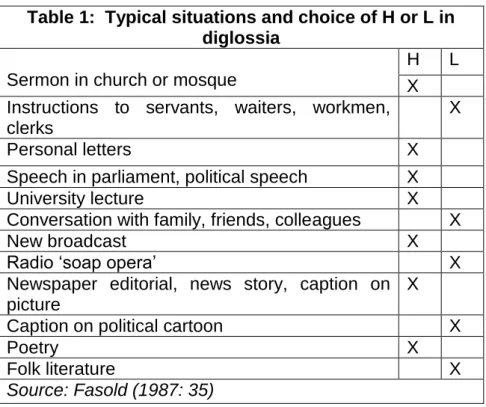
For Ferguson (1959), function is one of the most relevant issues of diglossia. Depending on the social context in which the speakers communicate, they have to choose between the H and L variety. For that reason, it is crucial to establish the setting in which each variety can be used. Table 2.1 is Ferguson’s list of possible situations in which the varieties are distinguished.
20
Table 1: Typical situations and choice of H or L in diglossia
Sermon in church or mosque
H L X Instructions to servants, waiters, workmen, clerks
X
Personal letters X
Speech in parliament, political speech X
University lecture X
Conversation with family, friends, colleagues X
New broadcast X
Radio ‘soap opera’ X
Newspaper editorial, news story, caption on picture
X
Caption on political cartoon X
Poetry X
Folk literature X
Source: Fasold (1987: 35)
According to Schiffman (2002), using the right variety is a serious issue, for example a speaker would be subject of ridicule if he uses H variety in an L domain or L in a H domain, as well the speaker could be avoided by the rest of the community. As for formal education and poetry, speakers may use both H and L simultaneously, i.e. university teachers give the lecture in H, but they explain it in L.
2.5.1.2 Prestige
In diglossic communities, the H variety is the one that speakers recognized to be the more elegant, more logical and the superior language. In some cases the status of H is related to religion and political issues (Ferguson, 1959). On the other hand, the L is felt to be the inferior or vulgar language.
There are situations in which the speakers do not admit the fact of speaking a non-prestige language, i.e. in a job interview or with people that just speak the H language (Schiffman, 2002).
21 2.5.1.3 Literary heritage
Ferguson (1959) states that within a diglossic context, the major part of the literature is written in the H. Literary work is highly estimated by the members of the speech community and it is considered as a continuation of the language. However, some works are written in L, such as folk literature and
“dialect” poetry, what is more, it has become popular in recent years to write literature in L, especially books for young people or writers from different ethnic backgrounds writing in English. Finally, Shiffman (2002) mentions that “in some traditions L variety would be used to show certain characters as rustic, comical and uneducated” (p. 207).
2.5.1.4 Acquisition
Among the members of a diglossic community, the L is the mother tongue. L is the language that the parents use to communicate with their children, in other words the L is learned in the normal way. On the contrary, H is learned by means of formal teaching and by explicit discussion of the grammar.
According to Fasold (1997), this way of learning the H variety, has two effects.
The first is that the speakers may not learn H at all. Secondly and last, those who speak H do not become as fluently as they do in L.
2.5.1.5 Standardization
Holmes (1997) indicates that the standard variety of a language is one which has been written and codified in some way, for example, dictionaries or grammar books. In all diglossic communities the H language is the one that is standardized and has established rules for pronunciation, vocabulary and orthography. These rules are generally learned within the classroom context. By
22
contrast, the L language is rarely standardized; this is due to the lack of written grammars and literature. However, sometimes there are studies of L, but these are mostly written in the mother language of outsiders (Schiffman, 2002), i.e.
Americans analyzing Mexican indigenous languages.
2.5.1.6 Grammar
For Ferguson (1959) H and L have to be forms of the same language, these varieties do not have the same grammatical structure. The H has a more complex grammar than the L. Mostly, L languages are less complex and do not have many grammatical structures. However, Fishman (1967) points out that in an extended diglossic community, it is possible that the H and L do not belong to the same language (Fasold, 1997).
A clear example of extended diglossia is the sociolinguistic situation that Latin immigrants face in the USA. For these speakers Spanish is their mother tongue, but they have to speak English in order to communicate, this refers to a diglossic community in which the two variables are standardized. Although in such cases, the grammar of both languages is quite complex, one variety is considered to be the low and the other the high. But this decision is taken by the speakers and the social context in which they are.
2.5.1.7 Lexicon
In H and L lexicon, the words are generally paired items, it means that there is a specific word in H and another in L, but the meaning of the two variants is the same. At the same time Ferguson (1959) mentions that the H and L varieties share vocabulary. This happens because as Fasold (1997)
23
states “it is expected that learned words and technical terms exist only in H , but equally there are words in L for home objects that have no equivalents in H”
(p. 38). This leads to the usual borrowing of H words into L. For example, in the Náhuatl language there are no terms for specific technological issues such as internet, mobile phone and computer, so Nahuatl speakers borrow the words from English or Spanish.
Summing up, the importance has been established of each one of these variables. All of them have to be considered in order to analyze the diglossic situation of some speech communities. However, not all these variables are present in each diglossic community; the presence of those variables depends on the characteristics of the language and how speakers use the H and l variety.
2.6 Conclusion
Undoubtedly, there are many factors that have an important role within the diglossic panorama within which speech communities are talked about, the different varieties of a language and how it is used. But, most of all, it is relevant to consider the role of the speakers, because the diglossic phenomenon takes place due to the speakers and how they establish that a language has prestige and other does not. For this reason, the linguistic and sociolinguistic background of the indigenous ELT students is of great relevance and it cannot be left aside. What is more, it has also to be taken into account the students’
perspectives through this situation and how it may affect their foreign language learning process.
24
CHAPTER III: Research Methodology
3.0 Chapter Introduction
This research is about diglossia as a sociolinguistic situation that ELT indigenous students face. The purpose of this study was to analyze the situation that those students face when they are learning English and also to determine how a diglossic situation may affect the ELT indigenous students’ academic and linguistic development. In this chapter I will provide a description of how I went about collecting the necessary data for answering my research questions.
The first section describes the setting of the research. The second section presents the subjects of the study and why and how the subjects were chosen. In the third section, the research methodology is introduced. Then, the fourth section describes the data collection instruments that were used to carry out this study. The fifth section explains the data collection procedures. In the sixth section, the data analysis procedures are provided and finally in the last section the conclusion is presented.
3.1 Setting
The study took place at the Language Department of one of the most important Mexican Universities, which is located in Puebla City. This faculty trains future English and French teachers. Moreover, the institution offers language courses such as German, Italian, French and other for those students who belong to the university and people who wish to learn a new language.
25 3.2 Subjects
The participants who were interviewed are a group of 10 ELT students, five men and five women. The range of ages of the participants is from 19 to 26 years old and all of them come from different states of Mexico. For the purpose of this study, the participants needed to cover some important requirements;
they had to come from an indigenous community and to speak an indigenous language as their mother tongue, as well, they had to use constantly the indigenous language in order to communicate with their family or friends.
Finally, they had to have an intermediate or advanced level of English.
3.3 Research methodology
The methodology that I used for this research is a qualitative case study.
The qualitative research attempts to explain social phenomena. In other words, it helps people to understand the world in which we live and to explain why things are in a certain way (Degu & Yigzaw, 2006). At the same time, qualitative research studies phenomena in their natural settings and describes these phenomena and problematic moments in the individual’s lives (Denzin &
Lincoln, 205).
Furthermore, the present research is a case study due to its own nature, since it describes the sociolinguistic problems that ELT indigenous students face in a diglossic situation. According to Yin (1984) a case study describes the behavior of the subjects involved in a phenomenon and allows the researcher to keep the meaningful characteristics of real-life events. Moreover, the data for a case study can be obtained from different sources such as interviews, observation and documents. Finally, the present study is descriptive because its
26
aim is to describe current sociolinguistic problems, existing beliefs and actual behaviors of ELT indigenous students.
3.4 Instruments
The data of this research were collected by means of interviews. I chose to use the interviews as one of my instruments because one of the goals of my research is to know the academic problems that ELT indigenous students face and to know their perceptions and opinions about it. An interview is an active process that leads to the construction of meaning of a specific topic (Fontana &
Frey, 2005). With the interviews, I could know and find out the different characteristics of each participant and how their English learning was affected by their indigenous language.
3.5 Data collection procedure
Data was gathered through interviews. In order to collect the data the following steps were done: first, I had to design and pilot the instrument to see if the interview questions provided the necessary information for the purpose of the study, after the piloting phase, I identified the students whose mother tongue is an indigenous language. Then, I contacted these students and told them what the present research was about and asked them if they wanted to take part in it. Finally, once the participants agreed to participate, each of them was interviewed individually.
27 3.6 Data Analysis
First of all, the interviews were transcribed in a Word document.
Secondly, each interview was reread. Then, the interviews were compared; this was in order to get a clearer view of the results obtained. Also, some comments were added to the interviews’ transcripts, so that the most relevant information could be easily found. At the same time, some graphics and tables were made.
The graphics and tables refer to the last part of the interviews. Finally, the results were analyzed with the help of the comments, graphics and tables.
3.7 Chapter Conclusion
Throughout this chapter, the setting in which this research project took place was provided. Also, important background information about the participants was given. In addition, the research methodology and the instrument which was used to obtain information were discussed. Finally, the data collection procedure and the data analysis were explained. In the following chapter the results obtained are provided and discussed.
28
CHAPTER IV: DATA ANALYSIS
4.0 Introduction
The aim of this chapter is to present the results obtained from the interviews made, in order to answer my research questions. All the information obtained from the interviews was transcribed in an excel word document. The transcripts used refer to this document. Additionally, the aims and research questions are provided, so that the data analysis can be related to the purpose of this study.
It is necessary to clarify some important aspects:
Along the chapter the terms H and L are used to refer to high variety and low variety. The L variety refers to a language that is not considered prestigious and is used among family and friends (See Chapter II) / (Ferguson, 1959)
In this chapter I use P1 to refer to participant 1, P2 to refer to participant 2 and so on.
All these participants speak different indigenous languages; these are Náhuatl, Zapotec, Mixteco, Chatino, Tlapaneco and Amuzgo.
4.1 Aims and Research questions
Before starting with the data analysis, it is important to remind the purpose of the study. For this reason, the aims are presented as follows:
To identify the sociolinguistic perceptions that ELT indigenous have about the diglossic phenomenon they face.
To determine how a diglossic situation impacts the academic development of ELT indigenous students.
29
It is also important to keep in mind the research questions that served as a guide for the design of the instrument, as well as for obtaining the data collected. The research questions are the followings:
What are the sociolinguistic perceptions that ELT indigenous students have about the diglossic situation they face?
How does a diglossic situation help ELT indigenous students’ academic development while learning English?
4.2 ELT indigenous students’ perceptions about diglossia
An important aim of this research project was to find out the student’s opinions about diglossia, in order to analyze their perceptions. It is important to keep in mind that diglossia refers to a stable language situation in which two languages (H and L variety) are used for different purposes and contexts.
4.2.1 Students’ perceptions
As a result, 3 students (n=10) knew what diglossia meant and the other participants did not know what diglossia is about. Although, students did not define exactly what a diglossic situation represents, they did mention some of the most important diglossia characteristics such as the interaction of the H and L variety and how they impact each other:
Se refiere a la exclusión-inclusión y el impacto entre las diferentes lenguas, tanto extranjeras como las nativas (P7).
It refers to the exclusion-inclusion and the impact of both foreign languages and mother tongues.
30
Curiously, one participant mentioned that students may face linguistic problems due to a diglossic situation:
Tienen problemas en el lenguaje. Y son alteraciones en cuanto a la fonética y las formas (P2).
They have problems when using the language. These are alterations concerned with phonetic and the grammatical forms.
What is more, another student pointed out that within the diglossic panorama there is a superposed language variety that overtakes another. That is the existence of the H and L variety:
Si no mal recuerdo está relacionado a como una lengua sobrepasa a otra (P4).
If I am right, it is related to the fact of how a language overtakes another language.
It is true that in a diglossic situation two or more languages interact constantly and that there is always a variety that is highly codified, which can lead to the extinction of the low variety. However, for this to happen, many other linguistic and social factors need to be taken into account.
4.2.2 Low variety: Prestige and identity
In this section students were asked about their identity as native speakers of an indigenous language. 8 of the ten students agreed that the indigenous language they speak is an important part of their identity that cannot be kept apart from them, because it represents their traditions, their values, their family and their own history:
31
Porque, todo lo que soy ahora, todo lo que pienso yo al futuro, todo es, porque este eso. Mi lengua indígena ha sido parte de mi formación desde mi nacimiento hasta la fecha. Ha formado parte de mí, de mi persona, de quien soy ahorita, mi manera de pensar, mi manera de ser, todo (P5).
Because it is everything I am, all I think about the future is because of my mother tongue. My indigenous language has been part of my education since I was born till now. It is a part of me, of my person, of who I am, of my way of thinking, everything.
From the participants interviewed, 2 of them were not sure if their indigenous language represents their identity or not. They mentioned this is due to the fact that they are studying English and other languages at the same time:
Porque ahorita que ya me vine para acá, ya casi no la práctico, se me puede olvidar entre estudiar inglés, alemán y francés (P10).
Since I came here, I do not practice it anymore. I can forget it while studying English, German and French.
What is more, the two participants remarked that this situation leads them to a mix of different cultures and makes them hesitate about their identity as speakers of any language:
En cierta parte, porque ya estoy inmersa a lo que es el español y pues a la cultura de la lengua inglesa, alemana… entonces ya es toda una mezcla de culturas (P2).
Somehow, because I am deep into Spanish and English and German cultures, so this is a mix of cultures.
Equally important is the prestige aspect, which is one of the main points of diglossia. In other words, the conception thatspeakers have about the different language varieties that they use. Regarding this point, 3 of the participants do not see their mother tongue as a prestige language, due mainly to their social environment:
32
Porque bueno he encontrado lugares en los que hablas, aunque hables lengua indígena, es como una persona de bajo estatus (P3).
I have found places where indigenous languages are considered of low status.
Furthermore, four participants mentioned that within the society they live, indigenous languages are not as prestigious as other languages (e.g. Spanish, German, French or English). As a consequence of it, many indigenous speakers are ashamed of expressing themselves in their mother tongues, which is causing the extinction of these languages:
Si es muy conocida o hablada podría decir que no, porque pues aquí en nuestro país ya se están perdiendo muchísimo (P9).
If it is well known or spoken, I could say no, because in our country indigenous languages are disappearing.
Likewise, these four students shared that at least for them, their mother tongue is a prestigious language, because as set before it is an important part of their identity:
Desde mi punto de vista, yo siento que se debería considerar como una lengua de prestigio porque es una de las pocas lenguas o bueno de las muchas lenguas mexicanas que están siendo poco a poco, eh…
orilladas a una desaparición (P7).
From my point of view, I feel it should be considered as a prestige language because is one of the few or lots of languages that are disappearing.
On the other hand, three of the students said that the indigenous language they speak is as prestigious as other languages and it should be treated in the same way without making any distinction:
33
Yo creo que cada lengua indígena o lengua mexicana tiene su propia riqueza y pues yo creo que es igual de importante que las otras lenguas como el inglés, alemán, italiano y todas esas (P8).
I believe that every indigenous or Mexican language has its own richness and I believe it is as important as other languages such as English, German, Italian and all of them.
However, a quite interesting point is that two of the three participants that consider their mother tongue to be prestigious, did not call it language, instead they called it dialect. This is contradictory because if these students have their mother tongue in a high consideration, they should call it a language instead of dialect.
To sum up, it can be established that even though the participants’
mother tongue represents their identity, it is not considered by them to be a prestige language and not because they are ashamed of speaking it, but because of the social influence over them. And in the long term, it can be a problem, since as said before; it can cause the total extinction of these languages.
4.3 Functions
Function is one of the most relevant issues of diglossia that is the language that speakers use depending on the context (See Chapter II). The following results are based on the participants’ use of their mother tongue and English.
34 4.3.1 High and Low varieties functions
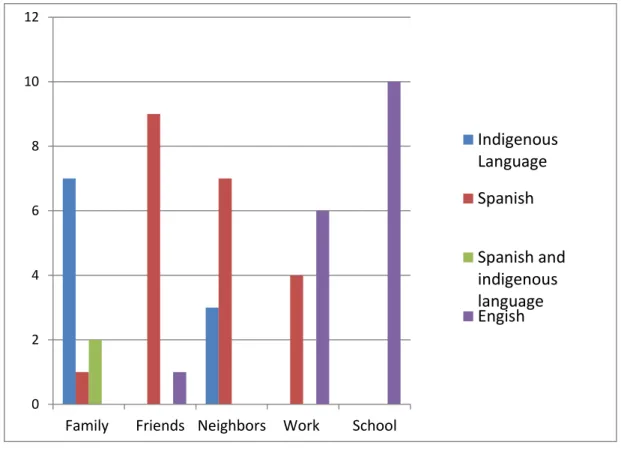
In this part, students were asked about what language they use (English, Spanish or their indigenous language) in the different social contexts they are in (with friends, family, at work and at home) and which is the reason for using one language instead of another. The graphic below shows the results.
Figure 4.1 Participants’ use of High and Low varieties
As can be seen, the indigenous language is mostly used within the family context. This is because participants learnt their mother tongue at home with their parents and siblings:
Because, most of the time my mother and brother speak Nahuatl, so I see it as normal” Porque, la mayoría de las veces mi mamá y mi hermano siempre están hablando en náhuatl, entonces llego y pues lo veo como normal (P4).
0 2 4 6 8 10 12
Family Friends Neighbors Work School
Indigenous Language Spanish
Spanish and indigenous language Engish
35
What is more, some of the students affirmed that they speak their indigenous language at home because their family cannot speak Spanish very well and some of their relatives do not speak Spanish at all. At the same time, all the participants said that they just speak Spanish with their friends, mainly because most of the participants do not live in their hometowns, but in Puebla, where they cannot practice their indigenous language. Some of the participants mentioned that if they could choose to speak one language, they would choose their mother tongue:
Prácticamente no hablo náhuatl, pero si tuviera la forma de, bueno escoger una, escogería náhuatl (P1).
I speak very little Nahuatl, but if I had to choose, I would chose Nahuatl.
On the other hand, the 10 participants use English at the university, because it is required in their different subjects, for their homework or because they are currently doing their teaching practice. Also six of the students use English at their work. With this, it can be established that the participants fulfill the diglossia function criteria. That is, they use English, Spanish and their indigenous language for different communicative purpose and with different people.
4.4 Diglossic impact on ELT indigenous students
It is important to clarify that all of the participants are bilingual speakers, but not because they are learning English, but due to the fact that they already speak an indigenous language and Spanish. The following results show if speaking an indigenous language has helped the participants to learn English.
36
4.4.1 Diglossic impact on ELT indigenous students’ academic development while learning English
It is known that for bilingual speakers it is easier to learn a third language and that is what this section is about. But, first of all, it is important to take a look at the participants’ linguistic skills in their mother tongue, this in order to establish the relation between the participants’ indigenous language and English. The results obtained are presented in the following graph.
Figure 4.2: Participants’ linguistic skills in their mother tongues.
Graph 4.2 shows that the linguistic skills that the participants have most developed are the speaking and listening skills, with 35% and 34% respectively.
All the students interviewed said that they understand very well their indigenous language, and also speak it fluently. But, what was curious is that some of the participants mentioned that they can understand better the language than speaking it. This is an example of metalinguistic awareness, that is when the
Listening 35%
Writing Reading 14%
17%
Speaking 34%
Linguistic skills
37
speakers of the language are conscious of the linguistic skills they possess and uses these skills according to their linguistic needs.
Me considero más apta para leerlo, para comprenderlo también. Si, puedo hablarlo un poco (P10).
I consider myself capable of reading it and to understand it. Yes, I can speak it, but just a Little.
As most of the participants moved out of their hometowns to study, they do not practice their mother tongue as often as before, that may be the reason for which they consider to understand better their indigenous language than speak it. Regarding the reading skill, 6 of the students remarked that they have practiced this skill. It is worth mentioning that P7 and P10 were taught their language in a formal way at home by their parents and that is why they can read in their native language:
Porque mi madre tuvo mucha influencia sobre mí en eso (P9).
Because my mother had a lot of influence much influence on me.
The other four participants can read their language because they attended bilingual schools where they were educated in their indigenous language and Spanish:
Ah sí, me educaron en la primaria. Solo los seis años de primaria (P10).
Yes, I was educated at the primary school. Just the six years of primary school.
Finally, five of the participants mentioned that they can write in their mother tongue, as mentioned before it is due to the fact that they were taught the language at school and as they can already read it, then it is easier for them
38
to write it. Curiously, one participant said that she is trying to write it using the phonetic symbols, what actually shows the relation that the participant is making between her mother tongue (Nahuatl) and what she has learned in the major:
Lo hablo y en estos momentos trato de escribirlo usando los símbolos fonéticos o las letras del abecedario en español P2.
I speak it and right now I try to write it using the phonetic symbols and the Spanish alphabet.
4.4.2 Indigenous language influence on ELT students’ English learning This part of the interview was focused on the impact that the participants’
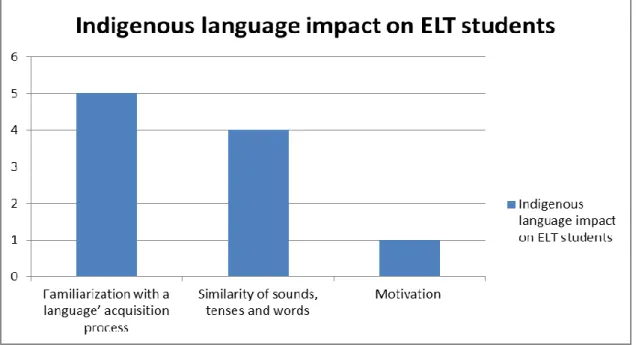
mother tongue has had on their English learning. All the participants said that speaking an indigenous language has helped them to learn English. Here the term metalinguistic awareness plays an important role since as the participants are conscious of the structures, forms and patterns of their mother tongues, they can manipulate their native languages in order to approach a goal that in this case is to learn English through the relation that participants have stablished between English and their indigenous languages. The following graph shows the results related to the aspect mentioned above.
39
Figure 4.3 Impact of indigenous languages on ELT students’ English learning
Figure 4.3 shows that for the participants it was easier to learn English for three different reasons. Students affirmed that as they speak two languages (Spanish and their mother tongue) they feel motivated to learn more languages.
Another reason they mentioned is that they are familiar with the process of learning a new language.
Bueno en mi caso ya estoy familiarizado con la adquisición de una segunda lengua y luego en la adquisición de una tercera lengua, pues sí, es más fácil (P6).
Well, in my case I am familiar with the acquisition of a second language and the acquisition of a third one, so, yes, it is easier.
As most of the participants learnt Spanish at school, it is natural for them to study the grammar of a language and vocabulary charts.
Sí, porque desde pequeña estoy inmersa en el aprendizaje de las lenguas. Aprendí el español en un contexto escolar y ya estoy acostumbrada a aprender con gramática.
Yes, because since I was a child, I have been in touch with the languages learning. I learnt Spanish at the school, so I am used to learning with grammar (P2)
40
It would seem that indigenous languages do not have any relation with English, but according to students’ opinions, there are a lot of similarities between their mother tongue and English. The first one is linked to the phonetic aspect. In the following table the results obtained from this part are presented.
Figure: 4.4 Phonetic similarities between English and indigenous languages
Indigenous sound similar to English sounds
Language Indigenous word
Meaning of the indigenous word
/ʃ/ Nahuatl Xocoyolt
Xá
Edible plant Maybe
/ə/ Nahuatl Iztak White color
/w/ Nahuatl Wan And
/z/ Chatino Nanze Yes
Figure 4.4 shows that Nahuatl and Chatino have similar sounds with English. As it can be observed, the participants did not have to learn new sounds like Spanish speakers, instead they just transferred the sounds from their mother tongue to English.
Si, por ejemplo /ʃ/ también existe en inglés, cómo shower y así se me hace más fácil decirlo y aprenderlo. (P10)
Yes, for example /ʃ/ also exists in English, like shower. That is why it is easier to learn the words.
Furthermore, the participants mentioned that they learnt English vocabulary easily because they have almost identical words in their mother tongues. An example can be observed in the following table.
Figure 4.5 Vocabulary similarities between English and indigenous languages
Indigenous language
Indigenous word English word Indigenous word’s meaning
Zapotec Son Song A traditional song