Rezaee-Zavareh MS, et al. , 2017; 16 (2): 188-197
188
Combination of Ledipasvir and Sofosbuvir for
Treatment of Hepatitis C Virus Genotype 1 Infection:
Systematic Review and Meta-Analysis
Mohammad Saeid Rezaee-Zavareh,*,†,‡,§ Khashayar Hesamizadeh,†,‡,§ Bita Behnava,†,‡,§ Seyed Moayed Alavian,†,‡,§ Mohammad Gholami-Fesharaki,|| Heidar Sharafi†,‡,§
* Student Research Committee, Baqiyatallah University of Medical Sciences, Tehran, IR Iran.
† Baqiyatallah Research Center for Gastroenterology and Liver Diseases (BRCGL), Baqiyatallah University of Medical Sciences, Tehran, IR Iran. ‡ Meta-analysis Study Group, Iran Hepatitis Network, Tehran, IR Iran. § Middle East Liver Diseases (MELD) Center, Tehran, IR Iran. || Department of Biostatistics, Faculty of Medical Sciences, Tarbiat Modares University, Tehran, IR Iran.
March-April, Vol. 16 No. 2, 2017: 188-197
CONCISE REVIEW
INTRODUCTION
Among the approximately 80 million individuals in the world with chronic hepatitis C virus (HCV) infection, about 46% are infected with HCV genotype 1, the most difficult-to-treat with interferon-based regimens.1 Be-cause of the low rate of treatment success and expected side-effects of Pegylated-Interferon (PegIFN) and Riba-virin (RBV) for treatment of HCV-infected patients, ef-forts have been made to develop IFN-free treatment regimens.2,3
Protease inhibitor (PI)-containing regimens for pa-tients with HCV genotype 1 infection was introduced in
2011. However, there have been some drug-drug interac-tions associated with PI-containing regimens and also they should be used with PegIFN and had many side-effects.4 The treatment of patients with HCV genotype 1 infection has been revolutionized by introduction of recent direct-acting antiviral agents (DAAs) including Sofosbuvir (SOF); a uridine nucleotide analogue inhibitor of the HCV NS5B polymerase and Ledipasvir (LDV); an inhibi-tor of the HCV-encoded NS5A protein.5,6 The best treat-ment option is the one which has the highest sustained virologic response (SVR) rate with minimal adverse ef-fects in the shortest treatment duration. The combination of SOF/LDV for 12 or 24 weeks with or without RBV has
The Official Journal of the Mexican Association of Hepatology, the Latin-American Association for Study of the Liver and
the Canadian Association for the Study of the Liver
Manuscript received: Manuscript received: Manuscript received: Manuscript received:
Manuscript received: August 11, 2016. Manuscript accepted:Manuscript accepted:Manuscript accepted: December 06, 2016.Manuscript accepted:Manuscript accepted:
DOI:10.5604/16652681.1231562.
A B S T R A C T A B S T R A C T A B S T R A C T A B S T R A C T A B S T R A C T
Background and aim. Background and aim.Background and aim. Background and aim.
Background and aim. The combination of Sofosbuvir (SOF) and Ledipasvir (LDV) has been lead to considerable enhancement of treatment of hepatitis C virus (HCV) genotype 1 infection. A meta-analysis of the currently available studies was undertaken with the aim to evaluate the antiviral efficacy of SOF/LDV therapy for 12 or 24 weeks with or without Ribavirin (RBV) in patients with HCV genotype 1 infection. Material and methods.Material and methods.Material and methods.Material and methods. In this meta-analysis, we searched databases including PubMed, Scopus,Material and methods. Science Direct and Web of Science using appropriate keywords. All papers which evaluated the efficacy of combination therapy of SOF/LDV with or without RBV for 12 or 24 weeks among patients with HCV genotype 1 infection were included. Results.Results.Results.Results.Results. The 20 published articles were assessed for eligibility and finally 10 articles pooling 2248 participants were included in this meta-analysis. Pooled SVR12 for four SOF/LDV regimens were 95% (95%CI = 93%-97%) for 12 weeks of treatment with SOF/LDV, 97% (95%CI = 95%-98%) for 24 weeks of treatment with SOF/LDV, 96% (95%CI = 94%-97%) for 12 weeks of treatment with SOF/ LDV/RBV and 98% (95%CI = 97%-99%) for 24 weeks of treatment with SOF/LDV/RBV. Only in treatment regimen of SOF/LDV for 12 weeks, cirrhosis had a significant effect on the SVR12 (OR = 0.21, 95%CI = 0.07-0.66). Furthermore, NS5A resistance-asso-ciated substitutions at baseline were assoresistance-asso-ciated with decrease in the rate of SVR (OR = 0.31, 95%CI = 0.2-0.5). Conclusions.Conclusions.Conclusions.Conclusions.Conclusions. The Interferon-free regimen of SOF/LDV for 12 or 24 weeks with or without RBV is highly effective for treatment of patients with HCV genotype 1 infection.
Key words. Key words.Key words. Key words.
189
SOF/LDV for HCV Genotype 1: a Meta-analysis. , 2017; 16 (2): 188-197
enhanced the SVR rate up to 95%-100% in treatment-naïve and IFN-experienced patients with HCV genotype 1 in-fection.7 There is a need for determining exact SVR rate for treatment with SOF/LDV in combination with or without RBV in duration of 12- or 24-week. Moreover, ef-fect of some factors such as cirrhosis, previous history of treatment, and NS5A resistance-associated substitutions (RASs) on the SVR rate with the mentioned regimen should be evaluated.
A meta-analysis of the currently available studies was undertaken with the aims of evaluation of the antiviral effi-cacy of SOF/LDV combination therapy for 12 or 24 weeks with or without RBV in patients with HCV genotype 1 in-fection.
MATERIAL AND METHODS
Data resources and search strategies
In this meta-analysis, we comprehensively and sys-tematically searched electronic databases including PubMed, Scopus, Science Direct and Web of Science us-ing appropriate search strategies for each database. Focus of the keywords in our search strategies were on the treatment protocols; SOF, LDV and their appropriate al-ternatives. Furthermore, for finding any possible existing grey literatures we did a search on Google scholar and af-ter finding related titles, we continued our search until we found 200 unrelated serial titles. Moreover, referenc-es of the retrieved publications were also searched for identification of any possible missed publications in electronic search. Our last search was performed on Sep-tember 2, 2015 and no language limitation was consid-ered. An update in our search was performed in March 16, 2016.
Eligibility criteria
Any paper which evaluated the effect of combina-tion therapy with SOF/LDV with or without RBV for 12 or 24 weeks on SVR, 12 weeks after termination of treatment (SVR12) among patients with HCV genotype 1 infection were included in this meta-analysis. The studies with the data for intention-to-treat analysis were included otherwise the paper was excluded. Fol-lowing items were considered as our exclusion crite-ria; patients on hemodialysis, patients with previous history of SOF-based treatment, patients with simulta-neous infection with human immunodeficiency virus (HIV), patients with decompensated cirrhosis (Child-Pugh B and C8) and history of liver or kidney trans-plantation.
Study selection,
quality assessment and data extraction
Based on the PRISMA guideline for reporting of sys-tematic review,9 all papers from search results were inde-pendently reviewed by two people (MSR-Z and KH) at each level of screening (title, abstract and full-text). At the end of each level of screening, any disagreements between these two authors were resolved by mutual discussion. However, remained disagreements were resolved by con-sensus and discussion with other colleagues (BB, SMA and HS).
Cochrane’s risk of bias assessment tool was used for quality assessment of each included paper10 and follow-ing bias risks were evaluated; random sequence genera-tion (selecgenera-tion bias), allocagenera-tion concealment (selecgenera-tion bias), blinding of participant and personnel (perform-ance bias), blinding of outcome assessment (detection bias), co-interventions, incomplete outcome data (attri-tion), selective reporting (reporting bias), intention-to-treat analysis, group similarity at baseline, compliance, timing of outcome assessments and other biases. Based on this assessment, each bias risk for each paper rated as high, unclear and low. High and unclear risks were scored as zero and low risk as one. Articles with score of more than 6 were categorized as low risk studies. Again any differences or disagreement were resolved by mutual discussion.
Following data for participants of each arm of the in-cluded studies were extracted; gender, HCV genotype, cirrhosis, polymorphisms near IFNL3 (rs12979860), histo-ry of previous treatment, treatment duration, age, body mass index (BMI) and HCV RNA level before treatment. Furthermore, some data for each study including publica-tion year, sample size and country name were gathered.
Data analysis
Rezaee-Zavareh MS, et al. , 2017; 16 (2): 188-197
190
RESULTS
Study screening
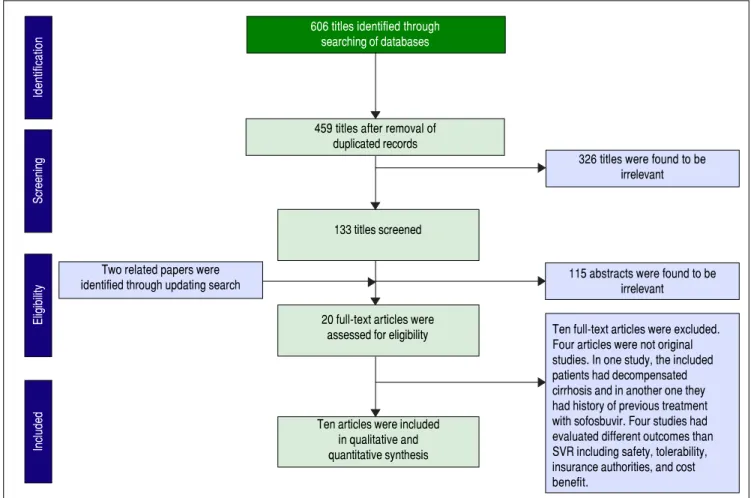
A total of 606 papers were identified via database searching. After removing duplications, 459 papers were remained for screening. Figure 1 shows the number of pa-pers at each level of screening. Two other papa-pers were also found by updating search. Twenty of full-text articles were assessed for eligibility and finally ten papers were in-cluded in our quantitative synthesis (meta-analysis).
Risk of bias assessment
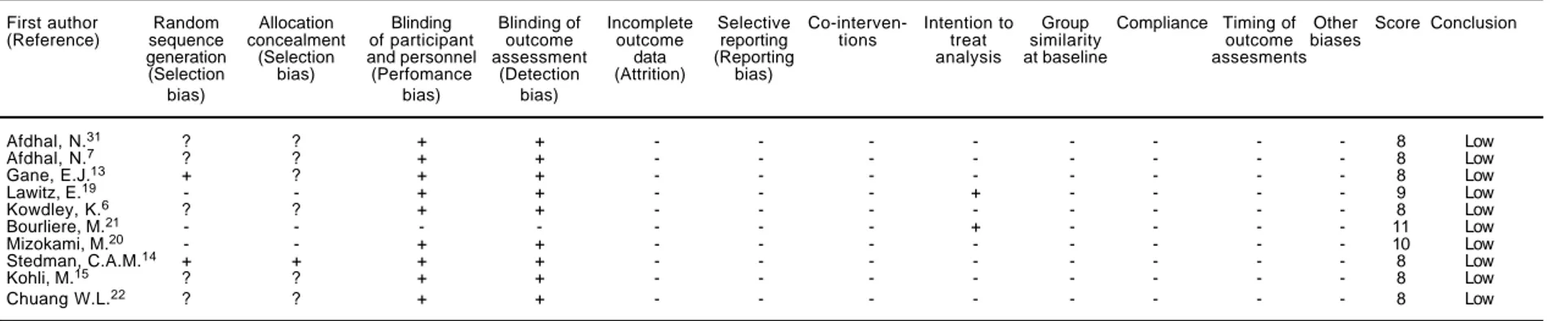
Considering table 1, all included studies were catego-rized as low risk (with taking a score of more than 7) and therefore no studies were excluded based on the quality assessment.
Characteristics of the included studies
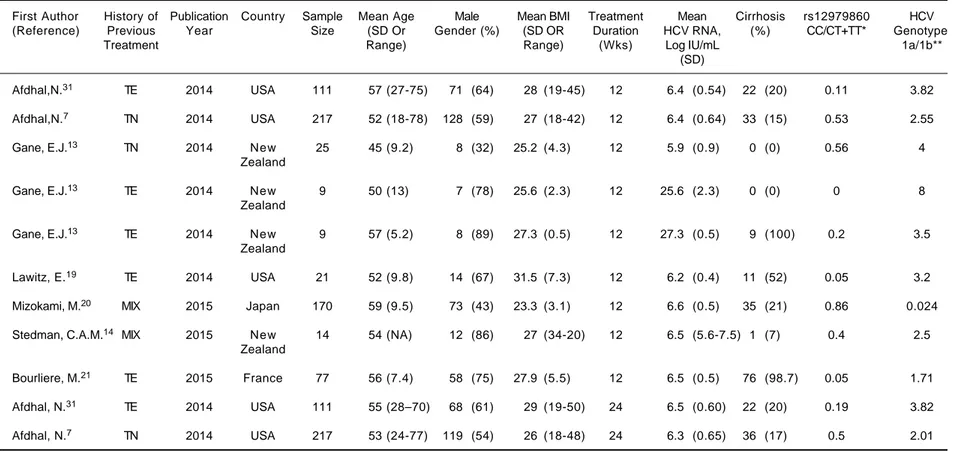
Based on the goal of this study, we showed characteris-tics of each arms of the included papers in table 2
(combi-nation of SOF/LDV) and table 3 (combi(combi-nation of SOF/ LDV/RBV).
Evaluation of treatment outcome
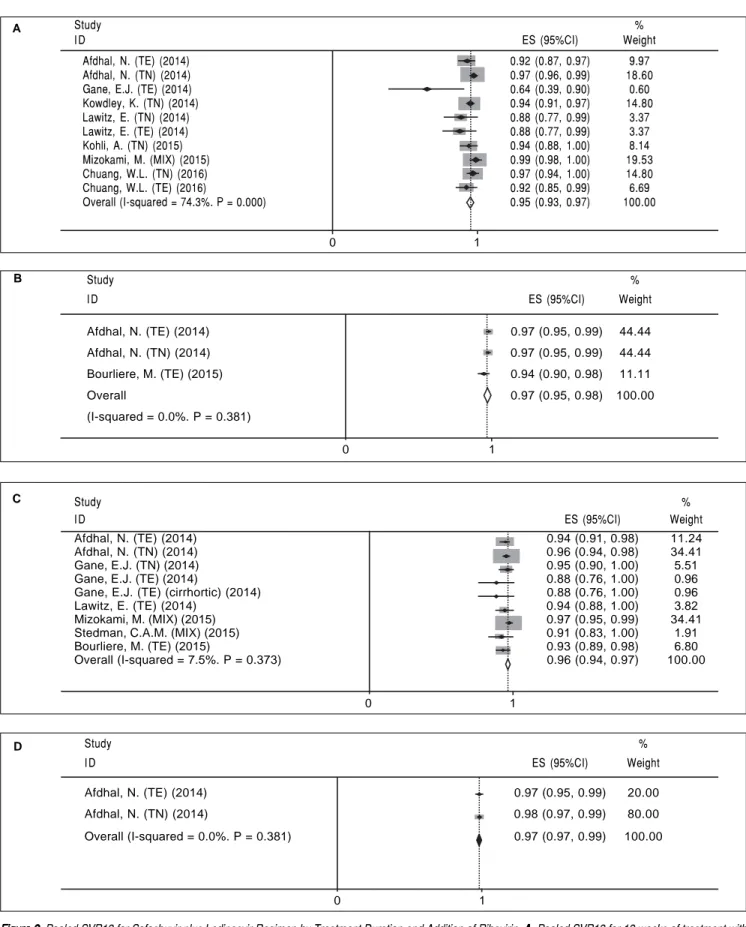
We calculated pooled SVR12 for four HCV treatment regimens including 12 weeks of SOF/LDV (A), 24 weeks of SOF/LDV (B), 12 weeks of SOF/LDV/RBV (C) and 24 weeks of SOF/LDV/RBV (D). Summary of results of these meta-analyses has been shown in the table 4.
• Treatment regimen A (12 weeks of sofosbuvir plus
ledipasvir). Ten arms in eight studies were found which evaluated regimen A (Table 2). There was sig-nificant heterogeneity between results of study arms (χ2 = 35.01, P < 0.001, I-squared = 74.3%) and thus pooled SVR12 for this regimen based on random-effect model was calculated as 95% (95%CI=92%-97%) (Figure 2A). Both Begg’s test (P = 0.074) and Egger’s linear regression test (P < 0.001) was significant and showed publication bias. We used trim and fil method to overcome this bias and according to this method Pooled SVR12 was calculated as 95% (95%CI = 93%-97%).
606 titles identified through searching of databases
459 titles after removal of duplicated records
326 titles were found to be irrelevant
133 titles screened
115 abstracts were found to be irrelevant
Two related papers were identified through updating search
20 full-text articles were
assessed for eligibility Ten full-text articles were excluded. Four articles were not original studies. In one study, the included patients had decompensated cirrhosis and in another one they had history of previous treatment with sofosbuvir. Four studies had evaluated different outcomes than SVR including safety, tolerability, insurance authorities, and cost benefit.
Ten articles were included in qualitative and quantitative synthesis
Figure 1. Figure 1. Figure 1. Figure 1.
Figure 1. Screening of articles based on PRISMA statement.
Included
Eligibility
Screening
191
SOF/LDV for HCV Genotype 1: a Meta-analysis.
, 2017; 16 (2): 188-197
Table 2. Characteristics of the Included Studies for Combination of Sofosbuvir plus Ledipasvir.
First Author History of Publication Sample Mean Age Male Mean BMI Treatment Mean Cirrhosis rs12979860 HCV (Reference) Previous Year Country Size (SD Or Gender (%) (SD OR Duration HCV RNA, (%) CC/CT+TTa Genotype
Treatment Range) Range) (Wks) Log IU/mL 1a/1bb
(SD)
Afdhal, N.31 TE 2014 USA 109 56 (24-67) 74 (68) 29 (19-47) 12 6.5 (0.44) 22 (20) 0.1 3.73
Afdhal, N.7 TN 2014 USA 214 52 (18-75) 127 (59) 27 (18-41) 12 6.4 (0.69) 34 (16) 0.34 2.18
Gane, E.J.13 TE 2014 New Zealand 10 61 (4.9) 10 (100) 31 (6.8) 12 6.5 (0.6) 10 (100) 0.11 4
Kowdley, K.6 TN 2014 USA 216 53 (20-71) 128 (59) 28 (19-45) 12 6.4 (0.8) 0 (0) 0.35 3.9
Lawitz, E.19 TN 2014 USA 19 46 (11.6) 11 (58) 28.1 (5.8) 12 6.1 (0.8) 0 (0) 0.05 8.5
Lawitz, E.19 TE 2014 USA 19 54 (6.6) 15 (79) 31.4 (4.7) 12 6.3 (0.5) 11 (58) 0.11 18
Kohli, A.15 TN 2015 USA 20 57 (8) 14 (70) 25 (4) 12 NA up to 20% 0.33 1.22
Mizokami, M.20 MIX 2015 Japan 171 60 (9.2) 69 (40) 23.3 (3.6) 12 6.6 (0.5) 41 (24) 1.011 0.042
Chuang, W.L.22 TN 2016 Taiwan 42 54 (30-75) 13 (31) 24 (19-36) 12 6.6 (0.68) 5 (12) 5 0.10
Chuang, W.L.22 TE 2016 Taiwan 43 55 (33-7) 23 (55) 24 (20-30) 12 6.6 (0.55) 4 (9) 1.26 0.16
Afdhal, N.31 TE 2014 USA 109 56 (25-68) 74 (68) 28 (19-41) 24 6.4 (0.57) 22 (20) 0.17 3.54
Afdhal, N.7 TN 2014 USA 217 53 (22-80) 139 (64) 27 (18-48) 24 6.3 (0.68) 33 (15) 0.31 2.14
Bourliere, M.21 TE 2015 France 78 57 (10.7) 56 (72) 26.3 (4.2) 24 6.5 (0.6) 77 (100) 0.08 1.85
SD: standard deviation. NA: not available. TE: treatment experience. TN: treatment naive. a This column gives information about patients’ status of rs12979860 in each study. b This column gives us
some information regarding patients’ status of subtype 1a and 1b in each study. Table 1. Risk of bias assessment for the included studies.
First author Random Allocation Blinding Blinding of Incomplete Selective Co-interven- Intention to Group Compliance Timing of Other Score Conclusion
(Reference) sequence concealment of participant outcome outcome reporting tions treat similarity outcome biases
generation (Selection and personnel assessment data (Reporting analysis at baseline assesments
(Selection bias) (Perfomance (Detection (Attrition) bias)
bias) bias) bias)
Afdhal, N.31 ? ? + + - - - - - - - - 8 Low
Afdhal, N.7 ? ? + + - - - - - - - - 8 Low
Gane, E.J.13 + ? + + - - - - - - - - 8 Low
Lawitz, E.19 - - + + - - - + - - - - 9 Low
Kowdley, K.6 ? ? + + - - - - - - - - 8 Low
Bourliere, M.21 - - - - - - - + - - - - 11 Low
Mizokami, M.20 - - + + - - - - - - - - 10 Low
Stedman, C.A.M.14 + + + + - - - - - - - - 8 Low
Kohli, M.15 ? ? + + - - - - - - - - 8 Low
Rezaee-Zavareh MS, et al.
, 2017; 16 (2): 188-197
192
Table 3. Characteristics of the included studies for combination of sofosbuvir plus ledipasvir and ribavirin.
First Author History of Publication Country Sample Mean Age Male Mean BMI Treatment Mean Cirrhosis rs12979860 HCV
(Reference) Previous Year Size (SD Or Gender (%) (SD OR Duration HCV RNA, (%) CC/CT+TT* Genotype
Treatment Range) Range) (Wks) Log IU/mL 1a/1b**
(SD)
Afdhal,N.31 TE 2014 USA 111 57 (27-75) 71 (64) 28 (19-45) 12 6.4 (0.54) 22 (20) 0.11 3.82
Afdhal,N.7 TN 2014 USA 217 52 (18-78) 128 (59) 27 (18-42) 12 6.4 (0.64) 33 (15) 0.53 2.55
Gane, E.J.13 TN 2014 New 25 45 (9.2) 8 (32) 25.2 (4.3) 12 5.9 (0.9) 0 (0) 0.56 4
Zealand
Gane, E.J.13 TE 2014 New 9 50 (13) 7 (78) 25.6 (2.3) 12 25.6 (2.3) 0 (0) 0 8
Zealand
Gane, E.J.13 TE 2014 New 9 57 (5.2) 8 (89) 27.3 (0.5) 12 27.3 (0.5) 9 (100) 0.2 3.5
Zealand
Lawitz, E.19 TE 2014 USA 21 52 (9.8) 14 (67) 31.5 (7.3) 12 6.2 (0.4) 11 (52) 0.05 3.2
Mizokami, M.20 MIX 2015 Japan 170 59 (9.5) 73 (43) 23.3 (3.1) 12 6.6 (0.5) 35 (21) 0.86 0.024
Stedman, C.A.M.14 MIX 2015 New 14 54 (NA) 12 (86) 27 (34-20) 12 6.5 (5.6-7.5) 1 (7) 0.4 2.5
Zealand
Bourliere, M.21 TE 2015 France 77 56 (7.4) 58 (75) 27.9 (5.5) 12 6.5 (0.5) 76 (98.7) 0.05 1.71
Afdhal, N.31 TE 2014 USA 111 55 (28–70) 68 (61) 29 (19-50) 24 6.5 (0.60) 22 (20) 0.19 3.82
Afdhal, N.7 TN 2014 USA 217 53 (24-77) 119 (54) 26 (18-48) 24 6.3 (0.65) 36 (17) 0.5 2.01
SD: standard deviation. NA: Not available. TE: treatment experience. TN: treatment naive. * This column gives information about patients’ status of rs12979860 in each study. ** This column gives us some information regarding patients’ status of subtype 1a and 1b in each study.
Table 4. Summary of meta-analyses of the sustained virologic response rate for combination of sofosbuvir and ledipasvir.
Regimen Ribavirin Use Treatment Duration (Wks) SVR Rate (%) 95%CI (%)
A No 12 95 93-97
B No 24 97 95-98
C Yes 12 96 94-97
D Yes 24 98 97-99
193
SOF/LDV for HCV Genotype 1: a Meta-analysis. , 2017; 16 (2): 188-197
Figure 2. Figure 2.Figure 2.
Figure 2.Figure 2. Pooled SVR12 for Sofosbuvir plus Ledipasvir Regimen by Treatment Duration and Addition of Ribavirin. A.A.A.A.A. Pooled SVR12 for 12 weeks of treatment with sofosbuvir plus ledipasvir. B. B. B. B. B. Pooled SVR12 for 24 weeks of treatment with sofosbuvir plus ledipasvir. C.C.C.C.C. Pooled SVR12 for 12 weeks of treatment with sofosbuvir plus ledipasvir and ribavirin. D.D.D.D.D. Pooled SVR12 for 24 weeks of treatment with sofosbuvir plus ledipasvir and ribavirin. TE: treatment experience. TN: treatment naïve.
Study %
I D ES (95%CI) Weight
Afdhal, N. (TE) (2014) 0.97 (0.95, 0.99) 44.44
Afdhal, N. (TN) (2014) 0.97 (0.95, 0.99) 44.44
Bourliere, M. (TE) (2015) 0.94 (0.90, 0.98) 11.11
Overall 0.97 (0.95, 0.98) 100.00
(I-squared = 0.0%. P = 0.381) B
0 1
Study %
I D ES (95%CI) Weight
Afdhal, N. (TE) (2014) 0.94 (0.91, 0.98) 11.24
Afdhal, N. (TN) (2014) 0.96 (0.94, 0.98) 34.41
Gane, E.J. (TN) (2014) 0.95 (0.90, 1.00) 5.51
Gane, E.J. (TE) (2014) 0.88 (0.76, 1.00) 0.96
Gane, E.J. (TE) (cirrhortic) (2014) 0.88 (0.76, 1.00) 0.96
Lawitz, E. (TE) (2014) 0.94 (0.88, 1.00) 3.82
Mizokami, M. (MIX) (2015) 0.97 (0.95, 0.99) 34.41 Stedman, C.A.M. (MIX) (2015) 0.91 (0.83, 1.00) 1.91
Bourliere, M. (TE) (2015) 0.93 (0.89, 0.98) 6.80
Overall (I-squared = 7.5%. P = 0.373) 0.96 (0.94, 0.97) 100.00
0 1
C
Study %
I D ES (95%CI) Weight
Afdhal, N. (TE) (2014) 0.97 (0.95, 0.99) 20.00
Afdhal, N. (TN) (2014) 0.98 (0.97, 0.99) 80.00
Overall (I-squared = 0.0%. P = 0.381) 0.97 (0.97, 0.99) 100.00 D
0 1
Study %
I D ES (95%CI) Weight
Afdhal, N. (TE) (2014) 0.92 (0.87, 0.97) 9.97
Afdhal, N. (TN) (2014) 0.97 (0.96, 0.99) 18.60
Gane, E.J. (TE) (2014) 0.64 (0.39, 0.90) 0.60
Kowdley, K. (TN) (2014) 0.94 (0.91, 0.97) 14.80
Lawitz, E. (TN) (2014) 0.88 (0.77, 0.99) 3.37
Lawitz, E. (TE) (2014) 0.88 (0.77, 0.99) 3.37
Kohli, A. (TN) (2015) 0.94 (0.88, 1.00) 8.14
Mizokami, M. (MIX) (2015) 0.99 (0.98, 1.00) 19.53
Chuang, W.L. (TN) (2016) 0.97 (0.94, 1.00) 14.80
Chuang, W.L. (TE) (2016) 0.92 (0.85, 0.99) 6.69
Overall (I-squared = 74.3%. P = 0.000) 0.95 (0.93, 0.97) 100.00
0 1
Rezaee-Zavareh MS, et al. , 2017; 16 (2): 188-197
194
• Treatment regimen B (24 weeks of sofosbuvir
plus ledipasvir). For treatment regimen B we found only three arms in three papers (Table 2). No signifi-cant heterogeneity was found regarding related studies to this regimen (χ2 = 1.92, P = 0.38, I-squared = 0%). Based on a fixed-effect model, pooled SVR12 for regi-men B was 97% (95%CI = 95%-98%) (Figure 2B). Given the number of the included studies was small (n = 3) we did not run related tests for publication bias.
• Treatment regimen C (12 weeks of sofosbuvir
plus ledipasvir and ribavirin). Nine study arms
in seven papers were found for this type of regimen (Table 3). As no significant heterogeneity was found (χ2 = 8.64, P = 0.37, I-squared = 7.5%), fixed-effect model was used and pooled SVR12 calculated as 96% (95%CI = 94%-97%) (Figure 2C). There was publica-tion bias based on both Begg’s (P = 0.009) and Egger’s linear regression (P = 0.001) tests. Based on the trim and fill method pooled SVR12 was calculated as 96% (95%CI = 94%-97%).
• Treatment regimen D (24 weeks of sofosbuvir
plus ledipasvir and ribavirin). As table 3 shows, A
AA A A
B BB B B
Treatment regimen OR (95%CI) SVR by cirrhosis (%)
Cirrhotic Non-cirrhotic patients patients
0.00176 1 568
12 weeks, SOF/LDV 0.21 (0.07, 0.66) 93.8 97.6
24 weeks, SOF/LDV 0.30 (0.01, 6.30) 98.1 99.2
12 weeks, SOF/LDV Plus RBV 1.23 (0.50, 3.08) 95.4 94.4
24 weeks, SOF/LDV Plus RBV 3.38 (0.2, 567.54) 100 99.6
SVR by previous Treatment history (%) With history Without history
0.0873 1 11.5
12 weeks, SOF/LDV 0.53 (0.24, 1.20) 95.1 97.2
24 weeks, SOF/LDV 1.08 (0.29, 4.05) 97.8 97.6
12 weeks, SOF/LDV Plus RBV 1.61 (0.53, 4.91) 97.9 97.3
24 weeks, SOF/LDV Plus RBV 0.44 (0.09, 2.20) 97.8 99.0
OR (95%CI)
Figure 3. Figure 3. Figure 3. Figure 3.
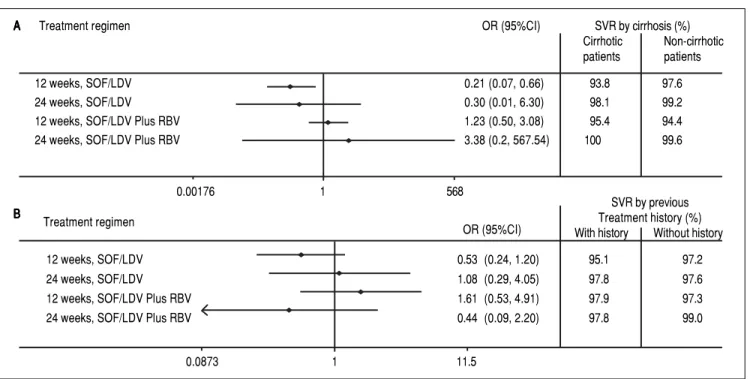
Figure 3. Effect of cirrhosis and previous history of treatment on the sustained virologic response for sofosbuvir plus ledipasvir regimen. A.A.A.A.A. Effect of cirrhosis on sustained virologic response. B. B. B. B. B. Effect of previous history of treatment on sustained virologic response.
Figure 4. Figure 4. Figure 4. Figure 4.
Figure 4. Effect of NS5A resistance-associated substitutions on the sustained virologic response for sofosbuvir plus ledipasvir regimen.
Study %
ID OR (95%CI) Weight
Afdhal, N. (TE) (2014) 0.13 (0.04, 0.39) 24.64
Afdhal, N. (TN) (2014) 0.26 (0.08, 0.85) 17.26
Kowdley, K. (TN) (2014) 0.45 (0.22, 0.91) 38.99
Lawitz, E. (TN) (2014) 0.04 (0.00, 0.48) 7.49
Mizokami, M. (MIX) (2015) 0.57 (0.05, 6.38) 3.21
Bourliere, M. (TE) (2015) 0.26 (0.04, 1.65) 6.87
Chuang, W.L. (MIX) (2016) 1.50 (0.07, 32.74) 1.54
Overall (I-squared = 18.9%. P = 0.285) 0.31 (0.20, 0.50) 100.00
0.01 1 7
195
SOF/LDV for HCV Genotype 1: a Meta-analysis. , 2017; 16 (2): 188-197
there were two study arms in two papers for this regi-men. There was no significant heterogeneity regarding results of these two studies (χ2 = 0.77, P = 0.38, I-squared = 0%) and according to fixed-effect model, pooled SVR12 was calculated as 98% (95%CI = 97%-99%) (Figure 2D). Because of the small number of included studies (n = 2) we could not run the related tests for publication bias.
Effect of baseline parameters on sustained virologic response
• Cirrhosis. In most study arms for these four men-tioned treatment regimens, the whole patients were cirrhotic or non-cirrhotic and therefore we could not run a meta-analysis of odds ratio (OR). However, we combined data of each arm related to each treatment regimen and finally calculated the OR for effect of cirrhosis on SVR12 using Peto method. Considering figure 3A, only in treatment regimen A, cirrhosis had a significant effect on SVR12 (OR = 0.21, 95%CI = 0.07-0.66).
• Previous history of treatment. We evaluated the ef-fect of previous history of treatment on SVR12. Figure 3B shows combined data related to each treatment reg-imen and ORs (according to Peto method) related to effect of previous history of treatment. Based on this analysis, previous history of treatment had no signifi-cant effect on SVR12 in all regimens.
• NS5A resistance-associated substitutions. Data re-garding NS5A RASs were extracted from the included studies which evaluated RASs at baseline. Because data about this issue were not available for evaluation of each regimen (A, B, C and D), inevitably we investi-gated the effect of the RASs on the main regimen SOF/ LDV with or without RBV for 12 or 24 weeks. Data of three papers were not included in this analysis; Gane, et al.13 because of adding another medication (GS-9669) to SOF/LDV regimen in two study arms, Stedman, et al.14 because of unavailable data of evaluation of RASs on SVR and Kohli, et al.15 because of reporting inade-quate data about number of patients with SVR and NS5A RASs. Moreover, Kowdley and coworkers6 eval-uated the effect of SOF/LDV for 8 weeks in one arm of their study and as we could not separate reported data about NS5A RASs and SVR from this arm, so we ex-tracted all the data from this study and included them in this meta-analysis. According to figure 4, NS5A RASs had a significant reduction effect on the SVR in SOF/LDV regimen (OR = 0.31, 95% CI = 0.2-0.5). There was no heterogeneity across results of studies regarding detection of NS5A RASs at base-line and treatment response. Also, based on Begg’s
(P = 0.65) and Egger’s (P = 0.67) tests, no publica-tion bias was found.
DISCUSSION
The current meta-analysis showed the high efficacy of SOF/LDV combination therapy in patients with chronic hepatitis C genotype 1 infection. The previous standard of care for treatment of HCV genotype 1 infection was PegIFN and RBV with less than 60% SVR rate in patients with HCV genotype 1 infection and the treatment accom-panied by many side-effects.16
The recognition of key proteins in the HCV replica-tion cycle provided the opportunity to target these proteins and inhibit the production of virions.17 HCV treatment regimens has had a long story from IFN-based to IFN-free regimens. This provided a treatment regimen with high SVR rate, short treatment duration and small number of adverse events. The goal of having an IFN-free treatment regimen for HCV genotype 1 infection was achieved with introduction and approval of SOF/LDV reg-imen in 2014.18
Rezaee-Zavareh MS, et al. , 2017; 16 (2): 188-197
196
In this study, we collected the data for assessment of the impact of baseline NS5A RASs on treatment success how-ever in none of these studies the data for resistance assess-ment was stratified regarding the treatassess-ment regimen. As a result, the data for all arms of each study was included in this meta-analysis. This meta-analysis found the baseline RASs of NS5A gene of HCV as a parameter impacted treat-ment response rate. It is worth to note, that most of pa-tients with treatment failure harbored NS5A RASs at the time of treatment failure which shows the major role of NS5A RASs in treatment failure of patients treated with LDV.6,7,19-22 However, clinical utility for assessment of NS5A RASs before starting the treatment is not defined yet maybe because of the high treatment response rate to SOF/LDV and very low specificity of assessment of NS5A RASs for prediction of treatment failure.
The introduction of other DAAs and IFN-free regi-mens and their approval for treatment of patients with HCV genotype 1 infection was continued after approval of SOF/LDV. In December 2014, combination of Ombitas-vir/Paritaprevir-r/Dasabuvir (3 direct acting antiviral; 3D) for HCV genotype 1 infection with more than 95% effica-cy was approved.23 In January 2016, the combination thera-py with Grazoprevir/Elbasvir (GZR/EBR) with about 95% SVR rate was approved.24 Given, SOF has renal metabo-lism, this antiviral agent cannot be administered in chron-ic kidney disease (creatinine clearance < 30 mL/min/1.73 m2) and the 3D and GZR/EBR are the alternatives for treatment of patients with chronic kidney disease and HCV genotype 1 infection.25,26 Furthermore, other combi-nations of DAAs such as SOF/Daclatasvir (27) and SOF/ Velpatasvir28 have been available as pan-genotypic treat-ment regimens.
In conclusion, the treatment of HCV genotype 1 with SOF/LDV combination results in high (≥ 95%) treatment response. The decision to add RBV to SOF/LDV and/or prolongation of SOF/LDV can be made based on presence of cirrhosis, contraindication of RBV and the cost issue. More identification of HCV-infected people and provid-ing more access to treatment for them can help for HCV elimination.29 The next goal in the field of HCV treatment is the development of new HCV therapeutic regimens without RBV with a promising 100% treatment response and no drug-drug reaction.30
ACKNOWLEDGEMENTS
Authors’ Contribution: Study concept and design: Mo-hammad Saeid Rezaee-Zavareh, Bita Behnava, Seyed Moayed Alavian and Heidar Sharafi; acquisition of data: Mohammad Saeid Rezaee-Zavareh and Khashayar Hesa-mizadeh; analysis and interpretation of data: Mohammad Saeid Rezaee-Zavareh, Mohammad Gholami-Fesharaki
and Heidar Sharafi; drafting of the manuscript: Moham-mad Saeid Rezaee-Zavareh, Khashayar Hesamizadeh, Mo-hammad Gholami-Fesharaki and Heidar Sharafi; critical revision of the manuscript for important intellectual con-tent: Bita Behnava and Seyed Moayed Alavian.
AUTHORS’ DECLARATION OF PERSONAL INTERESTS
None declared.
DECLARATION OF FUNDING INTERESTS
None declared.
REFERENCES
1. Gower E, Estes C, Blach S, Razavi-Shearer K, Razavi H. Global epidemiology and genotype distribution of the hepatitis C virus infection. J Hepatology 2014; 61(1 Suppl.): S45-57. 2. Manns MP, McHutchison JG, Gordon SC, Rustgi VK,
Shiff-man M, Reindollar R, GoodShiff-man ZD, et al. Peginterferon alfa-2b plus ribavirin compared with interferon alfa-alfa-2b plus ribavirin for initial treatment of chronic hepatitis C: a ran-domised trial. The Lancet 2001; 358: 958-65.
3. Sulkowski MS, Cooper C, Hunyady B, Jia J, Ogurtsov P, Peck-Radosavljevic M, Shiffman ML, et al. Management of adverse effects of Peg-IFN and ribavirin therapy for hepatitis C. Nat Rev Gastroenterol Hepatol 2011; 8: 212-23.
4. EASL Recommendations on Treatment of Hepatitis C 2015. J Hepatology 2015; 63: 199-236.
5. Lawitz E, Mangia A, Wyles D, Rodriguez-Torres M, Hassa-nein T, Gordon SC, Schultz M, et al. Sofosbuvir for previous-ly untreated chronic hepatitis C infection. New Engl J Med 2013; 368: 1878-87.
6. Kowdley KV, Gordon SC, Reddy KR, Rossaro L, Bernstein DE, Lawitz E, Shiffman ML, et al. Ledipasvir and sofosbuvir for 8 or 12 weeks for chronic HCV without cirrhosis. New Engl J Med 2014; 370: 1879-88.
7. Afdhal N, Zeuzem S, Kwo P, Chojkier M, Gitlin N, Puoti M, Romero-Gomez M, et al. Ledipasvir and sofosbuvir for un-treated HCV genotype 1 infection. New Engl J Med 2014; 370: 1889-98.
8. Tarantino G, Citro V, Conca P, Riccio A, Tarantino M, Capone D, Cirillo M, et al. What are the implications of the spontane-ous spleno-renal shunts in liver cirrhosis? BMC Gastroen-terology 2009; 9: 89.
9. Moher D, Liberati A, Tetzlaff J, Altman DG. Preferred report-ing items for systematic reviews and meta-analyses: the PRISMA statement. PLoS medicine 2009; 6: e1000097. 10. Higgins JPT, Green S (eds.). Cochrane Handbook for
Sys-tematic Reviews of Interventions Version 5.0.2 (updated September 2009). The Cochrane Collaboration 2008. Availa-ble from: www.cochrane-handbook.org.
11. Cai TT. One-sided confidence intervals in discrete distribu-tions. Journal of Statistical Planning and Inference. 2005; 131: 63-88.
12. Duval S, Tweedie R. Trim and fill: A simple funnel-plot-based method of testing and adjusting for publication bias in meta-analysis. Biometrics 2000; 56: 455-63.
197
SOF/LDV for HCV Genotype 1: a Meta-analysis. , 2017; 16 (2): 188-197
polymerase inhibitor sofosbuvir plus the NS5A inhibitor ledi-pasvir or the NS5B non-nucleoside inhibitor GS-9669 against HCV genotype 1 infection. Gastroenterology 2014; 146: 736-43 e1.
14. Stedman CA, Hyland RH, Ding X, Pang PS, McHutchison JG, Gane EJ. Once daily ledipasvir/sofosbuvir fixed-dose combi-nation with ribavirin in patients with inherited bleeding disor-ders and hepatitis C genotype 1 infection. Haemophilia : the official journal of the World Federation of Hemophilia. 2015. 15. Kohli A, Osinusi A, Sims Z, Nelson A, Meissner EG, Barrett
LL, Bon D, et al. Virological response after 6 week triple-drug regimens for hepatitis C: a proof-of-concept phase 2A cohort study. Lancet(London, England) 2015; 385: 1107-13. 16. Tsubota A, Fujise K, Namiki Y, Tada N. Peginterferon and rib-avirin treatment for hepatitis C virus infection. World J Gas-troenterol 2011; 17: 419-32.
17. Jazwinski AB, Muir AJ. Direct-acting antiviral medications for chronic hepatitis C virus infection. Gastroenterol & Hepatol 2011; 7: 154-62.
18. Alavian SM, Hajarizadeh B, Bagheri Lankarani K, Sharafi H, Ebrahimi Daryani N, Merat S, Mohraz M, et al. Recommenda-tions for the Clinical Management of Hepatitis C in Iran: A Consensus-Based National Guideline. Hepatitis Monthly 2016; 16: e40959.
19. Lawitz E, Poordad FF, Pang PS, Hyland RH, Ding X, Mo H, Symonds WT, et al. Sofosbuvir and ledipasvir fixed-dose combination with and without ribavirin in treatment-naive and previously treated patients with genotype 1 hepatitis C virus infection (LONESTAR): an open-label, randomised, phase 2 trial. The Lancet 2014; 383: 515-23.
20. Mizokami M, Yokosuka O, Takehara T, Sakamoto N, Korenaga M, Mochizuki H, Nakane K, et al. Ledipasvir and sofosbuvir fixed-dose combination with and without ribavirin for 12 weeks in treatment-naive and previously treated Japanese patients with genotype 1 hepatitis C: an open-label, ran-domised, phase 3 trial. Lancet Infect Dis 2015; 15: 645-53. 21. Bourliere M, Bronowicki JP, de Ledinghen V, Hezode C,
Zoulim F, Mathurin P, Tran A, et al. Ledipasvir-sofosbuvir with or without ribavirin to treat patients with HCV geno-type 1 infection and cirrhosis non-responsive to previous protease-inhibitor therapy: a randomised, double-blind, phase 2 trial (SIRIUS). Lancet Infect Dis 2015; 15: 397-404.
22. Chuang WL, Chien RN, Peng CY, Chang TT, Lo GH, Sheen IS, Wang HY,et al. Ledipasvir/sofosbuvir fixed-dose combi-nation tablet in Taiwanese patients with chronic genotype 1 hepatitis C virus. J Gastroenterol and Hepatol 2016.
23. Ferenci P, Bernstein D, Lalezari J, Cohen D, Luo Y, Cooper C, Tam E, et al. ABT-450/r-ombitasvir and dasabuvir with or without ribavirin for HCV. New Engl J Med 2014; 370: 1983-92.
24. Zeuzem S, Ghalib R, Reddy KR, Pockros PJ, Ben Ari Z, Zhao Y, Brown DD, et al. Grazoprevir-Elbasvir Combination Thera-py for Treatment-Naive Cirrhotic and Noncirrhotic Patients With Chronic Hepatitis C Virus Genotype 1, 4, or 6 Infection: A Randomized Trial. Ann Intern Med 2015; 163: 1-13. 25. Hill L. Hepatitis C Virus Direct-Acting Antiviral Drug
Interac-tions and Use in Renal and Hepatic Impairment. Topics in Antiviral Medicine 2015; 23: 92-6.
26. Roth D, Nelson DR, Bruchfeld A, Liapakis A, Silva M, Mon-sour HJr., Martin P, et al. Grazoprevir plus elbasvir in treat-ment-naive and treatment-experienced patients with hepatitis C virus genotype 1 infection and stage 4-5 chronic kidney disease (the C-SURFER study): a combination phase 3 study. Lancet (London, England). 2015; 386: 1537-45. 27. Alavian SM, Rezaee-Zavareh MS. Daclatasvir-based
Treat-ment Regimens for Hepatitis C Virus Infection: A Systematic Review and Meta-Analysis. Hepatitis Monthly 2016; 16: e41077.
28. Kahveci AS, Tahan V. Sofosbuvir and Velpatasvir: A com-plete pan-genotypic treatment for HCV patients. Turk J Gas-troenterol (the Official Journal of Turkish Society of Gastroenterology) 2016; 27: 205-6.
29. Alavian SM, Rezaee-Zavareh MS. The Middle East and hepa-titis C virus infection: does it need special attention? Lancet Infect Dis 2016; 16: 1006-7.
30. Hesamizadeh K, Sharafi H, Rezaee-Zavareh MS, Behnava B, Alavian SM. Next Steps for Eradication of Hepatitis C in the Era of Direct Acting Antivirals. Hepatitis Monthly. In press (In press): e37089.
31. Afdhal N, Reddy KR, Nelson DR, Lawitz E, Gordon SC, Schiff E, Nahass R, et al. Ledipasvir and sofosbuvir for pre-viously treated HCV genotype 1 infection. New Engl J Med 2014; 370:1483-93.
Correspondence and reprint request:
Heidar Sharafi, Ph.D.
Baqiyatallah Research Center for Gastroenterology and Liver Diseases (BRCGL), Baqiyatallah University of
Medical Sciences, Tehran, IR Iran Middle East Liver Disease Center, Tehran, IR Iran