THIRTEEN P
ASTON LETTERS IN SEARCH OF A ST
ANDARD
13
REVISTA CANARIADE ESTUDIOS INGLESES, 46; abril 2003, pp. 13-33
THIRTEEN PASTON LETTERS IN SEARCH OF A STANDARD
Isabel Moskowich-Spiegel Fandiño & Ana Montoya Reyes
Universidade da Coruña
ABSTRACT
The present paper proposes an approach to the development of the so-called Standard English from a morphological perspective. To this end, we present the concept of Standard in order to show the different theoretical viewpoints from which its nature and origin have been analysed. Traditionally, when dealing with Standard most authors based their studies on spelling. However, in the last few years the validity of morphemic analysis has been recognised as a way of measuring the evolution of English in the last years of the Middle Ages and beginning of the Renaissance. Thus, we here propose the analysis of certain letters by Paston men as indicators of language change.
KEYWORDS: Paston letters, morphemic units, Standard English.
RESUMEN
El presente trabajo pretende aproximarse a la cuestión del desarrollo del llamado Standard English desde el análisis morfológico. A tal objeto se presenta el propio concepto de estándar para mostrar las distintas perspectivas teóricas desde las que se han abordado su naturaleza y su origen. De forma tradicional, al hablar de estándar se hacía mayor hincapié en los aspectos relacionados con la escritura y la ortografía, pero en los últimos años se ha recono-cido la validez del análisis morfológico como medidor de la evolución de la lengua inglesa de finales de la Edad Media y principios del Renacimiento. Así, aquí se propone el análisis de ciertas variables morfológicas de las cartas de algunos hombres de la familia Paston como indicio de ese cambio.
PALABRASCLAVE: Cartas de la familia Paston, morfemas, inglés estándar.
0. INTRODUCTION
writ-ISABEL MOSKOWICH-SPIEGEL F
ANDIÑO & ANA MONTOY
A REYES
14
ing, or if, on the contrary, our samples illustrate the typical lack of homogeneity claimed by some authors (Mele Marrero & Martín Díaz, 2001:580).
To this end, section 1 will deal with the idea of “standard” from different points of view and some of the basic theories posed by different scholars, such as the traditional SAD theory and more recent ones defending the validity of macaronic texts for the study of standardization. Both perspectives will be tackled. Section 2 describes the corpus chosen as a source of data for this study. Such data will be analysed and debated in section 3. Since several years separate the letters chosen, we expect we will be able to find some changes in the type of language used. Section 4 will present the data obtained and section 5 will, hopefully, offer some preliminary conclusions about morphemic change towards the standard in the texts selected.
1. THE IDEA OF “STANDARD”
When speaking about Standard written English we probably think about a language that has a clearly defined orthography, lexicon and grammar. But before reaching this point a particular variety may have triumphed over all the rest, that is to say, it has spread and has become a model to imitate. After this selection, it has been codified, it has become apt for all linguistic functions and it has finally been accepted as the only valid variety for discourse. According to Haugen (in Smith, 1996:76) these four criteria (selection, codification, elaboration and acceptance) are the ones any variety must fulfill in order to say it is fixed or, in other words, that it is a standard. On the contrary, any variety meeting only some of the requirements “may be regarded as focussed and standardized” (Smith, 2000:129). In other words, a language is standardized or not depending on the homogeneity it presents. Ac-cording to Jonathan Hope one of the most popular definitions of standard is:
The standard, as any fule kno, is a non-regional, multifunctional, written variety, historically based on the educated English used within a triangle drawn with its apexes at London, Cambridge and Oxford. Even more specifically, the propaga-tion of this ‘incipient’ standard can be linked to a particular branch of the late medieval bureaucracy: the court of Chancery (2000:49).
Some other scholars make a further distinction between standard and
stand-ardized language:
THIRTEEN P
ASTON LETTERS IN SEARCH OF A ST
ANDARD
15
Be it as it may, we will here assume that Standard English fulfilled all these requirements at some point in its history. Several sources have been traditionally taken into consideration when dealing with the origin of Standard English, among which “Chancery English” has been one of the most often mentioned. Others have been the introduction of the printing press in England, the language of the Court or that variety used by men educated in the triangle formed by London, Oxford and Cambridge. No doubt all these have contributed to and have played their role in the formation of standard language. However, in the last decade or so, more and more scholars have defended the idea that the origins for the Standard must be looked for not only in the factors and places mentioned above but also somewhere else.
The different studies carried out by sociolinguistics from the sixties have demonstrated that language change takes place in several steps (not necessarily in-dependent, discrete or even chronologically successive). These studies show that language change is, in the first place, a question of individual speech, that is to say, changes are produced more often when speaking than when writing as observed in today’s speech communities. It is only gradually that individual changes, after co-existing with the norm, may gain some ground and influence on other individuals of the community and, finally, become the accepted form depending on the degree of influence of such people (Labov, 1972; Milroy, 1985). The way in which the changes expand have been much discussed and classified according to the process and direction in which they develop, the type of social structure or network in which they first appear, etc., both in existing speech communities and in the past (Iglesias Rábade & Moskowich, 1993, 1997). We suppose that in its evolution towards standardization the English language must have suffered numerous and different changes that were at first reflected in individual speech and (not necessar-ily much) later assimilated into writing.
Among the different tendencies when approaching the topic there is one that clearly stands out. It is the one that places the origin of Standard English in what has been labelled “Chancery English.” It is likely that this tendency was some-how favoured by Eilert Ekwall (1956) whose studies on population movements in London between 1270 and 1300 were used as the basis for works by John Fisher (1977) and Michael Samuels (1989) among others. This approach shows no doubt about the responsibility of Chancery English in the growth of Standard English. As Fisher (1977:896) puts it: “(...) we may see the modern written standard emerging from conventions established by the clerks in Chancery between 1420 and about 1440, and spread by professional scribes throughout England by 1460.”
However, we agree with Wright (1994, 1996a, 1996b, 1999, 2001) in her consideration of texts that have not sprung from late medieval bureaucracy but from different commercial transactions. In this sense, non-formal or non-official texts such as memoranda and all sorts of notes and letters could be as valid wit-nesses and protagonists in the development of Standard English as acts of court, royal grants or legal documents of all sorts.
ISABEL MOSKOWICH-SPIEGEL F
ANDIÑO & ANA MONTOY
A REYES
16
that several favourable circumstances met in order to promote the development of a language with national identity. It was then that confidence in the competence of the English language increased because it was considered valid to face all the com-municative needs of that moment (Bourcier, 1981). Some scholars (Davis, 1951, 1952; Bourcier, 1981; Lass, 1999) affirm that there is a progressive linguistic selec-tion that could account for the movement towards a more uniform and, thus, less regional and dialectal language. To reach this point, the amalgamation of different writing systems (originated, in their turn, in different dialectal varieties) was neces-sary until such amalgamation developed its own characteristic identity (Blake, 1996:172-3) reflected in the consideration of English as the language of a nation. Norman Davis describes in some of his works (1951, 1952, 1955) how the process followed by many writers who slowly changed their regional spelling in the direc-tion of Standard English took place without any special conflict, mainly well into the Early Modern English period when standardization is considered well estab-lished (McIntosh, 1963; Görlach, 1993; Lass, 1999).
The most extended tendency is the one that maintains that this homog-enizing process reflected in writing was originated in the particular linguistic use of a socially prestigious group. All other regional uses would inevitably tend to con-verge with this “more prestigious” one (Fisher, 1977; Fisher et al., 1984). Inside this trend of thought, London is considered the city in which all of the speakers whose habits towards a standard were placed (Morsbach, 1888; Lekebusch 1906). Within this sense, the publication by Chambers and Daunt (1967) contributed to a better knowledge of English in the early 15th century in London. However, not all lin-guists coincide in their considerations, as is the case of Samuels (1981) who claims that there could not have existed a “distinct City dialect” in London since too many variants were gathered there.
A different approach is the one adopted by John H. Fisher, who attracted many an eye with his theories on “Chancery Standard.” He and some other authors defend the idea that this language born in the royal Chancery offices in the 15th century is the source of the language model imitated by the society of the moment. Fisher (1977, 1996) affirms that this particular variety would in time become Modern English.
Inside this tendency we are analysing, Morsbach (1888), Lekebusch (1906) and Flasdieck (1922) also considered the royal Chancery played a fundamental role in the diffusion of London educated language. It was Dibelius (1901) who first used the term kanzleienglisch to denote the London linguistic type. However, the theoretical approach that rejects Chancery English1 as the only origin of Standard English is well represented by Laura Wright and Jonathan Hope.
1 Samuels provided the term Chancery English with a more restricted and technical sense in
THIRTEEN P
ASTON LETTERS IN SEARCH OF A ST
ANDARD
17
The interest for the origin of Standard English gave rise to many studies. One of the pioneers was Edwin Guest (1838), who maintained that Present-Day English does not directly descend from the Anglo-Saxon literary Standard. Another one was R.L. Latham (1850), who pointed at the importance of London in the standardization process. T.L. Kington Oliphant (1873) held this same viewpoint, though he stated that London English was by then highly influenced by that of Central Midlands.
We can classify 19th-century studies in three main trends (Gómez Soliño:1984): authors emphasising the linguistic influence of certain prestigious writers (Chaucer, Wycliff, Caxton); secondly, those proposing London and Gov-ernment institutions as the fundamental pieces in the construction of the new lan-guage, and, finally, those authors that do not focus on particular writers or geo-graphical areas when searching for the source of English. Up to World War II and
mainly inside the three approaches just mentioned, most studies on the origin of English Standard were carried out in Germany (ten Brink (1884), Morsbach (1888), Dibelius (1901), Lekebusch (1906), Frieshammer (1910), Flasdieck (1922).
The study of standardization went on after World War II. The research
carried out by Ekwall in 1956 on London population in the late Middle Ages attracted many linguists’ attention. In his study he used those Londoners’ surnames denoting place names in the period stretching from 1270 to 1300. His aim was to discover the geographical origin of these people by placing their surnames on the map. The results showed a higher number of individuals coming from the South than from the Midlands, which contradicted what had been previously observed.
Nowadays, other authors such as Wright (1996b:104-105) think that the problem with Ekwall was that his methodology was neither accurate nor conclud-ing. She affirms that the different varieties of a language are not hermetic and static. We cannot expect them to take place inside the isoglosses delimited by dialectolo-gists. We cannot say that there has been a migration whenever a particular dialectal form is detected outside its geographical area:2
Ekwall and Samuels, historical dialectologists, sought to find the nearest part of the North, as it were, to London; and to locate an exodus from there, in order to explain forms found in the North entering London texts. The Midlands is the nearest place to fit these requirements. Is it, however, necessary to posit a migra-tion of Northern speakers into London, to account for the new morphological
2 Other authors insist that standard language should not be identified with a particular
ISABEL MOSKOWICH-SPIEGEL F
ANDIÑO & ANA MONTOY
A REYES
18
forms? After all, linguistic features can move without a population movement, and over a period of 150 years (i.e., 1258-1400) we would expect a dialect to show change. (1996b:111)
The main problem is that the results Ekwall obtained were used as the basis for other studies. Among those that followed him, Benskin (1992) or Samuels (1989) can be mentioned. The latter classifies the texts produced in the 14th and 15th centuries in four groups that constitute the sources for Standard English. Contrary to Ekwall, who admitted that Standard English had some East Midlands influence, Samuels (1989) prefers to place this influence in the Central Midlands though he accepts Ekwall’s proposal of population movements southwards from the Midlands (Samuels, 1989).
The reference to Ekwall is also present in the works of other scholars. Thus, Gómez Soliño (1984:24) mentions:
Si, como ya se ha señalado, la lengua estándar londinense es más un reflejo de los dialectos de las East Midlands y del Norte, por ese orden, que de ningún otro dialecto medieval inglés, habrá que pensar que o bien el inglés moderno se gestó directamente en las East Midlands como a Hübener y a Peitz les parece más lógico, o bien surgió en Londres tras haberse producido una alteración tipológica en el dialecto de la capital, como afirman Morsbach y otros, en cuyo caso hay que expli-car la causa que produjo tal cambio. Esto último es lo que ha logrado Ekwall.
The studies published from the mid-twentieth century onwards insist on the fact that Chancery English is the source for Standard English. Some (Fisher, 1977; Cable, 1984) defend the idea that the clerks writing for the Royal Chan-cery were contributing to the creation of this new linguistic code as they stand-ardized their spelling. However, others (Wright, 1996b) reject this idea since there is no evidence that the scribes had reached such a level of standardization. The problem with the first approach is that it only considers the origin of Standard English —and, in that sense, it may well have been in the Royal Chancery— but it does not consider other factors that may have intervened in its later develop-ment such as the printing press which played an important role in the evolution of the English language (Gómez Soliño, 1984 ).
We cannot know whether Caxton’s intervention was that crucial or, on the contrary, whether the history of English would have been the same even without his existence since he had no intention to follow any standard (Blake, 1973). Other authors (Gómez Soliño, 1984) recognise the important role played by the printing press in the evolution of English (printed texts were intended for a bigger audience than Chancery texts) though they admit it was not so decisive. In fact, printed texts show diversity rather than uniformity in their spelling and the work of many for-eign printers together with thatof many English printers to use spelling variants that could not be readily understood by their readers may have delayed the stand-ardization process.
THIRTEEN P
ASTON LETTERS IN SEARCH OF A ST
ANDARD
19
First, the chief linguistic consequence of successful standardization is a high degree of
uniformity of structure. (...) Second, standardization is implemented and promoted primarily through written forms of language. (...) Third, standardization inhibits lin-guistic change and variability. (2000:13)
The expansion of Chancery English as the Standard of the nation is diffi-cult to explain though it is known that the Court travelled with the king all over the country (Fisher et al: 1984). This difficulty grows if we consider that it is a written standard. Tejada explains this phenomenon in the following terms:
En esferas alejadas de Londres no se produjo la imitación inmediata del estilo que allí exportaban los funcionarios. Parece que la práctica habitual pasó por el desa-rrollo de normas regionales, formas de inglés escrito que había suprimido de su repertorio los rasgos más exóticos del habla local, en favor de otros más neutros y ampliamente aceptados, que facilitaban probablemente la gestión burocrática y administrativa. A esto hay que añadir la labor más o menos consciente que desem-peñaron los varones instruidos en las Inns of Court que volvían a sus lugares de nacimiento para ejercer sus carreras. (1999:13)
It is possible that the need for a fixed means of communication was also felt in other spheres such as in commercial transactions and business and not only in the Court (Wright, 1996a, 1996b, 1999, 2002). This would somehow have con-tributed to the creation and spreading of the Standard. Let us bear in mind that “it is possible that the spread of the national standard may have taken place at different rates in different genres of writing” (Taavitsainen, 2000:136).
Most documents written in the period in which the standardization of English is supposed to have taken place show a language that can in no way be called monolingual, but they are written in a mixture of Latin and English or Anglo-Norman and Latin. In these macaronic texts the linguistic mixture can be perceived not only in the lexical but in the morphological level too. A good example of macaronic texts can be found in one of the samples in our corpus, letter n. 2 by William Paston I, addressed to an unidentified lawyer in Rome where we can read:
(1) I haue, by aduys of counseill, in makyng a procuracie ad agendum defendum prouocandum et appellandum to yow (...) (Davis, 1971:3)
To ignore macaronic texts because of their mixed linguistic nature would mean to ignore most medieval texts as well as social and linguistic evidence (Wright, 1996a). It is probable that speakers of late Middle English and early Modern Eng-lish did not feel bilingualism and diglossia as something strange. Thus, Chancery English “is just one functional variety of written English, with a very limited read-ership, whereas Standard English has come to be multifunctional” (1996a:3).
ISABEL MOSKOWICH-SPIEGEL F
ANDIÑO & ANA MONTOY
A REYES
20
English. Studies being carried out nowadays follow somehow divergent paths. To-gether with Wright, other authors seem to react against the idea of a standard origi-nating from one particular variety. Thus, Hope (2000:49) opposes to the “single ancestor dialect, also called SAD hypothesis “not because the linguistic data supports it (in fact does the opposite, but because the family-tree metaphor demands it).” The single-source hypothesis has been certainly popular as claimed by Hope
The attractiveness of the SAD hypothesis is clear: it provides a neat explanation for the emergence of Standard English from the morass of competing variants in the Middle English period, and it is an economical account, since by operating at the level of dialect rather than linguistic feature, it automatically explains why any and every linguistic variant was selected to become part of the standard. The alter-native would be an ‘every variant has its own history’ account, which would have to treat each variant as a separate entity. Such an account would present us with standardization as a random, haphazard process with no overall organisation. The SAD hypothesis is also highly teachable, because it leaves no loose ends, and be-cause (in its ‘Chancery Standard’ realisation) it provides a clear motivation for changes: they happened because an identifiable group of people made identifiable decisions. (2000:50)
However, it is being reformulated to include the possibility of having a hybrid origin for Standard English which is, in our opinion, a more realistic approach, mainly if we take into consideration the mechanisms of language change as seen to work in present-day English. We agree with Hope when he claims that:
(...) the selection of single linguistic features from a range of dialects - features which are then recombined into a new dialect which lacks a common ancestor. Standardization thus becomes, not a unitary process operating on all dialects over a much longer time. (...) Standardization is not simply a set of decisions made by one identifiable group of late medieval bureaucrats: it is a complex of processes, growing out of the decisions made by a much wider range of writers in English (including, for example, the hundreds, perhaps thousands, of people involved in keeping and exchanging business records). (2000:51)3
Of course, certain processes occurred during the standardization cannot be easily accounted for by what he calls “linguistic naturalness.” Hope finds an expla-nation for speakers’ choices apparently not so natural in certain social constraints that make them choose more complex structures.
3 Hope’s standpoint here coincides with that defended by the Linguistic Atlas of Late
Mid-dle English. This Atlas demonstrated that the isoglosses used to delimit the five dialectal areas
THIRTEEN P
ASTON LETTERS IN SEARCH OF A ST
ANDARD
21
We believe, with Hope (2000) and Wright (1994, 1996b, 2000, 2002) that Standard English was not consciously created after a decision taken by the mem-bers of the Royal Chancery but it was rather created by all those people who could write.
2. OUR CORPUS
The linguistic situation in late Middle English is one of great diversity, in which different varieties coexist with more or less difficulty as regards their mutual intelligibility, in other words, the “‘one word, one spelling’ system was not yet in operation” (Wright, 1999:170). However, texts intended for printing were often corrected by printers (Samuels, 1981:44). These corrected editions are the ones that contributed to the idea of the Standard. In this sense, texts that were not, in principle, intended for publication are closer to the real linguistic situation than those texts that have been manipulated in one way or another. Letters could be grouped inside the first type and thus be more representative of the language of the period in which the Standard was being developed(Davis, 1955).
The source of data chosen for this research is constituted by some personal letters belonging to the Paston family as edited by Norman Davis (1971). Since the origin of Standard English is generally placed in the limit between Middle English and early Modern English, the Paston letters seem relevant evidence for our pur-pose here.
However, it is not our intention to enter the question of periodisation al-ready addressed by many authoritative scholars.4
The letters selected can be divided into two main groups on a chronologi-cal basis: those in the first group were written in the first half of the fifteenth cen-tury (from 1425 to 1452, a period in which the process of Standardization ad-vances and becomes firmer) and the second one belongs to the last years of the same century and the beginning of sixteenth century (from 1489 to 1503, see table 1).
There are some reasons that explain the selection of this material. In the fifteenth century, there was a growth in literacy and bureaucracy became more complex; as a consequence of this new situation, written production began to in-crease both in quantity and quality. Among the different types of documents, let-ters became a new form of record especially for families. They were personal ar-chives as well as a new way to communicate in the distance. People began to use them not only for their business affairs but also for their personal relationships.
4 The two main tendencies have been the one defending external or outer history as
ISABEL MOSKOWICH-SPIEGEL F
ANDIÑO & ANA MONTOY
A REYES
22
From that moment onwards almost every family had its own archive; but the evi-dence preserved amounts to just a dozen groups from the fifteenth century (Barber, 1981). Among this reduced number of texts, the Paston letters, together with the Stonor papers and the Cely papers, constitute one of the best and most complete collections (over 360 letters and memoranda). On the other hand, many of these texts were not written in order to conform to a style; therefore, if we take this piece of information and we add to it the relevance and role which letters were acquiring, the Paston letters represent a suitable source of information about the state of lan-guage at that time.
The period studied by the present work covers from 1425 to 1503, as we can see in the table below. The first date, 1425, corresponds to the year when the first letter was written by one of the men belonging to the Paston family. On the other hand, the last date, 1503, corresponds to the latest letter written, whose au-thor in this case was John Paston III (William Paston I’s grandson).
The texts analysed comprise a total amount of approximately 6,000 words which seems enough for a tentative first approach to the topic. The total number of words found in each text, their author, their addressee, the numeric reference given to each letter by Davis (1971) and the date when the letter was written is shown in the following table:
TABLE 1. LETTERS SELECTED
YEAR AUTHOR LETTER ADDRESSED... NUMBER
NUMBER OFWORDS
1425 William Paston I 1 To John Staynford 325
1425 William Paston I 2 To an unidentified lawyer in Rome 522
1425 William Paston I 3 Probably to Master John Urry 498
1426 William Paston I 4 To William Wostede, John Longham, and Piers Shelton 692
1449 John Paston I 37 To an unidentified person in London 622
1452 William Paston II 81 To John Paston I 378
1489 William Paston III 413 To John Paston III 640
1487-1493 Edmond Paston II 400 To John Paston III 656
1487-1495 John Paston III 390 To Lord Fitzwalter 194
1492 William Paston III 414 To John Paston III 641
1495 William Paston IV 421 To John Paston III 127
1500 John Paston III 391 To Richard Croft 380
1503 John Paston III 392 To William Paston III and Richard Lightfoote 353
THIRTEEN P
ASTON LETTERS IN SEARCH OF A ST
ANDARD
23
Only autographed letters have been chosen disregarding those containing any piece of writing produced by clerks.
3. VARIABLES CONSIDERED
Either from the SAD viewpoint or from the hybrid origin one (see section 2), most studies have focused on the evolution of spelling5 until English is fixed (Wright, 2000; Rissanen, 2000). In the last years, however, the “standardization of a language encompasses not only its spelling system, but also its vocabulary and grammatical system” (Wright, 1999). The letters studied for this piece of research were written within a time span of seventy-eight years and throughout different generations whose identity is known. They were composed when the process of standardization of the English language was quite developed. Nevertheless, as this process was still under way, it is not infrequent to find texts which contain morpho-logical variation.
Consequently, not only spelling, but also the lexicon and grammar must be examined in order to make any statements about the degree of standardization of a particular text. Basing upon Wright’s proposal (1999) we have selected a number of morphological variables. Such variables are the following:
INFINITIVE MARKERS
We will here consider two types of markers: endings and prepositions pre-ceding. Within endings we will look for - (e)n (defenden in letter 3 (1425)) , -e (such as stonde in letter 1 (1425)) and Ø (be in letter 2 (1425)) endings. As for preceding prepositions we will be interested in for to as in for to dystroy (letter 413 (1489)), to (to amend letter 37 (1449)), and a of which we have no cases in our samples.
PAST PARTICIPLEMARKERS.
Markers can precede or follow the participles. Thus, we will make a first division between those participles that take a prefix and those that do not. Inside the first group, the prefixes we will be considering are y-, i-, a-.
As for the possible endings, we will focus on the presence of -n (either -yn or -en) versus -ne: writen (letter 1),
ISABEL MOSKOWICH-SPIEGEL F
ANDIÑO & ANA MONTOY
A REYES
24
PRESENT INDICATIVEMARKERS
For 3rd person singular (the use of -s, -th or any other endings will be indicative of Standardization or lack of it): namyth (letter 2), semys (letter 400).
For 3rd person plural (in this case, the possible endings are -n, -e, -th or Ø):
seyn (letter 1), knowith (letter 4), thynke (letter 400).
THIRDPERSONPLURALPRONOUNS
Opposition between h- (such as hem) pronouns and th-(such as them) pro-nouns for the 3rd person plural in subject function and consideration of object and possessive functions.
NEGATORS
The tendency to use [ne + verb + negator] will be considered “less standard” than other practices in which double negation is not so common.
ADVERB MARKERS
Choice between endings in -ly and -lich(e): vntrewely (letter 2), dayly (letter 414 ).
As mentioned in section 3, devoted to the corpus, we have decided to choose some of the letters which were written at the beginning of fifteenth century and some of them which were closer to sixteenth century. In this way, it will be possible to see: if the language was standardized, if the language still had many dialectal words or if there is a movement from a non-standard to a standard language through the time span considered. The following section will provide us with data relative to this particular point.
4. ANALYSIS OF DATA
4.1. INFINITIVEMARKERS
In Modern English the infinitive is formed either preceded by the preposi-tion to or without any preposipreposi-tion or suffix, a form which is known as bare infini-tive. During the Middle English period, the infinitive is often used with preceding
to or with for to and in Northern English and Scots for till (Mossé, 1987) even
tempo-THIRTEEN P
ASTON LETTERS IN SEARCH OF A ST
ANDARD
25
ral auxiliaries (shall, will) or modal auxiliaries and after a number of verbs such as
go, hear or think. This form is also found in the accusative-with-infinitive
construc-tion. These possibilities are well represented in the corpus studied here.
(2) I prey you shewe it to my lordys good lordshepe (letter 392);
(3) for to geynsstonde suche persons as is abowtward for to destroy owre suffereyn lorde the Kynge (letter 413)
(4) that it may please yow of your specyall grace to dyrect ought your lettres sygned wyth your hand (letter 390)
We have also found some examples of infinitives which are coordinated (by the conjunctions or/and). In this case, only the first infinitive is preceded by the preposition to as well as in Present-day English:
(5) the seyd Jamys shall vpon the syght of your seyd wryghtyng delyver or cause to be delyverd (letter 390)
(6) And thys to be fulfyllyd and kept (letter 413)
But there are still some signs which reflect the French influence on the English language; that is the case of t’endure, a form present in one of the letters (ner 390) where we can appreciate the vocalic contraction between the preposition and the verb.
On the other hand, infinitives suffer the changes produced by the weaken-ing of final vowels into /´/ and the loss of final -n (García García, 2001). This process spread in early Modern English in such a way that both the infinitive and the first person singular of the present indicative came to share the same form (Moskowich, 2001).
In the corpus under study, just 2% of the infinitives have the older -n suf-fix. This tendency is followed by all authors and the only three tokens we have found are one in letter 3 (1425) and two in letter 37 (1449), both written in the first half of the fifteenth century. The weak verb have takes different forms in differ-ent tenses throughout the texts analysed, but we want to mdiffer-ention the presence of some apocopated forms. In the Northern dialect some verbs frequently used had apocopated forms (Mossé, 1987); have is one of these verbs and in the case of the texts analysed we have found two letters which show some examples of these forms (letter 81: þat õe schuld a be on of þe capetayns of þe ryserse in Norfolk (...) schuld an
vtteryd ferthere; letter 421: all the comun shuld a be takyn a-way). Table 3 below
represents the distribution of infinitive endings in our corpus. TABLE 2. INFINITIVE PREFIXES
INFINITIVEPREFIXES FORTO TO TO- FORMSIN % OTHERFORMSIN %
ISABEL MOSKOWICH-SPIEGEL F
ANDIÑO & ANA MONTOY
A REYES
26
4.2. PAST PARTICIPLEMARKERS
In the Middle English period the prefix ge-, used in Old English for the formation of the past partiple, had reduced to i-/y- until it finally disappeared. In fact, none of the men writing these letters have used this residual past participle prefix, a fact that could be considered as an example of a clear sign of the standardi-zation in progress.
On the other hand, we cannot forget the tendency to rely on Latin catego-ries as well as on its structures which was followed by most grammarians at that time. This conception of the English grammar was still in use during the fifteenth century and it lasted until after the Civil War (Görlach, 1993). The influence of this latinization can be obseved in some of the letters considered, as it is the case of the form apostata (letter 4).
Apart from these considerations, the number of weak verbs (113) is higher than that of strong ones (37), as could be expected, since this group of verbs be-came the productive class (Mitchell, 2001). Among the weak verb forms we find an important number of past participles whose ending is already the form used in Modern English (letter 2: told, sent; letter 400: made, thought). Aside from these cases, the ending chosen by most of the letters’ authors is the dental suffix -d pre-ceded by either -i or -y instead of -e (letter 37: portrayid, informyd; letter 400: shewyd,
causyd).
The presence of -y instead of -e before -n (letter 392: vntakyn, letter 400:
brokyn) in the strong past participles ending is also present in our corpus and its
frequency is quite high. Finally, the ending most often used for the strong past participles is the -n or -yn suffix.
After these considerations, the results achieved show that, even though we cannot still state that the standardization of the past participle forms is completed at this point, there is no doubt that there is a high degree of regularisation. As table 4 illustrates, there seems to be no difference in the selection of the different alterna-tives for the past participle formation, either for the weak or the strong forms, between the letters written during the first half of the fifteenth century and those written closer to the sixteenth century, at least in the group of letters we have con-sidered.
TABLE 3. INFINITIVE SUFFIXES
INFINITIVESUFFIXES -EN -E Ø -NFORMSIN% NON -NFORMSIN %
278 4 206 69 2 98
TABLE 4. STRONG PAST PARTICIPLE SUFFIXES
PAST PARTICIPLES -N -N (E) Ø -YN -E -NFORMSIN% NON -NFORMSIN %
THIRTEEN P
ASTON LETTERS IN SEARCH OF A ST
ANDARD
27
4.3. THIRDPERSONSINGULARMARKER
This feature (the way in which the third person singular of the present indicative is expressed) is not really determining to reach any conclusion about its degree of standardization, at least in the group of texts analysed. The results in table 5 show that only five forms contain the -s ending and they are all written by a single author (Edmond Paston II) in a single letter (letter 400, written between 1487 and
1493: semys (3 times); makys; seruys). In this letter we also find the form hasse which is not, obviously, the standardized verb form for the third person singular of have in the present indicative, though it is closer to the form we find in present-day English than hath, variable found in this corpus (letter 3, written in 1425 by the Paston pater familias, William Paston I).
In addition to this, if we reconsider the -s forms found in the corpus and their relevance, we cannot establish whether these five forms represent a turning point; but the time span during which the letter is supposed to have been written (between 1487-1493) can be really significant, as it is closer to the following century and it is possible that Edmond Paston II was conscious of the current
changes6 in language. This makes us think about an apparent movement towards the standard.
TABLE 5. THIRD PERSON SINGULAR MARKER
PRESENT TENSE -TH -S -THMARKERSIN % -SMARKERSIN %
29 24 5 83 17
6 In May 1469, Edmond II was staying at Caister hoping to go to London to an inn of
court or chancery (Davis, 1971). We do not know if he finally did it, but he spent most of his life moving all over the country and we know he lived, briefly, in London, so it is possible he learnt some of the linguistic changes in progress.
4.4. THIRDPERSONPLURALMARKER
ISABEL MOSKOWICH-SPIEGEL F
ANDIÑO & ANA MONTOY
A REYES
28
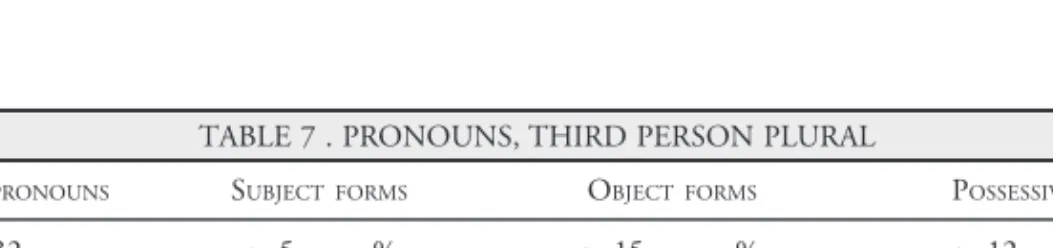
4.5. THIRDPERSONPLURALPRONOUNS
After studying a group of guild certificates (dated between 1388/89) Wright (1999) maintains that the distribution of the pronouns for the third person plural was stable in London at the end of the fourteenth century, as the texts show they forms in subject position, hem forms in object position, and here forms in posses-sive position.
The Paston letters we analyse present they forms in subject position, except in one case where we have found the alternative spelling þey (letter 37). The standard-ized form has been found in three letters (ner 413, 414, 421) written between 1487 and 1495, while þey appears in a letter written a little earlier, about 1449. We can think, then, that the standard form was in current use in the late fifteenth century.
In object position we have hem (four times), theym (three times) and them (five times). The form hem appears in letters 1, 2 and 4 written in 1425 by William Paston I, who seems to prefer the older forms (Montoya, 2001); theym is recorded in two letters (ner 391, 392) from 1500 and 1503 written by John Paston III. Consider-ing these counts we could think there is no consistent movement towards the stand-ardized word. But the standard form is also used in three letters written by two differ-ent hands, Edmond Paston II and William Paston III (who also uses they), between
1487 and 1493. With these results, it is possible to think that William Paston I did not use the standard form as the old ones were still in use. It is more difficult to explain why John Paston III did not use the standard form while his two brothers,
Edmond Paston II and William Paston III did. Therefore, a more detailed study about
his letters is necessary to come to any conclusion about his linguistic choices. The forms in possessive position are not completely standardized, although a change in their use can be observed. Only William Paston I uses the older form
here. The other tokens for present-day their recorded in our corpus are ther; so we
can see a preference for a form which is closer to the standard than here. TABLE 6. THIRD PERSON PLURAL MARKER
PRESENTTENSE -N -E Ø -TH -THMARKERSIN% OTHERMARKERSIN %
17 7 9 0 1 6 94
TABLE 7 . PRONOUNS, THIRD PERSON PLURAL
TOTALPRONOUNS SUBJECTFORMS OBJECTFORMS POSSESSIVEFORMS
32 n. 5 % n. 15 % n. 12 %
They (4) 80 Hem (4) 26,6 Here (1) 8
Þey (1) 20 Theym (3) 20 Ther (11) 92
THIRTEEN P
ASTON LETTERS IN SEARCH OF A ST
ANDARD
29
4.6. NEGATORS
The letters analysed show a significant consistency which moves towards the standard when the verb is needed in its negative form. We have also detected a generalised tendency to avoid the construction [ne + verb + neg]. The pattern ob-served is characterized by [verb + not/nought] and [verb + no] instead when the verb is followed by an adjective (letter 81: I wryth no better; letter 416: I am as yet no
bettyr horsyd than). There are only two examples of [ne + negative adverb] (letter 2: I was neuere somouned ne neuer hadde tydynges of þis matier (...) ne neuere hadde to do more). The negative particle used by most of the Paston men is not in a post-verbal
position. Only one of the men of the Paston family, William Paston I, uses nought as well as [ne + negative adverb]. There is another different form, nowghte, used once by John Paston III (letter 392), but it can be considered a linguistic
reminis-cence or dialectal form, since he uses later on not three times instead of nowghte in the same letter.
The negative particle is used with full, auxiliary and modal verbs and it is not contracted but on two ocassions (letter 416: I canot; whyche dednott). The aux-iliary verbs are not still used by any of the Paston members considered, even when they use the imperative mood (letter 37: but let him not wete of þe mater atwix my
modir and him).
To sum up, there seems to be a progressive homogeneity towards an overall pattern determined by the selection of not, which is the form we have today.
TABLE 8. NEGATIVE PARTICLES
NEGATIVEPARTICLES NOT NOUGHT NOWGHTE NE NOTIN% OTHERPARTICLESIN %
40 30 7 1 2 75 25
4.7. ADVERBMARKERSASARATIOOF -LYMARKERSTO -LICH(E) MARKERS
The choice of adverb endings (between the two under consideration here) is evident in this particular case: the tokens for the -ly ending amount to 34 and in what refers to the
-lich(e) ending, it does not appear. There is only one form which does not end in -ly but in -lye (letter 390: daylye), apart from this spelling variant, the rest of adverbs end in
ISABEL MOSKOWICH-SPIEGEL F
ANDIÑO & ANA MONTOY
A REYES
30
5. CONCLUSIONS
Since some degree of linguistic innovation seems to be present in the sam-ples under study we could say that there is a clear tendency to use Standard English from what Samuels (1989) calls Post-Middle English Period onwards.
However, such innovation is not observed at the same pace in all the texts nor does it appear in all the morphemic units studied.The letters analysed reflect the existence of a morphological consistency mainly in the case of infinitives —which appear preceded by to and without final suffixes most of the time— the use of the negative particle not and the absence of double negatives in the verb phrase. Adverbs ending in -ly are clearly preferred to those ending in -lich(e).
But variation is still typical of manuscripts at this time, even more if we consider that the Paston family’s original language was quite regional (Norfolk dia-lect). We know most of the men in this family moved all over the country and got in touch with very influential personalities and court members such as the Duke of Norfolk, the Duke of Gloucester or the Earl of Oxford. So it may be that this variation is due, in part, to their constant travels.
On the other hand, the abandonment of some older forms in favour of the standardized ones is really significant. Such is the case of William Paston I, who used h- forms for the third person plural personal pronouns or ne/nought to express negation. Other members of the family (the sons and grandsons of the man just mentioned) did not use either ne or two negative particles. Instead they show a clear preference for the use of not close to the verb. Thus, we can state that these examples are an evidence of the progressive movement towards the standard lan-guage, even though a more detailed analysis of a higher number of written docu-ments belonging to this family should be necessary.
THIRTEEN P
ASTON LETTERS IN SEARCH OF A ST
ANDARD
31
BENSKIN, M. “Some New Perspectives on the Origins of Standard Written English.” Dialect and
Standard Language in the English, Dutch, German and Norwegian Language Areas Ed. J.A.
van Leuvensteijn & J.B. Berns. Amsterdam: Royal Netherlands Academy of Arts and Sci-ences, 1992. 71-105.
BENSKIN, M. & M.L. SAMUELS, eds. So Meny People and Longages and Tongues: Philological Essays in
Scots and Mediaeval English: Presented to Angus McIntosh. Edinburgh: Middle English
Dia-lect Project, 1981.
BLAKE, N. A History of the English Language. London: Macmillan, 1996.
—— Caxton and His World. New York: Academic Press, 1973.
BOURCIER, G. History of the English Language. Cheltenham: Stanley Thornes, 1981.
CABLE, T. “The Rise of Written Standard English.” The Emergence of National Languages. Ed. A. Scaglione. Ravenna: Longo Editore, 1984. 75-94.
CHAMBERS, R.W. & M. DAUNT, eds. A Book of London English 1384-1425. Oxford: Clarendon,
1967.
DAVIS, N. “A Paston Hand.” Review of English Studies 3.11 (1952): 209-21.
—— “A Scribal Problem in the Paston Letters.” English and Germanic Studies 4 (1951): 31-64.
—— Paston Letters and Papers of the Fifteenth Century. Part I. Oxford: Clarendon, 1971.
—— “The Language of the Pastons.” PBA 40 (1955): 119-44.
DELA CRUZ CABANILLAS, I. & F.J. MARTÍN ARISTA, eds. Lingüística histórica inglesa. Barcelona: Ariel,
2001.
DIBELIUS, W. “John Capgrave und die englische Schriftsprache.” Anglia 23 (1901): 153-94, 323-75,
427-72.
EKWALL, B.E. Studies on the Population of Medieval London. Stockholm: Almqvist and Wiksell, 1956.
FENNELL, B. A History of English: A Sociolinguistic Approach. Oxford: Blackwell, 2001.
FISHER, J.H. “Chancery and the Emergence of Standard Written English in the Fifteenth Century.”
Speculum 52 (1977): 870-99.
—— The Emergence of Standard English. Kentucky: The UP of Kentucky, 1996.
FISHER, J.H et al. An Anthology of Chancery English. Knoxville: The U of Tennessee P, 1984.
FRIESHAMMER, J. Die sprachliche form der Chaucerschen prosa, ihr verhältnis zur reimtechnik des dichters
sowie zur sprache der älteren Londoner urkunden, von Johann Frieshammer. Halle a. S.: M.
Niemeyer, 1910.
ISABEL MOSKOWICH-SPIEGEL F
ANDIÑO & ANA MONTOY
A REYES
32
FLASDIECK, H.M. “Forschungen zur Frühzeit der neuenglishchen Schriftsprache.” Studien zur englischen
Philologie (1922): 65-66.
GARCÍA GARCÍA, L. “La morfología flexiva del inglés medieval.” Lingüística histórica inglesa. Ed. I. de
la Cruz Cabanillas & F.J. Martín Arista. Barcelona: Ariel, 2001. 161-223.
GÓMEZ SOLIÑO, J.S. Variación y estandarización en el inglés moderno temprano: 1470-1540. U de
Oviedo. Unpublished PhD. Dissertation, 1984.
GONZÁLEZ ESCRIBANO, J.L. “Retórica epistolar en la Inglaterra del siglo XV: el caso de William Paston,
1378-1444.” Estudios literarios ingleses: Edad Media. Ed. J.F. Galván Reula, Madrid: Cátedra, 1985. 253-283.
GÖRLACH, M. Introduction to Early Modern English. Cambridge: Cambridge UP, 1993.
—— The Linguistic History of English. London: Macmillan, 1997.
GUEST, E. A History of English Rhythms. London: W. Pickering, 1838.
HOPE, J. “Rats, Bats, Sparrows and Dogs: Biology, Linguistics and the Nature of Standard English.”
The Development of Standard English. Ed. Laura Wright. Cambridge: Cambridge UP, 2000.
49-56.
IGLESIAS RÁBADE, L. & Moskowich-Spiegel Fandiño, I. “Applied Historical Sociolinguistics:
Net-work Analysis.” Papers from the 4th International Conference of the Spanish Society for
Medi-eval English Language and Linguistics. Ed. T. Fanego. Santiago de Compostela: U de
San-tiago de Compostela, 1993. 153-163.
—— “Technical and Colloquial Character of Scandinavian and French Loan-words in Early Middle English.” Studies in Middle English Language and Literature. León: U de León, 1997. 199-206.
KINGTON OLIPHANT, T.L. The Sources of Standard English. London: Macmillan, 1873.
LABOV, W. Sociolinguistic Patterns. Philadelphia: Pennsylvania UP, 1972.
LASS, R. ed. The Cambridge History of the English Language. 1476-1776. Vol. III. Cambridge:
Cam-bridge UP, 1999.
LATHAM, R.G. The English Language. London: Walton & Maberly, 1850.
LEKEBUSCH, J. Die Londoner Urkundensprache von 1430-1500. Studien zur englischen Philologie 23.
Halle: Niemeyer, 1906.
MARKUS, M. “Linguistic Commercialism in and around the Paston and Cely Letters: An OED and
Corpus-Based Approach.” Journal of English Linguistics 29.2 (2001): 162-178.
MCINTOSH, A. “A New Approach to Middle English Dialectology.” English Studies 44 (1963): 1-11.
MELE MARRERO, M. & A. MARTÍN DÍAZ. “Formación y desarrollo del inglés moderno.” Lingüística
histórica inglesa. Ed. I. de la Cruz Cabanillas and F.J. Martín Arista. Barcelona: Ariel, 2001.
573-596.
MILROY, J. “Historical Description and the Ideology of the Standard Language.” The Development of
Standard English. Ed. L. Wright. Cambridge: Cambridge UP, 2000. 11-28.
MILROY, J. & L. MILROY. “Linguistic Change, Social Network, and Speaker Innovation.” Journal of
Linguistics 21 (1985): 339-84.
MITCHELL, B. & F. ROBINSON. A Guide to Old English. Oxford: Blackwell, 2001.
MONTOYA REYES, A. Las cartas de William Paston I: aplicación de la fit-technique en la localización
THIRTEEN P
ASTON LETTERS IN SEARCH OF A ST
ANDARD
33
MORSBACH, L. Über den Ursprung der neuenglischen Schriftsprache. Heilbronn: G. Henninger, 1888.
MOSKOWICH-SPIEGEL FANDIÑO, I. “Morfología flexiva del inglés moderno.” Lingüística histórica
in-glesa. Ed. I. de la Cruz Cabanillas & F.J. Martín Arista. Barcelona: Ariel, 2001. 624-654.
MOSSÉ, F. An Introduction to Middle English. Baltimore: The Johns Hopkins UP, 1987.
RISSANEN, M. “Standardization and the Language of Early Statutes.” The Development of Standard
English. Ed. L. Wright. Cambridge: Cambridge UP, 2000. 117-130.
SAMUELS, M.L. “Some Applications of Middle English Dialectology.” Middle English Dialectology:
Essays on Some Principles and Problems. Ed. Laing M. Aberdeen UP, 1989. 64-80.
—— “Spelling and Dialect in the Late and Post-Middle English Periods.” So Meny People and Longages
and Tongues: Philological Essays in Scots and Mediaeval English: Presented to Angus McIntosh.
Ed. M. Benskin & M.L. Samuels, Edinburgh: Middle English Dialect Project, 1981. 43-54.
SMITH, J. An Historical Study of English. Function, Form and Change. London: Routledge, 1996.
—— “Standard Language in Early Middle English?” Placing Middle English in Context. Ed. I. Taavitsainen, T. Nevalainen, P. Pahta, & M. Rissanen. Berlin: Mouton de Gruyter, 2000. 125-139.
TAAVITSAINEN, I. “Scientific Language and Spelling Standardization: 1375-1550.” The Development
of Standard English. Ed. L. Wright. Cambridge: Cambridge UP, 2000.131-154.
TEJADA CALLER, P. El cambio lingüístico: claves para interpretar la lengua inglesa. Madrid: Alianza,
1999.
TEN BRINK, B. Chaucers Sprache und Verskunst. Leipzig: T.O. Weigel, 1884.
WRIGHT, L. Sources of London English: Medieval Thames Vocabulary. Oxford: Clarendon, 1996a.
—— “About the Evolution of Standard English.” Studies in English Language and Literature. ‘Doubt
Wisely’: Papers in Honour of E.G. Stanley. Ed. M.J. Toswell & E.M. Tyler. London: Routledge,
1996b. 99-115.
—— “Middle English Variation: London English Guild Certificates of 1388/89.” Language Change:
Advances in Historical Linguistics. Ed. Jahr, E.H. Berlin: Mouton de Gruyter, 1999.
169-196.
—— “On the Writing of the History of Standard English.” Historical Linguistics 1992: Papers from
the Seventh International Conference on English Historical Linguistics. Ed. F. Fernández et al.
Amsterdam: John Benjamins, 1994. 105-115.
—— ed. The Development of Standard English: Theories, Descriptions, Conflicts. Cambridge: Cam-bridge UP, 2000.
—— “The Role of International and National Trade in the Standardization of English.”
Re-interpre-tations of English: Essays on Language, Linguistics and Philology (I). Ed. I. Moskowich-Spiegel