FACULTAD DE INGENIERÍA Y COMPUTACIÓN Escuela Profesional de Ciencia de la
Computación
Modeling Cultural Heritage Knowledge in Urban Tourism through
CURIOCITY Ontology
Tesis
Presentada por:
Alexander Giuliano Pinto De la Gala
Para Optar por el Título Profesional:
Licenciado en Ciencia de la Computación
Asesor: Dra. Regina Paola Ticona Herrera
Arequipa, Setiembre 2021
Department of Computer Science 3
Abbreviations
W3C World Wide Web Consortium HTML Hyper Text Markup Language OWL Web Ontology Language
URI Uniform Resource Identifier URL Uniform Resource Locator URN Uniform Resource Name
UCSP Universidad Cat´olica San Pablo
IRI International Resource Identifier XML Extensible Markup Language RDF Resource Description Framework POI Point of Interest
Universidad Cat´olica San Pablo 3
A Dios por todas las oportunidades que me d´a.
A mis padres, Nora y Esmelin, por todo el amor y apoyo brindado; a Pamela y Luc´ıa por las muchas horas que no pude compartir y queda por recompensar.
A la Universidad Cat´olica San Pablo, por la formaci´on humana y profesional recibida.
Agradezco de forma especial a mis asesores por ser gu´ıa en la realizaci´on de este trabajo, adem´as de darme la oportunidad de formar parte del equipo del proyecto de investigaci´on RUTAS, D.Sc. Regina Ticona, D.Sc. Yudith Cardinale y D.Sc. Irvin Dongo; por confiar en m´ı, por sus ense˜nanzas y paciencia.
Este trabajo fue realizado en el marco del proyecto de investigaci´on RUTAS (Robots para centros Urbanos Tur´ısticos y basados en Sem´antica). Este proyecto fue financiado por FONDO NACIONAL DE DESARROLLO CIENTIFICO, TECNOLOGICO Y DE INNO- VACION TECNOLOGICA - FONDECYT entidad ejecutora de CONCYTEC N➦de con- trato 01-2019-FONDECYT-BM-INC.INV.
Resumen
El patrimonio cultural tiene el potencial de contar una historia, de ser y con- vertirse en el legado de una sociedad. Los elementos que conforman este pa- trimonio se relacionan entre s´ı, adem´as de otros elementos como sus artesanos y creadores, su materia prima, y otros de naturaleza abstracta como su uti- lidad o valoraci´on. El patrimonio cultural tiene incluso el potencial de definir un periodo de tiempo por las caracter´ısticas que sus elementos comparten.
Estas relaciones conforman una compleja red sem´antica, que representan el conocimiento de este dominio, el cual a su vez, puede extender hacia otras or- ganizaciones. La modelizaci´on formal del conocimiento en forma de ontolog´ıas, ha permitido la preservaci´on y estandarizaci´on del conocimiento de patrimonio cultural, adem´as de sus objetivos propios como son el intercambio y reuso de esta informaci´on. Sin embargo, existe una basta diversidad de objetivos que los autores persiguen en el dise˜no de una ontolog´ıa, partiendo generalmente de alg´un est´andar, para adaptarse y capturar de manera ´optima caracter´ısti- cas propias de cada tipo de patrimonio, que son influenciadas por variables como los aspectos sociales propios de cada pa´ıs, exigencias tecnol´ogicas, o por la debida adaptaci´on al usuario final. El turismo urbano, extiende tambi´en el concepto de patrimonio cultural, incorporando los intereses del visitante dentro del entorno de una ciudad. En este contexto, este trabajo busca modelizar el conocimiento de centros tur´ısticos urbanos a trav´es de est´andares tecnol´ogicos y la experiencia de ontolog´ıas existentes de museos; y proponer una catego- rizaci´on del conocimiento de patrimonio cultural desde la opini´on de un ente mundial como la UNESCO. Producto de la modelizaci´on se conformar´a un on- tolog´ıa, la cual ser´a validada de manera cualitativa y cuantitativa; y probada en la implementaci´on de unframework de servicios que brindar´a soporte a una variedad de aplicaciones, entre estas, un sistema de robots gu´ıas tur´ısticos.
Palabras clave: Ontolog´ıa, Patrimonio Cultural, Turismo Urbano, Eva- luaci´on de Ontolog´ıa, Repositorio Sem´antico, Populaci´on Autom´atica de On- tolog´ıa.
Cultural heritage has the potential to tell a story, to be and to become the legacy of a society. The elements that constitute this heritage are related to each other, in addition to other elements such as its artisans and creators, its source material, and others of an abstract nature such as its utility or appraisal.
Cultural heritage also has the potential to define a period of time because of the characteristics that its elements share. These relationships create a complex semantic network, representing the knowledge of this domain, which in turn, can be extended to other organizations. The formal modeling of knowledge in the form of ontologies has allowed the preservation and standardization of cultural heritage knowledge, in addition to its own objectives such as the exchange and reuse of this information. However, there is a wide variety of objectives that authors pursue in the design of an ontology, generally starting from some standard, to adapt and optimally capture the characteristics of each type of heritage, which are influenced by variables such as the social aspects of each country, technological requirements, or due adaptation to the end user.
Urban tourism also extends the concept of cultural heritage, incorporating the visitors’ interests within the environment of a city. In this context, this work seeks to model the knowledge of urban tourist centers through technological standards and the experience of existing ontologies of museums; and to propose a categorization of the knowledge of cultural heritage from the opinion of a world entity such as UNESCO. As a result of the modeling, an ontology will be developed, which will be validated qualitatively and quantitatively; and tested in the implementation of a service framework that will support a variety of applications, among these, a system of tourist guide robots.
Keywords: Ontology, Cultural Heritage, Urban Tourism, Ontology Eval- uation, Semantic Repository, Automatic Ontology Population.
Department of Computer Science i
Contents
1 Introduction 2
1.1 Purpose and Context . . . 3
1.2 Problem Statement . . . 3
1.3 Objective . . . 5
1.3.1 Specific Objectives . . . 5
1.4 Contributions . . . 5
1.5 Thesis organization . . . 6
2 Semantic Web and Cultural Heritage: Preliminaries 7 2.1 Semantic Web . . . 7
2.1.1 International Resource Identifier - IRI . . . 8
2.1.2 Extensible Markup Language - XML . . . 9
2.1.3 Resource Description Framework - RDF . . . 9
2.1.4 RDF Schema . . . 11
2.1.5 Ontology . . . 12
2.1.6 Ontologies Operations . . . 13
2.1.7 Relationships between Ontologies . . . 14
2.1.8 Web Ontology Language (OWL) . . . 14
2.1.9 Simple Protocol and RDF Query Language - SPARQL . . . 15
2.1.10 Ontology Evaluation and Validation Methodology . . . 16
2.2 Cultural Heritage . . . 20
Universidad Cat´olica San Pablo i
2.3 Chapter Summary . . . 21
3 Literature Review of Cultural Heritage and Points of Interest Ontologies 22 3.1 Point of Interest Ontologies . . . 22
3.2 Ontology Standards and Cultural Heritage Classification Projects . . . 23
3.3 Research on Ontologies of Cultural Heritage and related topics . . . 26
3.4 Comparative Analysis of Proposals . . . 29
3.4.1 Proposed Cultural Heritage Knowledge Categorization . . . 29
3.5 Discussion and Final Considerations . . . 31
4 CURIOCITY: The Proposal 33 4.1 Upper Ontology Level . . . 35
4.2 Middle Ontology Level . . . 36
4.2.1 Site Middle Ontology Module . . . 37
4.2.2 Temporal Entity Middle Ontology Module . . . 37
4.2.3 Music Middle Ontology Module . . . 39
4.2.4 Performing Arts Middle Ontology Module . . . 40
4.2.5 Food Middle Ontology Module . . . 40
4.3 Low Ontology Level: Artworks at Museums . . . 41
4.4 Inference Rules . . . 41
5 CURIOCITY Ontology Validation 44 5.1 Experts’ opinions regarding the golden standard . . . 44
5.2 Evaluation and comparison of ontologies . . . 46
5.2.1 Lexical Level . . . 47
5.2.2 Structural Level . . . 48
5.2.3 Domain Knowledge Level . . . 53
5.3 Evaluation Discussion . . . 56
Department of Computer Science iii
6 CURIOCITY Framework: Case of Use 58
6.1 CURIOCITY Framework: General Architecture . . . 58
6.1.1 Semantic Repository Layer . . . 59
6.1.2 Data Processing Layer . . . 59
6.1.3 Application Layer . . . 63
6.2 CURIOCITY Framework Implementation . . . 63
6.2.1 Semantic Repository Layer . . . 64
6.2.2 Data Processing Layer . . . 64
6.2.3 Application Layer . . . 70
6.3 Empiric Evaluation . . . 72
6.3.1 CURIOCITY Framework and D-RUTAS Repository . . . 72
6.3.2 Mapping D-RUTAS to CURIOCITY Ontology . . . 72
6.3.3 Time Response of Queries . . . 73
6.3.4 Time Response for a Complex Multi-criteria Search Query . . . 74
6.3.5 Time Response for a Simple Search Query . . . 75
6.3.6 Time Response for an Insert Query . . . 75
6.3.7 Time Response for an Update Query . . . 75
6.3.8 Time Response for a Delete Query . . . 76
6.3.9 Results Discussion . . . 76
7 Conclusions and Future Work 78 7.1 Reported Issues . . . 79
7.2 Contributions . . . 79
7.3 Future Work . . . 79
Appendices 81 A CURIOCITY: Concepts and Properties 82 A.1 Upper Ontology Elements . . . 82
Universidad Cat´olica San Pablo iii
A.2 Middle Ontology Elements . . . 83
A.2.1 Concepts of Site as Cultural Heritage . . . 83
A.2.2 Concepts of Event as Cultural Heritage . . . 85
A.2.3 Properties of Place as Cultural Heritage . . . 85
B CURIOCITY: Inference Rules 86
C SPARQL Queries 89
Bibliography 98
Department of Computer Science v
List of Tables
2.1 Data Sources and Analysis of Cultural Heritage elements in tourism [Yu
and Xu, 2019]. . . 21
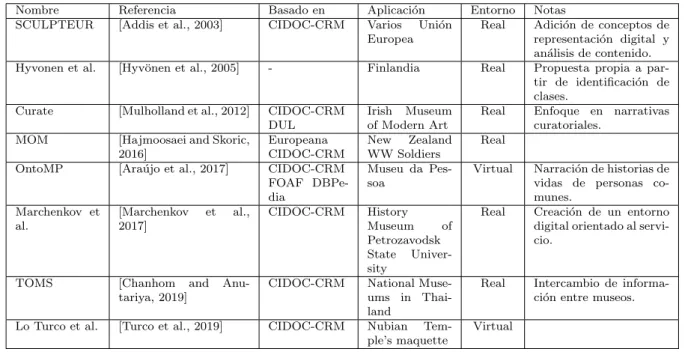
3.1 Ontolog´ıas de Museos y Patrimonio Cultural . . . 29
3.2 Comparison of Ontologies related to Cultural Heritage . . . 32
5.1 Participants demographic characteristics of the domain knowledge evalua- tion questionnaire . . . 45
5.2 Metrics values for Lexical evaluation . . . 48
5.3 OQuaRE Metrics Values . . . 48
5.4 Quality Evaluation ofStructural characteristic . . . 49
5.5 Quality Evaluation ofFunctional Adequacy Characteristic . . . 50
5.6 Quality Evaluation ofCompatibility Characteristic . . . 51
5.7 Quality Evaluation ofReliability Characteristic . . . 51
5.8 Quality Evaluation ofTransferability Characteristic . . . 51
5.9 Quality Evaluation ofOperability Characteristic . . . 52
5.10 Quality Evaluation of Maintainability Characteristic . . . 53
5.11 OQuaRE Evaluation Summary . . . 54
5.12 Domain Knowledge level - questionnarie . . . 56
6.1 IRI’s naming convention . . . 62
6.2 Number of records processed from D-RUTAS and instantiated triples in CURIOCITY Ontology . . . 72
Universidad Cat´olica San Pablo v
6.3 Summary of mapping concepts and properties from D-RUTAS museum data to CURIOCITY ontology . . . 73 6.4 Summary of mapping concepts and properties from D-RUTAS object data
to CURIOCITY . . . 74 6.5 Summary of Query Time Responses . . . 77
Department of Computer Science vii
List of Figures
2.1 Semantic Web Architecture [W3C, 2020a] . . . 8
2.2 RDF document example . . . 10
2.3 Perspectives, levels and methods for a comparative study of ontologies [Car- dinale et al., 2020]. . . 16
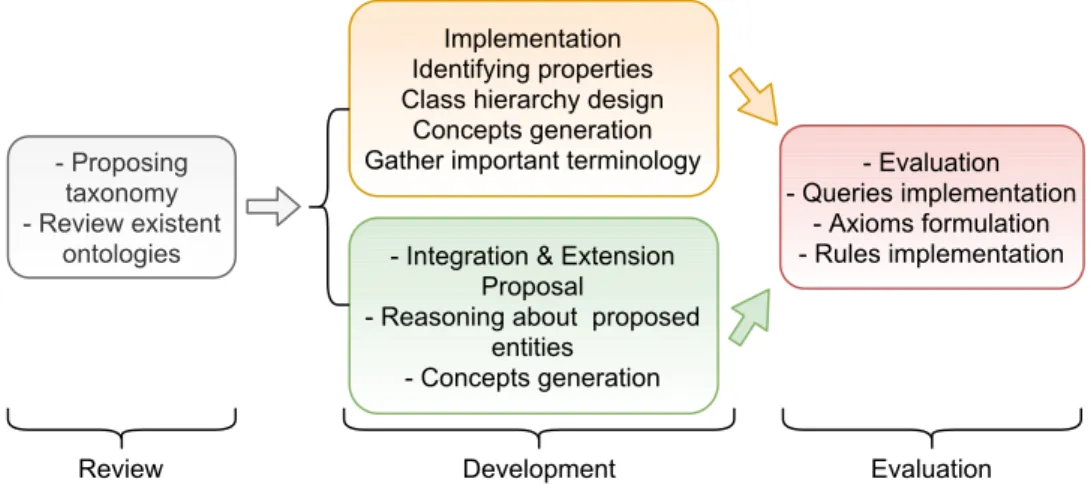
4.1 Activities to develop CURIOCITY Ontology . . . 34
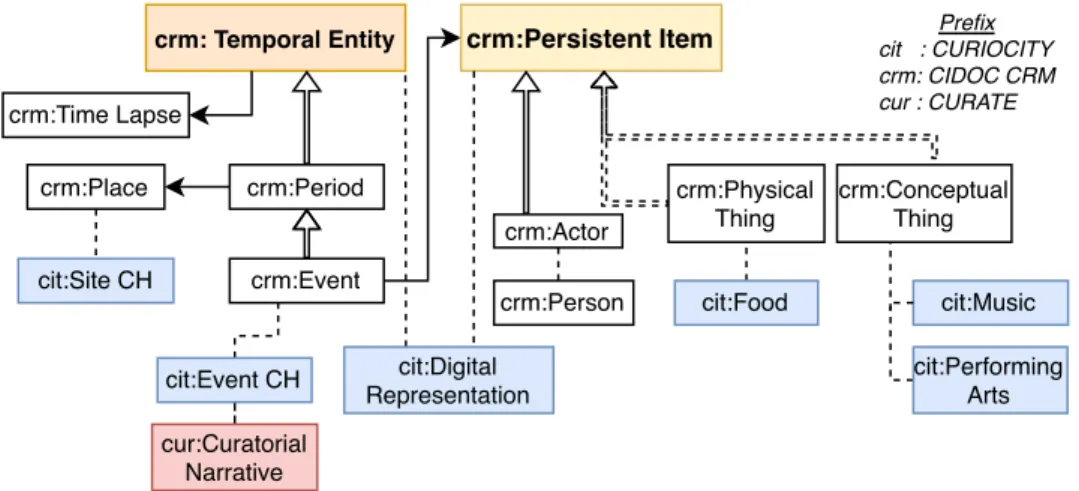
4.2 General Architecture of CURIOCITY Ontology . . . 35
4.3 CURIOCITY Upper Ontology: General Reasoning . . . 35
4.4 Reasoning about Spatial Information [Doerr et al., 2003] . . . 37
4.5 Reasoning about Extended Site as Cultural Heritage: Site Middle Ontology Module . . . 38
4.6 Reasoning about Temporal Information Module [Doerr et al., 2003] . . . . 38
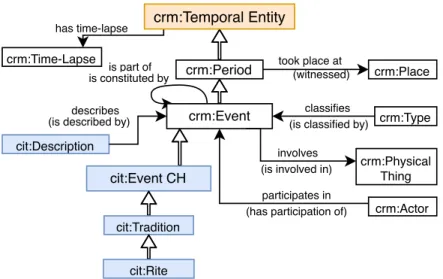
4.7 Reasoning about Temporal Information and Event: Temporal Entity Mid- dle OntologyModule . . . 39
4.8 Reasoning about Music: Music Middle OntologyModule . . . 39
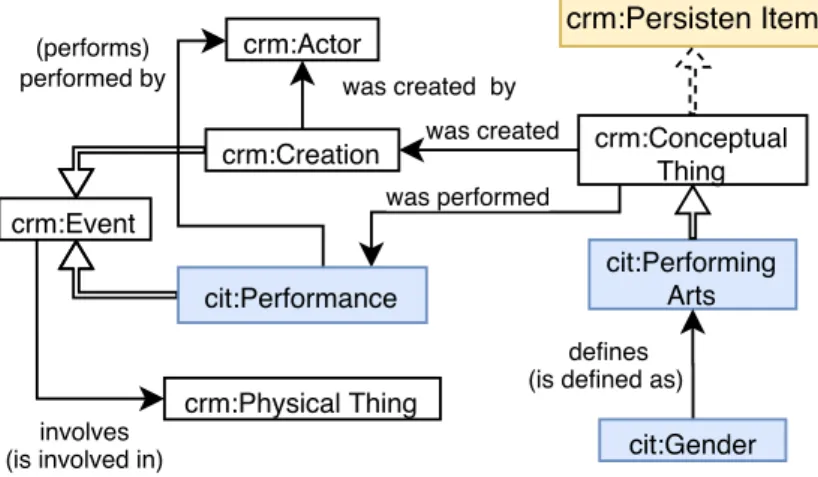
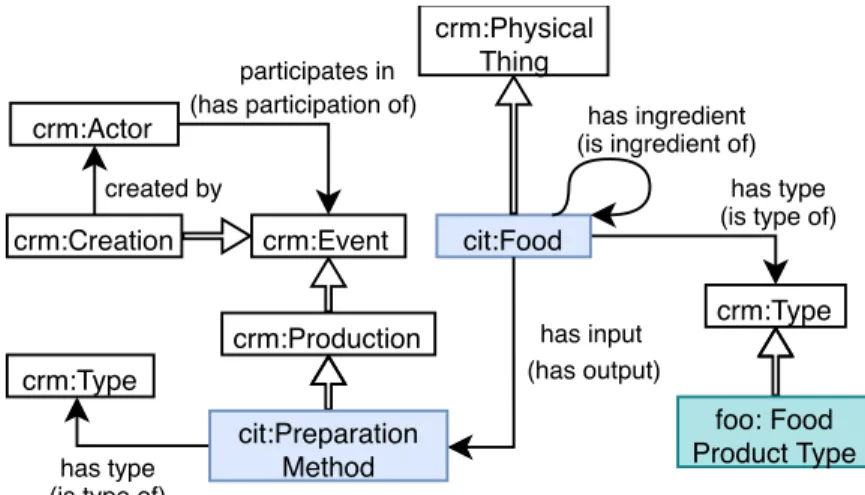
4.9 Reasoning about Performing Arts: Performing Arts Middle OntologyModule 40 4.10 Reasoning about Culinary Tradition: Food Middle Ontology Module . . . . 40
4.11 Reasoning about Museum Cultural Heritage CURIOCITY - CIDOC CRM 42 4.12 Allen’s Temporal relations [Nys et al., 2018]) . . . 43
5.1 Summary of answers to the question about concepts related to Cultural Heritage . . . 46
5.2 Summary of answers to the question about information needed for the description of a Cultural Heritage item . . . 47
Universidad Cat´olica San Pablo vii
5.3 Quality Evaluation ofStructural characteristic . . . 49
5.4 Quality Evaluation ofFunctional Adequacy Characteristic . . . 50
5.5 Quality Evaluation of Compatibility, Reliability, Transferability, andOper- ability Characteristics . . . 52
5.6 Quality Evaluation ofMaintainability Characteristic . . . 53
5.7 OQuaRE Evaluation Summary . . . 54
6.1 CURIOCITY Framework Architecture . . . 59
6.2 Instantiation process of CURIOCITY ontology . . . 60
6.3 Mapping museum data to CURIOCITY - CIDOC CRM . . . 61
6.4 Current version of CURIOCITY Framework . . . 64
6.5 Desktop Admin GUI . . . 71
6.6 Desktop Admin: Query Module . . . 72
6.7 Time Response for a Complex Multi-criteria Search Query . . . 75
2 Department of Computer Science
Chapter 1 Introduction
Cultural heritage has the potential to narrate a story, to describe a time and a place, a society and its culture. The objects that constitute this heritage are not only in relation to each other, but also to their designer, creator or owner, and even to their usefulness and purpose at a given time. In particular, museums are the main organizations that manage, preserve and exhibit regional and international cultural heritage to the world.
Museums, initially dedicated to the preservation of cultural heritage in the form of artworks, relics, historical documentation, among others, have become active in the propagation of culture through communication and information technologies, often be- coming virtual spaces. In this way, they become accessible to a wider public and promote knowledge dissemination beyond countries’ borders. Museums stand out as a source of knowledge and are the main point of interest in urban tourism centers.
Urban tourism is, along with many others, one of the social and economic activities that take place in an urban environment. Although cities are not necessarily part of the itinerary of a tourism trip, the average visitor inevitably spends a lot of time in urban centers, so a tourist’s activities are related to different places of interest that can range from visiting museums, spending time in a park, learning about social customs, or even medical emergencies [Ashworth and Page, 2011]. In this way, the cultural heritage of a city is expanded by the activities and interests generated by urban tourism, so this heritage is no longer contained only in museums, but it is extended to a wider context with its own characteristics.
Therefore, cultural heritage forms a complex semantic network of relationships and associations, which represents the knowledge of a specific domain. With this knowledge, resources and objects that describe a specific domain (e.g., a collection, a museum, a historical site) can be related, and even extended to other knowledge organizations within and outside the domain, thus creating an even more complex network. With the intention of preserving heritage and standardizing this knowledge, several authors have proposed a formal knowledge modeling.
Knowledge of a domain-specific task allows solving a problem more efficiently [Fensel, 2004]. Formal knowledge modeling pursues identification and explicit definition of relevant concepts of a phenomenon, as well as its use restrictions. This representation must be
2 Universidad Cat´olica San Pablo
formal, i. e., it must be machine-readable and machine-processable. Furthermore, the formal modeling of knowledge in a specific domain allows the development of interoperable and easily customizable services to different particular user requirements.
These complex knowledge networks are part of the study of Semantic Web, which proposes concepts and tools such as ontologies, with the objective of creating a common consensus of standard definitions and structures that can be used to describe resources and define their relationships.
Ontologies were developed to facilitate the process of sharing and reusing knowledge, they provide a semantics of information sources that can be processed by computers and communicated between different agents, both human and machine. Thus, an ontology is a formal way of capturing valid knowledge for a particular domain.
1.1 Purpose and Context
Knowledge modeling of cultural heritage in museums using ontologies has been addressed by several authors; each of them from a point of view according to the characteristics of their own research and particular interests; for instance, some of them aim to deal with the current heterogeneity of data and resources [Hajmoosaei and Skoric, 2016], allow collaboration between a group of museums [Chanhom and Anutariya, 2019], assist the visitor according to interest profile [Buffa et al., 2016] or a virtual museum implementation [Araujo et al., 2016], among other objectives.
This diversified set of objectives means that an ontology design, although it may start from a common or standard base, must be adapted to optimally capture certain characteristics of the project, which may be influenced by social aspects of a country or city, or by technological requirements of the project such as distributed and distant data sources, or by its adequacy to the end users, who may be a web page visitor or a robot guidance system, among many other variables.
Furthermore, tourism is a social activity that contributes to a country’s economy, in addition to being an important source of employment generation. In Peru, in 2015, tourism represented 3.9% of the Gross Domestic Product (GDP) [MINCETUR-PERU, 2015], which shows that it is an industry of prime importance for national economy.
Peru’s characteristics catalogue it mainly, as a historical-cultural destination, however, other tourism alternatives such as culinary tourism, adventure tourism or eco-tourism have been developed. Among these options, urban tourism is perhaps the predominant alternative of choice for visitors.
1.2 Problem Statement
Although modeling the knowledge of cultural heritage in museums has been addressed by several authors, usually these models are within a indoor perspective; however, the concept of cultural heritage is dynamic, so it involves other concepts with values, not only
4 Department of Computer Science cultural but also aesthetic, academic, economic and recreational values, which are relevant to a society. In addition to this, urban tourism perspective considers that visitor’s interests are broad in a city environment, which in turn constitutes an urban tourism center with its own cultural heritage, with different characteristics and relationships, and therefore requires a different organization of knowledge.
Modeling the domain knowledge through ontologies requires an iterative process where it is necessary to establish the domain and the scope of the ontology; to understand the domain through expert opinions and review existing proposals previously validated, in order to identify important terms. Then, it is necessary to define a taxonomy, a hierarchy of classes, either based on a top-down approach, starting from general concepts to subse- quent more specialized ones; or with an inverse bottom-up approach; or a combination of both. Through this comprehension of the domain, it is possible to define the internal struc- ture of the concepts, their intrinsic and extrinsic properties, as well as identifying initial relationships with other concepts. Once an initial network of concepts and relationships has been established, the formal representation is defined by means of tools that allow automated reasoning tasks for consistency checking using descriptive logic. To strengthen the reasoning capabilities of the ontology, it is necessary to implement rules based on logical and mathematical operations that allow inferring new knowledge, in addition to assertive knowledge based on the relationships between classes. Each process step has a validation stage, which may lead to a review and adjustment of previous progress. Finally, the ontology must be evaluated qualitatively by domain experts about the accuracy of the domain concepts representation, as well as the relationships between them; and evaluated in a quantitative way following a standard methodology, which usually proposes several metrics to evaluate quality and correctness characteristics of the ontology.
Modeling the knowledge in the cultural heritage domain formally by means of an ontology, which is the focus of this work, constitutes an important step towards the standardization and homogenization of concepts, thus opening the way for the exchange of information for researchers and those interested in cultural heritage.
It also allows the generation of standardized catalogs of artworks from museums, parks and historical sites, etc., which as far as we know, are mostly not available for mu- seums in Peru and, in particular, in Arequipa. The ontology to be developed, among many of its applications, will be the knowledge base for the development of virtual museums, online services related to art and culture, or recommendation systems in the context of e-tourism. It is of particular interest, its application in a robot system, which based on the knowledge represented by the ontology, It is of particular interest, the application of the ontology in a robot system, which based on the knowledge represented by the ontology, can answer queries and generate tourism plans and user visits, as part of its work as a tour guide.
Having defined this need, we propose the following objectives to be fulfilled in this work.
4 Universidad Cat´olica San Pablo
1.3 Objective
To represent formally the knowledge of Cultural Heritage in the context of urban tourism centers through the development of an ontology, applying technological standards that allow the exchange and reuse of information.
1.3.1 Specific Objectives
1. Propose a taxonomy of knowledge organization in the cultural heritage problem, based on existing ontologies, particularly from museums.
2. Analyze the features considered in existing ontologies and decide whether to adopt or exclude them, as well as to identify missing features to be incorporated in a proposed ontology.
3. Propose inference rules to generate additional knowledge besides the explicit ones.
4. Validate the developed ontology in a qualitative and quantitative way.
5. Test and verify the developed ontology in the context of an urban tourism center in the city of Arequipa - Peru, for a system of tourist guide robots.
1.4 Contributions
The present work has currently the next contribution:
❼ A published article: Pinto-De la Gala A., Cardinale, Y., Dongo, I. and Ticona- Herrera, R. (2021). “Towards an Ontology for Urban Tourism” in Proc. of the 36th ACM/SIGAPP Symposium on Applied Computing (SAC ’21), Virtual Event, page 1887-1890. Republic of Korea. https://doi.org/10.1145/3412841.3442142.
(CORE: B, Qualis: A1).
❼ A published article: Cardinale, Y., Cornejo-Lupa, M. A., Pinto-De la Gala, A., Ticona-Herrera, R. (2021). ”Application of a Methodological Approach to Compare Ontologies”, International Journal of Web Information Systems. Emerald Publish- ing. http://doi.org/10.1108/IJWIS-03-2021-0036.
❼ A submitted article (under review): ”CURIOCITY: A Cultural Heritage Ontology for Urban Tourism”, Semantic Web Journal, IOS Press 1.
❼ A submitted article (under review): ”CURIOCITY Framework: Managing Het- erogeneous Cultural Heritage Data”, International Conference on Web Information System Engineering, (WI-IAT 2021).
1the present work contains information from this paper which is under review and open access as policy of the journal publisher, and can be currently found on http://www.semantic-web-journal.
net/content/curiocity-cultural-heritage-ontology-urban-tourism
6 Department of Computer Science
1.5 Thesis organization
Chapter 2 presents a brief introduction about Semantic Web and its technologies, de- tailing the concepts related to ontologies, like representations, operations and validation methodology. It also includes a review of the concept of Cultural Heritage.
Chapter 3 presents a literature review of the proposed ontologies for the problem of modeling Cultural Heritage in museums, besides a related work review of ontologies in the domain of tourism Points of Interest. It also presents the proposed Cultural Heritage knowledge categorization.
Chapter 4 introduces the proposal of ontology for cultural heritage in the urban tourism context: CURIOCITY.
Chapter 5 presents the results for the quantitative and qualitative evaluation of CURIOCITY ontology.
Chapter 6 describes a case of use: the process of developing a framework to offer services to applications, having as foundation CURIOCITY ontology.
At last, Chapter 7, presents the general conclusions of this work, and future work beyond the scope of this theses.
6 Universidad Cat´olica San Pablo
Chapter 2
Semantic Web and Cultural Heritage:
Preliminaries
In this chapter we present the basic concepts needed to approach the problem we aim to solve. We will review the Semantic Web and related technologies, and how these technologies allow knowledge modeling and how they can be applied to urban tourism.
Additionally, we will review the concept of cultural heritage and the main charac- teristics that should be taken into account for modeling.
2.1 Semantic Web
Today most of the information on the web is human-oriented, which means that humans can access, read and interpret documents stored on a web server. This information, in the form of web pages, is mostly written in Hyper Text Markup Language (HTML) language.
Web pages are generated either manually or by means of applications written in another programming language.
HTML documents are part of the so-called web data layer, a layer that provides services such as browsing or searching, which can be summarized as services oriented to the delivery of documents.
The idea behind Semantic Web is to provide services that process and deliver ab- stracted information and knowledge [Doerr et al., 2003], by creating and adding a layer so this information should not only be displayed, but can also be used and interpreted by computers.
World Wide Web Consortium (W3C) and the Semantic Web community have pro- posed several mechanisms for encoding and manipulating information data in a way that enables understanding, interoperability and automation by the computer. Figure 2.1 il- lustrates Semantic Web architecture, initially proposed in 2000 and updated in several versions.
2.1.2 Extensible Markup Language - XML
Semantic Web requires a language for exchanging resource descriptions. Extensible Markup Language (XML) is used to encode documents and represent arbitrary data structures.
XML solves integration problems, due to its flexible encoding, wide support between dif- ferent systems and easiness to represent and display data. XML has limitations from a semantic point of view, due to its inability to represent relationships or constraints.
2.1.3 Resource Description Framework - RDF
Resource Description Framework (RDF) is a formal data model used to provide standard descriptions of resources so that applications based on it can interoperate and intercom- municate with each other. Semantic Web is by nature highly distributed, so a graph-like data structure enables a logical representation as well as the integration of data from multiple sources. RDF is the standard for encoding this data. RDF is the basic building block for Semantic Web support, RDF is to the Semantic Web as HTML has been to the web [Yu, 2007].
RDF is basically composed of the following elements:
1. Resource: anything we can describe, from a web page to real-world objects like a dog or cat. As discussed above, resources are identified by URIs. A resource may be anonymous or blank node, when its purpose is only to provide a context for other properties. This resource is not given an identifier usually, because other RDF documents have no need to use it or add details to it.
2. Property: is a resource that we can use to describe some aspect, characteristic, attribute, or relationship of a given resource; e.g., weight, color, etc.
3. Statement: an RDF statement is used to describe resource properties.
We will discuss about the RDF statements below.
RDF Statements
RDF statements use triples, which are atomic structures consisting of a tuple with the following format:
resource (subject)+ property (predicate)+ property value (object)
and can be interpreted as:
<subject> has a property <predicate> which value is <object>
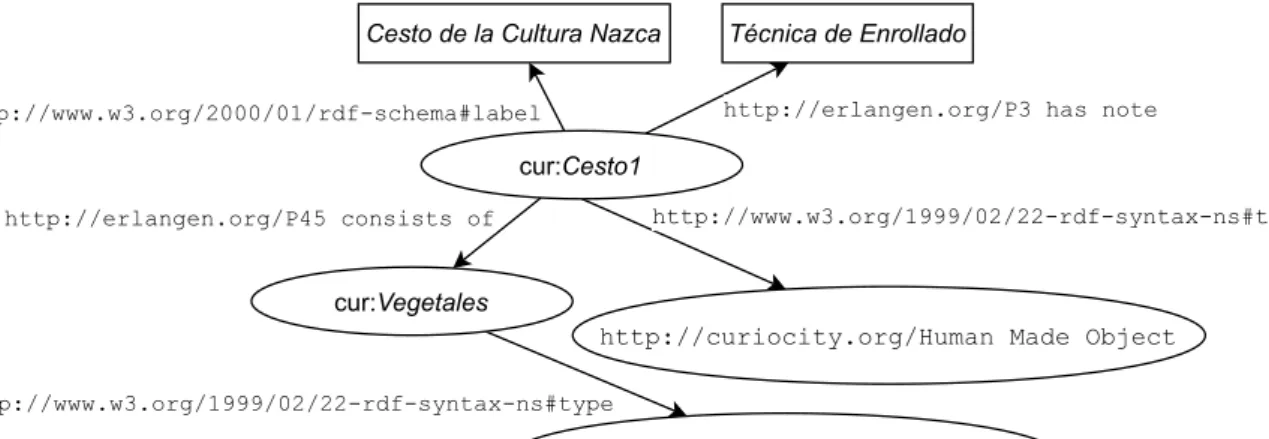
Figure 2.2, shows five triples (t1 to t5) with different resources, properties and literals:
10 Department of Computer Science
❼ t1: <cur:Cesto1,crm:P45_consists_of,cur:Vegetales>
❼ t2: <cur:Vegetales,rdf:type,crm:E57:Materialt>
❼ t3: <cur:Cesto1,rdf:type,cur:Human_Made_Object>
❼ t4: <cur:Cesto1,rdfs:label,"Cesto de la Cultura Nazca">
❼ t5: <cur:Cesto1,crm:P3_has_note,"Tecnica de Enrollado">
whose respective simplified interpretations are:
❼ t1: Resource Cesto1has a property consist of which value isVegetales
❼ t2: Vegetalesis type Material.
❼ t3: Cesto1 is type Human Made Object.
❼ t4: Cesto1 has a property label which value is Cesto de la Cultura Nazca.
❼ t5: Cesto1 has a property note which value is Tecnica de Enrollado.
KWWS FXULRFLW\ RUJ +XPDQ 0DGH 2EMHFW KWWS HUODQJHQ RUJ 3 KDV QRWH KWWS ZZZ Z RUJ UGI VFKHPD ODEHO
KWWS ZZZ Z RUJ UGI V\QWD[ QV W\SH KWWS HUODQJHQ RUJ 3 FRQVLVWV RI
FXU&HVWR
KWWS HUODQJHQ RUJ ( 0DWHULDO KWWS ZZZ Z RUJ UGI V\QWD[ QV W\SH
FXU9HJHWDOHV
7pFQLFD GH (QUROODGR
&HVWR GH OD &XOWXUD 1D]FD
Figure 2.2: RDF document example
RDF Representations
RDF documents have different representations called serializations. W3C defines four formats: RDF/XML, Turtle, N-Triple and N3.
The first serialization adopted by W3C is RDF/XML, where nodes and edges of an RDF document are represented using XML syntax. RDF/XML contains several liter- als that allow to represent and describe concepts and relationships. Code 2.1 shows an example of RDF/XML serialization, taking as a source the triples t1tot5 seen above.
Code 2.1: RDF/XML Document example
1 <?xml v e r s i o n=” 1 . 0 ”?>
2 <r d f:RDF xmlns:r d f=”h t t p : / /www. w3 . o r g /1999/02/22❂r d f❂syntax❂ns#” xmlns: cur=”h t t p : / / c u r i o c i t y . o r g / ” xmlns:crm=”h t t p : / / e r l a n g e n . o r g / ” xmlns: r d f s=”h t t p : / /www. w3 . o r g /2000/01/ r d f❂schema#”>
3 <cur: Human Made Object r d f: nodeID=”Cesto1 ”>
4 <r d f s: l a b e l> Cesto de l a C u l t u r a Nazca </r d f s: l a b e l>
5 <crm: P3 has note> T e c n i c a de E n r o l l a d o </crm: P3 has note>
6 <crm: P 4 5 c o n s i s t o f r d f: nodeID=” V e g e t a l e s ”/>
10 Universidad Cat´olica San Pablo
7 </cur: Human Made Object>
8 <crm: E 5 7 M a t e r i a l r d f: nodeID=” V e g e t a l e s ”>
9 </crm: E 5 7 M a t e r i a l>
10 </r d f:RDF>
The interpretation of this RDF statement is as follows:
❼ Line 1 indicates that the document is in XML format.
❼ Line 2 indicates that this is an RDF document (rdf:RDF), and declares the RDF namespace and its URI reference http://www.w3.org/1999/02/22-rdf-syntax-ns#, in addition to its shortcut rdf. It also declares other namespaces under rdfs, crm and
cur shortcuts.
❼ Line 3 declares that the described resource is: rdf:nodeID="Cesto1" which is an in- stance of class cur:Human_Made_Object.
❼ Lines 4, 5 and 6 describe Cesto1, which has three properties: rdfs:label with value
Cesto de la Cultura Nazca, propertycrm:P3_has_notewith valueTecnica de Enrollado
and propertycrm:P45_consists_of which point to noderdf:nodeID="Vegetales".
❼ Lines 8 and 9 declares the resource Vegetales, an instance of class crm:E57_Material.
All serialization formats are interchangeable, i. e. one format can be converted into another without loss of information, therefore modifications within a process can have serializations in one input format and a different format in the output, without any loss of properties.
There are different tools, both free and paid, that allow RDF documents manage- ment, in activities such as triples serialization in different formats, creation of Semantic Web applications or management of RDF graphs. Some available tools are Apache Jena, RDFox, Oracle Spatial and Graph, FRED, among others.
2.1.4 RDF Schema
W3C defines RDF Schema (RDFS) as a semantic extension of RDF. It provides mech- anisms for describing groups of related resources and the relationships between them.
RDFS is written in RDF using terms proposed by W3C. These resources are used to de- termine the characteristics of other resources, such as domains and ranges of properties.
RDFS’ system of classes and properties is similar to the type system of object- oriented programing languages (OOP). However, OOP system defines a class in terms of the properties that an instance might have, instead RDFS describes properties in terms of the class of resources to which they would apply. For instance, it is possible to define the property eg:author to have a domain eg:Document and a range eg:Person. In OOP would be defined the class eg:Bookwith an attributeeg:author of type eg:Person. This approach allows descriptions of a resource to be extended by anyone, which is a Semantic Web paradigm.
However, RDFS has the following limitations [Cardoso, 2006] :
12 Department of Computer Science
❼ RDFS cannot express equivalence between concepts. It is important to represent a semantic equivalence between concepts developed by different works.
❼ RDFS does not have the ability to express uniqueness and cardinality properties.
It is necessary to express in some cases that a property can only take a single value for an instance of a class.
❼ RDFS can express the values of a given property but cannot express a closed set of values; e.g., gender of a person.
❼ RDFS cannot express disjunction. It cannot express for example if John is male, John is not female.
❼ RDFS cannot create new classes by combining other classes using union, intersection and complement.
❼ RDFS cannot declare a range of constraints that only apply to some classes.
❼ RDFS cannot express some property features such as transitivity (e.g., greater than), uniqueness (e.g., is mother of) and the inverse of another property (e.g., writes and is written by).
2.1.5 Ontology
An ontology defines the terms used to describe and represent an area of knowledge. From this definition we can deduce that ontologies are domain specific, they do not represent all knowledge, only a particular area such as cinema, education, construction, museums, etc.
Ontologies contain terms and relationships between these terms. These terms are called classes or concepts. The relationships between these classes can have a hierarchical structure: higher level classes (superclasses) have broad definitions, while subclasses have more specific concepts. This representation assumes the concept of inheritance where subclasses possess all the attributes and characteristics of higher level concepts. Besides these relationships between superclasses and subclasses, there is another level of rela- tionships expressed by terms called properties. These properties describe characteristics and attributes of the concepts, in addition to associating different classes to each other.
The fundamental purpose of an ontology is to clearly define terms and the relationships between them, to encode the domain knowledge in a way that can be understood by a computer.
Ontologies provide the following benefits [Yu, 2007]:
❼ They provide a common definition and understanding, as well as an exchange of understanding of certain key concepts in the domain.
❼ They provide a way to reuse domain knowledge.
❼ They make domain assumptions explicit.
12 Universidad Cat´olica San Pablo
❼ Along with descriptive ontology languages, they provide a way to encode knowledge and semantics in a way that machines canunderstand.
❼ They make possible large-scale machine processing.
Working with ontologies can involve some operations necessary for the development of an application.
2.1.6 Ontologies Operations
It is common for an application to use several ontologies, due to the interaction or in- tegration with other systems that use other ontologies, or due to the modular structure that an ontology may have. Some basic operations are:
❼ Union of ontologies indicates the creation of a new ontology by joining existing ones. This union is not necessarily an integration of ontologies because inconsistency problems may arise between the original ones.
❼ Mapping from one ontology to another indicates a translation of concepts and rela- tionships from one ontology to another. It is not necessarily possible without some loss of information in the translation. The mapping may be partial.
❼ Alignment indicates a mapping process in both directions, where modifications to the original ontologies can be included so that a suitable translation exists. Addi- tionally, concepts and relationships may be included that allow the mapping to be articulated. The alignment can be partial.
❼ Refining is a mapping from one ontology O1 to another ontology O2, so that each concept of ontologyO1has an equivalent in ontologyO2, however primitive concepts of ontology O1 may not correspond to primitive concepts of O2.
❼ Unification is to align all concepts and relationships so that inferences from one ontology can be mapped to others. Unification is a two-way refinement process.
❼ Integrationis a process where starting fromO1 and O2 ontologies, a third ontology O3 is developed in a way that O3 allows interoperability in systems that use O1 or O2 as a translator or even O3 can replace O1 and O2. This process can range from alignment to unification.
❼ Inheritance indicates that an ontology O1 inherits all concepts and relations from O2 without inconsistency problems. This concept is important for modular ontology design.
These operations are usually very difficult processes that cannot be solved auto- matically due to drawbacks such as lack of decidability when using very expressive logic, or insufficient specification of an ontology, which does not allow finding similarities with another ontology.
14 Department of Computer Science
2.1.7 Relationships between Ontologies
In the same way as there are operations between ontologies, relationships between them can be defined, so deciding the relationship between two ontologies requires manual in- tervention. The Foundation for Intelligent Physical Agents (FIPA) specifies the following relationships [Obitko, 2001]:
❼ Extension, ontology O1 extends or includes ontology O2. Informally this means that all concepts and relations defined within O2 are found in O1 along with their constraints, meanings and other axiomatic relations of O2.
❼ Identical, ontologies O1 and O2 are identical. Concepts and relations are identical but the name may be different.
❼ Equivalent, ontologies O1 and O2 are equivalent. Concepts and relations are the same, but the language (syntax) is different. When O1 and O2 are equivalent they are strongly translatable to each other.
❼ Strongly translatable, source ontologyO1is strongly translatable to target ontology O2. The vocabulary of 01 can be fully translatable to the vocabulary of O2, the axiomatization of O1 is preserved in O2, there is no loss of information and no introduction of inconsistency. The representation languages may be different.
❼ Weakly translatable, source ontology O1 is weakly translatable to target ontology O2. The translation allows some loss of information but no introduction of incon- sistency is allowed.
❼ Approximately translatable, source ontology O1 is approximately translatable to target ontologyO2. Translation allows some loss of information and introduction of inconsistency. Some relationships may become invalid and some constraints are no longer applicable.
After reviewing basic concepts about ontologies, we shall look at the technological proposal recommended by W3C.
2.1.8 Web Ontology Language (OWL)
Web Ontology Language (OWL) is a language for ontology creation recommended by W3C, and also probably the most widely used for this purpose.
OWL is built on top of RDFS so classes and properties provided by RDFS can be used in creating an OWL document. OWL has the ability to express much more complex and rich relationships, overcoming the limitations of RDFS listed previously.
W3C defines OWL as consisting of three different sub-languages:
14 Universidad Cat´olica San Pablo
❼ OWL Lite supports users who require a classification hierarchy and simple restriction features such as 0 to 1 cardinality. It has the advantage of easiness of use.
❼ OWL DL, has greater expressiveness at the same time of assuring completeness and decidability, which means that the computations will be solved and finished. DL comes from the support it has for descriptive logic.
❼ OWL Full, has no restrictions on expressiveness, but does not guarantee any com- putational property. It uses all the combination of primitives arbitrarily. The major drawback of OWL Full is its maximum expressiveness which makes it undecidable.
These three languages are related to each other as layers, so every OWL Lite ontology is an OWL DL ontology, and every OWL DL ontology is an OWL Full ontology. The same relationship holds for the conclusions provided by these languages, understanding that they are legal and well-formed ontologies with valid conclusions. The inverse relationship is not usually true.
2.1.9 Simple Protocol and RDF Query Language - SPARQL
W3C defines SPARQL as a set of specifications that provide languages and protocols for querying and manipulating RDF graph content on the web or in an RDF repository.
SPARQL is currently in version 1.1.
SPARQL query language can be used to formulate a range of queries from matching patterns for a simple graph to complex queries. SPARQL has a syntax similar to SQL language used in relational databases.
A SPARQL query consists of different sections that define aspects of the query [Domingue et al., 2011]. Some common clauses are:
❼ PREFIX, is used to abbreviate URIs and improve the readability of the graph pattern.
❼ SELECT, this section specifies the information of interest.
❼ CONSTRUCT, alternatively to SELECT, triples can be requested as a query result;
so there is no restriction on the limitation of a query, i.e., queries are not limited to a resource but to linked data.
❼ WHERE, is the central clause of a query. In this section the exact graph pattern to be matched is defined. A basic pattern consists of individual patterns (subject, predicate, object), which are joined by variables, forming a template that will be filled during the matching process.
❼ FILTER, optionally, a WHERE clause is followed by a FILTER expression, which reduces the returned results to only those structures that meet a specific criterion.
SPARQL defines access protocols and interoperability data formats. Datasets can be exposed to the outside world via a SPARQL endpoint, and accessed via HTTP requests.
SPARQL can be implemented over different graph repositories, the most popular of which include Sesame, Jena, Virtuoso and others.
(StringSim(Oi, Oj)) and document similarity (DocSim(Oi, Oj)) metrics, as shown in Equation (2.1).
LS(Oi, Oj) =α×StringSim(Oi, Oj) +β×DocSim(Oi, Oj) (2.1)
where α + β = 1, are user-defined parameters; and Oi and Oj are the ontologies to compare.
Previous to calculate these metrics, ontology entities (i.e., classes, relationships, properties) have to be extracted from their implementations. Then, string similarity of entity names is calculated by pairs, comparing strings from the corresponding lists, according to Equation (2.2).
twoStringSim(s1, s2) = exp [s1.len+s2.len−ed(s1, s2)]
ed(s1, s2) (2.2)
where s1 and s2 are strings which represent ontology entities; ed(s1, s2) represents the edit distance between s1 and s2; ands1.len and s2.len denote each string length.
String Similarityof two ontologies (StringSim(Oi, Oj) can be computed using Equa- tion (2.3).
StringSim(Oi, Oj) = SE ×100 (NOi+NOj)−DE
(2.3)
where,SE is how many timestwoStringSim(Equation (2.2)) is greater than a predefined threshold; NOi, NOj are the total number of entities of each ontology; and DE represents the number of duplicated entities.
Document Similarity (DocSim(Oi, Oj) in Equation (2.1)), can be calculates using Vector Space Model (VSM) to evaluate linguistic similarity between two ontologies ([Jian et al., 2005]). In this sense, each ontology is represented as a document that consists of a bag of terms (conformed by the N terms that appear in any of the documents) extracted from the lists of entity’s names, labels, and comments in the ontologies. Term weighting function to calculate each component of the N-dimensional vector for each ontology is presented in Equation (2.4).
T ermW eighting =T F ×IDF (2.4)
where T F(a, b) is the Term Frequency and IDF(a) is the Inverse Document Frequency;
and can be calculated using Equations (2.5) and (2.6).
18 Department of Computer Science
T F(a, b) = t
T (2.5)
IDF(a) = 1
2×(1 + log 2D
d) (2.6)
where t is the number of times term a occurs in document b, T is the total terms in document b, D is the total of documents to compare; and d denotes the number of documents where term a occurs.
Then,Document Similaritybetween two ontologies is calculated by taking the cosine dot product, as Equation (2.7) shows, where V SO∗ are the term weighting vectors of the ontologies.
DocSim(Oi, Oj) = V SOi·V SOtj
kV SOikkV SOjk (2.7)
Structural Level Evaluation
Structural Level evaluation is focused to aspects related to taxonomy, hierarchy, relation- ships, architecture, and design. Quality and Correctness can be evaluated by analyzing relationships between ontology concepts and how these relationships are integrated, ob- serving aspects such as architecture and design.
In particular, to measure Quality at this level, OQuaRE metrics are appropri- ate ([Duque-Ramos et al., 2011]), that measure among other, number and type of re- lations; length of paths among classes in the ontology, number of properties, attributes, and annotations. OQuaRE metrics are calculated according to Equations. (2.8) to (2.21), under the notation:
❼ Ci: Ontology classes.
❼ RCi: Relations of class Ci.
❼ P roCi: Properties of class Ci.
❼ AncCi: Direct ancestor of class Ci.
❼ SubCi: Direct subconcept of class Ci.
❼ CT hing : Ontology root.
18 Universidad Cat´olica San Pablo
LCOM Onto = X
P athLength(CT hing, LeafCi)/X
P athLeaf Cj (2.8) W M COnto = X
P athLength(CT hing, LeafCi)/X
LeafCi (2.9)
DIT Onto = max(P athLength(CT hing, LeafCi)) (2.10) N ACOnto = X
Ci
XSubCj/X
LeafCj (2.11)
N OCOnto = X Ci
XSubCj/ X
Ci−X
LeafCk
(2.12)
CBOnto = X Ci
XAncCj/ X
Ci−X CTk
(2.13)
RF COnto = X Ci
XP roCj +X Ci
XAncCk
/X
Ci (2.14)
N OM Onto = X Ci
XP roCj/X
Ci (2.15)
RROnto = X Ci
XSubCj/ X Ci
XSubCj +X Ci
XP roCk
(2.16) P ROnto = X
Ci
XP roCj/ X Ci
XSubCk+X Ci
XP roCj
(2.17) AROnto = X
Ci
XRestCj/X
Ci (2.18)
IN ROnto = X Ci
XSubCj/X
Ci (2.19)
AN Onto = X Ci
XApCj/X
Ci (2.20)
T M Onto2 = X Ci
XAncCj/X
Ci (2.21)
Domain Knowledge Evaluation
Domain Knowledge evaluation has two points of view: the impact of the ontology on the results of an application and the coverage of the ontology in the domain.
This evaluation can be carried out by using a set of questions proposed by domain experts based on the golden standard. The idea is to create cases of use by grouping questions and translating them into SPARQL queries, then these queries are addressed to the ontology to evaluate the quality of the answers provided. The results are presented in a comparison matrix, indicating the percentage of answers returned.
Another comparison matrix to measure the knowledge modeling capability of an ontology is through the identification of main aspects of knowledge that should be modeled based on the golden standard.
An overview of the Semantic Web and its technologies, as well as an ontology evalua- tion methodology have been presented. It remains to do a review about cultural heritage, its basic concepts and what elements constitute it; in order to have a better understanding of the domain on which our ontology proposal is framed.
20 Department of Computer Science
2.2 Cultural Heritage
UNESCO defines heritage as our legacy from the past, what we live with today, and what we are passing to future generations. The concept of heritage is evolving contin- uously [Loulanski, 2006], so richness and complexity of cultural heritage is evident by the semantic evolution of this concept. Cultural heritage is commonly divided into two categories: tangible and intangible. However, UNESCO proposes a more exhaustive cat- egorization of cultural heritage types:
❼ Cultural Heritage:
– Tangible Cultural Heritage:
✯ Movable Cultural Heritage: paintings, sculptures, coins, manuscripts.
✯ Immovable Cultural Heritage: monuments, archaeological sites.
✯ Underwater Cultural Heritage: shipwrecks, underwater ruins and cities.
– Intangible Cultural Heritage: oral traditions, performing arts, rituals.
❼ Natural Heritage: natural sites with cultural aspects.
❼ Armed Heritage: heritage in the event of armed conflict.
Loulanski [Loulanski, 2006] considers a previous classification, which includes other concepts like Handicrafts, Documentary, Digital and Cinematographic Heritage, Lan- guages, Festive Events, Music and Songs,Traditional Medicine, Literature, Culinary Tra- ditions, andTraditional Sports and Games.
Loulanski also defines a spectrum of cultural heritage values in detail:
❼ Cultural values consider that appreciation and conservation of heritage generate distinctiveness feelings at local, regional, and national levels.
❼ Educational and Academic values provide a way to understand the past of our own culture, and with this knowledge to plan our future.
❼ Economic values assure that historical environments mean a contribution to eco- nomic development through tourism, but in general, how they create a better envi- ronment for community development.
❼ Resource values consider that long life buildings mean better use of resources and energy.
❼ Recreational values represent historical environments providing recreation and en- joyment.
❼ Aesthetic valuesreinforce the idea that historic buildings contribute to the aesthetic quality of urban and rural landscapes.
20 Universidad Cat´olica San Pablo
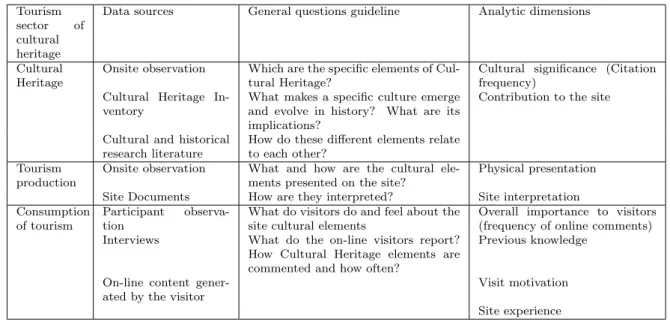
Recognizing which elements of cultural heritage are relevant to tourism is part of [Yu and Xu, 2019] study. This work summarizes methods and sources for collecting heritage data, which are useful as a guide for recognizing concepts and properties of the domain.
Table 2.1 presents a summary of these methods.
Table 2.1: Data Sources and Analysis of Cultural Heritage elements in tourism [Yu and Xu, 2019].
Tourism sector of cultural heritage
Data sources General questions guideline Analytic dimensions
Cultural Heritage
Onsite observation Which are the specific elements of Cul- tural Heritage?
Cultural significance (Citation frequency)
Cultural Heritage In- ventory
What makes a specific culture emerge and evolve in history? What are its implications?
Contribution to the site
Cultural and historical research literature
How do these different elements relate to each other?
Tourism production
Onsite observation What and how are the cultural ele- ments presented on the site?
Physical presentation Site Documents How are they interpreted? Site interpretation Consumption
of tourism
Participant observa- tion
What do visitors do and feel about the site cultural elements
Overall importance to visitors (frequency of online comments) Interviews What do the on-line visitors report?
How Cultural Heritage elements are commented and how often?
Previous knowledge
On-line content gener- ated by the visitor
Visit motivation Site experience
Cultural heritage in Peru and Arequipa is extensive and varied. There are sev- eral organizations that are responsible for its conservation and exhibition, along with its dissemination through digital media. A good reference source is the Organizaci´on de los Estados Iberoamericanos para la Educaci´on, la Ciencia y la Cultura 1, which has extensive information about Cultural Heritage in Peru.
2.3 Chapter Summary
It has reviewed some basic concepts of the Semantic Web and its technologies, which allows us to have a better understanding of knowledge modeling based on ontologies. Ad- ditionally, an introduction was made to the concept of cultural heritage, which constitutes the study domain of the present work. Having these tools described, we can make a sur- vey of works and researches related to the problem of knowledge modeling in the cultural heritage and museums domain.
1Organizaci´on de los Estados Iberoamericanos para la Educaci´on, la Ciencia y la Cultura -https:
//www.oei.es/historico/cultura2/peru/index.html
22 Department of Computer Science
Chapter 3
Literature Review of Cultural Heritage and Points of Interest Ontologies
This chapter describes related work on modeling knowledge of tourism and cultural her- itage, especially within the museum domain. First we describe ontologies to represent POI, then we present work that is considered as standard in the cultural heritage domain, and then, more particular studies that have proposed extensions of these standards, or integrations with others outside the domain. Finally, a discussion and comparison of the proposals is presented.
3.1 Point of Interest Ontologies
Regarding ontologies for Point of Interest (POI), several works have been proposed in the literature for the context of tourism.
The European ProjectHarmonise[Missikoff et al., 2003] proposes various technolo- gies to solve the interoperability problem in the tourist domain. To do so, they propose an ontology, calledIMHO(Interoperability Minimum Harmonisation Ontology), that consid- ers basic concepts used for representing the content of information exchanges in tourism transactions [Dell’Erba et al., 2002].
Another ontology proposed under an EU funded project, is Qall-Me [Ou et al., 2008]. It is a domain-specific ontology for question answering in the domain of tourism.
The tourism destinations, tourism sites, tourism events and transportation are covered by this ontology. Qall-Me is aligned with two upper ontologies, WordNet1 and SUMO2. In [Ozdikis et al., 2011], an extension of the Qall-Me ontology is proposed, by adding a new class SiteCategory and three object properties for relationships, namely strong- lyRelated, related, and weaklyRelated. Using these properties, several levels of rela- tionships among sites can be expressed. For example, a museum can be strongly related
1WordNet is a lexical database for the English language -https://www.w3.org/2006/03/wn/wn20/
2SUMO: The Suggested Upper Merged Ontology, created for search, interoperation, and communica- tion on the Semantic Web [Pease et al., 2002]
22 Universidad Cat´olica San Pablo
to a tourist office, while it is weakly related to an exhibition place.
The World Tourism Organization (UNWTO)3was created in 1975 for promoting the tourism, linked to the United Nations a year later. As an effort of 20 years to standard- ize and normalize tourism terminologies, UNWTO proposed a multi-language thesaurus (English, French, and Spanish) of the tourism domain in 2001. Terms very specific to tourism were also extensively defined for a better interoperability. Based on these con- cepts, Mondeca Tourism Ontology is proposed. Tourism object profiling, tourism and cultural objects, tourism packages, and tourism multimedia content are described. The used ontology language is OWL and it contains around 1000 concepts [Prantner et al., 2007, Moreno et al., 2013]. HiTouch Ontology [Prantner et al., 2007], created under the IST/CRAFT European program, and OnTour Ontology [Ou et al., 2008], developed by e-Tourism Working Group at Digital Enterprise Research Institute, both also use the concepts of UNWTO. HiTouch represent additionally tourism products and customers’
tourism expectations, while OnTour adds descriptions of leisure activities and geographic data.
DataTourisme4 ontology was created in 2017 by the company PERFECT MEMORY in a french project. The aim of this ontology is to centralize and publish as Linked Open Data (LOD) travel information produced by different tourist information systems in France. Additionally, this ontology is connected to different existing ontologies as FOAF5, Schema6, GoodRelations7, Dublin core8 to not duplicate areas that are described already and in this way, to facilitate links with these open databases.
Local tourism ontologies for Australia [Sharda et al., 2008], Thailand [Kongthon et al., 2011, Salaiwarakul, 2017], Iran [Bahramian and Abbaspour, 2015], and others, have also been proposed to mainly develop applications such as recommendation sys- tems [Bahramian and Abbaspour, 2015, Moreno et al., 2013] and tourism planning [Chin- napatjeerat et al., 2016].
3.2 Ontology Standards and Cultural Heritage Classifica- tion Projects
The problem of heterogeneity of concepts has led to the creation of several standards with the intention of standardizing and creating a basis for the development of ontologies for particular purposes. Although standards are a good starting point, they do not cover all the issues that may arise during the development of a project. In some cases the complexity of a standard may lead to only partial adoption of its proposal. In this Section we describe some popular standards in the Cultural Heritage domain.
3World Tourism Organization (UNWTO) - https://www.e-unwto.org/doi/abs/10.18111/
9789284404551
4https://info.datatourisme.gouv.fr/
5http://www.foaf-project.org/
6https://schema.org/
7http://www.heppnetz.de/projects/goodrelations/primer/
8https://dublincore.org/
24 Department of Computer Science The standardCIDOC Conceptual Reference Model (CIDOC CRM) [Doerr, 2005], is a tool recommended by ICOM (International Council of Museums), and since December 2006, it is recognized as an official ISO 21127:2014 standard. CIDOC CRM provides defi- nitions and structures, basic classes and relationships within the cultural heritage domain.
It has extensions that allow it to be adapted to different uses. One of these adaptations is CRM dig which is an ontology about the steps and methods on the production of digital material and 2D and 3D digital representations [Doerr and Theodoridou, 2014].
Some of the classes considered by CIDOC CRM are
❼ Temporal Entity: Events and states within a period of time.
❼ Place: Extensions of space and surface on the earth.
❼ Dimension: Quantifiable properties that can be measured by some means
❼ Persistent Item: Items that have a persistent identity (endurants). Contains the subclasses:
– Actor: Persons or Groups.
– Thing: Discrete and identifiable material things.
❼ Spacetime Volume: It can refer to a material phenomenon or an extension in space- time. It contains the subclasses:
– Physical Thing: Persistent items with a relatively stable shape, man-made or natural.
– Period: Phenomena or cultural manifestations that occur during time and space.
– Spacetime Snapshot: Arbitrary temporal extensions of a phenomenon within space-time. A portion within space-time.
Europeana Data Model Primer (EDM) [EDM, 2020] is an ontology that aims to standardize cultural heritage objects from different domains such as libraries, museums, audiovisual archives and others. It is not built on a particular standard but adopts a wide range of them, with the intention of being a Semantic Web framework between different domains.
Some classes considered by EDM are:
❼ Agent: Equivalent to CIDOC CRM Actor Class.
❼ Event: Equivalent to CIDOC CRM Period class.
❼ Information Resource: A resource whose essential characteristic can be communi- cated in a simple message, e.g., the text of a book, a musical score.
❼ Non-Information Resource: Resources that are not Information Resource, e.g., Peo- ple, Places.
❼ Physical Thing: Equivalent to CIDOC CRM Physical Thing.
❼ Place: Equivalent to CIDOC CRM Place.
❼ Provided Cultural Heritage Object (CHO): A superclass about cultural heritage objects.
❼ Time Span: Equivalent to CIDOC CRM Time-Span.
❼ Web Resource: Information resources with at least one web representation and a URI.
24 Universidad Cat´olica San Pablo
Finto [FINTO, 2020] is defined as a Finnish service for the publication and use of vocabularies, ontologies and classifications. Finto is sponsored by several Finnish govern- mental entities and is the continuation of the FinnOnto [SeCo, 2012] project, an ambitious project that is the basis for metadata, ontologies and linked data throughout Finland.
FinnOnto’s vision was to create a conceptual semantic infrastructure to interconnect pub- lic and private organizations for intelligent content exchange in the approach to the Se- mantic Web. Finto brings together ontologies from different domains, for our interest it includes the Ontology for the Domain of Museums and Applied Arts (MAO/TAO).
MAO/TAO has two superclasses, events and action and objects. Some of its basic concepts are listed below:
❼ events and actions: that can occur or happen, definite time but indefinite spaces.
– action: something that is done or accomplished.
✯ action with an object: action with an animated or non-animated object.
✯ independent action: action that do not require an object or more than one participant.
✯ mutual action: action between at least two participants.
– events: something done at a certain time and for a certain duration.
– periods of time: a time interval with a defined beginning and end.
– phenomena: a state or event with no defined beginning and end.
❼ objects: are entities that exist and have a certain defined space but undefined tem- poral limits.
– abstract objects: ideas that often take physical form, but the substance takes precedence over the physical manifestation.
– physical objects: animate or inanimate concrete objects with a mass.
✯ inanimate objects.
✯ matter.
✯ organic objects.
– physical whole: physical objects as a whole, where they are not primary func- tional entities.
– place: a portion of Earth or space.
✯ areas and regions.
✯ fictional places.
✯ places created by nature.
✯ places defined by humans.
– systems: functional entities that follow certain principles.
ICONCLASS [RKD, 2020] is a classification system developed by the Netherlands Institute for Art History, a hierarchical arrangement of definitions of objects, persons, events and abstract ideas that can be used for indexing, cataloguing and describing art- works involving images, such as paintings, reproductions, photographs and similar. The upper division of ICONCLASS contains ten topics, the first five of which are considered general topics, the remaining, special topics. Each division is divided into a maximum of nine subdivisions according to a logic of specificity. The first division is listed below:
26 Department of Computer Science
❼ Abstract, Non-representational Art
❼ Religion and Magic
❼ Nature
❼ Human being, Man in general
❼ Society, Civilization, Culture
❼ Abstract Ideas and Concepts
❼ History
❼ Bible
❼ Literature
❼ Classical Mythology and Ancient History
The Resource Description and Access (RDA)[RSC, 2020] standard is a set of el- ements, guidelines and instructions for the creation of metadata for library and cultural heritage resources according to international models, focused on linked data applications.
RDA was created as a replacement for the Anglo American Cataloguing Rules. RDA has had a mostly widespread application in the library domain. The use of RDA has a subscription cost.