BENEMÉRITA UNIVERSIDAD AUTÓNOMA DE PUEBLA
FACULTAD DE LENGUAS
Research Seminar students’ problems faced at the moment of selecting a research topic and how to overcome them
A thesis submitted to the Faculty of Languages for the degree of LICENCIATURA EN ENSEÑANZA DEL INGLÉS
By:
MICHELLE DIONICIO REYES LIZBETH ELILLER CILIA SÁNCHEZ
THESIS DIRECTOR:
MTRA. GICELA CUATLAPANTZI PICHÓN PUEBLA, PUE.
FEBRERO 2020
Research Seminar students’ problems faced at the moment of selecting a research topic and how to overcome them
This thesis has been read by the members of the thesis committee of:
Michelle Dionicio Reyes and Lizbeth Eliller Cilia Sánchez
And it is considered worthy of approval in partial fulfillment of the requirement for the degree of:
Licenciatura en Enseñanza del Inglés
Mtra. Gicela Cuatlapantzi Pichón
Thesis Director
Dra. Verónica Sánchez Hernández Mtro. Yonatan Puon Castro
Committee Member Committee Member
Benemérita Universidad Autónoma de Puebla
February 2020
ABSTRACT
For some students it is necessary and important to do a research project during their careers to get a degree, but during this process they face different problems. One of those problems is topic selection. This thesis reports on a qualitative case study and the primary aims were to explore and analyze Research Seminar I students’ main problems to select a topic and to find out the possible solutions. This study was carried out at the language department of big public university located in central Mexico. Twelve undergraduate English Language Teaching students participated in this investigation. The instruments to gather data were questionnaires and interviews. The interview included seven open-ended questions and was carried out in Spanish. The answers of each student were recorded and transcribed to be analyzed. With that information, we designed the questionnaire which included eight questions; two of them were multiple choice and six were open questions. After administering the questionnaire, the information was analyzed. The research findings revealed that students had problems when choosing a research topic because some of them did not have any idea about what they wanted to investigate. Narrowing the topic down was also a challenge for them. More results and implications are described within this thesis.
ACKNOWLEDGEMENTS
We would like to thank the following people for their dedication and contributions, without which this research would not have been possible to do:
We want to thank our thesis director Mtra. Gicela Cuatlapantzi Pichón for her patience, her support and time that she spent correcting and giving us feedback.
We would also like to thank our readers Dra. Verónica Sánchez Hernández and Mtro.
Yonatan Puon Castro for their time to read our thesis project. All their comments and corrections certainly helped to improve significantly this research project.
We want to thank the students who participated as subjects because without their answers this thesis would not have been possible.
Thanks to all of you for being part of something great. We did it!
DEDICACIONES
El haber terminado esta tesis significa mucho para mí porque es dar un gran paso muy grande en mi vida profesional y sobre todo en mi vida personal. Es un logro más en mi vida.
Quiero agradecer a Dios por haberme permitido llegar hasta aquí que con mucho esfuerzo y dedicación logré terminar la tesis.
También quiero agradecer a mis padres quienes se han sacrificado tanto por mí y que me tuvieron tanta paciencia para poder ver el resultado de este trabajo que con mucho esfuerzo hice. Siempre me apoyaron y estuvieron en los momentos más difíciles.
Mi padre Miguel Dionicio Fragoso siempre estuvo conmigo apoyándome y motivándome en todo momento. Se esforzó mucho para que yo pudiera ir a la universidad y terminar la carrera. Gracias por haberme brindado tu confianza y sobre todo haber tenido fe en mí.
A mi madre Maricela Reyes Valdez que estuvo ahí conmigo apoyándome y motivándome cada día. Ella trabajó mucho para que yo pudiera terminar la carrera y sobre todo ver el logro de mi esfuerzo que con mucho amor y cariño se lo dedico. Gracias por todo tu apoyo y por tener fe en mí.
A mi familia entera quiero agradecerles el apoyo y la motivación que me dieron esos días donde ya no podía más, gracias a esos consejos pude llegar hasta aquí.
A mis amigos les agradezco por haber estado ahí apoyándome y hacer de la universidad los mejores años.
Sobre todo, quiero agradecer a mi compañera, colega y más que una amiga Lizbeth Eliller Cilia Sánchez que sin su ayuda, apoyo y confianza no hubiera podido llegar hasta la meta y terminar la tesis.
A mi directora de tesis Gicela Cuatlapantzi Pichón por apoyarme en este último paso y el más importante de mi vida profesional. Por brindarme su apoyo, su tiempo y paciencia, por compartir su conocimiento conmigo. Gracias por todos los consejos. Por fin pude llegar a la recta final. La mejor directora de tesis.
Con cariño Michelle
DEDICACIONES
El logro de haber finalizado este proyecto ha sido una de las acciones más importantes de mi vida profesional, la cual me ha traído grandes satisfacciones no solo para mi sino también de las personas alrededor pues ha significado muchos sacrificios. Es por eso que esta tesis es dedicada a:
Dios especialmente porque fue quien puso en mi camino a las personas correctas para apoyarme en este difícil camino. También me ha guiado por un camino lleno de luz y junto a los Ángeles ( Miguel Ángel Lezama Hernández, Paulina Sánchez Cuenca, Emilio Pavía y Juan Cilia Espejel) que ahora están con él no hubiera podido y hubiera perdido toda la fe para concluir este último paso para la vida profesional.
Al Mtro. Yonatan Puon castro, quien estuvo pendiente de mí en todo momento, fuera y dentro de la universidad, para seguir adquiriendo conocimientos atreves de sus clases y pláticas y a la Mtra. Gicela Cuatlapanzi Pichón por apoyarme en el los últimos pasos para completar la primera etapa de la vida profesional.
Elia Sánchez Cuenca, mi querida madre, quien a pesar de las necesidades que padecíamos decidió apoyarme en toda mi vida universitaria. Para ella sus hijos estaban antes que nada y con amor, apoyo económico y porque no, con regaños logré mantenerme enfocada. Junto a mi padre Guillermo Cilia Luis me cuidaron y no me dejaron nunca.
Mis hermanos Héctor Eduardo Cilia Sánchez, Elva Yazmín Cilia Sánchez y Marco Antonio Cilia Sánchez quienes siempre estuvieron ahí para escucharme y apoyarme, no solo emocionalmente si no también económicamente. Son unas grandes personas.
Mi madrina Guadalupe Sosa Enríquez quien siempre aun en las peores circunstancias me ha enseñado siempre mantenerme de pie y ser fuerte ante cada batalla. Toda su sabiduría, apoyo, compresión y amor no solo conmigo si no también con toda mi familia y con el mundo me dieron la fuerza para continuar en esta carrera. Es el símbolo más grande de admiración, fuerza y sabiduría que Dios pudo haber puesto en mi camino. De corazón y sinceridad le dedico esta tesis. Es un gran ejemplo a seguir.
Mi querida compañera y amiga Michelle Dionisio Reyes quien con paciencia y complicidad me dejó continuar junto a ella para dar este gran paso en nuestras vidas.
Aida Raquel Maldonado Rivera, Analí Gallardo Areola, Marisol Loaiza Melca, Ángeles Dávila Rangel quienes con sus consejos, cariño y amistad no hubiera podido concluir nada después de que las conocí. Mis queridas amigas a ustedes también les debo este hecho tan emocionante para mí.
Jacir H Jonathan Saldaña Palma quien durante casi dos años estuvo animándome para terminar algo que se volvió tan importante para él como lo es para mí y a quien le debo todo el amor que ahora poseo.
Con amor y gran agradecimiento Eli
TABLE OF CONTENTS
CHAPTER ONE: INTRODUCTION...
1.0 Introduction ...
1.1 Rationale ...
1.2 Location of research ...
1.3 Purpose of study ...
1.4 Research aims ...
1.5 Research questions ...
1.6 Significance of study ...
1.7 Context of research ...
1.8 Chapter conclusion ………...
CHAPTER TWO: LITERATURE REVIEW ...
2.0 Introduction ...
2.1 Higher education ...
2.1.1 ELT undergraduate program ...
2.1.1.1 Linguistics ...
2.1.1.2 Research ...
2.1.1.3 Teaching ...
2.1.1.4 Elective areas ...
2.2 Writing a thesis ...
2.2.1 Research Methodology...
2.3. Research seminar ………...
2.3.1 Research topic ...
2.4 Conclusion ………
CHAPTER THREE: METHODOLOGY ...
3.0 Introduction ...
3.1 Setting ...
3.2 Participants ...
3.3 Research Methodology...
3.4 Instruments ...
3.4.1 Questionnaires...
3.4.2 Interviews ...
3.5 Data collection procedure ...
3.6 Data analysis ...
3.7 Conclusion...
CHAPTER FOUR: DATA ANALYSIS ...
4.0 Introduction ...
4.1 Research questions ...
4.2 Results ...
4.2.1 Research Methodology course ...
4.2.2 Research areas ...
4.2.3 Problems students faced to choose a topic ...
4.2.4 Opinions about choosing a topic ...
4.3 Conclusion...
CHAPTER FIVE: CONCLUSIONS ...
5.0 Chapter introduction...
5.1 Findings...
5.2 Limitations of the study ...
5.3 Further research...
5.4 Personal reflection...
REFERENCES ...
APPENDICES...
Appendix A...
Appendix B...
Appendix C...
Appendix D………..
Appendix E...
LIST OF TABLES
2.1 ELT programs ……….
4.1 ELT’s thesis writing areas ………...
LIST OF GRAPHS
4.1 Positive and negative opinions about the Research Methodology course ………….
4.2 Problems that Research Seminar I students have ………...………
4.3 Students’ suggestions ……….
BENEMÉRITA UNIVERSIDAD AUTÓNOMA DE PUEBLA FACULTAD DE LENGUAS
R E S EA R C H S E MINAR S TUDENTS’ PROBLE MS FACED AT THE MOMENT OF
SELECTING A RESEARCH TOPIC AND HOW TO OVERCOME THEM
BY: MICHELLE DIONICIO REYES AND LIZBETH ELILLER CILIA SÁNCHEZ
1.1 Introduction
To get a bachelor’s degree in different universities around the world, students’ usually have to write a thesis. It is an important project in students’ academic life if they want to continue with their studies.
A thesis is an extended argument. To pass, a thesis must demonstrate logical, structured, and defensible reasoning based on credible and verifiable evidence presented in such a way that it makes an original contribution to knowledge, as judged by experts in the field (Evans, Gruba, & Zobel, 2011, p.1).
Grix (2004) defines theses as works that add significantly to human knowledge. Therefore, a thesis has to have a good presentation, not just written layout, which means a good structure from the top to the bottom.
English Language Teaching (ELT) students face difficulties when they choose a topic for their thesis. Choosing a research topic is the first part for writing a thesis; Bell (1993) states that when you are writing a research project or a PhD thesis you will need to select a topic, identify the objectives of your study, plan and design a suitable methodology, devise research instruments, negotiate access to institutions, materials and people, collect, analyze and present information and finally, produce a well written report or dissertation. However, this study is only focused on the topic selection level.
In this study we focused on the frequent problems that Research Seminar students had when choosing a topic and how they solved them.
1.2 Rationale
We chose this topic because when we were in previous subjects we did not know how to choose a research topic for our thesis project. Thus, when we took the Research Seminar
subject we realized that we had a lot of difficulties choosing a research topic, starting with the area, so we did not know how to solve this situation until we were helped by our subject professor, we asked the students that had already written a thesis and we also read a lot.
Besides, we noticed we were not the only students that faced problems choosing the topic.
1.3 Location of Research
This study was carried out at the language department of public university. This department offers a degree in English Language Teaching (ELT). ELT students are required to take two Research Seminar subjects. It is necessary for students to take them following the syllabus (see Appendix C). In the first Seminar, students are expected to write the Introduction chapter and the Literature Review Chapter. In the second Seminar, students have to design their instruments, administer them and write the Methodology chapter. They also have to present their results in chapter 4 and conclusions in Chapter 5.
1.4 Purpose of the Study
The priority of this research was to analyze both, the problems that students had in the topic selection stage and the perspectives that students provided to solve them. In this way we could not only examine the difficulties but also to show what the students’ points of view were.
1.5 Research Aims
To explore and analyze Research Seminar students' main problems to select a topic.
To identify the possible solutions for the topic selection.
1.6 Research Questions
What are the main problems that Research Seminar students face when selecting a research topic?
What are the students’ points of view to solve those problems during the selection of a research topic?
1.7 Significance of the Study
Students would benefit because this study intends to provide the alternatives to the problem of selecting a thesis topic. The participants’ answers could shed light on how the topic selection could be a less complex process.
1.8 Context of Research
This study is related to the main areas that are research methodology and writing a thesis, the first area is important for us and our project because to design a thesis project it is necessary to know the underlying information about how research should be conducted.
The second area, methodology, is important because without it, the process of the thesis writing would not be complete. It is essential to know how a thesis should be written, the steps followed; for example, how to write a working title.
1.9 Chapter conclusion
In this chapter I, we provided background information about our research, established the purpose of the study, gave main concepts used in this paper, and a brief description of the study. In chapter 2 we will provide the literature review, this is, we will define concepts and explore the process of a thesis. In Chapter 3 we will describe the methodology, in chapter 4 we will show the analysis of the data, and finally in chapter 5, we will provide the conclusions about our findings of the whole research.
CHAPTER II: LITERATURE REVIEW 2.1 Introduction
At the end of their B. A. studies, students are required to develop a research project commonly known as thesis or dissertation. This is carried out, on one side, with the counseling of a thesis director and otherwise, with the student´s effort in the investigation.
This chapter will present the definition of main concepts, the similarities from different ELT programs: international, national and local, and the areas that students could focus on for their thesis projects, the process of writing a thesis is also included as well as studies related to this research project.
2.2 Higher Education (HE)
Kumar (2008) suggests that “in short, education is the development of individual according to his needs and demands of society, of which he is an integral part” (p.x). In general, what education means is about setting individuals in the world.
Particularly, higher education is an advanced level of study that is taken usually after you get the mature knowledge age this is when students enroll in the university. The term of higher education is contemplated as the continuation of the high school and the professional areas of study.
In order to continue with the knowledge improvement, students first of all need to finish high school then if they have enough motivation and really want to study they can choose different areas of study: Social Science, Human Studies, Medicine, Exact Sciences and Economic-Administrative Area. In other words, being at university is when students are in one of the most important stage in the beginning of their professional lives; this is at a
supposed mature age. However, the education in this stage is more complex than in lower levels because students need to think about what they want to achieve in the future and therefore, they have to make an important decision because they have to select an area of study.
Higher education in Mexico starts when a person has the opportunity to continue with the development of a professional life after they finish high school. Students study their undergraduate program for four or five years depending on the major that students choose.
2.2.1 ELT undergraduate programs
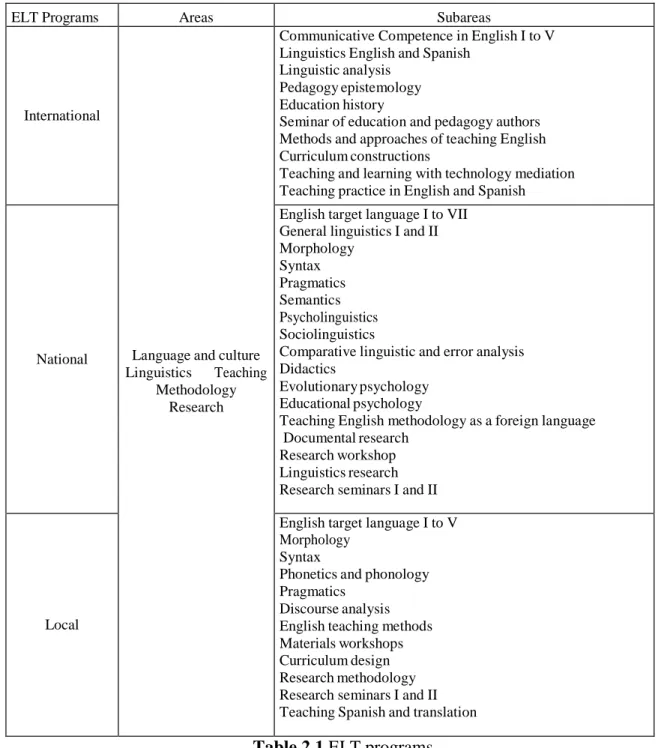
ELT programs are designed to train students to become English teachers. To look ELT programs more closely, we considered three different programs from three different language departments.
The first one is from a Colombian University (see Appendix A). It focuses on the teaching-learning process and techniques in both English and Spanish and guiding students be updated in the several theories that continuously emerge in the teaching area. In addition, a goal is to teach students to be responsible, ethic and committed with their profession.
The second program that we reviewed was national (see Appendix B). The name of the program is English Language Teaching from a big public university located in central Mexico, it is considered the most important institution and its main purpose is to give professionals to society. It included the following areas of study: teaching, research and education management. It is divided into nine semesters; fifty-two subjects are required to complete the program.
The local ELT program is from a big public university, located in central Mexico; it is independent and its purpose is to teach to students how to learn by themselves, not only keep the knowledge provided by teachers (see Appendix C). It focuses on the following areas: the language and culture (English I to V, English Literature), linguistics (Morphology and Syntax, Pragmatics), teaching methodology (English Teaching Methods, Material Workshop Curriculum Design), research (Research Methodology and Research Seminars I and II) and elective areas (Teaching Spanish and Translation among other).
It seems that there are common areas of study in ELT undergraduate programs. For the purpose of this study, in the following sections, we will explain further five areas in which undergraduate students of the local program focus to write their dissertations.
The definitions of the concepts below are an important part of these three programs and instead of subject are areas of study of the degree.
Here it is a table to understand better the ELT undergraduate programs:
ELT Programs Areas Subareas
International
Language and culture Linguistics Teaching
Methodology Research
Communicative Competence in English I to V Linguistics English and Spanish
Linguistic analysis Pedagogy epistemology Education history
Seminar of education and pedagogy authors Methods and approaches of teaching English Curriculum constructions
Teaching and learning with technology mediation Teaching practice in English and Spanish
National
English target language I to VII General linguistics I and II Morphology
Syntax Pragmatics Semantics Psycholinguistics Sociolinguistics
Comparative linguistic and error analysis Didactics
Evolutionary psychology Educational psychology
Teaching English methodology as a foreign language Documental research
Research workshop Linguistics research Research seminars I and II
Local
English target language I to V Morphology
Syntax
Phonetics and phonology Pragmatics
Discourse analysis English teaching methods Materials workshops Curriculum design Research methodology Research seminars I and II Teaching Spanish and translation
Table 2.1 ELT programs
2.2.1.1 Linguistics
Linguistics is an important field of study and research for ELT students since it includes several subareas such as phonetics and phonology, morphology, syntax and pragmatics.
Linguistics is the scientific study of human language (Fromkin, 2000-,). Apparently, this science is focused on the rules that native speakers of any language have acquired (Dostert, 2009). It means that this discipline notes the common characteristics of all languages.
Moreover, John Laver (2000) argues that “linguistics is the scientific study of the nature, use, and variety of all aspects of language” (p. 150).
The reason why Linguistics is included in an ELT is to show up students (people in general) how to use the language since it involves form, meaning and context. As non- native speakers, it is significant in order to acquire the accurate structure and rules for the development of one or more languages thereby Linguistics and its branches will help students to learn and to teach or share the knowledge of English.
2.2.1.2 Research
McMillan and Schumacher (1997) argue that Research “is a systematic process of collecting and logically analyzing information (data) for some purpose” (p.9). Creswell (2005) indicates that it “is a cyclical process of steps that typically begins with identifying a research problem or issue of study” (p.597).
Now, in an ELT program, Research for students is highly important because with the investigation that they follow up they can understand better how the world works, first of all. After that, they can recognize or acquire certain knowledge in order to comprehend the
problems in their own classrooms, observe their own teaching practice and investigate so they will be able to control effectively the situation.
This means that students do not have to keep what they learn during the courses, they can improve researching by themselves to support and to have the accurate knowledge.
2.2.1.3 Teaching
Teaching is defined “as a profession with its own code of ethics and standards, plus and body of knowledge, models, and techniques” according to Orlich, Harder, Callahan, Trevisan, Brown and Miller (2013, p.18), but at the same time it is a science and an art because it seeks for two essential ideas which are the knowledge of techniques and decision making (Orlich, et.al, 2013).
Teaching, into the ELT program, is a very important area because it is the major foundation of the program and because during the major students are taught how to teach others, plan classes by using techniques, materials, and in the end, evaluate the knowledge.
Likewise, teaching may be considered as the manner in which someone conducts to other person to learn, supplying with any information acquiring the understanding (Kimble and Garmey, 1963 cited in brown, 1994). It is, perhaps, the way in which the Teaching- Learning process works, in this case the academic field.
This area is important in ELT programs because students are being trained to become English teachers. Teaching is essential because students learn techniques, methods and approaches, how to create, use and apply materials that are affective and can be used to handle the class also to develop or improve the process of teaching and learning; both can be analyzed and evaluated during the teaching practice.
2.2.1.4 Elective Areas:
We included these areas as well because they are also an important part of the program since many students would like to become translators or want to know better the usage of our native language.
This section includes the areas that are offered in the local ELT undergraduate program which are: Spanish for foreigners and translation that are defined below.
Translation
Crystal (1987) claims that
The term translation is the neutral term used for all task were the meaning of expressions in one language (the ‘source’ language) is turned into the meaning of another (the ‘target’ language), whether the medium is spoken, written, or signed (p.344).
In this area, students acquire knowledge about translation characteristics and translation of types of texts and at the same time are exposed to the intercultural connections and the broadcast of the scientific and technological knowledge (Robinson, 2002). Students develop respect and sensitivity at the time they choose this ground.
Spanish as a foreign language
Concerning this area, students in ELT program learn about their own culture and linguistic aspects of the Spanish language, in order to explore and then apply methods and techniques for teaching Spanish as a foreign language and promote the culture of the language.
2.2 Writing a Thesis
To begin, the professional thesis is written mainly to get one of the types of degree and to contribute to create knowledge. Writing may be a hard and a large process that implies time
and knowledge. The candidate has to fulfill specific requirements to achieve the degree. To develop a thesis in language department where this study was carried out, it is necessary to include five chapters: the introduction, the literature review, methodology, results, and the conclusions but the total structure also includes the preliminary pages that are located at the beginning of the investigation, and at the end the references and the appendixes (Ibañez, 1995).
All the professional degrees: PhD (Doctor of Philosophy), Master of Arts (MA) and Bachelor of Arts (BA) have four characteristics in common.
First a thesis has a research question, it means a problem that is sought to be solved;
second, find the answer by analyzing a large number of data through a variety of methods, then, it involves a meticulous methodology to find out the answer, and as a result the final paper´s author will think about what is the new knowledge generated added to the topic beyond to the existing work (Grix, 2004).
The areas that students may need to write their thesis project are Research Methodology, how to write a thesis and academic writing. In this study we focus on the research methodology and how to write the first chapter of the thesis which is the introduction. They are explained in the sections below.
The aim of writing a thesis for students that are enrolled in ELT is important because it will help students to portray experiences that they observed and lived during their training in the transition of being a student to become a teacher. Structuring the features for designing a research paper based on the problems to have a possible solution for each situation is paramount to have a complete training as future teachers.
2.2.1 Research Methodology
In the first place we will define the term Research methodology
Research Methodology is a way to systematically solve the research problems. It may be understood as a science of studying how research is done scientifically. In it we study the various steps that are generally adopted by a research in studying his research problem along with the logic behind them. (Kothary, 2004, p.8)
According to Creswell (2005) Research methodology is a process which has the following steps:
Identifying a research problem: identifying the problem, justification of the problem and proposing the importance of the study.
Reviewing the literature: looking for books, journals, newspapers, publications related to the topic, and then do a summary of the important information obtained.
Specifying a purpose for Research: identifying the main purpose of the research.
Collecting data: the participants are identified for the research, asking for permissions and gathering information by asking people questions.
Analyzing and Interpreting the Data: involves taking the responses apart to identify the main data, to put it together and summarize it after that, students represent the information gathered in tables, graphics, and pictures.
Reporting and Evaluating Research: in this final part, the report will be structured in such a sensitive way for the audience (students, teachers, researchers, and so on). Thus the report should be designed according to the readers of the research, at the same time they will evaluate the dissertation for research or academic purposes and qualifies the investigation.
The steps above are the sequence in the methodology research and at the same time they are used in the Research Seminar for gaining a final project.
In addition, Charles (2008) points out that the research process includes:
Identifying the matter about which the concern exists.
Clarifying the specific problem upon which the research will center
Formulating research questions and/or hypotheses concerning the central problem
Carrying out procedures by which data are collected, summarized, and analyzed
Stating the findings determined through data analysis
Drawing conclusions related to the original research questions or hypotheses
When carrying out research, it is also necessary to consider whether the design would be qualitative, quantitative or mixed method. Creswell (2005) indicates that research designs
“are the specific procedures involved in the last three steps of research process: data collection, data analysis, and report writing” (p.51).
Qualitative Research is defined as
a type of educational research in which the researcher relies on the views of participants, asks broad, general questions, collects data consisting largely of words (text) from participants, describes and analyzes these words for themes, and conducts the inquiry in a subjective, biased manner (Creswell, 2005, p.39).
In qualitative research we find the following types of research designs for collecting and analyzing the data, and writing the report of results.
Grounded Theory Design: The researchers give a general explanation where they explain the action and interaction among people. Researchers use different techniques such as observations, conversations, formal interviews and public records.
Ethnographic design: the researchers study groups experiences, behavior, and beliefs.
They use interviews, observations, and documents by narrative description.
Narrative Research Design: researchers describe the individuals’ life through interviews, collect and tell stories about their individuals’ life.
According to Creswell (1998) the five traditions in qualitative research are biography, phenomenology, grounded theory and case study.
Biography design describes the individual’s life using interviews and documents. It can be method and phenomenon of the study. It consists on studying one or two individuals, gathering data through individual’s stories, reporting the experiences and ordering them chronologically.
Phenomenology design consists on understanding the essence of experiences about a phenomenon and describes the meaning of several individuals of their lived experiences.
Grounded theory is a systematic and qualitative procedure that describes how a process, an action or interaction occurs about a specific matter, by leveling it. In regard to research, it proceeds defining educationally every event, activity, action and interaction that takes place in a period of time. It is very useful to gather information through categorizing, linking and establishing the theory. It is used when there is a wish to have an extensive explanation of a theory’s process, inasmuch as grounded theory offers step by step the study of data.
The case study approach includes the study of a specific matter gathered over one or different cases inside a broad scheme through the time. The individual examines a case or a
bunch of cases by detailing in depth data collection including several sources such as interviews, audiovisual materials, report and so on.
Case studies are decided according to the size of the case. Therefore, they could be individual, a group of individuals, an entire program or an activity. In order to conduct this qualitative approach, it is needed to determine, first of all, if it is the correct methodology for the research matter. Secondly, it is important to distinguish the case or cases, then, select the type of data collection (interviews, participant observation, etc.). After that, the investigator identifies the type of data analysis that could be holistic analysis or embedded analysis. Finally, the explorer informs the sense of the investigation done, concluding the learning for the case, in that way.
Action research design is an approach that placed the research into the classroom and observes the students teaching-learning process (Creswell, 2005).
Whereas the Quantitative Research is defined as follows:
It is a type of educational research in which the researcher decides what to study, asks specific, narrow questions, collects numeric (numbered) data from participants, analyzes these numbers using statics, and conducts the inquiry in an unbiased, objective manner (Creswell, 2005, p.39).
According to Creswell (2005) the following Research Designs are included in quantitative research:
Survey Design: the researcher administers a questionnaire to know the opinions, beliefs, and attitudes of a group of people.
Correlational Design: investigators measure the degree of association between two or more variables using the statistical procedure of correlational analysis.
Experimental Research Design: the investigator determines the impact of an intervention on an outcome for participants’ study.
In addition, for research methodology a combination of both types of research, qualitative and quantitative, can be used.
A mixed method design includes “the procedures for collecting, analyzing and linking both quantitative and qualitative data in a single study or in a multiphase series of studies”
(Creswell, 2005, p.53).
This type of research method design is used when in a research there are both qualitative and quantitative data and provides a better understanding.
Research Methodology in an ELT program, is important because it helps students to follow, step by step, the process to investigate their own teaching practice.
2.3 Research Seminar
Research seminar is divided in two sections (1 and 2). In Research seminar 1 students are usually encouraged to carry out a research project. They select a research topic and write the literature review. In Research seminar 2 students collect and analyze data, provide the results and add final conclusions.
The research seminar class solves many of the problems that had previously been encountered in working with students conducting investigative projects. Students in the research class do not start a project without knowing exactly what they are doing and why they are doing it.
In this subject it is important to have feedback from partners and the professor because
2.3.1 Research Topic
Selecting a research topic is sometimes hard for students:
The first-and, to my mind, by far greatest – problem is the choice of subject and, more particularly, of title. The general area of study is hardly a problem. A field of study, such as the 1914-18 poets, or automation, or the psychology of aesthetics, is selected or assigned. Three thousand words, say, have to written on a topic in which the students are presumably interested. But at this stage the student is nowhere near fixing a title for the paper. It is clear that ‘automation’, for example, is inacceptable as a title. It is part to broad. The topic will have to be defined and limited after some preliminary reading…
(Berry, 1994, p.5)
In addition, Booth, Colomb and Williams (1995) suggest that
Finding a topic, though, is only the first step, so do not assume that once you have a topic, you need only search for information and report what you find. Beyond a topic, you have to find a reason for devoting week and months to pursuing it (p.35).
Schloss and Smith (1999) point out that “probably no step in developing and conducting a research project is as important, yet difficult, as a selecting a topic; the research topic serves as a foundation for the entire effort” (p.31).
Dorra and Sebilla (1977) state that selecting the topic is the previous step to all research.
This starts when within a specific topic there is a problem, it means, a question perfectly structured and defined which the scientific process will give an answer (p. 15)
In addition, Baena (1983) argues that students should always choose the topic according to their own interests and indicates that the topic should be specific, directed preferably to answer only one specific question which will help to research more in depth (p.15).
Certainly the more specific the topic is the more attractive will be for the audience.
2.4 Conclusion
To conclude, it is important to mention that writing a thesis is a process which involves knowledge of research methodology and thesis structure.
In this chapter, we will point out the main areas on which we based our final paper such as the research methodology; this section systematizes the steps to follow up in the process of writing the thesis. After that, we will summarize the importance of taking the research seminar class, and at the end of this chapter, it is included the research topic that helps out to identify a clear way to understand how to choose the proper research topic to write the thesis.
CHAPTER III METHODOLOGY 3.1 Introduction
This research was about the possible solutions to the main problems that students´ research seminar face at the moment of choosing a research topic; the purposes were to explore and analyze Research Seminar I students´ main problems to select a topic. It was carried out at a language department of one of the biggest public universities in central Mexico.
Therefore, to collect the data it was necessary to design an instrument that was a questionnaire.
In this chapter we will explain the subjects, the setting, the research methodology, and the instrument that we used. We will also provide an explanation of how we went about collecting the necessary data for answering our research questions.
3.2 Setting
This research was carried out at the language department of a big public university located in central Mexico. This department offers two undergraduate degrees one in English Language Teaching and one in French Language Teaching. These programs include subjects to design and develop a thesis during the last year: Research Seminars I and II, in which students do a draft of their papers. The participants of this study were studying the major in ELT.
3.3 Participants
The participants, at the time of this study, were taking Research Seminar I from the ELT undergraduate program in which they had to develop the two first chapters of their thesis.
We chose a mixed group with about 12 students.
3.4 Research Methodology
This study was focused on investigating the opinions related to the problems and solutions that students had when choosing a research topic. Therefore, we used a qualitative approach. According to Creswell (2005) qualitative research:
Is a type of educational research in which the researcher relies on the views of participants, ask broad, general questions, collects data consisting largely of words (or text) from participants, describes and analyzes these words for themes, and conducts the inquiry in a subjective, biased manner (p.39).
Also, within the characteristics of this qualitative research we found that the appropriate instruments to gather data are observations, interviews and questionnaires, documents and audiovisual materials (Creswell, 2005, p.209). We decided to use questionnaires and interviews which are described in the following sections.
3.5 Instruments
The instruments we used to gather data were questionnaires and interviews both used to know the participants’ views which could be useful to other students that face the same situation in future generations.
3.5.1 Questionnaires
According to Kidston (1985) questionnaires are a relatively inexpensive and easy way of collecting data on a given subject from a wide variety and from large numbers of people, and these characteristics undoubtedly explain the method's popularity (p.134). Hence this was the first instrument we used because it is useful to get different data from small or large numbers of participants. In this case we administered the questionnaire to seven
participants. The questionnaire included eight questions; two of them were multiple choice and six were open questions (see Appendix D).
3.5.2 Interviews
The interviews were in Spanish because we wanted to gather as much information as possible. Interviews are an open-ended type of instruments. The individual interviews allow us to collect personal data, points of view and real opinions of the participants about this matter.
The interview was structured with seven questions related to the thesis orientation, possible topics, and the usefulness of taking the methodology course and how hard selecting the topic was. To conclude, we asked for pieces of advice to future generations (see Appendix E).
3.5 Data collection procedure
To collect the data, we asked the teacher for permission, after we talked to the students about the problems that they had when they chose their research topic. With these points of view, we started to formulate questions and design the questionnaire. It was reviewed by our supervisor and after that it was piloted. Using these questionnaires, we could notice the people that had problems and the solutions for those problems. After that we redesigned the instrument.
After administering the questionnaire, the information was analyzed. First, we read the students’ answers and took notes about the problems and the solutions they gave. After that, we took into account the most important answers and we designed an interview according to what students said in the first questions.
Then we interviewed the students randomly, asking if they had taken the Research Methodology or Research Seminar I courses and we realized that the questions that we designed were good because students felt comfortable and they answered what we wanted to know to answer our research questions.
3.6 Data Analysis
At the moment of analyzing the data, we took into account mainly three questions: if the Research Methodology course had helped students to select their research topics, the problems that they had during the process of choosing a research topic and the suggestions that they gave for the new generations. After that we used the program Microsoft Excel for graphics.
3.7 Conclusion
In this chapter, the participants and where this study was carried out were described. We also gave an explanation of the type of research and methods we used to get appropriate data. In next chapter we will show the results according to the data analysis done.
CHAPTER IV: RESULTS 4-0 Introduction
This chapter is the complement of the chapter methodology because it will show the information gathered through the interviews designed in the methodology and applied to the Research Seminar I students. It will also answer the two research questions (RQ) that this study addressed. To a better understanding we described the significant students’
answers with tables and graphs.
4.1 Research questions
Our research questions are provided below:
What are the main problems that Research Seminar students face when selecting a research topic?
What are the students’ points of view to solve those problems during the selection of a research topic?
As we mentioned above, in order to get the appropriate answers, we interviewed twelve students who were taking Research Seminar I class.
4.2 Results
The aim of this section is, first of all, to answer the research questions through the analysis of the students’ answers and secondly, to mention important points of view that the participants gave for other students who are in the same situation or for those that are studying the ELT major at an early stage of it.
First, we present important aspects such as the importance or the Research Methodology course; secondly, we mention the areas students will write their thesis projects about and finally, we answer the RQ.
4.2.1 Research Methodology Course
The Research Methodology course helps students in different ways; such as providing steps for starting to write the thesis, looking for resources, guidance to carry out investigation.
PARTICIPANTS
9 8 7 6 5 4 3 2 1 0
YES NO
YES NO
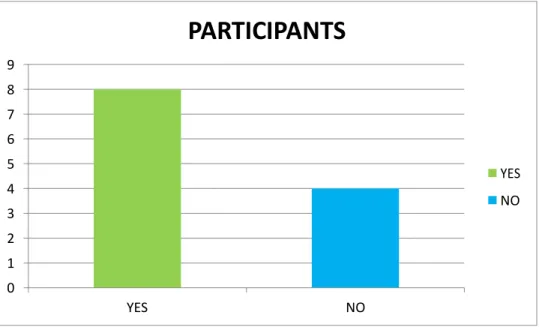
Graph 4.1 Positive and negative opinions about the Research Methodology course (n=12).
Eight students (n=12) mentioned that their Research Methodology course helped them to select their topic. These points are illustrated with the following participants’ opinions.
Si, si me ayudó muchísimo porque en ese curso pues vimos paso a paso que se tiene que hacer para delimitar un tema, vimos los diferentes métodos de investigación que existen y sobre todo leímos muchísimo. La profesora nos puso a leer muchos artículos académicos y muchas investigaciones y eso me ayudó muchísimo porque así descubres que no es tan difícil delimitar un tema pero que tampoco tan fácil como a veces lo pensamos (participant 4).
Yes, it helped a lot because in this course we saw step by step what we have to do to narrow a topic, we saw the different research methods that exist and mainly we read a lot. The teacher made us read a lot of academic articles and many research papers and that helped me because in that way you discover that it is not so difficult to narrow a topic as sometimes we think.
Si porque me dio las bases teóricas y afortunadamente en ese momento cuando estaba tomando metodología yo identifiqué un problema…si me ayudó para delimitar y todo eso, delimitar el tema de la tesis o sea hacerlo de lo general a lo específico (participant 12).
Yes, because it gave me the theory and fortunately at that moment when I was taking Methodology, I identified a problem… Yes, it helped me to narrow and all that, narrowing the thesis topic it means do it from general to specific.
Twelve students mentioned that the course helped them to identify a problem and four students agreed that the course did not help them too much. These students mentioned that the course was very short to choose a topic and the teacher asked them to select a topic as soon as they took the course. In addition, they learned how to cite, from a magazine or newspaper, identify the author and the year but they did not learn how to choose a topic.
For these reasons they were not satisfied with the topic because of the short period of time and the type of course.
Students thought that the course would help them with the first stage of the thesis project. They thought that the teacher would guide the students in the process of selecting a topic.
4.2.2 Research Areas
The table below presents the areas of study that students selected within the ELT major for writing their thesis.
Teaching Translation Spanish for Foreigners
Linguistics Research
Participants 8 0 3 1 0
Table 4.1 ELT’s thesis writing areas (n=12)
The main areas students investigate are Teaching, Research, Linguistics, Translation and Spanish for Foreigners. However, the majority of the students did not know this. It could be because their teacher just asks for a topic of interest without explaining that the
major is divided into different areas of study. In addition, students did not investigate about them by themselves. Not knowing the areas of research became the first problem students faced at the moment of choosing a topic, according to the questionnaire piloting.
Many of the students write their thesis in the teaching area due to the fact that we are studying to be teachers and they think that as future teachers it is important to observe the environment and focus on their learning and teaching experiences. Students had different opinions about the teaching area. An example of that is below:
Docencia, porque como vamos a ser maestros pues obviamente se me hizo interesante ver como los estudiantes adquirían la lengua inglesa. (participante 11)
Teaching, we are going to be teachers and< obviously it seemed interesting to see how the students acquired the English language (participant 11)
We, as future teachers, need to know how to identify a problem into a classroom such as class management, students’ development among other.
Other students wanted to compare or research about the curriculum. One of the participants mentioned “Pues es investigación… me voy a enfocar al diseño curricular, el programa de estudios” “Well it is investigation… I am going to focus on curriculum design, the syllabus”. The participant wanted to compare two curricula, the first one is from the ones that are preparing by themselves to teach any subject and the others are English teachers.
Even though the area of translation was not chosen by students, it did not mean that nobody was interested in investigating about it. It is also an important area of investigation.
This area has gained a significant importance in the ELT program and the authorities have implemented a translation department.
Spanish for foreigners is another optional area that students can choose from the curriculum and also write about any experience with a course or a problem students identify. Students interviewed mentioned the following:
I was interested in investigating this area because my purpose is teaching Spanish abroad, this is one of my goals… (participant3).
I was interested in this area because first, Spanish is a very important language from my point of view; it is very important in the historic field …And second because I think it is an area that is little studied in our career (participant 9).
Spanish is considered as an international language and students chose this area to write about because they are studying the elective subjects to get a particular certification.
About Linguistics, the participant who selected this area said that it has to do with how language interacts in a society, some students as future teachers should know how linguistics works.
Finally, it is important to mention the area of research, the area this paper is focused on.
It seemed that students do not choose it frequently, for their thesis development. It is because they think it is a wide and hard area of study or because the major is teaching.
There is a huge variety of topics from each area of investigation that students can choose to write a thesis project. Unfortunately, there are areas that seem to be not interesting for students such as research and translation.
4.2.3 Problems students faced to choose a topic
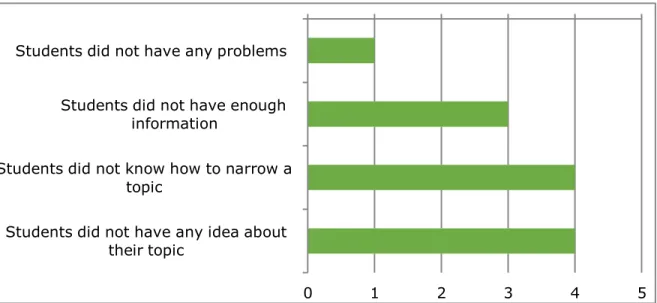
When students take the Research Seminar I, they are required to select a research topic for their thesis project but they face a lot of obstacles. According to what we noticed from the students’ answers, the first problem they had was that they did not know the area they were interested in. The following graphic shows the main results.
Students did not have any problems
Students did not have enough information
Students did not know how to narrow a topic
Students did not have any idea about their topic
0 1 2 3 4 5
Graph 4.2 Problems that Research Seminar I students have (n=12).
As shown above, a student did not have any problems because he/she already had his/her topic selected since they had been working on the thesis; one of the participants said:
No tuve problemas porque antes de que empezara ya tenía la idea de lo que quería hablar entonces ya no hubo problema con eso de cambiarlo, o de hablar de otro tema.
I did not have any problems because before I started I already had the idea of what I wanted to talk about so there was no problem about changing my ideas, or talking about other topic (participant 6).
Secondly, results showed that students did not have enough information about what they wanted to talk about; it is cited in the following participant’s answer:
Pues primero estaba muy confundida no sabía por dónde empezar y ahora lo que se me está presentando es encontrar bibliografía, me faltan checar otras tesis y de ahí yo creo que me voy a basar.
First of all, I was so confused because I did not know how to start and now what I am facing is to find the information for the literature review bibliography. I need to check other thesis and I think that will help me to continue. (participant 8).
Afterwards, the interviews showed that students did not know how to narrow a topic because they did not have any help from teachers or the subjects they took before starting taping the thesis; participant 4 mentioned the following:
Si, uno que tuve fue que no tenía claro a qué área pertenecía el tema que me interesaba porque era este originalmente Enseñanza de idiomas para cantantes de ópera, pero era demasiado general y mi primer problema fue ese delimitarlo más. Después otro problema al que ahora me estoy enfrentando es que no tengo claro cómo voy a elegir por ejemplo a mis participantes, ya tengo el contexto, pero no tengo claro que método voy a utilizar para recabar información tampoco exactamente que muestra voy a tomar.
Yes, I had one I did not know the area of research of my topic because my original idea was English language teaching for opera singers but it was too general and my first problem was to narrow it more. Then other problem that I am facing now is that I do not have a clear idea about how to choose my participants. I already have the context but not the method that I am going to use to collect information and the sample.
This participant shared since the beginning the importance of doing the thesis because she was considering to study master’s degree. The inconvenient situation she went through was that she was not sure about the area in which her final paper belonged to and she used her own experience for her thesis. Also she had some problems to choose the instruments and the sample she will use the gather the correct information. This student considered that by reading a lot it is possible to understand academic projects.
Finally, interviews disclosed that many students did not have any idea about their own topics. One of the participants stated the following:
Los problemas que tuve al principio eran que no sabía cómo o que tema escoger porque no me puse a pensar desde antes que es lo que podía hacer hasta que entré a seminario, es cuando me preocupé y ya me puse a pensar mucho y recibí recomendaciones, pero ninguna me gusto hasta que decidí optar por mi tema.
The problems that I had, at the beginning, were that I did not know how or what topic to choose because I did not think before about what I could do until I took Research Seminar I, It was when I worried about it and then I was overthinking and received recommendations but I did not like any until I decided to take my own topic.
These were the problems students commonly had during the Research Seminar I.
Furthermore, students mentioned that when they had already chosen a topic and they had to read more about it, there was not enough information or sources. Just one student said that she did not have any problems; she said the following:
Well, I did not have any problems because before I started, I already had more or less the idea I wanted to talk about…
This student mentioned this because she started to think about her topic since she was taking a subject related with Spanish for foreigners and it was where she had the idea about what she wanted to do.
4.2.4 Opinions about choosing a topic
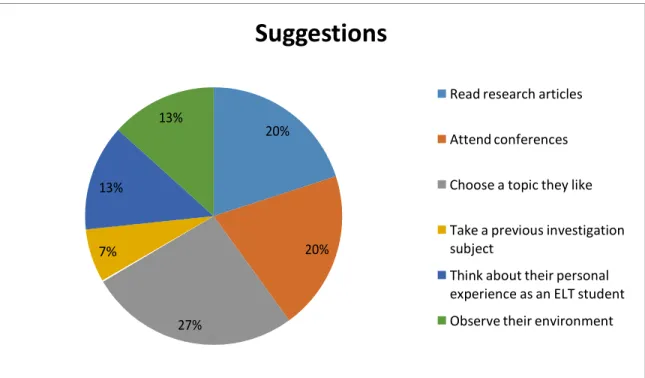
Students’ solutions for those problems that commonly appeared during the selection of the research topic are presented in the following graphic as ideas for new generations.
Suggestions
13% 20%
Read research articles
Attend conferences
13% Choose a topic they like
7%
27%
20%
Take a previous investigation subject
Think about their personal experience as an ELT student Observe their environment
Graph 4.3 Students’ suggestions (n=12)
Students gave suggestions for the students that had similar problems or to prevent those obstacles. Mainly, they mention that it is important to choose something they like, since they will spend a lot of time investigating about that. For example, the participant five said that students should choose a topic that they like if not it could be hard to develop it. On the other hand, students are advised reading articles related to the career, theses, read research
articles and also attend the different conferences that the department offers during the major.
Pues cuando estén tomando alguna clase o no sé alguna experiencia docente, que observen a lo mejor hay problemas allí o cuando toman alguna meta o sea a lo mejor sí que vayan a clase, pero también que se empiecen a dar cuenta de algunos problemitas que tenemos como estudiantes. Otra cosa es que investiguen el tema de su agrado porque una tesis es complicada, así que, si te gusta el tema pues se te va hacer más interesante. Entonces que hagan eso que aprovechen el tiempo en el que están ahorita, por ejemplo, en meta 1, meta 2, meta 3, que aprovechen eso o talleres o no sé si quieren hablar de lingüística también que se enfoquen más en adquisición del lenguaje, pragmática todas esas. (participante 5)
When they are taking some class or I do not know any teaching experience, they need to observe that maybe there are problems there or when they take some English course they need to realize about little issues that we have as students. Other thing is that they need to research the topic they like because a thesis is complicated so if you like the topic it will be more interesting. Therefore, they can take advantage of the courses they are taking now, for example, in target language 1, 2 or 3 or workshops. They need to take advantage of them or if they want to talk about Linguistics they can also focus more on language acquisition, pragmatics and so on. (participant 5)
Others suggested that students ought to select their research topic based on personal experiences with learning and teaching. Moreover, they mentioned they if they observe the problems they have when they are teaching or when they are taking subjects in which they have difficulties, it could help them.
4.3 Conclusion
In this chapter the results of the research were provided. The research areas were interested in were also explained as well as the problems students faced to choose a topic which was one of the main purposes of the thesis. Students´ opinions about choosing a topic and how they solved the selection of a research topic was also found out. In the following chapter, the conclusions will be mentioned.
CHAPTER V: CONCLUSION
5.1 Introduction
This chapter mentions the results gathered from the analysis data and as it was stated, it focused on the main problems that students had at the moment of choosing a research topic and what the solutions were for those students.
5.2 Findings
During the process of gathering information related to our research project we found problems about selecting a topic. The instruments used were a questionnaire and an interview. The first instrument was used to know students’ opinions about the process of selecting a research topic; the second instrument launched the results qualitatively to collect data about problems and suggestions that they commonly had and gave during the thesis process.
We noticed that most of the participants did not know about the areas of study for their investigation and because of that, many of them did not answer the question related to it in the instrument administered. We also found that the problems were not only about feelings, but also about the aspects of the topic itself, this is, they did not know how to explain it. Besides, it was found out that the students were very worried about the topic they chose because they felt that they were not being helped by their mentors. However, the whole study was done in order to answer two research questions. Thus, they are shown and answered in this section.
RQ1. - What are the main problems that Research Seminar students face when a selecting a research topic?
Regarding the students’ problems, they mentioned and agreed that the main problem was that they did not know about the research areas, due to the lack of information. Then, they mentioned that both the Seminar Research I or the Research Methodology subjects and the teachers did not help them as they would have liked because of the short period of time to select the topic. They also had problems to narrow it down. Most of them, said that they did not have or did not find enough information for the literature review.
RQ2.-What are the students’ points of view to solve those problems during the selection of a research topic?
As it was said, in order to answer this research question, the participants gave ideas about how to choose a topic for future generations. First of all, they mentioned that choosing the topic based on what they liked from the major could make it easier. Most of them also agreed that reading articles of thesis projects on the topics they had in mind facilitated the process of selecting a topic. They also mentioned that attending conferences would be useful in order to find out what they want to know about a specific issue and determine the topic of interest. Students also recommended thinking about their personal experiences and observing their academic context so that they can get more ideas. They pointed out that it is easier to write about something that is important and interesting for them.
5. 2 Limitations of the study
Firstly, at the moment of administering the first instrument we did not have enough participants and they did not provide information to answer our research questions;
therefore, we had to redesign our instrument. Secondly, the day we were going to interview
the participants, the teacher did not go so we had to look for them and interview them individually. We could not interview all the participants because they were not interested.
5.3 Further Research
The main purpose for developing this research project was to know the main problems that students face when they choose a research topic for their theses. The attention was focused on interviewing students and knowing what their opinions were about choosing their thesis topics. Thus from this work some suggestions for doing further research emerge.
This research was focused on Research Seminar I students, but it could be interesting to know about Research Methodology students’ opinions or other subjects to compare them with other students from the major.
In addition, it could be interesting to carry out a similar research in other majors by asking students their opinions about choosing their thesis projects and how difficult it is for them to take those subjects that are focused on research.
Further research can be done with the same purpose but by using a different quantitative instrument or, as in this case, a qualitative one in order to obtain more and diverse opinions and also by gathering information from a larger sample of students’ community.
Also, the research project could be based on structured questionnaires that at the same time it would be a switch into a quantitative investigation, directly.
Finally, as this research was based on the students’ opinions, it would be interesting to use questionnaires and interviews, with teachers who have taught the subjects related to research and it may be also interesting to observe their classes.