The prevalence of nonalcoholic fatty liver disease in the Americas
Jorge A. López-Velázquez,* Karen V. Silva-Vidal,* Guadalupe Ponciano-Rodríguez,**
Norberto C. Chávez-Tapia,* Marco Arrese,*** Misael Uribe,* Nahum Méndez-Sánchez*
* Liver Research Unit, Medica Sur Clinic & Foundation, Mexico City, Mexico. ** Departamento de Salud Pública, Facultad de Medicina, UNAM. Mexico City, Mexico. *** Departamento de Gastroenterología, Pontificia Universidad Católica de Chile, Santiago, Chile.
ABSTRACT
Nonalcoholic fatty liver disease (NAFLD) is an alarming public health problem. The disease is one of the main causes of chronic liver disease worldwide and is directly linked to the increased prevalence of obesi-ty and obesi-type 2 diabetes mellitus (T2DM) in the general population. The worldwide prevalence of NAFLD has been estimated at 20-30%, but the prevalence is unknown in the Americas because of a lack of epidemiolo-gical studies. However, given the trends in the prevalence of diabetes and obesity, the prevalence of NAFLD and its consequences are expected to increase in the near future. The aim of the present study is to present the current data on the prevalence of NAFLD in the Americas. We performed an electronic search of the main databases from January 2000 to September 2013 and identified 356 reports that were reviewed. We focused on the epidemiology and prevalence of known NAFLD risk factors including obesity, T2DM, and the metabolic syndrome (MS). The prevalence of the MS was highest in the United States, Mexico, Costa Rica, Puerto Rico, Chile, and Venezuela. In addition, Puerto Rico, Guyana, and Mexico have the highest prevalence of T2DM in the Americas, while USA has the most people with T2DM. In conclusion, the prevalence rates of NAFLD and obesity were highest in the United States, Belize, Barbados, and Mexico.
Key words. Obesity. Metabolic syndrome. Diabetes mellitus. Epidemiology.
Correspondence and reprint request: Prof. Nahum Méndez-Sánchez, MD,
MSc, PhD, FACG, AGAF.
Liver Research Unit, Medica Sur Clinic & Foundation
Puente de Piedra 150, Col. Toriello Guerra, Mexico City, Mexico. Ph.: (+52 55) 54247200, Ext. 4215. Fax: (52 55) 5666-4031, 55606-1651 E-mail: [email protected]
Manuscript received: December 20, 2013. Manuscript accepted: January 18, 2014.
INTRODUCTION
Nonalcoholic fatty liver disease (NAFLD) refers
to the presence of hepatic steatosis, as demonstrated
by imaging or by histology, in the setting of no
sig-nificant alcohol consumption and the absence of
other known secondary causes.
1NAFLD is strongly
associated with obesity and metabolic disturbances
such as insulin resistance (IR), type 2 diabetes
mellitus (T2DM), and dyslipidemia. In the past few
decades, obesity has become an epidemic health
pro-blem and, as a consequence, we are witnessing an
increase in the prevalence of NAFLD in all age
groups. NAFLD has become the most frequent cause
of chronic liver disease in Western countries.
2Because the populations in the Americas seem to be
particularly susceptible to obesity and T2DM, and
because of the increasingly inactive lifestyles with
abundant and high-energy food, NAFLD is expected
to become a highly prevalent disorder in this world
region.
3NAFLD is associated with increases in all-cause
and liver-related mortality compared with the
general population, in fact cardiovascular disease is
the most common cause of death in NAFLD
patients. Thus, the diagnosis, treatment, and
prevention of NAFLD and concomitant metabolic
disorders in these individuals are of high priority to
health systems in the Americas.
1,4The aim of this
review is to examine the available information on
the prevalence of NAFLD and/or related disorders
in the Americas and to generate good estimates of
the magnitude of the problem in this continent.
Definition and natural history of NAFLD
the total liver weight (mainly in the perivenular
region and periportal areas)
5together with no
evidence of significant alcohol consumption (defined
as > 21 drinks per week in men or > 14 drinks per
week in women over the preceding 2-year period, or
> 10 g of daily alcohol consumption at the current
time), and no current treatment with steatogenic
medication or presence of a dietary disorder.
1Clinically, NAFLD comprises a broad pathological
spectrum that includes simple steatosis; fatty liver
accompanied by inflammation, fibrogenesis, and
hepatocellular necrosis (nonalcoholic steatohepatitis,
NASH); increased fibrosis and the consequent loss
of liver function (cirrhosis); and, in some cases,
development of hepatocellular carcinoma (HCC).
1,5In 10-20% of NAFLD patients with simple fatty
liver disease, the disease will progress to NASH, and
3-5% might develop cirrhosis.
5The prevalence of
HCC in cirrhotic patients with NASH is 2-3%
per year; cirrhotic patients have a lower risk of
developing HCC compared with those infected with
hepatitis C virus.
6,7Diagnosis
Most NAFLD patients are asymptomatic, and the
diagnosis often follows abnormal findings from
routine biochemistry tests, an abdominal
ultra-sound, or assessment of cardiovascular risk.
8NAFLD screening is controversial in
asymptoma-tic and even in high-risk patients.
9Although liver
biopsy is the gold standard for the diagnosis of
NAFLD and NASH, this method has several
disad-vantages such as cost, invasiveness, and dependence
on the operator’s skill, and the fact that because the
histological features (e.g., inflammation and
hepato-cyte ballooning) are distributed unequally
throug-hout the liver parenchyma, the disease can be
misdiagnosed. In addition, diagnosis based on
patho-logy results is often not possible in
community-ba-sed research studies and clinical practice settings.
1Alternatively, several noninvasive markers or
tests have been proposed for diagnostic purposes
including biochemical criteria (aminotransferase
levels) and hepatic imaging (ultrasonography,
computed tomography, and magnetic resonance
imaging), however these markers and tests have
limitations.
Mild to moderate elevation of serum
aminotrans-ferase levels is the most frequent and often the only
laboratory abnormality found in patients with
NA-FLD; however, most people with NAFLD have
nor-mal aminotransferase levels.
10Thus, studies using
liver enzyme measures probably underestimate the
prevalence of NAFLD. The best noninvasive method
for diagnosing steatosis seems to be ultrasound
(US).
9However, US has one important disadvantage:
low accuracy in people with NAFLD and other
conditions such as high body mass index (BMI) or
steatosis < 10% of liver weight.
11Proton magnetic
resonance spectroscopy (
1H MRS) is better than US
in detecting and quantifying minor fat infiltration,
and it can detect steatosis as low as 3% of total liver
weight.
12,13A number of biomarkers have been developed to
differentiate between simple steatosis and NASH:
blood cytokeratin-18 fragment, adipocyte fatty acid
binding protein, and fibroblast growth factor
21.
14,15,16Although these biomarkers hold great
pro-mise as noninvasive markers of NASH, they must
be confirmed in independent cohorts to achieve
bet-ter diagnostic accuracy.
Epidemiology
The epidemiology of NAFLD is an intense area of
research worldwide. Several studies have reported a
prevalence of 20-30% in unselected populations from
developed countries
7,10,17and a prevalence of
2.7-12.2% for NASH.
18In a recent prospective cohort
study of asymptomatic middle-aged patients using
US and liver biopsy, the prevalence rates of NAFLD
and NASH were reported as 46% and 12.2%,
respec-tively.
18,19The incidence has been estimated at one
in three adults in the developed world,
20Europe,
parts of Africa, and Asia.
2NAFLD can affect
indivi-duals at any age.
In the Americas, most studies of NAFLD have
fo-cused on specific groups instead of the general
popu-lation, and there are few studies on the overall
prevalence of NAFLD in specific countries or regions.
Hence, the exact incidence and prevalence
throug-hout the continent remains unknown. The prevalence
of NAFLD is expected to increase in the Americas
given the socioeconomic and demographic transitions
over the past 20 years and the associated unhealthy
dietary habits, acquisition of an industrial urban
lifestyle, and changes in epidemiological profile of
disease prevalence, especially in South America.
21There has been an increase in the prevalence of
chronic noncommunicable diseases, mainly
cardio-vascular disease and cancer, because of the increases
in longevity and decreases in the prevalence of
infectious diseases.
21-24mortality, and by population aging. Nutrition has
shifted from a high prevalence of undernutrition to
a predominance of diet-related noncommunicable
chronic diseases. These changes are associated with
rapid processes of urbanization and economic
growth because of technological changes and
innovations, which have led to reduced physical
activity levels and changes in food patterns and
dietary intake, including increased consumption of
energy-dense processed foods.
25In this context, health interventions to prevent
or manage chronic diseases become important
because of the 10 leading causes of mortality in
adults in the Americas, seven are chronic diseases.
26The prevalence of NAFLD in the Americas has
been investigated using different diagnostic
me-thods, and varies depending on the screening test
used and the specific population studied. Table 1
summarizes the results of some studies that have
published the prevalence of NAFLD in the United
States (USA) and Latin American countries.
Inter-pretation of these findings should take into account
the source population and the operational definition
of NAFLD used in the studies.
NAFLD is the most frequent cause of abnormal
liver biochemistry findings in many developed and
developing countries.
27,28In the USA, NAFLD seems
to be more prevalent when diagnosed by
1H MRS
and liver biopsy than by aminotransferase levels.
In a study of the frequency of elevated
aminotransfe-rase levels as a surrogate for NAFLD and the MS in
overweight multiethnic children/adolescents from
South and Central America and the Caribbean,
Hispanics had higher enzyme levels than
Afro-Caribbeans.
29Several population studies have been performed
to estimate NAFLD prevalence in the USA. A
cohort study showed that 2.8-5.4% have abnormal
liver enzyme levels unrelated to alcohol, viral
hepa-titis, or iron overload
17,30and that 66-90% of such
cases are probably secondary to NAFLD.
31Howe-ver, this method for NAFLD diagnosis has low
spe-cificity for detecting NAFLD. Another study using
1H MRS in all participants in the Dallas Heart
Study (32.1% Caucasians, 48.3% African Americans,
and 17.5% Hispanics) concluded that the prevalence
of hepatic steatosis varies significantly with ethnicity
(45% in Hispanics; 33% in whites; 24% in African
Americans). The differences in the prevalence of
NAFLD also appeared to be related to the higher
prevalence of obesity and IR in Hispanics. They also
reported that one in three adult Americans and one
in 10 children/adolescents have steatosis, which
equates to > 70 million adult Americans with
NAFLD.
10Another study that examined risk factors for and
heritability of NAFLD found that NAFLD was more
common in Hispanic Americans than in African
Americans. Insulin sensitivity and visceral adipose
tissue correlated independently with NAFLD to a
si-milar extent in the two ethnic groups. Age,
triglyce-ride level, and plasminogen activator inhibitor
1 level were also significantly associated with
NAFLD in Hispanics, whereas adiponectin was
independently associated with NAFLD only in
African Americans.
32The prevalence of NAFLD has been studied in
some Latin American countries. In a multicenter
analysis of 1,280 patients in Brazil, liver biopsy was
performed in 437 patients, and isolated steatosis,
Table 1. Prevalence of NAFLD in some countries.
Country (reference) Population study (n) NAFLD Prevalence Prevalence
diagnosis of NAFLD (%) of NASH (%)
USA30 Population-based cohort study (15,676) ALT 5.4 NA
USA10 Population-based cohort study (2,287) HMRS 31 NA
USA32 IRAS Family Study (1,142) CT 24 NA
USA37 Adult participants (12,454) US 19 NA
USA38 Healthy living liver donors (284) Biopsy 37 15 NASH
Mexico35 General asymptomatic population (2,503) US 17.1
Brazil39 Brazilian middle-aged and older adults US 35.2
Brazil40,41 Brazilian patients (3,156) US 18* NA
Brazil42 Asymptomatic Brazilian adolescents US/ALT 2.3** NA
Chile36 Hispanic subjects (832) US 23 NA
Bogota, Colombia34 Males from the Colombian Air Force (263) US 26.6 NA
steatohepatitis, and fibrosis were found in 42%,
58%, and 27% of these patients, respectively.
33A
cross-sectional study in Bogota, Colombia, reported
a prevalence of 26.6% of NAFLD in the young male
Hispanic population.
34A cohort study of 2,503
Mexi-can patients who underwent a medical
examina-tion
35and a study of the general population in
Chile,
36both of which used US to diagnose NAFLD,
found prevalence rates of 17.1% and 22%,
respective-ly
10,30,32,34-42(Table 1). From the data published to
date, it appears that the highest prevalence is in the
USA, where biopsy is used for diagnosis, whereas
the prevalence is lower in Brazil, where US is used.
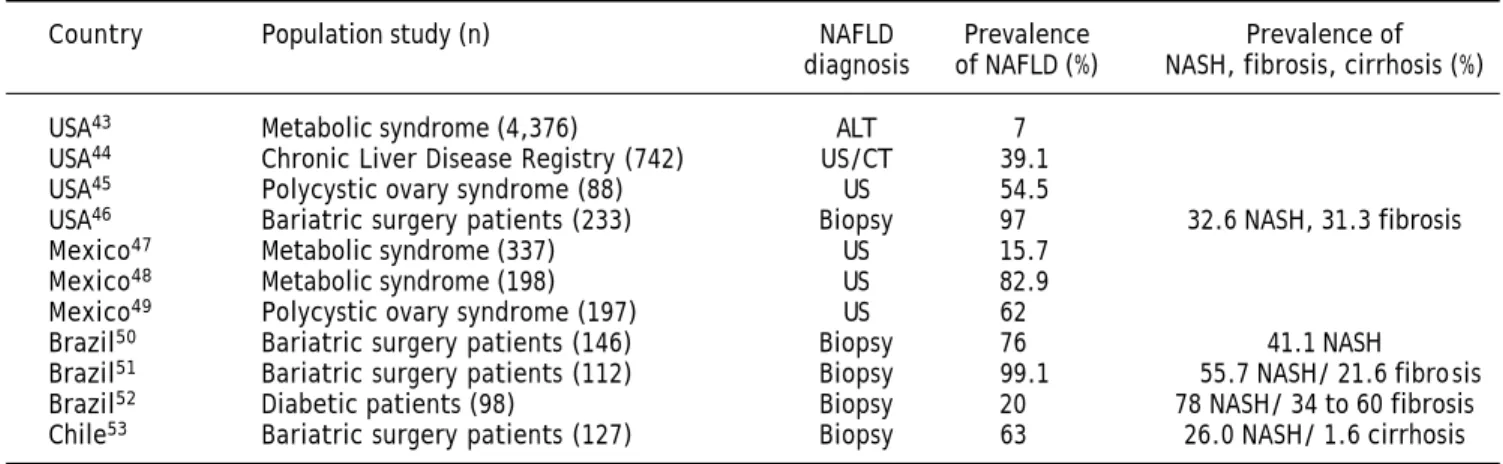
Table 2
43-53summarizes the results of several
stu-dies on the prevalence of NAFLD in high-risk
popu-lations by country. These studies show that the
prevalence is as high as 99% in groups with common
risk factors such as T2DM, obesity, and/or the MS,
and in specific high-risk groups such as those with
morbid obesity or polycystic ovary syndrome.
Studies of the prevalence of NAFLD in the
Ameri-cas have mainly used US to diagnose the disease in
large populations, whereas liver biopsy is mainly
restricted to high-risk populations. The available
data suggest that the prevalence of NAFLD is
in-creasing in this continent (Tables 1 and 2).
18,20NAFLD is a complex condition that involves ethnic,
genetic, and environmental factors that determine
its development and progression. The prevalence of
NAFLD increases with age and is highest in men
aged 40-65 years. There is some debate about whether
the prevalence is higher in men or women, but some
studies have found that NAFLD and NASH are more
common in men (Table 2). It is noteworthy that
fami-ly members of NAFLD patients have a higher risk of
developing NAFLD regardless of age and BMI.
27RISK FACTORS
Ethnicity
The population in the Americas is a complex mix
of human groups, especially in South America,
one of the most diverse regions in the world.
Ethnicity is an important predictor for chronic liver
disease complications and has a strong influence on
the response to treatment of chronic liver disease.
44NAFLD affects all ethnicities, although previous
studies have shown that Hispanics have a higher
prevalence of NAFLD than do African Americans or
Caucasians and that Hispanics may be considered
the ethnic group with the highest risk. This
increa-sed risk may reflect the higher rates of IR and
visce-ral adiposity at equivalent BMI in Hispanics
compared with other ethnic groups.
44,54,55A cohort study of 1,026 adults from several
eth-nic groups with biopsy-proven NAFLD studied the
severity of the disease. Latinos with NASH were
younger, performed less physical activity, had higher
carbohydrate intake, and were more than six times
more likely to have acanthosis nigricans compared
with non-Latino whites with NASH who had
Homeostasis Model of Assessment-IR as a
signifi-cant risk factor and a higher prevalence of
hyper-tension.
56These data suggest that NAFLD is more
prevalent among Hispanics individuals and less
pre-valent among African Americans.
19,30,44,54Genetics
Family and interethnic variation studies suggest
that genetic factors are important risk determinants
of the susceptibility to and severity of NAFLD
Table 2. Studies conducted on the prevalence of NAFLD in high risk populations in several countries across the Americas.
Country Population study (n) NAFLD Prevalence Prevalence of
diagnosis of NAFLD (%) NASH, fibrosis, cirrhosis (%)
USA43 Metabolic syndrome (4,376) ALT 7
USA44 Chronic Liver Disease Registry (742) US/CT 39.1
USA45 Polycystic ovary syndrome (88) US 54.5
USA46 Bariatric surgery patients (233) Biopsy 97 32.6 NASH, 31.3 fibrosis
Mexico47 Metabolic syndrome (337) US 15.7
Mexico48 Metabolic syndrome (198) US 82.9
Mexico49 Polycystic ovary syndrome (197) US 62
Brazil50 Bariatric surgery patients (146) Biopsy 76 41.1 NASH
Brazil51 Bariatric surgery patients (112) Biopsy 99.1 55.7 NASH/ 21.6 fibrosis
Brazil52 Diabetic patients (98) Biopsy 20 78 NASH/ 34 to 60 fibrosis
Chile53 Bariatric surgery patients (127) Biopsy 63 26.0 NASH/ 1.6 cirrhosis
(Table 3). Multiple polymorphisms in genes affecting
lipid metabolism, cytokine regulation, fibrotic
me-diators, and oxidative stress may be associated with
lipid content and with the development and
progres-sion of steatohepatitis and/or fibrosis.
57Interestingly, inherited factors play a major role
in the susceptibility to NASH. For example, the
rs738409 C/G single-nucleotide polymorphism of
pa-tatin-like phospholipase domain-containing 3
(PN-PLA3), which encodes the I148M protein variant,
was identified by a genome-wide approach as a
strong genetic determinant of liver fat content
inde-pendently of body mass, dyslipidemia, and IR. This
polymorphism also has been associated with NASH
and progressive fibrosis in patients with steatosis.
Several studies have shown that polymorphism in
the PNPLA3 gene predicts the extent of steatosis
in NAFLD. For example, a recent meta-analysis
estimated the strength of the effect of the I148
PNPLA3 variant on NAFLD and disease severity
across different populations. This meta-analysis
showed that rs738409 exerted a strong influence on
liver fat accumulation and on the susceptibility to
more aggressive disease.
58Other studies have investigated the association of
polymorphisms of glutamate-cysteine ligase and
mi-crosomal triglyceride transfer protein (MTP) genes
with NAFLD in Brazilian patients with
biopsy-pro-ven simple steatosis or NASH. The 493 G/T
poly-morphism in the MTP gene encodes the protein
responsible for transferring triglycerides to nascent
apolipoprotein B, and 129 C/T in the GCLC gene
en-codes the catalytic subunit of glutamate-cysteine
ligase in the formation of glutathione. The presence
of at least one T allele in the 129 C/T polymorphism of
the GCLC gene was independently associated with
NASH, whereas at least one G allele in the -493 G/T
polymorphism of the MTP gene differed slightly
bet-ween biopsy-proven NASH and simple steatosis.
These two polymorphisms could represent an
addi-tional factor for consideration when evaluating the
risk of NAFLD progression; however, further
stu-dies of larger populations are needed to confirm this
notion.
57The Insulin Resistance Atherosclerosis Family
Study (IRAS) quantified liver density with
compu-ted tomography and confirmed the association
bet-ween a PNPLA3 variant and NAFLD in Hispanic
Americans and African Americans. The rs738409
single-nucleotide polymorphism was strongly
asso-ciated with reduced liver density in Hispanic
Ame-ricans and African AmeAme-ricans. This study also
suggested that PNPLA3 contributes to the
diffe-rences in the risk of NAFLD between various
eth-nic groups.
58Recently, polymorphisms in the T-455C and
C-482T APOC3 promoter region have been reported to
predispose to dyslipidemia, insulin resistance, and
NAFLD in Indian subjects. In Caucasian patients
with NAFLD, APOC3 genotype is not associated
Table 3. Studies in the Americas on genetic modifiers of NAFLD.
Study Population Phenotype Participants (n) Genetic modifiers
Romeo, et al. US (mixed ethnicity) 1H-MRS-measured 2,051 (1,032 black; PNPLA3 (rs738409)
(2008) steatosis 636 white;
383 Hispanic)
Chalasani, et al. US (all female, Histologically- 236 FDFT1 (rs2645424)
(2010) European white characterized NAFLD COL13A1 (rs1227756)
ancestry) EFCAB4B (rs887304)
PZP (rs6487679)
Chromosome 7 (rs343062)
Speliotes, et al. US and European CT-measured 7,176 PNPLA3 (rs738409)
(2011) (meta-analysis steatosis NCAN (rs2228603)
of previous studies) GCKR (rs780094)
LYPLAL1 (rs12137855) PPP1R3B (rs4240624)
Oliveira, et al. Brazilian patients Histologically- 131 MTP (493) G/T
(2010) characterized
NAFLD and NASH
with progressive liver damage, but the
asso-ciation with liver damage in Hispanics has not
been evaluated.
59Several studies have been performed to investigate
the role of heritability in NAFLD and its
compli-cations. In a familial aggregation study, Schwimmer
et al. demonstrated that NAFLD is highly heritable.
They concluded that hepatic steatosis was
signifi-cantly more common in siblings (59%) and parents
(78%) of children with NAFLD. These data suggest
that familial factors are a major determinant of
whe-ther an individual develops NAFLD.
60Another
study, involving eight members of eight kindreds
with two or more patients with NASH and cryptogenic
cirrhosis found that the presence of NASH with or
without cryptogenic cirrhosis within these kindreds
suggested a possible genetic risk.
61Chalasani, et al. in a pilot genome-wide
associa-tion study of liver histology in non-Hispanic white
women with NAFLD, analyzed clinical, laboratory,
and histologic data. They found significantly
asso-ciated genetic variants with features of hepatic
his-tology in patients with NAFLD; however these
findings should be validated in larger and more
di-verse cohorts.
62Environmental and
lifestyle-related factors
Environmental and lifestyle-related factors such
as a low physical activity level and a high-fat diet
are associated with NAFLD development and are
re-lated to IR. The best predictors of NAFLD may be
BMI and waist circumference.
63The former seems to
have the strongest independent association with
NAFLD. In one study, although waist circumference
was a strong predictor of mortality in women,
ha-ving NAFLD, smoking, and BMI were independent
predictors of mortality in men.
64NAFLD is the hepatic manifestation of the MS.
In most NAFLD patients, the disease is mainly
asso-ciated with metabolic risk factors such as obesity
(75-95%),
4T2DM and/or IR (70%), and dyslipidemia
(50%).
19Up to two-thirds of patients with obesity
and T2DM present with hepatic steatosis.
65The central obesity phenotype is associated with
increased visceral fat content. The prevalence rates
of NAFLD and NASH in the morbidly obese have
been estimated to be as high as 91% and 37%,
res-pectively.
19,66Patients with central obesity are
cha-racteristically insulin resistant and present more
frequently with NAFLD than do patients with
lower-body obesity.
67IR and T2DM
IR and oxidative stress play an important role in
NAFLD development and progression. The high
con-centration of insulin may cause failure to suppress
fatty acid flux.
68-70The prevalence rates of NAFLD
and NASH in diabetic patients have been estimated
as 60-76% and 22%, respectively.
65,71IR is a major contributor to NAFLD, which is
why prevention is important. A cross-sectional
stu-dy in Chilean adults found that most people
diagno-sed with IR also had acanthosis nigricans and
concluded that acanthosis nigricans may be an early
marker of IR in this population.
72T2DM has been
shown to be an independent risk factor for chronic
liver disease in patients with NAFLD and is an
inde-pendent risk factor for cirrhosis and HCC.
Al-though most patients with simple fatty liver are not
at risk of death, they are at increased risk of
cardio-vascular disease, and fatty liver disease doubles the
risk of T2DM independently of the severity of liver
injury.
73According to data from the International
Diabe-tes Federation, North America and the Caribbean
region have the second highest prevalence of
diabe-tes: 10.7% of the adult population affected and an
in-cidence of 1 in 10 adults. Specifically, Puerto Rico,
Guyana, and Mexico have the highest prevalence of
diabetes in the Americas (Figure 1). The USA has
the most people –23.7 million– with diabetes
follo-wed by Mexico, Canada, and Haiti.
74The MS
NAFLD is the main hepatic manifestation of the
MS, and frequently coexists with obesity,
dyslipide-mia, and IR. The MS shares common mechanisms
with NAFLD development, and both form the
patho-physiological basis of IR. The MS is a common
com-plex entity with a high worldwide prevalence that
predicts, or is associated with, several diseases such
as T2DM, cancer, and NAFLD. About 90% of
NA-FLD patients have more than one MS component,
and one-third have the MS. There is no doubt that
NAFLD and the MS are strongly related, but not
all people with the MS will develop NAFLD, and
vice versa.
69,75,76Studies from the Latin American Group for the
Study of Metabolic Syndrome (GLESMO) tested
waist circumference as a diagnostic tool for
identi-fying people with visceral adiposity in Hispanics
from the Latin American region. The Latin
Ameri-can Diabetes Association suggested the use of the
International Diabetes Federation definition with
new Latin American criteria. However, for
epide-miological studies, it is advisable to also use the
Adult Treatment Panel (ATP) III criteria.
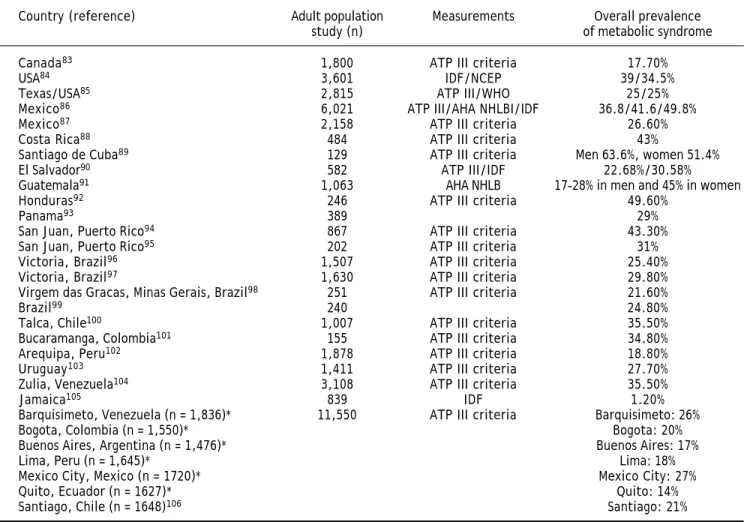
82Al-though there are insufficient data from all Latin
American countries, the available data show that the
prevalence of the MS is consistent between countries
and depends on the definition used, age ranges,
the proportion of men and women included in the
studies, and the type of population (urban, rural,
aboriginal) (Table 4).
82The general prevalence (weighted mean) of the
MS in Latin American countries is 24.9%. The MS
occurs slightly more frequently in women (25.3%)
than in men (23.2%), and the prevalence is highest
in people older than 50 years. The most frequent
components of the MS are a low blood high-density
lipoprotein cholesterol level (62.9%) and abdominal
obesity (45.8%).
Although several studies have reported the
preva-lence of the MS in Latin America, in most studies,
the MS was a secondary objective of the study.
Thus, the prevalence of this syndrome may not
reflect the real prevalence among the general
population.
Obesity
The extent of obesity correlates strongly with
NA-FLD prevalence and severity. Recent data show that
the prevalence of obesity in the Americas (23.5% in
males and 29.7% in females) is the highest in the
world. The Americas have the highest prevalence of
obesity in adults aged 20 years or more.
107The
trends between 1980 and 2008 indicated a rapid
in-crease in the prevalence of obesity, even in countries
with currently low rates.
The prevalence of obesity differs between ethnic
groups in the Americas. For example, non-Hispanic
Afro-Americans have the highest age-adjusted rates
of obesity (49.5%) compared with Mexican
Ameri-cans (40.4%), Hispanics (39.1%), and non-Hispanic
whites (34.3%).
108The Pan American Health Organization reports
that in Argentina, Colombia, Peru, Paraguay, and
Uruguay, more than 15% of the entire population is
obese. National comparative studies have found that
the prevalence of obesity in the adult population is
> 20% in 17 of 20 Latin American countries.
21In all
South American countries except for Brazil,
Argen-tina, Colombia, and Bolivia, > 50% of the
popula-tion is overweight.
21In Bolivia, Chile, Ecuador, and
Peru, 11-15% of the adolescent population is obese.
In this age group, obesity is more prevalent in
ur-ban areas and in areas with low socioeconomic
sta-tus. A summary of the data on the prevalence of
obesity in America (Figure 1) shows that the USA,
Figure 1. Prevalence of obesity and T2DM in the Americas. Diabetes prevalence data are from reference 74. Obesity prevalence
data from references 109-123. Obesity T2DM
Haiti Peru Colombia Honduras
Bolivia Brazil Guatemala Argentina
Ecuador
Nicaragua
Guyana
Paraguay Jamaica
Cuba
Uruguay Dominica Canada Panama El Salvador Costa Rica
Dominican Republic
Chile
Antigua and Barbuda
Puerto Rico
Trinidad and Tobago
Venezuela Bahamas
Mexico
Barbados
Belize
United States
Prevalenvce (%)
40
35
30
25
20
15
10
Mexico, Barbados, and Belize have the highest
pre-valence of obesity. Using the available data, several
projections have estimated that by 2030, there will
be 65 million more obese adults in the USA.
109Prevalence of NAFLD in the
Americas estimated from obesity rates
The largest increases in the prevalence of the MS
have occurred in the USA, Mexico, Costa Rica, Puerto
Rico, Chile, and Venezuela. Using information from
the Cardiovascular Risk Factor Multiple Evaluation in
Latin America (CARMELA)
106study, we confirmed
that Chile, Mexico, and Venezuela are countries with
a high prevalence of MS in Latin America.
Despite the relative lack of studies on the
epide-miology of NAFLD in emerging regions such as
La-tin America, we believe that the prevalence of
obesity-associated diseases such as NAFLD in the
Americas can be estimated from the prevalence rates
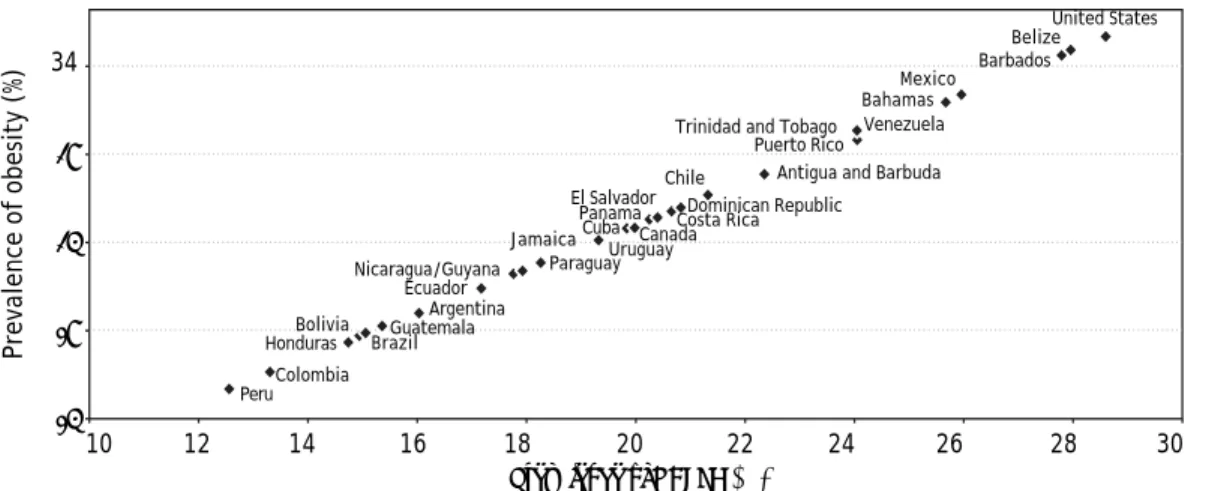
of obesity. Assuming that about 80% of obese
pa-tients might develop NAFLD, we predicted the
pre-valence for different countries, as shown in figure 2
and discussed below.
Based on the prevalence of obesity, the prevalence
rates of NAFLD are estimated as 26% in Mexico, 29%
in the USA, 15-20% in Central America, and 28% in
Belize and Barbados, which have high obesity
preva-lence. In South America, the prevalence of NAFLD
have been estimated as 24% in Venezuela and Chile,
20% in Uruguay, 18% in Guyana, Paraguay, and
Ecuador, and ≤ 16% in the other countries.
In summary, we found that the prevalence of
obe-sity and NAFLD in the Americas are highest in the
USA, Belize, Barbados, and Mexico.
Knowing the prevalence of NAFLD in the Americas
will help establish appropriate preventive measures
be-cause the early recognition and treatment of this disease
are critical given its important role in the development
and progression of cardiovascular disease.
Table 4. Prevalence of metabolic syndrome in the Americas.
Country (reference) Adult population Measurements Overall prevalence
study (n) of metabolic syndrome
Canada83 1,800 ATP III criteria 17.70%
USA84 3,601 IDF/NCEP 39/34.5%
Texas/USA85 2,815 ATP III/WHO 25/25%
Mexico86 6,021 ATP III/AHA NHLBI/IDF 36.8/41.6/49.8%
Mexico87 2,158 ATP III criteria 26.60%
Costa Rica88 484 ATP III criteria 43%
Santiago de Cuba89 129 ATP III criteria Men 63.6%, women 51.4%
El Salvador90 582 ATP III/IDF 22.68%/30.58%
Guatemala91 1,063 AHA NHLB 17-28% in men and 45% in women
Honduras92 246 ATP III criteria 49.60%
Panama93 389 29%
San Juan, Puerto Rico94 867 ATP III criteria 43.30%
San Juan, Puerto Rico95 202 ATP III criteria 31%
Victoria, Brazil96 1,507 ATP III criteria 25.40%
Victoria, Brazil97 1,630 ATP III criteria 29.80%
Virgem das Gracas, Minas Gerais, Brazil98 251 ATP III criteria 21.60%
Brazil99 240 24.80%
Talca, Chile100 1,007 ATP III criteria 35.50%
Bucaramanga, Colombia101 155 ATP III criteria 34.80%
Arequipa, Peru102 1,878 ATP III criteria 18.80%
Uruguay103 1,411 ATP III criteria 27.70%
Zulia, Venezuela104 3,108 ATP III criteria 35.50%
Jamaica105 839 IDF 1.20%
Barquisimeto, Venezuela (n = 1,836)* 11,550 ATP III criteria Barquisimeto: 26%
Bogota, Colombia (n = 1,550)* Bogota: 20%
Buenos Aires, Argentina (n = 1,476)* Buenos Aires: 17%
Lima, Peru (n = 1,645)* Lima: 18%
Mexico City, Mexico (n = 1720)* Mexico City: 27%
Quito, Ecuador (n = 1627)* Quito: 14%
Santiago, Chile (n = 1648)106 Santiago: 21%
The management of risk factors is extremely
im-portant for limiting the burden of NAFLD. The
pre-sent review brings us closer to an understanding of
the prevalence of NAFLD in the Americas. However,
it is not possible to know the full scope of the
pro-blem, partly because data from some countries are
not available and because methodological differences
between studies limit a combined analysis of their
results.
CONCLUSION
The prevalence of NAFLD in the Americas is
highest in the USA, Belize, Barbados, and Mexico.
the increasing prevalence of NAFLD in American
countries is likely to be linked to an increased
prevalence in obesity; this will present a challenge
in the coming years in terms of public health costs.
Efficient and well-planned preventive strategies
based on lifestyle modification and nutritional
interventions focused mainly on the pediatric
popu-lation should be implemented to reduce the disease
burden. This would likely reduce the impact on
health-service costs related to chronic liver disease
in these nations.
ABBREVIATIONS
•
1H MRS: proton magnetic spectroscopy.
•
BMI: body mass index.
•
CARMELA: Cardiovascular Risk Factor
Multi-ple Evaluation in Latin America.
•
HCC: hepatocellular carcinoma.
•
IR: insulin resistance.
•
MS: metabolic syndrome.
•
MTP: microsomal triglyceride transfer protein.
•
NAFLD: nonalcoholic fatty liver disease.
•
NASH: nonalcoholic steatohepatitis.
•
PNPLA3: patatin-like phospholipase
domain-containing 3 gene.
•
T2DM: diabetes mellitus.
•
US: ultrasound.
•
USA: United States of America.
REFERENCES
1. Chalasani N, Younossi Z, Lavine JE, Diehl AM, Brunt EM, Cusi K, Charlton M, et al. The diagnosis and management of non-alcoholic fatty liver disease: practice guideline by the American Association for the Study of Liver Diseases, American College of Gastroenterology, and the American Gastroenterological Association. Am J Gastroenterol 2012; 55: 2005-23.
2. de Alwis NM, Day CP. Non-alcoholic fatty liver disease: the mist gradually clears. J Hepatol 2008; 48: 104-12.
3. Available from: http://www.paho.org/hq/index.php? option=com_content&view=article&id=3501&Itemid=2391 (Interactive visualization of leading causes of deaths, Re-gion of the Americas 2009-2010, working age population 40-65 years).
4. Angulo P. Nonalcoholic fatty liver disease. N Engl J Med 2002; 346: 1221-31.
5. Méndez-Sánchez N, Arrese M, Zamora Valdés D, Uribe M. Current concepts in the pathogenesis of nonalcoholic fatty liver disease. Liver Int 2007; 27: 423-33.
6. Sanyal AJ, Banas C, Sargeant C, Luketic VA, Sterling RK, Stravitz RT, Shiffman ML, et al. Similarities and diffe-rences in outcomes of cirrhosis due to nonalcoholic steatohepatitis and hepatitis C. Hepatology 2006; 43: 682-9.
7. Ascha MS, Hanouneh IA, Lopez R, Tamimi TA, Feldstein AF, Zein NN. The incidence and risk factors of hepatocellular carcinoma in patients with nonalcoholic steatohepatitis. Hepatology 2010; 51: 1972-8.
Figure 2. Correlation between the prevalence of Obesity and NAFLD in the Americas. The graph was built with data from the
prevalence of obesity for each country; NAFLD prevalence was estimated assuming that about 80% of obese patients might
develop NAFLD4 in the Americas Countries.
Prevalence of obesity (%)
34
29
24
19
14
10 12 14 16 18 20 22 24 26 28 30
Prevalence of NAFLD (%)
United States Belize Barbados Mexico Bahamas Puerto Rico Trinidad and Tobago Venezuela
Antigua and Barbuda Chile
Dominican Republic Costa Rica El Salvador
Panama Canada Uruguay Cuba Jamaica
Paraguay Nicaragua/Guyana
Ecuador Argentina Guatemala Brazil Bolivia Honduras
8. Wieckowska A, Feldstein AE. Diagnosis of nonalcoholic fatty liver disease: invasive versus noninvasive. Semin Li-ver Dis 2008; 28: 386-95.
9. Obika M, Noguchi H. Diagnosis and evaluation of nonalco-holic fatty liver disease. Exp Diabetes Res 2012; 2012: 145754.
10. Browning JD, Szczepaniak LS, Dobbins R, Nuremberg P, Horton JD, Cohen JC, Grundy SM, et al. Prevalence of he-patic steatosis in an urban population in the United Sta-tes: impact of ethnicity. Hepatology 2004; 40: 1387-95. 11. Ryan CK, Johnson LA, Germin BI, Marcos A. One hundred
consecutive hepatic biopsies in the workup of living do-nors for right lobe liver transplantation. Liver Transpl 2002; 8: 1114-22.
12. Roldan-Valadez E, Favila R, Martínez-López M, Uribe M, Ríos C, Méndez- Sánchez N. In vivo 3T spectroscopic quantification of liver fat content in nonalcoholic fatty li-ver disease: correlation with biochemical method and mor-phometry. J Hepatol 2010; 53: 732-7.
13. Fishbein M, Castro F, Cheruku S, Jain S, Webb B, Gleason T, Stevens WR. Hepatic MRI for fat quantitation: its rela-tionship to fat morphology, diagnosis, and ultrasound. J Clin Gastroenterol 2005; 39: 619-25.
14. Feldstein AE, Wieckowska A, Lopez AR, Liu YC, Zein NN, McCullough AJ. Cytokeratin-18 fragment levels as noninva-sive biomarkers for nonalcoholic steatohepatitis: a multi-center validation study. Hepatology 2009; 50: 1072-8. 15. Milner KL, van der Poorten D, Xu A, Bugianesi E, Kench JG,
Lam KS, Chisholm DJ, et al. Adipocyte fatty acid binding protein levels relate to inflammation and fibrosis in nonal-coholic fatty liver disease. Hepatology 2009; 49: 1926-34. 16. Li H, Fang Q, Gao F, Fan J, Zhou J, Wang X, Zhang H, et al.
Fibroblast growth factor 21 levels are increased in nonal-coholic fatty liver disease patients and are correlated with hepatic triglyceride. J Hepatol 2010; 53: 934-40. 17. Ruhl CE, Everhart JE. Determinants of the association of
overweight with elevated serum alanine aminotransferase activity in the United States. Gastroenterology 2003; 124: 71-9.
18. Vernon G, Baranova A, Younossi ZM. Systematic review: the epidemiology and natural history of non-alcoholic fatty liver disease and non-alcoholic steatohepatitis in adults. Aliment Pharmacol Ther 2011; 34: 274-85. 19. Williams CD, Stengel J, Asike MI, Torres DM, Shaw J,
Contre-ras M, Landt CL, et al. Prevalence of nonalcoholic fatty liver disease and nonalcoholic steatohepatitis among a largely middle-aged population utilizing ultrasound and liver biopsy: a prospective study. Gastroenterology 2011; 140: 124-31. 20. Bellentani S, Scaglioni F, Marino M, Bedogni G.
Epidemiolo-gy of nonalcoholic fatty liver disease. Dig Dis 2010; 28: 155-61.
21. Aballay LR, Eynard AR, Díaz Mdel P, Navarro A, Muñoz SE. Overweight and obesity: a review of their relationship to metabolic syndrome, cardiovascular disease, and cancer in South America. Nutr Rev 2013; 71: 168-79.
22. Aballay LR, Osella AR, Celi A, Díaz M. Overweight and obe-sity: prevalence and their association with some social characteristics in a random sample population- based stu-dy in Córdoba city, Argentina. Obes Res Clin Pract 2009; 3: 75-83.
23. World Health Organization. The Global Health Observatory 2012. Available at: http://www.who.int/gho/en/ index.html
24. Cuevas A, Alvarez V, Olivos C. The emerging obesity pro-blem in Latin America. Expert Rev Cardiovasc Ther 2009; 7: 281-8.
25. Rivera JA, Barquera S, González-Cossío T, Olaiz G, Sepúlve-da J. Nutrition transition in Mexico and in other Latin American countries. Nutr Rev 2004; 62: 149-57.
26. Pan American Health Organization; Health in the Americas 2012. Available at: http://new.paho.org/saludenlasamericas. 27. Ratziu V, Bellentani S, Cortez-Pinto H, Day C, Marchesini
G. A position statement on NAFLD/NASH based on the EASL 2009 special conference. J Hepatol 2010; 53: 372-84. 28. Das K, Das K, Mukherjee PS, Ghosh A, Ghosh S, Mridha AR,
Dhibar T, et al. Nonobese population in a developing coun-try has a high prevalence of nonalcoholic fatty liver and significant liver disease. Hepatology 2010; 51: 1593-602. 29. Carrillo-Iregui A, Lopez-Mitnik G, Cossio S, Garibay-Nieto
N, Arheart KL, Messiah SE. Relationship between amino-transferases levels and components of the metabolic syn-drome among multiethnic adolescents. J Pediatr Endocrinol Metab 2010; 23: 1253-61.
30. Clark JM, Brancati FL, Diehl AM. The prevalence and etio-logy of elevated aminotransferase levels in the United Sta-tes. Am J Gastroenterol 2003; 98: 960-7.
31. Skelly MM, James PD, Ryder SD. Findings on liver biopsy to investigate abnormal liver function tests in the absence of diagnostic serology. J Hepatol 2001; 35: 195-9.
32. Lynne E. Correlates and heritability of nonalcoholic fatty liver disease in a minority cohort. Obesity (Silver Spring) 2009; 7: 1240-6.
33. Cotrim HP, Parise E, Oliveira, Leite N, Martinelli A, Galizzi J, De Cassia R, et al. Nonalcoholic fatty liver disease in Brazil: clinical and histological profile. Ann Hepatol 2011; 10: 33-7.
34. Perez M, Gonzáles L, Olarte R, Rodríguez NI, Tabares M, Salazar JP, Jaimes S, et al. Nonalcoholic fatty liver disease is associated with insulin resistance in a young Hispanic population. Prev Med 2011; 52: 174-7.
35. Lizardi-Cervera J, Laparra DI, Chavez-Tapia NC, Ostos ME, Esquivel MU. Prevalence of NAFLD and metabolic syn-drome in asymptomatic subjects. Rev Gastroenterol Mex 2006; 71: 453-9.
36. Riquelme A, Arrese M, Soza A, Morales A, Baudrand R, Pé-rez-Ayuso RM, González R, et al. Non-alcoholic fatty liver disease and its association with obesity, insulin resistan-ce and increased serum levels of C-reactive protein in His-panics. Liver Int 2009; 29: 82-8.
37. Lazo M, Hernaez R, Eberhardt MS, Bonekamp S, Kamel I, Guallar E, Koteish A, et al. Prevalence of nonalcoholic fatty liver disease in the United States: The Third National Health and Nutrition Examination Survey, 1988-1994. Am J Epidemiol 2013; 178: 38-45.
38. Minervini MI, Ruppert K, Fontes P, Volpes R, Vizzini G, de Vera ME, Gruttadauria S, et al. Liver biopsy findings from healthy potential living liver donors: reasons for disqualifi-cation, silent diseases and correlation with liver injury tests. J Hepatol 2009; 50: 501-10.
39. Karnikowski M, Córdova C, Oliveira RJ, Karnikowski MG, Nóbrega Ode T. Non-alcoholic fatty liver disease and me-tabolic syndrome in Brazilian middle-aged and older adults. Sao Paulo Med J 2007; 125: 333-7.
40. Matteoni L, Boente L, Soares D, Leal R, Campos F, César Araújo, D’Almeida F, et al. Nonalcoholic fatty hepatic di-sease: relevance of the diagnosis on abdominal ultra-sound. Gazeta Médica da Bahia 2011; 81: 7-9.
41. Parise ER, Salgado AL, Secaf R, Cerri L, Cerri G. Prevalen-ce of liver steatosis in abdominal ultrasound. GED 2003; 22: 235-7.
disease in asymptomatic Brazilian adolescents. World J Gastroenterol 2009; 15: 473-7.
43. Liangpunsakul S, Chalasani N. Unexplained elevations in alanine aminotransferase in individuals with the metabo-lic syndrome: results from the third National Health and Nutrition Survey (NHANES III). Am J Med Sci 2005; 329: 111-6.
44. Weston SR, Leyden W, Murphy R, Bass NM, Bell BP, Manos MM, Terrault NA. Racial and ethnic distribution of nonalco-holic fatty liver in persons with newly diagnosed chronic li-ver disease. Hepatology 2005; 41: 372-9.
45. Gambarin-Gelwan M, Kinkhabwala SV, Schiano TD, Bodian C, Yeh HC, Futterweit W. Prevalence of nonalcoholic fatty liver disease in women with polycystic ovary syndrome. Clin Gastroenterol Hepatol 2007; 5: 496-501.
46. Kunde SS, Lazenby AJ, Clements RH, Abrams GA. Spectrum of NAFLD and diagnostic implications of the proposed new normal range for serum ALT in obese women. Hepatology 2005; 42: 650-6.
47. Roesch-Dietlen F, Dorantes-Cuéllar A, Carrillo-Toledo MG, Martínez-Sibaja C, Rojas-Carrera S, Bonilla-Rojas QC, Uchino-Higueras V, et al. Frequency of NAFLD in a group of patients with metabolic syndrome in Veracruz, Mexico. Rev Gastroenterol Mex 2006; 71: 446-52.
48. Castro-Martínez MG, Banderas-Lares DZ, Ramírez-Martí-nez JC, Escobedo-de la Peña J. Prevalence of nonalcoholic fatty liver disease in subjects with metabolic syndrome. Cir Cir 2012; 80: 128-33.
49. Gutierrez-Grobe Y, Ponciano-Rodríguez G, Ramos MH, Uri-be M, Méndez-Sánchez N. Prevalence of non alcoholic fatty liver disease in premenopausal, postmenopausal and polycystic ovary syndrome women. The role of estrogens. Ann Hepatol 2010; 9: 402-9.
50. de Oliveira CP, de Mello ES, Alves VA, Saviero SM, Strauss E. Changes in histological criteria lead to different preva-lences of nonalcoholic steatohepatitis in severe obesity. Ann Hepatol 2007; 6(4): 255-61.
51. Lima ML, Mourao SC, Diniz MT, Leite VH. Hepatic histopa-thology of patients with morbid obesity submitted to gas-tric bypass. Obes Surg 2005; 15: 661-9.
52. Leite NC, Villela-Nogueira CA, Pannain VL, Bottino AC, Rezende GF, Cardoso CR, Salles GF. Histopathological sta-ges of nonalcoholic fatty liver disease in type 2 diabetes: prevalences and correlated factors. Liver Int 2011; 3: 700-6.
53. Boza C, Riquelme A, Ibañez L, Duarte I, Norero E, Viviani P, Soza A, et al. Predictors of nonalcoholic steatohepatitis (NASH) in obese patients undergoing gastric bypass. Obes Surg 2005; 15: 1148-53.
54. Petersen KF, Dufour S, Feng J, Befroy D, Dziura J, Dalla Man C, Cobelli C, et al. Increased prevalence of insulin re-sistance and nonalcoholic fatty liver disease in Asian-In-dian men. Proc Natl Acad Sci USA 2006; 103: 18273-77. 55. Caldwell SH, Harris DM, Patrie JT, Hespenheide EE. Is NASH
underdiagnosed among African Americans? Am J Gastroen-terol 2002; 97: 1496-500.
56. Bambha K, Belt P, Abraham M, Wilson LA, Pabst M, Ferrell L, Unalp-Arida A, et al. Ethnicity and nonalcoholic fatty li-ver disease. Hepatology 2012; 55: 769-80.
57. Daly AK, Ballestri S, Carulli L, Loria P, Day CP. Genetic de-terminants of susceptibility and severity in nonalcoholic fatty liver disease. Expert Rev Gastroenterol Hepatol 2011; 5: 253-63.
58. Sookoian S, Pirola CJ. Meta-analysis of the influence of I148M variant of patatin-like phospholipase domain contai-ning 3 genes (PNPLA3) on the susceptibility and
histologi-cal severity of nonalcoholic fatty liver disease. Hepatology 2011; 53: 1883-94.
59. Valenti L, Nobili V, Al-Serri A, Rametta R, Leathart JB, Za-ppa MA, et al. The APOC3 T-455C and C-482T promoter re-gion polymorphisms are not associated with the severity of liver damage independently of PNPLA3 I148M genotype in patients with nonalcoholic fatty liver. J Hepatol 2011; 55(6): 1409-14.
60. Schwimmer JB, Celedon MA, Lavine JE, Salem R, Campbell N, Schork NJ, Shiehmorteza M, et al. Heritability of nonalco-holic fatty liver disease. Gastroenterology 2009; 136: 1585-92.
61. Struben VM, Hespenheide EE, Caldwell SH. Nonalcoholic steatohepatitis and cryptogenic cirrhosis within kin-dreds. Am J Med 2000; 108: 9-13.
62. Chalasani N, Guo X, Loomba R, Goodarzi MO, Haritunians T, Kwon S, et al. Genome-wide association study identifies variants associated with histologic features of nonalcoho-lic Fatty liver disease. Gastroenterology 2010; 139(5): 1567-76.
63. Otgonsuren M, Stepanova M, Gerber L, Younossi ZM. An-thropometric and clinical factors associated with mortali-ty in subjects with nonalcoholic fatmortali-ty liver disease. Dig Dis Sci 2013; 58: 1132-40.
64. Bellentani S, Saccoccio G, Masutti F, Crocè LS, Brandi G, Sasso F, Cristanini G, Tiribelli C. Prevalence of and risk factors for hepatic steatosis in Northern Italy. Ann In-tern Med 2000; 132: 112-7.
65. Targher G, Bertolini L, Padovani R, Rodella S, Tessari R, Ze-nari L, Day C, et al. Prevalence of nonalcoholic fatty liver disease and its association with cardiovascular disease among type 2 diabetic patients. Diabetes Care 2007; 30: 1212-8.
66. Machado M, Cortez-Pinto H. NASH, insulin resistance and iron. Liver Int 2006; 26: 1159-62.
67. Stranges S, Dorn JM, Muti P, Freudenheim JL, Farinaro E, Russell M, Nochajski TH, et al. Body fat distribution, rela-tive weight, and liver enzyme levels: a population-based study. Hepatology 2004; 39: 754-63.
68. Samuel VT, Liu ZX, Qu X, Elder BD, Bilz S, Befroy D, Roma-nelli AJ, et al. Mechanism of hepatic insulin resistance in non-alcoholic fatty liver disease. J Biol Chem 2004; 279: 32345-53.
69. Green RM. NASH–hepatic metabolism and not simply the me-tabolic syndrome. Hepatology 2003; 38: 14-7.
70. Sanyal AJ, Campbell-Sargent C, Mirshahi F, Rizzo WB, Con-tos MJ, Sterling RK, Luketic VA. Nonalcoholic steatohepa-titis: association of insulin resistance and mitochondrial abnormalities. Gastroenterology 2001; 120: 1183-92. 71. Beymer C, Kowdley KV, Larson A, Edmonson P, Dellinger EP,
Flum DR. Prevalence and predictors of asymptomatic liver disease in patients undergoing gastric bypass surgery. Arch Surg 2003; 138: 1240-4.
72. Pinheiro AC, Rojas P, Carrasco F, Gómez P, Mayas N, Mo-rales I. Acanthosis nigricans as an indicator of insulin re-sistance in Chilean adult population. Nutr Hosp 2011; 26: 940-4.
73. Musso G, Gambino R, Cassader M, Pagano G. Meta-analy-sis: natural history of non-alcoholic fatty liver disease (NAFLD) and diagnostic accuracy of noninvasive tests for liver disease severity. Ann Med 2011; 43: 617-49.
74. International Diabetes Federation. IDF Diabetes Atlas, 5th edn. Brussels, Belgium: International Diabetes Federation, 2011. Available at: http://www.idf.org/diabetesatlas 75. Chitturi S, Farrell GC. Etiopathogenesis of nonalcoholic
76. Vanni E, Bugianesi E, Kotronen A, De Minicis S, Yki-Järvi-nen H, Svegliati-Baroni G. From the metabolic syndrome to NAFLD or vice versa? Dig Liver Dis 2010; 42: 320-30. 77. Yilmaz Y. NAFLD in the absence of metabolic syndrome:
different epidemiology, pathogenetic mechanisms, risk factors for disease progression? Semin Liver Dis 2012; 32: 14-21.
78. Grundy SM, Cleeman JI, Daniels SR, Donato KA, Eckel RH, Franklin BA, et al. Diagnosis and management of the me-tabolic syndrome: an American Heart Association/Natio-nal Heart, Lung, and Blood Institute Scientific Statement. Circulation 2005; 112: 2735-52.
79. Einhorn D, Reaven GM, Cobin RH, Ford E, Ganda OP, Han-delsman Y, Hellman R, et al. American College of Endocri-nology position statement on the insulin resistance syndrome. Endocr Pract 2003; 9: 237-52.
80. Alberti KG, Zimmet P, Shaw J. IDF. The metabolic syndrome-a new worldwide definition. Lancet 2005; 366: 1059-62.
81. Tillin T, Forouhi N, Johnston DG, McKeigue PM, Chaturvedi N, Godsland IF. Metabolic syndrome and coronary heart disease in South Asians, African-Caribbeans and white Europeans: a UK population-based cross-sectional study. Diabetología 2005; 48: 649-56.
82. Aschner P, Buendía R, Brajkovich I, Gonzalez A, Figuere-do R, Juarez XE, Uriza F, et al. Determination of the cu-toff point for waist circumference that establishes the presence of abdominal obesity in Latin American men and women. Diabetes Res Clin Pract 2011; 93: 243-7. 83. Riediger N, Clara I. Prevalence of metabolic syndrome in
the Canadian adult population. CMAJ 2011; 183: E1127-E1134.
84. Ford ES. Prevalence of the metabolic syndrome defined by the International Diabetes Federation among adults in the US. Diabetes Care 2005; 28: 2745-9.
85. Hunt KJ, Resendez RG, Williams K, Haffner SM, Stern MP. National Cholesterol Education Program versus Would Health Organization in relation to all cause and cardio-vascular mortality in the San Antonio Heart Study. Circu-lation 2004; 110: 1251-7.
86. Rojas R, Aguilar-Salinas CA, Jiménez-Corona A, Shamah-Levy T, Rauda J, Avila-Burgos L, Villalpando S, et al. Me-tabolic syndrome in Mexican adults. Results from the National Health and Nutrition Survey 2006. Salud Pub Mex 2010; 52: 11-8.
87. Aguilar-Salinas CA, Rojas R, Gómez-Pérez FJ, Valles V, Ríos-Torres JM, Franco A, Olaiz G, et al. High prevalence of metabolic syndrome in Mexico. Arch Med Res 2004; 35: 76-81.
88. Williams ES, Baylin A, Campos H. Adipose tissue arachido-nic acid and the metabolic syndrome in Costa Rican adul-ts. Clin Nutr 2007; 26: 474-82.
89. Araujo Y, Roque C, Escobar E, Abraham E. Caracteriza-ción del síndrome metabólico en pacientes de la provin-cial de Santiago de Cuba, año 2010. Rev Latinoamer Patol Clin 2013; 60: 96-10.
90. Juarez X, Benitez J, Quezada R, Cerritos R, Aguilar R. Prevalencia del síndrome metabólico en la población urba-na de San Salvador. Asociación latinoamericaurba-na de diabe-tes 2006; 19: 25-30. Available at: http:// revistaalad.com.ar/pdfs/060103.pdf
91. Gregory CO, Dai J, Ramirez-Zea M, Stein AD. Occupa-tion is more important than rural or urban residence in explaining the prevalence of metabolic and cardio-vascular disease risk in Guatemalan adults. J Nutr 2007; 137: 1314-9.
92. Hall J, Alvarenga M, Gómez O. Prevalence of hypertension in adults in El Progreso, Yoro, Honduras. Rev Med Hondur 2005; 73: 60-64. Available at: http://www.bvs.hn/RMH/ pdf/2005/pdf/Vol73-2-2005-2.pdf
93. DeBoer MD, Chen D, Burt DR, Ramirez-Zea M, Guerrant RL, Stein AD, Martorell R, et al. Early childhood diarrhea and cardiometabolic risk factors in adulthood: the Insti-tute of Nutrition of Central America and Panama Nutri-tional Supplementation Longitudinal Study. Ann Epidemiol 2013; 23: 314-20.
94. Pérez CM, Guzmán M, Ortiz AP, Estrella M, Valle Y, Pérez N, Haddock L, et al. Prevalence of the metabolic syndro-me in San Juan, Puerto Rico. Ethn Dis 2008; 18: 434-41. 95. Gomez M, Ramirez M, Disdier O. Prevalence of the
meta-bolic syndrome among a determined Puerto Rican popula-tion. P R Health Sci J 2006; 25: 111-6.
96. Marquezine GF, Oliveira CM, Pereira AC, Krieger JE, Mill JG. Metabolic syndrome determinants in an urban popula-tion from Brazil: social class and gender-specific interac-tion. Int J Cardiol 2008; 129: 259-65.
97. Salaroli LB, Barbosa GC, Mill JG, Molina MC. Prevalence of metabolic syndrome in population-based study, Vito-ria, ES-Brazil. Arq Bras Endocrinol Metabol 2007; 51: 1143-52.
98. Velásquez-Meléndez G, Gazzinelli A, Côrrea-Oliveira R, Pi-menta AM, Kac G. Prevalence of metabolic syndrome in a rural area of Brazil. Sao Paulo Med J 2007; 125: 155-62. 99. de Oliveira EP, de Souza ML, de Lima MD. Prevalence of
metabolic syndrome in a semi-arid rural area in Bahia. Arq Bras Endocrinol Metabol 2006; 50: 456-65.
100. Mujica V, Leiva E, Icaza G, Diaz N, Arredondo M, Moore-Carrasco R, Orrego R, et al. Evaluation of metabolic syn-drome in adults of Talca city, Chile. Nutr J 2008; 7: 14. 101. Pinzón JB, Serrano NC, Díaz LA, Mantilla G, Velasco HM,
Martínez LX, Millán PA, et al. Impact of the new definitions in the prevalence of the metabolic syndrome in an adult population at Bucaramanga, Colombia. Biomedica 2007; 27: 172-9.
102. Medina-Lezama J, Zea-Diaz H, Morey-Vargas OL, Bola-ños-Salazar JF, Muñoz-Atahualpa E, Postigo-MacDowall M, Corrales-Medina F. Prevalence of the metabolic syndrome in Peruvian Andean Hispanics: the PREVENCION study. Diabetes Res Clin Pract 2007; 78: 270-81.
103. Schettini C, Schwedt E, Moreira V, Mogdasy C, Chávez L, Bianchi M, et al. Prevalencia del síndrome metabólico en una población adulta. Rev Urug Cardiol 2004; 19: 19-28. Available at: http://www.scielo.edu.uy/scielo.php? script=sci_arttext&pid=S0797-00482004000100003 &lng=es
104. Florez H, Silva E, Fernández V, Ryder E, Sulbarán T, Cam-pos G, Calmón G, et al. Prevalence and risk factors asso-ciated with the metabolic syndrome and dyslipidemia in white, black, Amerindian and mixed Hispanics in Zulia Sta-te, Venezuela. Diabetes Res Clin Pract 2005; 69: 63-77. 105. Ferguson T, Tulloch-Reid M, Younger N, Knight-Madden J,
Samms-Vaughan M, Ashley D, Broeck J, et al. Prevalence of the metabolic syndrome and its components in rela-tion to socioeconomic status among Jamaican young adults: a cross-sectional study. BMC Public Health 2010; 10: 307.
107. World Health Organization. World health statistics 2013. Available at: http://apps.who.int/iris/bitstream/10665/ 81965/1/9789241564588_eng.pdf
108. Flegal KM, Carroll MD, Kit BK, Ogden CL. Prevalence of obesity and trends in the distribution of body mass index among US adults, 1999-2010. JAMA 2012; 307: 491-7. 109. Wang YC, McPherson K, Marsh T, Gortmaker SL, Brown M.
Health and economic burden of the projected obesity trends in the USA and the UK. Lancet 2011; 378: 815-25. 110. Gotay CC, Katzmarzyk PT, Janssen I, Dawson MY,
Ami-noltejari K, Bartley NL. Updating the Canadian obesity maps: an epidemic in progress. Can J Public Health 2012; 104: 64-8.
111. Ogden CL, Carroll MD, Kit BK, Flegal KM. Prevalence of obesity among adults: United States, 2011-2012. NCHS Data Brief 2013; 131: 1-8.
112. ENSANUT 2012. Available at: http://ensanut.insp.mx/in-formes/ENSANUT2012ResultadosNacionales.pdf
113. Health in the Americas 2012. Available at: http:// w w w . p a h o . o r g / s a l u d e n l a s a m e r i c a s / i n d e x . p h p ? option=com_content&view=article&id=9&Itemid=14& lang=en
114. Brathwaite N, Brathwaite A, Taylor M. The socio-econo-mic determinants of obesity in adults in the Bahamas. West Indian Med J 2011; 60: 434-41.
115. World Health Organization, NCD Country Profiles 2011. Available at: http://www.who.int/nmh/publications/ ncd_profiles_report.pdf
116. Panamerican Health Organization. Encuesta de Diabetes, hipertensión y factores de riesgo de enfermedades cró-nicas, San José, Costa Rica 2009. Available at: http:// www.paho.org/hq/index.php?option=com_docman&task =doc_view&gid=16262&Itemid=
117. Morejóng A, Rodríuez M, Díez E, García D, Salas V, Ordúñez P. Metabolic syndrome in a health area of Cienfuegos. CARMEN Second Measurement. Finlay 2011; 1: 6-14.
118. Estudio Factores de Riesgo Cardiovascular y Síndrome Metabólico (Efricard II). Available at: http:// saludfunglode.org/documentos/efricard-2.pdf
119. Cardone A, Borracci R, Milin E. Estimación a largo plazo de la prevalencia de obesidad en la Argentina. Rev Ar-gent Cardiol 2010; 78: 23-9.
120. Navía O, Caballero D, Flores J, Gutiérrez V, Ramírez W. Prevalencia de factores de riesgo asociado a diabetes mellitus tipo 2 en población mayor de 20 años en los servi-cios de salud de II y III nivel del área urbana y rural en Bolivia. 2007. Cuad Hosp Clin 2007; 52: 53-58. Available at: http://www.revistasbolivianas.org.bo/scielo.php? script=sci_arttext&pid=S1652-67762007000200008& lng=es
121. Ministerio de Salud Chile. Resultados de la Encuesta na-cional de enfermedades. 2009-2010. MINSAL 2010. Avai-lable at: http://epi.minsal.cl/wp-content/uploads/2012/ 07/InformeENS_2009-2010_CAP1.pdf
122. Encuesta Nacional de la Situación Nutricional en Colombia 2010 (ENSIN). Available at: http://www.icbf.gov.co/por-tal/page/portal/Descargas1/Resumenfi.pdf