Interferon-based therapy delays but metabolic comorbidity
accelerates progression of chronic hepatitis C
Roberto F. Martínez-Macías,* Paula Cordero-Pérez,* Omar A. Juárez-Rodríguez,* Carlos Y. Chen-López,* Francisco M. Martínez-Carrillo,* Gabriela Alarcón-Galván,**
Roberto Mercado-Hernández,*** Linda E. Muñoz-Espinosa*
* University Hospital, Liver Unit, UANL. Monterrey, Nuevo León, Mexico. ** University Hospital, Pathology Service, UANL. Monterrey, Nuevo León, Mexico. *** Informatics Department, UANL School of Biology. Monterrey, Nuevo León, Mexico.
ABSTRACT
Background. We compared mortality and complications of chronic hepatitis C between treated and un-treated Mexican patients after long-term follow-up. We used a time-to-event analysis and identified the prognostic factors. Material and methods. Seventy-four patients with chronic hepatitis C were studied. They were ≥ 18 years of age and had a molecular diagnosis of chronic hepatitis C and ≥ 6 months of fol-low-up. Patients with neoplasia or those infected with human immunodeficiency virus or hepatitis B Virus were excluded. Kaplan-Meier analysis, log-rank test, annualized incidence per 100 person-years, and step-wise discriminant analysis were used to analyse mortality and complications. Results. The end-point of an-nualized incidence was lowest in sustained virological responders, intermediate in non-responders, and highest in untreated patients. The absence of treatment impacted adversely on cirrhosis development and the occurrence of portal hypertension and hepatic decompensation/hepatocellular carcinoma (log-rank, p < 0.05). Diabetes impacted adversely on liver-related death/liver transplantation among un-treated patients. Stepwise discriminant analysis showed that diabetes, high blood pressure, and no retreatment predicted cirrhosis development (eigenvalue ≥ 0.8; p < 0.05). A MELD score ≥ 18 and age ≥ 50 years predicted hepatic decompensation/hepatocellular carcinoma (eigenvalue < 0.8; p < 0.05). APRI ≥ 1.5 predicted mortality/liver transplantation and liver-related death/liver transplantation (eigenvalue < 0.8; p < 0.05). Conclusions. This is the first long-term study of chronic hepatitis C among Mexican patients. Treated patients showed less progression of liver disease. Treated patients showed less progression of liver disease; and older patients, those with metabolic comorbidities, with MELD score ≥ 18 and APRI ≥ 1.5 exhibited adverse effects.
Key words. Hepatic disease. Longitudinal follow-up. Diabetes mellitus. Hepatic decompensation. Hispanics.
Correspondence and reprint request: Linda Elsa Muñoz-Espinosa, MD, PhD.
Liver Unit, Department of Internal Medicine, “Dr. Jose E González” University Hospital, Monterrey, Nuevo León, C.P. 64460, México
Tel.: (52) 8183294205. Fax (52) 8189894088 E-mail: [email protected]
Manuscript received: June 04, 2014. Manuscript accepted: August 09, 2014.
INTRODUCTION
Globally, up to 170 million people are estimated to have chronic hepatitis C virus (HCV) infection.1
Once HCV-related cirrhosis has developed, the an-nual incidence of clinical decompensation, death or liver transplantation (LT), and hepatocellular carci-noma (HCC) among untreated patients or
non-re-sponders (NRs) to antiviral therapy (AT) with chronic hepatitis C (CHC) is ~4%, ~3%, and ~3% per year, respectively.2-7 A sustained virological
re-sponse (SVR) is associated with improved overall survival,2,5 reduced risk of morbidity and liver
fail-ure, and improved quality of life.8 The relationship
between AT and long-term viral suppression depends on host, viral, and on-treatment factors.9
Intermediate benefits of AT on patient outcomes and the natural history of disease are also present in NRs.5,10 Any duration of AT for HCV was
associ-ated with a lower risk of mortality in a large nation-al sample of HCV-infected people.10 In Mexico, the
CHC incidence is rising,11 and its prevalence and
percentage of patients with genotype (G) 1 are 1.2-1.5%12 and ~70%,13 respectively. Hispanic patients
long-term follow-up in treated Mexican patients with CHC. The aim of this study was to compare mortali-ty and clinical complications of CHC between treat-ed and untreattreat-ed Mexican patients. We developtreat-ed a time-to-event analysis and identified the prognostic factors.
MATERIAL AND METHODS
Study design, participants, and setting
We conducted a dynamic, retrospective, compara-tive cohort study at the Liver Unit of Dr. José Eleu-terio González University Hospital, Universidad Autónoma de Nuevo León (UANL), the main terti-ary centre treating patients with liver diseases in north-east Mexico. Medical records of patients with CHC admitted from 1987 onwards were reviewed; 310 of > 500 patients were studied and 134/310 (43%) were eligible. Reasons for the exclusion of the remaining 176 (57%) patients were: < 6 months of follow-up (n = 131, 42%), non-molecular diagnosis of CHC (n = 21, 7%), occurrence of mortality or LT during the first 6 months of follow-up (n= 5, 2%), ALD (n = 5, 2%), neoplasia (n = 5, 2%), HIV (n = 2, 1%), HBV (n = 2, 1%), AIH ( n = 4, 1%), <18 years old at baseline (n = 1, 1%). There were two inception cohorts: patients exposed to AT (RxG) (n = 67) and those not exposed to AT (noRxG) (n = 67). Nevertheless, over the 134 eligible patients, cir-rhosis and hepatic decompensation were more com-monly found among noRxG than RxG patients (57%, 44% vs 40%, 13%, respectively), therefore only 74 patients were included in this study, in order to pro-vide baseline comparability and to avoid membership bias. RxG patients were treated according to the guidelines at the time. Reasons for not fulfilling therapy were too-advanced liver disease (n = 12, 32%), medical contraindications (n = 9, 24%), refus-al to receive AT (n = 12, 32%), < 12 weeks of AT be-cause of adverse events (n = 2, 5%), and lack of financial support (n = 2, 5%). Follow-up started when RxG received their first AT and at their first medical interview for noRxG; all variables were con-current with each start point. Inclusion criteria were aged ≥ 18 years, CHC diagnosis by HCV polymerase chain reaction (PCR) and/or HCV G, and medical management in this unit for ≥ 6 months. The exclusion criteria were coexistent ma-lignant neoplasia, hepatitis B or HIV infection, alco-holic liver disease, autoimmune hepatitis (excluding probable and definite cases according to the revised score of the International Autoimmune Hepatitis
Group [R-IAIHG]), or drug-induced liver disease. Table 1 summarizes the baseline characteristics of the two groups. The protocol was approved by the UANL Medical School Institutional Review Board, and was complied with the Helsinki Declaration.
Clinical and laboratory assessment
The baseline variables recorded were: demograph-ics; AT type; comorbidities (diabetes mellitus [DM], dyslipidaemia, liver steatosis [LS]); alcohol abuse history; liver-related complications (cirrhosis, portal hypertension [PH]; gastro-oesophageal varices [GEV]; a history of ascites or gastro-intestinal bleeding secondary to PH [GIBsPH] and/or encepha-lopathy); body mass index (BMI); biochemical, hae-matological, and serological tests; α-fetoprotein (AFP) level; imaging study results; endoscopic fea-tures; and fibrosis stage (liver biopsy, non-invasive methods). In eight patients, the G was not available. Viral load (VL) values not expressed in IU/mL were converted using the conversion factor of Pawlosky,
et al.14 Liver enzyme levels were expressed in IU/L
and AFP in ng/mL. RxG on-treatment follow-up was performed in weeks 4, 12, 24, and 48, and then 24 weeks after AT (24postAT). Imaging studies were performed and AFP level was measured every 6 months in cirrhotic patients. AT adverse events were recorded in a predefined fashion. Follow-up times were computed as the difference in months between the cirrhosis diagnosis date and the date of attrition, end of follow-up (21 April, 2013), and/or each end-point occurrence date. For mortality/LT, liver-related death (LRD)/LT, and cirrhosis, the time-to-event analysis considered the date of occur-rence minus each cohort’s follow-up starting point. Whenever a non-cirrhotic patient developed cirrho-sis, a clock-reset approach was used; the follow-up was censored for non-cirrhotic status when cirrho-sis was diagnosed, the follow-up of the cirrhotic patient was reset to zero, and the case was restarted as a new case. The same assessment features recorded at baseline were recorded during the last visit for a medical consultation.
Definition of end-points and baseline features
End-points were primary outcomes: mortality/LT and LRD/LT, and secondary outcomes: occurrence of cirrhosis, PH, HCC and the composite event of clinical decompensation defined as D’Amico, García-Tsao stage progression (DAGTP)15 and HCC,
Fibrosis stage was defined by METAVIR whenev-er a livwhenev-er biopsy was available (n = 53) and by non-invasive tests (FibroTest, FibroScan or aspartate transaminase-to-platelet ratio index [APRI] results
n = 11), and/or clinical criteria (fibrosis stage F4) (n = 10). International definitions to classify PH,16
HCC,17 ascites, HRS, SBP,18 GEV, GIBsPH,19 and
encephalopathy20 were used. DAGTP from stage 1-2
Table 1. Baseline features of the cohort.
Total (%) RxG (%) noRxG (%) p
n 74 (100) 37 (100) 37 (100)
-Age ± SD 49 ± 12 46 ± 10 51 ± 14 0.025
Gender
F/M 44/30 (60/40) 24/13 (65/35) 20/17 (54/46) 0.593
Fibrosis stage
F0-F2 25 (34) 11 (30) 14 (38) 0.595
F3 11 (15) 7 (19) 4 (11) 0.172
F4 38 (51) 19 (51) 19 (51) 0.592
D’amico, García-Tsao in cirrhotics
Stages 1 & 2 23 (61) 12 (63) 11 (58) 0.500
Stage 3 & 4 15 (39) 7 (37) 8 (42)
BMI + SD 28 ± 9 27 ± 8 28 ± 10 0.926
> 30 kg/m2 19 (28) 10 (29) 9 (27) 0.618
HCV RNA (UI/mL) ± SD 842,629 ± 1,432,718 938,938 ± 1,879,569 743,310 ± 781,117 0.740 HCV RNA (log/mL) ± SD 5.9 ± 6.1a 6 ± 6.2 e, b 5.9 ± 5.9 c, d, e
HCV RNA > 600,000 UI/mL 25 (36) 11 (31) 14 (41) 0.592
HCV genotype
G1 50 (68) 22 (59) 28 (76) 0.007
G 2, 3, 4 16 (22) 14 (38) 2 (5)
Non available 8 (10) 1 (3) 7 (19)
Child-Pugh in cirrhotics
A/B/C 26/11/0(68/29/0)f 14/4/0 (74/21/0)f 12/7/0 (63/37/0) 0.050
MELD > 18 in cirrhotics 2 (5) 2 (11) 0 0.247
High blood pressure 14 (19) 4 (11) 10 (27) 0.117
Diebetes mellitus 14 (19) 4 (11) 10 (27) 0.117
Dyslipidemia 7 (10) 3 (8) 4 (11) 0.500
Liver steatosis 17 (23)f 11 (31)f 6 (16) 0.270
History of alcohol abuse 9 (12) 5 (14) 4 (11) 0.375
Blood transfusion before 1992/IV 51/6/4/26 22/2/3/13 29/4/1/13
drugs/tattoos/other (69/8/5/35) (59/5/8/35) (78/11/3/5) 0.300
ALT (UI/L) 116 ± 92g 125 ± 104f 107 ± 79f 0.665
AST (UI/L) 113 ± 75g 116 ± 73g 109 ± 77 0.884
Platelet count, x 109/L in cirrhotics 150 ± 83 154 ± 63 146 ± 106 0.045
APRI ≥ 1.5 in cirrhotics 24 (63) 11 (58) 13 (68) 0.297
Interferon α standard alone 6 (8) 6 (16) -
-Interferon α standard or
natural Interferon + ribavirin 11 (15) 11 (30) -
-PegInterferon α 2a/b + ribavirin 20 (27) 20 (54) -
-a 5, b 2, and c 3, patients had qualitative rather than quantitative HCV PCR, respectively. d 2 patients had VL below LLOQ (range 1,000-1,800 UI/mL) but
either had HCV genotype and/or qualitative HCV PCR (+). e One patient had HCV viral load above upper limit of quantification. f 1 and g 2,patients did not
to 3-4 was assessed by the date of onset of the perti-nent secondary outcomes and/or jaundice (direct bi-lirubin ≥ 2.50 mg/dL). Patients were not censored according to previous secondary outcomes. Patients were censored if they were lost to follow-up and if they received LT before developing any end-point.
The baseline features studied included history of alcohol abuse defined as an alcohol consumption of > 60 g/day in men and > 40 g/day in women (no patient had alcohol abuse at the baseline), DM, high blood pressure (HBP), and dyslipidaemia as defined by expert committee criteria21 or mention of
their diagnosis and current treatment in the pa-tient’s history. SVR was defined as the absence of VL at 24postAT9 according to the lower limit of
quanti-fication (LLOQ) or lower limit of detection available at that time. LS was identified according to the cri-teria of Chalasani, et al.22 Any event that happened
within the first 6 months of follow-up was framed as a baseline feature.
Statistical analysis
Sample size was determined in a non-probabilistic fashion. Baseline features were compared using the χ2
test (categorical) or Student’s t test (continuous). Inci-dence rates per 100 person-years (p100py) of primary and secondary outcomes were calculated along with 95% confidence intervals (CIs).23 Kaplan-Meier
cumu-lative incidence analysis, grouped by end-point status (1 = present; 2 = absent), and log-rank post hoc test-ing were applied for the time-to-event analysis. Step-wise discriminant analysis (SDA) was performed to predict the profile and number of patients presenting with each of the 13 end-points at the end of follow-up: end-point present or end-point absent.24,25 Variables
were selected for this analysis because they are alleged predictors of a favourable or unfavourable outcome of CHC. They were entered as binary predictor variables, with values corresponding to those registered at the end of follow-up. Statistical tests were done using SPSS v.19 and online resources.23
RESULTS
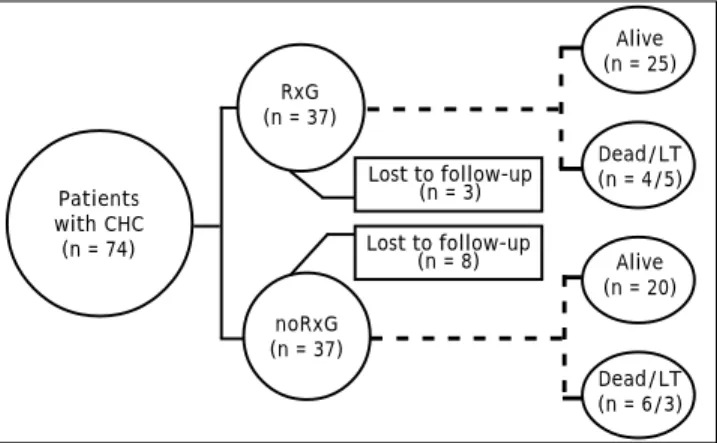
The median follow-up was 83 (6-195) months: 82 (6-178) and 84 (10-195) months in RxG and noRxG, respectively. In RxG, AT reached 48 weeks (n = 26 G1) and 24 weeks (n = 13 non-G1). AT was not completed because of treatment failure (n = 6) and stroke at week 43 of AT (n = 1, G1). One G1 patient who completed 48 weeks of AT did not achieve 24po-stAT because of LT. SVR was achieved by 13 (35%). Despite retreatment, no treatment-experienced pa-tient (n = 6) became HCV RNA negative. Around 15% of all patients were lost to follow-up: RxG, n = 3 (8%) and noRxG, n = 8 (21%) (Figure 1).
Table 2. End-point annualized incidence according to antiviral treatment status.
Overall patients RxG noRxG
End-pointsa SVR NR
Rate (95% CI) Rate (95% CI) Rate (95% CI) Rate (95% CI)
Mortality/LT 6.4 (3.9–9.9) 0.7 (0.03–3.5) 5.5 (2.5–10.4) 3.4 (1.7–6.1)
Non-LRD 0.7 (0.1–2.3) – 0.6 (0.03–3.1) 0.3 (0.02–1.7)
LRD/LT 5.7 (3.3–9.1) 0.7 (0.03–3.5) 4.8 (2.1–9.5) 3.1 (1.5–5.6)
DAGTP/HCC 4.2 (2.3–7.2) – 5.2 (1.6–12.4) 11.1 (5.1–21.1)
Cirrhosis 4.2 (1.8–8.4) 1.34 (0.06–6.6) 3.3 (0.16–16.4) 11.1 (4.1–24.6) PHb 9.2 (5.6–16.4) 11.0 (1.9–38.9) 11.0 (3.4–25.7) 46.2 (18.7–96)
HCC 3.6 (1.5–7.1) – 3.0 (0.5–10.0) 4.2 (1.5–9.3)
a All complications except cirrhosis, mortality/LT, and LRD/LT were studied from the time of cirrhosis diagnosis onwards. b Portal hypertension was diagnosed
as splenomegaly (n = 7), ascites (n = 3), and gastro-oesophageal varices (n = 1). Figure 1. Patient follow-up. CHC: chronic hepatitis C. RxG: exposed to antiviral therapy. noRxG: unexposed to antiviral treatment. LT: liver transplantation.
RxG (n = 37)
Patients with CHC
(n = 74)
noRxG (n = 37)
Lost to follow-up (n = 3)
Alive (n = 25)
Dead/LT (n = 4/5)
Alive (n = 20)
Dead/LT (n = 6/3) Lost to follow-up
Cirrhosis development
During follow-up, in the non-cirrhotic patients at baseline, 2/18 (11%) in RxG and 5/18 (28%) in noRxG developed cirrhosis. Annual incidence p100py was 3.3 times greater in noRxG than in NRs and 8.2
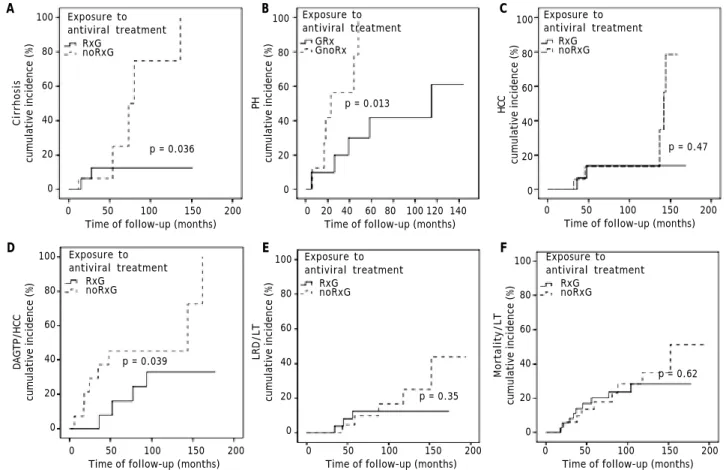
times greater in noRxG than in those with SVR (Table 2). Kaplan–Meier cumulative incidence of cirrhosis in years 6, 8, 10, and 13 remained at 13% in RxG, but increased from 25% to 75% to 100% in years 6, 8, and 11 in noRxG (log-rank p = 0.036) (Figure 2A).
Table 3. Endpoint occurrences at the end of follow-up.
Total, n (%) RxG, n (%) noRxG, n (%)
Portal hypertension 11/19 (58) 5/10 (50) 6/9 (67)
D’Amico, García-Tsao progression 8/38 (21) 3/14 (21) 5/14 (36)
D’Amico, García-Tsao progression/Hepatocellular carcinomaa 12/28 (43) 4/14 (21) 8/14 (57)
Ascites 9/33 (28) 4/17 (24) 5/16 (31)
Gastro-intestinal bleeding secondary to portal hypertension 5/41 (12) 3/20 (15) 2/21 (10)
Encephalopathy 10/43 (23) 5/21 (24) 5/22 (23)
Hepatorenal syndrome 3/45 (7) 1/21 (5) 2/24 (4)
Spontaneous bacterial peritonitis 2/45 (4) 1/21 (5) 1/24 (4)
Hepatocellular carcinoma 7/45 (16) 2/21 (10) 5/24 (21)
Death/liver transplantation b 18/74 (24) 9/37 (24) 9/37 (24)
a Appeared as ascites (n = 2), GIBsPH (n = 1), and HCC (n = 1) in the RxG and as ascites (n = 4), jaundice (n = 1), and HCC n = 3) in the noRxG. b Causes of
liver-related death were encephalopathy (n = 2), HRS (n = 2), HCC (n = 1), GIBsPH (n = 3), LT (n = 8), non-liver liver-related (n = 2), heart disease (n = 1) and DM (n = 1). Figure 2. Comparison by log-rank test between RxG and noRxG: A. Cirrhosis. B. Portal hypertension (PH). C. Hepatocellular carcinoma (HCC). D. D’Amico, García-Tsao progression/hepatocellular carcinoma (DAGTP/HCC). E. Liver-related death (LRD)/ Liver transplantation (LT). F. Mortality/LT.
A B C
D E F
Cirrhosis
cumulative incidence (%)
100
80
60
40
20
0
0 50 100 150 200 Time of follow-up (months)
PH
cumulative incidence (%)
100
80
60
40
20
0
0 20 40 60 80 100 120 140 Time of follow-up (months)
HCC
cumulative incidence (%)
100
80
60
40
20
0
0 50 100 150 200 Time of follow-up (months) Exposure to
antiviral treatment RxG
noRxG
p = 0.036
Exposure to antiviral treatment
GRx GnoRx
p = 0.013
Exposure to antiviral treatment
RxG noRxG
p = 0.47
Exposure to antiviral treatment
RxG noRxG
Exposure to antiviral treatment
RxG noRxG
Exposure to antiviral treatment
RxG noRxG
0 50 100 150 200 Time of follow-up (months)
0 50 100 150 200 Time of follow-up (months)
0 50 100 150 200 Time of follow-up (months)
DAGTP/HCC
cumulative incidence (%)
100
80
60
40
20
0
LRD/LT
cumulative incidence (%)
100
80
60
40
20
0
Mortality/LT
cumulative incidence (%)
100
80
60
40
20
0 p = 0.039
p = 0.35
Cirrhosis-related secondary outcomes
The time-to-event sub-analysis stratified several factors related to AT as shown in table 3 and figures 2B-2F. Only PH and DAGTP/HCC in RxG vs noRxG were significant by the log-rank test (p < 0.05).
The rates of PH, DAGTP/HCC, and HCC annual incidences p100py were 4.2, 1.7, and 1.4 times high-er, respectively, in noRxG than in NRs (Table 2). No patients with SVR experienced any of these, except for PH (11 p100py) (Table 2).
Mortality, LRD, and LT
Mortality/LT reached 18/74 (24%) at the end of follow-up and was 9/37 (24%) in both groups. LRD occurred in 3/37 patients (8%) in RxG and in 5/37 patients (14%) in noRxG. Mortality/LT and LRD/LT Annual incidences p100py were more common in RxG than noRxG (Table 2). Kaplan-Meier cumula-tive incidence estimates were not significant for mortality/LT (p = 0.62) or LRD/LT (p = 0.35) in the RxG and noRxG (Figures 2E and 2F).
Discriminant analysis
PH and DAGTP sub-analyses did not qualify for SDA (F value to enter < 3.84 or overfitting). Six variables separated the two subgroups according to their end-point occurrence (present/absent) (p < 0.05). Mortality/LT and LRD/LT were predicted by
APRI ≥ 1.5; cirrhosis by DM, HBP, and no retreat-ment; DAGTP/HCC was predicted by model of end-stage liver disease (MELD) ≥ 18 and age ≥ 50 years (Table 4). Predictor subsets with the highest power to predict prognosis had eigenvalues > 0.8. These subsets included retreatment (Wilks’ λ = 0.534; p < 0.001); HBP (Wilks’ λ = 0.643; p = 0.001); and DM (Wilks’ λ = 0.754; p = 0.002) in the cirrhosis model. Age ≥ 50 years (Wilks’ λ = 0.670; p = 0.001) and MELD ≥ 18 (Wilks’ λ = 0.839; p = 0.001) were significant in the DAGTP/HCC model. Despite a high positive predictive value (PPV) of > 80%, only the cirrhosis model had high sensitivity (> 85%) and predicted membership with classification accu-racy > 25% compared with classification by chance. All other models had p < 0.05 and PPV > 80% but lower sensitivity, classification accuracy < 25%, eigenvalues < 0.80, and high variability of their predictors (Wilks’ λ > 0.2).
Comparison of end-points in patients with and without DM
DM was present in 14/74 patients at baseline: RxG n = 4, noRxG n = 10. At end of follow-up, two non-diabetics (n = 1/25 [4%] NR, n = 1/28 [3.6%] noRxG) developed DM. The clock-reset approach in-troduced 16 newly diagnosed patients into the time-to-event analysis. The median follow-up for diabetics and non-diabetics was 52 (17-167) and 88 (6-195) months, respectively. The percentage of patients
Table 4. Discriminant models for the presence/absence of each end-point according to concurrent predictors present at the end
of the follow-up.
End-point Discriminant analysis
occurrence
End-point^ Predictor Wilks’ λ F Discriminant Eigen Misclassified cases CCC
function value (%)
Sen (%) PPV (%) MPP (%)
Cirrhosis
development Retreatment ** 0.534 6.5 -0.721 0.872 86 86 68 94.4
HBP ** 0.643 11.5 0.911
DM ** 0.754 17.2 0.948
DAGTP/HCCa Age ≥50 years**,b 0.670 5.5 0.644 0.823 42 100 51 75.0
MELD ≥ 18 **,c 0.839 13.2 0.890
LRD/LT APRI ≥ 1.5 **,d 0.819 12.8 1 0.221 25 40 76 85.9
Mortality/LT APRI ≥ 1.5 **,d 0.888 9.0 1 0.126 30 60 76 86.5
Sen: sensitivity. MPP: membership prior probability. CCC: correctly classified cases. a Child-Pugh score ≥ 6 was not included in SDA because encephalopathy
and ascites as end-points were included in the predictor score. b 8/12 were ≥ 50 years old when experiencing DAGTP/HCC. c 2 and d 4 patients did not have
with SVR was lower in diabetics (20%) than in non-diabetics (36%). Because of the low DM prevalence, only the LRD/LT comparison in noRxG with and without DM is presented here (p < 0.05) (Figure 3).
DISCUSSION
This is the first study of Mexican patients with CHC to evaluate the effects of AT given before the protease-inhibitor era and assessed after long-term follow-up. As expected, the end-point annual inci-dence was lowest among those with SVR (4.4 to 11.1 times less than in the noRxG), intermediate in NRs (1.3 to 4.2 times less) and highest among the noRxG (0.3-46.2 p100py). The prognostic factors identified by SDA showed that MELD ≥ 18 and age ≥ 50 years predicted DAGTP/HCC and that APRI ≥ 1.5 predicted mortality/LT and LRD/LT. The log-rank test showed that the absence of AT impacted adversely on cirrho-sis, PH, and DAGTP/HCC cumulative incidences in noRxG vs RxG even after > 10 years of follow-up.
Our comparison of the AT effect vs the noRxG agrees with that in a previous report showing that the rates of hepatic decompensation/HCC and mor-tality were higher in untreated vs. treated patients26
during a similar follow-up (50 vs. 13% and 45 vs.
13%, respectively). A higher percentage of noRxG had G1, Child-Pugh score ≥ 6, and thrombocytope-nia than RxG (p < 0.05), although mortality/LT did not differ significantly between these groups. The higher mortality/LT ratio among the noRxG (6/3)
vs. the RxG (4/5) group, alongside the non-probabil-istic nature of the present sample-size and the high proportion of patients with advanced liver disease at
baseline, could have overcome the benefit among the RxG that the improvement in fibrosis progression and cirrhosis complications should have had on their mortality/LT. When SVR is reached, DM may not have a negative impact on LRD/LT.2 There were
few RxG diabetics in this cohort, and any adverse influence of DM on LRD/LT was confirmed only in the noRxG (p < 0.05).
The treated CHC patients had increased end-points of cumulative incidences for mortality/LT at 6 and 10 years compared with Italian27 and US26
co-horts, and for HCC compared with Taiwanese3 and
Italian-Argentine28 cohorts. The cumulative
inci-dence of DAGTP/HCC was also higher here than in US patients26 during a similar follow-up. The lower
cumulative incidence in non-Latino cohorts could reflect different AT schemes or G distribution, lower percentage of patients with cirrhosis (≤ 36% in other studies, ≥ 51% in our study), and higher percentage of an SVR (67% in Taiwanese patients,3 36% in our
study). Studies from other countries have demon-strated diverse CHC complication burdens in treated and untreated patients; notably, the baseline distri-bution of features and cohort data collection designs were not uniform.3-7,26,28-33
Mortality/LT cumulative incidence among noRxG CHC patients here and in a Japanese cohort6 were
similar after 6 years of follow-up and lower than in the US (26) (~18%, ~20%, and ~28%, respectively). However, the cumulative incidence in both stud-ies6,26 increased steadily thereafter, as opposed to
the value in these Mexican patients, which re-mained lower at 10 years (~35%, ~45%, and ~50%, respectively). The HCC cumulative incidence here is similar to that in Italian-Argentine patients28
(~16% at 6 years and ~36% at 10 years) but is low-er than that reported in two large Japanese cohorts (≥ 28% at 6 years and ≥ 55% at 10 years).6,33
Mortal-ity here and in the Japanese study6 was mostly liver
related, whereas ~50% of mortality in the US pa-tients was not.26 Older age and male sex were
prog-nostic factors for mortality/LT and HCC by multivariate analysis in noRxG CHC co-horts.6,26,28,33 History of alcohol abuse was also a
significant factor for HCC in US26 and Japanese6
pa-tients.
Cirrhosis annual incidence among our NR CHC non-cirrhotic patients (3.5 p100py) was lower than that in a US cohort (9.9 p100py),32 although the US
cohort had a higher incidence of BMI ≥ 30, G1 (100%), and DM (26%), possibly accounting for these differences.32 Longer follow-up of noRxG and
the baseline occurrence of DM (27%), overweight Figure 3. Kaplan-Meier analysis of the cumulative
inciden-ce of liver-related death (LRD)/liver transplantation (LT) ac-cording to the presence of diabetes mellitus at baseline (DM) in noRxG.
LRD/LT cumulative
incidence among noRxG (%)
100
80
60
40
20
0
0 50 100 150 200
Time of follow-up (months) DM status at baseline.
DM present at baseline. DM absent at baseline.
(BMI = 28), hepatic decompensation (22%), and G1 (74%) may explain the higher frequency of cirrhosis and HCC annual incidence compared with Asian3,31
populations.
End-point annual incidence values among NR CHC compensated cirrhotic patients were similar to those reported for Canadian-European2 patients for
DAGTP and LRD/LT, and higher than in North American,2 European,2,5 and/or Taiwanese3 cohorts
for HCC. However, the HCC annual incidence is lower here than in Japanese patients.33
The annual incidence in SVR compensated CHC cirrhotic patients here was nil for DAGTP suggest-ing that a favourable response to treatment affected the CHC natural history. This was reported in simi-lar cohorts from North America,2 South America,30
and Europe,2,5 although the annual incidence of
HCC among Canadian-European,2 Italian,5 and
Jap-anese33 patients was slightly higher than in our
pa-tients with SVR (0.55, 0.66, 0.49, and 0 p100py, respectively).
In our non-cirrhotic CHC cohort, the cirrhosis annual incidence was 4.2 p100py, whereas fibrosis/ year progression was 0.04-0.12 METAVIR units in an Argentinean retrospective study.7 DM, HBP, and
no retreatment were negative prognostic factors in our patients, whereas in the Argentinean study7
al-cohol abuse predicted fibrosis/year progression. An-nual incidence values for HCC and mortality/LT in compensated CHC cirrhotics were higher here than those reported in other Latin-American populations (3.4 and 6.4 vs.≤ 3.0 and ≤ 3.5 p100py, respective-ly).4,29 Annual incidence for hepatic decompensation
in Cubans4 was double that in our patients, possibly
because of higher G1 and NR/noRxG prevalence in the Cubans (96 and 92% vs. 68 and 82%, respective-ly). The reasons for these differences between ethnic groups are unclear.
This study has some limitations. It was a ret-rospective study of a sample of the Mexican popula-tion. Because of the non-probabilistic sample size, log-rank differences and SDA findings were not evident for all end-points. Fifteen per cent of the overall cohort abandoned the follow-up, and noRxG may have been susceptible to attrition bias (21%). We tried to reduce potential bias by studying secondary outcomes only among cirrhotic patients fulfilling similar inclusion/exclusion criteria.
CONCLUSION
We found that interferon-based therapy benefi-cially affected HCV-related complications among
Mexican patients with CHC after a long-term fol-low-up. The prognostic factors were metabolic co-morbidities and no retreatment for cirrhosis development; APRI ≥ 1.5 for mortality/LT and LRD/LT; and older age and MELD ≥ 18 for DAGTP/HCC. DM was confirmed to impact ad-versely on LRD/LT in noRxG. Noteworthy, the high proportion of patients with advanced liver disease at baseline in this study could have overcome the benefit among the RxG that the improvement in fibrosis progression and cirrho-sis complications should have had on their mor-tality/LT.
ABBREVIATIONS
• 24postAT: 24 weeks after antiviral therapy. • AFP: α-fetoprotein.
• APRI: aspartate transaminase-to-platelet ratio index.
• AT: antiviral therapy. • BMI: body mass index. • CHC: chronic hepatitis C. • CI: confidence interval.
• DAGTP: D’Amico, García-Tsao progression. • DM: diabetes mellitus.
• G: genotype.
• GEV: gastroesophageal varices.
• GIBsPH: gastro-intestinal bleeding secondary to portal hypertension.
• HBP: high blood pressure. • HCC: hepatocellular carcinoma. • HCV: hepatitis C virus.
• HRS: hepatorenal syndrome.
• LLOQ: lower limit of quantification. • LRD: liver-related death.
• LS: liver steatosis. • LT: liver transplantation.
• MELD: model of end-stage liver disease.
• noRxG: group of patients not exposed to antivi-ral therapy.
• NR: non-responder to antiviral therapy. • p100py: per 100 person-years.
• PCR: polymerase chain reaction. • PH: portal hypertension.
• PPV: positive predictive value.
• RxG: group of patients exposed to antiviral therapy.
FINANCIAL DISCLOSURES
The authors who have taken part in this study declare that they do not have anything to disclose regarding funding or conflicts of interest with re-spect to this manuscript.
ACKNOWLEDGEMENTS
We thank Jesús Adrián Guerra-Rivera and Mari-ana Arroyo-Tiburcio for their support in data collec-tion and Ana María Rivas-Estilla and Neri Alejandro Álvarez-Villalobos for their critical discussion of the manuscript. This project was partially supported by CONACYT-GRANT 162077 LEME.
REFERENCES
1. Szabo SM, Bibby M, Yuan Y, Donato BM, Jimenez-Mendez R, Castaneda-Hernandez G, Rodíguez-Torres M, et al. The epidemiologic burden of hepatitis C virus infection in Lat-in America. Ann Hepatol 2012; 11: 623-35.
2. Van Der Meer A, Velt B, Feld JJ, Wedemeyer H, Dfour J-F, Lammert F, Duarte-Rojo A, et al. Association Between Sus-tained Virological Response and All-Cause Mortality Among Patients With Chronic Hepatitis C and Advanced Hepatic Fibrosis. JAMA 2012; 308: 2584-93.
3. Yu M, Lin S-M, Chuang W-L, Dai C-Y, Wang J-H, Lu S-N, Sheen IS, et al. A sustained virological response to inter-feron or interinter-feron/ribavirin reduces hepatocellular car-cinoma and improves survival in chronic hepatitis C: a nationwide, multicentre study in Taiwan. Antiviral thera-py 2006; 11: 985-94.
4. Gomez EV, Rodriguez YS, Bertot LC, Gonzalez AT, Perez YM, Soler EA, García AY, et al. The natural history of com-pensated HCV-related cirrhosis: A prospective long-term study. J Hepatol 2012; 58: 434-44.
5. Bruno S, Stroffolini T, Colombo M, Bollani S, Benvegnu L, Mazzella G, Ascione A, et al. Sustained virological response to interferon-α is associated with improved outcome in HCV-related cirrhosis: A retrospective study. Hepatology 2007; 45: 579-87.
6. Kobayashi M, Ikeda K, Hosaka T, Sezaki H, Someya T, Aku-ta N, Suzuki F, et al. Natural History of Compensated Cir-rhosis in the Child-Pugh Class A Compared Between 490 Patients With Hepatitis C and 167 With B Virus Infec-tions. J Med Virol 2006; 78: 459-65.
7 . Reggiardo MV, Fay F, Tanno M, García-Camacho G, Bottaso O, Ferretti S, Godoy A, et al. Natural history of hepatitis C virus infection in a cohort of asympto-matic post-transfused subjects. Ann Hepatol 2012; 11: 658-66.
8. Veldt BJ, Heathcote EJ, Wedemeyer H, Reichen J, Hof-mann WP, Zeuzem S, Manns MP, et al. Sustained virologic response and clinical outcomes in patients with chronic hepatitis C and advanced fibrosis. Ann Intern Med 2007; 147: 677-84.
9. Ghany MG, Strader DB. Diagnosis, Management, and Treatment of Hepatitis C: An Update. Hepatology 2009; 49: 1335-74.
10. Butt AA, Wang X, Moore CG. Effect of hepatitis C virus and its treatment on survival. Hepatology 2009; 50: 387-92.
11. Méndez-Sánchez N, García-Villegas E, Merino-Zeferino B, Ochoa-Cruz S, Villa AR, Madrigal H, Kobashi-Margáin RA, et al. Liver diseases in Mexico and their associated mortality trends from 2000 to 2007: A retrospective study of the na-tion and the federal states. Ann Hepatol 2010; 9: 428-38. 12. Méndez-Sánchez N. The socioeconomic impact of hepatitis
C infection and liver transplantation in Mexico. Ann Hepa-tol 2012; 11: 550-51.
13. Kershenobich D, Razavi HA, Sánchez-Avila JF, Bessone F, Coelho HS, Dagher L, Gonçales FL, et al. Trends and pro-jections of hepatitis C virus epidemiology in Latin Ameri-ca. Liver International 2011; 31: 18-29.
14. Pawlotsky J-M. Use and interpretation of virological tests for hepatitis C. Hepatology 2002; 36: S65-S73.
15. D’Amico G, Garcia-Tsao G, Pagliaro L. Natural history and prognostic indicators of survival in cirrhosis: a systemat-ic review of 118 studies. J Hepatol 2006; 44: 217-31. 16. Bosch J, Berzigotti A, Garcia-Pagan JC, Abraldes JG. The
management of portal hypertension: rational basis, availa-ble treatments and future options. J Hepatol 2008; 48: S68-S92.
17. Llovet JM, Fuster J, Bruix J. The Barcelona approach: di-agnosis, staging, and treatment of hepatocellular carcino-ma. Liver Transplant 2004; 10: S115-S120.
18. Runyon BA. Introduction to the revised American Associa-tion for the Study of Liver Diseases Practice Guideline management of adult patients with ascites due to cirrho-sis 2012. Hepatology 2013; 57: 1651-3.
19. Garcia-Tsao G, Sanyal AJ, Grace ND, Carey W. Prevention and management of gastroesophageal varices and variceal hemorrhage in cirrhosis. Hepatology 2007;46: 922-38. 20. Bajaj J. Review article: the modern management of
hepat-ic encephalopathy. Alimentary pharmacology & therapeu-tics 2010; 31: 537-47.
21. Third Report of the National Cholesterol Education Pro-gram Expert Panel on detection, evaluation, and treat-ment of high blood cholesterol in adults (Adult Treattreat-ment Panel III). Circulation 2002;106: 3143.
22. Chalasani N, Younossi Z, Lavine JE, Diehl AM, Brunt EM, Cusi K, Charlton M, et al. The Diagnosis and Management of Non-alcoholic Fatty Liver Disease: Practice Guideline by the American Gastroenterological Association, Ameri-can Association for the Study of Liver Diseases, and Amer-ican College of Gastroenterology. Hepatology 2012; 55: 2005-23.
23. Sullivan KM, Pezullo JC. Single Person-Time Rate. Available at: http://www.openepi.com/PersonTime1/PersonTime1. htm. 2013.
24. Brenn T, Arnesen E. Selecting risk factors: a comparison of discriminant analysis, logistic regression and Cox’s re-gression model using data from the Tromsø heart study. Statistics in medicine 1985; 4: 413-23.
25. Johnson RA, Wichern DW. Applied Multivariate Statistical Analysis. Prentice Hall; 2002.
26. Niederau C, Lange S, Heintges T, Erhardt A, Buschkamp M, Hürter D, Nawrocki M, et al. Prognosis of Chronic Hepati-tis C: Results of a Large, Prospective Cohort Study. Hepa-tology 1998; 28: 1687-95.
27. Fattovich G, Giustina G, Degos F, Tremolada F, Diodati G, Almasio P, Nevens F, et al. Morbidity and mortality in com-pensated cirrhosis type C: a retrospective follow-up study of 384 patients. Gastroenterology 1997; 112: 463-72. 28. Brunetto M, Oliveri F, Koehler M, Zahm F, Bonino F. Effect
29. Di Benedetto N, Peralta M, Alvarez E, Schroder MT, Estepo C, Paz S, Fainboim, et al. Incidence of hepatocellular car-cinoma in hepatitis C cirrhotic patients with and without HIV infection: a cohort study, 1999-2011. Ann Hepatol 2014; 13: 38-44.
30. Ferreira SdC, Carneiro MdV, Souza FF, Teixeira AC, Vil-lanova MG, de Castro Figueiredo JF, Passos AD, et al. Long-term follow-up of patients with chronic hepatitis C with sustained virologic response to interferon. Braz J In-fect Dis 2010; 14: 330-4.
31. Hsu C-S, Huang C-J, Kao J-H, Lin HH, Chao Y-C, Fan Y-C, Pei-Shan Tsai. Interferon-Based Therapy Decreases Risks of Hepatocellular Carcinoma and Complications of Cirrhosis in Chronic Hepatitis C Patients. PLoS One 2013: 8: e70458.
32. Dienstag JL, Ghany MG, Morgan TR, Di Bisceglie AM, Bonko-vsky HL, Kim H-Y, Seeff LB, et al. A Prospective Study of the Rate of Progression in Compensated, Histologically Advanced Chronic Hepatitis C. Hepatology 2011; 54: 396-405.