Chronic Hepatitis C Patients with Obesity:
Do We Need Two Operators for
Accurate Evaluation of Liver Stiffness?
Gamal E. Shiha,*,† Shahira El-Etreby,† Mounir Bahgat,† Magdy Hamed,† Mohamed El Sherbini,† Elsayed A. Ghoneem,† Khaled Zalata,‡ Reham E. Soliman,*,§ Mohamed A. ElBasiouny,*,† Nabiel NH Mikhail*,|| * Egyptian Liver Research Institute and Hospital (ELRIH), Sherbin, El Mansoura, Egypt. † Hepatology and Gastroenterology Unit, Internal Medicine. Department, Faculty of Medicine, Mansoura University, Egypt. ‡ Pathology Department, Faculty of Medicine, Mansoura University, Egypt. § Tropical Medicine Department, Faculty of Medicine, Port Said University, Egypt. || Department of Biostatistics, South Egypt Cancer Institute, Assiut University, Egypt.
September-October, Vol. 17 No. 5, 2018: 795-801
INTRODUCTION
The accurate diagnosis of chronic hepatitis C (CHC) related fibrosis is crucial for prognosis and treatment de-cisions, and is currently best evaluated by histological ex-amination of liver biopsy.1,2 However, liver biopsy has
several disadvantages, including poor patient compliance, sampling errors, limited usefulness for dynamic follow-up, and a risk of complications typical of invasive proce-dures. In addition, the predictive power of histology may be weakened by sampling variability.3-7 Together, these
constraints of liver biopsy have encouraged the search for non-invasive methods to assess progression of fibrosis. The ideal noninvasive technique should be valid, painless, reproducible, easy-to-learn, easy-to-perform and cheap.
There is an interest in developing methods, either sero-logical or imaging, which is all non-invasive, in order to determine the presence and degree of fibrosis. Among these new techniques are serum markers and unidimen-sional transient elastography (FibroScan).
Transient elastography (TE) using FibroScan is a noninva-sive, and reproducible technique that evaluates tissue stiffness. Liver stiffness measurement (LSM) has been demonstrated to be a reliable tool for assessing hepatic fibrosis and cirrhosis, especially in patients with chronic hepatitis.8-12
Obesity is one of the most significant public health problems faced by people from industrialized countries and is rapidly catching up in developing countries also. In 2016, it is estimated that more than 1.9 billion adults were overweight with 650 million obese.13
The Official Journal of the Mexican Association of Hepatology, the Latin-American Association for Study of the Liver and
the Canadian Association for the Study of the Liver
Manuscript received: Manuscript received:Manuscript received:
Manuscript received:Manuscript received: August 30, 2017. Manuscript accepted:Manuscript accepted:Manuscript accepted: November 11, 2017.Manuscript accepted:Manuscript accepted:
DOI:10.5604/01.3001.0012.3138
A B S T R A C T A B S T R A C T A B S T R A C T A B S T R A C T A B S T R A C T
Introduction and aim. Introduction and aim.Introduction and aim. Introduction and aim.
Introduction and aim. Transient elastography is gaining popularity as a non-invasive method for predicting liver fibrosis, but inter observer agreement and factors influencing reproducibility have not been adequately assessed. Material and methods.Material and methods.Material and methods.Material and methods.Material and methods. This cross-sectional study was conducted at Specialized Medical Hospital and the Egyptian Liver Foundation, Mansoura, Egypt. The in-clusion criteria were: age older than 18 years and chronic infection by hepatitis C. The exin-clusion criteria were the presence of as-cites, pacemaker or pregnancy. Three hundred and fifty-six patients participated in the study. Therefore, 356 pairs of exams were done by two operators on the same day. Results.Results.Results.Results.Results. The overall inter observer agreement ICC was 0.921. The correlation the two op-erators was excellent (Spearman’s value q = 0.808, p < 0.001). Inter-observer reliability values were κ = 0.557 (p < 0.001). A not negligible discordance of fibrosis staging between operators was observed (87 cases, 24.4%). Discordance of at least one stage and for two or more stages of fibrosis occurred in 60 (16.9%) and 27 cases (7.6%) respectively. Obesity (BMI ≥ 30 kg/m2) is the main factor associated with discordance (p = 0.002). Conclusion.Conclusion.Conclusion.Conclusion.Conclusion. Although liver stiffness measurement has had an excellent correlation between the two operators, TE presented an inter-observer variability that may not be negligible.
Key words. Key words.Key words. Key words.
In clinical practice, the applicability of FibroScan is particularly influenced by the expertise of the operator14
and the body mass index (BMI) of the patient.15
Accord-ing to The World Federation for Ultrasound in Medi-cine and Biology, 201516 the main limitation to the use of
TE in clinical practice is its limited applicability in pa-tients with obesity. The use of the XL probe reduces the failure rate in them but results in a high rate of unreliable results (approximately 25%). Subcutaneous adipose tissue attenuates the transmission of the shear wave into the liver and the ultrasonic signal to measure the propaga-tion speed. Therefore, numerous studies have shown that obesity is the strongest predictor of failure or unreliable LSM.17
In Egypt, where the HCV prevalence is the highest in the world,18 the National recommendations required that
HCV-infected patients undergo a liver biopsy at the initial evaluation and that a treatment is offered to patients with a fibrosis rate ≥ F2. Egypt moved to mass treatment of HCV, but still, liver fibrosis determines the type and dura-tion of treatment. Having a cheaper and more acceptable alternative to liver biopsy is critical in a country where six million individuals are chronically infected with HCV.19
However, these new noninvasive methods should be lo-cally evaluated, as circulating virus genotype (genotype 4), increased body mass index highly prevalent in Egypt, and co-infections with schistosomiasis may interfere with liv-er fibrosis assessment. The national plan of action for pre-vention, care and treatment of viral hepatitis in Egypt (2014-2018) suggested the use of noninvasive methods (Fi-broScan and FIB4) for evaluation of viral hepatitis pa-tients.20 Uncertainties still exist regarding reliability and
reproducibility of TE.21,22
The present study aimed to evaluate the inter observer variability in TE in patients with CHC, obtained on the same day, by two experimented operators and the factors affecting this variability.
MATERIAL AND METHODS
Study design
This cross-sectional study was conducted at Special-ized Medical Hospital and the Egyptian Liver Foundation, Mansoura, Egypt. The inclusion criteria were; age older than 18 years and chronic infection by hepatitis C that characterized by the presence of HCV-RNA in blood se-rum. The exclusion criteria were the presence of ascites, pacemaker or pregnancy. Three hundred and fifty-six con-secutive patients with CHC participated in the study. Therefore, 356 pairs of exams were done by two operators at the same day and before the start of any anti-HCV treat-ment. Both operators have realized more than 500 exams previously, being classified as experienced operators.15
Ethical considerations
This study protocol was conducted in accordance with the Helsinki Declaration and was approved by Mansoura Faculty of Medicine Ethics Committee. All patients signed an informed consent upon enrolment in this study.
Transient elastography (TE)
The procedures were performed by two independent investigators on the same day. The right lobe of the liver was accessed through an intercostal space while the pa-tient was lying down in the dorsal decubitus position with the right arm in maximum abduction position. Using the FibroScan (Echosens, Paris, France) guide, a portion of liver of at least 60 mm in thickness, free of large vessels, was identified for examination. The rate of successful measurement was calculated as the ratio between the num-bers of validated to total measurements. The results were expressed as a median value of the total measurements in kilo Pascal (kPa). TE was considered reliable when the following criteria had been met:
• Ten successful measurements.
• An interquartile range (IQR) lower than 30% of the median value.
• A success rate of more than 60%.23
Liver stiffness was considered as the median of all valid measurements.
Liver fibrosis staging
Liver fibrosis, estimated by TE, was converted to the METAVIR scoring system24 as proposed by Ziol, et al.:8 < 8.8
as F0-F1; 8.8-9.6 as F2; > 9.6-14.6 as F3 and > 14.6 kPa as F4.
Liver biopsy
Liver biopsy specimens were obtained under complete aseptic procedures to retrieve 15 mm core or at least 15 por-tal tracts. The specimen was processed and stained with he-matoxline and eosine. Fibrosis was staged on a 0.4 scale:
• F0: no fibrosis.
• F1: portal fibrosis without septa. • F2: portal fibrosis and few septa. • F3: numerous septa without cirrhosis.
• F4: cirrhosis according to METAVIR scoring system.24
BMI measurement
measured using a digital scale, recorded to the nearest 0.1 kg. All measurements were taken at least twice; a third measurement was taken if the two measurements differed by a pre-determined amount (> 0.5 cm for height, > 0.2 kg for weight). The average of the two closest measure-ments was used. BMI was computed as the ratio of meas-ured or reported weight [kg] to height [m] squared.
Statistical analysis
Statistical analyses were performed using version 24, SPSS (Statistical Package for Social Sciences) (IBM Corp., USA). Continuous variables were reported as me-dian (IQR). Categorical variables were reported as fre-quency (%). Non-parametric tests, Mann–Whitney test for quantitative and Fisher’s exact test for qualitative comparisons, were used. Applicable examinations ob-tained by both operators were compared and assessed by Wilcoxon signed-rank for paired continuous variables, Mann-Whitney U test, and Spearman’s rank correlation. Inter-observer agreement was assessed the intra class correlation coefficient (ICC) and Kappa (κ) index. In ad-dition, the Bland–Altman graphic was plotted.25
Signifi-cance level was determined when P ≤ 0.05 assuming two tailed tests.
RESULTS
TE was performed by both operators in 356 patients [70.8% male gender, median (IQR) age 39 (31-47) years, BMI 27.6 (24.4-32.5) kg/m²]. Table 1 shows the baseline characteristics of the studied patients.
The use of receiver operator characteristic (ROC) curves to get cut-off points for this data and the relation of these classifications to liver biopsy Metavir score were previously reported in a separate paper.26
The overall inter observer agreement ICC was 0.921 (95% CI 0.903-0.936). The correlation between first and second operator was excellent (Spearman’s value q = 0.808, p < 0.001). Figure 1 graphically displays the rela-tionship between the results of both tests. However, we observed an important difference of the median values of LSM between examinations performed by the first and second operator in the paired patients (6.8 kPa for the first operator vs. 7.6 kPa for the second operator; p = 0.002).
Table 2 shows number of patient staged for liver fibro-sis by FibroScan performed by both operators based on the score system proposed by Ziol, et al. 2005.8
Inter-ob-server reliability values were κ = 0.557 (p < 0.001). A not negligible discordance of fibrosis staging between opera-tors was observed by this method (87 cases, 24.4%). Dis-cordance of at least one stage and for two or more stages of fibrosis occurred in 60 cases (16.9%) and 27 cases (7.6%) respectively.
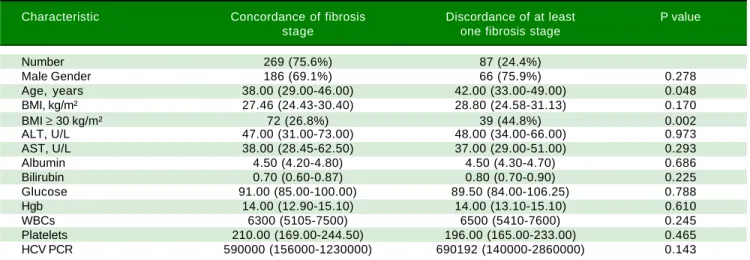
Table 3 summarizes the factors associated with dis-cordance on fibrosis stage based on FibroScan. It appears that obesity (BMI ≥ 30 kg/m²) is the main factor associated with discordance (p = 0.002).
Bland-Altman plot showed an acceptable agreement, presenting only thirteen patients scoring outside the tram-lines (95 percent limits of agreement of ± 2 standard devi-ations) (Figure 2). However, this graphic highlighted a trend of difference across the mean rates with a greater disagreement in higher liver stiffness.
Table 1. Baseline characteristics of studied patients.
Characteristic Value
All patients 356
Male Gender 252 (70.8%) Age (years) 39.00 (31.00-47.00) BMI (kg/m²) 27.57 (24.44-32.51) BMI ≥ 30 kg/m² 111 (31.2%) ALT (U/L) 47.50 (32.00-69.75) AST (U/L) 38.00 (28.93-60.00) S. albumin (g/dL) 4.50 (4.20-4.80) S. bilirubin(mg/dL) 0.70 (0.60-0.80) Glucose (mg/dL) 91.00 (84.75-102.00) Hgb (g/dL) 14.00 (12.90-15.10) WBCs(/cmm3) 6.3 (5.2-7.5)
Platelets (/cmm3) 207 (167-242)
HCV PCR (IU/L) 643500 (154500-1468312)
Data are presented as number (%), or median (IQR). BMI: body mass in-dex. ALT: alanine transaminase. AST: aspartate transaminase. Hgb: hemo-globin. WBCs: white blood cells. HCV PCR: hepatitis C virus polymerase
chain reaction. Figure 1.Figure 1.Figure 1. Correlation between the two liver stiffness measurements.Figure 1.Figure 1.
First operador
0 20 40 60
Second operator 60
40
20
0
DISCUSSION
In the last years, papers were published referring to the variability in TE, most of them presenting conflicting re-sults.11,27-30 Although this study has shown an excellent
correlation between the two operators, we should high-light a considerable inter observer variability in TE. The excellent correlation between operators [ICC 0.921 (95% CI 0.903-0.936); p < 0.001 and Sperman’s q = 0.808; p < 0.001] described in our study confirmed the results of pre-vious publications.11,27,29 Furthermore, the κ value for
di-agnosis of fibrosis stages showed in our results, was very similar to those described by others authors.28,30 Fraquelli,
et al.,11 the first authors that evaluated the reproducibility of
TE, reported an excellent inter observer ICC of 0.98 (0.977-0.987) in 200 patients with chronic liver disease, most of them with CHC infection. Boursier, et al.27
showed 25% of discordance of at least one stage of fibrosis. This relative high discrepancy of fibrosis stage was also re-Table 3. Risk factors associated with concordance/discordance on fibrosis staging based TE between the two operators.
Characteristic Concordance of fibrosis Discordance of at least P value stage one fibrosis stage
Number 269 (75.6%) 87 (24.4%)
Male Gender 186 (69.1%) 66 (75.9%) 0.278
Age, years 38.00 (29.00-46.00) 42.00 (33.00-49.00) 0.048 BMI, kg/m² 27.46 (24.43-30.40) 28.80 (24.58-31.13) 0.170
BMI ≥ 30 kg/m² 72 (26.8%) 39 (44.8%) 0.002
ALT, U/L 47.00 (31.00-73.00) 48.00 (34.00-66.00) 0.973 AST, U/L 38.00 (28.45-62.50) 37.00 (29.00-51.00) 0.293
Albumin 4.50 (4.20-4.80) 4.50 (4.30-4.70) 0.686
Bilirubin 0.70 (0.60-0.87) 0.80 (0.70-0.90) 0.225 Glucose 91.00 (85.00-100.00) 89.50 (84.00-106.25) 0.788 Hgb 14.00 (12.90-15.10) 14.00 (13.10-15.10) 0.610
WBCs 6300 (5105-7500) 6500 (5410-7600) 0.245
Platelets 210.00 (169.00-244.50) 196.00 (165.00-233.00) 0.465 HCV PCR 590000 (156000-1230000) 690192 (140000-2860000) 0.143
Data are presented as number (%), or median (IQR). BMI: body mass index. ALT: alanine transaminase. AST: aspartate transaminase. Hgb: hemoglobin. WBCs: white blood cells. HCV PCR: hepatitis C virus polymerase chain reaction.
Table 2. Patient (n) staged for liver fibrosis by FibroScan performed by both operators based on the score system proposed by Ziol,
et al. 2005.8
First operator Second operator
F0-1 F2 F3 F4 Total
F0-1 198 18 18 0 234
F2 10 8 9 0 27
F3 9 8 27 10 54
F4 0 0 5 36 41
Total 217 34 59 46 356
κ = 0.557, p < 0.001.
Figure 2. Figure 2. Figure 2. Figure 2.
Figure 2. Bland and Altman plot. The solid line represents the mean of the difference of LSM performed by both operators. The dashed lines define the limit of agreement (mean of LSM ± 2SD).
Difference of
liver stiffness measurement by both operators
0 20 40 60
20
10
0
-10
-20
-30
-40
-50
ported by Roca, et al.29 in a more recent publication (23%).
We found similar rates of discordance (24.4%) with those described by these previous authors27,29 and smaller rates
than those found by Perazzo, et al.30 who found rate of
dis-cordance of 35%. TE might be influenced by the etiology of liver disease31 and the prevalence of fibrosis, known as
spectrum effect.32 These two major factors may explain
the difference between these studies. Our study included exclusively mono-infected CHC patients. Similarly, study of Perazzo, et al.30 included only CHC mono-infected
pa-tients. Conversely, Fraquelli, et al.11 and Boursier, et al.27
included patients with chronic liver disease of mixed eti-ologies and Roca, et al.29 enrolled HIV patients, most of
them (61%) with hepatitis C co infection and mild liver fibrosis.
These high rates of discrepancy of at least one stage of fibrosis are not negligible and might influence the man-agement of patients with CHC. Distinction between mild and fibrosis F ≥ 2 indicates antiviral treatment in many countries or may have impact on the duration of treat-ment. In this present study 55 (15.4%) patients were classi-fied as mild fibrosis by one operator and F ≥ 2 by the other. Furthermore, the diagnosis of cirrhosis defines the start of hepatocellular carcinoma screening in many coun-tries. Our study reported discordance in 15 (4.2%) patients on the cirrhosis diagnosis between operators impacting in the hepatocellular screening. Thus, about 20% of our pa-tients would have had impact on their management by this discordance when using exclusively TE.
In a study that evaluated more than 13,000 TE examina-tions, unreliable results were independently associated with body mass index, lower operator experience, older age, female gender, and metabolic factors.15 However, in
our study, only overweight (BMI ≥ 30 kg/m²) was signifi-cantly associated with concordance/discordance on fibro-sis staging based on TE between the two operators. TE should be used cautiously as an indicator of liver biopsy for assessing liver fibrosis in patients with fat problems. An association of inter observer discrepancy with higher body mass index has been found in other studies like that of Fraquelli, et al.,11 Boursier, et al.,27 and Wong, et al.34 The
interaction of fat with low-frequency vibrations of TE may affect the signal to noise ratio, which is the relevant parameter for assessing liver stiffness.11
Our study major strength was the fact that our sample was composed exclusively of patients with CHC infec-tion. Previous studies that have evaluated TE inter observ-er variability analyzed patients with chronic livobserv-er disease of mixed etiologies, with the exception of Perazzo, et al.30
LSM accuracy and proposed cutoffs were different ac-cording to the liver disorder.33 Probably, also there is a
variation in the inter observer agreement of this method in different hepatic diseases.
The inter observer variability might be caused by inter-pretation of artificial TE cutoffs. In our study, LSM were well correlated between operators. Among 51 patients di-agnosed as cirrhosis (F4) by at least one operator, none were misclassified as mild fibrosis (F0F1). The major dis-crepancy was observed in F0 to F2 fibrosis stages, where published cut-offs are extremely variable.
Non-invasive biomarkers can also accurately stage liver fibrosis in CHC.35 The association of biomarkers with
TE would minimize the limitations of TE and could be useful in clinical practice.
Thus, clinicians should be aware that the inter observer variability in TE might exist and could impact on manage-ment of patients with CHC. TE results should be careful-ly anacareful-lyzed by expert hands, especialcareful-ly in patients with a single evaluation caused by the possibility of inter observ-er variability.
CONCLUSION
Although LSM has had an excellent correlation be-tween the two operators, TE presented an inter-observ-er variability that may not be negligible. TE is a user-friendly non-invasive technique, however, its per-formance may be altered by high BMI, which affects both the feasibility and reproducibility of the test. It is recommended that with high BMI, two TE examina-tions with the XL probe, with two experienced examin-ers, should be done. The presence of this inter observer variability should be taken in consideration during the use of TE in treatment centers, research, and clinical trials.
ABBREVIATIONS
• ALT: alanine transaminase. • AST: aspartate transaminase. • BMI: body mass index. • CHC: chronic hepatitis C. • HCV: hepatitis C virus. • Hgb: hemoglobin.
• ICC: intra class correlation. • IQR: inter quartile range. • kPa: kilo Pascal.
• LSM: liver stiffness measurement. • PCR: polymerase chain reaction. • ROC: receiver operator curve. • SD: standard deviation.
• SPSS: statistical package for social sciences. • TE: transient elastography.
CONFLICT OF INTEREST
The authors who have taken part in this study declared that they do not have anything to disclose regarding con-flict of interest with respect to this manuscript.
FINANCIAL SUPPORT
This work was funded by Science Technology Devel-opmental Fund (STDF) grant, Egyptian Ministry of higher education and scientific researh under call named; TC/2/Health/2010/hep-1.6:diagnostic imaging for accurate diagnosis and staging of the disease, project number 3512.
REFERENCES
1. Bravo AA, Sheth SG, Chopra S. Liver biopsy. N Engl J Med
2001; 344: 495-500.
2. Saadeh S, Cammell G, Carey WD, Younossi Z, Barnes D, Ea-sley K. The role of liver biopsy in chronic hepatitis C.
Hepa-tology 2001; 33: 196-200.
3. Piccinino F, Sagnelli E, Pasquale G, Giusti G. Complications fol-lowing percutaneous liver biopsy. A multicentre retrospective study on 68,276 biopsies. J Hepatol 1986; 2: 165-73. 4. Bedossa P, Dargere D, Paradis V. Sampling variability of liver
fibrosis in chronic hepatitis C. Hepatology 2003; 38: 1449-57. 5. Guido M, Rugge M. Liver biopsy sampling in chronic viral
hep-atitis. Semin Liver Dis 2004; 24: 89-97.
6. Colloredo G, Guido M, Sonzogni A, Leandro G. Impact of liv-er biopsy size on histological evaluation of chronic viral hep-atitis: the smaller the sample, the milder the disease. J
Hepatol 2003; 39: 239-44.
7. Rousselet MC, Michalak S, Dupre F, Croué A, Bedossa P, Saint-André JP, Calès P. Hepatitis Network 49. Sources of variability in histological scoring of chronic viral hepatitis.
Hepatology 2005; 41: 257-64.
8. Ziol M, Handra-Luca A, Kettaneh A, Christidis C, Mal F, Ka-zemi F, de Lédinghen V, et al. Noninvasive assessment of liver fibrosis by measurement of stiffness in patients with chronic hepatitis C. Hepatology 2005; 41: 48-54.
9. Castera L, Vergniol J, Foucher J, Le Bail B, Chanteloup E, Haaser M, Darriet M, et al. Prospective comparison of tran-sient elastography, Fibrotest, APRI, and liver biopsy for the assessment of fibrosis in chronic hepatitis C.
Gastroenter-ology 2005; 128: 343-50.
10. Ganne-Carrie N, Ziol M, de Le’dinghen V, Douvin C, Marcellin P, Castera L, Dhumeaux D, et al. Accuracy of liver stiffness measurement for the diagnosis of cirrhosis in patients with chronic liver diseases. Hepatology 2006; 44: 1511-17. 11. Fraquelli M, Rigamonti C, Casazza G, Conte D, Donato MF,
Ronchi G, Colombo M. Reproducibility of transient elastogra-phy in the evaluation of liver fibrosis in patients with chronic liver disease. Gut 2007; 56: 968-73.
12. Foucher J, Chanteloup E, Vergniol J, Castera L, Le Bail B, Adhoute X, Bertet J, et al. Diagnosis of cirrhosis by transient elastography (FibroScan): a prospective study. Gut 2006; 55: 403-8.
13. World Health Organization. Obesity and overweight: Fact Sheet. http://www.who.int/mediacentre/factsheets/fs311/ en/Accessed 4 October 2017.
14. Carrión JA, Puigvehí M, Coll S, Garcia-Retortillo M, Cañete N, Fernández R, Márquez C, et al. Applicability and accuracy
improvement of transient elastography using the M and XL probes by experienced operators. J Viral Hepat 2015; 22: 297-306.
15. Castera L, Foucher J, Bernard PH, Carvalho F, Allaix D, Mer-rouche W, Couzigou P, et al. Pitfalls of liver stiffness meas-urement: a 5-year prospective study of 13,369 examinations.
Hepatology 2010; 51: 828-35.
16. Ferraioli G, Filice C, Castera L, Choi BI, Sporea I, Wilson SR, Cosgrove D, et al. WFUMB guidelines and recommendations for clinical use of ultrasound elastography: Part 3: liver.
Ul-trasound Med Biol 2015; 41: 1161-79.
17. Puigvehí M, Broquetas T, Coll S, Garcia-Retortillo M, Cañete N, Fernández R, Gimeno J, et al. Impact of anthropometric features on the applicability and accuracy of FibroScan® (M and XL) in overweight/obese patients. J Gastroenterol
Hepatol 2017; 32: 1746-53.
18. Deuffic-Burban S, Mohamed SK, Larouze B, Carrat F, Valleron AJ. Expected increase in hepatitis C related mortality in Egypt due to pre-2000 infections. J Hepatol 2006; 44: 455-61. 19. Breban R, Doss W, Esmat G, Elsayed M, Hellard M, Ayscue
P, Albert M, et al. Towards realistic estimates of HCV inci-dence in Egypt. J Viral Hepat 2013; 20: 294-6.
20. Ministry of Health and Population, Egypt. Plan of Action for the Prevention, Care and Treatment of Viral Hepatitis, Egypt 2014-2018.
21. Gaia S, Carenzi S, Barilli AL Bugianesi E, Smedile A, Brunello F, Marzano A, et al. Reliability of transient elastography for the detection of fibrosis in nonalcoholic fatty liver disease and chronic viral hepatitis. J Hepatol 2011; 54: 64-71. 22. Tsochatzis EA, Gurusamy KS, Ntaoula S, Cholongitas E,
Davidson BR, Burroughs AK. Elastography for the diagnosis of severity of fibrosis in chronic liver disease: a meta-analy-sis of diagnostic accuracy. J Hepatol 2011; 54: 650-9. 23. Poynard T, Ingiliz P, Elkrief L, Munteanu M, Lebray P, Morra
R, Messous D, et al. Concordance in a world without a gold standard: a new non-invasive methodology for improving accuracy of fibrosis markers. PLoS ONE 2008; 3: e3857. 24. Bedossa P. Intraobserver and interobserver variations in
liv-er biopsy intliv-erpretation in patients with chronic hepatitis C. The French METAVIR Cooperative Study Group. Hepatology
1994; 20: 15-20.
25. Bland JM, Altman DG. Statistical methods for assessing agreement between two methods of clinical measurement.
Lancet 1986; 1: 307-10.
26. Shiha G, El-Etreby S, Bahgat M, Hamed M, El Sherbini M, Ghoneem EA, Zalata K, et al. Comparison between Transient Elastography (FibroScan) and Liver Biopsy for the Diagnosis of Hepatic Fibrosis in Chronic Hepatitis C Patients. MJVH
2016; 2: 17-25. http://elriah.liver-ri.org.eg/mjvh/Issues/is-sue3/7- Article 3.pdf
27. Boursier J, Konate A, Gorea G, Reaud S, Quemener E, Ober-ti F, Hubert-Fouchard I, et al. Reproducibility of liver sOber-tiffness measurement by ultrasonographic elastometry. Clin
Gastro-enterol Hepatol 2008; 6: 1263-9.
28. Neukam K, Recio E, Camacho A, Macías J, Rivero A, Mira JA, López C, et al. Interobserver concordance in the as-sessment of liver fibrosis in HIV/HCV-coinfected patients us-ing transient elastometry. Eur J Gastroenterol Hepatol 2010; 22: 801-7.
29. Roca B, Resino E, Torres V, Herrero E, Penades M. Interob-server discrepancy in liver fibrosis using transient elastog-raphy. J Viral Hepat 2012; 19: 711-5.
30. Perazzo H, Fernandes FF, Gomes A, Terra C, Perez RM, Figueiredo FA. Interobserver variability in transient elastog-raphy analysis of patients with chronic hepatitis C. Liver Int
31. Sebastiani G, Castera L, Halfon P, Pol S, Mangia A, Di Marco V, Pirisi M, et al. The impact of liver disease aetiology and the stages of hepatic fibrosis on the performance of non-in-vasive fibrosis biomarkers: an international study of 2411 cases. Aliment Pharmacol Ther 2011; 34: 1202-16. 32. Poynard T, De Ledinghen V, Zarski JP, Stanciu C, Munteanu
M, Vergniol J, France J, et al. FibroTest and Fibroscan per-formances revisited in patients with chronic hepatitis C. Im-pact of the spectrum effect and the applicability rate. Clin
Res Hepatol Gastroenterol 2011; 35: 720-30.
33. De Ledinghen V, Vergniol J. Transient elastography (FibroS-can). Gastroenterol Clin Biol 2008; 32: 58-67.
34. Wong GL, Wong VW, Chim AM, Yiu KK, Chu SH, Li MK, Chan HL. Factors associated with unreliable liver stiffness
meas-urement and its failure with transient elastography in the Chi-nese population. J Gastroenterol Hepatol 2011; 26: 300-5. 35. Chou R, Wasson N. Blood tests to diagnose fibrosis or
cir-rhosis in patients with chronic hepatitis C virus infection: a systematic review. Ann Intern Med 2013; 158: 807-20.
Correspondence and reprint request:
Gamal E. Shiha, M.D.
Egyptian Liver Research Institute and Hospital, Elmansoura-Damietta Road, Sherbin, Dakahlia, Egypt.