BENEMÉRITA UNIVERSIDAD AUTÓNOMA DE PUEBLA
Facultad de Lenguas
Maestría en la enseñanza del inglés
Gamifying the EFL Classroom: Understanding the Power of the Gamification of Education
A Thesis submitted to the Faculty of Languages for the degree of
Maestro en la Enseñanza del Inglés
By
Alan García Altuzar Puebla, Pue. October 2020
i
Gamifying the EFL Classroom: Understanding the
Power of the Gamification of Education
This investigation has been read by the members of the Committee of
Alan García Altuzar
And is considered worthy of approval in partial fulfillment of the requirements
for the degree of
MAESTRÍA EN LA ENSEÑANZA DEL INGLÉS
______________________
Dra. Verónica Sánchez Hérnandez (Supervisor)
_________________________ ______________________
Mtra. Ma. Fátima Encinas Prudencio Mtro. Yonatan Puón Castro
_________________________
Mtra.Gisela Cuatlapantzi Pichón
Benemérita Universidad Autónoma de Puebla Puebla, Pue.
October 2020
TABLE OF CONTENTS Abstract
Acknowledgements Dedications
CHAPTER ONE: INTRODUCTION 1.1 Introduction to the Problem 1.2 Purpose of the Study
1.3 Research Questions 1.4 Significance of the Study 1.5 Ethical Issues
1.6 Research Content and Organization
CHAPTER TWO: LITERATURE REVIEW 2.1 Gamification
2.2 Gaming vs Playing
2.3 Gamification Elements and Mechanics 2.4 The Science Behind Gamification
2.5 Risk Taking in the Language Learning Process 2.6 Exploratory Practice
2.7 Strategies of Ethnographic Research
CHAPTER THREE: RESEARCH METHODOLOGY 3.1 Overview of Methodology
3.2 Research Method 3.3 Participants 3.4 Instruments
3.5 Procedures
3.5.1 Transcription Analysis 3.5.2 Data Analysis
CHAPTER FOUR: FINDINGS 4.1 Introduction
4.2 Setting up the Device for Gamification in the Classroom 4.3 Students’ Analysis of their Writing in Class
4.3 Focus Group Interview and Participants’ Insights
CHAPTER FIVE: CONCLUSIONS 5.1 Discussion of Findings
5.2 Implications for Current and Future Practices 5.3 Limitations of the Study
5.4 Directions for Further Research
LIST OF REFERENCES LIST OF TABLES
LIST OF FIGURES
CHAPTER I: INTRODUCTION
The current research focuses on the effects of gamifying the English as a foreign language (EFL) classroom in both teachers and students’ as well as their experiences on bringing such concept into their classrooms. In order to do so, this first chapter will first provide a description of the problem that this research aims to deal with. Likewise, the main objectives of this investigation will be explained followed by the research questions that guided the project. Finally, the contribution and significance of this study to the EFL field will be discussed to then proceed to provide some relevant definitions of concepts related to this research. In Chapter Two, the relevant theoretical framework that constitutes the concepts for the gamification of education for the following study is presented. Chapter Three elaborates on the methodological procedures followed for the development of this project by describing the setting, participants and instruments. Chapter Four illustrates the data collection method as well as the data analysis. Finally, Chapter Five discusses the findings, conclusions, implications and limitations of the study.
In addition, suggestions for the implementation of further research will be given in order to contribute to the improvement of future research on the field.
1.1 Introduction to the Problem
The notion of applying the concept of gaming in the classroom evokes different reactions in people. While some joyfully welcome video games in the classroom others, as Cruz (2007) comments, others might see them as satanic tools. However, from the point of view of students, some might consider traditional schooling as boring and ineffective which shows in their lack of motivation and engagement that has now become a major problem in education (Lee & Hammer,
2011). Hence, teachers have embarked on a quest to find new approaches to teaching and gaming has proven to be a more than useful option not only in education in general, but in EFL teaching and learning as well. Piaget (1962) believed that playing is essential in learning and mastering skills and more recently, Gee (2007) and Squire’s (2006) research suggest that video games have the potential to improve learning outcomes and motivation in education.
Furthermore, Thorne, Black & Sykes (2009) recognized videogames for promoting collaboration and interaction between players and at the same time promoting foreign language acquisition and motivation.
Thus, a concept that has been adopted recently is gamification, which is defined as the use of gaming elements in non-gaming contexts ( Deterding, Dixon, Khaled & Nacke, 2011). Furthermore, gaming provides elements that stand out in education. Especifically, Role-playing Games (RPGs) provide the participants with a virtual world in which they can collaborate, participate and where they are motivated to progress due to their involvement with immersive tasks that promote participation (Keranen, Encinas, & Bazerman, 2012). Nevertheless, according to Dicheva, Dichev, Agre, & Angelova (2015) gamification is a process that may prove to be very difficult, time consuming and in most instances, costly. This is the main reason why this research sets out to find a feasible and accessible way to gamifying education in the Mexican context and its effects on students’ learning and instructors’ teaching. This objective will be accomplished by exploratory practice. This research’s findings will be useful not just in exploring more on gamification of education but to set the bases to develop a series of activities that could fit into a gaming based syllabus.
1.2 Purpose of the Study
This study aims to explore how gamification can be implemented during a course teaching English to adolescent learners. It also attempts to understand how the different elements of games which have proven to be effective could be extrapolated to the teaching and learning process. The purposes of this study are as follows. First of all, it will provide a summarized description of how gamification can be implemented in an EFL course with adolescents. Secondly, this research will describe how teaching and learning could be improved if we apply the same principles that game operates on, such as skills, levels, experience points, quests, and fantasy. In so doing, it will explore which of these elements can have a qualitative impact on learning experiences, from the standpoint of the learners and the results of this type of strategy. Finally, this study will provide insights that may guide future pedagogical practices concerning gamification in the language classroom.
1.3 Research Questions
For this study, the chief focus was on what aspects of gamification are beneficial, and how this information can be used in foreign language education.
Therefore, the research questions for the study were as follows:
RQ1: What elements of gamification could have an important qualitative impact on the learners?
RQ1.1: What is the relative weight that these elements present in games could have on language learning success?
RQ2: What are the perceived effects from the students’ standpoint?
1.4 Significance of the Study
In today’s digital generation gamification has become a popular tactic to increase motivation and engagement and with this, enhance learning.In addition, educators, from different levels and contexts, who are in favor of games in school, have to overcome many obstacles such as the objections of parents, teachers and administrators who usually games as insufficiently serious, that they are “just play”
(Klopfer, Osterweil & Salen, 2009).
Hence, this research arises from the necessity of making the learning/
teaching of English a more enjoyable process for both teachers and students by exploring the effects of gamifying the classroom. Furthermore, as an additional intention of this project is to provide teachers with the necessary guidelines to gamify their classroom as a way to improve the teaching-learning process.
Additionally, the gamification of education may prove to be not only applicable to the EFL classroom but to the classroom in general.
1.5 Ethical Issues
Any study is subject to potential ethical issues in both collecting the data and interacting with participants. Especially in this type of study, because of its ethnographic nature, participants were actively engaged and were a continued source of qualitative data from observation and interviews. For this reason, permission was asked to the responsible of the program, and students were informed about the kind of methodology and agreed to it. Respect of personal data was ensured from the beginning and all throughout the research, to preserve all participants’ privacy.
1.6 Research Content and Organization
This paper is organized in 5 chapters. The first one introduces the topic, the purpose of the study and the research questions. In the literature review, the main theoretical tenets and concepts related to this study are explored and discussed in detail, to provide a solid theoretical framework for the field work. In Chapter Three, the approach, method, and research instruments are presented, along with a detailed description of the participants, procedures, and data analysis used in the research. Chapter Four presents and discusses the results of the research and addresses the research questions in the light of the theory presented in Chapter Two. Finally, Chapter Five presents the main conclusions and implications for current and future practices, explores the limitations of the study and presents some directions for further research.
CHAPTER II: LITERATURE REVIEW
Video games were initially developed with the purpose of entertainment but it did not take long for people to realize they can demonstrably motivate users to engage with them with a level of intensity and duration rarely seen in people in other activities. This lead to the intriguing query of whether game elements could be applied to different contexts and up to what level these would be benefited by becoming more engaging and enjoyable for the users (Flatla, Gutwin, Nacke, Bateman, and Mandryk, 2011). Hence, in order to understand the concept of gamification and the key terms surrounding it, a literature review will be provided in this section by reviewing the concepts of gamification, gamification elements and mechanics, the science behind gamification, and risk taking in the language learning process.
2.1 Gamification
The term gamification began appearing in non-gaming contexts in 2010 (Robson, Plangger, Kietzmann, McCarthy & Pitt, 2015). Nevertheless, since it started gaining popularity among researchers in a variety of fields, there has been a constant discussion and debate over gamification’s actual definition and how it can be applied to different contexts. Helgason (2010) explains gamification as “the adoption of game technology and game design methods outside of the games industry”. Its popularity is heavily due to its flexibility and adaptability, since it can be applied in different contexts and for a variety of purposes. From a broad perspective, gamification is used as a driver to promote not only learning, but also employeeperformance, customer engagement, and even crowdsourcing initiatives.
According to a publication on their own website, Gartner Inc., one of the world's
leading information technology research and advisory company, the increasing popularity of gamification lies in its potential to strengthen engagement, change behaviors and support innovation.However, for the purposes of this research, the term will be defined regarding its application in education and language learning.
Gamification is simply defined as “the use of game design elements in non-game contexts” (Dixon, Khaled and Nacke, 2011, p.11) and more recently as “the phenomenon of creating gameful experiences” (Koivisto & Hamari, 2014). To complement these definitions, Kapp (2012, p. 10) defined gamification as “using game-based mechanics, aesthetics, and game thinking to engage people, motivate action, promote learning, and solve problems”. The definition used throughout this paper entails parts of the ones mentioned that I consider relevant for this research and is as follows: gamification is the use of game elements and game design to enhance motivation, engagement, and guide the behavior of the users towards the language learning process (a non-game context).
2.1.1 Gaming vs Playing
Gamification may be perceived as a way of making the classroom an informal place but it is important to point out that Gamification is related to games, not play. Play can be conceived as the broader, looser category different from games (Salen & Zimmerman, 2014). In game studies, Caillois (2001) provides a clear explanation on this distinction between play and games by elaborating on the concepts of paidia and ludus, both concepts from ancient Greek. Whereas paidia or playing denotes a more uncontrolled, improvisational and expressive recombination of behaviors and meanings, ludus or gaming entails playing in a more formal, structured way guided by rules and where there is competition and a
desire of striving towards achievement of objectives. To provide further support for the distinctness of playing and gaming, academic as well as industry research critiques of gamified applications have constantly claimed gamification focuses almost entirely on designing a rule-bound, goal oriented environment for play (i.e., ludus), in which there is little space for open, free play (i.e., paidia) (Alfrin, 2012;
Deterding, 2012).
Elaborating on this clear distinction between playing and gaming is of sum importance for this research because it seeks to ease the possible anxiety of teachers who do not want to use gamification in their classroom as a result of fear of their classroom becoming a complete mayhem. In a few words, gamifying your classroom will provide a structured design for your class rather than letting your students play all the time.
2.3 Gamification Elements and Mechanics
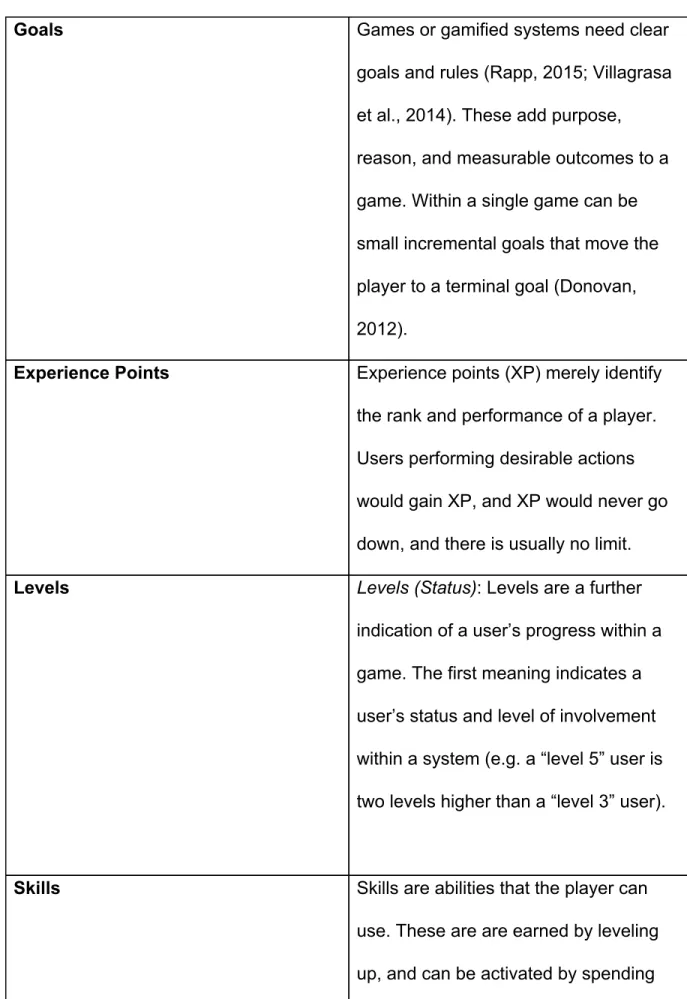
There are no explicit specifications on which game design element could be the most successful in every specific situation (Landers & Callan, 2011). Just as when planning lessons for a specific class, the success of the chosen elements will depend on the students, the objective of the course and the subject matter. Since gamification has its origins in the gaming industry, I consider important a quick review of basic game elements as well as pointing out that no technological elements were used in this research because of the unavailability of such elements in the public education system. There are plenty of mechanics used in video game design, but not all are directly transferable to gamification, and that is why I provide the list of the terms that are relevant to this research:
Table 1: Elements of Gamification (Adapted from Zichermann & Cunningham, 2011; Deterding et al., 2011; Werbach & Hunter, 2012; Burns, 2015)
Goals Games or gamified systems need clear
goals and rules (Rapp, 2015; Villagrasa et al., 2014). These add purpose, reason, and measurable outcomes to a game. Within a single game can be small incremental goals that move the player to a terminal goal (Donovan, 2012).
Experience Points Experience points (XP) merely identify the rank and performance of a player.
Users performing desirable actions would gain XP, and XP would never go down, and there is usually no limit.
Levels Levels (Status): Levels are a further indication of a user’s progress within a game. The first meaning indicates a user’s status and level of involvement within a system (e.g. a “level 5” user is two levels higher than a “level 3” user).
Skills Skills are abilities that the player can use. These are are earned by leveling up, and can be activated by spending
experience points . The higher the level of the player, the better skills.
Challenges and Quests Challenges are “puzzles or tasks that require effort to solve” (Werbach &
Hunter, 2012). Usually, challenges and quests build on top of point-based systems and are focused on motivating users to accomplish even more difficult tasks. These can be as simple as the normal tasks, quizzes, exams that we normally do in the classroom.
Competition and Cooperation Competitions allow users to compete with one another, with a clear winner and loser. At the most basic level, the
presence of leaderboards create a form of competition. However, on a broader level, competitions between users and groups determine who can accomplish certain tasks quicker, better, etc.
The opposite of competition is
cooperation, this allow users to work together and collaborate to accomplish certain tasks.
Feedback Feedback within any gamified service should be immediate (Landers & Callan, 2011). Positive reinforced behavior (rewards) leads to repetition (Robson et al., 2015). There should also be
corrective feedback and
supportive/guiding feedback (Donovan, 2012).
Rewards Common rewards in gamification are
virtual goods, points, badges, or
leaderboards (Deterding, 2015; Sarangi
& Shah, 2015). However,they may be tangible rewards such as a point in an exam (Rapp, 2015). Regardless of the rewards, the method of receiving them should be easy to understand and targeted to learning outcomes (Landers
& Callan, 2011). It’s also important to note that rewards that are given out too often and easily (without a challenge) quickly lose their importance (Rapp, 2015). Rewards should be matched to a difficult, yet attainable challenge
(Landers & Callan, 2011).
2.4 The Science Behind Gamification
Researchers from game industries and academia have studied affective factors that make games so engaging as well as how cognitive processes are benefited by the use of gamification. This section aims to explore some of the research done on motivation, cognition and risk taking.
The majority of the literature focuses on motivational concepts. One of the most prevalent theories is Csikszentmihalyi’s (1996) flow, a specific kind of happiness that he named flow, which is considered as one of the fundamental reasons that people play games. Flow is a ”state of absorption, characterized by intense concentration, loss of self-awareness, a feeling of being perfectly challenged (neither bored nor overwhelmed) and a sense that time is flying. In order to achieve flow, the important condition is a balanced goal that is challenging, yet achievable within the individual’s ability” (p. 6). This concept is found in several papers of the reviewed literature in this research (Deterding et al., 2011;
McGonigal, 2011; Zichermann & Cunningham, 2011; Werbach & Hunter, 2012).
Flow then, can also be defined as “the satisfying, exhilarating feeling of creative accomplishment and heightened functioning” (Csikszentmihalyi, 2000, p. 13.). He strongly believed that everyday life lacks of flow but it can be easily found in abundance in games (McGonigal, 2011). A more modern description of flow is one that almost everyone has experienced “being in the zone”, when a person is occupied on one task and is completely absorbed by it. Nevertheless, Csikszentmihalyi (2000), warns the designers of gamification that the flow state is often found between anxiety and boredom. Hence, if we provide students with only
easy achievable tasks, they will become bored whereas if students deem the task too complicated, anxiety and demotivation will take over them. Therefore, teachers in their role of gamification designers should take into account all these considerations to provide an enhanced and gamified learning environment by considering students’ skill and challenge level, and slowly increase the challenge level as the user gains experience in order to maintain the state of flow.
Hand in hand with this is the cognitivist theory of Self-Determination (SDT) developed by Deci and Ryan (1985). These researchers base their claims on the premise that human have a constant desire for growth, but that the external environment must support them and act as a complement. According to SDT, human needs fall into three categories. First is competence, defined as the ability for individuals to accomplish external feats. Second is relatedness, the universal desire for interactions and social connectedness. Third is autonomy, the freedom over your own choices and values (Werbach & Hunter, 2012).
How does SDT relate to flow? Well, according to McGonigal (2011) SDT’s competence is clearly related to the balance between skill level and challenge level that help maintain flow whileautonomyacts as a trigger for a more successful state of flow since autonomy in games is part of the essential structure of gameplay. The use of gamification aims to two types of factors for ESL/EFL students: affective and cognitive. Girardelli, Barroero, & Gu (2016) claim that, within gamifications, affective factors are addressed by playing artificial roles in a fictional context. In this setting, ESL/EFL students can be “someone else” in the classroom and while doing so, they can feel more open towards the norms, as well as to the formality and seriousness a class is usually seen in. All this may even be a saving face environment in case of mistakes which results in students’ participation increasing
in the classroom. In addition, the activity addresses second-level, cognitive challenges in that “it encourages the practice of certain organizational formats and it refers to areas with large background knowledge, such as super heroes, fairy tales, and other popular forms of fictional story telling” (Girardelli, Barroero, & Gu, 2016, p. 20). Gamification’s goal is to be both challenging and rewarding which requires mental stimulation balanced with emotional comfort to provide a good platform for learning.
2.5Risk Taking in the Language Learning Process
Risk taking is defined as: “a situation where an individual has to make a decision involving choice between alternatives of different desirability; the outcome of the choice is uncertain; there is a possibility of failure” (Bebee, 1983, p. 39).
Because of the possibility of failure and a consequence to it in education, some students tend not to take risks and their participation in classroom activities seems to be diminished. Furthermore, Cervantes (2013) as well as Zafar & Meenakshi (2011) claim that risk taking is a crucial element in language learning and gamification is a useful way to promote risk taking among students to enhance not only participation but to promote a safe learning environment.
In the preceding paragraphs, the most important theoretical elements concerning gamification have been explained and discussed. The main objective of this research is to explore how these elements can be used in English Language Teaching to make learning more challenging, meaningful, and enjoyable. The next section of the literature review concerns the theories under which the research has been conducted.
2.6 Exploratory Practice
In order to carry out this research project, selecting a methodology that would provide the necessary tools to accurately address the needs of such project was indeed a major concern. In this part, I will discuss the theory behind the selected approach, methodologies, and instruments used throughout this research.
First, Exploratory practice (EP), explained as an “indefinitely” sustainable type of research which allows research to be “ongoing” rather than controlled experimental classroom research was selected. This allows both teachers and learners to develop their own understandings of the life in the classroom (Allwright, 2005). Adding to this, Hanks (2015 p. 2) explains that EP is a “form of practitioner research in language education which aims to integrate research, learning and teaching.” This last concept of integration of EP’s major contribution to this research. This is because, as Hall (2017, p. 4), puts it “diversity and complexity are fundamental elements of language teaching and learning, and of language classrooms”. That is, because of the participants in the classroom and all the different local contexts in which teaching and learning English occurs, each classroom is unique. Research must then take this into account.
The principles of Allwright’s (2003) exploratory practice (EP) are that (a) the quality of life in the language classroom is much more important than instructional efciency, (b) ensuring our understanding of the quality of classroom life is far more essential than developing ever “improved” teaching methods, and (c) understanding such a quality of life is a social, not an asocial matter (Allwright, 2000, 2003; Allwright & Bailey, 1991). These tenets lead the philosophy of the present research, since as language practitioners we must (a) give priority to quality of life rst, (b) work primarily to understand real language classroom life, (c)
involve everybody, (d) work to bring people together, (e) work empathically for mutual development, (f) integrate the work for understanding into classroom practice, and (g) make the work a continuous enterprise (Allwright 2003, cited in Kumaravadivelu (2006). Thus, in order to explore gamification in the classroom and to be able to take into account these principles that will allow us to understand the phenomenon and practices as they naturally occur in a real environment.
One of the most important elements of exploratory practice considered in this research, is the involvement of the students in the teaching and researching in the classroom. Fanselow & Barnard (in Allwright 2006, p. 175) argue that “students who explore classroom interaction are researchers just as are teachers or researchers or teacher trainers who investigate classrooms.” Therefore, in this research, not only the voice of the teacher and researcher is important, but the students will take an active role in the planning, development, and evaluation of the teaching practices and the derived research. Given the characteristics of exploratory practice, the most appropriate way to address it is by means of ethnographic research, which is discussed below.
2.7 Strategies of Ethnographic Research
Ethnographic research is the description and analysis of a culture’s practices and beliefs (Dornyei, 2007). Nevertheless, from the perspective of classroom research, culture is not to be understood solely as an ethnic group but as any learning community. Reeves, Kupe and Hodges (2008, p. 512) add to this when they explain ethnography as “the study of social interactions, behaviours, and perceptions that occur within groups, teams, organisations, and communities.”
1) Ethnographic research
a) Journal
b) Focus group (interviews) 2) Longitudinal research 3) Qualitative research
Qualitative research “entails collecting primarily textual data and examining it using interpretive analysis” (Crooker 2009, p. 5). Hence, this research will use some of these strategies to perform data collection and analysis.
A plethora of research approaches has been developed within qualitative research, including narrative inquiry, case study, ethnography, action research, phenomenology and grounded theory. These approaches use a wide variety of data collection methods such as observation, interviews, open-response questionnaire items, verbal reports, diaries, and discourse analysis.
CHAPTER III: METHODOLOGY
In this chapter, the information concerning the methodology, the setting, the participants, and the instruments used in this research project is provided. A detailed description of the data collecting process, the analysis and the comparisons is presented as well.
3.1 Overview of Methodology
First of all it is important to characterize this study in the light of an exploratory-practice approach, using selected strategies of ethnographic research in the form of participant observation of a case group. Additionally, the study is longitudinal in nature, as it was important to study how gamification works over a course of instruction. Finally, the study is qualitative since it provides data obtained in the classroom using instruments such as a diary, semi-structured interviews, and a focus group interview.
For the purposes of this study, Exploratory Practice (EP) is used since it develops our own understandings of life in the language classroom (Allwright, 2005, p.361). EP is a research method that aims to harmonize research, learning and teaching. EP promotes the idea of both teachers and learners puzzling about their language learning/teaching experiences, using “normal pedagogic practices as investigative tools” (Allwright, 2003, p. 127). This is of particular interest to this research because the entire concept of gamifying a classroom was new to both the researcher and the students and this methodology provided the most appropriate platform to explore its effects.
3.2 Research Method
Exploratory practice in combination with some specific elements of ethnographic research are used because it allows the complete and extensive observation of the phenomenon under study, that is, gamification. The ethnographic research strategies used consider participant observation as “a form of inquiry in which the researcher is both an observer, and as such is responsible to persons outside the situation being studied, and also a genuine participant, and as such has a stake in the situation and its outcomes” (Criollo 2003). Exploratory practice research typically takes place in a natural setting, in this case, the classroom, and the researcher can thus record and study behavior as it normally occurs. It involves the intensive examination of a situation in which data are collected on many variables over an extended period of time. In this case, the data was collected from the researcher’s own diary, students’ work, semi-structured interviews, and a focus group. Thus, the analysis of the data is largely qualitative and it is also more inductive.
3.3 Participants
I participated in this research along 25 students, all of the students in a pre-intermediate level course of English in central Mexico. The group belongs to a US embassy program and their age is 14 years old. They all belong to public schools, in which traditional teaching is still very popular, and have taken one or two courses of English before. There were 14 female students and 11 male students. These participants fulfill the requirement to explore the research questions of this study and that is why they were chosen this way. Furthermore, for the interviews and focus group, a purposive sampling of students was selected randomly.
3.4 Instruments
In collecting data, I followed a multi-dimensional approach (Richards, 2003) and three instruments were required. The first one consists of a weekly journal kept by the teacher.The second instrument consists of interviews to students in the middle of the process to capture their responses and reactions to gamification over time. Having these two instruments contributed to the fulfillment of the purpose of this study since the first one was designed for the teacher, while the second deepened into students’ experiences and reactions. Finally, a Focus group was carried out in order to obtain more specific information about the gamification process from the students’ standpoint and be able to triangulate with the impressionistic information developed in the diary and the other interviews. In order to provide a framework for the semi-structured interview, Castillo-Montoya (2016) protocols on interviews were considered.
3.5 Procedures
The weekly journal was kept by the teacher, recording anything that might be have been of interest for the research as well as unexpected happenings in the classroom. Regarding interview questions, they were first applied in a one-on-one basis for reliability. After that, they were piloted with a larger group to add the final modifications. Later, interviews were carried out with participants in the middle of the process, whereas the focus group interview was carried out by the end of the data collection process. The next step was the transcription, description and analysis of the recordings obtained, using Template Analysis (King, 2004). As for the samples of students’ work, they were collected throughout the course in the form of exams, homework, and free writing quizzes. Having the data collected, this was organized to create templates where the most observable findings of this
research are shown. These results were also the basis to propose suggestions in further teaching and provide the conclusions. The results are shown in Chapter IV.
3.5.1 Data Analysis
Qualitative analysis on the collected data was conducted in four steps:
transcribing data; reading and generating categories, themes and patterns by using King’s (2004) guidelines to analyze both the recordings and the journal; interpreting findings;and writing the report (Wilson, 2010). After having collected the recordings, transcriptions were done. King (2004) argues that the advantage of Template Analysis is that it allows for introduction of further themes as they emerge during the analysis which provides an open platform to analyze results as they are being obtained and modify the categories or subcategories as the researcher seems fit. The most relevant extracts are also transcribed and will be shown in Chapter IV as well.
CHAPTER IV: RESULTS CHAPTER IV: FINDINGS
This section describes the key findings of the research by firstly analyzing them across the different instruments in two different stages of the implementation of gamification, and secondly by finding connections of such results in students’
work samples.
Because the interviews, both individual and the focus group, were semi-structured they allowed for flexibility while interviewing the students.There were themes that were followed and covered in every interview but interviewees had slightly different approaches to some of the themes. The main themes of both the journal and the interviews can be categorized into six parts. First, experiences and behaviours; in the second part, opinions and values were discussed; in the
third part, the feelings of students as participants were discussed; the fourth category was knowledge; the fifth category was fun and its importance; the sixth theme concerned the comparison between school and the english classroom. After discussing the two different types of interview as well as the teacher’s journal, students’ samples of work are described to find any possible connections across the different used instruments.
4.2 Setting up the Device for Gamification in the classroom
On a theoretical basis, gamification would positively affect the educational procedures, but the students will decide whether it works in practice. In this regard, the present study aimed to determine how the gamification of the educational process is perceived by the students, the effects it may have on their performance, and to highlight the prominent elements of the gamification process.
Thus, the diverse elements of gamification, such as the mechanics, dynamic, and components, were discussed and determined with students who took an active part during the process of gamification. They became players in the classroom. At the very beginning of this research, students were exposed to the idea that the course was actually a game and that completing the period of implementation successfully meant finishing the game with a narration technique to make them emotionally more positive to the implementation process. Students became willing to progress as they became aware of their classmates’ experience points, level and abilities. Cooperation mechanisms were also put into practice by awarding extra experience points to students who helped a student in class or a group of students. The components of game design, which are experience points (xp), levels and abilities, were integrated into the teaching, learning, and assessment processes. During the period of implementation, students' maximum
level reached was 43 while the average was 36 and the minimum was 29 . As the students’ progressed, they gained abilities to their present levels. There were three different “stages” for each of the characters, each one symbolizing the students’
overall progress in the class.
4.3 Analysis of Students Writing in class
Students’ writings consisted mostly of open questions to promote free writing (Hwang, 2010). To determine the reliability of the grading, writings would be graded by both teachers and assigned randomly every time. These writing samples were taken from four free writing activities at the beginning of the implementation process and four at the final stage. The samples at the beginning of implementation were considered as the base for each student’s progress on their writing. In general, students’ writings showed improvements in the aspects of length, evaluating point of view, and supporting conclusion. To further analyze this, students’ samples of their writing, at different stages of the implementation of gamification, will be presented and discussed.
4.3.1 Beginning stages
One of the questions asked was on describing situations or movie characters. Students were expected to answer this in the form of simple sentences since these would represent their first experiences of writing in English in such a specific way. Here are some examples of student’s answers at the first stages of the implementation of gamification:
Q1: What was your favorite part of the movie? Describe it.
A1: When the Merida’s brother transform in bears
A2: When Merida help to her mother, for what her mother transforms in human.
A3: My favorite part is when the magics appear in the building and disappear and appear.
A4: when in the channel tu robe a million of dollars.
A5:When buit tail for chimuelo hiccup
A6: When meet to toothels and meat fish.
A7: When Rapunzel fight with Gothel.
A8:When Eugene is dead in the arms of Rapunzel but not really dead.
Q2: What was your favorite character? Why? Describe him/her/it.
A1: is black color, eyes green, popping eyes.
A2: My favorite dragon is “chimuelo” because is very cute, is fun.
A3: Rapunzel: hair long, beautiful, green eyes, and intelligent.
A4: Rapunzel, because your hair is very long.
A5: the 4 knight, because are very handsomes and she is pretty, intelligent and know how trick awesome.
A6: Is the younger magic, is young, handsome, clever, skiny, intelligent.
A7: Cato, nice, intelligent, tall, dark skin.
A8: Cato, it’s tall, fast, handsome, aggressive, and has yellow hair.
As observed, answers are limited to short simple sentences and only sometimes do students attempt to create a compound sentence. This resulted in having to use words in Spanish, problems in the order of the sentences and most importantly, problems in conveying meaning. The clear possibility of failure limited students' responses as mentioned by Bebee (1983) when describing how students take risks.
4.3.2 Final stages
During the final stages of implementation of gamification, description questions were also asked. This time, students were expected to write not only longer sentences, but complete paragraphs and be willing to take more risks when writing.
Let us remember that by this time, students already had more abilities to use when writing and may in consequence, be favorable to their performance. Here are some of the examples collected in this final stage:
Q1: What was your favorite part of the movie? Describe it.
A1: My favorite part is when Max Dacosta captures president of the company and starts to fight with agent Kruger but the friend of Max dies and this made me sad.
A2: My favorite part is when Max goes to Elysium and erase all the system, and he becomes a citizen of Elysium to help his friend’s daughter. I like that part because everybody that is out of elysium comes to elysium and they are happy.
A3: When the brothers are going for their 5th victory in the sea but a kaiju was there and one of the brothers dies. They were very united, they were
alone in life, and for this they did everything together. It is a little sad but I liked this part.
A4: When Mako gets lost in her memories. She sees how the general save her because her parents died and she was alone. She goes in a crisis and couldn’t have control of the jaeger.
A5: When the toys stay in the trash and they hold their hands, but in the ultimate secon the aliens save them with a machine and put them in a secure place, and they come back to Andy’s house.
A6: When Andy gives his toys to Bonnie to take care of them and before Andy left they played together. When he left he said goodbye to Bonnie and she says goobye with the hand of woody, Andy was very sad in this moment
A7:When they go to the “other” world because it’s very beautiful and it was totally different. The mom cooks, the father plays the piano; their garden is very pretty, but the world has a white space.
A8: The other world because it is more crazy and beautiful. The animals speak and the world was stranger because in the wood the floor changes to white color and there is color only in the home of the witch. Everything the person had the buttons instead of eyes.
Q2: What was your favorite character? Why? Describe him/her/it.
A1: The cat, because the cats helps to Coraline to find her parents and kill the witch. Also because is very brave.
A2:My favorite character is Coraline because she is brave and intelligent.
She has short blue hair, brown eyes and freckles. She’s wearing an orange shirt, yellow jacket, blue jeans and yellow boots.
A3:My favorite Kaiju was the categorite three, it is the first Kaiju that appeared in the movie is all black which reptile.
A4: The german jaeger is my favorite jaeger. It’s the color white and it’s the fastest jaeger. The jaeger throws misiles. The german jaeger is my favorite because I like the appearance.
A5:Agent Kruger. He was a very bad man who did not want other people, he was a former military man.
A6: Agent Kruger. He is more rich than other people in that world, he isn’t older, and he has many wiapons, and he helps people, he is brave and rude.
A7: Lotzo. Daisy was her owner. She loved Lotzo but one day she lost it.
She cried and ask for Lotzo but she didn’t find it. Then, she remplaced Lotzo for a new Lotzo.
A8: Lotzo was bough for dazy, one day, dazy and him, was to a piknik day, and dayzy forgot to lotzo. Next, lotzo found the way to return to home, and dazy alredy was changed it. Since that day was bitter.
As expected, the first noticeable change in the students’ writing is its length which goes from the form of a sentence in its simplest form to small paragraphs which incorporate more than one sentence. Thus, this conveys the students’ point
of view better by in general having a topic sentence, a body , and most of the time, a concluding part for their paragraphs. By the final stage, we can clearly observe students are trying to convey their point of view, they do not settle for a short answer and have the desire to express more. Another final observation is that even if there are still mistakes in the final stage, students were willing to take risks with language as long as they could finish their thoughts, which shows that, just as Cervantes (2013) as well as Zafar & Meenakshi (2011) claim, gamification promoted a safe learning environment in which risk taking is a crucial element in language learning.
Regarding the questions referring to descriptions of characters, we can observe improvements as well. Again, length is the first noticeable factor. Students write much more in the final stage, they do not settle now for a series of two to three adjectives, they now want to tell us why they like or dislike a certain character. Their point of view in the first stages consists of just a mere superficial description that lacks support, but then at the final stage we can observe the student now even gives examples of the characters attitudes or actions he/she dislikes. We can also observe a complete form on these small paragraphs.
Students know show they can write a complete paragraph even if sometimes they commit mistakes or do not know a specific word. As Csikszentmihalyi (2000) states, by getting students into the “flow” state, we have students performing at this
“intense concentration” level .
4.4 Focus Group Interview and Participants’ Insights
During the final stage of this research, a focus group interview was carried out in order to gather participants’ final insights on the whole process of
implementing gamification into the classroom. The recording of the semi-structured interview was then transcribed and translated. The student interview data were analyzed using Template Analysis (King, 2004) guidelines in relation to the following elements: (a) students’ opinions of their writing quizzes, (b) students’
opinions of their progress in tests, (c) students’ opinions of learning effectiveness using gamification, and (d) students’ opinions of gamification. Specifically, for each element, students’ positive and negative comments, as well as suggestions for improvements were noted down.
4.4.1Students opinions of their writing quizzes
As writing became an important part of this research, it was of utmost importance to listen to student’s opinions on having them take weekly written quizzes on the movies they watched. First, extracts from their answers will be presented to then be discussed.
S3: The first time I did a writing quiz, I was very upset because I could not write anything. I felt powerless and angry with myself. In Spanish if you ask me about my favorite movie I can talk to you about it for 20 minutes… or more. But in English I could barely write one sentence. But then, at some point, I got a lot of experience points in one of my quizzes and I was very happy. I started using my abilities when I did not know how to say what I wanted. It was easier to say what I thought about the movie, what I liked and disliked.
S8: To be honest, the first quiz I wasn’t in class so I thought that on the second I would not have any problems because my classmates told me it
was easy. So I was very confident for the second quiz and... boom! I could not write what I wanted, I did not know a lot of vocabulary I needed for my answers. Then I told myself, you have to do better, you need to get more points and use your powers! I watched the next movies with my family and that was nice. I started getting more points and it was fun.
It was consistently found that all seven interviewees were not fond of the quizzes at the beginning of the process since they felt they could not express their ideas, they felt limited. Nevertheless, as time passed, they gained confidence and they felt their ideas could be heard and understood, which coincides with Zafar &
Meenakshi’s (2011) explanation of how creating a safe learning environment will help students in their learning. They remark on the fact that educators usually ask questions from books or texts seen in class, but by watching movies during the weekend, they were doing something different and fun, which is one of gamification’s main purposes(Alfrin, 2012; Deterding, 2012). Nevertheless, there were some students who pointed out that sometimes they did not like certain movies and that made the quizzes more challenging.
4.4.2 Students’ Opinions of their progress on tests
The second element to take into account was student’s opinions of their progress on tests. Exams were taken every two months as part of the program’s requirements. Due to the fact that anxiety “is a common phenomenon that constitutes a universal cause of poor academic performance among students worldwide” (Dawood et. al, 2016, p.57) it was of interest for this research to see how much gamification elements implementation helped achieving a state of flow (Meenakshi, 2011). Needless to say, a considerable improvement was expected
on student’s performance on tests but it was also crucial to listen to student’s opinions on the grades they got, the difficulty of the exams, and their experiences when taking a test while under the context of gamification.
S1: I loved the grading system because… for example, in school I always want a good grade, and if I get a 5 or a 6 I cry and I do not want to tell my parents about it. But here, for example, if the exam was worth 850 points and I got 400 hundred… if I really thought about it, yes I failed the exam…
but I never really thought of that, I thought “yes, I have 400 more points to use my abilities” and I think that because of this, I was very relaxed in my exams here and not like in the ones at my school.
S5: I love the Access program, because since we started being different characters in the classroom, it became my favorite class ever. In school, my teachers are boring and we never do anything fun, but here… I have the chance to do very different things. In the first exam I did not get a very good grade, but in the next ones… with my abilities I got better grades. For example, if I did not know the answer to one question I knew that I had points to get clues from you, teacher, or from one of my classmates, that is simply fantastic!
All seven interviewees’ opinions on their progress on tests were very positive. They found the elements of gamifications helpful in succeeding in their late exams. The obtained experience points in previous activities could be used during the exam and they commented it was not only entertaining to use them but also helpful. This is relevant to this research since this coincides with the important condition mentioned by Deterding et al., 2011; McGonigal, 2011; Zichermann &
Cunningham, 2011; Werbach & Hunter, 2012 in which gamification helps finding a balanced goal that is challenging, yet achievable within the individual’s ability which, in turn, helps students enter into the “flow” state . Another relevant finding is that with the changing of the grading system, students’ level of anxiety about exams was lowered because now they were not worried about getting a 9 or a 10, but rather they wanted more experience points to keep on getting “stronger”. This is stated by Kapp (2012, p. 10) when he explains that by using gamification, we promote learning and problem solving abilities.
CHAPTER FIVE: CONCLUSIONS 5.1 Discussion of Findings
The formerly established research questions guided this study. The first objective was to explore which elements of gamification could have an important qualitative impact on the learners? Then, what is the relative weight that these elements present in games could have on language learning success? And finally, what are the perceived effects from the students’ standpoint? A significant improvement in terms of student writings, test scores and perceived effects was found between the ungamified and gamified parts of the course. A significant improvement was also recorded on students’ senses of cooperation and competition . These results suggest that gamification, as long as it is well planned, is effective in improving several aspects of the teaching-learning process.
Specifically, we found that the gamifying the classroom improved students’
ability to concentrate on the actual tasks rather than on a final number grade to be obtained. In addition, I wish to highlight the following observation. The students in this research did not only increase the size of their writing in the tests and quizzes,
but also in quality, vocabulary and grammatical accuracy since as they mentioned, there was no pressure on obtaining a specific number . Moreover, throughout the four different tests applied to students during the process of this research, students improved their scores significantly, sometimes even using the abilities of their characters just for fun because as they commented: “I already knew the answer but I just wanted to activate my powers”. Although the current research cannot and has no intention to be generalized at this moment, the above result seems to suggest that gamification improves overall students' tests and writings. Addressing the final research question, students’ perceived effects gamification supported the results of the collected data such as exams and writings as well as when compared to the teacher’s journal. All seven interviewees expressed their preferences for the gamified class they were taken in comparison with their English classes at school.
They found peer interaction and feedback more effective when cooperation and competition were hand in hand and both held benefits for them.
The gamification elements and mechanics used in the course were also reported to be extremely helpful. Specifically, the experience points and level concepts, which allowed students to be less anxious when performing any given task. Even high level students who were used to getting good grades commented on the relief they felt they were not getting a 5 or a 10 in this class. The use of game mechanics motivated students to be significantly more involved in any individual or group task given. All seven students in the focus group reported that the experience points system was motivating, while some students were particularly encouraged by their rank on the leaderboard and their available
abilities. There are two plausible explanations for this. First, the use of gamification mechanics gives explicit goals for participants to aspire to (Kumar & Herger, 2013).
According to the results obtained in this research, students’ performance can be improved when the goals are specific and moderately challenging, but most specifically when students have a clear sight of what those goals are without the constraint of receiving a reprimand from their parents or teachers (Locke &
Latham, 1990). In the gamified classroom , students were also given experience points for every meaningful contribution to the class or to their classmates.
Meaningful contributions, as previously mentioned, referred to stating one’s own perspective about the topic, or supporting students when they seemed to be struggling in individual or team tasks. Another finding is that, using a leaderboard showed users where their performance stood in regard to other users. Therefore, using a leaderboard catered to the competitive nature of human beings, which prompted participants to generate more posts (Festinger, 1954).
5.2 Implications for Current and Future Practices
Overall, the results of this study recommend the use of elements of the gamification approach for the teaching-leaning process since it will allow for great flexibility for any educator willing to try something new. The success of the implementation of gamification in the classroom depends largely on several factors that worked together, including the introductions of this scheme for students along with its key components and elements, the establishing of a new grading system based on experience points, and feedback from the teacher and peers. The results suggest that the use of free writing samples along with gamification was
particularly useful because they specifically enhanced students’ overall quality of their writing (Graham & Perin, 2007).
5.3 Limitations of the Study
Although this study shows that gamifying a classroom improved students’
overall performance in the English classroom, it has the limitation of not being able to show for certain that gamification was the only reason for these results.
First, to generalize the findings of the present study, it would have been much more valuable if there was a control group of students at the same level who participated in the same program but in which gamification was not implemented.
Then, it would have been possible to compare both groups and see whether their overall performance increased or not and in regard to which areas.
Another limitation was that we sampled only a group of students who were previously selected to participate in the English Microscholarship Program ACCESS and whose overall performance at school, not necessarily in the English class, was higher than average. Hence, the results of this study should not be generalized to other contexts but that does not mean it is not encouraged to experiment with gamification in our classrooms.
5.4 Directions for Further Research
In the future, the duration and sample size of the participants should be extended. As an example, it would be of interest to investigate the effects of game mechanics over a longer period of time, to see if the motivational effect of points or leaderboards holds or wears off. We could also examine how gamification affects students in other subject disciplines, such as mathematics or the sciences. Finally, educators should be wary of using abilities, experience points, and leaderboards as they may backfire. In general, regardless of any mainstream enthusiasm for a
learning technique, it is prudent for educators to evaluate existing empirical evidence behind trends before adopting these approaches in the classroom (Haynus, 2015).
LIST OF REFERENCES
Alfrink, K. New games for new cities. Presentation, FutureEverything, Manchester, UK, 2011. http://goo.gl/6Wfx4.
Beebe, L. (1983). Risk-taking and the language learner. Classroom oriented research in second language acquisition , 39-66. Rowley; Massachusetts:
Newbury House.
Caillois, R. Man, Play, and Games. University of Illinois Press, Urbana, Chicago, 2001.
Castillo-Montoya, M. (2016). Preparing for Interview Research: The Interview Protocol Refinement Framework. Qualitative Report, 21(5).
Cervantes, I. M. (2013). The role of risk-taking behavior in the development of speaking skills in ESL classrooms. Revista de Lenguas Modernas, (19).
Cover, J. G. (2010). The creation of narrative in tabletop role-playing games . McFarland.
Cruz, J. Q. (2007). Video games and the ESL classroom. The Internet TESL Journal, 13.
Csikszentmihalyi, M. (1996). Flow and the psychology of discovery and invention. New York: Harper Collins.
Csikszentmihalyi, M. (2000). Beyond boredom and anxiety. Jossey-Bass.
Dawood, E., Al Ghadeer, H., Mitsu, R., Almutary, N., & Alenezi, B. (2016).
Relationship between Test Anxiety and Academic Achievement among Undergraduate Nursing Students. Journal of Education and practice, 7(2), 57-65.
Deci, E. L., & Ryan, R. M. (1985). The general causality orientations scale:
Self-determination in personality. Journal of research in personality , 19(2), 109-134.
Deterding, S. (2012). Playful Technologies. Depletion Design. A Glossary of Network Technologies. Institute of Network Cultures, Amsterdam, forthcoming.
Deterding, S., Dixon, D., Khaled, R., & Nacke, L. (2011). From game design elements to gamefulness: defining gamification. In Proceedings of the 15th international academic MindTrek conference: Envisioning future media environments (pp. 9-15). ACM.
Dicheva, D., Dichev, C., Agre, G., & Angelova, G. (2015). Gamification in education: a systematic mapping study. Educational Technology &
Society,18(3), 1-14.
Dörnyei, Z. (2007). Research Methods in Applied Linguistics . Oxford: Oxford University Press
Elliot, A. J., & Covington, M. V. (2001). Approach and avoidance motivation.
Educational Psychology Review, 13(2), 73-92.
Flatla, D. R., Gutwin, C., Nacke, L. E., Bateman, S., & Mandryk, R. L. (2011, October). Calibration games: making calibration tasks enjoyable by adding motivating game elements. In Proceedings of the 24th annual ACM symposium on User interface software and technology (pp. 403-412). ACM.
Gee, J. P. (2003). What video games have to teach us about learning and literacy . New York: Palgrave Macmillan.
Gillispie, L., Martin, F. & Parker, M. (2009). Effects of the Dimension-M 3D Video Gaming Experience on Middle School Student Achievement and Attitude in
Mathematics. In I. Gibson, R. Weber, K. McFerrin, R. Carlsen & D. Willis (Eds.),Proceedings of Society for Information Technology & Teacher Education International Conference 2009 (pp. 1462-1469). Chesapeake, VA: Association for the Advancement of Computing in Education (AACE).
Girardelli, D., Barroero, P., & Gu, T. (2016). Gamifying Impromptu Speech for ESL/EFL Students. In Second International Conference on Higher Education Advances.
Hall, G. (2017). Exploring English language teaching: Language in action . London:
Routledge.
Helgason, D. (2010). Trends. Unity Technologies Blog, 2010.
Keranen, N., Encinas, F., & Bazerman, C. (2012). Immersed in the game of science: Beliefs, emotions, and strategies of NNES scientists who regularly publish in English. International advances in writing research: Cultures, places and measures, 387-402.
Kumaravadivelu, B. (2006). TESOL methods: Changing tracks, challenging trends.
TESOL Quarterly, 40(1), 59-81.
Klopfer, E., Osterweil, S., & Salen, K. (2009). Moving learning games forward.Cambridge, MA: The Education Arcade.
Koivisto, J., & Hamari, J. (2014). Demographic differences in perceived benefits from gamification. Computers in Human Behavior, 35, pp. 179-188.
Landers, R. N., & Callan, R. C. (2011). Casual social games as serious games:
The psychology of gamification in undergraduate education and employee training. In Serious games and edutainment applications (pp. 399-423).
Springer London.
McGonigal, J., (2011). Reality is Broken: Why Games Make Us Better and How They Can Change the World. de Reality is Broken: Why Games Makes Us Better and How They Can Change the World, Penguin, 22-23.
Reeves, Scott & Kuper, Ayelet & David Hodges, Brian. (2008). Qualitative research: Qualitative research methodologies: Ethnography. BMJ (Clinical research ed.). 337. a1020. 10.1136/bmj.a1020.
Robson, K., Plangger, K., Kietzmann, J. H., McCarthy, I., & Pitt, L. (2015). Is it all a game? Understanding the principles of gamification. Business Horizons, 58(4), 411-420. doi:10.1016/j.bushor.2015.03.006
Salen, K., & Zimmerman, E. (2004). Rules of play: Game design fundamentals . MIT press.
Squire, K. (2006). From content to context: Videogames as designed experience. EducationalResearcher 35(8), 19–29.
Wilson, J. (2014). Essentials of business research: A guide to doing your research project. Sage.
Zafar, S., & Meenakshi, K. (2011). A study on the relationship between extroversion-introversion and risk-taking in the context of second language acquisition. International Journal of Research Studies in Language Learning, 1(1), 33–40.
Zicherman, G. (2011) A Long Engagement and a Shotgun Wedding: Why Engagement is the Power Metric of the Decade. Presentation, Gamification Summit, San Francisco, CA. http://goo.gl/jlaO0.
Zichermann, G. and Cunningham, C. (2011) Gamification by Design: Implementing Game Mechanics in Web and Mobile Apps. O’Reilly, Sebastopol.