The position expects a surplus of $297,000 for this year, primarily due to underutilization of labor due to vacancies. The regional economic prosperity forecasts a surplus of $650,000 this year, mainly due to underspending in the labor market due to vacancies.
MVRD Requisition and Levies / Total Revenue
These ratios are intended to help demonstrate the financial ability of Metro Vancouver Districts to continue to provide services to the region on a sustainable basis. This involves evaluating a number of factors, including the ongoing ability to ensure that revenues match expenditures, the ability to meet debt obligations, and the flexibility to deal with unexpected contingencies.
Operating Reserves/ Total Revenues
Total MVRD Requisition, Water, Sewer and Solid Waste Charges / Per Capita
For the eight months ending August 31, 2020, Metro Vancouver's capital expenditures compared to the prorated capital budget were approximately 47.9%. Capital expenditures for Solid Waste Services through the end of August were $22.3 million compared to a prorated capital budget of $59.0 million.
Metro Vancouver
WSATTACHMENT 3 - WS
Lulu Island - Delta Main No. Emergency Power Strategy for Regional Water Facilities Regional Ongoing N Coordination with Comprehensive Regional Water System Plan. External agency has yet to start work. g) GVWD Cost Share City of Coquitlam, Fortis and BC Hydro (h) Scope of construction scope less than originally anticipated.
LWS Capital Project Status Information
August 31, 2020
SWS Capital Project Status Information – Solid Waste Services
Construction is underway and approximately 60% complete, with the expected commissioning of the new transfer station scheduled for spring 2021. Construction of Phase 2 Landfill Gas Upgrade System for the new Coquitlam Transfer Station is underway.
Capital Project Status Information August 31, 2020
Kennedy Newton Main – This project comprises approximately 9.0 km of 1.8 m diameter steel water main between Kennedy Reservoir and Newton Reservoir in the City of Surrey. E2 Shaft Replacement – The E2 shaft, which has controlled groundwater in Cleveland Dam's East Abutment since the 1950s, is nearing the end of its life and is to be replaced by a system of horizontal drains. 1 – Seismic Upgrade and Upgrades (Non-Seismic) – The key components of the seismic upgrade work are exterior shear walls, replacement of existing roof slab and thickening of perimeter walls and footings.
Coquitlam Intake Tower Seismic Upgrade - The Coquitlam Intake Tower is located in the southeast corner of Coquitlam Lake. 500,000 will be reported to the Performance and Audit Committee to align with the thresholds outlined in the policy.
Appendix A
Award was made to the proponent with the highest ranking and the lowest cost based on the evaluation criteria established in the RFP. Canada for providing professional support services for Metro Vancouver's Wastewater Treatment Plants (WWTP) Industrial Control System (ICS). Award was made to the proponent with the highest ranking based on the evaluation criteria established in the RFP.
The award was made to the highest ranked proposer based on the evaluation criteria set forth in the RFP. The award was made to the five (5) highest ranked proponents based on the evaluation criteria set forth in the RFP.
Appendix B
Appendix C
01 is the result of ten (10) change orders issued to date resulting from additional engineering services required during construction, including review of contractor submittals, inspection services and reviews of water mains connection work for minimize impact on the Greater Vancouver Water District's existing water supply. 01 is the result of increased cost of chemicals and increased amount of sodium hypochlorite used, mainly due to the new odor control unit at AIWWT. Change Orders have been issued to cover the costs of additional geotechnical investigations during Phase 1 and Phase 2 of the Project, as well as additional environmental and permitting costs and trenchless costs.
01 is the result of the need for time to submit a new contract and a possible transitional period. Circumstances at the beginning of 2020 prevented the publication of a new tender for these services.
Appendix D
Metro Vancouver has been exploring proposals to manage VOC emissions from cannabis production and processing. Summary of Comments on Proposals to Regulate Emissions from Cannabis Production and Processing of the Climate Action Committee Regular Meeting Date: October 16, 2020 Page 3 of 4. Summary of Comments on Proposals to Regulate Emissions from Cannabis Production and Processing Committee of Climate Action Regulation October: 16, 2020 Page 4 of 4.
Summary of Consultation Activities and Feedback (Phase 1: June to November 2019), a Proposed Emissions Regulation for Cannabis Production and Processing Operations in Metro Vancouver (Doc. A Framework for Additional Stakeholder Engagement on Management Emissions from Cannabis Production and Processing Operations (Doc. #) 41002211 ).
Summary of Consultation Activities and Feedback (Phase 1: June to November
A Proposed Emission Regulation for Cannabis Production and Processing Operations in Metro
Consultation Overview 1.1 Introduction
The Metro Vancouver Regional District (operating as Metro Vancouver) is responsible for managing and regulating air quality in the Lower Mainland. Emissions from the production and processing of cannabis include volatile organic compounds (VOCs) that can contribute to the formation of harmful ground-level ozone and fine particles. Emissions from cannabis production and processing occur especially during the flowering and harvest phases, when high levels of a group of VOCs called terpenes can be produced.
Metro Vancouver and its member jurisdictions have received a number of complaints about odorous emissions from cannabis production operations. Metro Vancouver has explored proposals to control VOC emissions from the production and processing of cannabis.
Consultation Objectives
Metro Vancouver uses site-specific permits, sectoral emissions regulations, and provisions in the Greater Vancouver Regional District (GVRD) Air Quality Management Bylaw no. During the summer and fall of 2019, Metro Vancouver led a consultation on the proposals in the discussion paper. . The Issues-Response table provides a summary of the feedback, and detailed feedback, including meeting minutes, incoming correspondence, public feedback and written submissions, is available from Metro Vancouver upon request.
Collect feedback, mainly through one-on-one meetings or workshops between target groups and Metro Vancouver, where a dialogue about the issues can occur;. Raise awareness of Metro Vancouver's role in managing VOCs in the region with potentially affected groups.
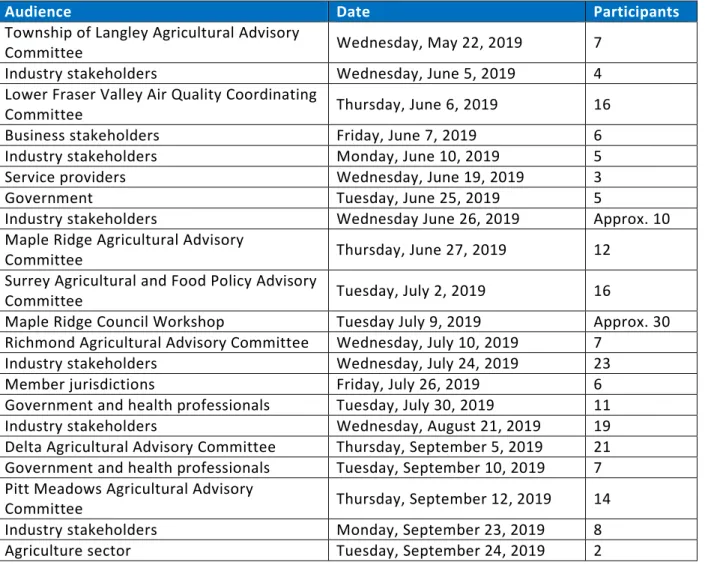
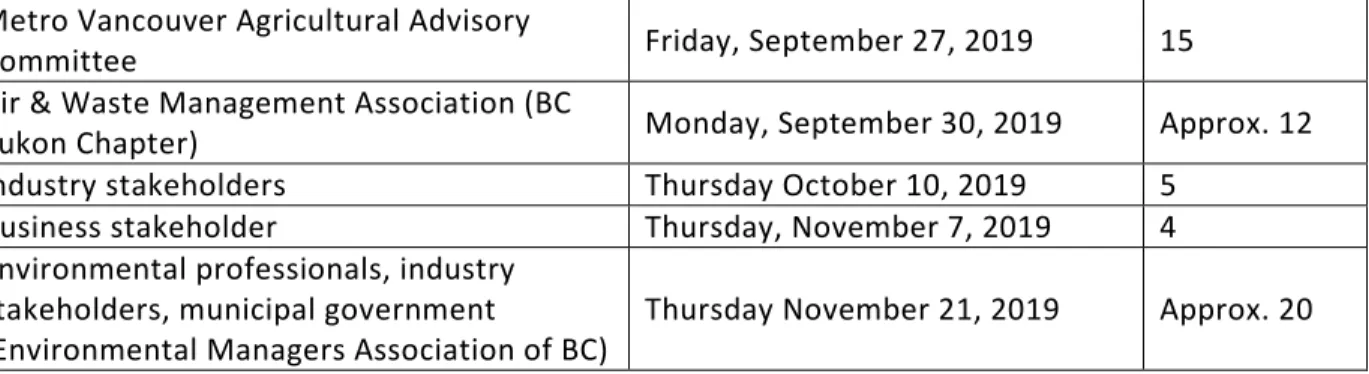
List of Stakeholders
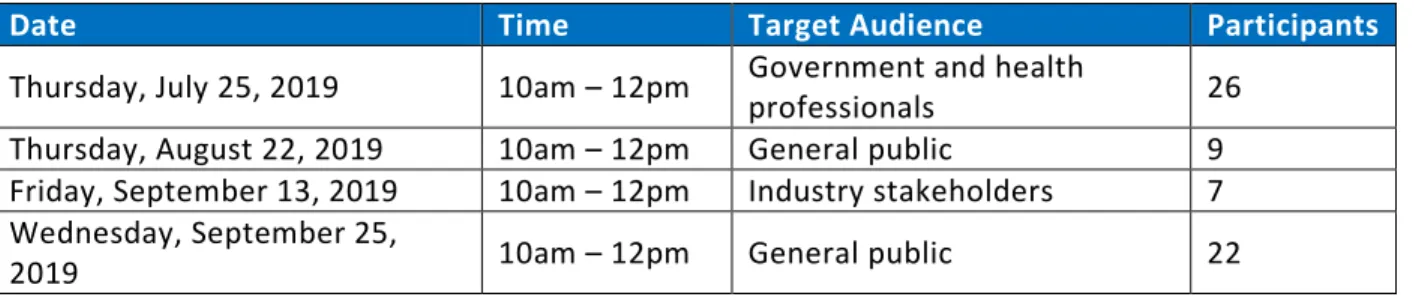
Consultation Activities .1 Webinars
- Meetings and Presentations
- Online Comment Form
- Phone Calls and Emails
- Community Pop-up Engagement Events
The feedback received through these webinars is included in the summaries provided in Section 2 of this report. 20 The feedback received through these meetings and presentations is included in the summaries in Section 2 of this report. Results of the comment form multiple choice question, as well as summaries of responses to open questions can be found in Section 2 of this report.
The feedback received through these channels has been incorporated into the summaries in Chapter 2 of this report. Feedback received during these events has been incorporated into the summaries in Part 2 of this report.
Support Materials
- General Information Material
- Promotional Materials for Pop-ups and Webinars
- Presentations
Consultation Feedback 2.1 Summary of Feedback
Detailed Feedback .1 Jurisdiction
- Implementation
- Justification
- General feedback
They specifically questioned whether hemp growers, home growers and the production of edible products would be included in these regulations. However, others were skeptical about the overall process of implementing a regulation, and whether or not the scientific data really justified a need for regulation. Others commented on aspects of the consultation and engagement process, as well as miscellaneous topics.
Participants noted that there would be an unfair advantage to illegal producers if these regulations were only enforced against legal production facilities. Participants expressed a desire to know how illegal producers will be governed under the new regulatory environment.
Results of Public Feedback
- Online Questionnaire Feedback
12 Participants shared their general support for the proposed regulation and how it could affect their lives for the better. Other participants noted the general opposition to the proposed regulation and how it would negatively affect their lives. Participants asked what groups Metro Vancouver met with during the consultation, as well as what the overall tone of the feedback was.
Participants also focused on the need for a direct contact at Metro Vancouver to whom they could direct future questions and concerns and provide materials. Several varied comments requested more background information on the project and suggested meeting with more groups to gather more conclusive feedback.
Have you heard about Metro Vancouver’s proposal to manage emissions from commercial cannabis production and processing facilities in the region?
14 Question 2: Based on your interest in managing emissions from commercial marijuana production and processing facilities, what best describes you? 15 Question 3: Have you experienced any personal impact from the emissions from commercial marijuana production and processing operations in Metro Vancouver.
Cannabis production should be conducted indoors or be temporarily enclosed during periods of peak emissions (such as during flowering)
16 Question 5: Cannabis waste management activities, including composting, that take place on property where cannabis is produced or processed must be enclosed in a facility.
Question 6: Cannabis production and processing facilities should prevent emissions that affect public health and the environment from being released beyond property boundaries at a level where
17 Question 7: Facilities should be required to submit to Metro Vancouver a comprehensive air emissions management plan, certified by a qualified professional, for odorous air pollutants and other emissions.
Metro Vancouver issues regional air quality advisories when air quality degrades in the region or in the Fraser Valley Regional District. Air quality advisories are more frequent in the
18 is in force, the uncontrolled release of emissions or the circumvention of emissions controls by facilities must be prohibited.
There should be no release of emissions from facilities within 200 metres of residential areas, hospitals, schools, daycares, playgrounds, or senior care facilities
19 Question 10: Facilities should not use odor masking or odor neutralizing products outdoors.
20 Question 11 b) During peak production times (such as during flowering), the air in all temporary enclosures used for outdoor cannabis cultivation is drawn through activated carbon filters that control volatile organic compounds.
- Written submission feedback
- Next Steps
21 Question 11 d) The facility shall avoid the uncontrolled release of emissions or the circumvention of emissions controls unless permitted by the Metro Vancouver District Director (as defined in the Environmental Management Act). Other submissions included questions about the need for regulation and whether the number of complaints warranted regulatory action. The emails also questioned the need for regulation due to the reliability of VOC measurements and whether Metro Vancouver has jurisdiction in this area.
Some submissions were skeptical about the need for regulation, while others shared general support. Through the written submission process, the project team received a number of considerations and suggestions for the implementation process that could be considered as part of a future draft of Metro Vancouver's regulatory approach.
Consultation Issues-Response Table (Phase 1: June to November 2019)
Metro Vancouver's authority to regulate air emissions due to the BC Protection of Agricultural Practices (Right to Farm) Act. Volatile organic compound emissions from hemp cultivation and processing in the Metro Vancouver region are projected to reach emission levels from other industrial sectors that are currently regulated. Metro Vancouver's air emissions management responsibilities are authorized under the BC Environmental Management Act.
Metro Vancouver seeks to reduce emissions of volatile organic compounds, including those associated with odors. The Metro Vancouver Regional District (MVRD, operating as Metro Vancouver) is responsible for managing and regulating air quality in the region under authority delegated from the provincial government in the BC Environmental Management Act (EMA).