ENVIRONMENT AND HAPPINESS: NEW EVIDENCE FOR SPAIN
JUNCAL CUÑADO
FERNANDO PÉREZ DE GRACIA
FUNDACIÓN DE LAS CAJAS DE AHORROS DOCUMENTO DE TRABAJO
Nº 579/2011
De conformidad con la base quinta de la convocatoria del Programa de Estímulo a la Investigación, este trabajo ha sido sometido a eva- luación externa anónima de especialistas cualificados a fin de con- trastar su nivel técnico.
ISSN: 1988-8767
La serie DOCUMENTOS DE TRABAJO incluye avances y resultados de investigaciones dentro de los pro- gramas de la Fundación de las Cajas de Ahorros.
Las opiniones son responsabilidad de los autores.
ENVIRONMENT AND HAPPINESS: NEW EVIDENCE FOR SPAIN*
Juncal Cuñado*
Fernando Pérez de Gracia*
Abstract
In this paper we study the impact of sustainability and environmental conditions on happiness in the Spanish regions with individual-level data from the European Social Survey, using an ordinal logit model. The main results of the paper are the following.
First, after controlling for most of the socio-economic variables affecting happiness, we still find significant regional differences in subjective well-being or happiness. Second, these regional differences cannot be explained with the usual macroeconomic regional variables, such as per capita GDP or unemployment rate. However, we find that environmental variables, such as pollution, play a significant role in explaining regional differences in happiness. Furthermore, we also find significant variables of regional climate data on individual subjective well-being. Finally, and as expected, we find significant effect of different socio-economic variables on happiness, such as health, income and unemployment status among others.
Keywords: Environment economics, Climate, Air pollution, Happiness, Regional economics.
JEL classification codes: I31; Q50, R10.
Correspondence author: Juncal Cunado, Universidad de Navarra, Facultad de Ciencias Económicas y Empresariales, Campus Universitario, E-31080 Pamplona, SPAIN. E-mail:
* Department of Economics and Quantitative Methods, Universidad de Navarra.
Acknowledgements: The authors gratefully acknowledge financial support provided by the Ministerio de Ciencia y Tecnología (ECO2008-02458-E) within the EUROCORES HumVIB programme of the European Science Foundation. An earlier version of this paper has been presented at the EUNIP 2010 Conference (Reus, 2010).
1. Introduction
In recent years, there has been a large emerging body of empirical economic literature on subjective well-being (individual life satisfaction or also called happiness) and economics.1 For example, the Chairman of the Board of Governors of the Federal Reserve System of the U.S., Ben Bernanke (2010) in a recent conference on may 2010 presented the new results on economics and happiness.
The interest on this subject may be explained by different factors. First, monetary socio-economic indicators (such as GDP per capita) have been found to be insufficient measures of the well-being of citizens (see, for example, United Nations, 1954 and Erikson, 1993 and more recently, Jones and Klenow, 2010). Thus, there is a wide range of studies that uses subjective well-being indicators to measure individual happiness (see, for example, Clark and Oswald, 1994; Di Tella et al., 2001, 2003; Easterlin, 1974, 1995, 2001; Frey and Stutzer, 2002a,b; and Ferrer-i-Carbonell, 2005 among many others).
Second, quality of life studies can help to evaluate the welfare effects of different factors such as health (Berger and Leigh, 1989; Veenhoven, 1991; Hartog and Oosterbeeck, 1998; Alesina et al., 2004 and Blanchflower and Oswald, 2008), education (Di Tella et al., 2001; Albert and Davia, 2005 and Bechetti et al., 2006), macroeconomic variables (Di Tella et al., 2001), airport noise (Van Praag and Baarsma, 2005), terrorism (Frey et al., 2009), air pollution (Welsch 2002, 2006, 2007; Di Tella and MacCulloch, 2006, Ferreira et al., 2006 and Luechinger, 2009, 2010) and climate (Frijters and van Praag, 1998;
Rehdanz and Maddison, 2005; Welsch 2002, 2006, 2009; Brereton et al., 2008 and Welsch and Küling, 2009) among others. Furthermore, these studies help inferring implications of different policies, such as environmental or other public policies (see, for example, Rehdanz and Maddison, 2005; Ferrer-i-Carbonell and Gowdy, 2007 among many others). Recent surveys on the relationship between economics and happiness are Frey and Stutzer (2002b), Easterlin (2005), Clark et al. (2006), Di Tella and MacCullough (2006), Helliwell (2006), Bruni and Porta (2007), Layard (2006) and Graham (2008) among others.
The subjective well-being literature uses the individual´s self-reported satisfaction with life to understand the determinants of happiness and to evaluate the impact of different policies on individual satisfaction. In this paper we study the impact of climate
1 Throughout the paper we use the terms happiness and life satisfaction interchangeably. Many recent studies assume happiness and life satisfaction as synonymous (see, for example Caporale et al., 2009 and Cunado and Perez de Gracia, 2010). In this paper, we used both happiness and life satisfaction scores as measures of subjective well-being (i.e., dependent variable in our empirical analysis). The
and air pollution conditions on happiness in the Spanish regions using individual-level data from the European Social Survey. We combine this data set with regional data on macroeconomic obtained from Instituto Nacional de Estadistica and some climate and pollution indicators obtained from Ministerio de Medio Ambiente y Medio Rural y Marino.
The objective of this paper is the analysis of the impact of individual variables (e.g., age, income, health, gender, marital status, number of children, education, employment status), macroeconomic regional variables (e.g., GDP per capita, its growth rate, and the unemployment rate), regional climate variables (e.g., average mean temperature, average mean precipitation, humidity, number of rainy days, number of sun hours) and air pollution variables (e.g., nitrogen dioxide and phosphorus) on individual happiness. This is the first paper using Spanish regional data on self reported happiness and climate and air pollution indicators. Ferreira et al. (2006) and Luechinger (2009) are two recent papers that focused on a regional basis. Ferreira et al. (2006) using data on subjective well being of the Irish regions in 2001 analyze environmental attributes linked to each respondent’s dwelling area using a Geographic Information System while Luechinger (2009) using pollution data and a large panel survey for Germany, a country with a large variation in pollution, both across space and over time estimate the effect of pollution on life satisfaction and housing rents.
The remainder of the paper is structured as follows. Section 2 briefly reviews the main literature contributions on the impact of socio-economic variables, climate and other environmental variables such as air pollution indicators on individual happiness. Section 3 presents the data sources, the definition of the variables, the estimation procedure and the main results for the Spanish regions during year 2008. Finally Section 4 offers some concluding remarks.
2. Literature Review on Happiness, Climate and Air Pollution
As we have explained in the Introduction Section, in this paper we explore the connection between subjective well-being and some climate and air pollution indicators. A large number of studies attempts to address this relationship between the environment variables and subjective well-being (see, for example, Fritjers and Van Praag, 1998;
Welsch, 2002, 2006, 2009; Rehdanz and Maddison, 2005; Becchetti et al., 2007;
Zidanseck, 2007; Ferrer-i-Carbonell and Gowdy, 2007, Brereton et al., 2008 and Florida et results are very similar with both proxy variables (happiness and life-satisfaction). The life satisfaction
al., 2010 among many others) and air pollutions indicators and happiness (see, for example, Welsch 2002, 2006, 2007 and Luechinger, 2010 among others). A recent survey on the connection between human well-being and environmental conditions can be found in Welsch and Kühling (2009).2
For example, Rehdanz and Maddison (2005) using a panel of 67 countries attempting to explain differences in self-reported levels of happiness. Their results suggest that climate variables such as temperature and precipitation can be used to investigate differences in self-reported subjective well-being. They found that higher mean temperatures in a coldest month increase happiness while higher mean temperatures in the hottest month decrease happiness. Finally, they also obtained that precipitation does not significantly affect happiness. In other related study, Becchetti et al. (2007) using data from World Value Survey (third and four waves), World Development Indicators, Fraser Institute of Economic and Freedom Index and the National Oceanic and Atmosferic Administration of the US Department of Commerce showed that the number of rainy days increases life satisfaction up to a peak of around 110 days while it reduces it afterwards suggesting that rain has a hump-shaped impact and should depend on the effect of it on the reduction of sun brightness and visibility. After a minimum of 140 days of fog, the satisfaction level stars increasing. Furthermore, the paper found that the effect of fog is negative detecting an U-shaped impact. In addition, they obtained that the temperature has also a U-shaped effect on people´s satisfaction. Brereton et al. (2008) using data disaggregated at the individual and local level for Ireland obtained that climate has a significant influence on well-being. In particular, they suggested that wind speed affects negatively and increase in both January minimum temperature and July maximum temperature also increase life satisfaction. In addition, they also obtained that access to major transport routes and proximity to coast ad to waste facilities are relevant variables that influence well-being. More recently, Florida et al. (2010) using data from the 2009 Gallup - Healthways Survey in 184 US metropolitan areas found that the correlations are statistically non significant for January temperature and temperature stability while July temperature is negatively and significant related to metropolitan happiness.
In other studies, Welsch (2002, 2006) and Luechinger (2010) analyze the relationship between happiness and some pollution indicators. For example, Welsch (2006) using panel data for ten European countries finds that air pollution plays a statistically significant role as a predictor of intercountry and inter-temporal differences in
2 Peiró (2001), Ateca et al. (2004) and, recently, Ahn and Mochón (2010) analyze the relationship between happiness and socioeconomic variables (unemployment, income, health and marital status among others)
subjective well-being. In a recent European study, Luechinger (2010) using data from the Eurobarometer, OECD and European Air Quality data base for the period 1979 – 1994 also obtained that air pollution affects negatively life satisfaction. In other recent contribution to the literature, Ferrer-i-Carbonell and Gowdy (2007) using data from the British Household Panel Survey from 1991 to 2003 found a significant negative correlation between well-being and concern about ozone pollution and a positive correlation between well-being and concern about species extinction.
In other recent paper, Zidanseck (2007) explored the relation between sustainable indicators and happiness. Using data from Environment Sustainability Index and Environmental Performance Index for 1990 and 2000, Zidanseck (2007) found a significant relationship between sustainability and happiness in both directions: people who are happier tend to care more about the environment and people who live in a better environment tend to be happier.
Following previous empirical studies that suggest a connection between environmental indicators and their impact on subjective well-being, in this paper we examine the importance of such relationship in the Spanish regions in year 2008.
3. Empirical Analysis: Data, Variables, Estimation and Results
For the empirical analysis of the Spanish case, we use three different data sources.
First, we use the European Social Survey to obtain happiness data and most of the socio- economic factors affecting happiness (EES, www.europeansocialsurvey.org).3 The European Social Survey (EES) provides rich data on individuals’ subjective well-being, political interests, trust, electoral participation, party allegiance, socio-political orientations, environmental attitudes and demographic and socio-economic characteristics required to control for individual heterogeneity (age, gender, education, employment status, marital status, number of children, income, etc.). Second, we also use GDP per capita and the unemployment rate data for each of the Spanish regions from Instituto Nacional de Estadística (INE, www.ine.es). Finally, we combine previous data with climate and air pollution data from Ministerio de Medio Ambiente y Medio Rural y Marino (AEMET, www.aemet.es).
in the Spanish case. The results they found regarding the relationship among these variables are in line with those obtained in this paper.
3 The ESS is a biennial multi-country survey covering over 30 nations. The first round was fielded in 2002/2003. Some papers that also used the ESS are Benesch et al. (2006), Caporale et al. (2009), Sironi
Table 1 summarizes all the data used in this paper. In this paper, we define different variables, some of them related with personal status (e.g., gender, age, income, subjective general health, marital status and main activity), the regional economic performance (e.g., GDP per capita, GDP growth rate and unemployment rate for each of the variables), others related with climate (e.g., average mean temperature, average main precipitation, relative humidity, number of rainy days, number of snowy days, number of foggy days, number of freeze days, number of sunny days and number of sun hours) and finally, pollution variables (e.g., nitrogen dioxide and phosphorus emissions).
TABLE 1. Description of the variables used
Variable name Source Description
Happiness ESS How happy are you, from 1 (not happy at all) to 10 (absolutely happy) Satisfied with your life ESS How satisfied with life as a whole, from 1 (not satisfied at all) to 10 (absolutely
satisfied)
Gender ESS Dummy variable which takes value 1 if the respondent is male, 0 otherwise Age ESS Age of the respondent in years
Income ESS Subjective feeling about household´s income nowadays: 1 (living comfortably on present income), 2 (coping on present income), 3 (difficult on present income), 4 (very difficult on present income)
Children ESS Dummy variable which takes value 1 if the respondent has children, 0 otherwise Subjective general
health
ESS Discrete variable which takes the following values: 1 (Very good), 2 (good), 3 (fair), 4 (bad), 5 (very bad)
Marital status ESS Discrete variable which takes the following values: 1 (married); 2 (in a civil paternship);
3 (separated); 4 (divorced); 5 (widowed); 6 (never married, never in a civil paternship) Main activity ESS Discrete variable which takes the following values: 1 (paid work); 2 (education); 3
(unemployed looking for a job); 4 (unemployed, not looking for a job); 5 (permanently sick or disabled); 6 (retired); 7 (housework and children)
Regions ESS Spanish region where the individual lives GDP per capita INE Per capita GDP of each of the Spanish regions Unemployment rate INE Unemployment rate for each of the Spanish regions T AEMET Annually averaged mean temperature (ºC) Tmax AEMET Average mean temperature in hottest month (ºC) Tmin AEMET Average mean temperature in coldest month (ºC) R AEMET Regional averaged mean precipitation (mm) H AEMET Regional relative humidity
DR AEMET Number of rainy days DN AEMET Number of snowy days
DT AEMET Number of days in which it stormed DF AEMET Number of foggy days
DH AEMET Number of freeze days DD AEMET Number of sunny days I AEMET Number of sun hours
Nitrogen AEMET Pollution by nitrogen dioxide (Tons/year) Phosphorus AEMET Pollution by phosphorus (Tons/year)
Notes: ESS stands for European Social Survey (www.europeansocialsurvey.org); INE stands for Instituto Nacional de Estadística (www.ine.es) and AEMET stands for Agencia Estatal de Meteorología (www.aemet.es).
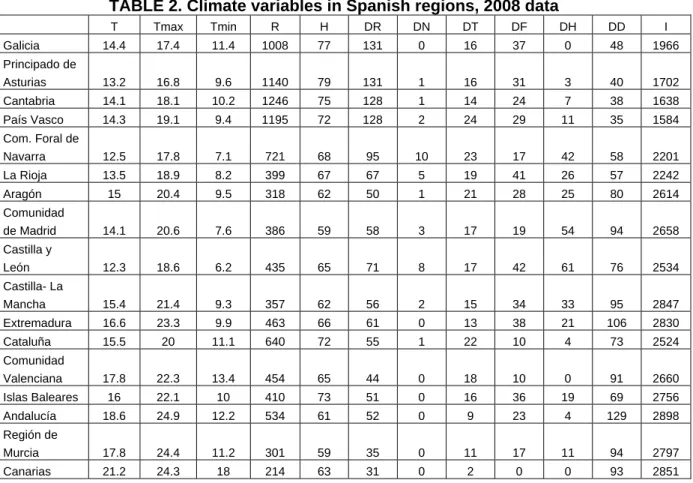
Table 2 includes the information on climate variables for each of the Spanish regions for 2008. The results show that Andalucia and Canary Islands present the
higher mean temperatures (with 18.6 and 21.6 ºC respectively) while Castilla – Leon and Navarra present the lower temperatures in 2008 (with 12.8 and 12.5 ºC respectively). When we observe the average mean precipitation, we detect that the Pais Vasco and Cantabria present the higher precipitation with 1195 and 1246 mm respectively while Murcia and Canary Islands present the lower precipitation with 301 and 214 mm respectively. Other relevant climate indicator is the number of sun hours per year which also present a higher variability with 2898 in the case of Andalucia and 1584 in the case of the Pais Vasco.
TABLE 2. Climate variables in Spanish regions, 2008 data
T Tmax Tmin R H DR DN DT DF DH DD I
Galicia 14.4 17.4 11.4 1008 77 131 0 16 37 0 48 1966 Principado de
Asturias 13.2 16.8 9.6 1140 79 131 1 16 31 3 40 1702 Cantabria 14.1 18.1 10.2 1246 75 128 1 14 24 7 38 1638 País Vasco 14.3 19.1 9.4 1195 72 128 2 24 29 11 35 1584 Com. Foral de
Navarra 12.5 17.8 7.1 721 68 95 10 23 17 42 58 2201 La Rioja 13.5 18.9 8.2 399 67 67 5 19 41 26 57 2242
Aragón 15 20.4 9.5 318 62 50 1 21 28 25 80 2614
Comunidad
de Madrid 14.1 20.6 7.6 386 59 58 3 17 19 54 94 2658 Castilla y
León 12.3 18.6 6.2 435 65 71 8 17 42 61 76 2534
Castilla- La
Mancha 15.4 21.4 9.3 357 62 56 2 15 34 33 95 2847 Extremadura 16.6 23.3 9.9 463 66 61 0 13 38 21 106 2830 Cataluña 15.5 20 11.1 640 72 55 1 22 10 4 73 2524 Comunidad
Valenciana 17.8 22.3 13.4 454 65 44 0 18 10 0 91 2660 Islas Baleares 16 22.1 10 410 73 51 0 16 36 19 69 2756 Andalucía 18.6 24.9 12.2 534 61 52 0 9 23 4 129 2898 Región de
Murcia 17.8 24.4 11.2 301 59 35 0 11 17 11 94 2797 Canarias 21.2 24.3 18 214 63 31 0 2 0 0 93 2851
As in many studies in the literature, this paper uses individual´s responses to the question: “How happy are you”. The respondent answers on a scale from 1 to 10, where 1 stands for not happy at all and 10 for completely happy. This happiness measure is explained by means of using the following model
k i k k i k
ui, 'x, ' , (1)
with i1....I, k = 1,…, K
where u is the answer to the happiness question, i represents the individual, k the Spanish region, x is a set of explanatory variables and is a set of environmental variables (i.e., climate and pollution indicators). Equation (1) is estimated using an Ordered Logit model (see, for example, Maddala, 1983). Peiro (2006) and Cunado and Perez de Gracia (2010) among others also estimated the determinants of happiness using an Ordered Logit Model.
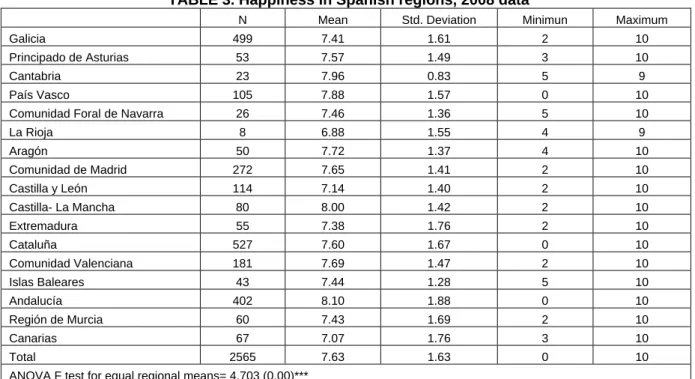
The estimation procedure is carried out in two different steps. In a first step, we present some descriptive data on happiness across the Spanish regions. As shown in Table 3, based on an ANOVA F test, we can reject the null hypothesis of no regional differences in happiness which suggest the region in which an individual lives may be a significant variable explaining his/her happiness or satisfaction level.
TABLE 3. Happiness in Spanish regions, 2008 data
N Mean Std. Deviation Minimun Maximum
Galicia 499 7.41 1.61 2 10
Principado de Asturias 53 7.57 1.49 3 10
Cantabria 23 7.96 0.83 5 9
País Vasco 105 7.88 1.57 0 10
Comunidad Foral de Navarra 26 7.46 1.36 5 10
La Rioja 8 6.88 1.55 4 9
Aragón 50 7.72 1.37 4 10
Comunidad de Madrid 272 7.65 1.41 2 10
Castilla y León 114 7.14 1.40 2 10
Castilla- La Mancha 80 8.00 1.42 2 10
Extremadura 55 7.38 1.76 2 10
Cataluña 527 7.60 1.67 0 10
Comunidad Valenciana 181 7.69 1.47 2 10
Islas Baleares 43 7.44 1.28 5 10
Andalucía 402 8.10 1.88 0 10
Región de Murcia 60 7.43 1.69 2 10
Canarias 67 7.07 1.76 3 10
Total 2565 7.63 1.63 0 10
ANOVA F test for equal regional means= 4.703 (0.00)***
Notes: N denotes number of observations. In the last row of the table, we show the statistic for the ANOVA F test for equal regional means. The statistic is 4.703, and the p-value is 0, so that, we can reject the null hypothesis of no regional differences at any significance level. ***
In a second step, we include individual socio-economic explanatory variables in the happiness equation. The main results obtained in this analysis are the following (see Table 4, Model 1):
- First, we find a significant effect of age on happiness. In fact, we find a non- linear effect of age on happiness: the negative effect of “age” and the positive effect of “age*age” indicates that happiness is U-shapped with age.
- Second, we do not find a significant effect of the “gender” variable on happiness. In former analysis, we find a low but significant (at a 10%
significance level) effect of this variable. That is, women seem to be happier in average than men after controlling for the rest of explanatory factors. A similar result is also obtained by Castriota (2006).
- Third, one of the most significant variables on happiness is “subjective general health”. People who feel they have a very good, good or fair health are happier than those with bad health. Similar results are found by Berger and Leigh (1989), Veenhoven (1989,1991), Hartog and Oosterbeeck (1998) and Alesina et al. (2004).
- Fourth, “income” has also a positive significant and relevant effect on happiness. Similar result is also found by Veenhoven (1989).
- Fifth, “marital status” plays also a significant role on happiness: people who are married or in a civil partnership are happier than singles, while separated and widowed individuals are less happy than single ones (similar to Clark and Oswald, 1994; Blanchflower and Oswald, 2004b and Brereton et al., 2008 among others).
- Sixth, the unemployment status has a negative and significant effect on happiness. While there are no significant differences among the variable which controls for professional activities, being unemployed and looking for a job is the unique negative and significant variable in this group of factors. A similar result is also found by Clark and Oswald (1994), Blanchflower and Oswald (2004a) and Winklemann (1998).
- Having children have also a positive significant effect on happiness.
- Finally, we find that, even after controlling for all the former socio-economic variables, there are still significant regional variables. For example, we still find higher happiness indexes in some regions such as Andalucia, Castilla - La Mancha, Comunidad Valenciana and Cataluña, and lower indexes for La Rioja or Canarias. This is a key conclusion of this paper, since it indicates that socio- economic variables are not enough for explaining differences in happiness. The rest of the paper tries to explain these regional differences in happiness. The results presented in Model 2 (Table 4) indicate that these regional variables cannot be explained by the usual macroeconomic regional variables such as per capita GDP, its growth rate and regional unemployment rate. In fact, when we include both macroeconomic and environmental variables in the same equation, we observe that these last variables explain differences in happiness among regions better than the macroeconomic variables.
When we estimate the happiness equation including individual socio-economic variables, regional economic variables and climate and pollution variables using an ordinal logit model, the main results are the following (see Table 4, model 3). The results are the following:
- Due to the high correlation coefficient among regional temperature variables (average, maximum and minimum temperatures), we only include as explanatory variable the average temperature, which plays a significant and negative effect on individual happiness. That is, people living in regions with high temperature are not as happy as those living in other regions.
- Other climate variables, different from temperature, play additional roles in explaining happiness. For example, regional rain precipitation has a positive significant effect on individual happiness. A similar result is found by Brereton et al. (2008). For the Irish case they interpreted the results as follows: an increased rainfall slightly increases life satisfaction. Furthermore, the results suggest that humidity and number of freeze days have a negative impact on happiness. Finally, the number of sun hours has a positive effect on individual happiness.
TABLE 4. Ordinal Logit estimation
Model 1 Model 2 Model 3
Age -0.074 (26.5)*** -0.074 (26.56)*** -0.074 (26.70)***
Age2 0.001 (18.33)*** 0.001 (18.45)*** 0.001 (18.57)***
Gender Male Female
-0.132 (2.66) -0.13 (2.66) -0.138 (2.92)*
Health Very good Good
Fair Bad Very bad
2.66 (46.36)***
1.83 (23.02)***
1.39 (13.44)***
0.835 (4.76) **
2.67 (46.88)***
1.84 (23.30)***
1.40 (13.67)***
0.85 (4.89)**
2.71 (48.05)***
1.87 (24.11)***
1.43 (14.25)***
0.87 (5.13)**
Income Comfortable Quite comfortable Difficult
Very difficult
1.55 (57.76)***
1.09 (31.16)***
0.366 (3.28)*
1.55 (57.74)***
1.09 (31.27)***
0.37 (3.34)*
1.53 (56.48)***
1.07 (30.35)***
0.34 (2.86)*
Marital status Married Civil paternship Separated Divorced Widowed
Never married, never civil paternhip
0.69 (28.43)***
0.575 (6.24)**
-0.563 (3.09)*
-0.17 (0.10) -0.45 (4.29)**
0.69 (28.56)***
0.58 (6.26)***
-0.56 (3.05)*
-0.16 (0.09) -0.45 (4.30)*
0.69 (28.60)***
0.57 (6.10)**
-0.56 (3.06)*
-0.175 (0.10) -0.46 (4.45)**
Main activity Paid work Education
Unemployed, looking Unemployed, not looking
Sick, disabled Retired
Housework, children
-0.039 (0.082) 0.080 (0.131) -0.71 (10.65)***
0.282 (0.94) 0.025 (0.01) 0.253 (2.94)*
-0.04 (0.09) 0.08 (0.13) -0.72 (10.93)***
0.27 (0.86) 0.02 (0.01) 0.25 (2.90)*
-0.033 (0.06) 0.066 (0.09) -0.71 (10.81)***
0.282 (0.943) 0.030 (0.01) 0.258 (3.07)*
Children Yes No
0.226 (5.96)** 0.22 (5.83)** 0.222 (5.81)**
Region Galicia P. de Asturias Cantabria País Vasco Com. Foral Navarra La Rioja
Aragón C. de Madrid Castilla y León Castilla La Mancha Extremadura Cataluña Com. Valenciana Islas Baleares Andalucía Región de Murcia Canarias
0.244 (1.03) 0.329 (0.94) 0.415 (0.89) 0.508 (3.04)*
0.137 (0.10) 0.137 (0.04) 0.436 (1.61) 0.259 (1.05) -0.201 (0.51) 0.795 (6.60)***
0.094 (0.08) 0.506 (4.45)**
0.552 (4.38)**
0.217 (0.37) 1.144 (21.68)***
0.338 (1.08) Macroeconomic
regional variables
Per capita GPD Unemployment rate Per capita GDP growth
0.00 (0.04)
0.02 (0.07) -0.03 (0.02) Climate
variables
T Tmax Tmin R H DR DN DT DF DH DD I
-0.24 (2.45)
0.004 (4.84)***
-0.18 (11.66)***
-0.002 (1.03)
-0.033 (5.66)**
-0.023 (2.19) 0.003 (4.87)**
-0.172 (5.01)**
0.002 (11.89)***
-0.086 (15.30)***
-0.006 (2.84)*
-0.024 (7.31)***
0.001 (5.00)**
Pollution variables
Nitrogen
Phosphorus -0.37 (1.22) -0.282 (2.58)**
Pseudo-R2 0.251 0.250 0.249
Notes: *, ** and *** indicate significant at 10, 5 and 1% level.
- As far as air pollution variables are concerned, the two variables we use in this paper are correlated (the correlation coefficient is 0.86), so that, we include in model 3 one of them, obtaining a significant and negative effect on individual happiness. That is, the results suggest that people living in more polluted areas report lower happiness indexes than those living in less polluted areas. This result is similar to that of Welsch (2002, 2006 and 2007) and Luechinger (2010) who find that air pollution variables present a negative and significant impact on individual level of happiness.
4. Concluding Remarks
In this paper we analyze regional differences in happiness across Spanish regions using data for 2008 from the European Social Survey Database, Instituto Nacional de Estadística and Ministerio de Medio Ambiente y Medio Rural y Marino, and by means of estimating different Ordinal Logit Models. A first look at the data shows significant differences among Spanish regions. For example, Andalucia and Castilla - La Mancha are the regions which present the highest happiness average index, while La Rioja, Canarias and Castilla-Leon present the lowest indexes.
When we include individual socio-economic variables in the happiness equation, we still find significant regional differences in happiness, which implies that individual happiness also depends on geographical or regional variables. In order to account for these variables, we include in the happiness equation regional economic, climate and pollution variables.
The most relevant results obtained in this paper are the following. Climate and air pollution variables affect happiness more than other regional macroeconomic variables, such as regional GDP or unemployment rate. In fact, the average temperature of the region has a negative impact on individual happiness, while average rain precipitation has a positive effect on this variable. Furthermore, people who live in a region with higher number of sun hours seem happier, while those who live in a region with a higher relative humidity are less happy. In this paper, the pollution variables are proxied by nitrogen dioxide and phosphorus emissions. Pollution
variables affect in a significant negative way on individual happiness. Finally, and as expected, we find several individual explanatory variables with a positive and significant effect on happiness, such as age, health, income, married people and significant and negative of the unemployment and separated or widowed people.
We believe that the results obtained in this paper may help designing public policies in order to affect individual happiness at regional level. For example, it seems than policies directed to control the pollution may have positive effects on individual happiness and subjective well-being.
References
Ahn, N. and Mochón, F. (2010): La felicidad de los españoles: factores explicativos. Revista de Economía Aplicada 54, 5–31.
Albert, C. and Davia, M.A. (2005): Education, wags and job satisfaction. Paper presented at the Epunet Conference 2005, Colchester.
Alesina, A., Di Tella, R. and MacCulloch, R.J. (2004): Inequality and happiness: Are Europeans and Americans different?. Journal of Public Economics 88, 2009-2042.
Ateca, V., Serrano, R. and Vera, E. (2004): The leisure experience: Me and the others. Institute for Social Studies of Andalusia, IESA WP Series 0418.
Becchetti, L., Castriota, S., Londoño Bedoya, D.A. (2007): Climate, happiness and the Kyoto Protocol: Someone does not like it hot. Mimeo.
Bernanke, B. (2010): The economics of happiness. Conference at the University of North
Carolina Commencement Ceremony, May 8, 2010, http://www.federalreserve.gov/newsevents/speech/bernanke20100508a.htm
Blanchflower, D. and Oswald, A.J. (2008): Hypertension and happiness across nations. Journal of Health Economics 27, 218-233.
Benesch, C., Frey, B.S. and Stutzer, A., (2006): TV channels, self control and happiness.
Institute for Empirical Research in Economics, University of Zurich WP Series No. 321.
Brereton, F., Clinch, J.P. and Ferreira, S. (2008): Happiness, geography and environment.
Ecological Economics 65, 386 – 396.
Bruni, L. and Porta, P.L. (2007): Handbook on the economics of happiness. Northampton, MA:
Edward Elgar.
Caporale, G.M., Georgellis, Y., Tsitsianis, N. and Yin, Ya Ping, (2009): Income and happiness across Europe: Do reference values matter?. Journal of Economic Psychology 30, 42 – 51.
Castriota, S. (2006): Education and happiness: A further explanation to the Easterlin paradox.
Mimeo.
Clark, A. E. and Oswald, A. J. (1994): Unhappiness and unemployment. Economic Journal 104, 648-59.
Clark, A. E., Frijters, P. and Shields M.A. (2006): Income and happiness: Evidence, explanations and economic implications. Mimeo, Paris-Jourdan Sciences Economiques.
Cunado, J. and Pérez de Gracia, F. (2010): Does education affect happiness? Evidence for Spain.
Paper presented at the XIX Meeting of the Economics of Education Association Conference, Zaragoza, Spain.
Di Tella, R. and MacCulloch, R. J. (2006): Some uses of happiness data in economics. Journal of Economic Perspectives 20, 25-46.
Di Tella, R.; MacCulloch, R. J. and Oswald A. J. (2003): The macroeconomics of happiness.
The Review of Economics and Statistics 85, 793 – 809.
Di Tella, R.; MacCulloch, R. J. and Oswald A. J. (2001): Preferences over inflation and unemployment: Evidence from surveys of happiness. American Economic Review 91, 335- 341.
Easterlin, R.A. (1974): Does economic growth improve the human lot?. In Paul A. David and Melvin W. Reder, (eds.), Nations and Households in Economic Growth: Essays in Honor of Moses Abramovitz, Academic Press, New York.
Easterlin, R.A. (1995): Will raising the incomes of increase the happiness of all?. Journal of Economic Behaviour and Organisation 27, 35-47.
Easterlin, R.A. (2001): Income and happiness: Towards a unified theory. Economic Journal 111, 465-84.
Easterlin, R. A. (2005): Building a better theory of well-being. In: Luigino Bruni and Pier Luigi Porta (eds). Economics and Happiness. Framing the Analysis. Oxford: Oxford University Press: 29-64.
Erikson, R. (1993): Descriptions of inequality: The Swedish approach to welfare research. In Nussbaum, M., Sen, A. (eds.), The Quality of Life, Clarendon Press, Oxford.
Ferreira, S., Moro, M. and Clinch, P. (2006): “Valuing the environment using the life satisfaction approach”, University College Dublin WP.
Ferrer-i-Carbonell, A. (2005): “Income and well-being: An empirical analysis of the comparison income effect”, Journal of Public Economics 89, 997-1019.
Ferrer-i-Carbonell, A. and Gowdy, J.M. (2007): Environmental awareness and happiness.
Ecological Economics 60, 509-516.
Florida, R., Mellander, C. and Rentfow, P.J., (2010): The happiness of cities. Working Paper Series – Martin Prosperity Research 2010 – 10.
Frey, B. S. and Stutzer, A. (2002a): Happiness and Economics. Princeton University Press, Princeton.
Frey, B. S. and Stutzer, A. (2002b): What can economists learn from happiness research?.
Journal of Economic Literature XL, 402-435.
Frey, B. S., Luechinger, S. and Stutzer, A. (2009): The life satisfaction approach to valuing public goods: The case of terrorism. Public Choice 138, 317 – 345.
Frijters, P. and Van Praag, B. (1998): The effect of climate on welfare and well-being in Russia.
Climate Change 39, 61-81.
Gerlach, K. and Stephan, G. (1996): A paper on unhappiness and unemployment in Germany.
Economic Letters 52, 325-330.
Gowdy, J. M. (2004): The revolution in welfare Economics and its implications for environmental valuation and policy. Land Economics 80, 239 – 257.
Graham, C. (2008): The economics of happiness. In S. Durlauf and L. Blume (eds.). New Palgrave Dictionary of Economics. 2nd edition Basingstoke: Macmillam.
Hartog, J. and Oosterbeek, H. (1998): Health, wealth and happiness: Why pursue a higher education?. Economics of Education Review 17, 245-256.
Helliwell, J. F. (2006): Well-being, social capital and public policy: What's new?. Economic Journal 116, C34-C45.
Jones, C.I. and Klenow, P.J. (2010): Beyond GDP? Welfare across countries and time. NBER WP 16352.
Layard, R. (2006): Happiness and public policy: A challenge to the profession. Economic Journal 116, C24-C33.
Luechinger, S. (2009): Valuing air quality using the life satisfaction approach. Economic Journal 119, 482-515.
Luechinger, S. (2010): Life satisfaction and transboundary air pollution. Economics Letters 107, 4-6.
Maddala, G.S., (1983): Limited dependent and qualitative variables in econometrics.
Cambridge University Press, Cambridge, UK.
Moro, M., Brereton, F., Clinch, J. P. and Ferreira, S. (2009): Ranking quality of life using subjective well-being data. Planning and Environmental Policy Research Series WP, University College Dublin.
Ng, Y-K. (1997): A case for happiness, cardinalism and interpersonal comparability. Economic Journal 107, 1848-1858.
Peiro, A. (2006): Happiness, satisfaction and socio-economic conditions: Some international evidence. Journal of Socio Economics 35, 348-365.
Peiro, A. (2001): Condiciones socioeconómicas y felicidad de los españoles. Documento de Trabajo – IVIE, WP EC 2001-23.
Rehdanz, K. and Maddison, D. (2005): Climate and happiness. Ecological Economics 52, 111- 125.
Sironi, M. and Mencarini, L. (2009): Happiness, housework and gender inequality in Europe. A comparative of 26 countries with European Social Survey data. Mimeo.
United Nations (1954): International Definition and Measurement of Standards and Levels of Living. New York: United Nations Publications.
Van Praag, B.M. and Baarsma, B.E. (2005): Using happiness surveys to value intangibles: The case of airport noise. Economic Journal 115, 224 – 246.
Veenhoven, R. (1991): Questions on happiness: Classical topics, modern answers, blind spots.
In F. Strack, M. Argyle and N. Schwarz, Subjective well-being, Pergamon Press, Oxford.
Veenhoven, R. (1989): National wealth and individual happiness. In Grunert K.G. and F.ölander, Understanding economic behaviour, Kluwer Academic Publishers, Dordrecht.
F
UNDACIÓN DE LASC
AJAS DEA
HORROS DOCUMENTOS DE TRABAJOÚltimos números publicados
159/2000 Participación privada en la construcción y explotación de carreteras de peaje Ginés de Rus, Manuel Romero y Lourdes Trujillo
160/2000 Errores y posibles soluciones en la aplicación del Value at Risk Mariano González Sánchez
161/2000 Tax neutrality on saving assets. The spahish case before and after the tax reform Cristina Ruza y de Paz-Curbera
162/2000 Private rates of return to human capital in Spain: new evidence F. Barceinas, J. Oliver-Alonso, J.L. Raymond y J.L. Roig-Sabaté 163/2000 El control interno del riesgo. Una propuesta de sistema de límites
riesgo neutral
Mariano González Sánchez
164/2001 La evolución de las políticas de gasto de las Administraciones Públicas en los años 90 Alfonso Utrilla de la Hoz y Carmen Pérez Esparrells
165/2001 Bank cost efficiency and output specification Emili Tortosa-Ausina
166/2001 Recent trends in Spanish income distribution: A robust picture of falling income inequality Josep Oliver-Alonso, Xavier Ramos y José Luis Raymond-Bara
167/2001 Efectos redistributivos y sobre el bienestar social del tratamiento de las cargas familiares en el nuevo IRPF
Nuria Badenes Plá, Julio López Laborda, Jorge Onrubia Fernández
168/2001 The Effects of Bank Debt on Financial Structure of Small and Medium Firms in some Euro- pean Countries
Mónica Melle-Hernández
169/2001 La política de cohesión de la UE ampliada: la perspectiva de España Ismael Sanz Labrador
170/2002 Riesgo de liquidez de Mercado Mariano González Sánchez
171/2002 Los costes de administración para el afiliado en los sistemas de pensiones basados en cuentas de capitalización individual: medida y comparación internacional.
José Enrique Devesa Carpio, Rosa Rodríguez Barrera, Carlos Vidal Meliá
172/2002 La encuesta continua de presupuestos familiares (1985-1996): descripción, representatividad y propuestas de metodología para la explotación de la información de los ingresos y el gasto.
Llorenc Pou, Joaquín Alegre
173/2002 Modelos paramétricos y no paramétricos en problemas de concesión de tarjetas de credito.
Rosa Puertas, María Bonilla, Ignacio Olmeda
174/2002 Mercado único, comercio intra-industrial y costes de ajuste en las manufacturas españolas.
José Vicente Blanes Cristóbal
175/2003 La Administración tributaria en España. Un análisis de la gestión a través de los ingresos y de los gastos.
Juan de Dios Jiménez Aguilera, Pedro Enrique Barrilao González 176/2003 The Falling Share of Cash Payments in Spain.
Santiago Carbó Valverde, Rafael López del Paso, David B. Humphrey Publicado en “Moneda y Crédito” nº 217, pags. 167-189.
177/2003 Effects of ATMs and Electronic Payments on Banking Costs: The Spanish Case.
Santiago Carbó Valverde, Rafael López del Paso, David B. Humphrey
178/2003 Factors explaining the interest margin in the banking sectors of the European Union.
Joaquín Maudos y Juan Fernández Guevara
179/2003 Los planes de stock options para directivos y consejeros y su valoración por el mercado de valores en España.
Mónica Melle Hernández
180/2003 Ownership and Performance in Europe and US Banking – A comparison of Commercial, Co- operative & Savings Banks.
Yener Altunbas, Santiago Carbó y Phil Molyneux
181/2003 The Euro effect on the integration of the European stock markets.
Mónica Melle Hernández
182/2004 In search of complementarity in the innovation strategy: international R&D and external knowledge acquisition.
Bruno Cassiman, Reinhilde Veugelers
183/2004 Fijación de precios en el sector público: una aplicación para el servicio municipal de sumi- nistro de agua.
Mª Ángeles García Valiñas
184/2004 Estimación de la economía sumergida es España: un modelo estructural de variables latentes.
Ángel Alañón Pardo, Miguel Gómez de Antonio
185/2004 Causas políticas y consecuencias sociales de la corrupción.
Joan Oriol Prats Cabrera
186/2004 Loan bankers’ decisions and sensitivity to the audit report using the belief revision model.
Andrés Guiral Contreras and José A. Gonzalo Angulo
187/2004 El modelo de Black, Derman y Toy en la práctica. Aplicación al mercado español.
Marta Tolentino García-Abadillo y Antonio Díaz Pérez 188/2004 Does market competition make banks perform well?.
Mónica Melle
189/2004 Efficiency differences among banks: external, technical, internal, and managerial Santiago Carbó Valverde, David B. Humphrey y Rafael López del Paso
190/2004 Una aproximación al análisis de los costes de la esquizofrenia en españa: los modelos jerár- quicos bayesianos
F. J. Vázquez-Polo, M. A. Negrín, J. M. Cavasés, E. Sánchez y grupo RIRAG 191/2004 Environmental proactivity and business performance: an empirical analysis
Javier González-Benito y Óscar González-Benito
192/2004 Economic risk to beneficiaries in notional defined contribution accounts (NDCs) Carlos Vidal-Meliá, Inmaculada Domínguez-Fabian y José Enrique Devesa-Carpio
193/2004 Sources of efficiency gains in port reform: non parametric malmquist decomposition tfp in- dex for Mexico
Antonio Estache, Beatriz Tovar de la Fé y Lourdes Trujillo 194/2004 Persistencia de resultados en los fondos de inversión españoles
Alfredo Ciriaco Fernández y Rafael Santamaría Aquilué
195/2005 El modelo de revisión de creencias como aproximación psicológica a la formación del juicio del auditor sobre la gestión continuada
Andrés Guiral Contreras y Francisco Esteso Sánchez
196/2005 La nueva financiación sanitaria en España: descentralización y prospectiva David Cantarero Prieto
197/2005 A cointegration analysis of the Long-Run supply response of Spanish agriculture to the com- mon agricultural policy
José A. Mendez, Ricardo Mora y Carlos San Juan
198/2005 ¿Refleja la estructura temporal de los tipos de interés del mercado español preferencia por la li- quidez?
Magdalena Massot Perelló y Juan M. Nave
199/2005 Análisis de impacto de los Fondos Estructurales Europeos recibidos por una economía regional:
Un enfoque a través de Matrices de Contabilidad Social M. Carmen Lima y M. Alejandro Cardenete
200/2005 Does the development of non-cash payments affect monetary policy transmission?
Santiago Carbó Valverde y Rafael López del Paso
201/2005 Firm and time varying technical and allocative efficiency: an application for port cargo han- dling firms
Ana Rodríguez-Álvarez, Beatriz Tovar de la Fe y Lourdes Trujillo 202/2005 Contractual complexity in strategic alliances
Jeffrey J. Reuer y Africa Ariño
203/2005 Factores determinantes de la evolución del empleo en las empresas adquiridas por opa Nuria Alcalde Fradejas y Inés Pérez-Soba Aguilar
204/2005 Nonlinear Forecasting in Economics: a comparison between Comprehension Approach versus Learning Approach. An Application to Spanish Time Series
Elena Olmedo, Juan M. Valderas, Ricardo Gimeno and Lorenzo Escot
205/2005 Precio de la tierra con presión urbana: un modelo para España Esther Decimavilla, Carlos San Juan y Stefan Sperlich
206/2005 Interregional migration in Spain: a semiparametric analysis Adolfo Maza y José Villaverde
207/2005 Productivity growth in European banking
Carmen Murillo-Melchor, José Manuel Pastor y Emili Tortosa-Ausina
208/2005 Explaining Bank Cost Efficiency in Europe: Environmental and Productivity Influences.
Santiago Carbó Valverde, David B. Humphrey y Rafael López del Paso
209/2005 La elasticidad de sustitución intertemporal con preferencias no separables intratemporalmente: los casos de Alemania, España y Francia.
Elena Márquez de la Cruz, Ana R. Martínez Cañete y Inés Pérez-Soba Aguilar
210/2005 Contribución de los efectos tamaño, book-to-market y momentum a la valoración de activos: el caso español.
Begoña Font-Belaire y Alfredo Juan Grau-Grau
211/2005 Permanent income, convergence and inequality among countries José M. Pastor and Lorenzo Serrano
212/2005 The Latin Model of Welfare: Do ‘Insertion Contracts’ Reduce Long-Term Dependence?
Luis Ayala and Magdalena Rodríguez
213/2005 The effect of geographic expansion on the productivity of Spanish savings banks Manuel Illueca, José M. Pastor and Emili Tortosa-Ausina
214/2005 Dynamic network interconnection under consumer switching costs Ángel Luis López Rodríguez
215/2005 La influencia del entorno socioeconómico en la realización de estudios universitarios: una aproxi- mación al caso español en la década de los noventa
Marta Rahona López
216/2005 The valuation of spanish ipos: efficiency analysis Susana Álvarez Otero
217/2005 On the generation of a regular multi-input multi-output technology using parametric output dis- tance functions
Sergio Perelman and Daniel Santin
218/2005 La gobernanza de los procesos parlamentarios: la organización industrial del congreso de los di- putados en España
Gonzalo Caballero Miguez
219/2005 Determinants of bank market structure: Efficiency and political economy variables Francisco González
220/2005 Agresividad de las órdenes introducidas en el mercado español: estrategias, determinantes y me- didas de performance
David Abad Díaz
221/2005 Tendencia post-anuncio de resultados contables: evidencia para el mercado español Carlos Forner Rodríguez, Joaquín Marhuenda Fructuoso y Sonia Sanabria García 222/2005 Human capital accumulation and geography: empirical evidence in the European Union
Jesús López-Rodríguez, J. Andrés Faíña y Jose Lopez Rodríguez
223/2005 Auditors' Forecasting in Going Concern Decisions: Framing, Confidence and Information Proc- essing
Waymond Rodgers and Andrés Guiral
224/2005 The effect of Structural Fund spending on the Galician region: an assessment of the 1994-1999 and 2000-2006 Galician CSFs
José Ramón Cancelo de la Torre, J. Andrés Faíña and Jesús López-Rodríguez
225/2005 The effects of ownership structure and board composition on the audit committee activity: Span- ish evidence
Carlos Fernández Méndez and Rubén Arrondo García
226/2005 Cross-country determinants of bank income smoothing by managing loan loss provisions Ana Rosa Fonseca and Francisco González
227/2005 Incumplimiento fiscal en el irpf (1993-2000): un análisis de sus factores determinantes Alejandro Estellér Moré
228/2005 Region versus Industry effects: volatility transmission Pilar Soriano Felipe and Francisco J. Climent Diranzo
229/2005 Concurrent Engineering: The Moderating Effect Of Uncertainty On New Product Development Success
Daniel Vázquez-Bustelo and Sandra Valle
230/2005 On zero lower bound traps: a framework for the analysis of monetary policy in the ‘age’ of cen- tral banks
Alfonso Palacio-Vera
231/2005 Reconciling Sustainability and Discounting in Cost Benefit Analysis: a methodological proposal M. Carmen Almansa Sáez and Javier Calatrava Requena
232/2005 Can The Excess Of Liquidity Affect The Effectiveness Of The European Monetary Policy?
Santiago Carbó Valverde and Rafael López del Paso
233/2005 Inheritance Taxes In The Eu Fiscal Systems: The Present Situation And Future Perspectives.
Miguel Angel Barberán Lahuerta
234/2006 Bank Ownership And Informativeness Of Earnings.
Víctor M. González
235/2006 Developing A Predictive Method: A Comparative Study Of The Partial Least Squares Vs Maxi- mum Likelihood Techniques.
Waymond Rodgers, Paul Pavlou and Andres Guiral.
236/2006 Using Compromise Programming for Macroeconomic Policy Making in a General Equilibrium Framework: Theory and Application to the Spanish Economy.
Francisco J. André, M. Alejandro Cardenete y Carlos Romero.
237/2006 Bank Market Power And Sme Financing Constraints.
Santiago Carbó-Valverde, Francisco Rodríguez-Fernández y Gregory F. Udell.
238/2006 Trade Effects Of Monetary Agreements: Evidence For Oecd Countries.
Salvador Gil-Pareja, Rafael Llorca-Vivero y José Antonio Martínez-Serrano.
239/2006 The Quality Of Institutions: A Genetic Programming Approach.
Marcos Álvarez-Díaz y Gonzalo Caballero Miguez.
240/2006 La interacción entre el éxito competitivo y las condiciones del mercado doméstico como deter- minantes de la decisión de exportación en las Pymes.
Francisco García Pérez.
241/2006 Una estimación de la depreciación del capital humano por sectores, por ocupación y en el tiempo.
Inés P. Murillo.
242/2006 Consumption And Leisure Externalities, Economic Growth And Equilibrium Efficiency.
Manuel A. Gómez.
243/2006 Measuring efficiency in education: an analysis of different approaches for incorporating non-discretionary inputs.
Jose Manuel Cordero-Ferrera, Francisco Pedraja-Chaparro y Javier Salinas-Jiménez
244/2006 Did The European Exchange-Rate Mechanism Contribute To The Integration Of Peripheral Countries?.
Salvador Gil-Pareja, Rafael Llorca-Vivero y José Antonio Martínez-Serrano 245/2006 Intergenerational Health Mobility: An Empirical Approach Based On The Echp.
Marta Pascual and David Cantarero
246/2006 Measurement and analysis of the Spanish Stock Exchange using the Lyapunov exponent with digital technology.
Salvador Rojí Ferrari and Ana Gonzalez Marcos
247/2006 Testing For Structural Breaks In Variance Withadditive Outliers And Measurement Errors.
Paulo M.M. Rodrigues and Antonio Rubia
248/2006 The Cost Of Market Power In Banking: Social Welfare Loss Vs. Cost Inefficiency.
Joaquín Maudos and Juan Fernández de Guevara
249/2006 Elasticidades de largo plazo de la demanda de vivienda: evidencia para España (1885-2000).
Desiderio Romero Jordán, José Félix Sanz Sanz y César Pérez López 250/2006 Regional Income Disparities in Europe: What role for location?.
Jesús López-Rodríguez and J. Andrés Faíña
251/2006 Funciones abreviadas de bienestar social: Una forma sencilla de simultanear la medición de la eficiencia y la equidad de las políticas de gasto público.
Nuria Badenes Plá y Daniel Santín González
252/2006 “The momentum effect in the Spanish stock market: Omitted risk factors or investor behaviour?”.
Luis Muga and Rafael Santamaría
253/2006 Dinámica de precios en el mercado español de gasolina: un equilibrio de colusión tácita.
Jordi Perdiguero García
254/2006 Desigualdad regional en España: renta permanente versus renta corriente.
José M.Pastor, Empar Pons y Lorenzo Serrano
255/2006 Environmental implications of organic food preferences: an application of the impure public goods model.
Ana Maria Aldanondo-Ochoa y Carmen Almansa-Sáez
256/2006 Family tax credits versus family allowances when labour supply matters: Evidence for Spain.
José Felix Sanz-Sanz, Desiderio Romero-Jordán y Santiago Álvarez-García
257/2006 La internacionalización de la empresa manufacturera española: efectos del capital humano genérico y específico.
José López Rodríguez
258/2006 Evaluación de las migraciones interregionales en España, 1996-2004.
María Martínez Torres
259/2006 Efficiency and market power in Spanish banking.
Rolf Färe, Shawna Grosskopf y Emili Tortosa-Ausina.
260/2006 Asimetrías en volatilidad, beta y contagios entre las empresas grandes y pequeñas cotizadas en la bolsa española.
Helena Chuliá y Hipòlit Torró.
261/2006 Birth Replacement Ratios: New Measures of Period Population Replacement.
José Antonio Ortega.
262/2006 Accidentes de tráfico, víctimas mortales y consumo de alcohol.
José Mª Arranz y Ana I. Gil.
263/2006 Análisis de la Presencia de la Mujer en los Consejos de Administración de las Mil Mayores Em- presas Españolas.
Ruth Mateos de Cabo, Lorenzo Escot Mangas y Ricardo Gimeno Nogués.
264/2006 Crisis y Reforma del Pacto de Estabilidad y Crecimiento. Las Limitaciones de la Política Econó- mica en Europa.
Ignacio Álvarez Peralta.
265/2006 Have Child Tax Allowances Affected Family Size? A Microdata Study For Spain (1996-2000).
Jaime Vallés-Giménez y Anabel Zárate-Marco.
266/2006 Health Human Capital And The Shift From Foraging To Farming.
Paolo Rungo.
267/2006 Financiación Autonómica y Política de la Competencia: El Mercado de Gasolina en Canarias.
Juan Luis Jiménez y Jordi Perdiguero.
268/2006 El cumplimiento del Protocolo de Kyoto para los hogares españoles: el papel de la imposición sobre la energía.
Desiderio Romero-Jordán y José Félix Sanz-Sanz.
269/2006 Banking competition, financial dependence and economic growth Joaquín Maudos y Juan Fernández de Guevara
270/2006 Efficiency, subsidies and environmental adaptation of animal farming under CAP Werner Kleinhanß, Carmen Murillo, Carlos San Juan y Stefan Sperlich
271/2006 Interest Groups, Incentives to Cooperation and Decision-Making Process in the European Union A. Garcia-Lorenzo y Jesús López-Rodríguez
272/2006 Riesgo asimétrico y estrategias de momentum en el mercado de valores español Luis Muga y Rafael Santamaría
273/2006 Valoración de capital-riesgo en proyectos de base tecnológica e innovadora a través de la teoría de opciones reales
Gracia Rubio Martín
274/2006 Capital stock and unemployment: searching for the missing link
Ana Rosa Martínez-Cañete, Elena Márquez de la Cruz, Alfonso Palacio-Vera and Inés Pérez- Soba Aguilar
275/2006 Study of the influence of the voters’ political culture on vote decision through the simulation of a political competition problem in Spain
Sagrario Lantarón, Isabel Lillo, Mª Dolores López and Javier Rodrigo 276/2006 Investment and growth in Europe during the Golden Age
Antonio Cubel and Mª Teresa Sanchis
277/2006 Efectos de vincular la pensión pública a la inversión en cantidad y calidad de hijos en un modelo de equilibrio general
Robert Meneu Gaya
278/2006 El consumo y la valoración de activos Elena Márquez y Belén Nieto
279/2006 Economic growth and currency crisis: A real exchange rate entropic approach David Matesanz Gómez y Guillermo J. Ortega
280/2006 Three measures of returns to education: An illustration for the case of Spain María Arrazola y José de Hevia
281/2006 Composition of Firms versus Composition of Jobs Antoni Cunyat
282/2006 La vocación internacional de un holding tranviario belga: la Compagnie Mutuelle de Tram- ways, 1895-1918
Alberte Martínez López
283/2006 Una visión panorámica de las entidades de crédito en España en la última década.
Constantino García Ramos
284/2006 Foreign Capital and Business Strategies: a comparative analysis of urban transport in Madrid and Barcelona, 1871-1925
Alberte Martínez López
285/2006 Los intereses belgas en la red ferroviaria catalana, 1890-1936 Alberte Martínez López
286/2006 The Governance of Quality: The Case of the Agrifood Brand Names Marta Fernández Barcala, Manuel González-Díaz y Emmanuel Raynaud
287/2006 Modelling the role of health status in the transition out of malthusian equilibrium Paolo Rungo, Luis Currais and Berta Rivera
288/2006 Industrial Effects of Climate Change Policies through the EU Emissions Trading Scheme Xavier Labandeira and Miguel Rodríguez
289/2006 Globalisation and the Composition of Government Spending: An analysis for OECD countries Norman Gemmell, Richard Kneller and Ismael Sanz
290/2006 La producción de energía eléctrica en España: Análisis económico de la actividad tras la liberali- zación del Sector Eléctrico
Fernando Hernández Martínez
291/2006 Further considerations on the link between adjustment costs and the productivity of R&D invest- ment: evidence for Spain
Desiderio Romero-Jordán, José Félix Sanz-Sanz and Inmaculada Álvarez-Ayuso 292/2006 Una teoría sobre la contribución de la función de compras al rendimiento empresarial
Javier González Benito
293/2006 Agility drivers, enablers and outcomes: empirical test of an integrated agile manufacturing model Daniel Vázquez-Bustelo, Lucía Avella and Esteban Fernández
294/2006 Testing the parametric vs the semiparametric generalized mixed effects models María José Lombardía and Stefan Sperlich
295/2006 Nonlinear dynamics in energy futures Mariano Matilla-García
296/2006 Estimating Spatial Models By Generalized Maximum Entropy Or How To Get Rid Of W Esteban Fernández Vázquez, Matías Mayor Fernández and Jorge Rodriguez-Valez 297/2006 Optimización fiscal en las transmisiones lucrativas: análisis metodológico
Félix Domínguez Barrero
298/2006 La situación actual de la banca online en España
Francisco José Climent Diranzo y Alexandre Momparler Pechuán
299/2006 Estrategia competitiva y rendimiento del negocio: el papel mediador de la estrategia y las capacidades productivas
Javier González Benito y Isabel Suárez González
300/2006 A Parametric Model to Estimate Risk in a Fixed Income Portfolio Pilar Abad and Sonia Benito
301/2007 Análisis Empírico de las Preferencias Sociales Respecto del Gasto en Obra Social de las Cajas de Ahorros
Alejandro Esteller-Moré, Jonathan Jorba Jiménez y Albert Solé-Ollé
302/2007 Assessing the enlargement and deepening of regional trading blocs: The European Union case Salvador Gil-Pareja, Rafael Llorca-Vivero y José Antonio Martínez-Serrano
303/2007 ¿Es la Franquicia un Medio de Financiación?: Evidencia para el Caso Español Vanesa Solís Rodríguez y Manuel González Díaz
304/2007 On the Finite-Sample Biases in Nonparametric Testing for Variance Constancy Paulo M.M. Rodrigues and Antonio Rubia
305/2007 Spain is Different: Relative Wages 1989-98 José Antonio Carrasco Gallego
306/2007 Poverty reduction and SAM multipliers: An evaluation of public policies in a regional framework Francisco Javier De Miguel-Vélez y Jesús Pérez-Mayo
307/2007 La Eficiencia en la Gestión del Riesgo de Crédito en las Cajas de Ahorro Marcelino Martínez Cabrera
308/2007 Optimal environmental policy in transport: unintended effects on consumers' generalized price M. Pilar Socorro and Ofelia Betancor
309/2007 Agricultural Productivity in the European Regions: Trends and Explanatory Factors Roberto Ezcurra, Belen Iráizoz, Pedro Pascual and Manuel Rapún
310/2007 Long-run Regional Population Divergence and Modern Economic Growth in Europe: a Case Study of Spain
María Isabel Ayuda, Fernando Collantes and Vicente Pinilla
311/2007 Financial Information effects on the measurement of Commercial Banks’ Efficiency Borja Amor, María T. Tascón and José L. Fanjul
312/2007 Neutralidad e incentivos de las inversiones financieras en el nuevo IRPF Félix Domínguez Barrero
313/2007 The Effects of Corporate Social Responsibility Perceptions on The Valuation of Common Stock Waymond Rodgers , Helen Choy and Andres Guiral-Contreras
314/2007 Country Creditor Rights, Information Sharing and Commercial Banks’ Profitability Persistence across the world
Borja Amor, María T. Tascón and José L. Fanjul
315/2007 ¿Es Relevante el Déficit Corriente en una Unión Monetaria? El Caso Español Javier Blanco González y Ignacio del Rosal Fernández
316/2007 The Impact of Credit Rating Announcements on Spanish Corporate Fixed Income Performance:
Returns, Yields and Liquidity
Pilar Abad, Antonio Díaz and M. Dolores Robles
317/2007 Indicadores de Lealtad al Establecimiento y Formato Comercial Basados en la Distribución del Presupuesto
Cesar Augusto Bustos Reyes y Óscar González Benito
318/2007 Migrants and Market Potential in Spain over The XXth Century: A Test Of The New Economic Geography
Daniel A. Tirado, Jordi Pons, Elisenda Paluzie and Javier Silvestre
319/2007 El Impacto del Coste de Oportunidad de la Actividad Emprendedora en la Intención de los Ciu- dadanos Europeos de Crear Empresas
Luis Miguel Zapico Aldeano
320/2007 Los belgas y los ferrocarriles de vía estrecha en España, 1887-1936 Alberte Martínez López
321/2007 Competición política bipartidista. Estudio geométrico del equilibrio en un caso ponderado Isabel Lillo, Mª Dolores López y Javier Rodrigo
322/2007 Human resource management and environment management systems: an empirical study Mª Concepción López Fernández, Ana Mª Serrano Bedia and Gema García Piqueres